Trending News

Chennai Metro: Panasonic-Pioneer JV Bags PSD Contract of Line 3 & 5

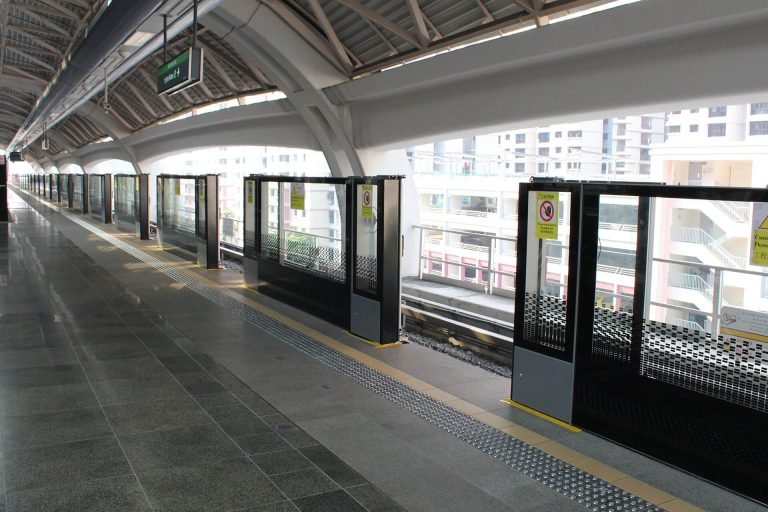
Chennai (Metro Rail News): The joint venture between Panasonic Manufacturing (Beijing) Co. Ltd. and  Pioneer Fil-Med  Pvt. Ltd. has secured a 146.95 crore contract from Chennai Metro. The contract involves supplying and installing Platform Screen Doors for Chennai Metro’s Line 3 and Line 5.

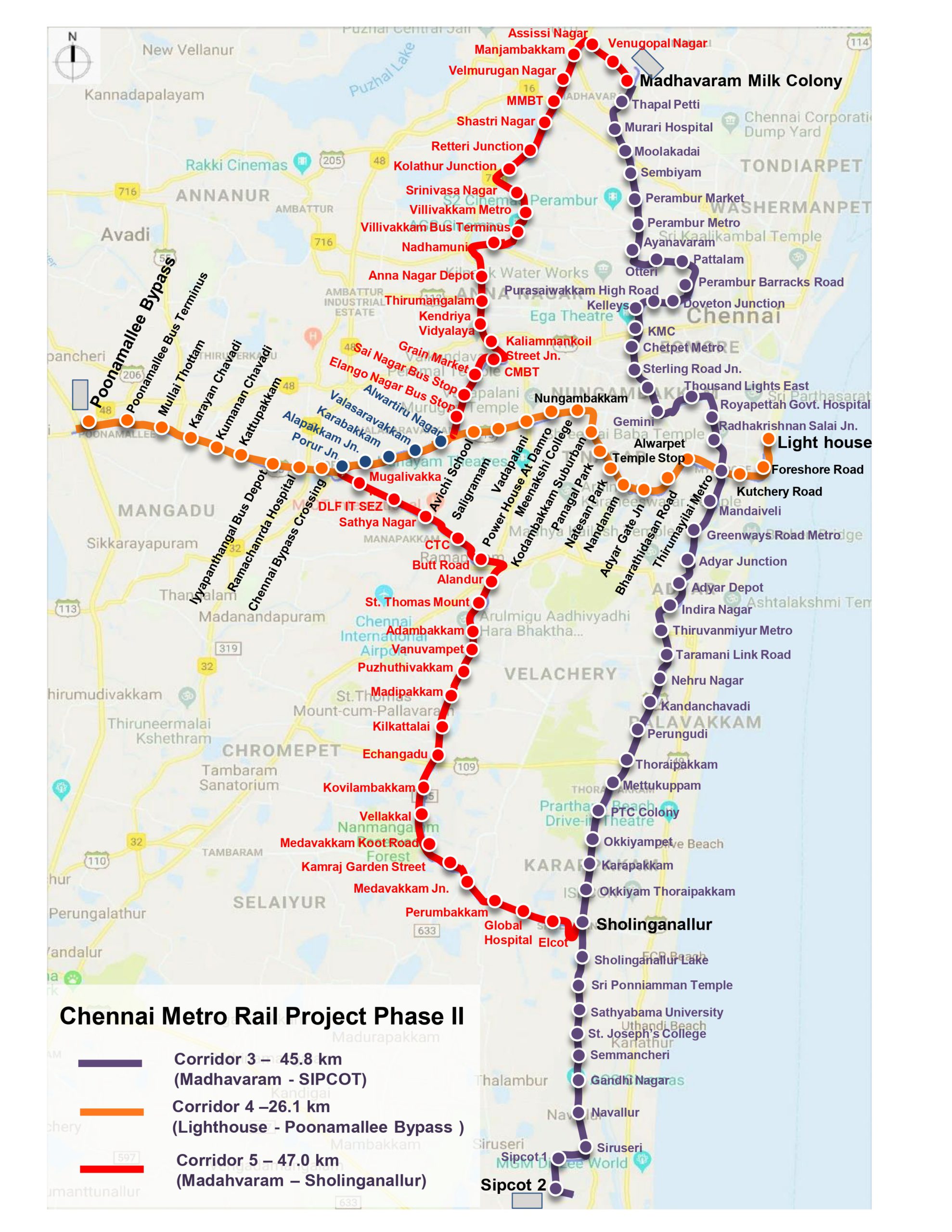
Chennai Metro Phase 2 Map

Line -3 and Line-5 of Chennai Metro will operate in a North-South orientation to link Madhavaram – SIPCOT (45.4 km Line-3) and Madhavaram – Sholinganallur (44.6 km Line-5), Respectively, through both elevated and underground stations. 

The contract’s scope includes the design, manufacture, supply, installation, testing, and commissioning of Platform Screen Doors. 

In Corridor-3, the contractor will install PSDs at 29 underground stations between Madhavaram Depot Station and Tharamani Station.

In Corridor 5, PSDs will be installed at 5 underground stations falling between Kolathur Junction Station and Nathamuni Station.

Final Contract Value: INR 85,36,03,003 + USD 7,392,013 (approx. INR 146,95,66,140.67 or 146.95 crore)

Deadline for the contract: 1465 Days ( approximately four years )

Other contracts for Platform Screen Doors

Another 2 packages by CMRL for installing platform screen doors:

Package ASA12A: In November 2023,  ST Engineering Urban Solutions Ltd. secured this package. Under this contract, ST Engineering is responsible for installing Platform Screen Doors at 10 elevated stations of Line 3 (Sholinganallur Lake – SIPCOT 2). Additionally, they will install PSDs at 29 stations of Line 5 (Grain Market – Elcot).

Package ASA09: The work under this package includes the PSDs at 10 elevated stations of Line-3 (Nehru Nagar – Sholinganallur) and 10 elevated stations of Line-5 (Assissi Nagar – Koyambedu). Currently, the bids are under technical evaluation for this package.

Ongoing development On Line 3 & 5 of Chennai Metro

Line-3’s 29 stations are under construction by DRA – Soma JV Tata Projects Ltd. and Rail Vikas Nigam Ltd. 

Line-5’s five underground stations are under construction by Tata Projects Ltd. 

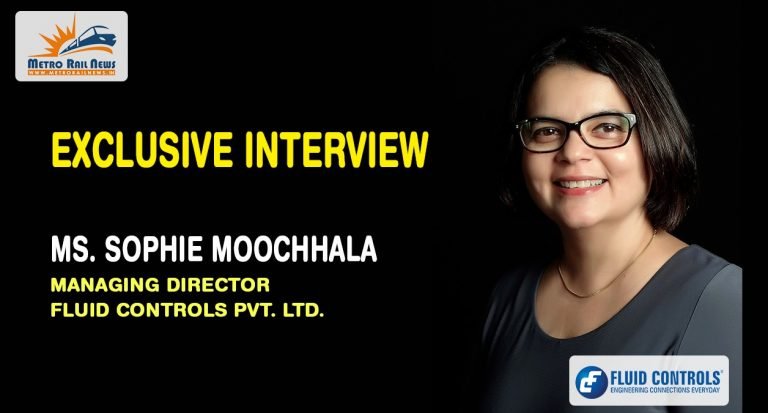
Exclusive interview of Sophie Moochhala on the occasion of International Women’s Day

To celebrate International Women’s Day, our Managing Editor Mr. Narendra Shah had a conversation with Ms Sophie Moochhala – Managing Director – Fluid Controls Private Limited. In which she speaks about the Company business strategy, Atmanirbhar Bharat Policy and Growth in a Post-COVID Situation.

Tell our readers about various innovative products recently developed for Metro & Railway Industries?
Fluid Controls Private Limited was established in 1974 by Dr. Y.E. Moochhala, a Ph.D. from Northwestern University, the USA with a vision to deliver high quality & high-performance products which delight customers. Fluid Controls offers customers comprehensive end-to-end “Make in India” solutions for Rail & Metro brake piping arrangements – from design & engineering services to supply of high-performance products and installation services. From its inception in 1974, Fluid Controls has engaged in original R&D and also has had an ethos of developing indigenous replacements for imported products. Our founder, Dr. Y E Moochhala, after a successful career in the USA decided to return to India because he was a strong believer in a self-reliant India. His idea was to develop high quality, high-performance products to suit local prototype climatic and performance expectations. Today, Fluid Controls is approved as an “In-House R&D unit” by the Department of Scientific & Industrial Research (DSIR), Government of India. Since 2011, we have developed more than 25 new products, which is very much in line with the Fluid Controls vision statement. Adding to our strength in innovating, Fluid Controls has filed its first Global Patent and
is in the process of filing two more patents. Particularly for the Rail & Metro Industry Fluid Controls has developed Across Frame Connectors for connection of pipelines between the shell and bogie for high-speed electric locomotives. These connectors eliminate welding processes and allow for seamless connection of pipes between the shell and bogie. Across Frame connectors also, reduce component parts required to be purchased as they are integrated fitting assemblies. Fluid Controls has also developed an entire range of FlexiGripTM connectors to provide zero-leakage and vibration resistant connections Here are the excerpts from the
interview:- “Success is a multi-faceted word! Professionally, for me, success is to build a brand which is trusted by customers
and which delights customers.” Sophie Moochhala Managing Director Fluid Controls Pvt. Ltd. between misaligned pipes or between pipes of different materials. The triple sealing action of the split ring, washer and O ring provides for a completely leak-proof connection. The split ring also provides superior vibration resistance by ensuring the joint remains in a springing condition. As an ongoing part of product development, Fluid Controls also customizes standard products to suit specific customer requirements.

How do you see the Govt of India’s Atmanirbhar Bharat policy?
Fluid Controls is a “Vocal for Local” MSME organization and we whole-heartedly support the Atmanirbhar Bharat initiative. Domestic manufacturers have the capability – be it in manufacturing, quality, or R&D – to cater to domestic requirements across sectors. In the past, legacy international vendors and lack of firm procurement policies constrained the effective implementation of “Make in India”. Atmanirbhar Bharat, which clearly outlines procurement policies, will go a long way to boost domestic manufacturers, especially in the MSME sector. With our manufacturing and R&D capabilities, Fluid Controls can contribute immensely to provide high quality, high-performance products to all sectors in the move to localize supplies.

Please share some of your value-added, problem-solving product and services offered by Fluid Controls?
A good example of a product we developed is the Fluid Controls Hydraulic Swaging Unit (HSU), which is a tool to ensure that twin ferrule connectors are installed correctly at the site. The unique feature of our HSU is that there is no need for manual intervention in the process. We also offer design and engineering services and have completed conversion projects (from one connector system to another) for several customers.

How Covid-19 outburst the Fluid Control’ business and the step you have taken to overcome it?
During the onset of the Pandemic COVID-19, our primary focus was to ensure the health and safety of our employees, their families, our customers and our business partners. And we had changed the way we approach every task and every activity. We had to adapt our model of operation since face-to-face meetings and interaction were not possible for some months (and we are still work-from-home at our Mumbai office!). We have invested in ERP and Microsoft Teams software to ensure the ease of teamwork and connectivity. To ensure seamless day-to-day operation, each department head would hold a daily telephonic meeting to discuss tasks and the way ahead. We also had to change the way we conducted our external business. During the lockdown period, Fluid Controls engaged with customers via video conferencing and calls. And, to ensure the least disruption in schedules, we have provided regular updates on our business status and order status to them. As many of our customers still do not allow business visits, we continue to have a virtual engagement with them. Once our plant became operational in May 2020, we provided our employees with a safe working environment. Whilst a major part of our staff is still working from home, “Operational Safety” being the primary parameter for the health and safety of people at work in the plant, we have planned our manufacturing with a system and process-focused approach. At Fluid Controls, we “Engineer Connections every day”. And in the time of the COVID-19 pandemic, we learnt how to “Adapt Everyday”!

What is your view on Business Growth in a Post COVID Situation?
I am very optimistic about the post-COVID growth situation and increased Union Budget allocations this year for railways will definitely lead to more business for companies such as ours. In addition, we are very positive that the focus on freight, Metros and RRTS/LRTS networks will result in an increasing demand
for rolling stock.


What are the Metro Projects in which Fluid Controls currently associated?
We are currently associated with projects for Mumbai Metro, Pune Metro, Delhi Metro and Chennai Metro. BEML suppled the First Driverless Metro Train developed in India form Mumbai Metro Line 2A.

What is the role of fluid Controls in the development of this true Atma Nirbhar product?
We are very happy to have been associated with BEML for Mumbai Metro. The Metro cars supplied by BEML have Fluid Controls DIN Single Ferrule connectors installed in the brake piping system. This is a very big achievement for Fluid Controls and we are very proud to have been approved by BEML for this project. Coming from a non-technical background,

how do you manage the most senior management position of an innovative product engineering company?
“Success” is a multi-faceted word! Professionally, for me, success is to build a brand that is trusted by customers and delights customers. At an organizational level, it is to build a team that is motivated, innovative and performs to high expectations. In this context, my having or not having an engineering background doesn’t really matter as I am supported by a team that has stellar engineering credentials.

What are the company’s business strategy and future expansion plan concerning the Metro & Railway market?
Over the years, Fluid Controls has developed comprehensive expertise for manufacturing, by identifying the right materials and ensuring “fit and forget” assembly. For Rail & Metro applications, we offer complete fitment of brake piping components, engineering and site installation services, pre-piped assemblies for easy site fitment, double ferrule fittings, DIN single ferrule fittings, threaded adaptors, Across Frame connectors, FlexiGripTM connectors, quick release connectors, isolation valves and clamps. A key part of our future plans is to tap into the brake piping business for the emerging high-speed train operations and to offer integrated solutions and hose assemblies to our current customer base. We are also focusing on global supplies to Europe, North America and SE Asia


Amaravati to join National Rail Network: Land Acquisition started for Errupalem–Amaravati–Nambur Railway line 

AMARAVATI (Metro Rail News): The long-awaited ₹2,047 crore Errupalem–Amaravati–Namburu 57 km new broad-gauge railway line gained fresh momentum in early August 2026 as land acquisition work started. The project was sanctioned by the Union Cabinet in 2024.

The new line will connect Andhra Pradesh’s greenfield capital Amaravati directly to the national rail network. It will also serve as a strategic bypass corridor and help reduce heavy traffic congestion at Vijayawada Junction.

Railway authorities have begun the process to acquire nearly 300 acres of land across eight villages in NTR district. The acquisition is being carried out in coordination with the state revenue machinery. The villages covered are Gottumukkala, Paritala, Jujjuru, G. Madhavaram, Chennaraopalem, Peddapurum, Alluru and Narasimharao Palem in Kanchikacherla and Veeralapadu mandals.

The Errupalem–Amaravati–Namburu line will pass through NTR, Vijayawada and Guntur districts of Andhra Pradesh and Khammam district of Telangana. It will provide rail connectivity to approximately 168 villages and about 12 lakh people through nine new stations.

Union Minister Shri. Ashwini Vaishnaw tabled the project details of   Errupalem–Amaravati–Namburu in the monsoon session of Parliament in response to questions raised by Rajya Sabha Member Shri Bhashyam Rama Krishna regarding the progress of ongoing and pending railway projects. 

The project was pending for years because of delays in land acquisition. As the land acquisition is at peace, the project will move into the execution stage. Once complete, this line is a crucial link to the capital city Amaravati. 

Also Read: Major boost for India’s logistics: First Vande Bharat freight train completes its  trial run at 130 km/h

Metro Line 13 gets green signal: Maharashtra to get a 25-km corridor to connect Mira-Bhayandar with Vasai-Virar

MUMBAI (Metro Rail News): The Maharashtra government on Tuesday, 18 August 2026, approved major transport infrastructure projects worth ₹28,227 crore. These projects cover the Mumbai Metropolitan Region (MMR) and Pune. The approved projects include ₹17,124.99 crore worth of Metro Line 13, a 25 km corridor with 16 stations linking Mira-Bhayandar to Vasai-Virar, and the eastern extension of the Pune Ring Road with an estimated cost of ₹10,502.36 crore. These initiatives aim to improve connectivity in key urban areas of the state.

The Cabinet Infrastructure Committee, chaired by Chief Minister Shri Devendra Fadnavis, took the decisions at Mantralaya (the state secretariat) in south Mumbai.

About Metro line 13 

The Mumbai Metropolitan Region Development Authority (MMRDA) will implement the project. Line 13 will extend north of Mumbai and connect Thane and Palghar districts.

The metro will span a total of 25.03 km, of which 21.78 km will be elevated, and 3.25 km will be underground, with a total of 16 stations: 13 elevated and 3 underground. The line will serve Mira Road, Vasai, Naigaon, Nalasopara and Virar.

One major highlight is a 4.92-km integrated six-lane road-and-metro bridge over Vasai Creek that will also link to Panju Island. A metro depot is planned at Chikhal Dongri. 

Other features of the Metro are its Interchange with Metro Line 9 at Netaji Subhash Chandra Bose Stadium and rail connectivity such as Direct interchange with Western Railway suburban stations at Naigaon, Nalasopara, and Virar. Bus services will operate at all stations to improve last-mile connectivity.

The corridor is expected to cut travel time by about 50% compared with road journeys. Daily ridership is projected to reach 4.49 lakh passengers by 2031. It will help reduce dependence on private vehicles, ease traffic on major national highways, and lower carbon emissions. The line will also strengthen connections between Vasai-Virar, Mira-Bhayandar, Mumbai’s suburbs and nearby industrial and logistics hubs.

The project requires 24.84 hectares of land. Chief Minister Shri Devendra Fadnavis has directed authorities to complete land acquisition and approach roads within six months.

Also Read: 15 years of Bengaluru Metro yet an average person spends 168 hours in traffic

15 years of Bengaluru Metro yet an average person spends 168 hours in traffic

BENGALURU (Metro Rail News): On the 20th October 2026, Bengaluru metro will complete 15 years of operation. Despite this, the massive traffic congestion problem of India’s IT capital has not seen much improvement. The first stretch of Bengaluru’s Namma metro was inaugurated on 20th October 2011 yet almost one and half decade later, an average person living in Bengaluru spends around 168 hours in traffic every year. The city’s metro had faced constant delays in implementation.

The traffic data of Bengaluru
(Source- TomTom Traffic Index)

At present, the Bengaluru metro has a length of around 96 km. Delhi metro, for comparison, had a length of 194 km (more than double of the present length of Bengaluru Metro) in its first 12 years of operation. After continuous delays, the pink link of Bengaluru Metro’s Phase II project was projected to start operations from 15th August yet for another time the project got delayed.

Moreover, there has been a significant cost escalation in Bengaluru Metro due to these delays. They are hit by inflation and depreciation, amounting to rising general price level and constant wear and tear of capital goods and raw material, increasing the cost. The initial budget sanction for the first phase of Bengaluru Metro was around ₹6395 crores in 2005 which was revised to almost ₹14,133 crores escalating the cost by 121%. The Phase II is still under implementation and its overall cost has spiked by 52.1% from the initial ₹26,405 crores to an estimated ₹40,425 crores.  

Delays in Bengaluru Metro 

Bengaluru metro has faced constant delays since the announcement of the project. The foundation stone for the project was laid in 2006. Since then, in the last two decades the project has faced several roadblocks. The land acquisition problem, leadership inconsistency, land acquisition hurdles and technical challenges have slowed the progress of the project.

Land Acquisition

The metro project is a large infrastructural project which requires a significant amount of land. Bengaluru has observed a saturated use of land over the last few decades. Thus, land acquisition has turned out to be a major reason behind delays in the Bengaluru Metro project. The metro project requires deforestation, displacement of local population, resolving legal disputes over land for acquiring them for the project, altering routes from heritage buildings. All these factors delay the project and sometimes they take months to resolve. 

Inefficient Central-State Govt. Coordination & Inconsistent Leadership

The central and state governments have shown inefficient coordination at various stages of the Bengaluru Metro project. The conflicts of interest in some crucial decisions such as routes, funding, fare prices, integration of the metro with other public transport systems and several other resolutions have observed an inefficient coordination between the central and state government. Furthermore, there has been a constant change in the leadership of the Bengaluru metro project. The project had 11 different managing directors in just 22 years. 

Technical Challenges

While working on the underground stretch of the Bengaluru Metro, engineers stated that they have faced technical challenges due to the hard Deccan rocks. The Tunnel Breaking Machine (TBM) had to cut through hard rocks, cavities and boulders. This was cited as a major reason for the delay in the underground section of the first phase. Further, technical challenges in roads alignment, construction of double decker roads and geological problems have led to delay in the project implementation.

Bengaluru’s urban mobility issue

a social media conversation on Bengaluru metro

Bengaluru has one of the worst traffic congestion issues in the world. During rush hours, the mobility is almost stagnant. The urban mobility problem in Bengaluru is a serious issue which needs to be addressed. The metro connectivity can bring much relief to the people yet the metro alone can not solve the problem. The suburban rail and a Regional Rapid Transit System (RRTS) can complement the public transport and improve connectivity. The number of vehicles is still increasing in the city, the traffic issue therefore needs immediate attention.

Also Read: India on the Move: Revisiting the milestones in Railway, Metro & RRTS on the 80th Independence Day

Railway Board clears 15 year old proposal to merge MRTS with Chennai Metro

CHENNAI (Metro Rail News): The Railway Board has approved the long-awaited merger of Chennai’s Mass Rapid Transit System (MRTS) with Chennai Metro Rail Ltd (CMRL). This change will merge the suburban rail corridor under a single state-led framework, with plans to transfer operations over two years.

The approval comes after years of talks between the Indian Railways and the Tamil Nadu government. A draft Memorandum of Understanding (MoU) has been prepared to outline the transfer of assets, infrastructure, and responsibilities.

Railway board approves long-pending proposal

The merger proposal began in January 2011, when the Tamil Nadu government first approached the Railway Board to transfer MRTS operations. The Railway Board issued its latest update on August 12, 2026, approving the draft MoU signed by Southern Railway and the Tamil Nadu government in May.

The agreement will set the framework for transferring MRTS assets and will gradually shift its operation and maintenance duties to CMRL.

Two year transition planned

The transition is going to happen in 2 stages instead of all at once. Under the draft MoU:

  • Southern Railway will transfer MRTS assets along with general operation and maintenance responsibilities within 90 days. But it will exclude core train operations and maintenance.
  • Over two years, train operations and the remaining maintenance responsibilities will gradually move to CMRL.
  • During the transition, Tamil Nadu will make the agreed payment for the assets, either in full or in installments.

The proposed assets for transfer include land, stations, and other infrastructure covering 19 of the 21 MRTS stations, along with:

  • Tracks  
  • Signalling and telecom systems  
  • Lifts and escalators  
  • Foot overbridges  
  • Other station infrastructure  
  • EMU rolling stock  

The MRTS project originated from the 1975 First Master Plan for Chennai. Passenger services originally ran between Chennai Beach and Velachery. The corridor was later extended to St Thomas Mount, with this extension commissioned in March 2026. The extended section includes stations at Puzhithivakkam and Adambakkam, although one station is still not operational yet.

Beach-Fort section needs special arrangements

The merger requires coordination between MRTS and Chennai Division railway stations. At Chennai Beach, platforms 9 and 10 have been proposed for MRTS services. At Fort station, the state government will build a crossing arrangement to enable track connectivity. A separate operational issue exists between Fort and Beach, where MRTS currently has only one track instead of the standard two-track setup. If the state government suggests doubling this section, Southern Railway will review the proposal based on operational needs and the Railways’ land management policy.

Special committee to oversee transition

The Railway Board has formed a committee made up of senior officials from Southern Railway and the Tamil Nadu government to oversee the merger process. The Convenor of the Chennai Unified Metropolitan Transport Authority (CUMTA) will coordinate the committee’s work. The committee will handle the operational, infrastructure, and administrative issues involved in the transfer.

The merger could create a more integrated management structure for MRTS and Chennai Metro. This could help improve maintenance, passenger facilities and future planning across Chennai’s Urban Rail Network. But the changes might also impact existing operational arrangements. Consumer activities T. Sadagopan mentioned that while the merger could enhance MRTS operations, it might also eliminate the chance of restoring direct MRTS service from St Thomas Mount to Arakkonam and Gummidipoondi. Before that, these direct services connected Velachery with destinations on Chennai’s western and northern suburban railway sections through Beach. 

The Railway Board’s approval clears a significant administrative barrier in the 15-year-old merger proposal. The immediate focus will now shift to the two-year transition, asset transfer, and integration of MRTS operations with Chennai Metro.

Also Read: Chennai Metro Phase 2 recorded 24th tunnel breakthrough at Moolakadai station

GMRC floats tender for Ahmedabad Metro cum RRTS hybrid corridors

AHMEDABAD (Metro Rail News): Gujarat Metro Rail Corporation (GMRC) has floated three tenders for Ahmedabad Metro Phase 3. These tenders are regarding the design consultancy services for the Metro cum Regional Rapid Transit System (RRTS) hybrid corridor of the Ahmedabad Metro Rail Project Phase 3. The proposal will add an additional network of 48.38 km. 

The routes proposed for this Metro cum RRTS hybrid project include Vakil Bridge metro station to Badrabad metro station (Phase- 3B2),  APMC metro station to Rakhial metro station (Phase- 3C1) and Malek saban lake metro station to Nehru Nagar metro station (Phase- 3C2).

Project Name CorridorNumber of stationsLength
Phase- 3B2Vakil Bridge metro station to Badrabad metro station12.38 km
Phase- 3C1APMC metro station to Rakhial metro station11 14.5 km
Phase- 3C2Malek saban lake metro station to Nehru Nagar metro station1521.5 km

The tenders include the detailed design consultancy work for the construction of these corridors. A separate tender was released by GMRC for each of these corridors. The last date for the submission of bids for the tenders is 25th September, 2026 at 15:00 hours.

About Ahmedabad Metro

Ahmedabad Metro Rail Project is a mass rapid transit project for the twin cities of Ahmedabad and Gandhinagar. The project has expanded the network to 68.5 km in its first two phases. The projects 2A and 2B are currently underway while the proposed Phase 3 will enhance the connectivity to the airport and major residential and commercial places of the cities.

Also Read: Ahmedabad Metro Phase 3 Gets PIB Clearance, Dholera Airport Link Moves Closer

Union Railway Minister Ashwini Vaishnaw Inaugurates Kailaras-Birpur Rail Section and flags off Gwalior-Kailaras train extension

MADHYA PRADESH (Metro Rail News): Union Railway Minister Shri Ashwini Vaishnaw inaugurated the gauge-converted Kailaras-Sabalgarh-Birpur rail section in Madhya Pradesh through video conferencing. He also flagged off the extension of the Gwalior-Kailaras train up to Birpur. Union Minister Shri.Jyotiraditya M. Scindia and Madhya Pradesh Chief Minister Shri.Mohan Yadav joined the event.

Shri. Ashwini Vaishnaw described the opening of the 56-km Kailaras-Birpur section as an important milestone for the Gwalior-Chambal area. He said the project became possible through the joint efforts of everyone involved. More than 100 villages in Bamor, Joura, Kailaras and Sabalgarh tehsils of Morena district, and Birpur, Sheopur and Karahal tehsils of Sheopur district will now enjoy better rail access. He further shared that the line will later extend to Sheopur Kalan and eventually to Kota. This will link the region with major educational and industrial centres. Work on the next stretches from Birpur to Seroni Road and from Seroni Road to Sheopur Kalan is nearly finished.

For railway development in Madhya Pradesh, eighty stations are being redeveloped, five Vande Bharat trains are running, and seven Amrit Bharat trains have been introduced. New projects such as the Indore-Manmad line will further improve links between the Gwalior-Chambal region and Malwa.

Chief Minister Shri Mohan Yadav said the improved rail connectivity will support a new industrial belt and boost tourism and other economic activities. He pointed to the region’s potential in battery energy storage, footwear, hydrogen manufacturing and tourism, noting that better train services will help these sectors grow.

Extension and further developments will boost connectivity in the region and improve trade, tourism and employment.

Also Read: Russia proposed Indo-Russian Rail connectivity to reduce dependence on sea routes

Pune Metro: Groundwork Started on Swargate-Katraj Underground Line

PUNE (Metro Rail News): Construction work has officially begun on Pune Metro’s long-awaited underground extension from Swargate to Katraj, with the first excavation starting at the busy Market Yard station. MLA Madhuri Misal inaugurated the excavation for the Market Yard station and also inspected the ongoing construction activities on the corridor.

Maha Metro has started digging shafts that will be used to lower Tunnel Boring Machines (TBMs) into the ground. Four TBMs will be deployed gradually over the next few months. 

Station building and tunnelling will happen simultaneously. Because the entire line is underground, traffic will not be disturbed. Road space would be used in some areas only. Barricades have been set up on Satara Road and some BRT lanes have been removed to make space for the station shafts.

Maha Metro has received sanction for the Pune Metro Phase-1 extension on the southern side, from Swargate to Katraj.The 5.46 km fully underground corridor will extend the existing Pimpri Chinchwad Municipal Corporation (PCMC) Swargate line further south. Initially line 1B extension has three stations Market Yard, Padmavati, and Katraj and later due to the demand of people, authorities added two more stations Balaji and Bibwewadi , a high population dense area.

image 9

The Swargate to Katraj corridor will benefit commuters from Bibwewadi, Balaji Nagar,Dhankawadi and padvati, some of the major residential hubs.The new line will improve connectivity to Market Yard, one of the city’s largest markets, Rajiv Gandhi Zoological Park. At Katraj, it will link with the PMPML city bus depot, Katraj-Kondhwa Road and the Katraj Bypass that connects to the Mumbai-Bangalore highway.

In a related development, feeder rickshaw services have been launched at Pimpri-Chinchwad Metro stations. The initiative, started by Mayor Ravi Landge, is a joint effort by Pune Metro, Pimpri-Chinchwad Municipal Corporation and Maharashtra Rickshaw Panchayat to improve last-mile connectivity and make public transport more efficient.

Also Read: 3 New Trains to Join Patna Metro Fleet by December 2026

3 New Trains to Join Patna Metro Fleet by December 2026

PATNA (Metro Rail News): Patna Metro Rail Corporation Ltd is set to add three new trains to its fleet. In contrast to the existing 3-coach rolling stock, these trains will feature 6 coaches, which nearly doubles the capacity. All three rakes are expected to reach Patna from Pune by December 2026. The trains will be taken on lease at a combined cost of around ₹63 crore.

These train sets were originally built for Pune Metro by Titagarh Rail Systems Limited. They will run on the elevated sections of Corridor I, also known as the Red Line.

Each new 6-coach train can carry about 1,800 passengers (seated and standing). This almost doubles the capacity of the present 3-coach trains, which hold roughly 940 passengers. The 3-coach train, which is currently operating in Patna Metro, was also leased from Pune Metro for three years. In mid-2025, the Bihar Cabinet had approved ₹21.15 crore for that lease.

The decision to lease from Pune Metro was practical. Both cities use standard-gauge tracks and 25 kV AC overhead power systems. Titagarh Rail Systems also had ready stock available, so Patna Metro could get the trains within months instead of waiting years for new manufacturing.

This lease arrangement acts as a quick bridge solution that lets Patna Metro expand services without long delays.

About Patna Metro

At present, Patna Metro runs on a 6.3 km stretch between Patliputra Inter-State Bus Terminal (ISBT) and Malahi Pakri. Khemnichak station, an important interchange point that will link Corridor I (Danapur to Khemnichak) and Corridor II (Patna Junction to New ISBT), is also expected to open by the end of 2026.

Also Read: DPR in motion for Lucknow-Kanpur RRTS: 3 institutions steps in to fund

DPR in motion for Lucknow-Kanpur RRTS: 3 institutions step in to fund

LUCKNOW (Metro Rail News): The Lucknow-Kanpur Namo Bharat Regional Rapid Transit System (RRTS) has gained momentum with the Alternative Analysis Report (AAR) and Detailed Project Report (DPR) work expected to begin soon as the project’s financial hurdles get resolved. The cost of preparing the DPR and AAR for the proposed RRTS is estimated at ₹6.03 crores with National Capital Region Transport Corporation (NCRTC) appointed to prepare the reports.

The project had received approval for DPR preparation but it initially faced financial hurdles. Now, three institutions have stepped in to fund the DPR and AAR preparation of this RRTS project i.e. Lucknow Development Authority (LDA), Kanpur Development Authority and Unnao-Shuklaganj Development Authority.

The preparation of DPR and AAR will be undertaken by NCRTC. The cost of preparing the reports is estimated at ₹6.03 crores. The cost will be equally borne by all the three institutions.

The DPR will assess the project’s route, number of stations, the alignment with other modes of transport, total cost of the project and the expected ridership. Now, the DPR preparation work is expected to initiate soon as the project has received funding assurance.

The Lucknow-Kanpur Namo Bharat RRTS is expected to improve the connectivity between two major cities of Uttar Pradesh. Both the cities have an operational metro system and the RRTS project is expected to further improve mobility across the region. The project will significantly reduce the travel time between Lucknow and Kanpur. Moreover, it is expected to enhance the economy and strengthen the cities within the proposed route.

Also Read: India on the Move: Revisiting the milestones in Railway, Metro & RRTS on the 80th Independence Day

Bangalore Metro to be equipped with Alstom’s AI-integrated CBTC system

Bangalore (Metro Rail News): Bangalore Metro Phase 2 is set to introduce fully driverless operations under Grade of Automation 4 (GoA4) on the Pink and Blue Lines, marking a major leap in the city’s public transport. 

To make train-to-train communication stronger and more reliable, Alstom is integrating advanced AI into its CBTC signalling system. The stronger the communication, the faster and smoother the service becomes. This AI-powered upgrade will support completely unattended train operations while adding predictive maintenance and real-time asset monitoring, making the network safer, more efficient and ready for higher capacity.

Alstom’s Digital Experience Centre in Bangalore has emerged as the company’s primary global base for designing and developing AI-integrated Communications-Based Train Control (CBTC) and signalling solutions. Driverless metro operations are in a trial stage in Delhi Metro Phase IV and several other networks around the world.

Initially, staff may still be present on trains and at stations to ensure smooth operations. The signalling system can technically support 90-second headways on straight sections of track. However, civil infrastructure, operational requirements, land availability and the level of service planned by the operator also influence what is practical.

Alstom is handling the complete end-to-end signalling engineering work for Bangalore Metro. The train-to-train communication technology being used in Bangalore is already in commercial operation in France and China, said Puneet Srivastava, Alstom India’s Managing Director for Signalling and Infrastructure, in an interview with Deccan Herald.

AI will help train operators decide the right speed, manage services and quickly respond to changing conditions by analysing large amounts of real-time data. It will also allow passengers to spot and choose less crowded coaches.

Non-safety AI tools for predictive maintenance, dynamic speed profiling and passenger crowd forecasting are added through the Mastria platform. These features improve efficiency without interfering with the core safety systems that prevent collisions and handle emergency braking.

AI provides operators with a clear real-time view of the entire network, allowing trains to be dispatched automatically and delays to be reduced. Predictive systems monitor equipment health around the clock so that maintenance teams can fix potential problems before they disrupt services. Automation also helps minimise human error in setting routes, applying emergency brakes and operating platform screen doors.

Alstom’s Urbalis CBTC technology already powers large driverless networks such as the Riyadh Metro and is now being rolled out across Bangalore Metro Phase 2. The Bangalore centre employs a major share of the nearly 4,000 signalling engineers based in India, strengthening the city’s position as a key technology development hub for the company.

Also Read: Bengaluru Metro awards ₹55.48 cr contract for travellator and connecting walkway at Central Silk Board

Patna Metro: E&M tender floated for underground stations of Corridor 2

PATNA (Metro Rail News): Patna Metro’s underground work has gained momentum with tender process gathering pace by the implementing agency, Delhi Metro Rail Corporation (DMRC). DMRC has floated a tender for the electrical and mechanical (E&M) work of the underground stations of the Patna Metro Corridor-2. The approximate cost of work is ₹327.96 crores and the completion period is of 24 months. 

Tender Information

InformationDetails
Tender No.PE-07 
Approximate Cost of Work₹327.96 Crores
Completion Period24 Months
Pre-Bid Meeting September 01, 2026 (11:00 hrs.)
Bid Submission OpeningSeptember 17, 2026 (09:00 hrs.)
Bid Submission DeadlineSeptember 24, 2026 (15:00 hrs.)

Scope of Work

The selected contractor will have to do the design verification, detail engineering, supply, installation, testing and commissioning of electrical and mechanical system, DG sets, environment control system, tunnel ventilation system and building management system for underground stations of corridor-2 of Patna Metro Rail Project.

Patna Metro Corridor-2 underground stations

  • Rajendra Nagar
  • Moin-Ul-Haq Stadium
  • University
  • PMCH
  • Gandhi Maidan
  • Akashwani 
  • Patna Junction

About Patna Metro Corridor-2

Patna Metro Corridor-2 (Blue Line) connects the new ISBT with Patna Junction. The line has 12 stations including 7 underground stations and 5 elevated stations. The elevated stations from the new ISBT to Malahi Pakri are already operational while the underground stretch is under construction. 

Also Read: Patna Metro gains momentum: Bids invited for finishing work at Mithapur, RK Nagar & Jaganpura 

Bengaluru Metro awards ₹55.48 cr contract for travellator and connecting walkway at Central Silk Board

BENGALURU (Metro Rail News): Bengaluru Metro Rail Corporation Limited (BMRCL) has awarded a ₹55.48 crore contract to Milan Road Buildtech LLP for civil and structural works related to a travellator and connecting walkway at Central Silk Board.

The project will connect the Yellow Line’s Central Silk Board Station with the Blue Line’s ORR Central Silk Board Station under the Bengaluru Metro Phase-2A project. 

Contract details

InformationDetails
ContractorMilan Road Buildtech LLP
Contract Value₹55.48 crore
Contracting Authority Bengaluru Metro Rail Corporation Limited (BMRCL) 
Completion Period9 months

Bidding details

Five companies participated in the tender. Milan Road Buildtech LLP emerged as the L1 bidder with a bid of ₹55.48 crore.

Bidder Bid Value Status 
Milan Road Buildtech LLP₹55.48 crore (L1)Accepted – AOC
MM Shawl Engineers & Contractors Pvt. Ltd.₹57 crore (L2)Rejected – Financial
Afcons Infrastructure Ltd.₹75.2 crore (L3)Rejected – Financial
NCC Ltd.₹78.9 crore (L4)Rejected – Financial
URC Construction Pvt. Ltd.Rejected – Technical

Scope of work 

Civil and Structural works including Architectural finishes for Travellator and Connecting Walkway between Reach-5/Phase-2 / Yellow Line Central Silk Board Station to Blue line ORR Central Silk Board Station of Bangalore Metro Rail Project, Phase-2A.

About the project

Bengaluru Metro’s Central Silk Board station is planned as a major multi-level interchange hub. It will connect the Yellow Line under Phase 2 with the Blue Line under Phase 2A, which will run towards KR Pura and Bengaluru Airport.

The station will also serve as an important transit point for commuters travelling along the Outer Ring Road (ORR) technology corridor. The Blue Line will begin from the Central Silk Board, making the station a key interchange point in the city’s expanding metro network.

Also Read: Railway Board Gives In-Principle CBTC Nod for Bengaluru Metro Pink & Blue Lines

Kolkata Metro eyes 130 km network as ridership and revenue continue to rise 

KOLKATA (Metro Rail News): Kolkata Metro is preparing for a significant expansion. The network is expected to reach around 130 km in the coming years. Metro Railway General Manager Prem Sagar Gupta noted the increase in passenger numbers and earnings as the system grows.  

Gupta shared the expansion plans during his Independence Day speech at Metro Rail Bhavan. He also reviewed the Kolkata Metro’s recent operational and financial performance.  

Kolkata Metro network expansion planned 

The Kolkata Metro currently operates across various corridors. Several new sections are under construction or in development. Gupta mentioned that the network should expand to about 130 km soon. This expansion will extend Metro services throughout Kolkata and neighboring areas.

Several projects are already underway. The Joka to Esplanade corridor, part of the Purple Line, and the Orange Line linking New Garia to the airport are among them. The expansion will provide more options for travel on the road and suburban rail, especially as demand in the city increases.  

Kolkata Metro carried 23.60 cr passengers in 2025-26 

Passenger numbers remain strong. According to Gupta, Kolkata Metro transported 23.60 crore passengers during the 2025-26 period. This statistic shows the rising dependence on Metro services for daily commutes in the city.  

The network is also experiencing increased revenue. Metro Railway earned ₹166 crore between April and July 2026. Gupta stated this amount is 34% higher than the revenue from the same period the previous year.  

Digital ticketing gains ground  

The Kolkata Metro is also seeing a rise in the use of digital payment and ticketing options. Passengers can use digital platforms to:  

  • Purchase tokens and smart cards  
  • Buy QR-based tickets  
  • Recharge smart cards  
  • Access Metro ticketing services through the Aamar Kolkata Metro app  

The app is available on both the Google Play Store and Apple’s App Store. This shift toward digital ticketing is expected to lessen reliance on physical counters and make ticket purchases easier during busy times.  

Along with the network expansion, Gupta mentioned that Metro Railway is working to improve operational safety, passenger amenities, and service reliability. This focus will be important as the network grows and serves more passengers.

Also Read: Kolkata Metro Orange Line clears 6 year Chingrighata delay

Two Foot Overbridges near Gurugram Sector 9 &10 to be dismantled for Metro corridor

GURUGRAM (Metro Rail News): The Gurugram Metropolitan Development Authority (GMDA) has given formal permission to Gurugram Metro Rail Limited (GMRL) to dismantle two foot overbridges (FOBs) that stand in the way of the upcoming metro line.

GMRL had requested the removal in June 2026, saying the structures were blocking the metro alignment and could delay construction. GMDA granted the approval on August 12, 2026.

One foot overbridge is near Alpine Public School in Sector 9, and the other is near Greenwood Public School in Sector 10, close to Basai Pond. Both bridges lie on the stretch between Umang Bhardwaj Chowk and Basai Flyover, where a metro station is also planned.

These FOBs were built only three years ago, in 2023, as part of a larger ₹114-crore road project. That package included road widening between Umang Bhardwaj Chowk and the Dwarka Expressway and some other projects. The removal will temporarily affect pedestrians, especially students and residents of Sectors 9, 9A, 10, 37C, and 37D who currently use these bridges for safe road crossing.

GMRL will bear the full cost of dismantling the existing FOBs. The metro agency is also responsible for storing and transporting the materials, with no financial burden on GMDA.

In return, GMRL is required to build and commission two new replacement FOBs along the same metro corridor. The exact locations of the new bridges must be approved by GMDA to ensure continuous and safe pedestrian access.

The Gurugram Metro will run about 28.5 km from Millennium City Centre to Cyber City and is being built in two phases. The World Bank recently approved a ₹1,409 crore loan for Phase II of the project. This step clears the path for metro construction while ensuring pedestrian facilities are restored in the same area.

Also Read: Flying Train: China’s Ultra-High Speed Train reaches 800 kmph in 5.3 seconds