




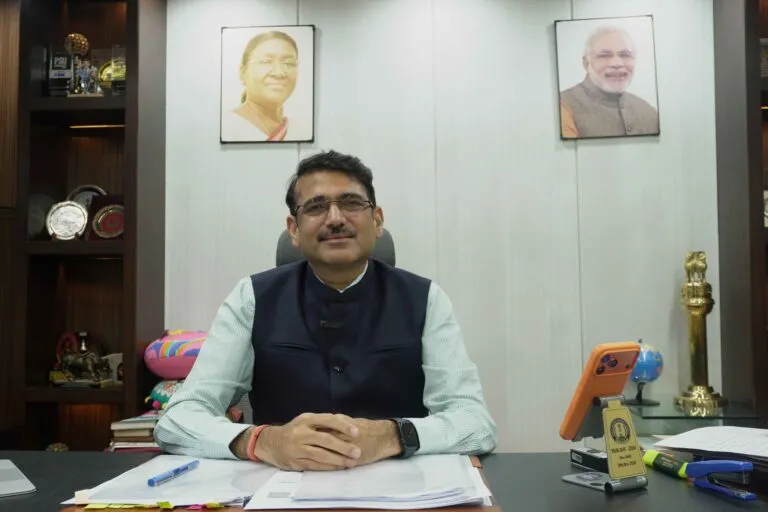
DELHI (Metro Rail News): Metro Rail News conducted an exclusive interview with Shri Manoj Kumar Dubey, Chairman & Managing Director (CMD) and CEO of the Indian Railway Finance Corporation (IRFC). During this interaction, Shri Dubey reflected on the evolving role of IRFC in financing the railway projects. In addition to this, he deliberated on IRFC’s vision to finance the metro, RRTS and HSR projects in the coming years. He concluded by mentioning the significant role that IRFC is playing in building the rail infrastructure for Viksit Bharat. Here are the edited excerpts:
Q1. Your association with Indian Railways spans over 3 decades. Could you reflect on your professional journey and explain how this depth of experience influences your leadership and decision-making at IRFC today?
I joined the Railways through the civil services, and in the civil services, there are many services. There are All India Services like IAS, IPS; there are revenue services, customs services; and there is a very important organisation called Railways, where four civil services are working. I got the opportunity of selection in the Indian Railway Accounts Services. The two-year training gave us the first flavour of what is in store, and I can tell you it is a behemoth system completely aligned with national service.
My father was a police officer. In India, we feel that those in uniform are in national service. It is a fact. But one fact that is perhaps not very magnified is that others are equally contributing. Railways in particular is in constant 24 into 7 service of the nation. This is one tribe of more than 11 lakh people who don’t make any noise about it, but they are always on the receiving end. Whenever there are festivals, whenever there is a national requirement, without making any fuss, everybody goes into the job.
Get the Daily Metro & Rail Brief
Join 125,000+ metro and rail professionals. Project updates, new tenders and contract awards from across India, in your inbox every day.
Railways taught me three things. One, to be focused on whatever I am doing, is going to national service. Two, it is one of the rare ministries maintaining its own balance sheet; despite all the subsidies and restrictions on rates, it has to show some profit that is called the operating ratio. Being in the nation’s service and remaining financially and commercially viable is something I learned every day from railways, and these values have come along with me in IRFC as well. Three, output can be quantified. These are the values that I inculcated. I worked in three divisions, then came to the Railway Board, worked extensively on public-private partnership policy. During this period, key initiatives such as the Madhepura and Marhowra locomotive factories were executed; the high-speed rail corridor was started in my time, and the Dedicated Freight Corridor (DFC) gained significant momentum. Then I joined Container Corporation of India Limited, CONCOR, as Director of Finance and worked there for six years. In late 2024 I came here, and today we are financing anything and everything coming in the railway ecosystem.
Q2. IRFC recently completed 40 years of its journey. How has the organisation evolved over the years in terms of its mandate, operating philosophy, and approach to financing rail infrastructure?

Out of these 40 years, 38 years of IRFC’s journey was to finance Indian Railways as its sole customer for anything required over and above budgetary support or internal generation. In the last three decades, aspirations of India and hence of Indian Railways have grown. Rajdhani and Shatabdi, the flagship trains, came only after IRFC started financing them. As a result, the movement of people for business and the growth of the nation increased manifold in the 1980s. In the wake of this, the requirement was to raise money from the market at cheaper rates and start building better-quality rolling stock, passenger coaches, and wagons to bring more efficiency in the loading of goods.
Today, more than 80% of the coaching and goods rolling stocks all coaches starting from Rajdhani coaches, general coaches, Tejas, Vande Bharat and more than 80% of locomotives are on the books of this company. From 2015 onwards, we started doing project financing also. Prior to 2015, we were only doing rolling stock financing. Today, nearly 50% of my ₹4 lakh-plus crore loan book with Indian Railways is through projects. The model is 15-year plus 15 year, 30-year long-term lending, and we are funding at the cheapest possible rate cheaper than any other financial institution in the country. The new journey started last year when we launched our new version, IRFC 2.0.
Q3. IRFC is preparing for its next phase of growth under the ‘IRFC 2.0’ vision. Could you outline the key pillars of this strategy?
I took over in 2024 in the later part of the year. If we take a closer look at the Railways’ requirement, we will find out that the capex of Indian Railways, which used to be less than ₹1 lakh crore in 2015, today is consistently nearly ₹3 lakh crore. In FY 2024, the Government of India put a special focus on Indian Railways and extended the required budgetary support.
For the past four years, including the current one, the Government of India has been catering for the complete Capex requirement of Indian Railways through budgetary support. IRFC came into a little quandary as there was no additional requirement of funds from extra budgetary resources. When I took over, the mandate was re-examined. The mandate was saying we could fund anything having a backward or forward linkage with the Railways. We never used this before. We started working on it.
We realised our strengths. IRFC operates as a lean organisation, with overhead costs that are minimal relative to its revenue, and it is far lower than anybody else in the industry. We are the only NBFC of this balance sheet size which is zero NPAs. These two factors together gave us the flexibility to raise funds at competitive rates and pass on that efficiency to our clients. As a result, IRFC has been able to finance most entities within the railway ecosystem, often at rates that are 70 to 80 paise to a rupee cheaper than others. Despite being cheaper than peers, earlier Railways was giving us only 40 paise of margin on a cost-plus model today we are making 2x to 3x margin.
We started funding NTPC Green, who will provide electricity to Indian Railways. We looked at DFCCIL, where a World Bank loan was at more than 10% rate, and funded them at nearly 7.5 to 6%. We started funding SPVs we never funded earlier in railway ecosystem minimum 1% to 1.5% cheaper than what they had. We also funded two fertiliser companies where all evacuation is done by the railways, again nearly 1% cheaper than they had earlier. By the end of the first FY of 2.0, we have sanctioned more than ₹80,000 crore of assets all in whole-of-government approach. Disbursement this year was higher than FY23, when we did ₹33,000 crore with the Railways; today we did ₹35,000 crore of disbursement itself. We have started running like any Vande Bharat or Rajdhani.
Q4. The refinancing of the Eastern Dedicated Freight Corridor’s World Bank loan has been described as a landmark transaction. Could you highlight the significance of this deal?
This deal emerged from the strong synergy within the railway ecosystem. We have our colleague officers in DFCCIL from the Indian Railway Accounts Service, and within a month of my joining, we began discussions and identified that the existing World Bank loan could be refinanced. The initial idea came from colleagues in DFCCIL, which we then took forward with the Railway Board and the Ministry of Finance. All stakeholders came on board, including the World Bank. Their philosophy is to assume risk during the construction phase. Once commercial operations begin, they prefer to exit so that their capital can be redeployed to other projects.
This was one successful venture where all stakeholders came on board. We leveraged our strength of raising funds at highly competitive rates, supported by a zero-NPA track record. With the approval of the Ministry of Finance, the Ministry of Railways, and the World Bank, we refinanced a loan of over ₹10,000 crore in INR terms, approximately USD 1.2 billion in one go, which resulted in total savings of more than ₹2,700 crore for DFCCIL. This has opened up a new pathway for us to either fund like a bilateral thing or align with bilateral or multilateral agencies: fund during the construction period, and after construction ends, take over the full loan. We are actively working on scaling this model.
Q5. Your mandate allows lending to projects linked with railways. How is the organisation rebalancing its portfolio as it diversifies beyond the railway sector?
Our mandate allows lending to projects linked with railways, and in a country like India, logistics is the backbone of any business. Whether it is export or import, everything comes to the ports, but consumption lies in the hinterland. Ports are essentially transhipment points. From Mumbai’s JNPT or Mundra in Gujarat, goods move towards northern regions like Delhi, Punjab, and Rajasthan, and in bulk, this movement is primarily handled by railways. The railways are the centre of all logistic solutions. Anything, road, boat or air cargo is linked to the railways. And “railway” is not only Indian Railways; the metro railways or the rapid railways are also a rail. Our business gamut today is huge. Any factory producing in bulk relies on rail for evacuation. All the coal being taken to powerhouses is 100% done by railway, unless the power generation company is right at the pit head, which is less in numbers. So there is no dearth of business, and this is something we recognised in the very first year of the IRFC 2.0 initiative.
At present, we have largely aligned ourselves with a whole-of-government approach. That is our mainstay, our forte. We understand how to appraise such projects, and importantly, we want to continue as a zero-NPA organisation. Whenever we fund a government-backed agency, that discipline remains intact. Earlier, we operated at around 40 paise spreads, with a NIM of about 1.4; today, our margins have increased nearly threefold. Over a 5–7 year horizon, both the deployed capital and NIM continue to grow steadily each quarter.
Q6. Beyond refinancing, are you exploring co-financing structures with multilateral agencies for upcoming infrastructure projects?
Absolutely. The positive and very heartening issue is that multilateral agencies are also approaching us. We are in discussions with a wide range of partners, and together we are identifying opportunities, particularly in long-gestation infrastructure projects such as metro rail, new Dedicated Freight Corridors, and high-speed rail corridors. These projects require intensive capital expenditure and long-term financing. There is now a natural convergence between IRFC and multilateral and bilateral agencies. This is perhaps going to be a game changer in financing these projects, which are largely promoted by government entities. There is a huge business gamut. Our team is already working with them, and in the future you will find that maybe some metro railway, maybe some DFC, maybe some high-speed train, we are funding together.
Q7. Indian Railways has largely relied on budgetary support in recent years. Do you expect it to return to market borrowings?
The government operates through a unified budget, and there are nearly 30 ministries competing for allocations. At present, there is a strong policy focus on the logistics sector, and for the past three years, the highest allocations have gone to the road and rail sectors. However, priorities can shift. The government may, at some point, decide that sufficient investment has been made in logistics and redirect its focus towards the social sector. We remain the sole financing arm for the logistics sector and Indian Railways in particular. The government can decide anytime, and we are ready.
Our balance sheet is strong and sizeable, so we have no dearth of legroom to finance Indian Railways as well as other siblings in the railway ecosystem. If we finance Indian Railways, it is on a cost-plus model. At the same time, we have the flexibility to fund other entities at relatively higher rates, which remain competitive compared to other lenders. This is the whole win-win gamut for IRFC today.
Q8. Metro rail projects are expanding rapidly across tier 1 and tier 2 cities in India. How large is the financing opportunity in this segment over the next few years?
This is a very large opportunity. The target is to add nearly 100 km of metro rail every year. On average, the cost is around ₹200 crore per kilometre, whether elevated or underground. Nearly ₹1 lakh crore, or to be very conservative, not less than ₹50,000 crore, is the requirement going for more than a decade. 51 metros have been sanctioned in this country. With a population of 1.4 billion, every tier-2 and tier-3 city is looking at two things: quality of air, directly linked to the transportation running in the city, and affordable shift. The Metro railway is the first choice.
Until now, these projects have largely been funded by bilateral and multilateral agencies. We see ourselves as a third option, or even a hybrid partner alongside them. When IRFC was granted Navratna status, this specific mandateto finance metro railwas given to us. The rationale is clear: we are among the most cost-effective NBFCs. The metro railway is not profit-making, but its economic return is very high. It is incumbent upon the state and central governments to see that metro railways proliferate, so that dirty fuel is not coming onto the roads and the quality of air is safeguarded. We have the headroom, the financial strength, and the frameworks in place, and very soon you will find that IRFC is funding metro railways.
Q9. How do you view Indian Railways’ long-term funding requirement, and what role do you see IRFC playing as its dedicated financing arm?
One thing is very clear the way Railways is expanding in line with the nation’s requirements, and the way the focus of the Government of India and the Ministry of Railways is there on the proliferation, with a 20-year and 25-year vision the Capex requirement of Indian Railways, at nearly ₹3 lakh crore, will go for many, many years. I can see at least for 10 years this requirement will be there. This will come directly through budgetary support, or the mega project can come on a PPP or concession model. In either case, IRFC is well-positioned and ready to finance them.
In this particular budget, 7 high-speed rail corridors and 1 DFC from Dankuni to Surat have been announced. A massive amount of funding will be required to cover these projects. The Honourable Minister has very clearly said that these projects are not only on paper; they will see physical progress very soon. For any physical progress, the first raw material needed is financing, and IRFC is here to facilitate this. The capital expenditure of around ₹3 lakh crore for Indian Railways is expected to continue for years; however, all the expenses can’t be met through budgetary support only. In the past, for high-speed rail corridors and for DFCs, funding came through bilateral and multilateral. We believe those businesses are on the platter. Railways and their allied requirements, such as First-mile connectivity, last-mile connectivity to ports and industrial parks, all these will remain in the picture. A lot of requirements are there for efficient and cheaper financing, where IRFC fits in.
Q10. What message would you like to give to the industry leaders and the readers of Metro Rail News?
Capex in the country should be taken as a national service. It is to be used by the public at large, not by some group of people. You create a railway line, you go to the road, and it is for everyone. You may have diverse philosophers, thinkers, and politicians, but for capital expenditure and development, everybody must be aligned.
As a financing company, we always say that the first raw material for any capital-intensive project is financing. The moment it comes at a cheaper rate, the project becomes viable. The moment we bring in smooth, subtle, hassle-free and cheaper financing, the project becomes viable right from day one. Number two, the onus lies on the executors to see the project is done within the timeframe. If these two things come together, there is no looking back in India.
My message to the industry: from the financing point, we should not pass on our inefficiency to the borrower. We have to be very efficient as a lender. At the same time, we should be part of the borrower’s project management as a watchdog so that they are not deviating and are doing things on time. If these two kinds of trust are there between the two, the country is really moving towards the Viksit Bharat, which is the dream of the Honourable Prime Minister, a dream he wants to inculcate in every Indian.
IRFC is the Railway bank.
Will IRFC cross the 4000 ??