



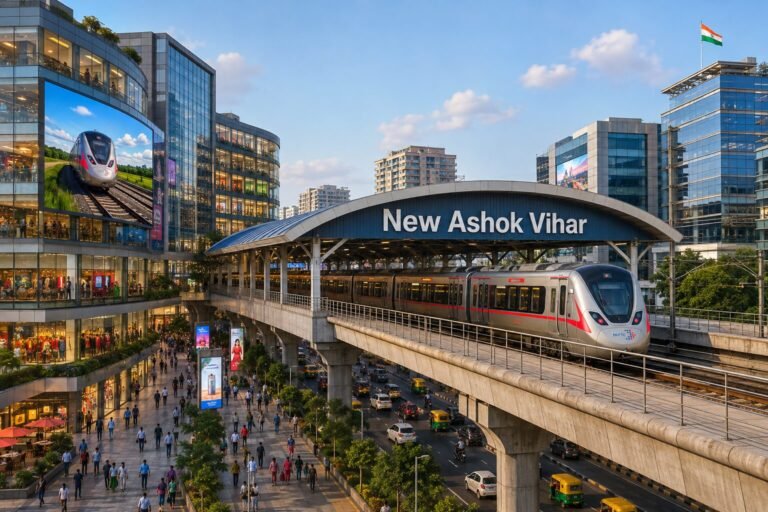
NEW DELHI (Metro Rail News): In the Lok Sabha session on Thursday (6th August), the Ministry of Housing and Urban Affairs (MoHUA) described the Transit Oriented Development (TOD) plan of Namo Bharat Regional Rapid Transit System (RRTS). As per the plans, there are multiple TOD projects planned around the corridor thereby projecting residential and commercial buildings around the station.
TOD refers to building residential and commercial infrastructure around the metro and RRTS corridors and stations aligning development with commutation friendly infrastructure. TOD can become a major source of non-fare box revenue for Namo Bharat. It will also become a foundation for the upcoming Namo Bharat projects.
TOD Plans for Namo Bharat
National Capital Region Transport Corporation (NCRTC), the implementing agency of Namo Bharat RRTS has informed the ministry that it has implemented several interventions across the Delhi-Meerut RRTS route including:
The weekly brief metro & rail professionals read.
- It has designed TOD zones of the Delhi-Ghaziabad-Meerut route. The report has been notified in the masterplan with special areas for TOD.
- NCRTC has laid out ideas for Influence Zones Plans (IZB) for the TOD nodes at Jangpura and Sarai Kale Khan under Delhi TOD policy, 2021.
- Further, as per the provisions of Delhi TOD policy, 2026, any new RRTS corridor will be considered for TOD in Delhi.
Significance of the TOD plan
A Transit Friendly Zone
The TOD plan will present the Namo Bharat RRTS as a commutation friendly zone. The zone will foster higher mobility across the corridor and create new potential for the overall economy. It will make RRTS stations a commercial hub. Moreover, it will utilize the space around the corridor for commercial and residential purposes, fostering optimum utilization of land.
Non-Fare Revenue
The TOD plan will prove to be an important source of Non-fare box revenue for the system. This way the Namo Bharat will get a new avenue to generate income. Non-fare box revenue includes the earnings from sources such as parking, lending out commercial and residential spaces. In short, it includes income from all the sources excluding the income from ticketing. For long term financial stability, the system must generate a significant amount through non-fare revenue sources.
About Namo Bharat
The Namo Bharat RRTS project was introduced to decongest the National Capital Region (NCR) and enhance its connectivity with the satellite cities. The first RRTS corridor in this project, Delhi-Ghaziabad-Meerut RRTS is now operational on an approximately 82 km stretch. Besides, Delhi-Alwar and Delhi-Panipat projects are prioritized for implementation.
Also Read: Namo Bharat records highest ridership amidst Kanwar Yatra on Monday
Project Overview