



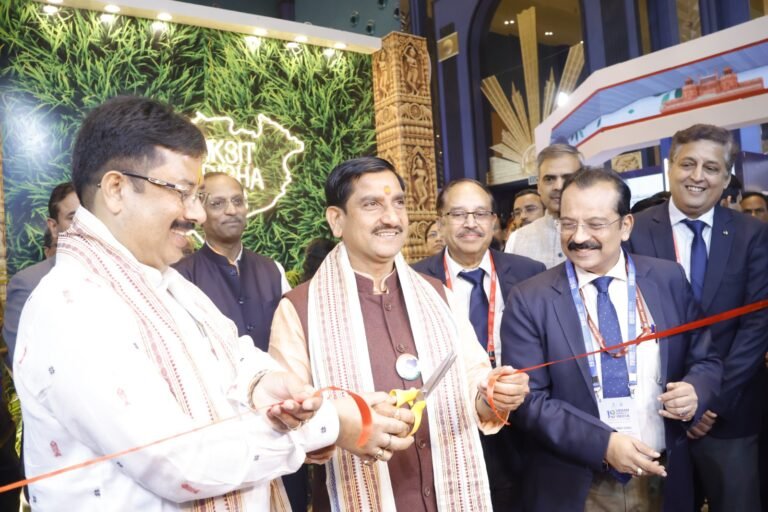
BHUBANESWAR (Metro Rail News): Union Minister of State for Housing and Urban Affairs Tokhan Sahu inaugurated the National Capital Region Transport Corporation’s (NCRTC) exhibition stall at the 19th Urban Mobility India (UMI) Conference and Expo 2026 in Bhubaneswar, Odisha, on October 23. The exhibition highlights the 82-km Delhi-Ghaziabad-Meerut Namo Bharat corridor, its integration with Meerut Metro, and plans to link regional rail infrastructure with urban development.
NCRTC is also showcasing the potential for nearly 2,900 km of Namo Bharat corridors across major regional clusters in India, alongside the use of augmented reality (AR) and virtual reality (VR) in the development and maintenance of the system.
Namo Bharat corridor records over 4.5 crore journeys
At the exhibition, NCRTC presented the development of the Delhi-Ghaziabad-Meerut Regional Rapid Transit System (RRTS), which began operations on its priority section in October 2023. The corridor spans 82 km and has 15 stations. Since the start of operations, the service has recorded more than 4.5 crore passenger journeys and now carries over one lakh commuters daily. Namo Bharat offers semi-high-speed regional connectivity, with fewer stops than conventional urban rail services, for passengers travelling longer distances across the National Capital Region. The exhibition also highlights the integration of Meerut Metro services with the Namo Bharat corridor, demonstrating how both services use the same infrastructure to support regional and urban travel.
The inauguration was attended by Dr Krushna Chandra Mahapatra, Odisha’s Minister for Housing and Urban Development and Public Enterprises; Satendra Singh, Secretary in the Department of Urban Development under the Ministry of Housing and Urban Affairs (MoHUA); and other dignitaries. NCRTC Managing Director Shalabh Goel, accompanied by senior management officials, presented the corridor’s features, technology and role in regional connectivity.
Get the Daily Metro & Rail Brief
Join 125,000+ metro and rail professionals. Project updates, new tenders and contract awards from across India, in your inbox every day.
Nearly 2,900 km of potential Namo Bharat corridors identified
NCRTC’s exhibition highlights the potential to replicate the RRTS model in other parts of the country. Nearly 2,900 km of potential Namo Bharat corridors have been identified across major regional clusters. The proposed corridors could improve connectivity between major cities and surrounding urban centres, supporting the development of larger economic regions. The concept also aligns with the Economic Survey 2025-26’s emphasis on developing mega-regions as new engines of economic growth.
The identified routes represent potential corridors and should not be interpreted as a fully approved or sanctioned network. Their development would require further planning and implementation.
Transit-oriented development around Namo Bharat stations
Transit-Orient Development (TOD) is another key focus of the NCRTC stall. The approach integrates public transport with planned residential, commercial and mixed-use developments around stations. NCRTC is presenting the following proposed and planned developments:
- Duhai Namo Bharat station: proposed development around the station to connect regional transport with surrounding urban areas.
- Sarai Kale Khan: Planned development around a major transport hub to improve access and integration with other modes.
- Harnandipuram: A planned TOD township intended to link urban development with regional rail connectivity.
- New Meerut: Another planned township that would combine transport access with residential and other urban facilities.
The approach aims to improve access to affordable housing, bring homes and workplaces closer to public transport, and encourage better-connected residential and commercial areas. It is intended to make regional transport infrastructure part of a wider urban planning strategy rather than treating stations as standalone facilities.
AR and VR demonstrate Namo Bharat technology
The NCRTC exhibition features interactive models, detailed project information and visual displays explaining the design and technology of the Namo Bharat system.
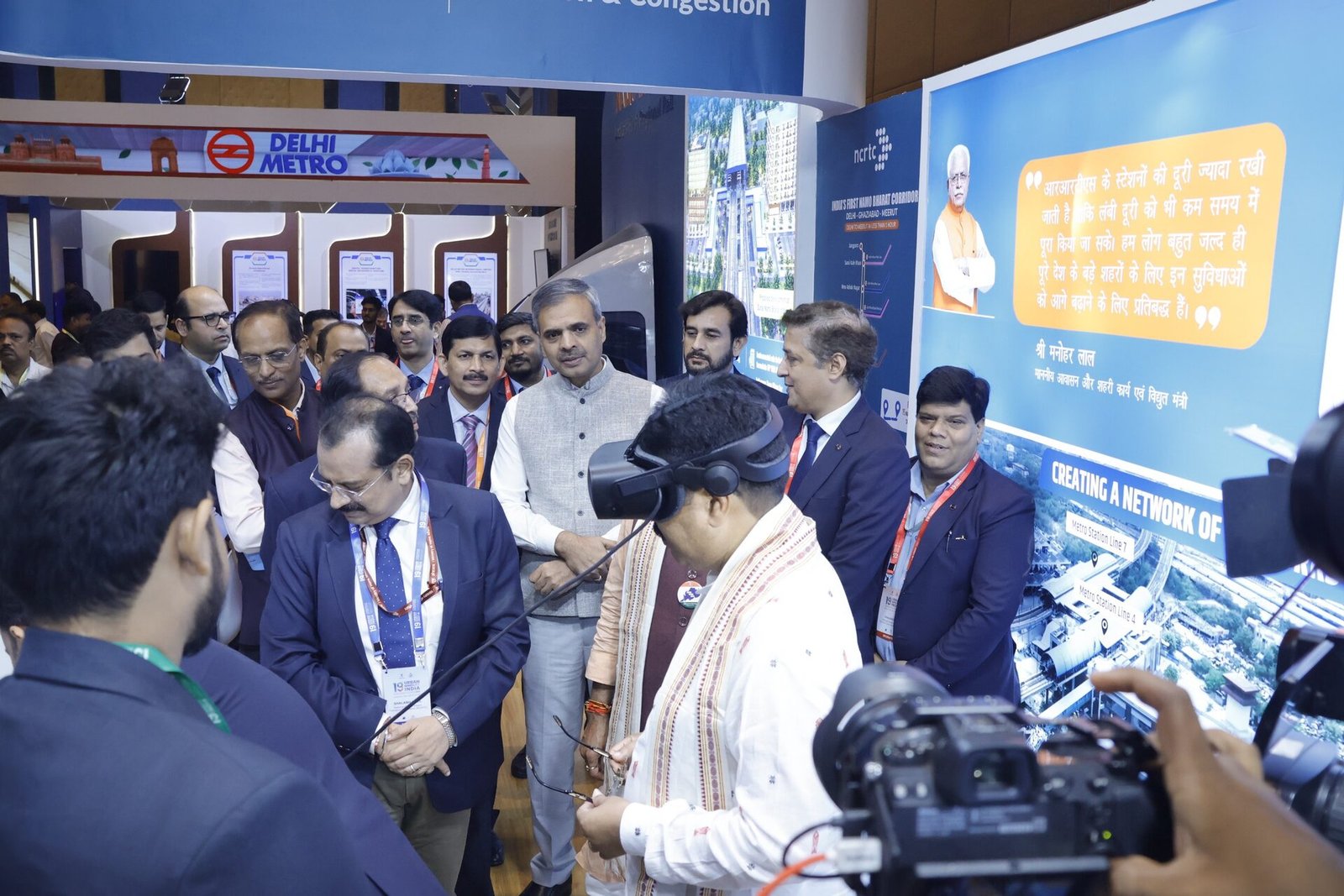
Visitors can also experience how augmented reality and virtual reality are used in the development and maintenance of the regional rail system. These technologies provide a way to present infrastructure and system-related information through immersive, interactive displays.
The exhibition aims to explain both the commuter-facing features of Namo Bharat and the technology used behind the scenes to develop and maintain the system.
UMI 2026 focuses on accessibility and liveability
The Ministry of Housing and Urban Affairs and the Government of Odisha are jointly organising the 19th Urban Mobility India Conference and Expo. The event is being held in Bhubaneswar from October 23 to 24, 2026. This year’s theme is ‘Urban Accessibility and Liveability in the Digital Age’. The programme focuses on improving access to urban transport, integrating transport infrastructure and using emerging digital technologies to improve the quality of urban life.
The two-day event brings together policymakers, transport authorities, industry representatives, technology providers and experts to exchange knowledge and explore approaches to sustainable and efficient mobility. NCRTC’s participation centres on regional rail, multimodal integration and transit-oriented development. These themes connect transport planning with wider questions of housing, land use and access to employment and other urban facilities.
Also read: NCRTC Likely to Get Approval Soon for Delhi-Panipat and Delhi-Gurugram Namo Bharat Corridors
Project Overview