KANPUR (Metro Rail News): Under the Kanpur Metro Rail Project, the construction work of underground section-I (Chunniganj-Nayaganj) of the first corridor (IIT-Naubasta) is progressing at a brisk pace. Today on 26th March the work of preparing the diaphragm wall (D-wall) for the construction of Chunniganj Underground Metro Station of this section has been commenced. At the other three stations of the said section namely Naveen Market, Bada Chauraha and Phoolbagh-Nayaganj, D-wall construction is ongoing and at Naveen Market and Bada Chauraha, this work is expected to be completed by the end of April month.
The work of D-Wall was first started at Naveen Market Metro Station. 102 D-wall panels have to be lowered in this station, out of which 87 have already been placed. At the same time, 84 out of 100 D-wall panels have been placed at Bada Chauraha Metro Station and 68 out of 107 at Nayaganj Metro Station.
What is D-Wall?
A D-wall can be understood as the boundary of an underground metro station. Before starting the construction of an underground metro station, this wall is constructed as a security enclosure around it. The D-Wall is formed with rectangular RCC panels. The length of the panels for D-wall in Kanpur’s Underground Section-I, will be around 5 meters and the width will be around 800 mm and approx 100 such panels will be used to form the D-Wall around each station. This wall will exist up to a depth of about 21 meters.
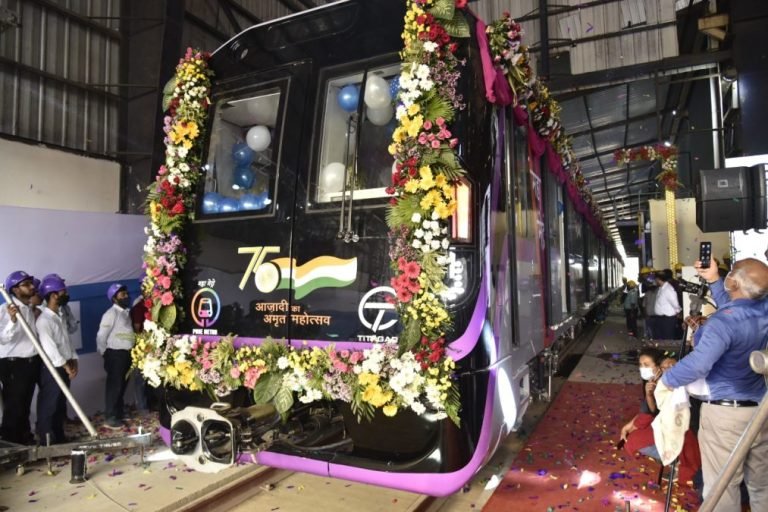
KOLKATA (Metro Rail News): India’s first light-weight metro train which is made of aluminium metal has been flagged off by Mr Manoj Joshi, Secretary, Ministry of Housing and Urban Affairs (MoHUA) today, 26th March. The event was held at Uttarpara, Kolkata.
This train is built by Titagarh Wagons Ltd. which is based in West Bengal, India under the Atmanirbhar Bharat initiative. The light weight aluminium body metro train is built for MahaMetro’s Pune project. Maha Metro MD Dr Brijesh Dixit, OSD, MoHUA Shri Jaydeep, Director (Rolling Stock) Shri Sunil Mathur and officials of Titagad Wagons were prominently present on the occasion.
Speaking on the occasion Shri Manoj Joshi said that a new eco-system is being developed in the country because of metro projects in the country. The manufacture of such a train is a big step towards the Make In India concept. He also congratulated Maha Metro MD Dr Dixit for taking a bold decision to use an aluminium-made train. Ten years back, such a decision couldn’t even be thought off, he said and also greeted Titagad Wagons for the risk it has taken in this field. He added that having made this train, its maintenance and ensuring quality is also a challenge.
Dr Brijesh Dixit, MD, Maha Metro said that the manufacturing of such a light-weight aluminium–body train in India for the first time and its use for Maha Metro project is a major step. Work on the Nagpur Metro project was started in 2015 and then there was not a single company manufacturing metro trains in the country. Much progress has been achieved in this direction since then. Two lines of Pune project have been recently launched and passenger services on the remaining project will soon be started he added. The state government has given extensive co-operation in executing Metro projects in the state, he said.
Mr Jaydeep, OSD, MoHUA, in his speech, spoke about the use of aluminium coach was a major achievement for Mass Rapid Transit System projects in the country. This is a landmark decision, he said this is a step towards fulfilling the concept of Atma Nirbhar Bharat as envisaged by the government. The chairman, Titagarh Wagons Shri J P Chaudhari and Managing Director Shri Umesh Chaudhari addressed the gathering and spoke about the project of the aluminium-body metro train.
The salient features of Aluminium-body train are as follows:
• The lightest Metro Coaches in India (6.5% lighter than the conventional stainless-steel coaches). • The first-time aluminium car body metro cars getting manufactured in India. • The most energy efficient metro cars due to their lighter weight. • Being an aluminium Car Body have a longer life and low maintenance. • Total 34 Trains, each with three car compositions, (Total 102 coaches). • 3 Car Composition, Total Passenger Capacity: 978 passengers for 3 car train [Driving Motor Car-315, Trailer Car-348], Seats=140 [Driving Motor Car-44, Trailer Car-52 (including 2 wheelchairs) • 66% Powering with More than 30% energy regeneration- Regenerative braking from 70 kmph to 10 kmph. • Panic Button for the safety of passengers-4 no. in each car. The passenger can communicate with the driver directly in case of any emergency. • In-train CCTV Coverage: 98%.
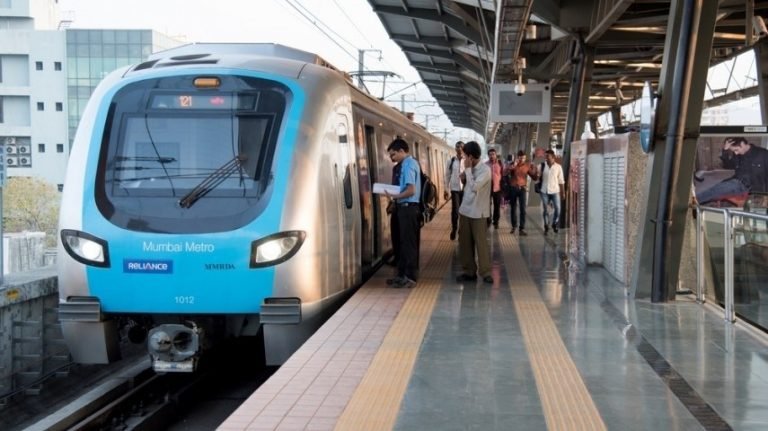
MUMBAI (Metro Rail News): Mumbai will now get a second metro line after eight years which can make the commute for people travelling in the western suburbs of the city more effortless.
The first-ever 11.40 km elevated Metro line which was constructed eight years back that connects Ghatkopar-Andheri-Versova, now two additional lines will be partially operational soon. The inspection on the lines was conducted after which The Commissioner of Metro Railway Safety (CMRS) gave the clearance.
As per the sources, the Mumbai Metropolitan Regional Development Authority (MMRDA) is constructing a 35-km stretch of two elevated Metro corridors – Line 2A between Dahisar and D N Nagar, and Line 7 between Dahisar East and Andheri East for which the Commissioner of Metro Railway Safety (CMRS) has given a green signal. The CMRS started inspection on these two lines on February 20, after which it was permitted for operations. The CMRS while conducting an inspection several times has communicated flaws or rectifications that are needed on the lines to the MMRDA, which the MMRDA claims it has rectified.
The two new metro lines, 2A and 7, will run parallel in the east and west side of the suburb, with the aim to ease the traffic on the Western Express Highway which is the major roadway of Mumbai. After the whole 35 km of corridor is operational, the commuters can travel between Dahisar and Ghatkopar by Metro without exiting the Metro station. The commercial operation of both lines has been planned in two phases. In Phase 1 of the project, 2A and 7 corridors will cover 18 stations and the two lines will be joined.
Bharat Earth Movers Limited (BEML) has supplied all the 10 Metro rakes to MMRDA for starting operations on these lines. The rakes are completely indigenous and can be driverless.
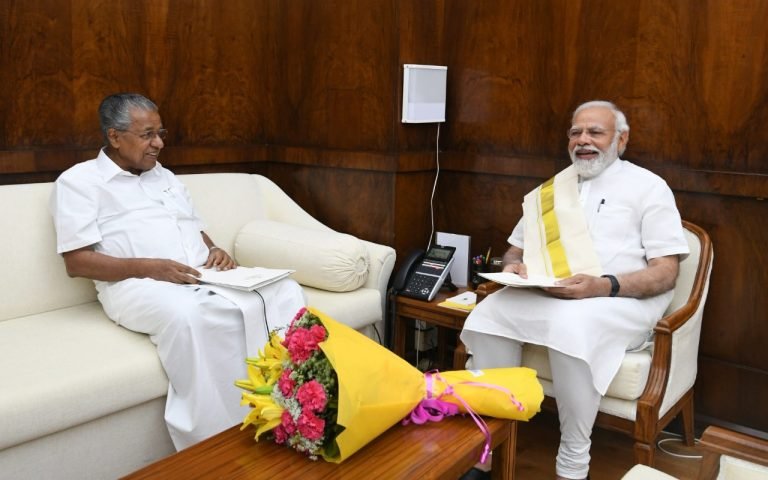
KERALA (Metro Rail News): Kerala is broiled in major controversy due to the SilverLine semi-high speed rail corridor project. Pinarayi Vijayan, Chief Minister, Kerala on Thursday, 24th March met Prime Minister Narendra Modi and looked for his intervention for speeding up necessary approvals from the central government. Vijayan after the meeting said that the Prime Minister’s response to the project was favourable.
The Rs 63,491-crore ambitious SilverLine project has been facing massive protests over the survey and marking of the corridor boundary.
Hours before the Chief Minister met the Prime Minister, MPs from the UDF which is Kerala’s Opposition alliance took out a protest march to Parliament against the K-Rail project, which turned into a brawl between them and the police.
Vijayan said that in the meeting, Prime Minister Modi heard him with full interest and his responses were healthy. “It was a good discussion… he said he will have a detailed discussion with the Railway Minister and see what can be done. We hope that the meeting with the Prime Minister will lead to a speedy sanction of permissions. We also had an informal interaction with the Railway Minister…. The Prime Minister’s stand on the project was favourable,” he said.
Previously Railway Minister Ashwini Vaishnaw in Lok Sabha said that the concerns over the environmental issues linked to the project are real and a final decision will depend upon the detailed techno-economic feasibility of the project.
After his meeting with PM, Vijayan told the reporters that there was a “political conspiracy” behind the protests against the project and that Kerala requires a safe, speedy and modern transport network as the current facilities in the state are not good. he also said that the vehicle density in Kerala is high whereas the roads are not sufficient to handle it. Due to this, the accident rates are also very high therefore the state needs a stable transport network.
The concerns over forthcoming impact on nearby houses and buildings due to the SilverLine project have emerged. The Detailed Project Report (DPR) has totally hinted at challenges to the houses and buildings near the proposed railway line. K-Rail has claimed that only a 10-metre buffer zone is needed to protect the surroundings whereas DPR suggests construction activity will require stretch of land more than that.
According to the renowned academician and environmentalist RVG Menon, the DPR is not detailed in regards to the challenges it would pose to the locals and therefore he termed the DPR as incomplete.
HYDERABAD (Metro Rail News): The Telangana Government plans to take up semi-high speed rail connectivity to Warangal and to Vijaywada. The Hyderabad Unified Metropolitan Transport Authority (HUMTA) has invited proposals from major firms to carry out a pre-feasibility study for the proposed semi-high speed rail connectivity to these corridors.
The project’s aim is to provide fast, safe and comfortable commuter systems at a rational fare for intra-regional movement of passengers. Warangal and Vijaywada corridors have been proposed because the passenger movement is high on these two corridors. The major difference between semi-high speed rail and the conventional railway is that the former will provide reliable, high frequency, point-to-point regional travel along a committed pathway. The motive of this system is to reduce dependence of commuters on road transportation and to ease the traffic.
This study will be based on secondary information, site visits and limited primary surveys for passengers, cargo and traffic/trips on competing facilities and based on the terrain and other technical requirements, a suitable system will be suggested for various sections of the corridor after reviewing the existing travel characteristics and estimation of the current and future travel demand for passenger and cargo traffic. The social and environmental aspects will also be assessed as part of the required measures for development.
The services on this line will be resumed at 7 am tomorrow on Sunday. The scheduled maintenance work will take place between Indiranagar and Swami Vivekananda metro stations. The operations between MG Road and Kengeri will be normal.
“Last train leaving Kengeri metro station towards Byappanahalli is at 9 pm and from Byappanahalli metro station towards Kengeri is at 9.30 pm. On Sunday Metro station service will resume normally at 7 am as per schedule on the entire purple line,” BMRCL informed in a release.
MUMBAI (Metro Rail News): Larsen & Toubro on 25th March emerged as the lowest bidder to design, manufacture and install tracks (Package T-3) of the 508.17 km Mumbai – Ahmedabad High Speed Rail (MAHSR Bullet Train) project.
Package T-3 in Gujarat is the second of three track related packages (T-1, T-2, T3) of this HSR line and will connect Mumbai and Ahmedabad through 12 stations at an estimated cost of Rs. 1.1 lakh crore.
It is a stretch of 116.175 km from south of Vadodara city to Sabarmati Depot through civil packages C5 (awarded to L&T), C6 (under construction by L&T), C7 (awarded to IRCON_DRA) and C8 (awarded to SCC-VRS JV)
India’s National High Speed Rail Corporation (NHSRCL) invited bids for this package in August 2021 with an undisclosed estimate and 5.36 years completion period. The technical bids for this were opened in December 2021 to reveal 4 bidders.
Financial Bid Values (Note: final approximate value is a combination of all currencies)
The brief scope of this package includes Design, Supply and Construction of Track and Track related Works including Testing and Commissioning on Design-Build Lump Sum Price basis for Double Line High Speed Railway between Vadodara (MAHSR Km. 393.700) and Sabarmati Depot and Workshop (MAHSR Km. 509.875) in the State of Gujarat for the Project for Construction of Mumbai-Ahmedabad High Speed Rail.
A special slab track system will be utilized for the Bullet Train project instead of a conventional ballasted track system found in main-line railway lines.
Here’s the scope and status of the Mumbai – Ahmedabad Bullet Train’s 3 track-work packages:
Package
Status
T-1 (Maharashtra): Design, Supply & Construction of Track & Track related works between HSR station at BKC/ Mumbai and Zaroli Village on MH/GJ border (156.855 km)
Tender Notice Pending
T-2 (Gujarat): Design, Supply & Construction of Track and Track related works between Zaroli Village and Vadodara (237.10 km)
KOLKATA (Metro Rail News): Metro Railway general manager Arun Arora on Thursday said that in the next four years, Kolkata will have a 100km of Metro network. Phase 1 of the Joka-Esplanade and New Garia-Airport corridors are also a part of this and can start running in September and October, respectively. Also, East-West Metro’s Sealdah extension will start operations by April this year. Arora, also said that by January, next year, the entire East-West Metro will be operational.
From Monday, Metro will run 284 services on the North-South corridor, said Arora. With eight more trains added to service, the carrier will now be four coaches short as compared to pre-pandemic time. The GM, Eastern Railway added that “Kolkata now has 39km of Metro network (North-South and East-West). By 2026, we shall easily achieve 100km.” To cater to the extensive network, 47 new rakes will be procured in the next three years, including China’s Dalian (14) and CRRC Zhuzhou (eight) and 14 rakes from Chennai’s ICF, Arora said. On the delay over Dalian rakes, Arora said, “The first one is undergoing various tests, which got delayed because of the pandemic. Once the rake gets the Commissioner of Railway Safety (CRS) nod, the rest can come.” Kolkata’s Line 2 is now a curtailed 6.97km from Sector V to Phoolbagan, awaiting CRS’s nod to add 2.3km to Sealdah. Allocating the latest difficulty over the first phase of the Joka-Esplanade and New Garia-Airport corridors, from Joka to Taratala on DH Road and New Garia to Ruby along EM Bypass, or extend these further from Joka to Majerhat and New Garia to Sector V respectively, Arora said infrastructure projects couldn’t be left idle. Previously Metro Railway supported the extended Phase 1 of both lines while RVNL stood for the original launching plans. Arora said the sections would run with “one train on one line” system for now because of the delay in floating tenders for communication-based train control (CBTC) signalling. The Noapara-New Barrackpore line may start by August 2026, but its Barasat extension was uncertain because of land issues, Arora said. “Nearly 18 lakh people will be using Kolkata Metro daily by 2025,” he added.
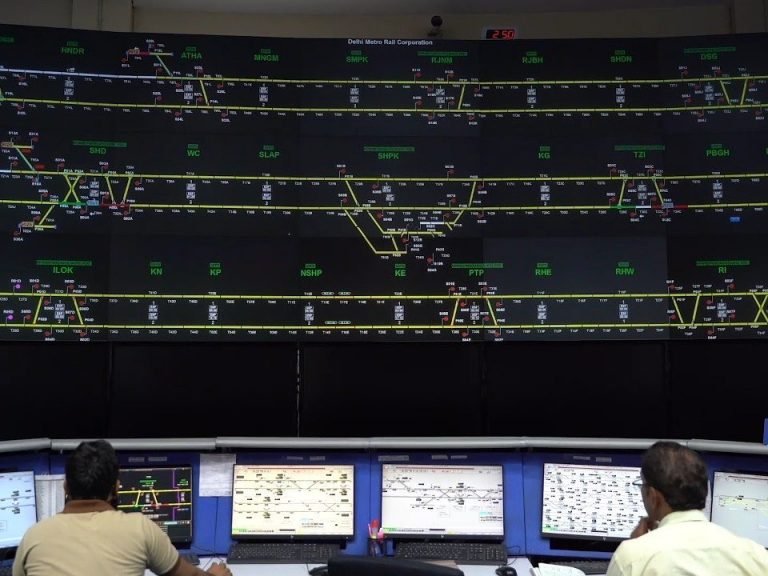
DELHI (Metro Rail News): Dr Mangu Singh, Managing Director inaugurated the final field trials of India’s first ever Indigenous Automatic Train Supervision System (i-ATS) on the red line virtually on Thursday, 24th March. The event happened in the presence of Directors and senior officials at Metro Bhawan.
The i-ATS has been developed by a joint team of DMRC & Bharat Electronics Limited (BEL). This development will make DMRC more self-reliant in the field of Metro Train Signalling and will boost the Government of India’s ‘Make in India’ initiative.
Delhi Metro on December 24 last year had entered into the 20th year of its operations and marked the occasion by commencing a field trial of the i-ATS technology.
ATS is a computer-based system, which manages train operations. This system is indispensable for high density operations such as the metro, where services are scheduled every few minutes.
LUCKNOW (Metro Rail News): The Awadh crossing in the state capital, which connects the expressway and highway to the city, is likely to be the pit stop for the ‘bullet train’ planned to start cruises on the Delhi-Varanasi High Speed Rail Corridor.DVHSR) by 2029. Answering a question on February 11 in Rajya Sabha, The Ministry of Railways has announced plans to conduct a survey and prepare a Detailed Project Report (DPR) for seven corridors, including DVHSR. According to government officials, the 813-km track will have 13 stations, including 12 elevated ones in Uttar Pradesh and one underground in Delhi, at which the train will run at a speed of 330 kmph. It will take at least 3 hours 33 minutes to reach Varanasi from the national capital with a limited number of stops. About 15 km long tunnel will be built for the underground station.
Since the route alignment of DVHSR is with Yamuna and Agra-Lucknow Expressway and the proposed Ganga Expressway to avoid forest and wildlife, the train is likely to have its station at Lucknow at Avadh crossing. “A total of 43 trains per day will reach Avadh crossing station every 22 minutes,” an official said. Starting from Hazrat Nizamuddin, this train will stop at Noida Sector 146 Metro Station, Jewar Airport, Mathura, Agra, Etawah, Kannauj, Lucknow, Rae Bareli, Pratapgarh, Prayagraj, Bhadohi and will end at Manduadih (Varanasi). A Foot Over Bridge (FOB) will connect the station at Awadh Crossing to Singer Nagar Metro Station so that passengers can reach their destination in the city.
Similarly, FOB will be constructed from Prayagraj station to Phaphamau railway station. As per the proposed plan, 18 trains will run daily from Varanasi at an interval of 47 minutes. In Delhi, DVHSR underground station will be opposite Hazrat Nizamuddin railway station, while in Noida it will be opposite Sector 146 metro station. At Jewar, the DVHSR station will be part of the Jewar Airport transport network.
According to officials, another section of DVHSR has been proposed to connect Lucknow and Ayodhya, but it will depend on cost feasibility. Apart from the Delhi-Varanasi route, the survey will be conducted for Varanasi-Howrah, Delhi-Amritsar, Delhi-Ahmedabad. Mumbai-Hyderabad, Mumbai-Nagpur and Chennai-Mysore via Bangalore. Presently, the National High Speed Rail Corporation Limited (NHSRCL) is working on the Mumbai-Ahmedabad corridor.
NEW DELHI (Metro Rail New): Delhi metro which is spread in 400km with a big part constructed in 15 to twenty years in the past Delhi Metro Rail Corporation (DMRC) is now planning to switch the guide inspection by a drone survey. “DMRC will use drones for inspection as an advance means for a greater view and entry, taking out the guide mode of inspection that takes extra time and labour,” a spokesperson mentioned. “The inspection will likely be completed in a phased method in any respect elevated sections,” the official said.
Around 65% of the Delhi metro is built on elevated sections, that are affected by the weather through the years. “With the passage of time, buildings are anticipated to be affected on account of a number of exterior elements similar to local weather, practice motion, materials life,” the spokesperson said, including that such an inspection would assist in analysing and rectifying the problems to make the buildings last more. The inspection features a thorough checking of all minor parts associated to civil buildings, from bearings to viaducts. “This additionally contains elevated buildings like foot overbridges, piers, girders, ramps,” he mentioned. “This can be a routine train being carried out in all infrastructure tasks to maintain a examine on the security elements of civil buildings.” DMRC will hire an organisation that uses drones appropriate for aerial surveys with high-resolution 4k calibrated cameras. The digital camera system will likely be fitted with gimbals to make sure it stays steady and captures clear photographs based mostly on the exact location given by World Navigation Satellites System. The spokesperson mentioned numerous elements of the inspection including checking the security of buildings, discovering their bodily situation, detecting any abnormality or defects at an early stage, and figuring out precise and potential sources of an issue. Such inspections will assist in documenting systematically and periodically the situation of the metro, which will allow DMRC to figure out any vital structural adjustments and defects, he official added. The survey will assist DMRC’s plan and perform repairs, and strengthening and changing structural elements, the spokesperson mentioned. It is going to additionally present suggestions to designers and development engineers on the options creating upkeep issues, he added. As soon as any abnormality or defect is detected through the drone survey, DMRC’s groups can see the precise spot with the assistance of skylifts, scaffoldings and trolleys to hold out an in-depth inspection.
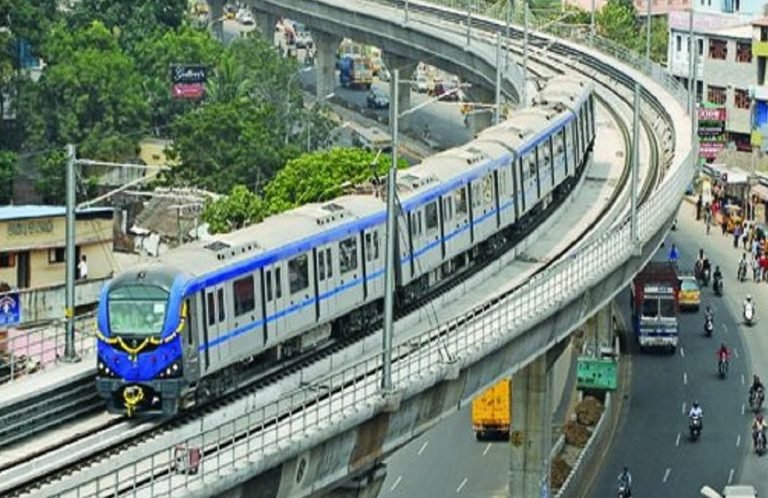
CHENNAI (Metro Rail News): Chennai Metro Rail Ltd. (CMRL) may take a re-look at Corridor 3 of its Phase II project. There is a probability of CMRL shortening the size of the project and terminating the line at Shollinganallur instead of SIPCOT in Siruseri. But this is not yet final.
The Phase II project is estimated to cost ₹61,843 crores and is a 45.3 km stretch. A high-level meeting that was held recently discussed the prospect of reducing the length of this stretch. “We are just mulling a possibility to build this stretch till Shollinganallur. No decision has been taken yet. We have to look at a host of issues and consult with the important stakeholders before taking any decision in this regard. There was a discussion about the difficulty in acquiring land along this stretch from Shollinganallur to SIPCOT and hence this option is being explored,” a source said.
Earlier ten stations were planned to be built between Shollinganallur and SIPCOT, which include Shollinganallur Lake, Sri Ponniamman Temple, Sathyabama University, St. Joseph’s College, Semmancheri, Gandhi Nagar, Navalur, Siruseri, SIPCOT-1 and SIPCOT-2. People in thousands which includes IT employees and students, travel to these areas from various parts of the city. Even when the number of commuters dipped during the pandemic, most of the restrictions have now been lifted and offices are opening up, sources said.
“This stretch has been planned as an elevated one and because of the road width, it is easy to construct viaducts and stations in these locations. Also, in future, since it will cater to a large population. In times of increasing traffic, it will ease commuting significantly for the students and working professionals,” the source added.
CMRL had previously planned a depot at SIPCOT but the proposal was dropped as part of measures to trim the cost of the project. Now the Phase II work is on at several locations between Madhavaram and Shollinganallur and Light House and Poonamallee.
BENGALURU (Metro Rail News): The Bengaluru Metro Rail Corporation Limited (BMRCL) has decided to increase the height of walls near some metro lines after many incidents of stone-pelting by outlaws were reported on running Bengaluru Metro trains.
As per the senior BMRCL officials, five such incidents have been reported in the last few years where the outlaws throw stones on passing trains from outside the Metro compound walls. “The exact number of incidents has not been recorded, but at least five such incidents have happened in the last few years at a few stations. Magadi Road, Srirampura, Chickpet, National College and City Railway stations have recorded stone-pelting incidents in which the glass of the trains have suffered cracks,” officials said.
The officials also assured that these stones have not harmed any passengers or the Metro crew because the trains have double-glazed windows. BMRCL officials said they have deputed security personnel too at the spots where such incidents have been reported. “As an additional measure, the height of the walls would be increased soon,” an official added.
The officials said that the trains which were damaged by stone pelting will be immediately repaired and then only they will be back in operation keeping in mind the passenger safety.
CHENNAI (Metro Rail News): The Madras High Court has asked Chennai Metro Rail Limited (CMRL) to list reasons for which the organisation could share its closed-circuit television (CCTV) camera footage with the people who seek it under the Right to Information (RTI) Act of 2005.
Justice Anita Sumanth asked senior counsel P.S. Raman who was assisted by CMRL’s counsel-on-record Jayesh Dolia, to provide a list by 5th April, of suggestions on how a mechanism could be devised and put in place. The judge said that this footage could be of great help to the citizens in some instances.
The orders were passed on a writ petition filed by CMRL challenging Tamil Nadu Information Commission’s (TNIC) direction to provide CCTV footage of the incidents that had been captured on a camera installed at Park Metro station between 10 p.m. and 10:45 p.m. on October 6, 2019. The TNIC at that time imposed a cost of ₹25,000 on CMRL because they were unable to provide a satisfactory reply to the RTI applicant V.
K. Mutharasu for over one year.
Mr. Raman argued that there was a possibility of a serious security threat if CMRL was forced to share CCTV footage with every other RTI applicant. he also mentioned that nearly one lakh CCTV cameras would be in operation after the CMRL completes phase II and someone with an ill intention in future could file multiple RTI applications seeking CCTV footage of different stations with the intension to piece them together and therefore could learn the entire operations of the metro.
He also specified a Supreme Court judgement in Pradyuman Bisht versus Union of India (2015) case in which it was held that the CCTV footage from court campuses could not be provided to all applicants under the RTI Act without the prior permission of the chaired officer concerned.
Finding evident force in his submissions, Justice Sumanth granted an interim stay of the TNIC’s order. She also ordered notices to the commission as well as the RTI applicant returnable by April 5 and said that the applicability of the apex court verdict to the present case would be decided later. However, the public had open access to Metro, and in some instances to help the public there must be some mechanism to see camera footage when needed, the judge asked Mr. Raman to come up with genuine suggestions.