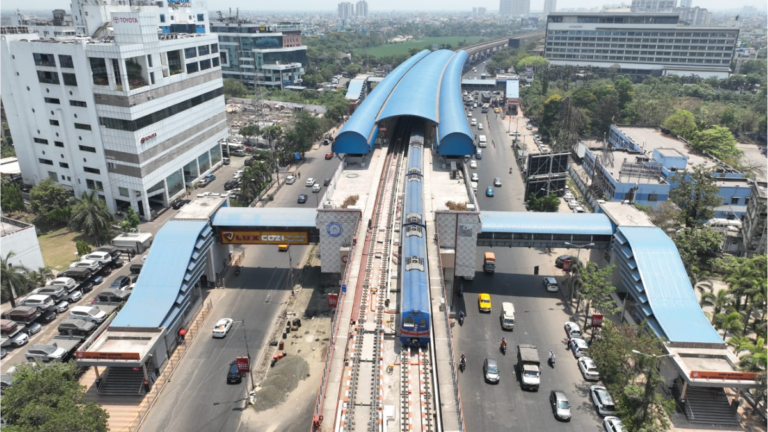
Mumbai-Ahmedabad High-Speed Rail Update: Land Acquisition Completes in Gujarat

AHMEDABAD (Metro Rail News): NHSRCL announced the completion of Land Acquisition for the MAHSR project in Gujarat on Monday. The last parcel of Land was acquired in September at Kathore Village in Surat district. 

Out of 951.14 hectares, 6,336 were private properties spread across eight districts of Gujarat. The total land acquired in Gujarat under the project goes as follows: 

City Land (in hectares) 
Surat 160.51
Vadodara 142.30 
Bharuch 140.32 
Ahmedabad 133.29 
Valsad 122.95 
Kheda 110.25 
Anand 52.59 
Navsari 88.93 

The total land required for the project comes down to 1389.49 hectares spread across in the following manner: 

State/UTLand Acquired (in percent) 
Gujarat100
Dadra & Nagar Haveli 100
Maharashtra 99.83

The operational control centre will be located at Sabarmati in Ahmedabad, and there will be Three depots, Two in Gujarat- Surat & Maharashtra and one in Maharashtra- Thane. The phase phase of the project between Surat & Bilimora is expected to be on track by 2026. 

The MAHSR project is being built between Ahmedabad & Mumbai as a High-Speed Rail Project employing Japan’s Shinkansen Technology at an estimated cost of Rs 1.10 lakh Crores. 


Intrigued by the future of Metro and its impact on our city? Join us at our upcoming InnoMetro event to delve deeper into this vital issue. Stay informed, get involved, and let’s ride the Metro towards a brighter, more sustainable future together. 

An Introduction To The Growing Market of Automatic Train Control

NEW DELHI (Metro Rail News): According to statistics, the global automatic train control market is worth $3.92 billion in 2023. It is predicted to increase at a CAGR of 12.3% to $8.85 billion by 2030. Automatic Train Control (ATC) refers to train protection systems for railways, including a speed control mechanism that responds to external inputs. ATC systems usually integrate various cab signalling techniques and use finer-grained deceleration patterns instead of the prior automatic train stop technique’s inflexible stops. ATO, which can be used in collaboration with ATC, is commonly regarded as the system component requiring the highest level of safety. According to studies conducted by the American Association of Railroads, accidents caused by human factors form the biggest category of train accidents all around the globe. The study says that most of the major train accidents have resulted from manual errors rather than machine failures in a study conducted for rail and metro systems in more than forty-eight countries.

In terms of ATC, one of the most significant market developments at the time was the increasing standardisation of rail signalling technologies. Suppliers can improve standards-based global architectures that provide a dependable foundation for local solution development and the interoperability required to meet local safety standards and requirements. In recent years, China has emerged as a superpower in the high-speed rail network. The communist nation possesses over fifty per cent of all global high-speed rail networks, opening a vast avenue and potential for the ATC market. No wonder the Chinese economy has pounced upon the opportunity and has emerged as one of the major players in the ATC market.

Construction and maintenance expenditures for the track, engineering buildings such as bridges and tunnels, railway signalling, communication systems, power supply in electrified areas, and terminal facilities are all substantial. These infrastructure expenditures and costs associated with equipment, site acquisition, and finance restrain the rolling stock market. Because of increased electrification in the transportation industry, the market for autonomous trains is expected to grow significantly. The advancement of the Internet of Things (IoT) in the transportation sector is a significant market driver for autonomous and self-driven trains. For example, German Rail Corporation and Siemens Mobility developed the first autonomous train for rail traffic. The train is completely automated and runs on digital technology. The train’s driver remains on board to supervise the passengers’ journey.

Interoperability of the train control and management system makes it easier for trains from different locations to communicate. Each national rail network has different technical requirements for rail infrastructure. Differed countries have distinct gauge widths, electrification requirements, and safety and signalling systems. The varied technological requirements raise the cost of running trains across nations.

Since the bulk of mainline railway lines are long and travel through nearly every intersection in the country, the mainline segment is expected to increase rapidly. These trains were designed primarily for long journeys. The mainline trains are also likely to be designed with cutting-edge technologies. Most railway operators utilise ATC for mainline trains because it helps reduce collisions and preserve train routes. The support and maintenance segment is expected to develop at the fastest CAGR over the projected period because organisational contexts are very complex, needing various interconnected IT systems to carry out daily operations. As a result, companies and organisations must update their ATC systems to optimise train operations. The support and maintenance services assist the deployed ATC system within the enterprise’s infrastructure. Round-the-clock troubleshooting assistance, an upgrade of the current ATC solution, proactive services, technical support from professionals, problem-solving, repairs, and test scenario management are all included in the support and maintenance services. The support and maintenance sector provides ATC solutions with 24-hour support along with site evaluations and training.

The Asia-Pacific region is expected to have the highest CAGR over the forecast period, owing to its extensive rail infrastructure. The market for autonomous trains is expected to expand significantly due to the region’s governments, particularly those of China, India, and Japan, increasing their investments in rail infrastructure development. The industry is also expanding rapidly as metro travel becomes increasingly popular as a mode of public transit in India. As a result, the railway network significantly impacts Asia-Pacific economic growth. Cisco, Hitachi, Toshiba, Thales, Tech Mahindra, General Electric, Advantech, Kyosan Electric Mfg. Co., Ltd, MERMEC Inc, MIPRO Electronics, ADLINK Technology Inc, Bombardier, Alstom, Kyosan, Vehicule Automatique Leger, SelTrac, and WSP are some of the key players in the Automatic Train Control market today.


Intrigued by the future of Metro and its impact on our city? Join us at our upcoming InnoMetro event to delve deeper into this vital issue. Stay informed, get involved, and let’s ride the Metro towards a brighter, more sustainable future together. 

Odisha To Get Its First Metro Rail In Bhubaneswar 

Bhubaneswar (Metro Rail News): The Temple City is all set to get its first running across, covering a distance of 26 Km with 20 stations. Chief Minister of Odisha, Mr Naveen Panaik, approved the DPR for the Bhubaneswar Metro prepared by Delhi Metro Rail Corporation (DMRC). 

The government of Odisha has constituted Bhubaneswar Metro Rail Corporation (BMRC) under the Companies Act, which is fully owned by the Government of Odisha itself. The entire cost for the project will be borne by the Government of Odisha itself. 

The metro will be running between Trisulia Square to Bhubaneswar Airport on an elevated structure running on the median or the side of the existing roads covering major stations like KIIT Square, Damana Square, Sishu Bhawan and Capital Hospital. 

A high-level committee has also been formulated to oversee the metro project to ensure expeditious outcomes. The DPR has been approved with a deadline to complete the project in 48 months’ time. The Chief Minister of Odisha will be laying the foundation stone for the metro project in January 2024. 


Intrigued by the future of Metro and its impact on our city? Join us at our upcoming InnoMetro event to delve deeper into this vital issue. Stay informed, get involved, and let’s ride the Metro towards a brighter, more sustainable future together. 

Agra Metro Update: TBM Yamuna Achieves Breakthrough 

AGRA (Metro Rail News): Agra Metro TBM ‘Yamuna’ achieved its last breakthrough for the up line at Taj Mahal Metro Station after completing tunnelling work from Ramlila Maidan to Taj Mahal Metro Station. It has successfully constructed a tunnel from Ramlila Maidan (launching shaft) to the Taj Mahal Metro Station on Monday

The tunnel construction work for the Agra Metro Rail Project’s underground section is progressing quickly, and this breakthrough marks yet another milestone for the completion of the Underground section. While the civil work of all underground stations is already being carried out rapidly, the tunnel construction work is being carried out by three TBMs- Yamuna, Ganga and Shivaji. 

Agra metro TBM Yamuna 02

Speaking on the same, MD UPMRC Shri Sushil Kumar said, “This is an important milestone as complete tunnel section for up line for three stations has been completed. We are striving to commence metro operations 6 months ahead of schedule, i.e March 2024 instead of actual deadline of August 2024. The three Elevated stations & train depot are ready. The testing of metro trains is being conducted successfully on the mainline.”

The TBM breakthrough is one of the most challenging achievements in a metro project, which requires high accuracy and ultimate precision. 

The TBM was launched on 6th February by the Hon’ble Chief Minister of Uttar Pradesh, Yogi Adityanath, and has completed the tunnel construction in a record time. Shivaji TBM has constructed a tunnel to the ramp area, and the construction of an underground section of the priority corridor, Agra Metro Rail Project, has been expedited.


Intrigued by the future of Metro and its impact on our city? Join us at our upcoming InnoMetro event to delve deeper into this vital issue. Stay informed, get involved, and let’s ride the Metro towards a brighter, more sustainable future together. 

Unravelling Transformation of Indian Railways: An Exclusive Interview of Shri Roop Narayan Sunkar

Our Managing Editor, Mr Narendra Shah, conducted an Exclusive Interview with Shri Roop N Sunkar, Member (Infrastructure), Ministry of Railways (Railway Board), Government of India, at Rail Bhavan, New Delhi.

Shri Roop N Sunkar is an officer of the Indian Railway Service of Engineering (IRSE) 1985 batch and has recently taken charge as Member Infrastructure of the Railway Board. He has previously served as the GM of the East Coast Railway. He has held various other roles such as Chief Project Director (CPD)/Bridge Work in West Central Railway, Divisional Railway Manager (DRM)/Ratlam, Chief Bridge Engineer in North Central Railway & West Central Railway, and Chief Engineer (Construction) at Bilaspur. 

Apart from his degree in B.Tech from Barkatullah University, Bhopal, he completed his LLB from Rani Durgavati Vishwavidyalaya, Jabalpur, in 2005, and has also completed a PG-Diploma in Environment and Sustainable Development as well as Disaster Management from IGNOU, Delhi.

GI6bNwQoq86DTpK5gYNeOy9vhjxf5WORB9IW9cgMlJvRuHhDrKJpJzMuwfILZ1ktHHDQ4GV026hUptspkd2Lx w2VabGnNsnfLCwEHQMMdWfFuDyHFuu9J 7NPR1WdJNTsf1cl3Nae5LRmpk

Q.1: Indian Railways is going through a transformational change across all its segments. How do you analyse the developmental works? The railways being the national transporter of the country, what are the priority and focus areas identified for equitable development?

Indian Railway is the country’s lifeline, and as the national transporter, we are committed to moving bulk quantities for longer distances, mainly coal, iron ores, bauxite and others. The railways cover nearly 1,26,000 kilometres of the network, which is fully saturated. We are serving approximately two crores of passengers daily. Two crore passengers move in our trains daily. So, we have significant challenges in developing the infrastructure further because we have to expand to handle the traffic volume. In the last few years, we have been significantly improving. Earlier, we were laying only two thousand kilometres of new tracks annually, up to five thousand kilometres annually. Last year, we did five thousand kms new track work.

Road over bridges and road under bridges are being constructed to eliminate the inconvenience caused to the passengers and improve safety. We have planned to eliminate the level crossing gates across the system, and that is being taken up. Freight movement being our core business, modern good sets are used and provided to move goods from one place to another. Across the country, 1309 stations have been sanctioned for modernisation. Major stations are being developed in a big way with extensive facilities like the city centres. We are making city centres, connecting people with foot-over bridges of wider width so that people can cross from one end to other with ease is also one of the crucial steps taken. For passenger traffic, as we have to deal with a large population, the length of trains is being increased. Platforms are being restructured to accommodate 24 coaches and, at the critical station, even 26 coach trains. The speed of trains has also been increased. New trains like Vande Bharat are being introduced. Demand is coming from all sections, and we are in a position to fulfil the public’s expectations. So, this is the volume of the work being done by Indian Railways in all sections, everywhere. All parameters are being covered.

Q.2. Railways in India have been criticised for improper asset management, under-utilisation and lack of utilisation of resources, cost-overruns and other fundamental issues at various levels for decades. How are you planning to address these challenges? What have been the significant accomplishments in recent years?

In railways, we plan for the future. Something is being underutilised. It is not being underutilised, and it is a futuristic belief about how we will expand. For future expansion, all these things are required. Land, for instance, is required to make the double, triple, or fourth line. Ours is always the futuristic thinking that it should not be the end. Whatever we are doing, it should not be the end. We believe in sustainable development. Whatever you do, leave the option for future development and renew for the new generation; they will end. So, what’s been done earlier, because of that only land is available and we can make third and fourth line and other places. Now, stations are being developed. So, it was only possible if the land were there. 

With the growth of the cities, stations are now being developed as the city centres. You will have marketing; people will like to come to those areas, they will have their business, it will be almost everywhere in major cities, major business hub, all sort of facilities will be available. That is the necessary thought process. So, no way it is underutilisation. Seeing the efforts being taken, you can say it is being underutilised, but tomorrow it may not be. It is only the way of looking at things.

Q.3. Do you agree with the statement that bullet train, HSR and S-HSR projects initiated and worked upon currently remain long delayed in the nation? Apart from high-speed train travel, do these projects also help provide congestion-free train travel in the country?

Naturally, we need not limit ourselves to what we have done in the last few years; we must compare and compete with the developing world. See the bullet train project, which is being executed much faster. In other stretches also, the speed of trains is being increased. Earlier, it was 100-110 kmph. It has already been increased to 130 kmph in many stretches, and then we are going up to 160 kmph in limited stretches. Delhi, Howrah, Mumbai, and Chennai are the main stretches where we have to see that we can enhance the speed on priority.

To serve the passengers better, speed is the most important thing. So, to achieve that, tracks are being upgraded. The coaches, locos, signalling systems, everything is being upgraded. We must minimise the travel time. That is the basic idea. For that only, new tracks are being constructed with high-speed potential. Even semi-high-speed sections have been identified. We are working on that. We have made DFC exclusively for goods traffic to offload the load on existing tracks to have more and more passenger trains run on these tracks. So, these are the various steps taken by us.

Q.4. What can be the best way to control over-crowding in Indian trains, especially in peak and festive seasons, amidst an ever-increasing and growing number of passengers through train travel? Where do you think the problem lies in running double-decker trains on busy routes to address such issues?

Seeing our vast population, Indian Railways is committed to helping the nation. For that, we are developing several terminals in all major cities. Delhi, Mumbai, and Patna are developing facilities everywhere for coaching, maintenance, etc. We must maintain the coaches, the tracks, and the locos. Several coaching depots have been developed; several local maintenance sheds have been developed. We have developed the platforms and expanded the stations and passenger facilities. So, all the steps have been taken to increase the facilities. The number of trains has also been increased. Every year, we add a few numbers of trains. For faster movement, Vande Bharat train Tejas is there. Earlier, we had the traditional ICF type of coaches having a speed potential of 110 kmph. Now, we have LHB coaches. The speed potential of these is very high. Tracks and signals are also being upgraded. So, with all these steps taken, we should be able to tackle the problem.

Q.5. What efforts are being undertaken to augment track capacity and strength across the entire route length of IR? What is the deadline set for the work? Kindly share the roll-out plan for the train protection systems. What have been the significant developments so far?

Everywhere saturation is there, we are going for the multi-tracking. Replacing the single track, we are making double track, third line, fourth line. Then, to increase the speed, we have taken steps to improve the track conditions. Track structures have been improved, curves have been realigned, and bridges have been strengthened. All these have been done. But what happens if we increase the speed? Then, we have to take corrective action so the driver can quickly control the speed. Because of the manual intervention, even if he loses control or misses the signal, it should be possible for the train to stop before the red signal. It should not cross the signal. It should not collide with another train ahead or a train coming from the opposite direction. 

For that, we have introduced the system of Kavach. Kavach is basically to protect and avoid collision of the train, and it prevents the signal passing danger. The technology is provided at various levels. It is provided in the train loco, in the system, provided at stations. So, even if the driver misses the signal aspect, automatically, brakes will apply, and the train will come to a halt. Already 1345 kilometres, stretch has been completed, work has been completed. Almost 3000 kilometres of track is being covered. We are in advanced stages. The work is in progress. Within the next few months, we will take up six thousand kilometres of more length.

Tenders will be invited, and slowly and steadily, the intention is to cover entire mail/express train areas and the entire route network. Regarding the deadline, it is a time-consuming process. It is not something that we can say is to be done tomorrow, or it will happen. It is highly technical, and safety is paramount for Indian Railways. We assign the top priority to safety in railways. Whatever we do, it has to be a proven technology, and it has to be a fail-safe system. Even if something goes wrong in the system, it has to be fail-safe. Fail-safe means the most dangerous aspect should be displayed. This red signal is the most dangerous aspect. Even if some failure takes place, the red aspect should come. So, that train is controlled by the driver or by this Kavach application. That is the requirement, development.

Q.6. With a hundred per cent electrification, DFCCIL is also expected to bring notable changes in the rail transport system in the country. What are the other significant initiatives envisioned for IR in the coming years?

If we have stretches with diesel loco, and there are stretches electrified, trains must first be brought with diesel loco and changed with an electrified loco. In the change process, time is consumed, and other lines also get occupied. First, removing and detaching the diesel loco and attaching the electric loco, then keeping the line for this detachment and attachment of loco. Hence, line capacity is reduced. If only the electrical loco is done through, it will help take minimum time; no time is required to change the traction.

Secondly, the speed of the electric loco is comparatively better, and it is environmentally friendly. Then fuel consumption is also less, compared to diesel loco it costs much less. So, all these things are there. It is more environmentally friendly and promotes green industry. All these initiatives are there, and Indian Railways is moving, which is a big thing.

Q.7. Please share your views on Metro Rail News. Any message for our readers?  

Metro Rail News, what I know, what I have seen, it covers so many things being developed all over the country in the metro and rail sector. What industries are doing, what government departments are doing, and what are government departments’ expectations in various areas? It covers everything. That way, it reconciles the monthly publication; it is very informative for industry, even government officials, to have the information because having information in one place is always helpful for anybody. You may be in the business, or you may be in the government services or the private industries. So, having the information in one place is always desirable. That way, Metro Rail News is doing good work.

tNEd8jbtAquq8hJuc50H U2t34AQrks Bw399q0kU5pHbrdNQWM5jCPFJwayeAMNzrGjPqCuy5ChU7WdFdjFNXVbl4d xd76Z0YrohQTUzo9b11ahXwX27Ykr VrHf gEM0D0P23JVS 9S5l


Intrigued by the future of Metro and its impact on our city? Join us at our upcoming InnoMetro event to delve deeper into this vital issue. Stay informed, get involved, and let’s ride the Metro towards a brighter, more sustainable future together. 

Bangalore Metro Update: Purple Line To Operate Fully From Today

Metro Rail News (New Delhi): Bringing good news to the metro Commuters of Bangalore, BMRC decided to open the complete stretch of the Purple line running from Chellaghatta in the Southwest to Whitefield in (Kadugodi) to the east. The Purple line has already begun its operations from this morning itself, with the first metro leaving the terminal stations at 5:00 A.M. 

Purple Line of Bangalore Metro Opens 02
@shaamblr/X

It completes a long-pending demand of the Bengaluru residents to ease their lives by allowing them a convenient and traffic-less commuting option from busy and highly prominent areas like Whitefield, Krishnarajapura, MG Road & Majestic stations. 

Purple Line of Bangalore Metro Opens 03
@shaamblr/X

The CMRS inspection for the pending stretches, namely, KR Pura-Baiyappanhalli & Kengri-Chellaghatta, was completed in September, and nods were received soon after that. BMRC announced a complete opening without any formal inauguration on 8th October 2023. It takes the total toll of operational coverage of the Bengaluru metro to 73.81 Km with 66 metro stations. 

The metro Journey on the entire stretch will cover 37 metro stations in about 82 minutes, charging people Rs. 57-60. 


Intrigued by the future of Metro and its impact on our city? Join us at our upcoming InnoMetro event to delve deeper into this vital issue. Stay informed, get involved, and let’s ride the Metro towards a brighter, more sustainable future together. 

Pune Metro Update: Trials Conducted on Aqua Line From Ruby Hall to Ramwadi

PUNE (Metro Rail News): The trail runs for the Pune metro stretch from Ruby Clinic to Ramwadi was conducted on Friday at 7.30 P.M. It entailed a round trip from Ruby Hall Clinic to Ramwadi, which took an hour to complete. 

It aimed at testing all the elements involved in metro operations. The trial run encompassed the robustness of tracks, reliability of electrical systems, etc. It aimed at establishing the operational expertise of Pune metro and adherence to safety standards

It is a significant development as it brings the city’s ambitious Aqua Line closer to operational reality. Once operational, it will bring the 15.7 Km Aqua Line into reality, easing people’s lives. 

Pune metro is a rapid transit system for the city of Pune that has three lines running in the city with a combined length of 54.14 Km, of which two lines are operational as of now. The three lines are:

  1. Purple Line: PCMC Bhavan to Swargate
  2. Aqua Line: Vanaz to Ramwadi 
  3. Line 3: Hinjawadi to Civil Court via Balewadi 

Intrigued by the future of Metro and its impact on our city? Join us at our upcoming InnoMetro event to delve deeper into this vital issue. Stay informed, get involved, and let’s ride the Metro towards a brighter, more sustainable future together.

First Steel Bridge Erected on Mumbai-Ahmedabad Bullet Train Project

AHMEDABAD (Metro Rail News): NHSRCL erected the first steel bridge for the MAHSR project on Friday. The bridge measures 70 meters in length, 12-14 meters in height, with a weight of 673 Metric Tonnes divided into 700 pieces. It has been installed near Kamrej Toll Pkaza on National Highway 53 in Surat city. 

A total number of 28 such bridges will be constructed in the project, which would go to about 70,000 MT running from 60 meters ‘simply supported’ to 130 + 100 meters continuous span. Out of 28 bridges, 17 will be installed in Gujarat, while the remaining 11 will be in Maharastra. 

First Steel Brifge of MAHSR by NHSRCL 02

“Steel bridges are most suitable for crossing Highways, Expressways and Railways lines. Unlike pre-stressed concrete bridges, spanning 40 to 45 meters, which are suitable for most sections, including river bridges. India has expertise in fabricating Steel bridges for heavy haul and semi-high-speed trains which run between 100 and 160 kmph., this is the first time, a Steel bridge to support a Shinkansen Bullet train running at a speed of 320 km per hour was fabricated and successfully launched with precision” the press release stated. 

The bridge was manufactured in a workshop in Hapur district near Delhi, which is 1200 Km away from the installation site. 

“Each production batch of steel was tested by Ultrasonic Testing (UT) at the manufacturer’s premises. The making of steel bridges undergoes high-tech and precise operations of cutting, drilling, welding and painting as per the design drawings prepared by Japanese engineers. The contractor is mandated to employ welders and supervisors certified by International Welding Experts. The welding process is also monitored by Japanese International Welding Experts (IWE) stationed at each workshop. Fabricated structure undergoes Check Assembly process. Then follows the sophisticated 5-layered painting of the steel structure,” the press release stated. 


Intrigued by the future of Metro and its impact on our city? Join us at our upcoming InnoMetro event to delve deeper into this vital issue. Stay informed, get involved, and let’s ride the Metro towards a brighter, more sustainable future together.

Pune Metro Line 3 Update: First Overhead L-Girder Lifted at Balewadi Stadium

PUNE (Metro Rail News): Making a significant achievement in its rapidly progressing work between Hinajwadi and Shivajinagar, Pune Metro Line 3 today marked the successful lifting of the first full overhead girder by the Station Element Gantry (SLG1).

The girder was lifted and installed at the proposed station PMR 10 in front of the Balewadi stadium. This girder, measuring 19 meters long, is constructed in a casting yard at Tathawade.

The work of Pune Metro Line 3 on the Hinjewadi to Shivajinagar route has been undertaken by Pune Metropolitan Region Development Authority (PMRDA) on a Public Private Partnership (PPP) basis, and Tata Group has established Pune IT City Metro Rail Limited as a special purpose company (SPC) for its implementation.

The Station Element Gantry (SLG1), a crucial piece of infrastructure, is responsible for the precision lifting and placement of girders, a fundamental component of the metro’s elevated structure.

SGL1 2

Mr Alok Kapoor, Chief Executive Officer of Pune IT City Metro Rail Ltd., expressed his satisfaction with the achievement, stating, “The girder is a crucial aspect of any metro project’s civil infrastructure since it supports the viaduct upon which the rails will be placed. The Pune Metro Line 3 project is progressing at a sustained pace, and with the successful lifting of the first station girder by SLG1, it is taking a significant step closer to becoming a reality. The project remains on track to provide a modern, efficient, and sustainable mode of transportation for Pune residents.”

The Pune Metro Line III is a 23 Km elevated Metro rail project connecting the IT hub of Hinjawadi to the Central business district of Shivajinagar. The Project would be developed & operated on a Design, build, finance, operate & and transfer (DBFOT) basis by a special purpose vehicle (SPV), Pune IT City Metro Rail Limited or PITCMRL, for a Concession Period of 35 years, including the construction period.


Intrigued by the future of Metro and its impact on our city? Join us at our upcoming InnoMetro event to delve deeper into this vital issue. Stay informed, get involved, and let’s ride the Metro towards a brighter, more sustainable future together.

PUNE METRO LAUNCHES “ONE PUNE VIDYARTHI PASS”: SMART, SECURE, AND STUDENT-FRIENDLY

PUNE (Metro Rail News) – The Pune Metro Rail Project is thrilled to announce the launch of the “One Pune Vidyarthi Pass,” a tailored solution designed to make student commuting effortless and economical. Starting today, this pass will empower students with seamless metro travel experiences, making their daily journeys convenient, efficient, and budget-friendly. As a launch offer, Pune metro is giving off the first 10 thousand cards accessible to the students on first cum first serve basis. Also, Students using the One Pune Vidyarthi Pass will benefit from a flat 30% discount on all ticketing transactions at Pune Metro.

Students can fill out the details on the following link https://customerportal.hdfcbankonepune.in/eform/  to apply for the card and operate it at any commercially operating metro station. 

The “One Pune Vidyarthi Pass” is a variant of the One Pune card, powered by the National Common Mobility Card (NCMC) Prepaid system from HDFC Bank. This pass is a part of Pune Metro’s commitment to facilitating convenient travel for students, ensuring fast, secure, and cashless transactions with reduced transaction times.

HDFC Student RuPay Platinum Prepaid card Front 01

The One Pune Vidyarthi Pass is a versatile card that serves multiple purposes, catering to seamless metro travel and enabling convenient shopping and various auxiliary applications. With its user-friendly Tap-and-Go functionality, it ensures effortless transactions. Operating on a prepaid, open system based on EMV standards, this pass offers the freedom to terminate journeys without needing pre-planning, as fares are deducted only up to the exit station. This feature saves valuable time, eliminating the need to stand in queues to purchase tickets, and allows customers to use the same card for both metro and bus travel across cities and states within the country. Compliant with the National Common Mobility Card (NCMC) specifications as mandated by the Reserve Bank of India (RBI) and adopted by all Payment Scheme Networks in the country, the One Pune Vidyarthi Pass also offers the flexibility of being transferable, allowing it to be utilised by friends, relatives, or family members, making it a truly convenient and adaptable travel solution.

Some of the Key Features of One Pune Vidyarthi Pass are 

  1.  Fast and Secure Contactless Payment: The pass allows commuters to enjoy quick and secure contactless payments, streamlining the travel experience.
  2.  Nationwide Usability: The card can be used at any NCMC-enabled metro station across India, enabling students to travel seamlessly.
  3. Offline Wallet Functionality: With an offline wallet feature, users can store money securely and make swift contactless payments in transit.
  4. Simple Issuance Process: Students can obtain the pass instantly at any Pune metro station by scanning the QR code, filling out an E-form, and verifying their identity with relevant documents such as a valid student ID card or a bona fide certificate for the current academic year.
  5. User-Friendly Management: The pass can be managed effortlessly through a dedicated portal, allowing users to load money, check balance, set limits, and block or unblock the card.
  6. 30% Discount on Ticketing Transactions: Students using the One Pune Vidyarthi Pass will benefit from a flat 30% discount on all ticketing transactions at Pune Metro.

Requirements for Availing One Pune Vidyarthi Pass:

  • Age Limit: The pass is available to students aged 13 years and above.
  • Documentary Proof: Students must provide a valid student ID card (up to graduation level) issued by the Government or a bona fide certificate for the current academic year.
  • For Minors (13-18 years): Without a PAN card, students can fill out an E-form with the last four digits of their Aadhar card number and the guardian’s details.
  • Discount Offer: The pass offers a flat 30% discount on ticket fare amounts.
  • Card Validity: The One Pune Vidyarthi Pass is valid for three years and is non-transferable. Misuse will result in severe penalties.

Using One Pune NCMC Card for Metro Ticket Payments:

The One Pune Vidyarthi Pass facilitates contactless transactions. Users must tap the card at the source station’s entry gate/validator and the destination station’s departure. Fare calculations are based on the entry and exit taps, with each transaction restricted to Rs. 2,000. The pass also supports purchasing and renewing Pune Metro Travel passes directly at metro stations. There is a daily limit of 20 contactless transactions.

Post the early bird offer; the One Pune Vidyarthi Pass comes with a transparent fee structure to ensure affordability and accessibility for students. The card issuance fee is Rs. 150, and an annual fee of ₹75.00 is applicable. When loading or topping up the card, a fee of 1.8% of the recharge value is charged, not exceeding ₹12. In case of card replacement or re-issuance, a fee of ₹150.00 is applicable. The pass offers the convenience of balance inquiry without any additional charge. Please note that all charges mentioned above are exclusive of GST and are subject to the terms and conditions outlined by the Pune Metro Rail Project.

Recharge/Top-Up Process:

Users can recharge or top-up their One Pune Vidyarthi Pass at Pune Metro station counters, Digital Kiosks installed at metro stations, or online through the ONE Pune card customer portal. After topping up online, commuters must insert the card into an Add Value Machine (AVM) at a metro station to update the Chip Balance.

“On this occasion, the Managing Director of Pune Metro said, ‘Pune, often referred to as the Oxford of the East, has a rich academic heritage, attracting students from all corners of the country. The introduction of the One Pune Vidyarthi Pass is a significant step forward, aiming to make commuting for students not only economical but also secure, comfortable, and fast enabling them to focus on their assignments or pursue hobbies with the saved travel time. It’s more than just a travel solution; it’s a student’s best companion.”


Intrigued by the future of Metro and its impact on our city? Join us at our upcoming InnoMetro event to delve deeper into this vital issue. Stay informed, get involved, and let’s ride the Metro towards a brighter, more sustainable future together.

Mumbai-Ahmedabad Bullet Train Update: First Mountain Tunnel Breakthrough Recorded in 10 Months

AHMEDABAD (Metro Rail News): A major development unfolded in the ambitious bullet train project in India, with L&T recording the first mountain tunnel breakthrough in Package C4 of the 508.17 Km long Mumbai – Ahmedabad High-Speed Rail (MAHSR) project near Zaroli Village in Guajarat’s Valsad on Thursday. 

First tunnel Breakthrough in MAHSR project 01
P.C: Darshana Jardosh

The tunnel runs 350 meters in length, 10.25 meters in height & 12.6 meters in diameter. It is technically a single-tube horseshoe-shaped tunnel to have parallel tracks for the high-speed trains, which has been built using the New Austrian Tunneling Method (NATM) that stands as a testament to modern-day technological advancement in construction.  

The Mumbai-Ahmedabad High-Speed Rail Project will have 7 mountain tunnels, all of which will be constructed using the NATM, which basically entails making holes in the tunnel face, drilling holes, charging explosives and Controlled blasting. The remaining 6 tunnels are located in Maharashtra on the C3 Package.  

First tunnel Breakthrough in MAHSR project 03
P.C: Darshana Jardosh

NHSRCL had awarded Package C4’s civil construction contract to L&T at an estimated cost of Rs 24,985 in November 2020. It’s the longest of the 8 packages in the MAHSR project representing 46.66% of the total. The scope of the contract entails the construction of Surat Depot, 14 river crossings, 42 road crossings and 6 railway crossings. 

MAHSR is the first high-speed railway corridor in India that is being built between Mumbai and Ahmedabad at an estimated cost of 1.08 lakh crore.


Intrigued by the future of Metro and its impact on our city? Join us at our upcoming InnoMetro event to delve deeper into this vital issue. Stay informed, get involved, and let’s ride the Metro towards a brighter, more sustainable future together.

Good News! Delhi Metro Commuters to Get WhatsApp-Based Ticketing System on All Lines

NEW DELHI (Metro Rail News): The vision of DMRC is ‘Commuting experience in Delhi Metro to be a customer’s delight’.  Recognising that purchasing tickets is a pivotal part of the overall commuting experience, DMRC is proud to introduce a strategic initiative to enhance the ease of booking tickets for all Delhi Metro travellers. This program’s core principle is diversifying ticket procurement channels through various digital modes, including UPI, Credit/Debit cards, and more. DMRC is committed to simplifying and modernising ticket booking, ensuring passengers have a convenient and hassle-free experience. In recent times, DMRC has rolled out multiple initiatives such as QR ticketing via the Mobile App, Ticket Vending Machines, Ticket Windows, WhatsApp (on the airport line), and PayTM/ PhonePe (on the airport line), all of which accept popular digital payment methods.

In this direction, DMRC announced the expansion of its innovative WhatsApp-based ticketing system today. After a successful launch on the Airport Express Line in May this year, DMRC has now extended this cutting-edge service to cover all lines in the Delhi National Capital Region (NCR), including the Gurugram Rapid Metro in collaboration with Meta and their authorised partner Pelocal Fintech Pvt. Ltd.

Since its introduction on the airport line earlier this year, passengers have been experiencing the convenience of this service. Passengers can now simply send a message with the text ‘Hi’ to +91 9650855800 on WhatsApp or scan the provided QR code to effortlessly purchase metro tickets using their smartphones across the whole network. This user-friendly WhatsApp chatbot is available in English and Hindi, catering to a wide range of metro riders. The service extends its reach across the entire DMRC network, covering all stations, including the Gurugram Rapid Metro Corridor.

DMRC Whatsapp Based ticketing 02

With the introduction of this WhatsApp-based ticketing system, metro travellers can now purchase tickets with just a single click from the comfort of their homes or workplaces.

Commenting on this groundbreaking initiative, Dr Vikas Kumar, Managing Director of Delhi Metro Rail Corporation (DMRC), stated, “Providing metro commuters with the option to purchase metro tickets through a simple chat will significantly enhance their travel experience. WhatsApp is the preferred messaging platform for the majority of Indians, and buying a metro ticket will now be as easy as messaging a friend or family member. We are confident that this integration will encourage more commuters to choose the Delhi metro as their preferred mode of travel.”

Mr. Ravi Garg, Director of Business Messaging at Meta in India, said, “Our goal is to simplify the transit experience for WhatsApp users, which is another step in that direction. Every day, millions of commuters rely on the Delhi metro to reach their desired destinations, and we are thrilled to provide this ticketing experience within their WhatsApp chats.”

Key Features of the WhatsApp Ticketing Service:

  1. Up to a maximum of 6 QR tickets can be generated by a user in a single time.
  2. Tickets can be booked between 6 am and 9 pm for all lines and from 4 am to 11 pm for the Airport Line (Orange Line).
  3. Ticket cancellations are not allowed in WhatsApp Ticketing.
  4. A marginal convenience fee will be applied to transactions made via credit/debit card, while no convenience fee will be charged for UPI-based transactions.

Delhi Metro’s WhatsApp-based ticketing system across all lines promises to revolutionise how metro tickets are purchased, offering commuters a hassle-free and efficient way to travel. DMRC remains committed to continually enhancing the metro experience for its passengers, and this collaboration with Meta is a testament to that commitment. 


Intrigued by the future of Metro and its impact on our city? Join us at our upcoming InnoMetro event to delve deeper into this vital issue. Stay informed, get involved, and let’s ride the Metro towards a brighter, more sustainable future together.

Kanpur Metro Update: TBM Tatya Records Third Breakthrough in Just 2 Months

KANPUR (Metro Rail News): Gulermak-SAM India Builtwell JV recorded the third breakthrough of its Tatya tunnel in the ambitious 32.4 Km Kanpur Metro Phase:01 project. The TBM built a tunnel from Naveen market to Bada Chauraha on the city’s Line 1, going from IIT Kanpur to Naubasta. 

TBM Tatya Records Third Breakthrough kanpur Metro 03

It’s 6th of the 8 breakthroughs planned in the Phase 1 project of the Kanpur Metro connecting MacRobertganj (Permat) Ramp – Nayaganj Station. With this, Line 1’s both up & down line tunnels have been built, connecting Nayaganj to Chunniganj Metro Station, covering a distance of 3.18 Km with 3 cut & cover station boxes. 

TBM Tatya Records Third Breakthrough kanpur Metro 02

UPMRC awarded the contract for Package KNPCC-05 to Gulermak-SAM India Builtwell JV in March 2021 with a 36-month deadline. 

Kanpur metro is being built at a cost of Rs. 11,076.48 Crores, with its First Phase, the Orange Line running between IIT Kanpur & Motijheel, being inaugurated in December 2021 by PM Narendra Modi. The remaining 14.9 km stretch of Orange Line between Motijheel & Naubasta is under construction. 


Intrigued by the future of Metro and its impact on our city? Join us at our upcoming InnoMetro event to delve deeper into this vital issue. Stay informed, get involved, and let’s ride the Metro towards a brighter, more sustainable future together.

Mumbai Monorail COO Sacked Over Charges of Bribery and Corruption by MMRDA

MUMBAI (Metro Rail News): Mumbai Metropolitan Region Development Authority (MMRDA) has dismissed the COO of Monorail, who is currently the additional chief (transport Planning) of the T&C division of MMRDA. 

The Anti-Corruption Bureau has registered a case against Mr Murthy regarding alleged charges of Bribery. The case was registered in August 2021 after Murthy allegedly demanded Rs 20 lakh to clear bills for the services the complainant’s firm provided. 

The complainant’s firm was entrusted with housekeeping duties for which the total bill amounted to Rs 2.5 Crore between January 2019 and August 2020, along with the bank deposit of 32 lakhs. Bills amounting to about Rs 2.3 Crores were cleared, but the pending amount was held, and Mr Murthy had allegedly asked for a bribe of 20 lakhs to clear the remaining bills. 

MMRDA is also conducting an independent inquiry into the alleged charges of tender irregularities during the reign of Mr Murhy as the COO of the Mumbai Monorail, which runs into lakhs of rupees. 

The ACB still needs to receive the Technical Evidence Report from the Forensic Science Laboratory, Kalina, for the registered bribery case. 


Intrigued by the future of Metro and its impact on our city? Join us at our upcoming InnoMetro event to delve deeper into this vital issue. Stay informed, get involved, and let’s ride the Metro towards a brighter, more sustainable future together.