


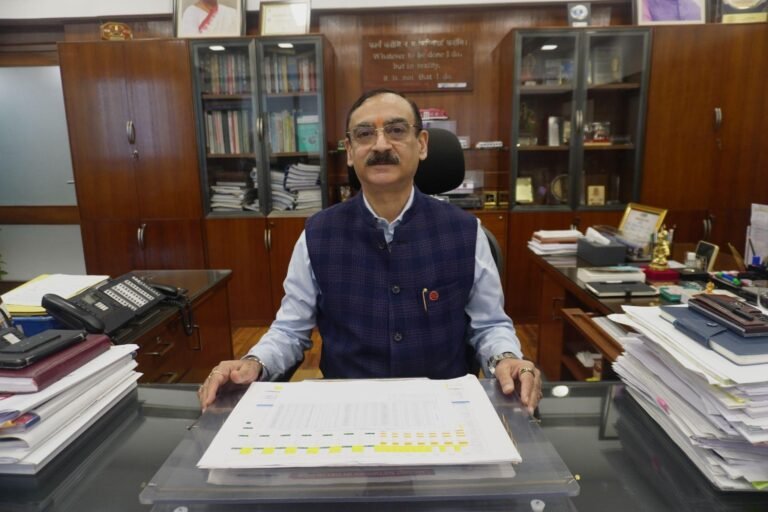
DELHI(Metro Rail News): Metro Rail News conducted an exclusive interview with Dr Vikas Kumar, Managing Director, Delhi Metro Rail Corporation (DMRC). The conversation touched upon crucial aspects including innovations, expansion and DMRC’s continuous focus on improving passenger convenience. During the conversation, Dr Kumar highlighted the measures being undertaken by DMRC to strengthen its financial sustainability. He also emphasised DMRC’s focus on Transit-Oriented Development (TOD) practices to generate sustainable revenue. In addition, Dr Kumar shed light on DMRC’s broader vision of extending its expertise in project execution, consultancy, DPR preparation, and operations and maintenance (O&M) to overseas markets through its international arm, Delhi Metro International Limited (DMIL). Here are the edited excepts:
1. Sir, you have been leading India’s largest metro system for the last 4 years. Could you please let us know the key milestones Delhi Metro Rail Corporation (DMRC) has achieved under your leadership and what are the challenges you have overcome during this span?
I assumed responsibility as Managing Director of DMRC at a time when COVID had just receded, and we were facing several challenges, particularly the sharp decline in ridership. A number of businesses, especially along the Airport Express corridor, had also moved away from us. So, the immediate challenge was to restore ridership and bring the system back to normal levels.
At DMRC, our vision has always been that the customer should come first, while safety, punctuality and reliability must remain paramount. There can be no compromise on these principles. Keeping these priorities at the centre, we decided to focus on delivering greater value to our customers through improved services and the adoption of technology.
The weekly brief metro & rail professionals read.
We launched the Sarthi app, which provides a wide range of information to passengers. We also introduced unmanned train operations and took several steps towards the indigenous development of technology. In 2023, we started work on the Indigenous Automatic Train Supervision system, or i-ATS, and we are also working on i-CBTC, an indigenous Communication-Based Train Control system. These initiatives are aimed at strengthening our technological capabilities and reducing dependence on imported systems.
Another important area of focus has been integrated ticketing. We have worked towards providing passengers with multiple modes and channels for ticketing, along with different payment options. The objective has been simple: passengers should have greater choice and convenience when using the Delhi Metro.
2. What’s the current status of Delhi Metro Phase 4 and Phase 5A? What are some of the milestones we can expect in the coming months?
In March, two major sections of the Delhi Metro Phase 4 expansion were officially inaugurated and commissioned: the Majlis Park to Maujpur-Babarpur corridor (Pink Line extension) and the Deepali Chowk to Majlis Park stretch (Magenta Line extension). The tunnelling work on Line 10 posed technical challenges, including the relocation of a sewer line and navigation through densely populated urban areas. However, we have overcome the challenges, and we are planning to commission the remaining portions of the priority corridors in phases in the months ahead.
As far as Phase 5A is concerned, we are working towards a strict deadline of completing the project by 2028. Against this backdrop, we are in discussions with the DDA on the land and planning-related aspects of the project so that the required clearances and coordination can be taken forward within the stipulated timeline.
3. The Golden Line is expected to play a crucial role in airport connectivity. What economic impact do you expect this corridor to have beyond passenger mobility?
The Golden Line (Line 10) will connect some very important areas of South Delhi with Aerocity and the airport. It will pass through areas such as Vasant Kunj, Kishangarh, Chhattarpur, IGNOU, Saket, and Sangam Vihar, and will connect these areas with Tughlakabad.
These are important residential, commercial and institutional areas, and better connectivity will improve their accessibility to the airport as well as other parts of Delhi. It will also provide better access to employment centres and commercial activity in these areas.
So, beyond passenger mobility, the corridor will support economic activity by improving connectivity to these important parts of South Delhi. It will also reduce dependence on road-based transport and make movement between residential areas, employment centres and the airport more convenient.
4. What measurable operational improvements has DMRC achieved since introducing unattended train operations? Are there plans to extend driverless train operation on other lines of the Delhi Metro?
Delhi Metro has established a high standard of operational efficiency, punctuality and reliability. In fact, in terms of punctuality and reliability, Delhi Metro has outpaced established metro systems such as Hong Kong MTR. At present, the overall punctuality of the Delhi Metro network stands at 99.95%, while the corridors under unattended train operations record an even higher punctuality level of 99.97%.
The introduction of unattended train operations has contributed to greater operational consistency and more precise management of train schedules. It has also enabled Delhi Metro to increase service frequency on key corridors. This has enabled higher passenger carrying capacity and more efficient utilisation of the existing infrastructure.
Going forward, unattended train operations are planned to be extended to the upcoming corridors under Phase IV. The existing corridors continue to operate efficiently under the present system and are well suited to their current operational requirements. At this stage, there is no operational requirement to convert the existing corridors to unattended train operations.
5. DMRC has repaid ₹9,948.09 crore of its JICA loan through operational revenues. What financial principles have enabled the organisation to maintain this repayment trajectory while continuing to invest in network expansion?
DMRC’s relationship with JICA has been very long. The repayment of the JICA loan has been possible because of a disciplined approach towards financial management and the consistent generation of revenue from operations and other activities. We have placed considerable emphasis on developing non-fare revenue sources. Transit-oriented development is one such area. We are working with land-owning agencies and other stakeholders to make better economic use of the land and assets available around the Metro network. The objective is not only to improve connectivity and urban development but also to create sustainable revenue streams for the organisation. Our approach is to ensure that the assets associated with the Metro system generate value without compromising the primary purpose of the network. ToD provides an opportunity to integrate transport infrastructure with commercial and other urban uses and, at the same time, strengthen the organisation’s revenue base. The repayment of ₹9,948.09 crore through operational revenues is not the result of a single measure. It reflects financial discipline, operational efficiency, and the development of multiple revenue streams.
6. Financial sustainability has been one of the most discussed topics lately. Could you shed some light on Delhi Metro’s financial performance, particularly its fare and non-fare revenue streams? What share of DMRC’s revenue would you ideally like non-fare income to contribute over the next decade?
Financial sustainability is an important consideration for any metro system, but our approach has always been to balance financial performance with passenger affordability. DMRC is making an operational profit, but we have also consciously capped fares within an affordable range so that the Metro remains accessible to a large section of the population. Fare revision cannot be viewed only from the perspective of revenue generation because affordability and wider public mobility are equally important considerations.
This makes the development of non-fare revenue streams particularly important for us. As I mentioned earlier, transit-oriented development is one of the key areas through which we are working to generate additional revenue. The land and assets associated with the metro network can create sustainable revenue streams without placing the entire financial burden on passengers.
At present, around 29% of DMRC’s revenue comes from non-fare sources. Our objective is to increase this contribution substantially over the coming years, with a target of taking the share to around 50%.
The larger objective is to create a more balanced revenue model in which fare revenue continues to support affordable public transport, while non-fare sources such as transit-oriented development, property development, advertising, and other commercial activities provide greater financial support to the organisation.
7. What measures is DMRC taking to promote greater public transport adoption and reduce dependence on private vehicles? What initiatives are being taken to promote last-mile connectivity?
We have taken a number of steps in this direction. If you see, regenerative braking is there, so whatever energy is generated during braking, that is utilised. Similarly, we are increasing the solar infrastructure at our stations, and we are also working on waste management.
The idea is that public transport should not only provide mobility, it should also be sustainable. And I think reducing our dependence on fossil fuels is also important, particularly given the kind of situation we are seeing in the Gulf and the uncertainty which is there. So, if more people use public transport, obviously, the dependence on private vehicles and fossil fuels will come down.
Another important area is Multi-Modal Integration. We are developing MMI at several stations, such as Sarai Kale Khan, so that different modes of public transport can be integrated with the Metro. This makes it easier for a passenger to shift from one mode to another and complete his journey.
We are also working on last-mile connectivity and have collaborated with service providers such as Rapido and Bharat Taxi. The idea is that the passenger should not only get a convenient Metro journey, but his complete journey should be convenient. If a person can easily reach the Metro station and can also get a convenient mode of transport after leaving the station, then obviously, it will encourage more people to use public transport instead of private vehicles.
8. Consultancy has become a crucial business vertical for DMRC. How do you see this business evolving over the next five years?
Well, consultancy has become an important business vertical for DMRC, and we are doing multiple types of work in this area. We are preparing DPRs, providing consultancy for Metro projects, assisting in project execution, and also providing Operation and Maintenance services.
In fact, we have also competed with established international players in this field. For Mumbai Metro Line 3, we outbid Keolis, and for Chennai Metro Phase II, we outbid Deutsche Bahn, and DMRC was successful in securing both the assignments. This shows that the experience and expertise that DMRC has developed over the years are also giving us the capability to compete with established international players.
9. Recent reports indicate that countries such as Israel, Egypt, and Kenya have shown interest in collaborating with DMRC. Which international markets do you consider the highest priority for DMIL, and what types of projects are you targeting?
DMIL has been established with the objective of taking the experience and expertise of DMRC to overseas markets. We are looking at different opportunities where our experience can be useful. Initially, we are targeting project execution, Operation and Maintenance, preparation of DPRs and other consultancy services.
If you see, many African countries are developing their MRTS infrastructure and we are well equipped to support them because we have the experience of planning, executing and operating a large Metro network. So, Africa is certainly an area where we see opportunities. Egypt is also developing High Speed Rail as well as MRTS infrastructure, so that is another opportunity for us. We are looking at how our experience can be utilised in such projects.
Similarly, there is a lot of reconstruction and infrastructure development that will be required in the Gulf countries because of the destruction caused by the ongoing wars. That can also create opportunities for organisations like DMRC, where our experience can be useful.
10. What are the key steps DMRC is taking to further improve the passenger experience?
We have taken several steps to improve the passenger experience, particularly through the use of digital technology. We have introduced multiple means of payment through various channels. A passenger can use QR ticketing, smart cards, NCMC cards, and can pay through UPI, net banking and other apps also.
We have, in fact, onboarded with ONDC also, so many merchants can come up and sell our tickets now. We have collaborated with NCRTC, Indian Railways and IRCTC in this endeavour. So, this is there as far as purchasing tickets is concerned.
The other aspect is providing information and guidance to passengers. For that, we have an AI chatbot also now. If you see, it is there, and it is helpful. It has all the information available for passengers and it talks as if a person is talking to you in your language. Currently, three languages are available in which it can converse.
If you see other facilities, we have planned lockers at stations. Then, station navigation through an app is also planned , so that if a person wants to go to maybe a toilet or find a place to eat, he would be guided by the map. Certain stations have now become so huge, and if a person is new, he would be guided by these.
So, these are the areas we are working on. There is always scope for improvement, and our team is working on these aspects to see how we can provide more value-added services to the passengers and further improve their experience.
11. What message would you like to convey to the stakeholders and the readers of Metro Rail News?
I would like to thank all the people who are working hard to make such a large organisation function. Running a Metro system of this scale requires the efforts of a large number of people, and I would like to appreciate all of them for their contribution.
I would also like to thank our passengers for their continued trust and support. At the same time, I would request passengers to cooperate with us and help us in keeping the Metro stations and premises clean. These are public spaces and maintaining cleanliness is a responsibility which requires the cooperation of everyone.
I would also like to thank all our stakeholders for their continued support and cooperation. The Metro system involves coordination with many organisations and stakeholders, and their support is important for us to continue providing reliable services, bringing innovation and take the system forward.
Also Read Our Exclusive Interview With Shri Manoj Kumar Dubey: Indian Railway Finance Corp. (IRFC) delivers highest-ever quarterly profit with zero NPA in FY27
Project Overview