Thane Metro Project: MMRCL invites bids for EHV Line Shifting & Diversion

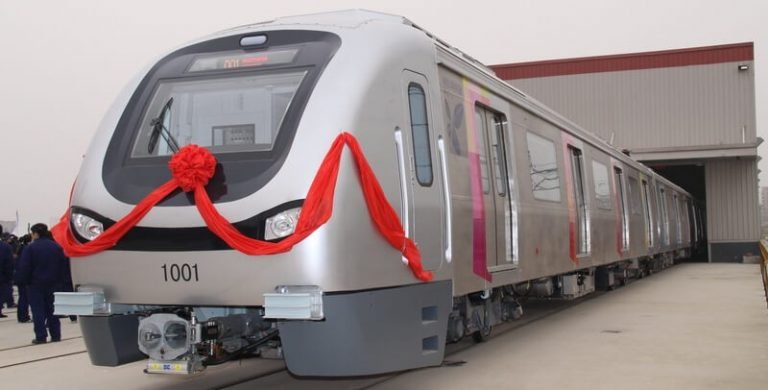
THANE (Metro Rail News): Maharashtra Metro Rail corporation limited (MMRCL) have invited tenders for shifting, diversion and height raising of existing EHV transmission line at various locations for Thane Integral Ring Metro Project.

Tender Details 

InformationDetails
Tender NoT1-035/Ele-03/2026
Bid security (EMD)Rs. 45,97,000/-
Approximate cost of workRs 91.94 Cr.
completion period18 months
pre-Bid meeting11 August, 2026 (12:00 hrs)
Bid submission opening20 August, 2026 (16:00 hrs)
Bid submission deadline27 August, 2026(16:00 hrs)

Scope of Work

The work includes shifting, diversion, and height raising of existing EHV transmission lines at various locations for the Thane Integral Ring Metro Project.

About Thane Ring Metro project

Thane Ring Metro project is a 29 km corridor that will run along the periphery of the west side of Thane city with 22 stations. The network also includes Ulhas river on one side and Sanjay Gandhi National park on other side.

The estimated cost of the total project is Rs 12,200.10 crore, with equal equity from Government of India and Government of Maharashtra as well as part-funding from bilateral agencies. Funds would also be raised through innovative financing methods such as by selling Station naming and access rights for corporate, monetization of assets, Value Capture Financing route. The corridor that connects major business hubs would provide an effective transport option for a large section of employees. The Project is likely to be completed by 2029. 

Also Read: Chennai Metro awards Rs 12.10 cr Civil Maintenance contract for High Court to Wimco Nagar section

Chennai Metro awards Rs 12.10 cr Civil Maintenance contract for High Court to Wimco Nagar section

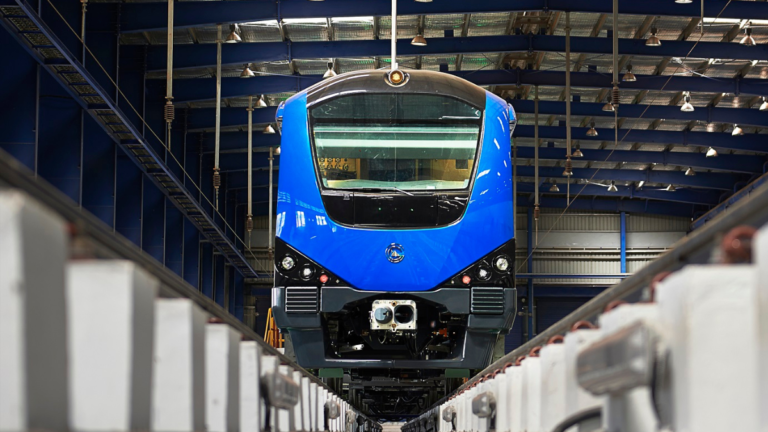
CHENNAI (Metro Rail News): Chennai Metro Rail Limited (CMRL) has awarded a Rs 12.10 crore contract for civil maintenance and related work on Section II of Corridor I. This section covers the stretch from High Court Metro Station to Wimco Nagar Depot Station. The contract was given to Adya Enterprises, which was the lowest bidder. 

Contract details

InformationDetails
Awarding Authority Chennai Metro Rail Limited (CMRL)
ProjectCivil Maintenance and Other Related Work in Section II of Corridor I 
Section High Court Metro Station to Wimco Nagar Depot Station
Awarded To Adya Enterprises (L1)
Contract ValueRs 12.10 crore
Contract Period1,095 days  

Bidder details

Bidder Bid ValueStatus
Adya EnterprisesRs 12.10 croreL1 (Potential Awardee) 
Sri Radha ConstructionsRs 14.40 croreL2 (Financially Qualified)  
Taurs EnterprisesRejected in Technical Evaluation  

Scope of work

The contract includes civil maintenance and other associated works in Section II (High Court Metro Station To Wimco Nagar Depot Station) of Corridor I of Phase I and Phase I Extension.

About the Project

Section II of Corridor I stretches from High Court Metro Station to Wimco Nagar Depot Station. It has 11 metro stations and includes both underground and elevated parts. The corridor connects infrastructure from Chennai Metro Phase I and the Phase I Extension between Washermenpet and Wimco Nagar. It is an important link between central and northern Chennai and plays a vital role in the city’s metro network.

Also Read: Kochi Water Metro Signs India’s First Carbon Credit Initiative with Kosher Climate

Kochi Water Metro Signs India’s First Carbon Credit Initiative with Kosher Climate

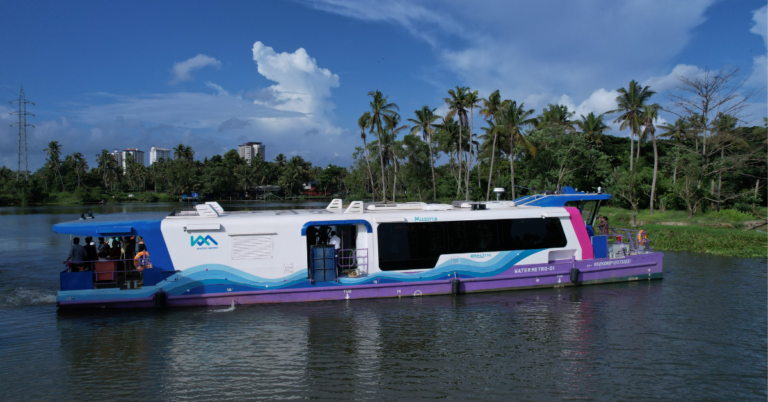
KOCHI (Metro Rail News): In a pioneering move, Kochi Water Metro signed an agreement with Kosher Climate to launch India’s first water metro carbon credit initiative. 

This landmark step makes Kochi the first water transit system in the country to generate non-fare green revenue by monetising the reduction in carbon emissions from its electric boat operations on international markets.

Zero-Cost Green Revenue

The project operates on a revenue-sharing model under which Kochi Water Metro Limited (KWML) incurs no financial liability.

“The project will be implemented under a revenue-sharing model, ensuring that Kochi Water Metro incurs no financial liability. All costs related to carbon credit certification, technical studies, documentation, and international approvals will be borne by the agency,” stated the Water Metro authority, according to the Indian Express report.

All costs related to carbon credit certification, technical studies, documentation, and international approvals will be fully borne by Kosher Climate.

Under the agreement, KWML will receive 71% of the revenue earned from trading these verified carbon credits in global markets, creating a new stream of non-fare green revenue.

Operational Scope & Implementation

The initiative will scientifically measure and verify the exact reduction in greenhouse gas emissions achieved through Water Metro.

Kosher Climate will assess the entire system to meet international carbon credit standards. Once certified, these carbon credits will be traded on global carbon markets.

This innovative non-fare revenue model will provide a sustainable financial cushion for future expansions. If successful, Kochi Water Metro is expected to become a national model for decarbonising ferry and inland water transport systems across India.

Also Read: Cabinet Approves ₹1,264 Crore Multi-Tracking Railway Project in Karnataka & Andhra Pradesh

Cabinet Approves ₹1,264 Crore Multi-Tracking Railway Project in Karnataka & Andhra Pradesh

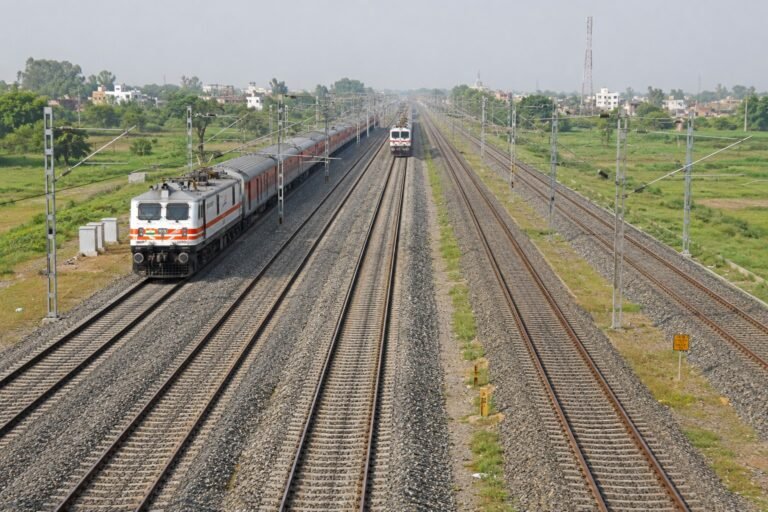
NEW DELHI (Metro Rail News): The Cabinet Committee on Economic Affairs, chaired by Prime Minister Shri Narendra Modi, has approved the construction of the 3rd and 4th lines on the Ballari-Guntakal section in Karnataka and Andhra Pradesh at a total cost of ₹1,264 crore.

Planned under the PM-Gati Shakti National Master Plan, the project aims to boost multi-modal connectivity and improve logistic efficiency across the region. The initiative will add approximately 46 km to the Indian Railways network, covering three districts in Karnataka and Andhra Pradesh.

This multi-tracking project will enhance connectivity to around 99 villages with a combined population of about seven lakh people.

Economic and Environmental Impact of the project

The new lines will serve as a vital route for transporting key commodities like iron ore, steel, coal, fertilizers, and food grains. Once completed, the project is expected to add 16.22 million tonnes of freight capacity per year.

By shifting more cargo from road to rail, it will significantly cut logistics costs while delivering major environmental benefits — saving 1.32 crore litres of oil and reducing 6.67 crore kg of CO₂ emissions ,equivalent to planting around 27 lakh trees.

The expansion will reduce delays, improve train reliability, create local jobs, and support overall regional development in both states. The project is targeted for completion by 2028-29.

Also Read: Indian Railways leads network electrification list ahead of China, Japan & UK 

Indian Railways leads network electrification list ahead of China, Japan & UK 

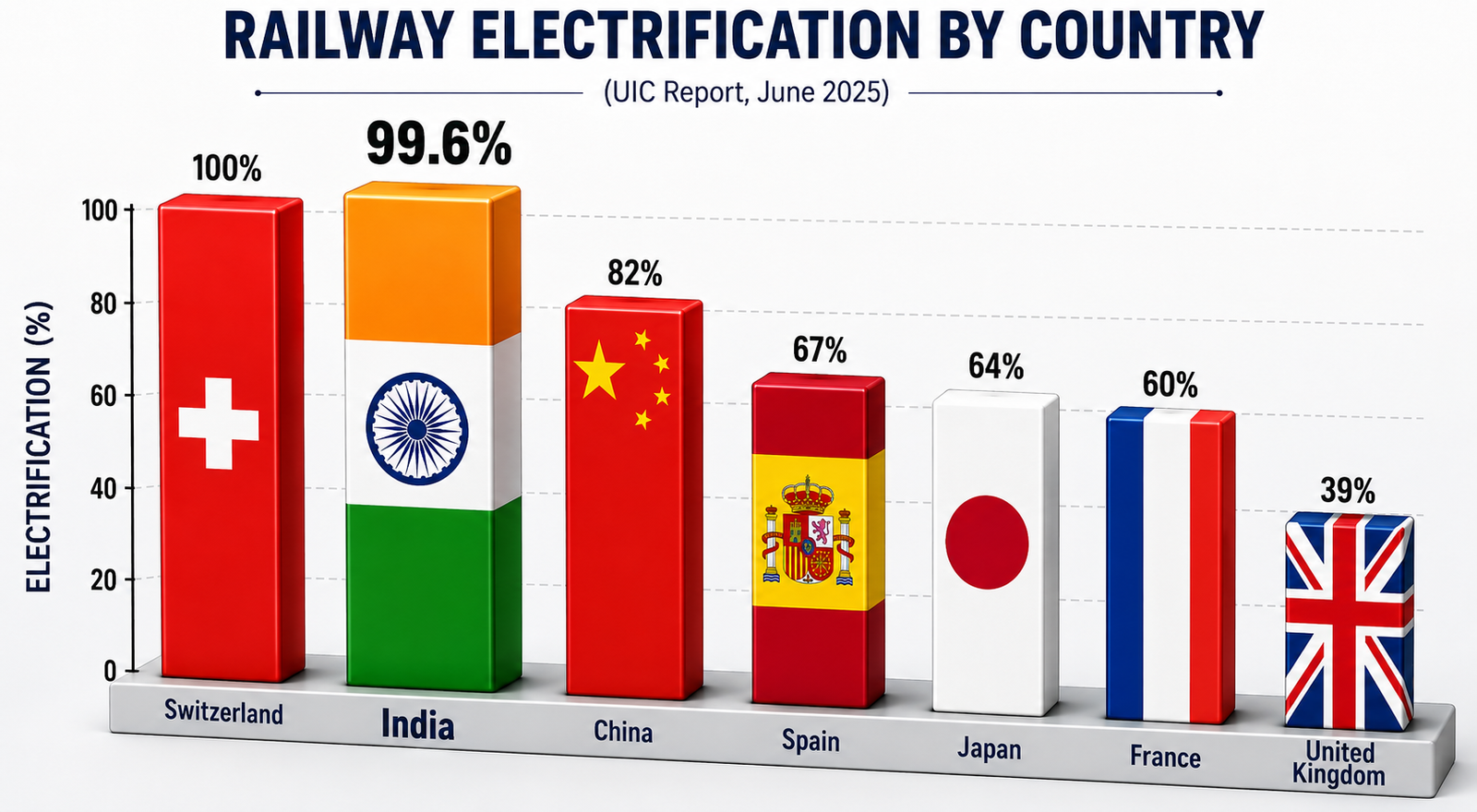
NEW DELHI (Metro Rail News): Indian Railways has radiated its network with a remarkable achievement setting a global example. The Indian Railways has successfully electrified 99.6% of its network. India now leads the global railway electrification charts ahead of China (82%), Japan (64%) and UK (39%).

In an answer to a question asked in the Monsoon Session (2026) of the Lok Sabha, Union Railways Minister Shri Ashwini Vaishnaw stated that 99.6% of the Broad Gauge (BG) network of the Indian Railways has been electrified. He further informed that the Indian Railways is saving 185 Crore litres of diesel because of the decrease in the dependence on fossil fuels.

Vaishnaw also stated that the electrification work on all new lines are being sanctioned and constructed with electrification. Moreover, the electrification on the remaining section has also been taken up. The target of achieving 100% electrification is going to be the next milestone for the Indian Railways. 

Global Comparision

According to International Union of Railways (UIR) report of June 2025, the electrification of railways system across the globally important system are as follows (see the graph)

image 18

Among the important railway networks across the world, Switzerland has achieved 100% electrification. India is amongst the top countries in the list with 99.6% network under electrification. The achievement is also notable as India has a large network of railways and the fact that most of this work was expedited while carrying a dense traffic in the operational lines. Another notable fact is that, India has surpassed several major countries by a big margin in the electrification of railway networks.

The Challenges of Mission 100% Electrification

The mission of attaining 100% electrification is a challenging task as it involves electrification of the operational networks and the work may encounter unforeseen obstacles. The Indian Railways took the following steps to expedite the electrification work:

  • Formation of Project Monitoring Group (PMG) portal to resolve the constraints being faced during the commissioning
  • Ensuring effective project monitoring mechanism 
  • Assured funding and enhanced financial powers to the field units

Environmental Impacts

A major impact of the electrification of the Railway network has been in the area of environmental sustainability. Electrification of the railway tracks reduce the dependence on fossil fuels and decrease diesel consumption translating into lower carbon emissions. A NITI Aayog data shows that the emission of CO2 for transporting 1 tonne for 1 km via railways is almost one-tenth of that of the roadways.

The Indian Railways consumed 108 crore litres of diesel in 2024-25 compared to 293 crore litres in 2015-16 saving a vital 185 crore litres of diesel. In addition to being environmentally friendly, this is also economically beneficial as it saves the precious foreign exchange stock of the Government used for the purchasing of fossil fuels.

The electrified networks are also more efficient in integrating renewable energy sources such as solar energy and wind energy for traction power systems resulting in better utilization of renewable electricity. The Indian Railways has commissioned 1164 Mega Watt (MW) of solar plants and around 103 MW of Wind power as of June, 2026. 

100% Electrification DOES NOT MEAN Net-Zero Carbon Footprints 

The 100% electrification of railways is not going to create an environmentally neutral impact. As many would think, by introducing 100% electrification, we are moving to a Net-Zero Carbon Emission. However, most of the electricity that we create is created through coal-based production resulting in the emission of carbon products elsewhere. In short, in the process of removing our Carbon footprints, we are creating newer prints through different avenues. 

Zone Wise Electrification

SNZONE% Electrified
1Central Railway100%
2East Coast Railway100%
3East Central Railway100%
4Eastern Railway100%
5Konkan Railway100%
6Kolkata Metro100%
7North Central Railway100%
8North Eastern Railway100%
9Northern Railway100%
10South Central Railway100%
11South Coast Railway100%
12South East Central Railway100%
13South Eastern Railway100%
14West Central Railway100%
15Western Railway100%
16North Western Railway99.8%
17Northeast Frontier Railway98.7%
18Southern Railway98.7%
19South Western Railway96.1%

State Wise Electrification

SNState% Electrified
1Andhra Pradesh100%
2Arunachal Pradesh100%
3Bihar100%
4Chandigarh100%
5Chhattisgarh100%
6Delhi100%
7Gujarat100%
8Haryana100%
9Himachal Pradesh100%
10Jammu & Kashmir100%
11Jharkhand100%
12Kerala100%
13Madhya Pradesh100%
14Maharashtra100%
15Meghalaya100%
16Mizoram100%
17Nagaland100%
18Odisha100%
19Puducherry100%
20Punjab100%
21Telangana100%
22Tripura100%
23Uttar Pradesh100%
24Uttarakhand100%
25West Bengal100%
26Rajasthan99.8%
27Tamil Nadu98.3%
28Assam97.9%
29Karnataka96.8%
30Goa91.4%

Conclusion

The Indian Railways has shown remarkable progress in recent years in advancing the Railways with modern upgrades. The milestone achievement of attaining 99.6% electrification shows a progress of not merely meeting the global standards but of becoming a global example. The upgrade has unlocked doors to several sustainable and energy efficient technologies but for a net-zero emission, the carbon emission involved in the primary process should also be addressed. The progress is notable, however, there is a long road to become a developed railway network.

Read this article to know more about Railway Electrification: Railway Electrification: A Path to Net Zero Carbon Emission by 2030

MoHUA’s Bifurcation: Will administrative reform improve urban governance or create coordination challenges?

NEW DELHI (Metro Rail News): The union government bifurcated the Ministry of Housing and Urban Affairs (MoHUA) into the Department of Capital Development and the Department of Urban Development, which is one of the most critical administrative changes in India’s urban governance framework in recent years. The reform has been materialised through an amendment to the Government of India (Allocation of Business) Rules, 1961. While the decision follows an intent to provide greater administrative focus, it also raises questions about institutional coordination, particularly in areas where urban planning, transport, and housing intersect.

Department of Capital Development

The newly created Department of Capital Development will oversee Delhi and the National Capital Region (NCR), including agencies such as the Delhi Development Authority (DDA), Delhi Metro Rail Corporation (DMRC), National Capital Region Transport Corporation (NCRTC), Central Public Works Department (CPWD), and the National Capital Region Planning Board. 

Department of Urban Development

In contrast, the Department of Urban Development will handle national urban policies, housing, water supply and sanitation, urban transport planning, climate adaptation, flagship missions such as AMRUT, Swachh Bharat Mission, and PM SVANidhi, and institutions including HUDCO and NIUA.

Top Bureaucratic Appointments Following the Bifurcation 

The restructuring is accompanied by a realignment of the ministry’s top administrative leadership. Katikithala Srinivas (IAS: Gujarat, 1989) has been moved from the Ministry of Housing and Urban Affairs to head the Ministry of Development of North Eastern Region. D. Thara (IAS: Gujarat, 1995) has been appointed Secretary, Department of Capital Development, while Satendra Singh (IAS: Jharkhand, 1995) has been appointed Secretary, Department of Urban Development. 

What the bifurcation could solve and where challenges may remain 

At first glance, the restructuring appears logical. Delhi and the NCR have unique governance requirements, multiple overlapping authorities, and large-scale infrastructure projects that often require close coordination with the central government. A dedicated department could potentially accelerate decision-making and improve accountability for projects within the national capital.

The restructuring, however, also introduces a new administrative interface between agencies responsible for implementing transport infrastructure and those responsible for broader urban policy. 

For example, DMRC and NCRTC now fall under the Department of Capital Development, while urban transport planning, housing policy, climate resilience, water supply, sanitation, and local governance remain with the Department of Urban Development. Modern urban planning increasingly relies on integrated decision-making, where transport infrastructure, land use, housing, and public services evolve together rather than independently.

The need for close coordination to deliver Transit-Oriented Development 

The issue becomes particularly relevant in the context of Transit-Oriented Development (TOD), where metro systems, land-use planning, housing policies, and local governments must function in close coordination. The separation of these functions will require strong interdepartmental mechanisms to ensure integrated planning and timely project execution.  

Another crucial aspect is the distinct treatment of Delhi and the NCR. By creating a department dedicated almost exclusively to the national capital and its surrounding region, the government has acknowledged the strategic importance and administrative complexity of managing India’s political and economic centre. It also reflects the growing scale and complexity of infrastructure development within the NCR, where multiple agencies operate under overlapping jurisdictions. Whether this model remains unique to the NCR or evolves into a broader institutional framework for metropolitan governance remains to be seen. 

The success of the reform can be measured not only by the creation of two departments but by tangible improvements in project delivery, policy coordination, and urban outcomes.

As India’s cities continue to expand and urban infrastructure grows more interconnected, the effectiveness of this institutional restructuring will become evident only through its implementation. The coming years will determine whether the bifurcation represents a meaningful governance reform or merely an administrative reorganisation.


South Central Railway completes 203 Km Kazipet-Balharshah Tripling & Electrification, costs 3000 crores

SECUNDERABAD (Metro Rail News): South Central Railway has achieved a significant milestone by successfully completing the entire tripling of tracks along with electrification between Kazipet (Telengana) and Balharshah (Maharashtra), covering a distance of 203 kilometres at a cost of around Rs 3,000 Crores.

The final stretch of tripling and electrification between Asifabad and Sirpur Kaghaznagar, spanning 11 kilometres, along with an important bridge across the Bibra River, was completed on 22nd July 2026. This marked the successful completion of the ambitious project.

The important railway line serves as a major gateway connecting across Telangana and Maharashtra. Earlier, the route faced heavy congestion due to passenger traffic and dense freight movement, particularly of coal and cement.

The tripling and electrification of the entire stretch has been completed and commissioned, except for a small portion near Balharshah station under Central Railway. Works for connecting the newly laid third line to the Balharshah Yard (Maharastra) are currently in progress.

The completion of this project gives a major boost to rail infrastructure in both Telangana and Maharashtra.

Game-changing benefits of SCR’s Tripling & Electrification Project

This project has greatly enhanced rail connectivity between Telangana and Maharashtra, creating smoother.

With the new third line and full electrification, train speeds have increased significantly, bottlenecks have been removed, and more trains can now run smoothly. Passenger and freight trains, especially those carrying coal, cement, and raw materials to power plants can now move much faster and more efficiently.

Full electrification not only boosts overall capacity and improves passenger travel but also saves energy, reduces fuel costs, and lowers carbon emissions for greener and cleaner rail operations.

Shri Sanjay Kumar Srivastava, General Manager, South Central Railway, stated that the completion of this important project will help meet the growing transportation needs of the region and marks a significant milestone in strengthening the rail network between the Northern and Southern parts of the country in the official press release of South Central Railway on 23 July 2026.

Also Read: East Central Railway awards Rs 358.97 cr doubling contract to RVNL for Sitamarhi-Raxaul Rail Section

Delhi Metro achieves engineering marvel: 58m steel span erected over NH-9 & Delhi-Meerut Expressway without stopping traffic

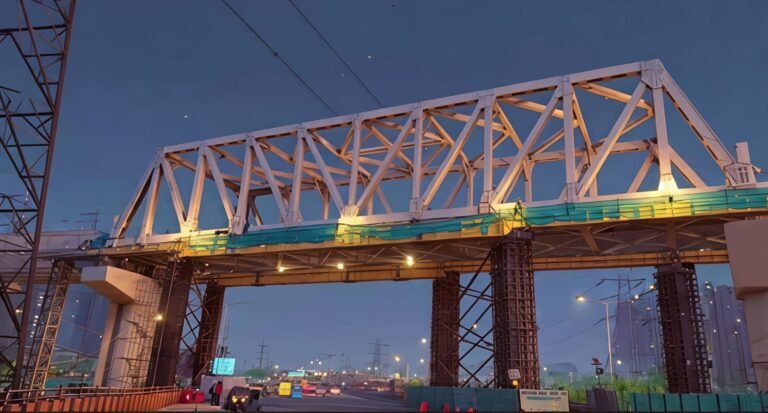
NEW DELHI (Metro Rail News): In a remarkable display of precision engineering, the Delhi Metro Rail Corporation (DMRC) has successfully erected a massive 58-metre steel span across National Highway-9 (NH-9) and the Delhi-Meerut Expressway near Noida Electronic City on the Blue Line.

This major milestone will enable safe and efficient reversal of trains, boosting operations on this vital corridor.

What makes this achievement truly stand out is that the entire operation was completed with zero disruption to the heavy traffic below. The corporation highlighted this in its official press release on July 22, 2026.

DMRC is now preparing to install a second steel span, measuring 73 metres, in the coming months. Together, these two special spans will help extend and strengthen the Blue Line infrastructure in this fast-growing area.

The special pre-fabricated 58-metre steel span was positioned on these beams from the Indirapuram side. Using powerful machinery called winches, the team slowly and safely pulled the massive structure across, allowing it to glide 14 metres above the busy NH-9 and Delhi-Meerut Expressway below, before reaching the Noida side. The entire pulling operation was carried out continuously and carefully over 48 hours.

Traffic continued to move normally throughout, with no road closures or delays.

This successful launch not only showcases DMRC’s technical excellence but also promises smoother and more reliable metro services for thousands of daily commuters in Noida and beyond.

Also Read: East Central Railway awards Rs 358.97 cr doubling contract to RVNL for Sitamarhi-Raxaul Rail Section

East Central Railway awards Rs 358.97 cr doubling contract to RVNL for Sitamarhi-Raxaul Rail Section

BIHAR (Metro Rail News): East Central Railway has awarded a Rs 358.97 crore contract to Rail Vikas Nigam Limited (RVNL) to double a 41.04 km railway section between Kundawa Chainpur and Raxaul in Bihar. This project will strengthen rail infrastructure in the Samastipur Division and improve connectivity on the busy Sitamarhi-Raxaul route. The contract involves building a second railway line from Chainage 145.500 km to 186.540 km.

Contract details 

InformationDetails
Contractor Rail Vikas Nigam Limited (RVNL)  
Contract Value Rs 358.97 crore (including 18% GST) 
Project  Doubling of Kundawa Chainpur-Raxaul rail section
Length 41.04 km 
Completion Period  1,095 days 

Scope of work

Under the contract, RVNL will handle earthwork, blanketing, and the construction of major and minor bridges. The company will also construct station buildings, platforms, level crossing (LC) works, and other related civil infrastructure. The entire project will meet the 25-tonne Indian Railway Standard Loading specifications.  

About the project

The Sitamarhi-Raxaul rail section is a significant railway section in Bihar. The doubling project will increase line capacity and allow for more trains to run on the route. It will also reduce congestion, improve punctuality and allow for smoother movement of passenger and goods trains. New bridges, station facilities and other civil infrastructure will improve the overall efficiency and reliability of the corridor.

Also Read: CM Rekha Gupta sets December 2026 target for Delhi’s first Double-Decker Flyover with Metro Corridor 

CM Rekha Gupta sets December 2026 target for Delhi’s first Double-Decker Flyover with Metro Corridor 

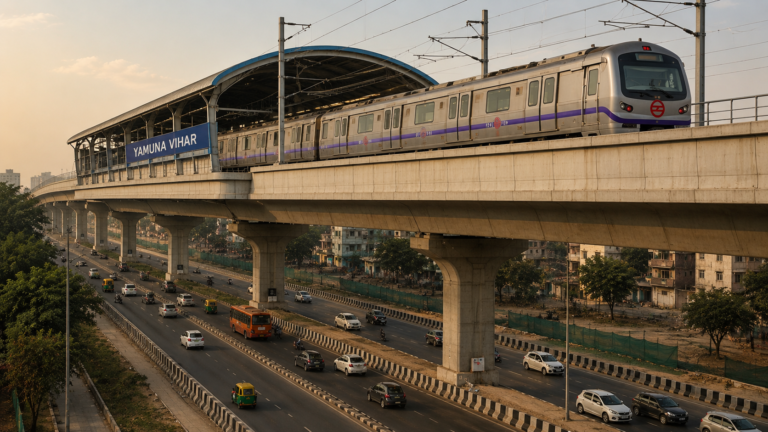
DELHI (Metro Rail News): Delhi’s first double-decker flyover, which will carry both road traffic and Metro services on the same structure, is expected to open by December 2026. Chief Minister Rekha Gupta announced this timeline after approving a revised project cost of Rs 291 crore.

The integrated project is under construction between Yamuna Vihar and Bhajanpura Metro stations in northeast Delhi. The Delhi Metro Rail Corporation (DMRC) is building it under an agreement signed with the Public Works Department (PWD) in February 2021. This flyover is going to improve traffic flow and support the Metro corridor on the same structure after getting completed.

Revised cost and construction progress

The Chief Minister approved the revised project estimate during the fifth Expenditure Finance Committee (EFC) meeting. Key project details include:

  • Original project cost: Rs 220.10 crore
  • Revised project cost: Rs 291 crore
  • Target completion: December 2026
  • Work completed so far: About 88%

CM Rekha Gupta also mentioned that construction slowed in 2023 because of delays in some required approvals. The project has now entered its final stage. The project will include much more than just the flyover. It features:

  • A 1.40-km double-decker structure
  • A six-lane elevated flyover
  • A Metro viaduct on the same structure
  • 140-metre ramps on both sides
  • New roads and footpaths
  • A drainage system
  • Rainwater harvesting facilities
  • Electrical work and road signage
  • Other supporting infrastructure

Better traffic flow 

Chief Minister Rekha Gupta said that around 65-70% of vehicles are expected to use the new elevated flyover after it opens. This will reduce traffic on the existing road, which will mainly be used by local vehicles. The flyover will also provide a signal-free route from Gokulpuri to Signature Bridge via Khajuri Khas, making travel faster and reducing congestion in northeast Delhi.

Also Read: DB E&C and SYSTRA India JV awarded General Consultancy Contract for Pune Metro Phase-1 Extension and Phase-2 

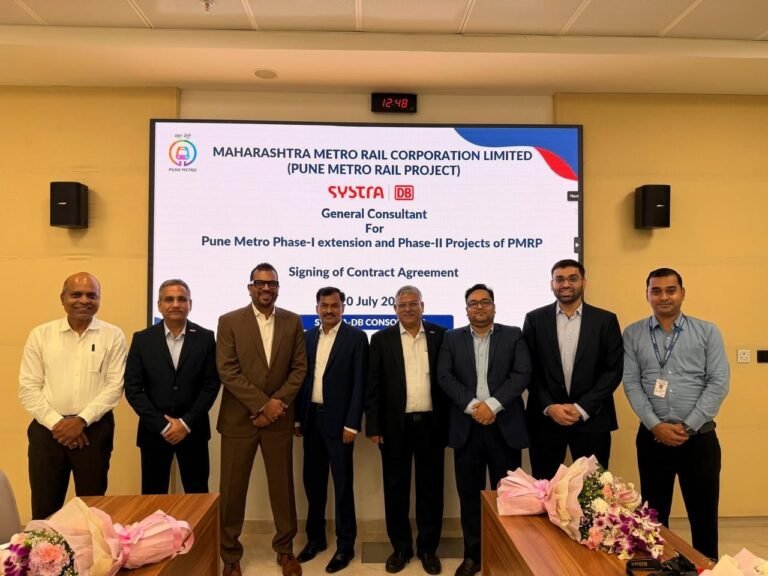
DB E&C and SYSTRA India JV awarded General Consultancy Contract for Pune Metro Phase-1 Extension and Phase-2 

PUNE (Metro Rail News): Maharashtra Metro Rail Corporation Limited has awarded the general consultancy contract for Pune Metro Phase-1 extension and Phase-2 to DB E&C in consortium with SYSTRA India. The company will provide planning, design, systems integration, project management, and construction supervision for the Pune Metro Rail Project. 

Pune Metro Phase-1 Extension Project:

The Phase 1 extension will add 23.06 km of new metro corridors to the existing metro lines and will include 21 stations across 4 stretches i.e 

  • PCMC-Nigdi
  • Swargate-Katraj
  • Vanz-Chandni Chowk
  • Ramwadi-Wagholi

Pune Metro Phase-2 Project: 

DB E&C and SYSTRA India JV will carry out General Consultancy services for two elevated corridors for the Pune Metro Phase-2 Project.The two corridors will span 31.64 km and include the development of 28 stations.

  • Khadakwasla-Swargate-Hadapsar-Kharadi
  • Nal Stop-Warje-Manik Baug

Once operational these corridors will provide commuters with enhanced connectivity to the North-South and East-West region of the Pune city. The executive director of DB Engineering and Consulting India Mr. Nataraj K M signed the contract with MahaMetro. DB Engineering and Consulting said that they are excited to implement the project and deliver a safe, reliable, and future ready network for Pune’s growing population.

Also Read: Electrical work consultancy tender floated for Delhi Metro & Jaipur Metro

Big boost for West Bengal: ₹440 Crore 3rd railway line project approved between Nimpura and Midnapur

WEST BENGAL (Metro Rail News): The Ministry of Railways has approved a ₹440 crore project to construct a 14.52-kilometer third railway line between Nimpura West Outer Cabin and Midnapur in West Bengal. 

This step aims to decongest a heavily overburdened corridor currently operating at over 115% capacity. By adding this critical extra track, Indian Railways will eliminate train movement bottlenecks, improve daily passenger train punctuality, and boost regional freight transport capacity by an additional 3.52 million tonnes annually for essential commodities like coal, steel, and cement. 

Significance of the new Railway line

Boost to Freight and Passenger Traffic-

This busy route handles huge amounts of both passenger and freight traffic. It transports important goods like iron ore, coal, cement, fertilizers, containers, and many other commodities  carrying nearly 23.8 million tonnes every year.

Currently, the section is overloaded at 115.71% capacity, causing heavy congestion. The new third line will ease this pressure, create extra capacity, and allow smoother movement for both passenger and freight trains.

Supporting Economic Growth-

Once completed, the new third line is expected to handle an extra 3.52 million tonnes of freight every year. 

This upgrade will make it easier and faster to transport essential goods, reduce congestion, and improve reliability on this busy corridor. It will greatly benefit industries and businesses while supporting overall economic growth through a stronger and more efficient railway network.

Also Read: Railway Minister announces completion of 261 stations under Amrit Bharat Station Scheme

Railway Minister announces completion of 261 stations under Amrit Bharat Station Scheme

NEW DELHI (Metro Rail News): Addressing Parliament during the ongoing Monsoon Session, Union Railway Minister Shri Ashwini Vaishnaw described the Amrit Bharat Station Scheme as a major shift in Indian Railways’ approach to station redevelopment. The scheme focuses on long-term, phased master plans to modernize stations across the country.

So far, 1,340 stations have been identified for redevelopment under the Amrit Bharat Station Scheme. Out of these, 261 stations have been completed.

The scheme is funded under Plan Head-53: Customer Amenities. Budgets are managed by railway zones. For the financial year 2026–27, the government has allocated ₹11,972 crore, of which ₹4,633 crore has already been utilized till June 2026.

What the Master Plan Covers ?

Each station gets a custom master plan designed to transform it into a modern urban hub. The focus is on better accessibility, passenger comfort, and seamless integration with the city.

Major Upgrades Include:

  • Seamless road connectivity on both sides of the station
  • Expanded parking facilities
  • Upgraded waiting halls and clean, modern toilets
  • Wider Foot Over Bridges (FOBs)
  • Premium facilities like air-conditioned concourses and executive lounges

The plans give special attention to Divyangjans (persons with disabilities) with lifts, ramps, and escalators. Stations will also promote local culture through ‘One Station One Product’ kiosks, use eco-friendly systems, and provide real-time passenger information. The goal is to turn railway stations into vibrant city centers.

The Minister also shared updates on the redevelopment of several important stations, including Bhubaneswar, Chhatrapati Sambhajinagar, Gaya, Nagpur Junction, Rameswaram, and Tirupati.

This ambitious scheme aims to give millions of passengers a world-class experience every time they travel by train.

Also Read: Bullet Train Project: Electrification work gains momentum on Mumbai-Ahmedabad High-Speed Rail Corridor

Bullet Train Project: Electrification work gains momentum on Mumbai-Ahmedabad High-Speed Rail Corridor

DELHI (Metro Rail News): Electrification work has gained traction on the Mumbai-Ahmedabad Bullet Train Project. This progress represents another important milestone in getting India’s first bullet train line ready for operations.

The Mumbai-Ahmedabad High-Speed Rail corridor will be India’s first railway line to use a 2×25 kV Overhead Traction System, a modern electrification technology found in high-speed rail networks around the globe. This system will ensure a steady and continuous power supply for trains traveling at speeds of up to 320 km/h.

Electrification System for High-Speed Rail

The corridor will receive electricity from the National Power Grid through specialized Grid Substations. Power will then travel to 14 Traction Substations located along the route. The traction substations include:

  • Maharashtra: Mumbai, Thane, Virar, Boisar and Thane Depot
  • Gujarat: Vapi, Bilimora, Surat, Bharuch, Vadodara, Anand, Mahemdabad, Ahmedabad and Sabarmati Depot

These substations will provide a smooth power transition as trains move from one section of the corridor to another without disrupting operations. The project will also have 31 Switching Posts to maintain an uninterrupted power supply and quickly isolate faults when needed. In addition to powering trains, 16 Distribution Substations will supply electricity to stations, signaling systems, maintenance depots and other operational facilities.

Overhead equipment installation underway

The electrification network will consist of nearly:

  • 22,000 steel masts
  • 25,700 cantilever assemblies
  • 1,125 track kilometers, including depot tracks

The steel masts, which stand between 10.5 and 14.5 meters high, will support a new compound catenary system, another technology being introduced in India for the first time. Engineers will install the overhead wires under controlled mechanical tension to ensure the train’s pantograph receives a smooth and steady power supply at speeds of up to 320 km/h.

Focus on Make in India 

The project has also advanced in local manufacturing. Several key parts of the electrification system are now being made in India. These include major transformers, cross arms for overhead equipment masts, ground wires, protection wires, and feeder wires. Manufacturers in India are also producing various traction power supply components, distribution power system equipment, and electro-mechanical systems. This localization effort is helping to build domestic expertise in high-speed rail technology, creating skilled jobs and reducing reliance on imported equipment.

The safety system includes earthquake detection

Safety is a major focus of the project. Each of the 14 Traction Substations will have Early Earthquake Detection Seismometers that can sense seismic activity and trigger protective measures within seconds. A total of 28 seismometers will be installed:

  • 22 along the bullet train corridor at traction substations and switching posts.
  • 6 additional inland seismometers in earthquake-prone areas of Maharashtra and Gujarat.

Of these, 12 will be placed in Maharashtra and 16 in Gujarat to enhance earthquake monitoring throughout the corridor.

Smart monitoring for reliable operations

A centralized control center will oversee the entire electrical network in real time. Automated protection systems will identify faults in fractions of a second and support the safe operation of the high-speed railway.

Also Read: Mumbai-Ahmedabad Bullet Train: Second TBM begins work on India’s first Undersea Rail Tunnel beneath Thane Creek