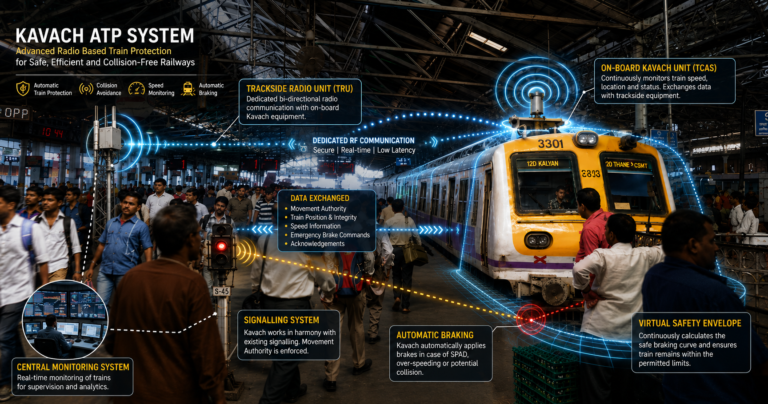
Mumbai Suburban to have more frequent trains with upcoming KAVACH 5.0

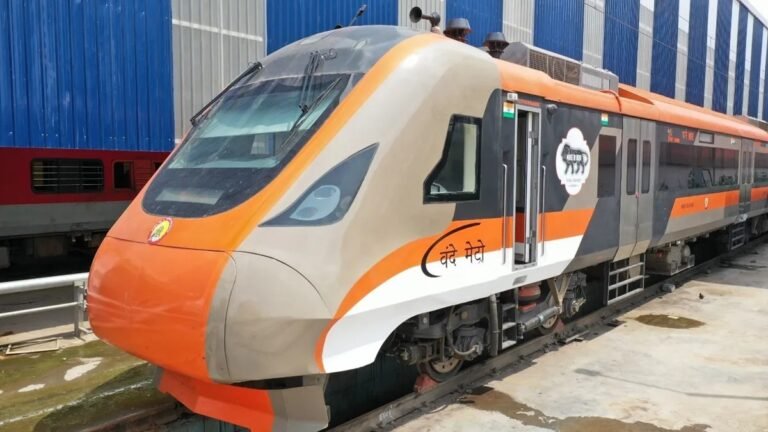
MUMBAI (Metro Rail News): Indian Railways is working on the Kavach 5.0 version, which will be implemented on Mumbai’s Suburban Network (or the Mumbai Locals) with enhanced safety features and to allow more frequent train services. Kavach 5.0 will be an advanced system with improved safety standards and upgrades following the feedback of the previous versions. The system is also envisioned for India’s premium train, Vande Bharat 4.0.

The Kavach 5.0 version was announced in April, 2025. It will be an advanced signalling and safety system designed for the suburban regions. It will reduce the inter-train headway distance with its fast signalling system leading to an increase in the frequency of trains. Upon implementation, this will provide relief to the daily commuters of the Mumbai Locals.

Kavach is India’s indigenously developed Automatic Train Protection (ATP) system. It is an initiative to foster “Made in India” railway technology and reduce dependence on foreign imports. Further, it is made specially keeping in mind the challenges of the Indian terrain and environmental conditions.

Working Mechanism of Kavach 
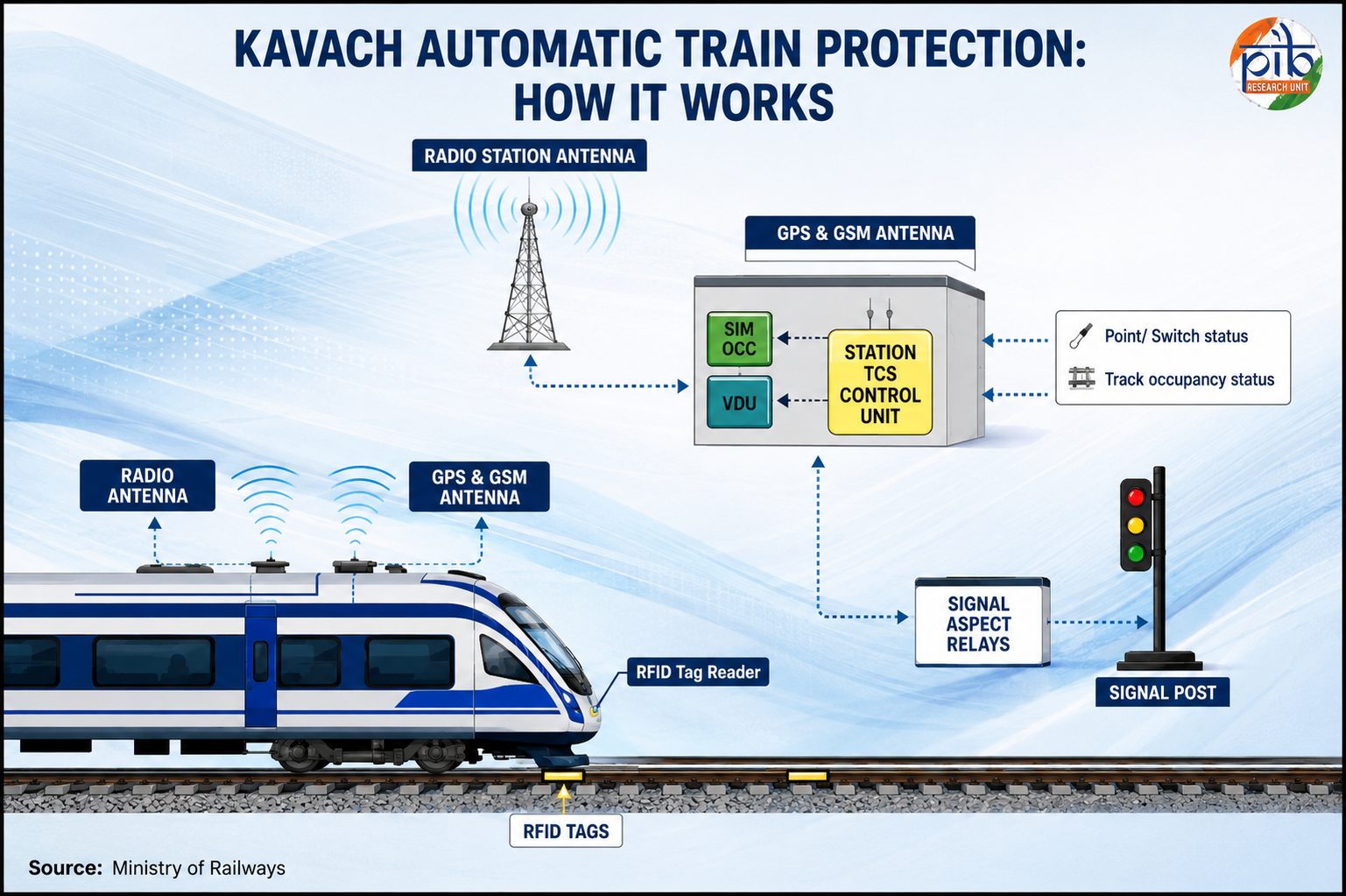
image 22

Kavach has two components, trackside and on-board. These components operate through continuous real time communication using Ultra High Frequency (UHF) radio antenna and Radio Frequency Identification tags mounted on the tracks. The trackside ATP system contains the information regarding the permitted speed in a particular track and the gradients. The on board ATP system monitors the train speed and provides critical information to the loco pilot. 

The main objective of the Kavach system is to assess the signals and launch automatic brakes in any of the cases such as if the train passes a Signal Passed At Danger (SPAD), if the loco pilot collapses, and if the train passes the permitted speed limit. Thus, the system prevents any potential collisions and accidents ensuring safe operations.

Evolution of Kavach 

Initially, India was dependent on foreign imports for train protection technology. To reduce this dependence and have Indian condition-friendly options, the development of Kavach was initiated. The first field trials of the system began in 2016. In 2018-19, the Kavach 3.2 version was approved and the latest version, Kavach 4.0, was approved in July 2024. The upcoming version 5.0 is currently under development.

Also Read: Maha Metro floats Rs 3.54 cr tender for Navi Mumbai Metro Line 1 maintenance
South Central Railway invites bids for construction & operation of Gati Shakti Multi-Modal Cargo Terminal at Nacharam

SECUNDERABAD  (Metro Rail News): South Central Railway has floated a tender for construction and operation of Gati Shakti Multi-Modal Cargo Terminal in Railway land at Nacharam in Manoharabad-Kothapalli section under Hyderabad division. 

Tender Details

DetailsInformation
Tender NumberY/C.140/GCT/EOI/NCRM/MOB-KPHI/2026 
Tender submission starting date27 July, 2026  from 10.00
Tender submission end date10 August, 2026  up to 17.00
Location Secunderabad
DivisionHyderabad

Scope of Work

The scope of work includes construction and operation of Gati Shakti Multi-Modal Cargo Terminal in Railway land at Nacharam in Manoharabad-Kothapalli section. 

About Gati Shakti Multi-Modal Cargo Terminals

Gati Shakti Multi-Modal Cargo Terminals (GCTs) are modern cargo facilities being developed under the Gati Shakti Cargo Terminal (GCT) Policy 2021 of the Ministry of Railways. These terminals seamlessly integrate rail with road, sea, and air transport to create efficient multi-modal logistics hubs. The Gati Shakti Cargo Terminals (GCTs) are essential to this vision, advancing modern logistics that will bolster India’s status as a global trade hub.Cargo Terminals are the strategic hubs to strengthen India’s logistics ecosystem.

Also Read: Maha Metro floats Rs 3.54 cr tender for Navi Mumbai Metro Line 1 maintenance
Maha Metro floats Rs 3.54 cr tender for Navi Mumbai Metro Line 1 maintenance
MUMBAI (Metro Rail News): Maharashtra Metro Rail Corporation Limited (Maha Metro) has invited e-tenders for the Annual Maintenance Contract (AMC) of the Signalling, Telecom and Automatic Fare Collection (AFC) systems for the Navi Mumbai Metro Line 1 (NMML1). The contract has an estimated value of Rs 3.54 crore (excluding GST) and will run for three years.

Tender details 

InformationDetails
Tender NumberNM1-S&T-02/2026
Estimated CostRs 3.54 crore (excluding GST)
Contract Period3 years (from 17 November 2026)
Bid Security (EMD)Rs 1.77 lakh
Pre-bid Meeting5 August 2026 at 11:00 AM
Tender Submission Deadline20 August 2026 (11:00 AM) to 27 August 2026 (4:00 PM)

Scope of work

The scope of work includes an Annual Maintenance Contract (AMC) for the Signalling, Telecom, and AFC (Automatic Fare Collection) System at NMML1. The contract duration is for three years, commencing from 17.11.2026. The project is located at Nagpur, Maharashtra, India. The successful bidder will be responsible for the maintenance of these critical systems.

About the project

Navi Mumbai Metro Line 1 is the first metro corridor in Navi Mumbai. It is developed by CIDCO. The metro connects the cities of CBD Belapur and Pendhar, addressing the need for better public transport in the growing satellite city. It enhances connectivity to residential, commercial, and transport nodes and promotes sustainable development in the Mumbai Metropolitan Region. 

Also Read: Chennai Metro Phase 1 & 2 Expansion: Bids Invited for DPRs’ Preparation 

Chennai Metro Phase 1 & 2 Expansion: Bids Invited for DPRs’ Preparation 

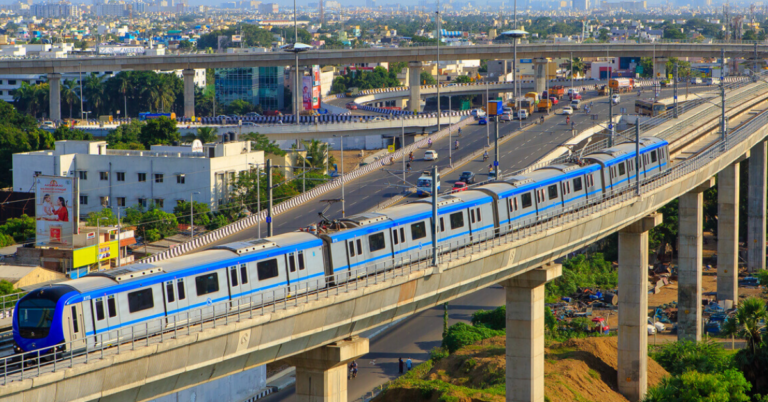
CHENNAI (Metro Rail News): The Chennai Metro Rail Limited is planning to expand the metro network across Phase 1 & Phase 2. In this direction CMRL has invited tenders to prepare a Detailed Project Report (DPR) for extending the metro line from the upcoming Kilambakkam station to Chengalpattu, as part of Corridor-1 (Phase-I) and Assisi Nagar to Wimco Nagar as part of the Corridor-5 (Phase-II) .

Tender Details for Kilambakkam–Chengalpattu Metro Extension Corridor-1(Phase-I)

Information Details
Tender No CMRL/CP/TDR-74-CS-DPR/2026 
Bid security (EMD)Rs.2,54,000/- 
Duration of Contract 120 days
Pre-bid meeting 13 August 2026 ( 11:00 Hrs. )
Bid submission deadline07 September 2026 ( 15:00 Hrs.) 

Scope of Work for Corridor-1 (Phase-I)

CMRL invites tenders to prepare Detailed Project Report (DPR) for the extension of Metro Rail from the proposed Kilambakkam Metro to Chengalpattu as part of the Corridor-1 (Phase-I).

Tender Details for Assisi Nagar-Wimco Nagar Metro Extension Corridor-5(Phase-II)

InformationDetails
Tender No CMRL/CP/TDR-73-CS-DPR/2026 
Bid security(EMD)Rs.1,03,000/- 
Duration of Contract 120 days
Pre-bid meeting 13 August 2026 (11:00 Hrs. )
Bid submission deadline07 September 2026 ( 15:00 Hrs. )

Scope of Work for Corridor-5(Phase-II)

CMRL invites tenders to prepare Detailed Project Report (DPR) for the extension of Metro Rail from Assisi Nagar to Wimco Nagar as part of the Corridor-5 (Phase-II) of CMRL. 

About Kilambakkam–Chengalpattu Metro Extension (Corridor-1)(Phase-I)

The Kilambakkam to Chengalpattu metro extension is a further extension of the Chennai Airport–Kilambakkam Metro project or Corridor-1 of Chennai Metro, for which CMRL submitted the Detailed Project Report (DPR) to the state government in February 2025, the Businessline reported. Corridor-1 of Chennai Metro is also known as Blue line.Corridor-1 runs from Wimco Nagar in the north to Chennai International Airport in the south, covering 32.6km.

The proposed metro extension is expected to reduce traffic congestion on the busy Grand Southern Trunk (GST) Road and the parallel suburban railway lines.

About Assisi Nagar-Wimco Nagar Metro Extension (Corridor-5)(Phase-II)

The Assisi Nagar-Wimco Nagar Metro extension is the Phase-II expansion of Corridor-5, a 47km running route from Madhavaram Milk Colony to Sholinganallur with 45 stations of Chennai Metro, which is under construction. Corridor 5 is also known as the Red line.

This extension will provide the first direct northern interchange connecting Corridor-5 (Red Line) into Corridor-1 (Blue Line). This extension will be a direct link between northern part of the city to exisiting Wimco Nagar Metro station, as per the source.

Also Read: Hyderabad Metro: HMRL to upgrade 10 high-traffic stations to improve passenger experience

Hyderabad Metro: HMRL to upgrade 10 high-traffic stations to improve passenger experience

HYDERABAD (Metro Rail News): Hyderabad Metro Rail Limited (HMRL) will upgrade 10 of its busiest Metro stations to enhance passenger movement, parking facilities, and overall convenience. This initiative will start as a pilot project before expanding throughout the network.

This decision follows a thorough inspection of Metro stations and their surroundings by HMRL Additional Managing Director B Ajith Reddy. During his visit, he checked station maintenance, passenger amenities, and infrastructure at street level to identify areas needing immediate attention.

Inspection highlights focus on commuter convenience

Ajith Reddy took the Metro from Begumpet Metro Station to Raidurg Metro Station to evaluate passenger services and station operations. During the inspection, he reviewed:

  • Platform maintenance and cleanliness
  • Concourse facilities and passenger movement
  • Ground-level infrastructure around stations
  • Parking arrangements
  • Retail spaces beneath Metro stations

He instructed officials to improve station management and ensure passengers have a better travel experience.

Cleanliness and maintenance under focus

The HMRL official pointed out the poor maintenance of the central medians between Metro pillars. He urged the agencies responsible for sanitation to take immediate corrective action. He also told officials not to compromise on quality and to keep the station surroundings cleaner.

HMRL will also enhance traffic and pedestrian movement around major stations, especially those serving Hyderabad’s IT corridor. Officials have been asked to reorganize transit facilities at:

  • Raidurg Skywalk
  • Mindspace Junction

The goal is to reduce congestion during peak office hours and make it easier for commuters to enter and exit.

Parking and station facilities to be upgraded

Ajith Reddy also directed officials to redesign parking areas at some of the busiest stations, including Begumpet, Ameerpet and Raidurg. The plan aims to use available space more efficiently and make parking simpler for Metro users. He also asked officials to review commercial spaces beneath Metro stations to ensure safety standards and avoid hindering passenger movement.

HMRL stated that upgrading these 10 stations will serve as a pilot project. Based on its performance, similar improvements will be implemented across other Metro stations in Hyderabad. The organization also mentioned that regular inspections will continue over the coming weeks to monitor progress and ensure officials carry out the planned improvements.

Also Read: Namo Bharat RRTS Expansion: NCRTC submitted DPRs of 4 corridors 

Namo Bharat RRTS Expansion: NCRTC submitted DPRs of 4 corridors 

NEW DELHI (Metro Rail News): In response to the question asked by Shri Raghav Chada, member of Rajya Sabha, Ministry of Housing and Urban Affairs (MoHUA) stated that National Capital Region Transport Corporation (NCRTC) has submitted the Detailed Project Reports (DPRs) of four routes of the proposed Namo Bharat Regional Rapid Transit System (RRTS) from Delhi to Karnal, Delhi to Bawal, Bawal to Behror and Ghaziabad to Noida Airport. The proposed routes are expected to improve the connectivity in the National Capital Region (NCR) and its neighbouring cities. Here are the details of each of these corridors:

Delhi to Karnal

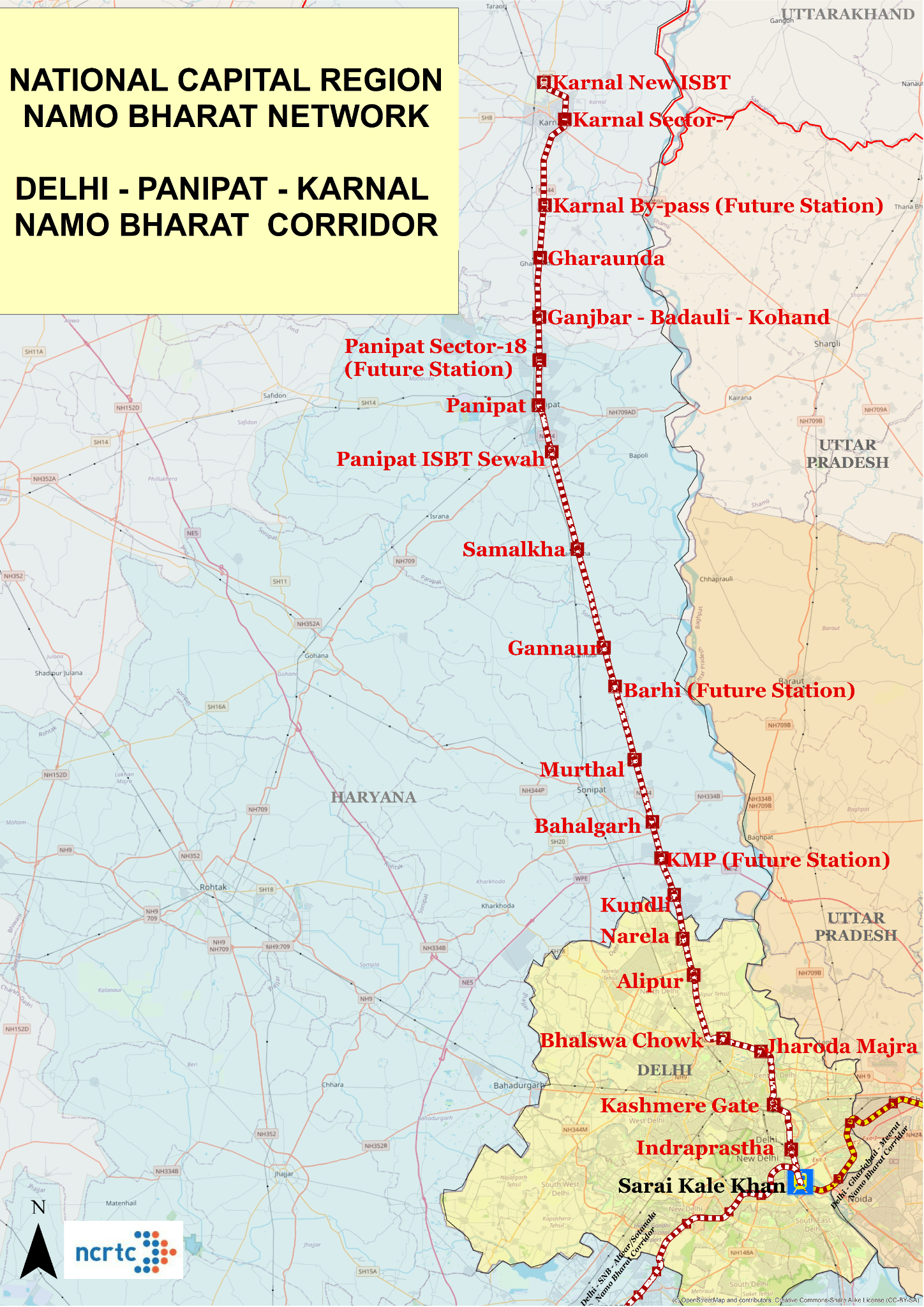
Delhi to Karnal Namo Bharat RRTS corridor is the extension of the proposed Delhi to Panipat corridor. It will provide improved connectivity between Delhi and Haryana. The corridor will connect Sarai Kale Khan in Delhi with Karnal ISBT in Haryana via Kashmere Gate, Murthal and Panipat. 

image 21

Delhi to Bawal & Bawal to Behror 

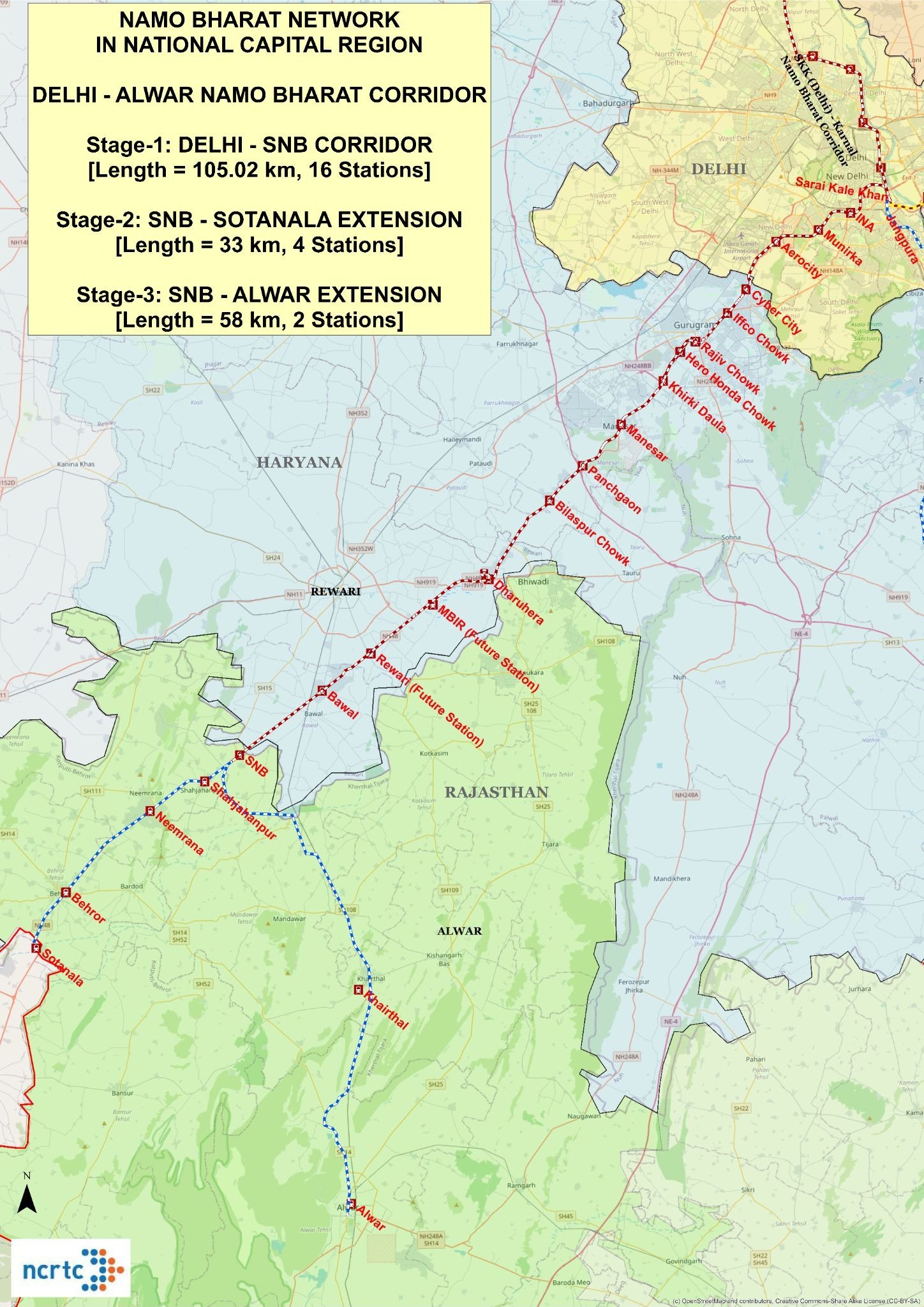
Delhi to Bawal Namo Bharat RRTS corridor is a part of the Delhi-Alwar RRTS corridor and Bawal to Behror extension is a branch line of the same route. The overall corridor is projected to be 196 km long connecting Sarai Kale Khan station in Delhi with Alwar in Rajasthan via Munrika, Aerocity, Gurugram and Rewari.

image 3

Ghaziabad to Noida Airport

A major project was recently announced to improve connectivity between Ghaziabad and Noida Airport. The proposed corridor will connect Ghaziabad to Noida International Airport in Jewar via Noida, Greater Noida and YEIDA city.

About Namo Bharat RRTS Corridors

NCRTC has planned seven semi-high speed Namo Bharat RRTS Corridors to improve connectivity in the National Capital Region (NCR) and its satellite cities. The first corridor, the Delhi-Meerut RRTS corridor is already operational on a 82.5 km stretch. At present, three corridors were prioritized for implementation including the operational Delhi-Meerut RRTS, Delhi-Alwar RRTS and Delhi-Panipat RRTS.

Also Read: Hirect to deliver propulsion systems for Vande Metro & 4 MEMU trainsets

Hirect to deliver propulsion systems for Vande Metro & 4 MEMU trainsets

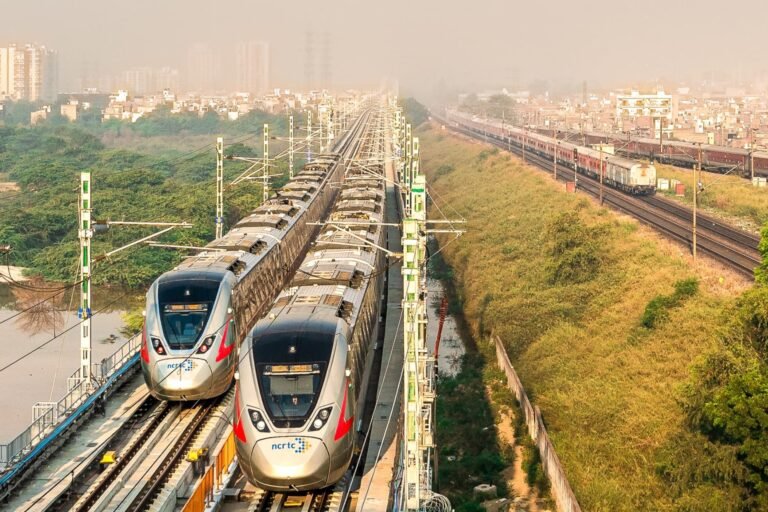
NEW DELHI (Metro Rail News): Hirect Ltd. (formerly known as Hind Rectifiers Limited) has secured two contracts from the Indian Railways at approximately Rs. 120 crores. The first contract includes the development of propulsion systems and electrics for the Vande Metro (Namo Bharat Rapid Metro) trainset valued at the cost of Rs. 60 crores. The contract must be executed within 21 months. The second contract includes the supply of complete propulsion systems for 4 MEMU trainsets. The completion period of the contract is 24 months and the approximate cost of the contract is Rs. 60 crores. 

Namo Bharat Rapid Rail: 

Namo Bharat Rapid Rail was introduced to enhance inter-city travel and provide a modern and seamless short-distance rail system influenced by the Vande Bharat Express. The first Vande Metro was flagged off by Prime Minister Shri Narendra Modi in September 2024. Currently, two pairs of Namo Bharat Rapid Rail services are being operated on the Indian Railways network. These trains run at the maximum operational speed of 130 km/h, and cover distances upto 300 km.

Train No.Name 
94803/94804Jaynagar – Patna Namo Bharat Rapid Rail
94801/94802Ahmedabad – Bhuj Namo Bharat Rapid Rail

Railway Minister Ashwini Vaishnaw had previously announced that given the positive response to the operational Vander Metro trains, 50 new Namo Bharat Rapid Rail trains will be manufactured. 

Also Read: Chennai MMLP awards Rs 216.99 cr rail connectivity contract to PKM Infrastructure JV

Chennai MMLP awards Rs 216.99 cr rail connectivity contract to PKM Infrastructure JV

CHENNAI (Metro Rail News): Chennai MMLP Private Limited has awarded a Rs 216.99 crore contract to PKM Infrastructure, in a joint venture with Nagarajan Construction Company Private Limited, for developing rail connectivity to the Chennai Multi Modal Logistics Park (MMLP) from Kadambattur Railway Station.

Contract details 

InformationDetails 
Contract NumberCMPL/MMLP Chennai/ef-356/2026 
Project Development of Rail Connectivity to Chennai MMLP from Kadambattur Railway Station
Awarding Authority Chennai MMLP Private Limited
Contract Value Rs 216.99 crore
Contractor  PKM Infrastructure – Nagarajan Construction Company Pvt. Ltd. (JV)

Bidder details

Bidder NameAmountStatus
PKM Infrastructure Rs 216.9 Cr (L1) Accepted-AOC
TSR Nirmaan Private Limited Rs 234.4 Cr (L2) Rejected-Financial 

Scope of work

The project involves developing a new Rail Connectivity to Multimodal Logistics Park (MMLP) Chennai on Engineering, Procurement and Construction (EPC) mode from Kadambattur Railway Station.

About the project

The Chennai Multi Modal Logistics Park (MMLP) is a significant logistics infrastructure project that aims to improve cargo movement by connecting rail, road, and port services. The new rail link from Kadambattur Railway Station will give direct access to the logistics park. This will help move freight more efficiently and lower road congestion and logistics costs. Chennai MMLP Private Limited is a joint venture of the National Highways Logistics Management Limited (NHLML), Chennai Port Authority (ChPA), Rail Vikas Nigam Limited (RVNL), and Tamil Nadu Industrial Development Corporation (TIDCO). This project is a key part of the government’s plan to strengthen multimodal freight infrastructure. 

Also Read: Chennai Metro awards Rs 12.10 cr Civil Maintenance contract for High Court to Wimco Nagar section

India’s first travellator skywalk at Mahalaxmi (Mumbai) linking metro, monorail and railway 

Mumbai (Metro Rail News): Mumbai is set to get a major boost in seamless connectivity. The Mumbai Metropolitan Region Development Authority (MMRDA) announced that India’s first travellator-equipped skywalk under the Mahalaxmi Multimodal Connectivity Project is nearing completion.

The project has reached approximately 90% completion, bringing Mumbai one step closer to a truly integrated transport network. MMRDA proudly shared this milestone on their official X account.

The skywalk will smoothly link three important transport systems: the Mahalaxmi Suburban Railway Station, Sant Gadge Maharaj Chowk Monorail Station, and Metro Line 3.

Once operational, this integrated interchange will cut transfer times by about 20 minutes. It will also greatly improve access to the Mumbai Monorail from South Mumbai and Worli.

MMRDA ensured that civic services continued without any interruption during construction. Before starting foundation work, they carefully relocated an 1,800 mm diameter storm water drain. Nearby water supply and sewer pipelines were left completely undisturbed.

More than just a skywalk: Passenger-Friendly design

The impressive pedestrian Skywalk stretches 283 meters in length and offers a wide 11-meter width. This spacious design keeps passenger movement smooth and comfortable, even during peak hours.

Other highlights of the project are six travellators with a combined length of 176 meters and two passenger lifts, ensuring full accessibility for senior citizens, persons with disabilities, and travelers with luggage.

The skywalk is designed to handle up to 4,500 commuters every hour.

This travellator-equipped skywalk is much more than a pedestrian link; it represents an integrated transport ecosystem in Mumbai where Metro, Monorail, and Suburban Rail work together as one seamless network.

Also Read: Indian Railways’ first Hydrogen-Powered Train crosses 1,200 km in trials, saves over 3,200 litres of diesel

Indian Railways’ first Hydrogen-Powered Train crosses 1,200 km in trials, saves over 3,200 litres of diesel

DELHI (Metro Rail News): India’s first hydrogen-powered train has completed over 1,200 km of test runs between Jind and Sonipat in Haryana. This marks a significant achievement for Indian Railways’ clean energy program. The Railway Ministry reported that the train has already saved more than 3,200 litres of diesel. Trials on the Delhi route are planned next.

Prime Minister Narendra Modi launched the country’s first hydrogen-powered train from Jind on July 17 as part of the Atmanirbhar Bharat initiative. The train is part of Indian Railways’ efforts to create zero-emission transport using local technology. Unlike diesel trains, it generates electricity onboard with hydrogen fuel cells and produces only water vapor as a by-product.

How the Hydrogen Train works

The train generates electricity using hydrogen fuel cells, which work through a chemical reaction between hydrogen and oxygen. The electricity drives the train’s motors, with no smoke or carbon emissions from the exhaust. This makes hydrogen one of the cleanest technologies for rail transport.

Indigenous technology developed by Indian Railways

The Railway Ministry stated that the hydrogen train has been fully developed by Indian Railways. The train features – 10 passenger coaches, two Hydrogen Driving Power Cars, 2,400 kW total power output, Hydrogen cylinders, and Lithium Iron Phosphate (LiFePO₄) batteries for extra power support. Indian Railways Minister Ashwini Vaishnaw called the project an important milestone, noting that India has developed this hydrogen propulsion technology.

India’s first Hydrogen Refuelling Facility at Jind

The project has also established Indian Railways’ first dedicated hydrogen storage and refueling facility at Jind. According to the Railway Ministry:

  • Green hydrogen is stored at pressures up to 500 bar
  • Hydrogen is dispensed at 350 bar
  • The facility can hold around 3,000 kg of hydrogen to support train operations

Multiple safety systems installed

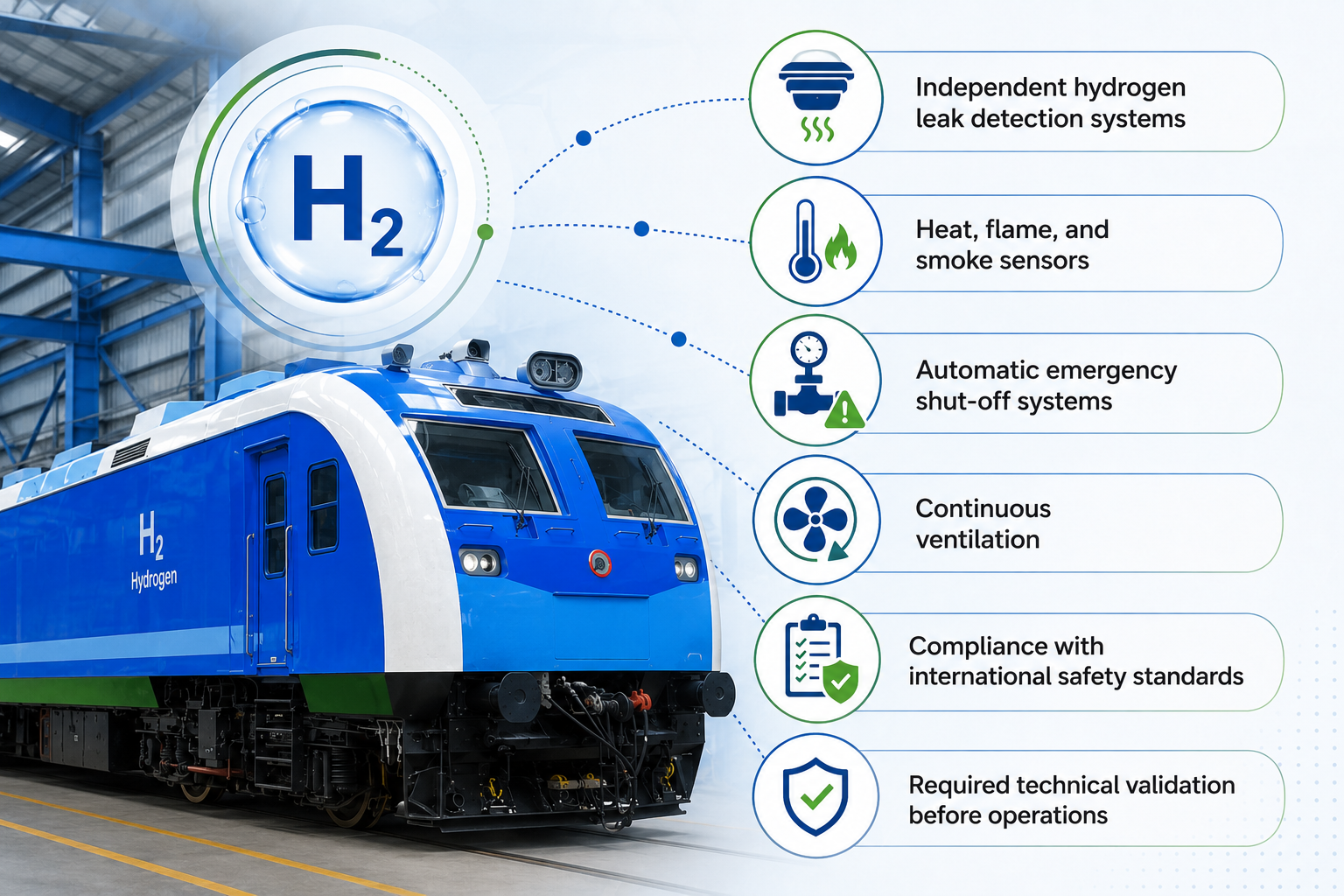
The hydrogen train includes several safety features to ensure safe operation in India. These features include:

image 20

Delhi route trials planned next

Following the successful trials between Jind and Sonipat, Indian Railways plans to start the next phase of testing on the Delhi route. The Railway Ministry stated that the project aims to create a complete local hydrogen rail ecosystem while helping India’s transition to cleaner and zero-emission rail transport.

Also Read: Big branding opportunity: Noida Metro Aqua Line offers co-branding rights for 12 stations 

Big branding opportunity: Noida Metro Aqua Line offers co-branding rights for 12 stations 

NOIDA (Metro Rail News): The Noida Metro Rail Corporation (NMRC) Limited has invited a tender for Co-Branding Rights at selected metro stations in the (NMRC Network) Aqua line. Winning licensees will gain the right to pair their company name directly with chosen metro stations as a prefix or suffix. This initiative will strengthen NMRC’s non-fare revenue stream for the Noida Metro.

Alongside station naming privileges, licensees will receive advertising rights to designated stations.

Tender Details

Tender NoNMRC/Co-Branding/2026/475 
License Period 10 (Ten) Years 
Number of stations12
Pre-Bid Meeting August 11, 2026, (11:00 hrs )
Online Bid Submission Start date August 18, 2026 
Last Date of Bid Submission August 25, 2026 ( 15.00 hrs )
Date of Technical Bid Opening August 25, 2026 (16.00 hrs )

Bid security (EMD)

Bid security (EMD) is different for each metro station, and EMD has to be paid for each metro station separately, in case the bidder wishes to apply for more than 1 (One) metro station.

Name of Metro Station EMD 
Sec-76₹ 7,60,000 
Sec – 101 ₹ 3,80,000 
Sec – 81 ₹ 2,60,000 
Sec – 83 ₹ 6,10,000 
Sec – 137 ₹ 7,60,000 
Sec – 144 ₹ 2,60,000 
Sec – 145 ₹ 6,10,000 
Sec – 147 ₹ 2,60,000 
Sec – 148 ₹ 3,80,000 
Pari Chowk ₹ 12,30,000 
Alpha-1 ₹ 9,50,000 
Depot Station ₹ 2,60,000 

What is the scope of co-branding?

For NMRC, the initiative maximizes non-farebox revenue to subsidize transit operating costs, modernizes station infrastructure, and enhances visual aesthetics through partner-funded landscaping, painting, and structural maintenance. 

In return, partner brands gain high-visibility through co-naming rights on metro maps, audio-visual announcements, and station names. This will give the brand direct exposure to thousands of daily commuters through comprehensive interior and exterior advertising inventory. 

About Aqua Line (Noida Metro)

The Noida Metro (officially the Aqua Line) is a rapid transit system owned and operated by the Noida Metro Rail Corporation (NMRC), connecting Noida and Greater Noida in Uttar Pradesh. 

Spanning a total distance of 29 km, this fully elevated transit network consists of 21 modern stations.

The corridor provides critical transit access along the busy Noida–Greater Noida Expressway, seamlessly linking major residential sectors, commercial zones, and educational hubs like Knowledge Park II and Pari Chowk. 

Also Read: Pune Metro Line 3: CMRS clears Maan-Balewadi section, operations to begin soon

Pune Metro Line 3: CMRS clears Maan-Balewadi section, operations to begin soon

PUNE (Metro Rail News): After numerous delays, Pune Metro Line 3’s Maan-Balewadi section is all set to launch soon. The Commissioner of Metro Rail Safety (CMRS) has given provisional authorisation for starting passenger operations on the 13 km Maan-Balewadi elevated double-track stretch. The date of the commencement has not been finalised yet.

Detailed inspections were carried out by CMRS in the presence of senior officials of Pune IT City Metro Rail Limited (PITCMRL) from 5th July to 8th July. Confirmatory trial runs were successfully completed on the stretch before provisional authorisation was granted. Metro services will initially operate across 12 stations, with trains running at the speed of 80 kmph.

The inspection verified statutory approvals and technical certifications,  and confirmed that the metro operator had obtained the required DoT licence to use telecommunications equipment. They also checked that all 12 stations had received No Objection Certificates (NOCs) from the fire department, confirming compliance with fire safety requirements.Certifications were also awarded for civil works, track, signalling, telecommunications, and rolling stock systems.

Anil Kumar Saini, CEO, Pune IT City Metro Rail Limited said, “It reflects our commitment to safety quality and engineering excellence. This is another decisive step towards bringing a modern metro system into service for the people of Pune,” when speaking about the CMRS clearance. 

Metropolitan Commissioner, Pune Metropolitan Region Development Authority (PMRDA), Abhijit Chaudhari, said, “The project will play a vital role in reducing traffic congestion in the Hinjewadi IT Park area while providing commuters with a safe, fast and environmentally sustainable mode of public transport.” 

The previous date for the commencement of services on the Pune Metro Line 3 was 15th July, but the launch was delayed due to the pending CMRS approvals, which have now been granted. 

Pune Metro Line 3, also known as the Puneri Metro or the Pink Line, is being developed under a public-private partnership model executed by Pune IT City Metro Rail Limited, a joint venture between the Tata Group and Siemens. When the agreement was first signed by the TATA-Siemens consortium, the project was originally targeted for completion by March 2023.

Once operational, the Pune Metro Line 3 will significantly reduce travel time and offer commuters seamless travel from the IT hub of Hinjewadi to Shivajinagar District Court.

Also Read: Pune Metro Line 3 to enter operations in July

Delhi Metro: DMRC invites bids for Passenger Connection between Line 7 & Line 8 Extension at Azadpur Metro Station 

DELHI (Metro Rail News): The Delhi Metro Rail Corporation (DMRC) has invited bids for the design and construction of a new passenger connection. This connection will link the underground Azadpur Metro Station on Line 7 (Pink Line) with the elevated Azadpur Metro Station on the Line 8 Extension. The estimated cost for this project is Rs 7.54 crore. It aims to improve passenger movement at one of Delhi Metro’s busiest interchange stations. 

Tender details 

InformationDetails
Tender NumberCPM-2/2026-27/D-22  
Estimated Cost Rs 7.54 crore (inclusive of all taxes) 
Tender SecurityRs 7.54 lakh  
Completion Period5 months
Pre-bid Meeting  4 August 2026 at 11:30 AM
Tender Submission Deadline14 August 2026, 9:00 AM to 22 August 2026, 3:00 PM  

Scope of work

The work includes design and construction of connection between underground Azadpur Station (Entry/Exit) of line-7 with Elevated Azadpur Metro Station of Line-8 extension. 

About the project

Azadpur is one of the most important interchange stations in the Delhi Metro network. It currently connects the underground Pink Line (Line 7) with the Yellow Line. Under Delhi Metro Phase IV, the Line 8 Extension (Magenta Line Extension) will also reach Azadpur, turning it into a triple-interchange station. 

The Pink Line station operates underground with dedicated entry and exit points. The upcoming elevated station on the Line 8 Extension will be part of the expanding Phase IV network. The new connection will make transfers between these metro lines faster and more convenient, enhancing Azadpur’s role as a major multi-modal transport hub in Delhi.

Also Read: Titagarh & RKFL’s railway wheelset plant to begin production in August

Titagarh & RKFL’s railway wheelset plant to begin production in August

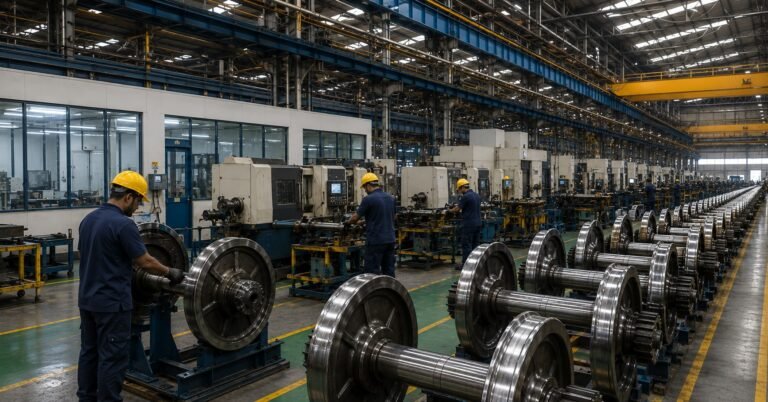
CHENNAI (Metro Rail News): In a major step for strengthening India’s self-reliance in railway products manufacturing, Titagarh Rail Systems Limited and Ramkrishna Forgings Limited (RKFL) are set to enter the production phase of their indigenous railway wheelset plant in August, 2026. 

The manufacturing plant is situated at Gummudipoondi near Chennai in Tamil Nadu. The plant is set to become the second largest forged wheel manufacturing plant in Asia with a capacity to produce 228,000 forged wheels every year.

Earlier, Titagarh and RKF consortium received a Letter of Acceptance (LOA) for the manufacturing and supplying of forged wheels for the Indian Railways. The total cost of the project is estimated at ₹2,000 Crore. The funding of this project has been taken up through a mix of equity and debt.

Asia’s 2nd largest plant

Marking another big milestone achievement, the wheelset manufacturing plant will take the position of Asia’s second largest forged wheel plant. The plant is situated in a large area covering 72.5 acres with a built-up area of 6.5 lakh square feet.

Upon completion, the plant is projected to produce around 228,000 forged wheels every year. This will reduce India’s dependence on foreign imports for forged wheels and develop an ecosystem for global exports.

Focused on Technology, Quality and Self-Reliance

The plant is focused on building an integrated ecosystem for technology, quality and self-reliance. It will combine the process of forging, machining and testing via real-time monitoring using Germany-based 10,000 tonnes presses, advanced robotic handling and heat treatment lines. RKFL announced that they have signed a 20-year contract with Indian Railways to manufacture and supply 15.4 Lakh wheels.

Read this story to know more about the growing railway manufacturing industry in India: Ashwini Vaishnaw commends  ‘Made in India’ railway products for leading global exports