




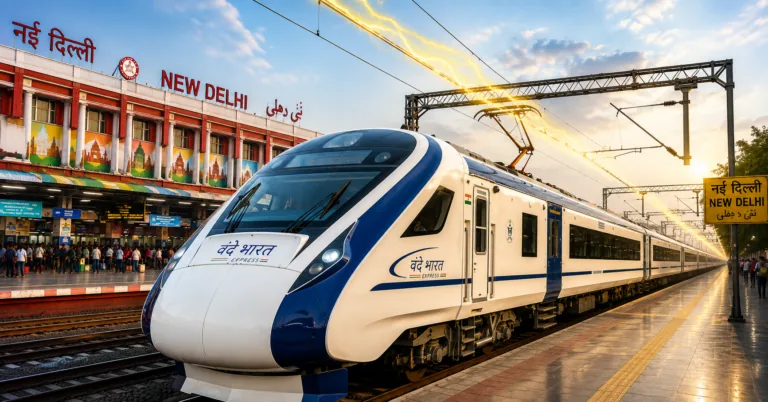
NEW DELHI (Metro Rail News): Indian Railways has radiated its network with a remarkable achievement setting a global example. The Indian Railways has successfully electrified 99.6% of its network. India now leads the global railway electrification charts ahead of China (82%), Japan (64%) and UK (39%).
In an answer to a question asked in the Monsoon Session (2026) of the Lok Sabha, Union Railways Minister Shri Ashwini Vaishnaw stated that 99.6% of the Broad Gauge (BG) network of the Indian Railways has been electrified. He further informed that the Indian Railways is saving 185 Crore litres of diesel because of the decrease in the dependence on fossil fuels.
Vaishnaw also stated that the electrification work on all new lines are being sanctioned and constructed with electrification. Moreover, the electrification on the remaining section has also been taken up. The target of achieving 100% electrification is going to be the next milestone for the Indian Railways.
Global Comparision
Get the Daily Metro & Rail Brief
Join 125,000+ metro and rail professionals. Project updates, new tenders and contract awards from across India, in your inbox every day.
According to International Union of Railways (UIR) report of June 2025, the electrification of railways system across the globally important system are as follows (see the graph)

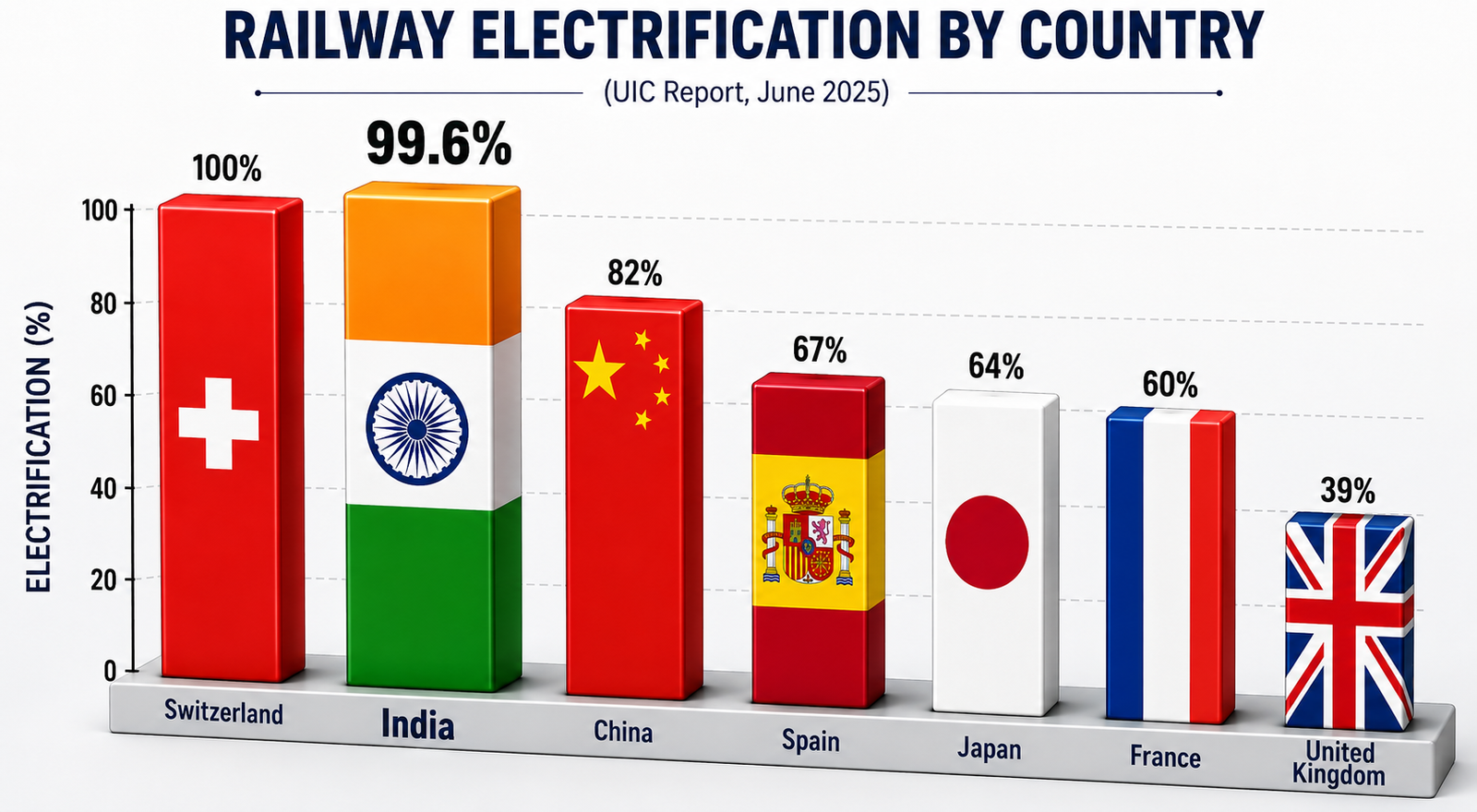
Among the important railway networks across the world, Switzerland has achieved 100% electrification. India is amongst the top countries in the list with 99.6% network under electrification. The achievement is also notable as India has a large network of railways and the fact that most of this work was expedited while carrying a dense traffic in the operational lines. Another notable fact is that, India has surpassed several major countries by a big margin in the electrification of railway networks.
The Challenges of Mission 100% Electrification
The mission of attaining 100% electrification is a challenging task as it involves electrification of the operational networks and the work may encounter unforeseen obstacles. The Indian Railways took the following steps to expedite the electrification work:
- Formation of Project Monitoring Group (PMG) portal to resolve the constraints being faced during the commissioning
- Ensuring effective project monitoring mechanism
- Assured funding and enhanced financial powers to the field units
Environmental Impacts
A major impact of the electrification of the Railway network has been in the area of environmental sustainability. Electrification of the railway tracks reduce the dependence on fossil fuels and decrease diesel consumption translating into lower carbon emissions. A NITI Aayog data shows that the emission of CO2 for transporting 1 tonne for 1 km via railways is almost one-tenth of that of the roadways.
The Indian Railways consumed 108 crore litres of diesel in 2024-25 compared to 293 crore litres in 2015-16 saving a vital 185 crore litres of diesel. In addition to being environmentally friendly, this is also economically beneficial as it saves the precious foreign exchange stock of the Government used for the purchasing of fossil fuels.
The electrified networks are also more efficient in integrating renewable energy sources such as solar energy and wind energy for traction power systems resulting in better utilization of renewable electricity. The Indian Railways has commissioned 1164 Mega Watt (MW) of solar plants and around 103 MW of Wind power as of June, 2026.
100% Electrification DOES NOT MEAN Net-Zero Carbon Footprints
The 100% electrification of railways is not going to create an environmentally neutral impact. As many would think, by introducing 100% electrification, we are moving to a Net-Zero Carbon Emission. However, most of the electricity that we create is created through coal-based production resulting in the emission of carbon products elsewhere. In short, in the process of removing our Carbon footprints, we are creating newer prints through different avenues.
Zone Wise Electrification
| SN | ZONE | % Electrified |
| 1 | Central Railway | 100% |
| 2 | East Coast Railway | 100% |
| 3 | East Central Railway | 100% |
| 4 | Eastern Railway | 100% |
| 5 | Konkan Railway | 100% |
| 6 | Kolkata Metro | 100% |
| 7 | North Central Railway | 100% |
| 8 | North Eastern Railway | 100% |
| 9 | Northern Railway | 100% |
| 10 | South Central Railway | 100% |
| 11 | South Coast Railway | 100% |
| 12 | South East Central Railway | 100% |
| 13 | South Eastern Railway | 100% |
| 14 | West Central Railway | 100% |
| 15 | Western Railway | 100% |
| 16 | North Western Railway | 99.8% |
| 17 | Northeast Frontier Railway | 98.7% |
| 18 | Southern Railway | 98.7% |
| 19 | South Western Railway | 96.1% |
State Wise Electrification
| SN | State | % Electrified |
| 1 | Andhra Pradesh | 100% |
| 2 | Arunachal Pradesh | 100% |
| 3 | Bihar | 100% |
| 4 | Chandigarh | 100% |
| 5 | Chhattisgarh | 100% |
| 6 | Delhi | 100% |
| 7 | Gujarat | 100% |
| 8 | Haryana | 100% |
| 9 | Himachal Pradesh | 100% |
| 10 | Jammu & Kashmir | 100% |
| 11 | Jharkhand | 100% |
| 12 | Kerala | 100% |
| 13 | Madhya Pradesh | 100% |
| 14 | Maharashtra | 100% |
| 15 | Meghalaya | 100% |
| 16 | Mizoram | 100% |
| 17 | Nagaland | 100% |
| 18 | Odisha | 100% |
| 19 | Puducherry | 100% |
| 20 | Punjab | 100% |
| 21 | Telangana | 100% |
| 22 | Tripura | 100% |
| 23 | Uttar Pradesh | 100% |
| 24 | Uttarakhand | 100% |
| 25 | West Bengal | 100% |
| 26 | Rajasthan | 99.8% |
| 27 | Tamil Nadu | 98.3% |
| 28 | Assam | 97.9% |
| 29 | Karnataka | 96.8% |
| 30 | Goa | 91.4% |
Conclusion
The Indian Railways has shown remarkable progress in recent years in advancing the Railways with modern upgrades. The milestone achievement of attaining 99.6% electrification shows a progress of not merely meeting the global standards but of becoming a global example. The upgrade has unlocked doors to several sustainable and energy efficient technologies but for a net-zero emission, the carbon emission involved in the primary process should also be addressed. The progress is notable, however, there is a long road to become a developed railway network.
Read this article to know more about Railway Electrification: Railway Electrification: A Path to Net Zero Carbon Emission by 2030