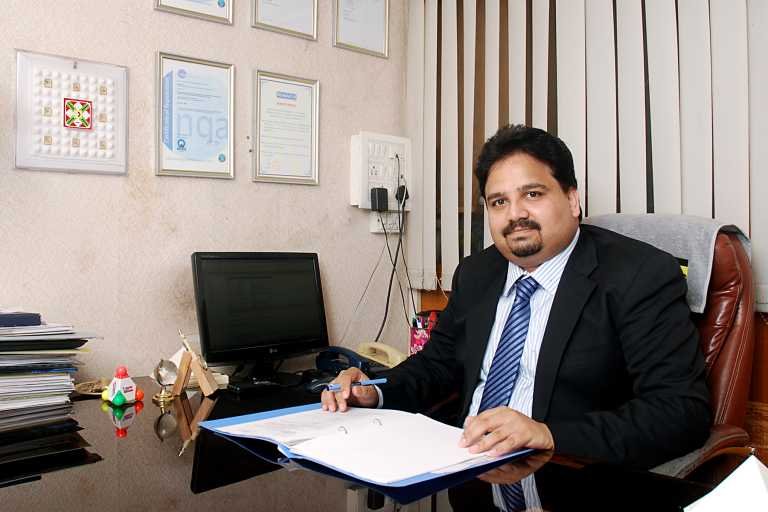
Metro Rail News has conducted Exclusive Interview with Mr. Neelesh Dixit, Managing Director, RENMAKCH India to know the Company’s expansion plan and status of ongoing projects in India. Here are the excerpts of the interview with him:-
- Mr. Dixit, tell us about your career and experience in Metro & Railways industry? What are your present roles in RENMAKCH?
RENMAKCH was started in 1996. Initially, we were serviced providers to the private and public limited companies in and around Mumbai for Reconditioning & Automaton of Machine Tools. We got entry into the Indian Railways in the year 1997 when one of the Under Floor Wheel Lathes of Central Railway was under breakdown since over a month, without any support from the OEM (Original Equipment Manufacturer) and we repaired & commissioned it successfully within two days without any experience of that particular type of machine. This was a big breakthrough not only for us but also for the Railways, as they got someone who can help them in breaking the monopoly of OEMs who were either not supporting or were charging heavily for their services.
Since then our experience with the Indian Railways has been very good, as we were not only their service providers but with our expertise in various fields, we acted more like their consultants helping them in resolving their daily critical issues, even related to Rolling Stock and sometimes even free of cost. Very soon we became their solution providers, which has brought us to a highly respectable level in the Railway Industry today. We are really thankful to the Indian Railways for having trusted us for over 20 years now.
We became active with the Metros in 2008, when DMRC’s Shastri Park Depot was being commissioned and we assisted in Installation & Commissioning of some of the most critical workshop equipment like Bogie Testing Machine, Battery Operated Shunter, etc. Providing these kinds of experienced maintenance services helped us to get associated with various Foreign Manufacturers which were looking for experienced Service Partners in India. Since then we have been active in the Metro Segment as well.
As a Managing Director, I am responsible for upgrading my company continually and making it future ready for the fast-growing Railways, Metro & High-Speed Sectors. I am responsible for ensuring the provision of the best in class technology and support to the system, with complete dedication & honesty. I am supported by a very good team of managers, office staff and engineers, who help me very efficiently to run this show. I am grateful to them for being a part of this journey of RENMAKCH.
- Please provide a brief overview of your company and its products/services.
RENMAKCH is a Comprehensive Solution Provider to Railways & Metros. It gives me great pride in mentioning that today we are the only company providing Comprehensive Solutions under one roof, viz; Workshop Equipment for Rolling Stock Maintenance, Testing, Condition Monitoring & Research, Turnkey Projects related to Supply / Maintenance / Operation & Maintenance / Wet Leasing of M&Ps (Machinery & Plants), Design, Development & Validation of Rolling Stock, Detailed Project Report (DPR) and Detailed Design Consultancy (DDC) for Setting up of State-of-the-Art Maintenance Depots, Bogie Shops, Wheel Shops, Manufacturing Units, Research Centres etc.,
- What inspired you to build the products / services/solutions for Metro & Railways infrastructure projects?
After commencing our journey and support to the Railways in 1997, I got various opportunities with challenging assignments. I was called for the most critical problems, for which even some of the experienced Railway Staff could not find the right solutions. This made me go deeper and deeper into every problem until it is solved and accepting such challenging opportunities increased my technical knowledge to a great extent. Dedication and Determination was the key to every success.
After association with our foreign partners, I got several opportunities to visit the latest Railway & Metro Workshops around the world. This made me realise the real difference between the age old outdated technologies of Indian Railways against those in other parts of the world. Having gained the technical experience of the Railway System, it was easy to understand and decide, what needs to be introduced in the Railways and in what ways, so that Railways can save a considerable amount of labour, time and money. This was very interesting, challenging and most importantly it was in the interest of the nation.
The products and solutions were brought by us to India with great hope. Lot or promotions were carried out, which still continue rigorously in various forms. Luckily this was the time when the Metro Sector had just started booming, which was more open to adopting such state-of-the-art technologies, than the Railways. They had travelled to foreign countries to see the latest train maintenance depots and realised very soon that they have to implement such high-level technologies for smooth, comfortable and trouble-free operations of the entire system.
Increase in the number of Metro Systems all over India increased the demand for state-of-the-art equipment for maintenance & testing as well. This brought reputed manufacturers from all over the world to India with their technology and solutions. RENMAKCH became one of the major contributors in this import of latest technologies to India. Today RENMAKCH is an associate for over 15 reputed technology providers of the world.
The import of technology was not easy for all, as it called for higher budgets and thereby increase in the overall project costs. There was a need for indigenisation and fortunately, the “Make in India” Policy helped in a great way to open doors to foreign companies for localisation of their technology. RENMAKCH was one of the first companies to come forward and take advantage under this policy by convincing some of the foreign principals and starting the Designing & Manufacturing of Railway & Metro Workshop Equipment in India, under Joint Venture and Transfer of Technology. This helped in a great way in bringing down the overall costs of the equipment and in turn bringing the foreign technologies within easy reach of the Indian customers, at reasonable prices.
- What was the most challenging part of your journey till now? How did you overcome those challenges?
There were many challenges at all stages which we have successfully overcome. It began with understanding the complicated Railway system, getting our own systems moulded to match with the Railway system, facing the bureaucracy, red tape, favouritism at different levels, procurement policies, etc. However, most of such challenges were very easily overcome by us, as we were determined to help the Railways for modernisation and our technical expertise was always being welcomed everywhere.
But the biggest of all challenges we faced were; the qualifying criteria, outdated evaluation procedures, L1 policy, no advance / progressive payments, complicated bank guarantees and security deposits, endless contract period in some cases, inspections without any know-how, joint notes, acceptance certificates, measurement books, billing procedures payment follow-ups, penalties and so on, which still keeps our Railway Systems the most complicated in the world. Tender Terms & Conditions are the same for whatever has to be purchased; whether it may be stationary / furniture / consumables / workshop plant & machinery / research equipment / land & building / bridges / track works / Rolling Stock / components / etc., every procurement has the same terms & conditions. These are common and well-known problems faced by all without any exceptions. There is absolutely no thought process in line for minimising these problems for smooth and easy working because nobody likes to take the risk of changing and upgrading the system to international standards, because of which reputed manufacturers like to stay away from such complicated system.
The technical challenges were also many. It was not easy to promote advanced technology in Railways because the primitive age-old technology still prevails and the system had made itself so dependent on it, that the advanced technologies were either not explored or simply ignored. The focus was more on the maintenance of existing systems, but very seldom on adopting internationally proven technologies. There are of course many reasons for such reluctance and some of them are also valid to an extent. But this is a big problem, as the technical experts in the system, who are capable of doing wonders in transformation, are often suppressed off their passions by such lethargic system and reluctance.
However, in the past few years, there is a lot of improvement seen in the system. Railways have taken dynamic decisions and opened fronts for all internationally proven technologies. With the downfall in the workforce available in maintenance depots, safety requirements growing higher, increase in demand for additional infrastructure, need for higher productivity, etc., have made the Railways to go for the best of the facilities and solutions available.
- Tell us about recently developed products of your company and their USPs and how these are helpful to metro & railway industry?
If we talk about foreign technologies, we have been promoting most of the best in class and state-of-the-art equipment like; Automatic Train Wash Plants (best in class sturdy design and up to 70% water reclamation) Under Floor Wheel Lathes (Standard & Tandem type with complete Redundancy in Operations), Under Floor Lifting Systems for Trains (completely safe 4 Column Lifting System), Mobile Lifting Jacks (highly compact design with movable anvil), Bogie Turn Tables (highly compact one-piece design), Multi-Purpose Roof Working Platforms (for carrying out different types of maintenance activities at one station), Bogie Testing Machines (with Wheel Loads Testing) Coli Spring Testing Machines (with lateral stiffness test, for LHB coaches), Damper Testing Machines (most compact design electro-mechanical type), Battery Operated Rail cum Road Shunters (most compact and safe design), etc.
Under the Make in India policy, we have already started manufacturing of this state-of-the-art technology under Joint Venture (JV) and Transfer of Technology (TOT) with reputed European Manufacturers like NEUERO and NENCKI. This includes equipment like; Under Floor Listing Systems, Mobile Lifting Jacks, Bogie Turn Tables, Bogie Testing Machines, Multi-Purpose Roof Working Platforms, Customised General Workshop Equipment, etc. and many more to follow.
- Please brief about some metro & railway projects where RENMAKCH is working?
Recently we have completed Installation & Commissioning of Train Under-Floor Lifting Systems at DMRC’s Mukundpur Depot, Kalindhikunj Depot and Vinod Nagar Depot. These systems were supplied from our principals NEUERO, Germany. Installation & Commissioning of Train Under-Floor Lifting System is going on at KMRCL’s Central Park Depot. This was also supplied from NEUERO, Germany. One set of Mobile Lifting Jacks with NEUERO Germany design has been supplied to Nagpur Metro this year. The first set of Bogie Turn Tables manufactured in India as per NEUERO Germany design, have been supplied to Indian Railways and are under commissioning. Two sets each of Multi-Purpose Roof Working Platforms and Under Floor Lifting Systems of NEUERO Germany are being supplied to Nagpur Metro through EPC Contractor SIEMENS India Ltd.
Two sets each of Under Floor Lifting Systems and Mobile Lifting Jacks for two depots of Ahmedabad Metro (MEGA) are under manufacturing and are likely to be supplied in the beginning of 2019. These are of NEUERO Germany design. Order for One complete set of Machinery for a new Long Rail Welding line (Flash Butt Welding Plant – FBWP) for a RITES Project at Sabarmati, is just received from the EPC Contractor SMS Group (India). This set of machines include; Rail Brushing Machine, Rail Grinding Machine, Rail Post Weld Straightening and Machine Rail Weld Test Press, all from NENCKI Switzerland.
As far as our Maintenance Service Contracts are concerned, we have works (Warranty / DLP / AMC / CAMC) going on at Angul, Ludhiana, Bhillai, Liluah, Howrah, Gwalior, Jagadhari, Mysore, Perambur, Bangalore, Mumbai, Delhi and Nagpur.
- In supervising and delivering the present project, who do you need to liaise with and are there any barriers to timely delivery and quality assurance?
Every project is different in its kind and its responsibilities. There are various departments who may be involved in the case to case basis. For example, in the case of procurement of M&Ps in the Indian Railways, the purchaser level is different and the consignee level is different. At the purchaser level, there are different departments handling the cases, such as Stores, Technical, & Finance and at the consignee level, there could be various departments like Stores, Production, Mill Wright (Mechanical + Electrical + General), Engineering and Administration. Every department at both the levels have different and important roles to play, hence we have to liaise with all.
Submissions like of GADs and progress reports, Manufacturing processes, Quality Control, Factory Acceptance Tests, Dispatch Documentation, etc, are critical points which could lead to delays in deliveries from the manufacturer’s side.
Approval of GADs, Site readiness, Stage Inspections, material movement at the installation site, availability of facilities for Installation & Commissioning & Load Trials, uninterrupted good quality power supply, earthing, concrete flooring, leak-proof sheds, clean surroundings, proper illumination, skilled operators, lack of knowledge of the equipment, acceptance tests, etc., are some of the most important factors which could be responsible for delays from the consignee side, if not planned and arranged timely at the consignee level.
Other factors could be observation period, commissioning certificates, bill submissions, payment follow-ups, etc.
- How has RENMAKCH responded to increase in demand of rail-based transportation industries?
RENMAKCH is very proactive and has been contributing to the best possible level to the Railways & Metros in every way possible. This includes support for planning, design & development of best in class infrastructure, bringing in best in class technology for Rolling Stock as well as for Maintenance, Testing & Condition Monitoring Equipment, providing effective solutions for modernisation and transformation, etc. We keep on upgrading ourselves with the latest technologies & standards from all over the world and continue to support our industry in a very highly professional manner and with unbiased attitude, in the interest of upgrading the most important segments, Railways & Metros, of our country.
- Recently you have visited a mega industry event InnoTrans 2018 at Berlin, Germany. What lessons you have learned from there in respect to the current revolution in railway sectors in India?
Yes, I have been visiting the INNOTRANS since almost a decade now. This is an event which is dedicated to the transportation industry, especially the Railways, Metros and Light Rail Transit Systems LRTS (Trams, Monorail, etc.) and is the biggest event of the industry. There is a display of the latest technologies from all parts of the world. It is the best platform for the decision makers of the Railways & Metros and who are a part of their support system. Many Indian manufacturers also take part in this event and display their capabilities for export possibilities. Interactions and networking during the event help to generate a huge amount of business and promotes technology tie-ups all over the world.
However, if you really expect to gain something from visiting such events, then it is important to visit with a highly positive mindset and a great acceptance level. You need to plan and strategise visits to the core technology providers at the event, discuss with them about their solutions and judge whether they can be implemented in our country if found useful and not simply use the event for the purpose of a leisure trip.
INNOTRANS shows you how fast the world is moving and what are the steps to be taken to bridge the gaps in technology. It also makes you aware of the highest level of passenger comfort, quality & safety standards being followed in some of the most developed/developing countries. India is a huge country and has one of the biggest & well managed Railway Networks of the world. It is practically not possible for the Railways in India to go for everything that you see in such events, but certainly, there is a vast scope for improvements and upgradation in all the aspects related to Passenger Comfort, Design, Quality & Safety, which can be taken home.
- You are also exhibiting in InnoRail India 2018 event in Lucknow, India on November 22-24, 2018. Please tell our readers about what are you exhibiting there?
We have been participating in the InnoRail at RDSO Lucknow, since the beginning. It is an event with a special theme of “Innovations in Railway Technology”. This time we would be focusing on Design, Development & Validation of Rolling Stock from PROSE Switzerland, Rail & Wheel Profile Measuring Systems from MINIPROF Denmark, Dynamic Test Systems for Railway Research from RENK Germany and Electrical Test Systems from MEGGER USA. These are some of the special and core requirements in the Railways & Metros and RENMAKCH has been an important source for such sophisticated and internationally proven technologies. We hope that the event will attract a good number of serious visitors.
- As you are a regular reader of Metro Rail News Magazine, please share your views and suggestions in respect to the content of the Magazine.
I have started reading the Metro Rail News Magazine this year and I should mention that you and your team is really doing a great job. Your activeness and interests in the Railway & Metro segments are clearly seen from the contents of this magazine. You are covering the latest news from almost all the metros very efficiently and to the minutest details possible. I see that Metro Rail News Magazine is highly active on business networking sites like LinkedIn also, which adds to its glory. With the present boom on the infrastructure and the transport industry, you people are doing a wonderful job by communicating the activities and progress of various projects going on in all parts of the country. Congratulations to you and keep it up.
- Any other information, you want to share with us with respect to technology development in metro rail industries.
Metro Rail is becoming the lifeline of all the important cities of India very fast, as soon as it is implemented. High level of Passenger Comfort, High Quality & Safety Standards, Minimum Maintenance and Minimum Manpower are of some of the most important aspects for its economic viability. “Make in India” policy involving indigenisation of Design & Technology is the key to success, which should be certainly subject to maintaining the highest possible level of Quality & Safety Standards and cannot be compromised.