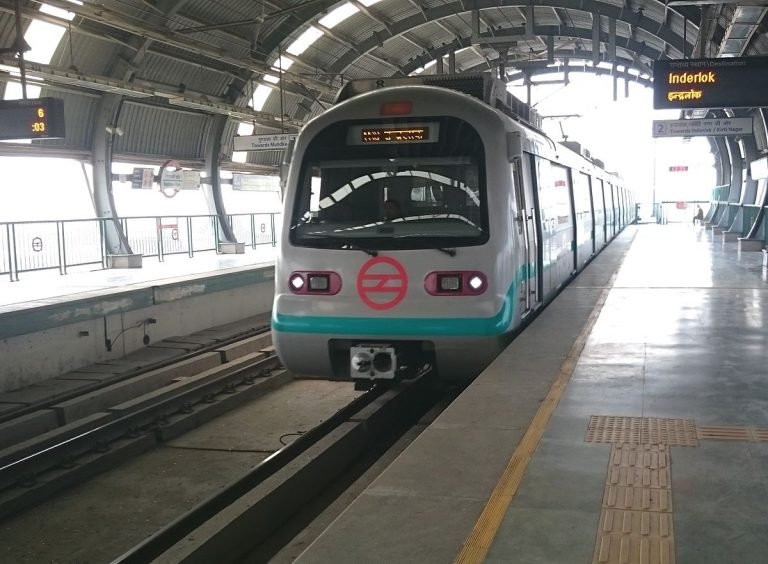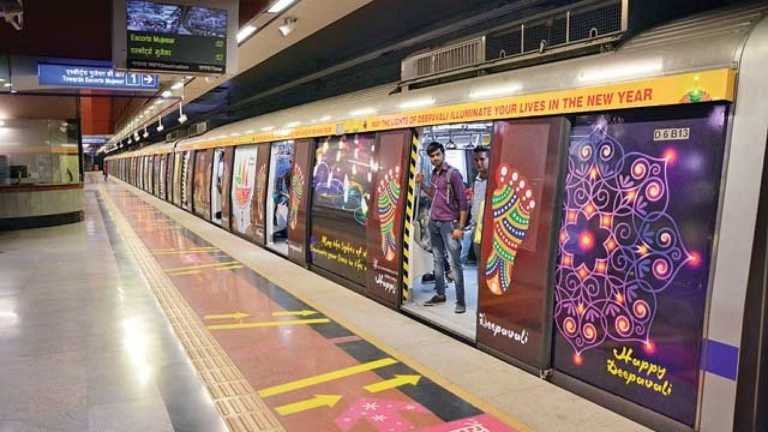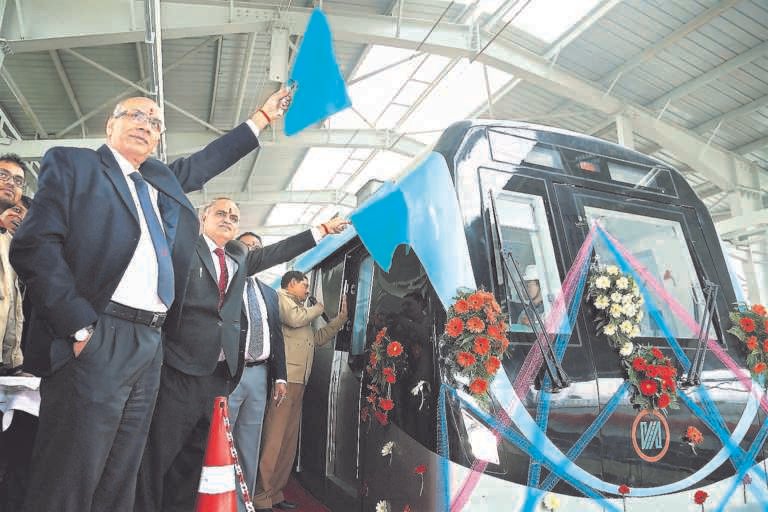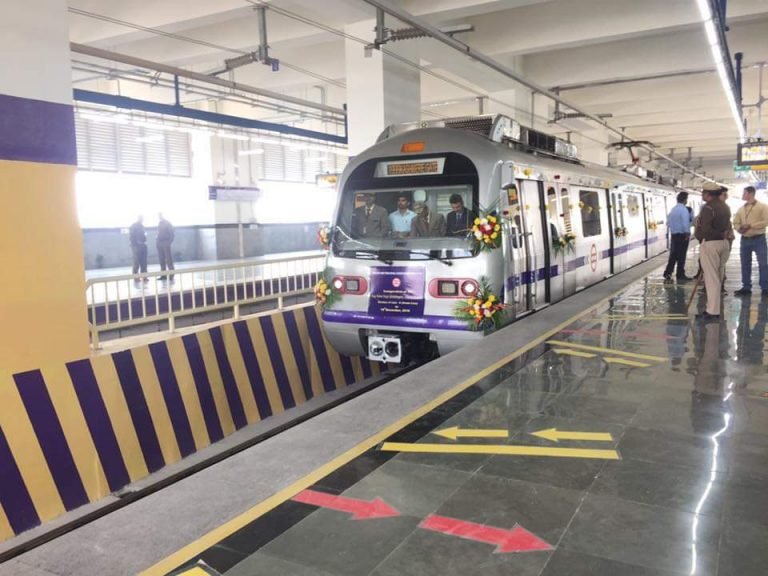
New Delhi: Prime Minister Narendra Modi has flagged-off the Delhi-Faridabad Metro Line that would allow hassle free travel for around two lakh daily commuters between the national capital and the industrial hub in Haryana.The extension of the Delhi Metro connects Badarpur to Escorts Mujesar in Faridabad.The total cost of the project from Badarpur to Escorts Mujesar is nearly Rs. 2,500 crore. Out of this, Rs. 1,557 crore was borne by the Haryana Government, the Centre contributed Rs. 537 crore, while the Delhi Metro provided Rs. 400 crore.The nine stations in this section include, Sarai, NHPC Chowk, Mewala Maharajpur, Sector 28, Badkal Mor, Old Faridabad, Neelam Chowk Ajronda, Bata Chowk and Escorts Mujesar. buy kamagra polo online https://lasernailtherapy.com/wp-content/themes/twentytwentytwo/inc/patterns/en/kamagra-polo.html no prescription
All these are elevated and located on either side of the Delhi-Mathura Road (NH-2).“The nine-station metro corridor which was 95 per cent indigenously built will provide people a safe, affordable, quick, comfortable, reliable, environment-friendly and sustainable transport facility,” a Haryana government spokesperson said.Haryana Chief Minister ML Khattar, addressing a press conference on Saturday, had thanked the Prime Minister for “gifting” the Metro service which would take the city to “another level of progress” with better connectivity with other NCR towns.He had also said that the Prime Minister would be announcing the go-ahead for connecting Gurgaon with Faridabad by Metro.
Lucknow: The Lucknow Metro Rail Corporation (LMRC) has completed over 80 per cent of the civil work for a 177 meters long balanced cantilever Metro bridge which is being constructed over river ‘Gomti’ by erecting special spans in an extremely challenging geographical condition in the capital city of Lucknow.
Once constructed fully, this special cantilever bridge will connect both the ends of the river, thereby, providing seamless Metro connectivity to the trans ‘Gomti’ region of Lucknow. Soon the residents of Hanuman Sethu Mandir locality, students and teachers of Lucknow University, Colvin Taluqdar College and the nearby residents, people residing in Police Line and New Hyderabad Colony shall be travelling by Metro.
Construction of this cantilever bridge posed a great challenge for Lucknow Metro as the construction had to be done without disturbing the flow of water in the river. LMRC, therefore, adopted the cantilever construction methodology and constructed only two pillars (one on either side the river bed) in Gomti and installed an 85 meters long span crossing the entire river flow from one end to the other to complete this work. In addition, two spans measuring 46 meters each have also been constructed on either side, thereby, making it a 46m + 85m+ 46m = 177 meters long cantilever Metro bridge.
Lucknow Metro is slated to complete the entire Metro construction work between Chaudhary Charan Singh Airport to Munshipulia (North – South Corridor) by early 2019 so that the entire 23 km long North-South corridor is made ready for commissioning as per the target stipulated by the Government.
Lucknow: Looks like good news is finally coming for Uttar Pradesh. The state will become the first state in India to have a rapid rail system. It will receive the rail system during the first implementation of RRTS.As per sources, work on country’s first rapid rail is also on track. The rapid rail first corridor network will connect Delhi and Meerut. The central government is likely to give its nod, ahead of 2019 election.In a meeting chaired by UP Chief Secretary in Lucknow, the National Capital Region Transport Corporation (NCRTC) team presented the plan. Experts from UP’s Metro Rail Corporation as well as other officers were also part of the meeting.Work on constructing the first Delhi-Meerut corridor has begun. Currently, road widening work has started from Duhai to Sahibabad in Ghaziabad is currently underway. Tender invitation work is put on fast track to speed up work.Central government too is taking cognisance of projects that can be initiated in couple of months. Rapid Raid network is one such project and preparations are underway.A rapid rail network will help in easing out traffic problems, save time and money. Most importantly, it will curtail the level of air and noise pollution owing to traffic jams.As per recent data around 46 million people live in 58 thousand square kilometres of NCR. And 39 per cent of the NCR population lives in Delhi. A rapid rail network will be a commuter friendly transport and is need of the hour. This network will be linked to metro stations, major airports and ISBT.As part of the plan -Kashmiri Gate, Sarai Kale Kha, Anand Vihar, Airport, IFFCO Chowk, Mohan Nagar are earmarked as bigger interchange points.In first phase three corridors are planned with Meerut-Ghaziabad-Delhi being the first corridor. In the second lap Delhi, Gurgaon, Rewari and Alwar will be covered. In the third corridor Delhi, Panipat and Sonipat will be connected.For the second phase, the officials plan to have five corridors. These include:
The first corridor will cover Delhi, Faridabad and Palwal
The second corridor will touch Ghaziabad and Khurja
In third, Delhi-Ballabhgarh-Rohtak
In fourth Ghaziabad-Hapur
Fifth corridor Delhi, Shahdara and Barot to be covered
NCRTC is a joint venture between government of India and state government of four states – Delhi, Rajasthan, Uttar Pradesh and Haryana. The body is formed to carry out design, construction, operation and maintenance work rail based Regional Rapid Transit System (RRTS) in the National Capital Region.Vinay Kumar Singh is heads the NCRTC and was earlier working with Rail Vikas Nigam Limited (RVNL) – a railway PSU involved in the study of high speed rail corridors.Singh holds excellent track record professionally. He was instrumental in starting construction of Delhi Metro on ground. Singh was also the first chief executive officer of the High Speed Rail Corporation of India. He is now the first Managing Director of NCRTC.
New Delhi: It is indeed rewarding to stay alert, especially if you are working with Delhi Metro. That is what Delhi cops did, it felicitated alert Delhi Metro Rail Corporation (DMRC) staffers who saved metro commuters life.This novel initiative by Delhi cop has come as a positive step, both for public and metro staff members. In the list of awardees there are drivers, train operators as well those working with DMRC.Citing an example, a train driver saved life of a 57-year-old man who jumped in front of a moving metro train at JLN Stadium. Thanks to the alertness of Delhi metro train driver, this man who was allegedly attempting a suicide was saved within no time.There was another attempt by a 23-year-old man who was spotted on tracks of Udyog Bhawan metro station by train operators. The train was stopped right on time and this man’s life was saved by DMRC train operators on spotting him on the tracks. This incident took place on July 18.These many such incidents wherein DMRC’s staff members’ alertness has saved many lives. Many staff members will now be rewarded under Delhi Police’s initiative.The aim of this initiative is to build a rapport with DMRC’s officials. Alert staffer will be awarded certification of appreciation. buy fildena online https://lasernailtherapy.com/wp-content/themes/twentytwentytwo/inc/patterns/en/fildena.html no prescription
DMRC has also welcomed this new initiative.Executive Director, Corporate Communications Anuj Dayal of DMRC appreciating the gesture. Dayal informs that all train operators under intensive training at their institute before put on job. It is due to training and their commitment towards their job that help in saving lives.All employees have to appear for psychometric test before joining the project. The tests assesses the incumbents ability to react quickly adds Dayal.During DMRC’s foundation day celebration DMRC had awarded a Delhi Police.A cop from Delhi Police was conferred with Managing Directors Award for meritorious performance. DMRC was aided by cop in a metro cable theft case. This officer was awarded by DMRC on Foundation day.
Mumbai: Settle into a pod in a vacuum tube, fasten your seat belt and whizz across to Pune from Mumbai in 20 minutes. Devendra Fadnavis, Maharashtra’s chief minister, believes the regular inter-city traveler will be able to do and afford this by 2024.By the end of 2018, construction is set to begin on a 15-km test track for the Mumbai-Pune hyperloop. For the uninitiated, the Hyperloop is a still-untested high-speed mass transportation concept floated by American entrepreneur and innovator Elon Musk.It involves building a near-perfect vacuum tunnel or tube, a railway track and a vehicle that floats above the track using magnetic levitation. Cargo and—if all goes well—passengers can then be loaded into this vehicle, which accelerates through electric propulsion and picks up speed due to extremely low friction in a vacuum.travel time down to 20 min. with Mumbai to PuneIf the technology can prove its promise, hyperloop might one day become the fastest transit option with the lowest fuel (electricity) consumption rates.Kaustubh Dhavse, an officer on special duty to Fadnavis, said the chief minister’s office is closely monitoring the project. “Work (on the test track) will start by end of this year,” Dhavse says.Hyperloop plan for Mumbai and Pune commuters“It won’t take a long time to build because the construction is simple. But we need to build a regulatory framework that cuts across various ministries and is beyond the purview of the state government. The ministry of civil aviation, the railway’s ministry—all of these need to be involved. An interdepartmental panel for the Hyperloop has been constituted.”
Virgin @HyperloopOne plans to send engineers to Pune shortly.
PMRDA has identified 15 km row demonstration track for #Hyperloop . It is noteworthy that 70% of materials and components required for Hyperloop can be sourced within Maharashtra itself. pic.twitter.com/97D2nHgGAf
The only working model right now is a test site built by Virgin’s Hyperloop One in the Nevada desert, which Fadnavis has visited. In February, Fadnavis signed a MoU with Richard Branson’s Virgin Hyperloop One to build the Mumbai-Pune track.While Dhavse refuses to give cost estimates for the whole project, the demo track, the initial 15km stretch proposed near Wakad, Pune, is expected to cost roughly ₹3,000 crore. Virgin will foot this bill.Virgin Hyperloop One’s website estimates that the top speed for a passenger vehicle or light cargo will be 670 miles (1,080km) per hour. “That is 2-3 times faster than high-speed rail and magnetic levitation trains, and 10-15 times faster than traditional rail. The average speed that the vehicles will travel at will vary based on the route and customer requirements,” the site says.estimated Hyperloop costDhavse adds, “The cost of this project will evolve but the cost per km will be about the same as the overhead metro, that’s about $15-25 million per km. What we had to study (before approving the test track) was the cost for commercial rollout, (and) what are the certifications needed for human trials.”When it does become commercial, Dhavse believes the cost of Mumbai-Pune hyperloop commutes would be comparable to road or rail alternatives.India’s future plans demoA recent report published by the McKinsey Global Institute said Mumbai needed $220 billion (approximately ₹14,74,000 crore) of investment in hard infrastructure and smart technology over the next 20 years to be “future-proof”. This pales in comparison against the city corporation’s smart city proposal of under ₹2,000 crore while the city’s recent Development Plan 2034 doesn’t lay out a cohesive infrastructure strategy or investment outlay for the city.
Suveer Sinha, partner, McKinsey, believes it’s too early to look at technologies like hyperloop. “The cost of building hyperloop is not as high as the cost of building hard infrastructure because it doesn’t need a lot of hard infra, besides the tunnel, the train track, and the pod that carries people. It will be much faster than conventional railway, which can then carry a much higher number of passengers, so the cost (which can be apportioned across a wider base) will be lower. The challenge is that this tech is not proven. It’s still an early phase of development and I think we should wait until the pilot is done and then see how this can be scaled up.”
Initial tests of hyperloop technology around the world have achieved speeds approaching about half the speed of sound. But that’s not the only speed early adopters are worried about.It’s also a race to see who builds the first working model. In the Gulf, a hyperloop proposal wants to crunch travel time between Dubai and Abu Dhabi. Fadnavis’ office must surely be monitoring that project as well.
Nagpur: As the city gears up to travel in Nagpur metro rail, the public transport lifeline of Nagpur is heading towards closure. In an ironically situation, the city buses will be shut down owing to shortage of funds.On the other hand Rs 6,000 core is been spent on setting up Nagpur Metro network in the city. There is no fund for reviving city buses that will stop operating from August 1. It is increasingly becoming difficult to run the buses owing to financial challenges. There are outstanding dues, loans and unfortunately, representatives are not doing enough to improve the situation.Sources reveal that Chief Minister Devendra Fadnavis is not showing any interest in the corporation issues. His attention is diverted towards Nashik owing to higher GST grant for the city.It is not just Fadnavis, but even union minister from Nagpur Nitin Gadkari projects have not materialised. They are stalled due to paucity of funds.Sources from corporation aver that only if 25% of outstanding dues is cleared for city buses, things are likely to improve. If the due are not cleared the red buses will be pulled off the road.Looking at the current data, over two lakh commuters use Aapli Bus Service. It is indeed unfortunate that the state government is not willing to spend Rs 60 crore in reviving bus services.It is Green Buses verses Red BusesIn stark contrast, corporation is plying Green Buses that hardly carries four passengers. On the other hand red buses carry substantial number of passengers. Even the fuel cost of operating Green Buses is higher than that of red buses. Despite of this reason, Nagpur Municipal Corporation has ordered closure of 36 Reb Buses.Inside sources inform that Green Bus is Gadkari’s project. If that is pulled off road, the corporation will invite Gadkari’s ire. The union minister has been advocating use of alternative source of fuel. Green Bus seems to fit the bill perfectly. This explains why NMC is operating Green Buses despite of running in huge losses.Many feel that money pilferage and unprofessionalism in running the bus service has caused problem. Both these issues need to be addressed and the services need to be brought at par with those in Mumbai and Pune.
Noida: Noida-Greater Noida’s Aqua Line Metro for Noida Sector-83 had a trial run on Tuesday for the first time. It’s trial run started from Sector-83 Metro station to Metro depot located in Greater Noida from Wednesday. During this time the metro will cover a total of 23 Kms. A total length of track of Aqua Line Metro is 29.707 km. Metro trial will be started on the entire track till next month.Speed test is also to be done in the Metro trial. This will be done under the leadership of the test research design and standard organization. After this, permission from Metro Rail Safety Commissioner (CMRS) will be allowed. Noida to Greater Noida Metro Route is to be operated by December 2018. buy stromectol online https://blackmenheal.org/wp-content/themes/twentytwentytwo/inc/patterns/en/stromectol.html no prescription
Signal system has been completed up to Sector-83 stations on the track.The Aqua Line Metro, which will be operated from Sector-83, it will be officially operated from the Sector-83 Metro station from Wednesday to the depot. This operation has to be done for about a month.Examination of technical aspects before the trialMetro on Tuesday reached the Aqua line at the station located at Sector-83 its trial will begin on Wednesday. In this way, several technical aspects were examined before the trial before metro speed, time to arrive at the station, track status. Research Design And Standards Organization (RDSO) will investigateDuring the trial, the speed of the Metro will be examined by Research Design and Standards Organization (RDSO). The track has to be operated at a speed of about 80-kilo meters per hour. In such a situation, special attention will be given to speed according to time its intensity will be examined.Metro will pass through these stationsThe Metro will go from Sector-149, 153, 147, 144, 143, 142, 137, 85 and 83 to Greater Noida Depot. After one month, there will be a trial on Dadri Road and its stations. After the trial, the Metro will be started after getting approval from the Metro Rail Safety Commissioner.Civil work on PD Upadhyay (Executive Director, NMRC) Metro route has been completed. The work of its bio duct is also completed. From today Sector-83 will be on trial. After this, there will be a further trial.
Bengaluru: Recently the Namma Metro is facing conflict between Hindi speaking people and those resisting the language’s imposition on non-Hindi speaking states down the Vindhyas. Karnataka Rakshana Vedike (large number of group of members) recently held a protest in front of the Bangalore Metro Rail Corporation(BMRC) office. They are demanding to end to the practice of trilingual announcements and signage (in English, Kannada and Hindi) in the newly-launched Metro.Kannadiga groups are arguing that the Centre hasn’t similarly insisted on triple-language announcements and signage across Metro trains in Maharashtra, Kerala and Tamil Nadu that have stuck to just English plus the regional language.When the news in neighbouring Tamil Nadu, the hashtag #StopHindiChauvinism began spread on Twitter. When DMK leader MK Stalin noticed that the numbers of milestones on highways were being written in Hindi by replacing English signage. From history we can see that, Tamil Nadu has always come up with emotive responses whenever there has been attempt at the imposition of Hindi. While framing of Constitution of India, there was lots debate goes on that where Hindi should be adopted as official language of India or not. Finally, the proposal was accepted with a slender one-vote margin. This was supposed to replace English in 1965 as the language of government but the status quo had to prevail in light of violent protests and agitations in many states.“Hindi was India’s national language and that it “is our misfortune that we give too much importance to English.” The BJP’s vice presidential candidate could not be further off the mark. India is a melting pot where people speak 122 major and 1,652 other languages. The citizens of every state are free to decide on the language of communication and as a result, the country can boast 22 ‘official’ languages, said Information and broadcasting Minister Venkaiah Naidu.In west Bengal there was such disruption when Chief Minister Mamata Banerjee’s announced that Bengali language will be compulsory in schools then the state’s Nepali-speaking areas gave rise to fresh demands for Gorkhaland.
New Delhi: One more incident occurs in Delhi Metro Rail Corporation station. Due to heavy rain newly built platform gets damaged and water logged in concourse area of metro station at Bhikaji Cama Place on Pink Line (Line 7).This is very bad news for Delhi Metro Commuters that the line which was likely to start in August gets damaged. This damages clearly shows poor construction and low quality material used in while constructing.On 25 July Pink line Inspection was done by the Commissioner of Metro Rail Safety (CMRS). The Commissioner for Metro Rail Safety (CMRS), paving the way for its opening that is expected in August 2018. The Pink Line having 8.10 km-long section consisting six stations, including two interchange facilities at INA (with the Yellow Line) and Lajpat Nagar (Violet Line).
Bhikaji Cama Place on Pink line( Line-7)
1 of 9
It is very shocked that even after the inspection of Pink line, damages occur in it. If there was such loopholes then how it gets safety approval from Commissioner of Metro Railway Safety (CMRS)….?? Delhi Metro Rail Corporation (DMRC) needs to look at the issues. Continuously Delhi Metro is losing its name because of improper services. Few days before there are number of incident occur:
And recently we have seen in the most newspaper that DMRC don’t have work to do due to which 600 Engineers are seating free. The whole dramatic news of Delhi Metro is not at all understandable to us. People really want to know the actual scenario of Delhi Metro. Delhi Metro is covering larger scale of network among India. It’s about safety of 32 lakh people who are travelling in Delhi Metro, there life may get affected if such incidence continues.It is very important for the Delhi Metro Rail Corporation (DMRC) to take urgent and corrective action against the such damages occurring in Delhi Metro sites. buy zoloft online blackmenheal.org/wp-content/languages/new/noprescription/zoloft-no-prescription.html no prescription
Hyderabad: The Hyderabad Metro Rail Limited (HMRL) has set an ambitious target for itself. It aims to increase passenger footfall from the current 80,000 passengers a day to a whopping 15 lakh a day in just two years.“Ameerpet-LB Nagar stretch(16km) and Ameerpet-Shilparamam(10km) will become operational by August and November respectively. This will push ridership from the current 80,000 to 5 lakh per day,” he said. “The entire first phase of the project — excluding the 6 km stretch between MGBS and Falaknuma — would be thrown open to the public by May next year.”The stretch between Shilparamam and Raidurgam, which was earlier added to phase-I, would also be open by end of 2019, he said. “When all three corridors of Metro, covering 66 km — become operational, the ridership would go up to 15 lakh,” Reddy claimed. He also said that the frequency of trains is likely to get a boost over the next couple of years from the current 6.5 minutes during peak hours to one train every 3 minutes.Regarding Phase-II expansions, he said that detailed project reports (DPRs) were being prepared and the report for Airport Express Corridor, between Raidurg and Shamshabad (30 km) that is estimated to cost Rs 4,645 crore, would be submitted to the State government soon. Expansion plans from BHEL to Lakdi-ka-pul (26 km), Nagole to LB Nagar (5 km) and also expansion plans to Airport from Falaknuma and LB Nagar are also being planned, with main aim to provide connectivity to the airport in a hassle-free manner from all corners of the city, NVS Reddy added.
Since the last five months, HMRL and Delhi Metro Rail Corporation’s (DMRC) engineers and experts have been conducting field surveys, soil tests and studies in different parts of the city to understand the feasibility of the project. buy cialis super force online https://healthcoachmichelle.com/wp-content/themes/twentytwentyone/inc/en/cialis-super-force.html no prescription
He claimed “Hyderabad is fast emerging as a corporate hub and we can assure that no one will complain about the Metro service for the next 100 year”
New Delhi: The ambitious Bullet Train project finds itself in the headline since the project was announced. In an interesting development, from managing director to the staff members associated with Bullet Train are in race to learn Japanese. In fact, most people now greet other with this line – “O genki desu ka? O hai yo go zai masu.” This means ‘how are you’ in English.All employees of National High Speed Rail Corporation Limited (NHSRCL) are learning Japanese with gusto. These staff members are busy rolling out country’s first bullet train, a high speed rail system from Japan.It is indeed interesting to note that all employee spend alternate day of the week to learn one of the toughest language in the world. Japanese is the ninth most spoken language and NHSRCL staff members associated with Mumbai-Ahmedabad train are been taught this language via professional teacher.The class is compulsory and no one is allowed to miss out on them. Students’ batch comprises of the managing director, four chief project managers working in staff offices in Mumbai, Surat, Vadodara and Ahmedabad. They learn via video link and attendance to these classes is mandatory.The officials inform that it is not just the train they are bringing to India. They are also integrating the culture that operated one of the best transport systems in the world.As reported by the Indian Express “The linguistic course has textbooks comprising of Marugoto- the course on Japanese language and culture, developed by the Japan Foundation and based on the established standard for Japanese-Language Education. The course book is designed with an emphasis on using Japanese to communicate, and on understanding and respecting other cultures.”Managing director of NHSRCL shares that those who fail to master Level 1 will not be sent for on-the-job training necessary for the project. There is Level 2, an advanced version. All employees are expected to pass in language proficiency in order to be part of the ambitious project.Training to start from OctoberNHSRCL officials will be sent to Japan in October to learn finer nuances of the Shinkansen. These officials will then train approximately 3,000 personnel at a training institute in Vadodara, those who will be operating the Bullet Train.The first batch of officials will be sent for around three months to Japan. The subsequent will be sent for six month to gain on-the-job training.Japanese Embassy in Delhi has arranged for professional language teacher. Students appear for a test post each module. Marks are tabulated for performance review as well.In fact, NHSRCL will import the complete customer service manual of the Shinkansen. It is this manual that determines customer-service ethos and practices of the transport system’s operations.Khare shares that language classes are important to facilitate easy communication with Japanese counterpart during training.
Kolkata: The largest underground facility of India to be set up at Metro Railway’s Biman Bandar (airport) station yard. The construction work of the project is expected to be completed by 2021.The general manager of metro, Ajay Vijayvargiya reviewed the progress of the construction along with senior officials. He stressed on the need to fasten up work to meet the deadline.At Biman Bandar, the station to integrate and connect Netaj Subhas Chandra Bose International Airport to Tollygunge, Garia, Salt Lake, Howrah and later Barasat.Metro Railway CPRO Indrani Banerjee said that they are using top, down, cut and cover methodology for construction. The site is situated at old elevated Biman Bandar station of Circular Railway, not in use at the moment.Banerjee added that the underground facility is 550m-long and 41.6m-wide yard, it will have six tracks. Construction work is happening at breath neck speed, diaphragm wall and plunge piles are nearing completion and building of top slab in progressing well.A huge yard is necessary at the airport as it has the junction of two prime metro alignments – 32-km Kavi Subhash-Biman Bandar (via Rajarhat) link and 6.873-km Noapara-Airport stretch. buy cialis soft online https://www.adentalcare.com/wp-content/themes/medicare/editor-buttons/images/en/cialis-soft.html no prescription
Even the East-West Metro Corridor linking Howrah Maidan and Salt Lake Sector-V is too scheduling a loop to the airport.Banerjee said that the yard will be made with modern facilities comprising of reversal of rakes and stabling.The Noapara-Airport extend is element of the 18.13-km-long Noapara-Barasat link. It is expected that two Kolkata Metro stations – Dum Dum Cantonment and Jessore Road – will come up between Noapara and Airport. Work at these two stations is nearly 70% complete. Viaduct for the project has been concluded for 2.48 km.An official shared that the progress of the project has been good during 2018-19, registering an overall financial progress of 23.49%. In 2018-19 itself 14.4% was achieved. Till June 2018, a total of 30.89 crore was spent on the project. In order to complete the project, 750 sqm land to be acquired and three residential buildings in Digla mouza is necessary, added the official.
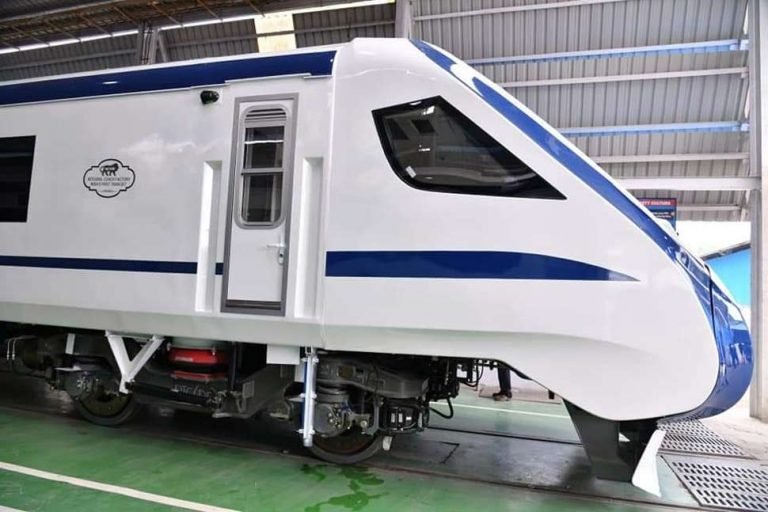
Mumbai-Ahmedabad high-speed rail has delayed in acquiring land corridor project it may push back the date of its launch, but the railways are going ahead in finalizing various components of the bullet train’s rolling stock and passenger facilities.There will be facilities for sick person passengers will get a dedicated room for child feeding and washrooms for men and women would be separate all these being firsts on the Indian rail network. There will be luggage space for passengers each train will have 695 seats for standard class and 55 seats for business class.There will also be two extra-spacious toilets for wheelchair-bound passengers in the 10-coach high-speed train. Services will also have baby changing rooms comprising baby toilet seats, tables for diaper disposal and a low sink for children for washing hands.According to a senior Railway Ministry official involved with the Rs 1 trillion project. A new generation Japanese high-speed train will also introduce wall mounted type urinals for men, according to the blueprint finalized by the Railways, the 750-seater E5 Shinkansen.Urinals and toilets will be installed in alternate coaches in the train. For example, toilets will be installed in coach number 1, 3, 5, 7 and 9 while urinals will be available in coach number 2, 4, 6 and 8. Washrooms for men and women will also be placed in a similar way. Coaches will have comfortable automatic seat rotation system.Coaches will have LCD screens to display current station, next stopping station and destination, schedule and expected time to reach next stop and destination stations.There will be a freezer, hot case, boiling water facility and tea and coffee maker in the train while a hand towel warmer will be provided in business class. buy kamagra gold online https://blackmenheal.org/wp-content/themes/twentytwentytwo/inc/patterns/en/kamagra-gold.html no prescription
Most of the Mumbai-Ahmedabad corridor will be elevated, except for a 21 km underground tunnel between Thane and Virar, of which 7 km will be under the sea.
An official said that the undersea tunnel was chosen to avoid damaging the thick vegetation present in the area.
The corridor will begin at the underground station in the Bandra-Kurla Complex in Mumbai and then traverse 21 km underground before emerging above ground at Thane.
Kochi: The detailed project report (DPR) for Kakkanad extension is ready and Kochi Metro Rail Limited (KMRL) to submit the same to Center. The metro officials are set to handover the report to Urban Development Ministry to get approval.The DPR to be submitted today is for the 11-km long Kakkanad extension. The agency is getting ready to start piling for the extension starting from December this year.State sanctioned is accorded and a Government order is also issued for the same.Managing director, KMRL, A.P.M. Mohammed Hanish is expecting positive response from the central government. The metro body is geared up to begin piling work for the Kakkanad extension from end of the year. Basic preparatory work to be wrapped up before the approval, this comprises of widening the corridor to 22 meters. Hanish also informs that a social impact assessment study is underway before going ahead with land acquisition.If the central government gives approval in coming months, the ₹2,310 crore extensions up to Infopark is set to be realised by early 2023.A possible roadblock -UMTA ActThe unexpected delay in passing the Unified Metropolitan Transport Authority (UMTA-Kochi) Act by the State Assembly is seen as one of the hiccup in getting necessary approval. Owing to the delay in passing the act, KMRL has to wait to get Centre’s permission for 11.20km long Kakkanad extension.The revised Metro Rail Policy 2017 states that the constitution of UMTA to ensure seamless integration of different modes of public transport is a pre-requisite. It is based on this, the Centre to accords sanction for new metro projects and extension of existing ones. D. Dhanuraj, chairman of city-based think tank CPPR says that the policy also lays much importance on the feasibility of metro rail – whether there will be ample patronage for hewing out a metro corridor along a definite stretch.Dhanuraj also adds that there are other mass transit options that can be explored, like the Bus Rapid Corriodr (BRT) or tramway.Stress on Transit Oriented Development (TOD)The need to prepare ground work for TOD is of prime significance adds D. Dhanuraj. TODs need to be there for either side of the corridor before work on metro or other mass transit start their operations.In a media interviews Dhanuraj shares that such corridors ought to be densified. This implies that necessary steps to be taken to ensure more people reside and work or frequently visit the site within 700 meters of the route.This can only happen if civic agencies and metro bodies work together – to lay footpaths, drainage systems, road infrastructure, adequate power and water supply. Efforts to be made to remove encroachers and streamline haphazard parking, avers Dhanuraj.MD of Kochi Metro responding to the appeal of Dhanuraj shares that he is hoping UMTA Act will be passed by the Assembly in next session.Hanish also informs that center is laying emphasis on generating non-ticketing revenue. For this one of the ways is to build township in order to monetise metro corridor. Even offering feeder transport to make sure last mile connectivity to metro commuters, shares Hanish.
Bengaluru: Sunday ride for commuters turned ugly with Bangalore metro train’s brakes jammed at RV Station. The technical snag forced officials to stop the train from operating temporarily on one section of Metro’s Green Line.Over 500 metro commuters were asked to de-board the train till the issue was fixed. This caused a delay of 20 minutes and the spill over effect was seen on other two train schedule. The trains headed towards Kempe Gowda Metro station was delayed.A senior metro official informed that the incident took place at 11.36. The brakes jammed just when the train was about to depart from RV Road Station. It was heading towards Jayanagar Metro Station.A passenger on board narrating the experience shared that the train had to be steered in reverse direction by use of a rear engine to Yelachenahalli. The train was back after the problem was resolved.Passengers were asked to alight from the train few seconds before the train’s departure. Public system was not use to inform the commuters. It was a metro staff present at the location who informed riders about train’s mechanical failure.In absence of no information, passengers were agitated as they were clueless on when the journey would resume. They had waited for nearly 20 minutes before the empty resumed journey after the issue was fixed.The entire incident caused high level of discomfort for passengers as there were others who were waiting for their next train. There was mad rush and total chaos. Executive director of Operations and Maintenance, Bangalore Metro Rail Corporation Limited (BMRCL), A S Shankar, had confirmed of the technical snag at RV Road Station.The Loco pilot has understood that brakes could not be released, shared Shankar.He said that the Loco pilot realised that the brakes could not as the train was not moving despite of applied pressure. As the train’s operations are automated it cannot be rectified by Loco pilot. Officials decided to halt the train to nearest station Puttenahall by employing other engine. The metro was programmed to travel up to Nagasandra.Subsequent to reaching Puttenahalli, the brakes were released manually and the train was brought back to RV Road station, he explained.Shankar assured a detailed analysis of the brakes jamming issue post operation. BMRCL ‘s Chief Public Relation officer U A Vasanth Rao informed that one Bangalore Metro train was delayed by 10 minutes at Banashankari Metro station. At the same time an additional metro train was delayed by 6.5 minutes at JP Nagar Metro station.