Home Blog Page 4

Bangalore Metro Pink Line misses 15th Aug deadline despite RDSO’s approval for rolling stock

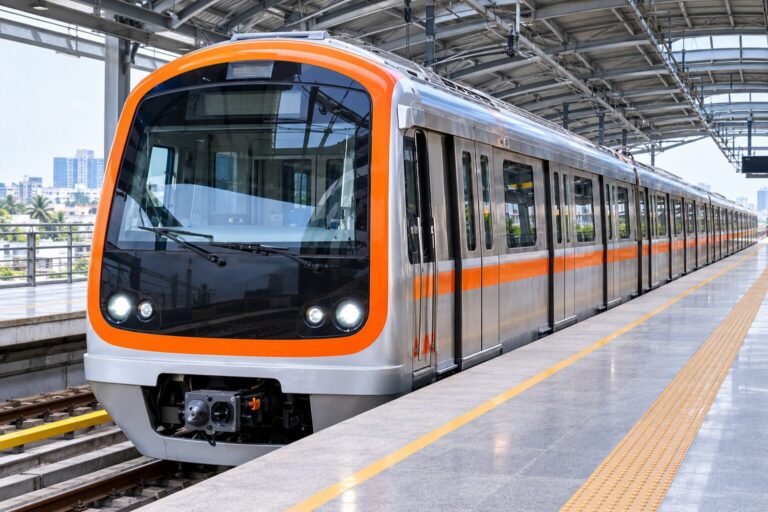
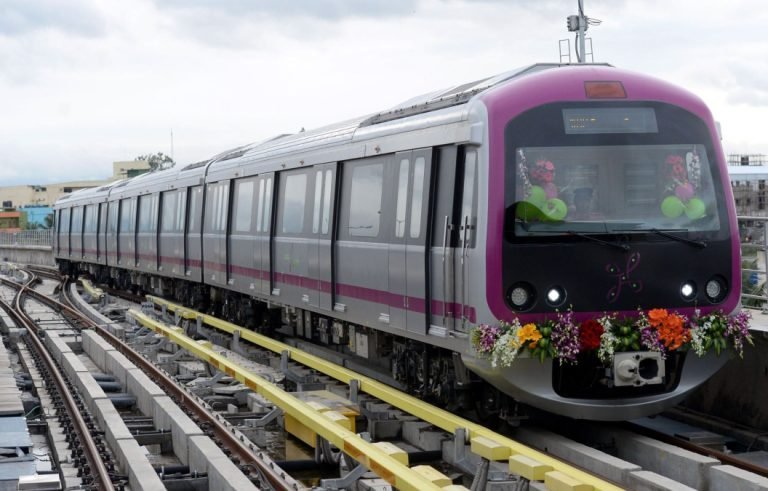
BANGALORE (Metro Rail News): Bangalore Metro Rail Corporation Limited (BMRCL) has received the interim speed certificate from Research, Design and Standards Organisation (RDSO) for the rolling stock of the upcoming Pink Line. This certification came after the successful execution of the necessary trials on the Pink Line from Kalena Agrahara to Tavarekere on Wednesday (12th August). Despite this the Pink Line has missed the deadline for 15th August. The project is now expected to open soon after the CMRS inspection.

The Chief Public Relation Officer (CPRO) of BMRCL informed on Thursday (13th August) that the new rolling stock of the pink line has gone through the Oscillation and Emergency Brake Distance Trial. The trials were successfully conducted and the RDSO granted the interim speed certification for the rolling stock.

As per an earlier confirmation, BMRCL has received eight trainsets for the pink line from BEML. They have planned to start operations with 3-4 trains in the beginning and gradually add more rolling stock.

This certification has paved the way for receiving the railway board sanction for the new rolling stock supplied by BEML. After the issue of certification, the Commissioner of Metro Rail Safety (CMRS) will inspect the rolling stocks and the overall safety standards, following which it will authorize the opening of the elevated pink line for passengers.

Bangalore Metro’s Pink line is under the Namma Metro phase II project. The pink line will connect Kalena Agrahara to Nagwara. At present, the elevated stretch of the line from Kalena Agrahara to Tavarekere is expected to open soon while the underground stretch from Dairy Circle to Nagwara is under construction. 

Also ReadBangalore Metro Pink & Blue Lines Receive Fresh Deadlines under New Leadership 

World Bank approves ₹1,409 crore loan for Gurugram Metro Phase 2, & Tenders are under evaluation

NEW DELHI (Metro Rail News): The World Bank has approved a ₹1,409 crore loan for the second phase of the Gurugram Metro, which will cover a distance of about 13km from Sector 9 to Cyber Hub. The total estimated cost of the Phase 2 project is ₹2,700 crore.

The Gurugram Metro extension project will cover a 28.5 km route from Millennium City Centre to Cyber City, and it is being executed in 2 separate phases. Phase 1 of the Gurugram Metro project involves a 15.22-km elevated corridor with 14 stations running from Millennium City Centre to Sector 9/Sector 101, including a 1.85-km spur to the Dwarka Expressway 

Work on both Phase 1 and Phase 2 will be carried out simultaneously to help the authorities complete the projects faster.

The loan proposal was submitted to the World Bank in June. The tender for the project is currently under evaluation by senior officials of Gurugram Metro Rail Limited (GMRL) and Haryana Mass Rapid Transport Corporation (HMRTC).Once the tender is approved , the process will be initiated for major civil works such as track laying, section construction and double-decker sections , The Hindustan Times reported on Tuesday ,12 Aug, 2026.

Stations and Route of the New Corridor

image 7

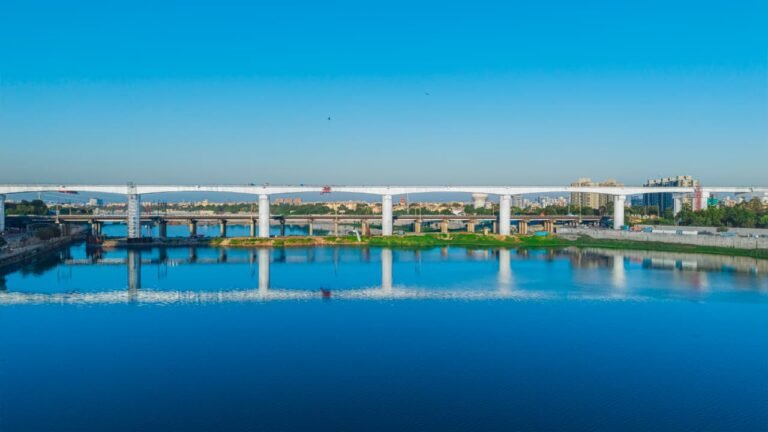
The proposed 13 km Sector 9 to Cyber Hub corridor will have 14 stations.These include Sector 7, Sector 4, Sector 5, Ashok Vihar, Sector 3, Bajghera Road, Palam Vihar Extension, Palam Vihar, Sector 23A, Sector 22, Udyog Vihar Phase 4, Udyog Vihar Phase 5 and Cyber City. A spur towards Gurugram Railway Station is also planned.

The new line will provide interchange facilities with the existing Rapid Metro as well as the Namo Bharat corridor, improving overall connectivity across Gurugram.

Current progress on Gurugram Metro Phase 1

Work on the first phase of the Gurugram Metro is progressing rapidly along the Millennium City Centre–Sector 9 corridor, with three pier caps laid and 28-metre U-shaped girders set to launch on August 28 near Sector 40.

The tender for the metro depot is under evaluation and expected to be awarded within a month. Meanwhile, land acquisition near Islampur and Basai for the depot and station is being expedited. GMRL Managing Director Mr. Chander Shekhar Khare confirmed the high-priority project remains on track, with a review meeting scheduled in Chandigarh this week.

Also Read: 238 Metro-Like Trains Announced for Mumbai – A Game Changer for Mumbaikars or a Challenge for Mumbai Metro? 

238 Metro-Like Trains Announced for Mumbai – A Game Changer for Mumbaikars or a Challenge for Mumbai Metro? 

MUMBAI (Metro Rail News): Mumbai’s suburban railway fleet is about to undergo a significant change, with 238 metro-like trains expected to start service in 2027. Chief Minister Devendra Fadnavis announced that the entire suburban fleet will shift to the new format by March 2030. The new trains will include features like automatic doors, air-conditioning, improved cleanliness, and better passenger amenities for Mumbai’s busy local train network. 

238 Metro-like trains to enter service from 2027

Fadnavis stated that the Centre has approved producing suburban trains using the design and features of Metro trains. These trains will be made at facilities that also produce modern rolling stock, including Vande Bharat trains. The first 238 metro-like suburban trains should be introduced in 2027. The government aims to convert the entire suburban fleet by March 2030. 

This announcement came during the launch of several MMRDA infrastructure projects in Mumbai, which included opening of the Chembur Metro Station on Mumbai Metro Line 2B.

The positive case: Why this could be a game changer

Mumbai’s suburban railway currently serves millions of passengers each day. According to the Indian Express report, nearly 127 million passengers travelled on Mumbai Suburban Rail in January 2026. Upgrading the trains could significantly enhance the daily travel experience for many commuters. 

  • Metro-style comfort without changing travel habits: Passengers wouldn’t need to change their usual travel habits to take advantage of this upgrade. Features like air-conditioning, automatic doors, and improved interiors could provide a Metro-like experience to the suburban network while keeping the same routes and reach of local trains. 
  • Higher value from existing infrastructure: The plan also allows Mumbai to enhance its current railway system instead of solely depending on new Metro infrastructure to meet growing travel demand. With the railway already covering a vast network, modern trains could increase the value of that system.

The negative case: Could this impact Metro ridership? 

Mumbai has invested heavily in expanding its Metro network. New corridors are gradually attracting passengers and providing alternative routes to the suburban railway.  However, the Metro will face competition from a suburban system that already offers extensive coverage and a large daily user base. 

  • Why switch if locals become Metro-like? : If local trains provide air-conditioning, automatic doors, and enhanced passenger facilities, some commuters might find fewer reasons to switch to Metro services, especially when both networks cover similar areas. This issue could be more relevant on routes where Metro and suburban railway stations are close together or serve overlapping travel markets. 

Mumbai’s challenge will be to ensure that its suburban railway and metro system compliment each other instead of competing unnecessarily. The two system serve different purposes, but their passenger areas can overlap. Interchange facilities, coordinated planning, and clear route specialization could help both networks attract and distribute passengers more effectively.

Also Read: Mumbai Metro: CM Devendra Fadnavis to inaugurate Chembur Metro Station on Line 2B

Patna Metro project obtains ₹628.32 Cr. from central govt. SASCI funds

PATNA (Metro Rail News): Patna metro project has obtained ₹628.32 crores fund allocation under Central Government’s Special Assistance Scheme for Capital Investment (SASCI) for the financial year 2026-27. This allocation has been made by the Government of Bihar from the overall approved allocation of ₹2,925 crore under the scheme. This new allocation is expected to expedite the work of Patna metro.

The central government sanctioned ₹2,628.32 crore to Bihar under the SASCI scheme on 23rd July. The state allocated ₹628.32 crore for the Patna metro project. It is expected that more funds will be allocated for the project. The funding mechanism of this project involves 20% of the overall cost from the state, 20% from the centre and the rest 60% from loans including that from Japan International Cooperation Agency (JICA).

According to a report of the Ministry of Housing and Urban Affairs (MoHUA), the physical progress of the 32.5 km Patna Metro Phase-I has reached 53% as of June, 2026. On the 2nd of July, 2026, the metro expanded its network to Malahi Pakri station extending metro connectivity to the busy Kankarbagh area of the city. After this extension, the metro’s operational length surpassed 6 km with five stations. 

About Patna Metro Project

The Patna Metro project Phase-I is a major developmental project in the capital of Bihar. The 32.5 km project has two corridors. Line 1 (red line) connects Danapur Cantonment to Khemmi Chak and line 2 (blue line) connects New ISBT to Patna Junction. There are two interchange stations planned at Khemmi Chak and Patna Junction. At present, the metro is operational along line 2 covering five stations from New ISBT to Malahi Pakri.

Also Read: Patna Metro Corridor-1:DMRC floats ₹10.86 Cr tender for track fastening system

Bengaluru Metro to connect Tamil Nadu Border: BMRCL plans 9 new stations 

BENGALURU (Metro Rail News): Bengaluru Metro is set to extend the Yellow Line from Bommasandra to Attibele, moving the corridor closer to the Tamil Nadu border. This proposed 10.5 km extension could enhance metro access along the rapidly developing Hosur Road corridor while Karnataka and Tamil Nadu are still deciding how to connect their metro systems.

image 7

Bengaluru Metro to move closer to Tamil Nadu border

The Bangalore Metro Rail Corporation Limited (BMRCL) has finished a feasibility study for extending the Yellow Line beyond its current Bommasandra terminal. The planned elevated route will cover about 10.5 km up to Attibele and will include 9 stations. The state government has approved the proposal to move forward. BMRCL is expected to invite tenders for creating the Detailed Project Report (DPR).

The extension will be built along the right side of Hosur Road (NH 44) and will serve several rapidly growing residential, industrial, and commercial areas between Bommasandra and Attibele.

Proposed stations

The nine-station alignment will include:

  1. Narayana Institute of Cardiac Sciences
  2. Chandapura Circle
  3. Hale (Old) Chandapura
  4. Thirumagondanahalli
  5. Balagaranahalli
  6. Attibele Industrial Area
  7. Yadavanahalli
  8. Attibele
  9. Attibele Terminal

The first station at Narayana Institute of Cardiac Sciences will be approximately 1.5 km from the existing Bommasandra terminal. Chandapura Circle will be about 1.8 km further along the proposed route. Several stations are expected to serve nearby areas. Thirumagondanahalli and Balagaranahalli will provide access to localities like Neralur, Chandapura, Masrur, and Suryanagar. Yadavanahalli station will also serve Jigala, Giddenahalli, and Krishnasagara. BMRCL plans to connect the stations with nearby neighborhoods through foot overbridges and subways where needed.

Separate plans for Bengaluru-Hosur metro link

This development occurs as Karnataka and Tamil Nadu continue to discuss a metro connection between Bengaluru and Hosur. Tamil Nadu has proposed a 23 km metro corridor between Hosur and Bommasandra, which includes 12 stations. About 12 km of the proposed route will be in Karnataka, while the remaining 11 km will be in Tamil Nadu. However, this proposed cross-border connection faces technical and administrative challenges. BMRCL has found several differences between the two states’ metro systems:

  • Traction: Bengaluru Metro uses 750V DC third-rail traction, while Tamil Nadu has proposed 25kV AC overhead electrification.
  • Train configuration: Bengaluru Metro operates six-coach trains, while Tamil Nadu has suggested three-coach trainsets.
  • Land acquisition: There is currently no clear process for acquiring land for the interstate project.
  • Revenue sharing: The agreement on sharing fare revenue between Karnataka and Tamil Nadu is not finalised.

These differences complicate direct integration of the two systems.

Attibele to come up as interchange point

Instead of merging the two metro systems directly, BMRCL has proposed an alternative approach. In this plan, Karnataka and Tamil Nadu could each build their metro lines up to their respective sides of the state border. The systems could connect through a 90-metre foot overbridge between the stations at Attibele. This would allow passengers to switch between the two metro networks without the trains needing to cross the state line.

Also Read: Lucknow Metro launches ‘Anjaneya’, electric-feeders for Last-Mile connectivity

Lucknow Metro launches ‘Anjaneya’, electric-feeders for Last-Mile connectivity

LUCKNOW (Metro Rail Corporation): Lucknow Metro has launched an electric feeder vehicle service to provide safe, affordable and convenient last-mile connectivity for passengers. Officially named ‘Anjaneya’, the service started operations on Wednesday, 12 August 2026, from Amausi Metro station.

In the initial phase, the service will cover four routes and operate daily from 6:00 am to 10:30 pm. Fares will range between ₹15 and ₹50, making it an economical option for daily commuters. Each vehicle is equipped with SOS emergency buttons, CCTV cameras and GPS tracking to ensure passenger safety and real-time monitoring.

Routes of Feeder Service

RouteMetro StationStops
BR-03Amausi Metro Station Nadarganj Chauraha, Haidari Chauraha, Gwari, Sarojini Nagar,Scooter India Chauraha Banthra. 
BR-04Indira Nagar Metro Station Polytechnic Chauraha, Awadh Bus Stand, Husariya, Ekana Stadium, Ahmamau, LuLu Mall, Utretia 
BR-08Indira Nagar Metro Station Polytechnic Chauraha, Kamta, Chinhat Tiraha, Matiyari Chauraha, BBD, Tiwariiganj, Anora Kala Underpass 
R-18Indira Nagar Metro Station Polytechnic Chauraha, Wave Mall,RML, IGP, Kathauta Chauraha, Takwa Chauraha, Divine Hospital, Dayal, Gomti Nagar Railway Station, Mantri Awas Marg, Lohia Path, HAL

The new feeder service will help passengers easily travel between metro stations and nearby neighbourhoods, reducing dependence on auto-rickshaws or private vehicles for short distances. It is expected to benefit office-goers, students, senior citizens and families who often face difficulty in reaching metro stations comfortably.

By combining safety features, affordable fares and reliable connectivity, the service aims to make metro travel more complete and passenger-friendly across Lucknow.

Also Read: New Amrit Bharat Express to Connect Jharkhand, Madhya Pradesh, Maharashtra, Telangana, Andhra Pradesh & Tamil Nadu

New Amrit Bharat Express to Connect Jharkhand, Madhya Pradesh, Maharashtra, Telangana, Andhra Pradesh & Tamil Nadu

NEW DELHI (Metro Rail News): In a major step to make long-distance travel easier and more convenient, Indian Railways is introducing the new Amrit Bharat Express between Dhanbad and Coimbatore. The service will connect Jharkhand, Madhya Pradesh, Maharashtra, Telangana, Andhra Pradesh and Tamil Nadu and cover 39 major stations along the route.

Two trains will operate on this corridor. The Dhanbad-Coimbatore Amrit Bharat Express will start its journey on Saturdays, while the Coimbatore-Dhanbad Amrit Bharat Express will begin operations on Tuesdays.

https://twitter.com/GMSRailway/status/2087451432819798518

Details of the Trains

Dhanbad -Coimbatore Amrit Bharat Express (22363),Saturdays
Dhanbad Jn
|
Balharshah
|
Renigunta
|
Coimbatore
4.10 pm (Sat)

9.10/9.15 pm 

10.40/10.50 am (Sun)

6.30 pm (Mon)
Coimbatore-Dhanbad Amrit Bharat Express(22364),Tuesdays
Coimbatore
|
Renigunta
|
Balharshah
|
Dhanbad Jn
7.50 am (Tue)

4.35/4.45 pm

7.00/7.05 am (Wen)

1.00 pm (Thu)

Currently, the main direct trains between Dhanbad and Coimbatore are the Dhanbad-Alappuzha Express and its return service. These trains often run fully booked, especially during peak vacation periods, leaving many passengers without comfortable options.The service will also ease pressure on existing trains and make travel easier for families, students and working professionals, enhancing overall connectivity, comfort and convenience on this important route.

The new Amrit Bharat Express will strengthen east-south connectivity and offer a more reliable alternative. Designed for comfort, the trains will provide better seating, improved onboard facilities and a smoother journey for long-distance travellers.

Also Read: Rail Coach Factory rolls out first batch of 19 LHB coaches for Bangladesh Railway

Mumbai Metro: CM Devendra Fadnavis to inaugurate Chembur Metro Station on Line 2B

MUMBAI (Metro Rail News): The Mumbai Metropolitan Region Development Authority (MMRDA) will open the Chembur Metro station on Metro Line 2B on August 13 (Today). This extends the operational section of the corridor by one station. The new station will connect the Metro, suburban railway, and Monorail, making it a key interchange for commuters in eastern Mumbai.

The Chembur station received approval from the Commissioner of Metro Railway Safety (CMRS) in June. This approval cleared the last regulatory requirement for passenger operations. Chief Minister Devendra Fadnavis will inaugurate the station today. He will be joined by Deputy Chief Minister and MMRDA Chairman Eknath Shinde and Deputy Chief Minister Sunetra Pawar. The station is part of a larger program. The MMRDA will also inaugurate four major projects today, including:

  • Chembur Metro station on Line 2B
  • Phase II of the Santacruz-Chembur Link Road
  • TBM Arjuna for the Thane-Borivali Twin Tunnel Project
  • Renaming of the BKC Connector after former Chief Minister Dr. Babasaheb Bhosale

Three transport modes within walking distance

The importance of the Chambur Metro Station largely comes from its location. The metro station is about 200 meters from Chambur Railway Station and around 100 meters from the V N Purav Marg Monorail station. This will bring three public transport systems closer together- Metro Line 2B, Suburban Railway and Mumbai Monorail.

For passengers arriving at Chembur by suburban train, the Metro will provide another option to travel towards areas connected by Line 2B. Similarly, commuters from the eastern suburbs will be able to switch between Metro and suburban rail instead of relying solely on road transport.

Mumbai Metro Line 2B gets 6th operational station

Phase I of Mumbai Metro Line 2B currently covers a 5.4 km stretch between Diamond Garden and Mandale, with five stations:

  • Diamond Garden
  • Shivaji Chowk
  • BSNL Metro
  • Mankhurd
  • Mandale

With the addition of Chembur, the operational eastern section will now have six stations. The first phase of this section began passenger operations in April. The inclusion of Chembur gives this relatively short operational corridor a direct tie to Mumbai’s established suburban rail and Monorail networks.

Also Read: Mumbai Metro: MMRDA awards ₹29.63 cr contract for Signage Works on Line 6 & 7A

Chennai Water Metro: CMRL floated tender for DPR along Buckingham Canal

CHENNAI (Metro Rail News): Chennai water metro is gradually becoming a reality. The Chennai Metro Rail Limited (CMRL) has floated a tender for the  Detailed Feasibility Report (DFR) cum Detailed Project Report (DPR) for the study of the feasibility of water metro transport from Ennore to Mahabalipuram along the Buckingham Canal. The last date for the submission of tender is 18th September 2026.

The study is expected to include various scientific assessments and technical analysis to test the feasibility of the water metro project. It is expected to assess the topography, water quality, route, project feasibility, expected ridership, environmental impact of the project and the financial assessments for the project.

The water metro will improve the connectivity in Chennai. It will connect the major corridor between Ennorre and Mahabalipuram through the Buckingham Canal. This project is expected to integrate other land transport such as rail, metro and other public transport to facilitate multi-modal connectivity. The project will also be an eco-friendly initiative as the boats will use batteries and reduce carbon emissions. 

India’s water metro expansion plan

At present, there is only one operational water metro in India, Kochi water metro in Kerala. The project has been successful in integrating multi-modal connectivity and improving mobility in Kochi. Recently, the Ministry of Port, Shipping and Waterways (MoPSW) has identified 18 cities for the development of water metro. This initiative will strengthen multi modal connectivity and expand India’s water metro map.

Also Read: Mumbai to get world’s largest water metro network

Mumbai Metro: MMRDA awards ₹29.63 cr contract for Signage Works on Line 6 & 7A

MUMBAI (Metro Rail News): The Mumbai Metropolitan Region Development Authority (MMRDA) has awarded a ₹29.63 crore contract to Milestone Corporation for signage, graphics and station elements across 14 stations on Mumbai Metro Lines 6 and 7A. The contract covers the design, manufacture, supply, installation, testing and commissioning of these station elements.

Contract details

Information Details
Contract Number MMRDA/MPIU/ML6/CA-309
Awarding AuthorityMumbai Metropolitan Region Development Authority (MMRDA)
Contract Value ₹29.63 crore
Contractor  Milestone Corporation
Completion Period 15 Months

Bidder details 

Bidder Bid Value Status
Milestone Corporation₹29.63 crore (L1)Accepted – AOC
CBM Industrie Ltd₹30 crore (L2)Rejected – Financial
AGX Retail Solutions Pvt. Ltd.Rejected – Technical

Scope of work

The contract includes design, manufacture, supply, installation, testing and commissioning of signage, graphics and station elements for 14 elevated stations viz. Swami Samarth Nagar, Adarsh Nagar, Jogeshwari (W), JVLR, Shyam Nagar, Mahakali Caves, Seepz Village, Saki Vihar Road, Rambaug, Powai Lake, IIT Powai, Kanjurmarg (W) and Vikhroli (EEH) (13 stations) of Metro Line 6 and Airport colony station (1 station) of Metro Line 7A of Mumbai Metro Rail Project of MMRDA. 

About Mumbai Metro Line 6 & 7A

Mumbai Metro Line 6 is a 15.31 km east-west corridor planned between Swami Samarth Nagar and Vikhroli. The line will improve connectivity across several important areas of Mumbai and provide links with other metro corridors.

Metro Line 7A is a 3.42 km extension of Metro Line 7, connecting Gundavali with CSMIA Terminal 2. The extension will strengthen metro access to Mumbai’s airport and improve connections with the existing Metro network.

Also Read: MMRDA grants signage contract to CBM Industrie for Mumbai Metro Line 2B