




This article has not been translated yet, so the English original is shown below. Translate now (takes a few seconds).
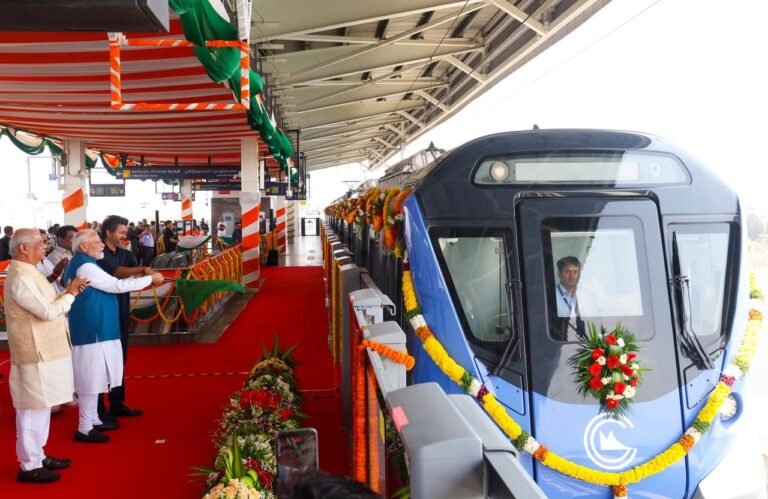
CHENNAI (Metro Rail News): Prime Minister Narendra Modi and Tamil Nadu Chief Minister Joseph Vijay inaugurated the first operational stretch of Chennai Metro Phase II, opening around 15 km of Corridor 4 between Poonamallee Bypass and Vadapalani. The ₹4,900 crore section adds 11 elevated stations and a double-decker viaduct, but six more stations and permanent entry and exit facilities at Vadapalani remain unfinished.
PM Modi and CM Vijay also travelled on the Metro between Poonamallee Bypass and Porur as officials briefed them on the project. The opening gives western Chennai a new rail connection, though passengers will initially have to use a temporary link to transfer between the new section and the existing Metro network at Vadapalani.
Chennai Metro Phase II Corridor 4 opens with 11 stations
The newly inaugurated section forms part of Corridor 4 under Chennai Metro Phase II. It runs from Poonamallee Bypass to Vadapalani and includes 11 elevated stations:
Get the Daily Metro & Rail Brief
Join 125,000+ metro and rail professionals. Project updates, new tenders and contract awards from across India, in your inbox every day.
- Poonamallee Bypass
- Poonamallee Bus Stand
- Poonamallee Government Hospital
- Karayanchavadi
- Kumananchavadi
- Kattupakkam
- Iyappanthangal
- Thelliyaragaram
- Porur Bypass
- Porur Junction
- Vadapalani
The corridor is expected to improve connectivity between western suburbs and central Chennai, offering commuters an alternative to congested roads.
The elevated section also features a double-decker structure of around 3.7 km, where the Metro viaduct runs above road infrastructure. Advanced signalling has been designed to support driverless train operations.

The section also introduces platform screen doors on an elevated Metro stretch in Chennai, adding a safety feature previously associated with other parts of the network.
Six stations and Vadapalani access works still pending
Despite the opening, construction continues on the remaining six stations between Porur and Vadapalani, along with permanent entry and exit facilities at Vadapalani.
Until those works are completed, passengers will use a link bridge connecting the new Phase II station facilities with the existing Phase I Vadapalani station.
The remaining stations and access works are expected to be ready by December, according to the New Indian Express report. Until then, the new corridor will operate with an incomplete set of planned station facilities.
Next focus: Koyambedu-Alandur connection
With the Poonamallee-Vadapalani stretch open, attention is turning to the wider Koyambedu-Alandur section, which is expected to cover nearly 29.6 km. The plan originally covered a 26-km stretch up to Chennai Trade Centre (CTC). Officials now aim to complete the additional 3.6-km link from CTC to Alandur, passing through the congested Butt Road area.
Track work up to CTC has been completed, and trial runs from Koyambedu to CTC are expected by the end of November. Extending trials to Alandur will take longer because track installation on that section is still pending. The extension of trials is expected to require around two additional months.
Chennai Metro Phase II Corridor 4: Key Project Details
| Information | Details |
| Project | Chennai Metro Phase II, Corridor 4 |
| Inaugurated stretch | Poonamallee Bypass-Vadapalani |
| Length | Around 15 km |
| Cost | ₹4,900 crore |
| Stations opened | 11 elevated stations |
| Double-decker structure | Around 3.7 km |
The opening brings Metro services deeper into western Chennai, but the corridor is not yet complete at all planned stations. The next milestones are finishing the pending Vadapalani access and six stations, followed by trial runs towards CTC and Alandur. The pace of those works will determine how quickly the wider Chennai Metro Phase II network can deliver its intended connectivity gains.
Also Read: Chennai Metro Phase II Records Three TBM Breakthroughs in 3 Days
Project Overview