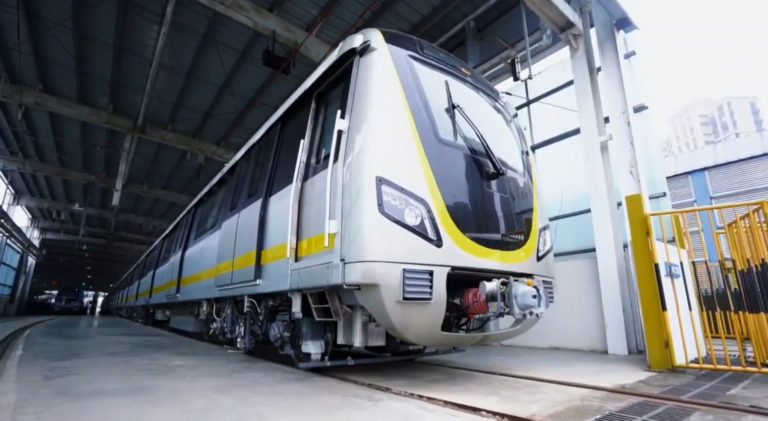
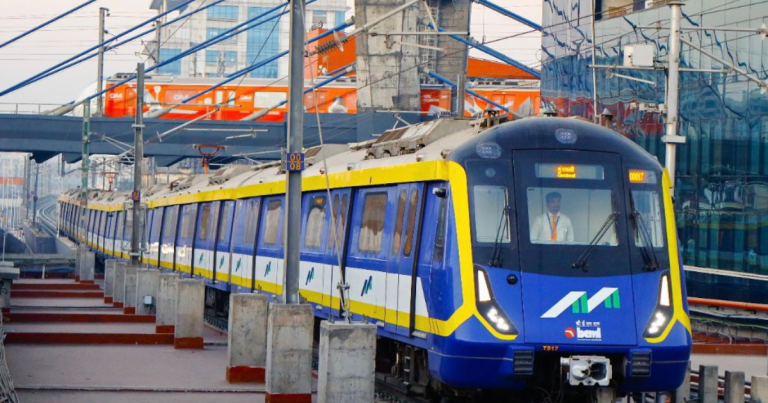
Mumbai (Metro Rail News): Mumbai Metro progressed as the Mumbai Metropolitan Region Development Authority (MMRDA) awarded three major contracts (Package CA-264,Package CA-265, Package CA-266 ) for architectural finishing activities at 13 elevated stations of Line 6 (Pink Line), which span 15.18 km from Swami Samarth Nagar (Lokhandwala) to Vikhroli.
Contact Details
Initial Contract: Originally, Delhi Metro Rail Corporation (DMRC) invited bids for these contracts under packages BC-04, BC-05 & BC-06 in August 2023. However, the tender was cancelled later.
MMRDA re-invited tender for the same contract in August 2024. Furthermore, in September 2024, Technical and financial bids were opened for the contract.
Package CA-264
SS SS Constructions grabbed Package CA-264 from MMRDA at Rs. 76.68 cr) and a 24-month deadline.
Scope of Work: This package includes the architectural finishing work for 3 elevated stations from IIT Powai to Vikhroli EEH.
Stations
IIT Powai
Kanjur Marg (W)
Vikhroli
MMRDA’s Brief Scope: Architectural finishing works including design, fabrication, supply, erection & roof sheeting of Pre-Engineered Building (PEB) structures and design & construction of external facade, water supply, sanitary installation, drainage, site development works at Three (03) Elevated Stations namely IIT Powai, Kanjur Marg (W) and Vikhroli (EEH) of Mumbai Metro Line-6 Project.
Note: The following stations are under construction by J Kumar Infraprojects under package BC-01R1
Package CA-265
MMRDA Awarded Package CA-265 to NA Construction at Rs. 124.41 cr with a 24-month deadline.
Scope of Work: The awarded contractor will be responsible for the architectural finishing work for 5 elevated stations between Mahakali Caves and Powai Lake.
Stations:
Maha Kali Caves
SEEPZ Village
Saki Vihar Road
Rambaug
Powai Lake
MMRDA’s Brief Scope: Architectural finishing works including design, fabrication, supply, erection & roof sheeting of Pre-Engineered Building (PEB) structures and design & construction of external facade, water supply, sanitary installation, drainage, site development works at Five (05) Elevated Stations namely Maha Kali Caves, SEEPZ Village, Saki Vihar Road, Rambaug & Powai Lake of Line-6, Swami Samarth Nagar to Vikhroli (EEH) corridor of Mumbai Metro Project.
Note: The stations mentioned above are under construction by MBZ – EIIL JV under package BC-02R.
Package CA-266
Landmark – Neev JV secured package CA-266 from MMRDA at Rs. 165.93 cr and 24 months deadline.
Scope of work: The awarded contractor will be responsible for the architectural finishing activities for 5 elevated stations between Swami Samarth Nagar and Shyam Nagar
Stations:
Swami Samarth Nagar
Adarsh Nagar
Jogeshwari (W)
JVLR
Shyam Nagar
MMRDA’s Brief Scope: Architectural finishing works including design, fabrication, supply, erection & roof sheeting of Pre-Engineered Building (PEB) structures and design & construction of external facade, water supply, sanitary installation, drainage, site development works at Five (05) Elevated Stations namely Swami Samarth Nagar, Adarsh Nagar, Jogeshwari (W), JVLR & Shyam Nagar of Mumbai Metro Line-06 Project.
Note: The stations covered in this contract are being constructed by J Kumar—CRTG JV under package BC-03.
Ahmedabad city is situated near the banks of the Sabarmati River and lies approximately 25 kilometres from Gandhinagar, the capital of Gujarat. The city is famous for its rich cultural heritage and historical significance, blending tradition with modernity. Ahmedabad city was founded in 1411 A.D. by Sultan Ahmed Shah, who named it after himself.
Historically known as the “Manchester of India,” Ahmedabad has been home to textile industries that have contributed to its economy. The city was the capital of Gujarat from 1960 to 1970, after which Gandhinagar became the state capital.
Ahmedabad is the fifth most populous city in India and the largest city in Gujarat, with an estimated population of 8.85 million. However, the city’s transport infrastructure struggled to keep pace with rapid urbanisation and the growing number of commuters. This created an urgent need for an efficient and reliable transport system to meet the demands of its residents. The Ahmedabad Metro system was introduced as a viable solution to address these challenges and improve urban mobility.
Historical Background Of Ahmedabad Metro
2003 (Initial Study): Gujarat Infrastructure Development Board conducted a study for urban transport between Gandhinagar and Ahmedabad.
June 2005 (DPR Approval): Detailed Project Report (DPR) prepared by Delhi Metro Rail Corporation (DMRC) and RITES was submitted and approved by the Central Government.
2005 (Project on Hold): Due to its viability and substantial cost of ₹4,295 crore the project was put on hold to prioritise Ahmedabad BRTS and Suburban railway projects.
2008: The project was revived, and new corridors were designed to assess its feasibility.
4 February 2010: The Government of Gujarat established a special purpose vehicle (SPV), Metro Link Express for Gandhinagar and Ahmedabad Company Ltd, with an initial allocation of ₹202 crore.
2014: The Central Government decided to take a 50% ownership stake in the SPV.
2018: The SPV was renamed Gujarat Metro Rail Corporation Limited (GMRC).
Glance At Ahmedabad Metro
Overview
Ahmedabad Metro is an Urban Mass Rapid Transit System (MRTS). The project was previously known as ‘Metro-Link Express for Gandhinagar and Ahmedabad’ (MEGA). The Gujarat Metro Rail Corporation (GMRC) Limited is responsible for the execution of the Ahmedabad Metro.
Phase 1, which spans 39.26 km became fully operational on 8 December 2024.
Phase 2, includes the extension of the existing line and one new corridor, currently out of 28.254 km the 20.8 km is operational while the remaining 7.45 km is under construction.
Key Specification
Authorized Authority
Gujarat Metro Rail Corporation (GMRC) Limited.
Speed and Track
Top Speed: 80 kmphAverage Speed: 33 kmphTrack Gauge: Standard Gauge – 1435 mm
Electrification
750 V DC Third Rail
Signalling
Communication-based Train Control (CBTC)
Daily Ridership
90,000/day (March 2023)
Rolling Stock
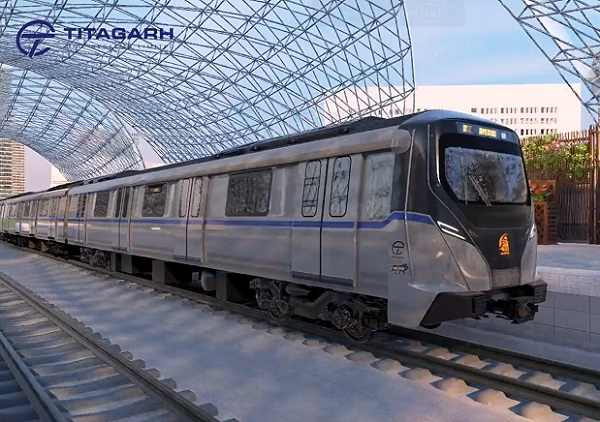
Phase 1: 96 coaches (32 train sets x 3) supplied by Hyundai RotemPhase 2: 30 Coaches ( 10 train sets x 3) will be supplied by Titagarh
Routes of Ahmedabad Metro
Operational: 60.06 km Under Construction: 7.45km
Phase 1
Overview
In February 2014, The Delhi Metro Rail Corporation (DMRC) prepared the DPR of Phase 1. The central government approved 39.26 km long Phase 1 of Ahmedabad Metro with 2 corridors on 18 October 2014. The entire Phase 1 project has been constructed at a cost of more than ₹12,900 crores.
14 March 2015: Construction commenced on the 6.5 km (4.039 mi) long Vastral – Apparel Park stretch of the East-West Corridor.
March 2016: Construction work for the North-South Corridor officially commenced.
June 2016: Indian Railways granted permission for the construction of the North-South Corridor on its land.
November 2015: Japan International Cooperation Agency (JICA) agreed to provide funding of ₹5,968 crore (US$720 million) for Phase 1 of the project.
2016: The first tranche of ₹4,456 crore (US$530 million) was released by JICA.
Station Names: Motera Stadium, Sabarmati, AEC, Sabarmati Railway Station, Ranip, Vadaj, Vijay Nagar, Usmanpura, Old High Court Interchange, Gandhigram, Paldi, Shreyas, Rajiv Nagar, Jivraj Park, APMC
Phase 1 Timeline
Date
Section
Distance
Line
6 March 2019
Vastral – Apparel Park
6 km
Blue Line
30 September 2022
Apparel Park – Thaltej
13.34 km
Blue Line
30 September 2022
APMC – Motera
18.52 km
Red Line
08 December 2024
Thaltej – Thaltej Gam
1.4 km
Blue Line
Major Contractors Involved in Phase 1
Contract
Contractor
General Consultant (GC) Service for Ahmedabad Metro Phase 1
SYSTRA – RITES – Oriental – AECOM JV
Supply and manufacture of 96 Coach Rolling Stock for Phase 1
Hyundai Rotem
design, supply, install, test and commission ballastless tracks for Ahmedabad Metro’s Phase 1 project.
Larsen & Toubro
Signalling and Train Control Systems
Nippon Signal
Telecommunication System for Phase 1 of Ahmedabad Metro
Larsen & Toubro
Power Supply Receiving & Distribution System, 750 V DC Third Rail Traction Electrification and SCADA System
Siemens Ltd. (India) – Siemens AG (Germany) JV
Construction of 6 km viaduct between Vastral Gam and apparel Park
J Kumar Infraprojects
Construction of 6 stations from Vastral Gam to Apparel Park
DRA – CICO JV
Construction of 4.62 km viaduct and 4 stations between Gyaspur Depot and Shreyas
IL&FS Engineering
Construction of 4.85 km viaduct from Motera to Ranip
Ranjit Buildcon
Construction of 5 stations between Motera and Ranip
Pratibha – Ranjit JV
Construction of 8.94 km viaduct and 6 stations between Shreyas and Ranip
Simplex Infrastructure
Construction of 2.45 km tunnel and 2 stations between East Ramp and Kalupur
Afcons Infrastructure
Construction of 4.38 km tunnels and 2 stations between Kalupur and West Ramp
Larsen & Toubro
Thaltej Gam to West Ramp(Viaduct, Sabarmati Bridge &7 stations – 8.21 km)
Tata – CCECC JV
Phase 2
Overview
On 19 February 2019, the Central Government of India approved the Phase 2 expansion of the Ahmedabad Metro project. This phase spans a total length of 28.254 kilometres and features the creation of a new corridor and the extension of the existing Red Line. The estimated cost of Phase 2 is Rs. 5384.17 crores.
February 2016: The Gujarat state government allocated ₹2 crore in its 2016-17 state budget for the preparation of the Detailed Project Report (DPR) for Phase 2. The Delhi Metro Rail Corporation (DMRC) was appointed to draft the DPR.
19 February 2019: The Central Government Cabinet approved Phase 2.
Operational Route of Phase 2
Line-2 (North-South / Red Line): Motera Stadium – Gandhinagar Sector-1
Length: 15.4 km
Type: Elevated
Number of Stations: 6
Station Names: GNLU, Raysan, Randesan, Dholakuva Circle, Infocity, Sector-1
Line-3 (Eastern Spur): Gujarat National Law University – Gujarat International Finance Tec-City (GNLU – GIFT City)
Length: 5.416 km
Type: Elevated
Number of Stations: 3
Stations Names: Gujarat National Law University (GNLU), Pandit Deendayal Petroleum University (PDPU) and Gujarat International Finance Tec-City (GIFT City)
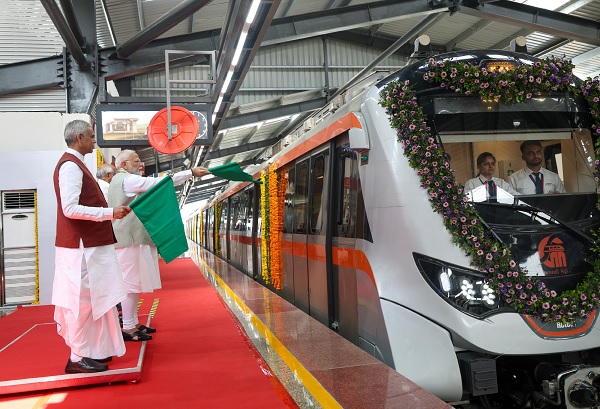
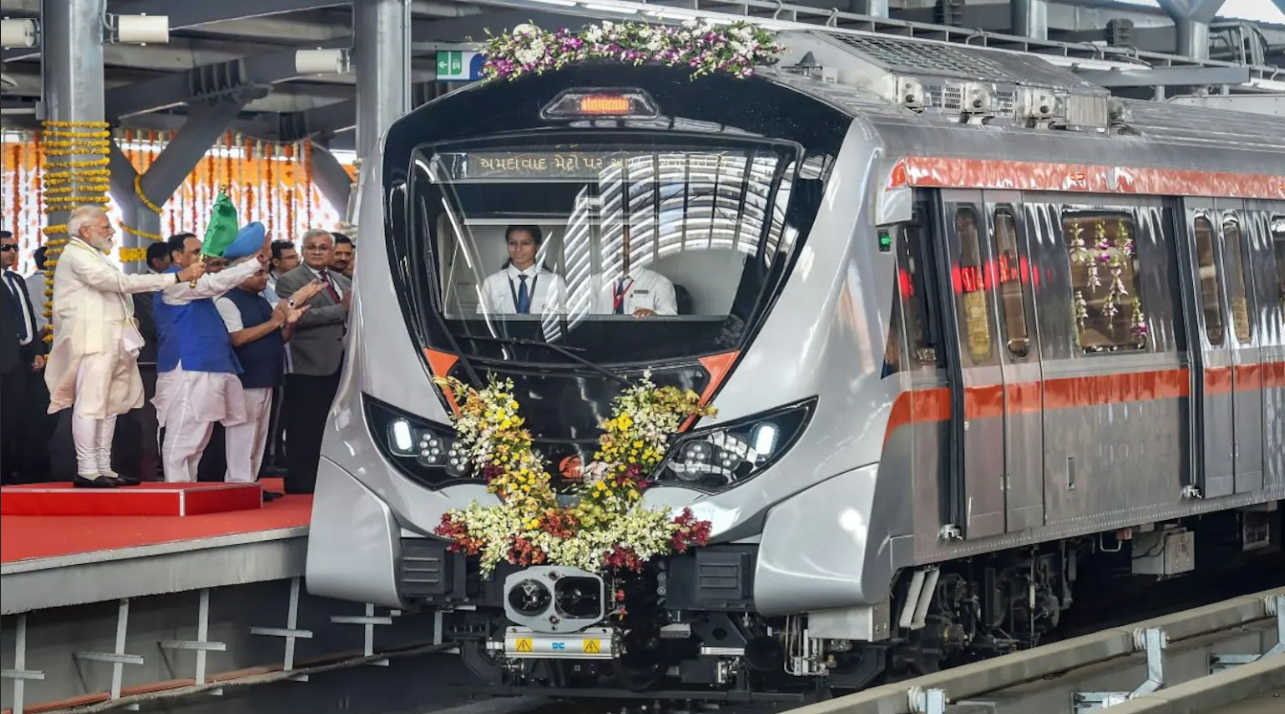
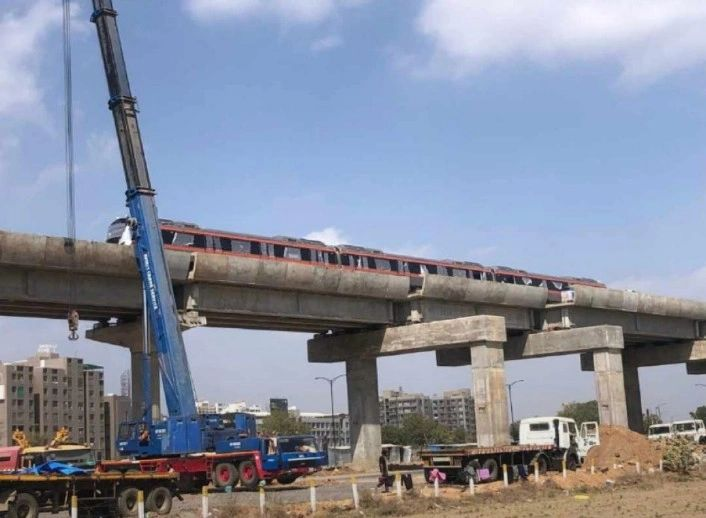
Recent Update: Trial Runs In February 2024, Gujarat Metro Rail Corporation (GMRC) initiated the trials on Ahmedabad Metro Phase 2’s 3.3 km elevated section between Dholakuva and Gujarat National Law University (GNLU) in Gandhinagar District. On 11 March 2024. Gujarat Metro Rail Corporation (GMRC) began the trial runs on Line 3 of Ahmedabad Metro Phase 2 spanning 5.416 km from (GNLU – GIFT City). Inauguration Mr Narendra Modi, the Prime Minister of India, inaugurated the Ahmedabad Metro’s Red Line extension from Motera Stadium to Gandhinagar Sector-1 and Line 3 of Phase 2 on 16 September 2024.
Under Construction Route in Phase 2
Line-2 (North-South / Red Line): Gandhinagar Sector-1 – Mahatma Mandir
Length: 7.45 km
Type: Elevated
Depot: Indroda (construction hasn’t started)
Number of Stations: 14
Station Names: Koteshwar Road, Vishwakarma College, Tapovan Circle, Narmada Canal, Koba Circle, Juna Koba, Koba Gam, Sector-10A, Sachivalaya, Akshardham, Juna Sachivalaya, Sector-16, Sector-24 and Mahatma Mandir
Timeline of Phase 2
Date
Section
Length
Line
16 September 2024
Motera Stadium – Gandhinagar Sector-1
15.4 km
Red Line
16 September 2024
GNLU-GIFT City
5.416 km
Line 3
Major Contractors Involved in Phase 2
Contracts
Contractors
Civil Package C1: Viaduct from Motera to GNLU (8.124 km) and GNLU to GIFT City (5.420 km) with 10 stations
Afcons Infrastructure
Civil Package C2: Viaduct from GNLU to Gandhinagar Sector-1 (6.478 km) with 5 stations
Ranjit Buildcon
Civil Package C3: Viaduct from Sector-1 to Mahatma Mandir with 7 stations
Dilip Buildcon (DBL)
Rolling Stock PackageRS3: 30 Coaches for Ahmedabad Metro Phase 2
Titagarh Wagons
SignallingPackage SIG-03: Communications-based train control (CBTC) for Phase 2
Nippon Signal – Nippon Signal India JV
“Design, Manufacture, Supply, Installation, Testing and Commissioning of Telecommunication System for Ahmedabad Metro Phase 2
Larsen & Toubro Limited
Electrification Package EP2: 750 V DC Third Rail for Phase 2
Rolling Stock Design for Phase 2 On 7 October 2024, Titagarh Rail Systems revealed the design of 10 new train sets for Phase 2 Ahmedabad Metro project under rolling stock Package RS3. These train sets will feature GoA4 grade automation, enabling fully driverless operations in Unattended Train Operations (UTO) mode.
Ridership Trend of Ahmedabad Metro
Yearly Ridership
Year
Ridership
March 2019
38,137
2019-20
284,934
2020-21
46,570
2021-22
241,694
2022-23 June
1,19,722
During the fiscal year 2022-23, the revenue generated from Ahmedabad Metro operations increased to ₹1,174.38 lakh, compared to just ₹21.86 lakh in the previous year. This growth was highlighted in the 13th annual report of Gujarat Metro Rail Corporation (GMRC) Limited
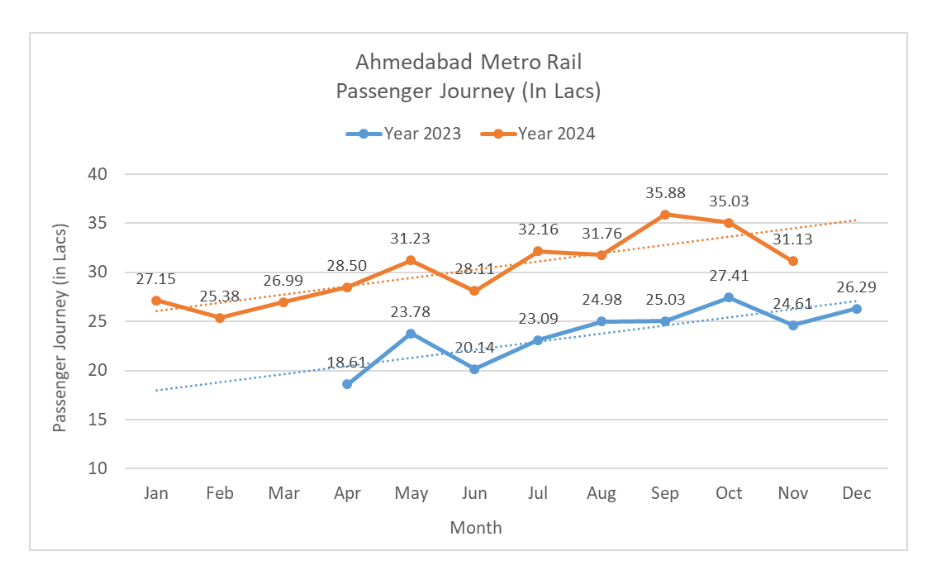
On May 14, 2024, the Ahmedabad Metro crossed the landmark of 100,000 daily passengers for the first time since the inauguration of Phase 1 in September 2022. On that day, 100,830 passengers used the service, and on May 16, the number reached 100,893 on a regular weekday.
Challenges Associated with Ahmedabad Metro
Low Fare Revenue: In the financial year 2022-23, Gujarat Metro Rail Corporation (GMRC) reported a loss of ₹321 crore, an improvement compared to a ₹465 crore loss in the previous year, 2021-22. On average, GMRC incurred a daily loss of ₹87 lakh in 2022-23. However, with the opening of new metro routes and an increasing number of passengers, it is expected that the financial performance will improve, and the losses will continue to reduce in the coming years.
Traffic Congestion Along Metro Corridor: The study conducted by Toral Vyas from the Department of Civil Engineering at Gujarat Technological University (GTU), between 2018 and 2023, analysed traffic movement along the Stadium-Thaltej stretch. Key findings include:
Two-Wheelers: Two-wheelers made up 52% to 78% of the traffic in the area.
Traffic During Construction: During the construction of the metro corridor, the Gurukul-Sunrise Park stretch recorded about 3,113 passenger car units (PCUs) per hour.
Traffic After Construction: After construction, the Gurukul-Sunrise Park stretch saw an increase to 4,250 PCUs per hour, while the Stadium to Commerce Crossroads stretch recorded 1,700 PCUs per hour.
Slowest Link: The Gurukul-Helmet link recorded an average speed of 23.76 km/h after construction.
Multi-Modal Integration:
One of the key challenges for the Ahmedabad Metro system is integrating with existing transportation networks, such as the Bus Rapid Transit System (BRTS) and railway services. Addressing this challenge is important to encourage more commuters to use the metro.
Benefits of Ahmedabad Metro
Economic Growth
The construction and operation of the metro have created numerous jobs, contributing to local economic development. Additionally, enhanced connectivity has increased property values near metro stations, attracting investment and boosting local businesses.
Environmental Benefits
The Ahmedabad Metro will connect people within the city better, and as people choose to travel by the metro instead of personal vehicles, carbon emissions are expected to be reduced, and the air quality will improve. The reduced traffic congestion will further contribute to the environmental benefits.
Conclusion
Ahmedabad Metro is one step towards streamlining the city’s urban mobility. The metro, with its modern transportation system, is reducing congestion, improving connectivity, and offering a reliable mode of transport for the residents. Phase 1 of the project is already operational, and Phase 2 is under construction, with new corridors being built to increase the metro coverage. Despite facing financial challenges, the metro’s increasing ridership and ongoing construction reflect its growing role in the city’s transportation network. The Ahmedabad Metro plays an important role in the city’s infrastructure and its efforts to manage urban growth.
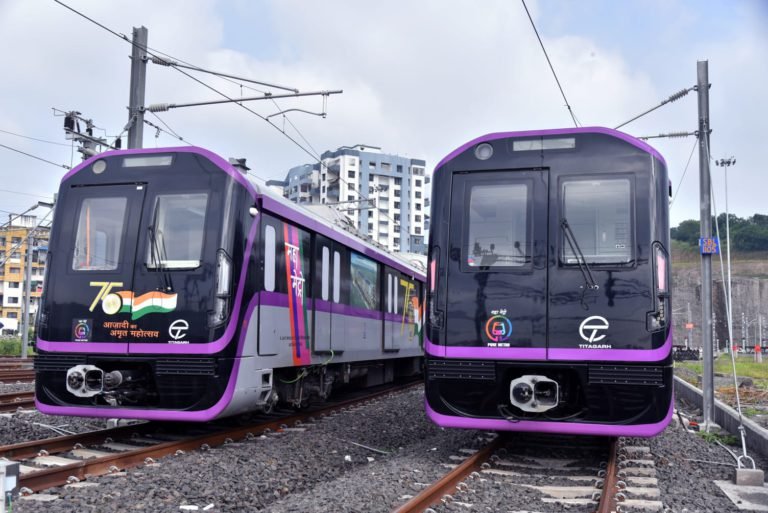
Pune (Metro Rail News): Maharashtra Metro Rail Corporation (Maha Metro) has invited bids for the electrification contract for the Pune Metro Purple Lines’ extension from Pimpri Chinchwad Municipal Corporation (PCMC) to Nigdi.
Tender Details
Tender Notice No: P1A-TR-03/2025
Contract Duration: 110 (One Hundred and ten Weeks) from the date of issuance of LOA
The Bid Security (EMD): INR 21,43,897/-
Pre-Bid Meeting: 14-Feb-2025
Bid Submission Deadline: 10-Mar-2025
Opening of Technical Bids: 11 March 2025
Maha-Metro Brief Scope: Design, Supply, Installation, Testing & Commissioning Of 25kV Flexible Overhead Catenary System, associated 25kV Sectioning Posts, 33kV Auxiliary Sub-Station (ASS), associated Cabling And SCADA Systems For Pune Metro Rail Project PCMC-Nigdi Elevated Extension.
About Pune Metro’s Purple Line
Operational route: Currently, the Purple Line is operational from PCMC to Civil Court spanning 16.6 km through 13 stations.
In September 2024, The Purple Line’s extension between Civil Court and Swargate spanning 3.3 km became operational. This section features 3 new stations.
The extension from Swargate to Katraj spans 5.464 km through 3 stations.
Purple Line’s northern extension between Pimpri Chinchwad Municipal Corporation (PCMC) and Bhakti Shakti (under construction) spans 4.519 km through 5 stations.
Indian Railways, the backbone of India’s transportation Infrastructure, is a state-owned enterprise that is organised as a departmental undertaking of the Ministry of Railways of the Government of India and operates India’s national railway system. As of 2024, the Indian railways has been recognised as the fourth largest network in the world in terms of size, covering a network of 68,584 kilometres. The Indian Railways is crucial for the country’s socio-economic scenario. Railways has not only promoted the movement of people but it has also made the transport of goods more convenient through enhanced connectivity thereby, reducing the logistic cost. The Indian Railways recorded highest revenue of Rs 2.56 lakh crore for the financial year 2023-24
Historical Background Of Indian Railways
Initial Proposal and Early Developments: The concept of Indian Railways was first proposed in 1832 in Madras. The British government acknowledged the potential associated with the idea. In 1845, The Madras Railway was formally established followed by the incorporation of the Great Indian Peninsula Railway (GIPR) in 1849 marking the beginning of organized railway construction in India.
First Passenger Train and Evolution: In 1853, the operations commenced on the first passenger train between Bombay to Thane covering a distance of 34 kms.
1880: The Indian Railways laid approximately 14,500 kilometres of track across major cities like Bombay, Madras, and Calcutta.
1951–52: The railway network across the country was reorganised into six regional zones for administrative purposes.
1925: The Indian Railway commenced operation on the first election train in Bombay on DC traction.
1955: The Indian Railways established the Integral Coach Factory in Madras for manufacturing rail coaches marking a significant step toward modernization.
Record Capital Investments in Indian Railways
In the Union Budget for 2024-25, Union Finance Minister Smt. Nirmala Sitharaman announced a record capital expenditure allocation of ₹2,62,200 crore for Indian Railways. This represents a substantial 77% rise compared to the investment levels over the past five years. Additionally, the Draft National Rail Plan outlines a long-term vision for the sector, proposing a total capital expenditure of ₹38.22 lakh crore by 2050. This comprehensive strategy aims to modernise and expand railway services, improve safety, and boost the efficiency of freight and passenger transportation across India.
Indian Railways’s Leading Footsteps Towards Modernisation
Throughout the years, the Indian Railways has been taking major steps to meet the increasing demands for modernization, sustainability, and efficiency.
1. Technological Advancement: The Indian Railways has been introducing a wide range of technological innovations to enhance the operation efficiency and passenger experience.
Example:
Indian Railway also introduced Online Monitoring of the Rolling Stock System (OMRS), a way-side inspection system that comprises technologies like Acoustic Bearing Detectors (ABD) and Wheel Impact Load Detectors (WILD) which monitor the functioning of train components in real-time. This system detects faults in bearings and wheels, allowing for timely corrective actions before failures occur.
2. Modernization Of Railway Infrastructure: The Indian Railways is aiming to enhance and modernise the station infrastructure to improve the passenger experience by providing better amenities.
Example:
Rani Kamlapati Railway Station, formerly known as Habibganj Railway, located in Bhopal is marked as the first world-class railway station. The station has been redeveloped under the Public-Private Partnership (PPP) model by Indian Railway to modernise the railway infrastructure. The station provides ultra-modern amenities such as a large covered parking area, 24X7 power backup, air-conditioned lobby, high-speed escalator etc.
3. Amrit Bharat Station Scheme: The Indian Railways recently introduced theAmrit Bharat Station Scheme to upgrade and modernize the total of 1,337 stations across the Indian Railways System.
The scheme aims to improve station accessibility, waiting areas, toilet facilities, lift and escalator installations as needed, cleanliness, offering free Wi-Fi, setting up kiosks for local products through initiatives like ‘One Station One Product’, enhancing passenger information systems, establishing Executive Lounges, designating spaces for business meetings, incorporating landscaping, and catering to the unique requirements of each station.
Completed Projects:
Gandhinagar Capital Station (Western Railway)
Sir M. Visvesvaraya Terminal Station (South Western Railway)
The first phase of Gomti Nagar Station (North Eastern Railway)
Ayodhya Railway Station (Northern Railway)
Cuttack Railway Station (East Coast Railway)
4. Enhanced safety: To create a more reliable and secure rail network the Indian Railway has been introducing new technologies which can contribute to achieving safe operations and increasing the efficiency of the operation.
Example:
Kavach: The introduction of the Kavach System, an Automatic Train Protection (ATP) is one such initiative taken by Indian Railways. The Kavach System prevents the trains collisions by applying emergency brakes through continuous monitoring. As of July 24, 2024, ₹1,216.77 crore had been spent on Kavach, with an additional ₹1,112.57 crore allocated for 2024-25. In the first phase, the Indian Railway plans to deploy the Kavach system in 10,000 locomotives along a 9000km railway network by December 2030.
Recent Update: In September 2024, Railway Minister Ashwini Vaishnaw reviewed the trial of KAVACH 4.0. The trial took place between Sawai Madhopur and Indargarh Railway stations in Rajasthan under the West Central Railway Zone.
5. Electrification of Railways: The Indian Railways has been targeting 100% electrification to achieve net-zero carbon emissions by 2030, promoting environmental sustainability and reducing operational costs. To reduce reliance on fossil fuels in rail operations. As of 2024, Indian Railways has completed electrification of 97% of its broad gauge network.
Example:
The Devlali railway station near Nashik in Maharashtra is powered entirely by solar energy. The Devlali Station will cut 100 MT of CO2 emissions annually, driving Railways mission towards net zero by 2030.
6. Development of Dedicated Freight Corridors: To enhance freight transport efficiency across the county, the Indian Railways took the initiative by introducing Dedicated Freight Corridors. DFCs are specialized railway lines designed exclusively for freight trains.
Key Corridors
Eastern Dedicated Freight Corridor (EDFC):
Length: Approximately 1,337 kilometres
Route: Sonnagar in Bihar to Sahnewal in Punjab.
Status: Fully operational as of April 2024.
Benefits: The travel time for transporting coal from coal fields in Eastern India to power stations in North India has been reduced from 35 hours to just 20 hours.
Western Dedicated Freight Corridor (WDFC):
Length: Approximately 1,506 kilometres
Route: Jawaharlal Nehru Port in Mumbai to Dadri in Uttar Pradesh.
Status: 93% operational,
Major Developments in Indian Railways
Throughout the years, Indian Railways has witnessed remarkable growth and modernisation through various major projects which aim at enhancing the infrastructure, efficiency and connectivity. Some of the most momentous developments include:
1. Chenab Bridge
Overview
Chenab Bridge is a major infrastructure project carried out by Indian Railways. The Chenab bridge is a part of the Udhampur-Srinagar-Baramulla Railway Link (USBRL), a dream project worth Rs 37000 crore. The bridge will have a lifespan of 120 years.
With the development, the Indian Railways marked history by creating the world’s highest arch bridge and Railway Bridge. The Indian Railways has conquered the biggest civil engineering challenge faced by any railway Project in India in recent history with the completion of this bridge.
Features of Chenab Bridge
The Chenab Bridge is situated in Jammu and Kashmir’s Reasi district, between Bakkal and Kauri.
Standing 359 meters (1,178 feet) above the Chenab River, the bridge is 35 meters higher than the Eiffel Tower in Paris.
The arch bridge is 1,178 feet above the riverbed, forming a crucial link from Katra to Banihal and able to withstand winds with speeds up to 260 kmph.
Recent Update: In June 2024, Indian Railways conducted the successful trial run of an eight-coach Mainline Electric Multiple Unit (MEMU) train on theChenab Bridge. The trials were conducted at a speed of 40 Kmph on an electrified line section between Sangaldan in Ramban district and Reasi spanning 46 km.
2. Anji Khad Bridge
The Anji Khad Bridge is a true engineering marvel and a milestone for the Indian Railways. The Bridge spans the Anji River and is part of the ambitious USBRL project which aims to provide seamless rail connectivity to the Kashmir Valley. The Bridge marks history by being the country’s first cable-stayed and second-largest railway bridge.
Key Features of the Anji Khad Bridge
Pylon Design: Standing 331 m above the riverbed, the bridge features a single pylon
Total Length: 473.25 meters.
Cost: Rs. 435 crore.
Viaduct and Embankment: The structure consists of a 94.25-meter central embankment and a 120-meter viaduct.
Recent Updates: Indian Railways conducted a successful first-loaded train trial run on the Anji Khad Bridge. The Ministry of Railways mentioned “The trial run on the Anji Khad Bridge, a key component of the Udhampur-Srinagar-Baramulla Railway Link (USBRL) project, has been successfully completed.”Services are anticipated to begin in January 2025 in this section.
3. High-Speed Rail Project
To bring transformative changes in the country’s infrastructure and economy the Indian Railways developed India’s first High-Speed Rail Project, reflecting the Indian Railways’ modernised approach towards enhancing connectivity. With this pioneering project, the Indian Railways aims to position the country as a competitive player in the global transportation sector.
A Special Purpose Vehicle, National High-Speed Rail Corporation Limited (NHSRCL) was established on 12th February 2016, to execute the bullet train project in India. For the beginning of this dream project, The Mumbai – Ahmedabad High-Speed Rail corridor was prioritised by Indian Railways which is currently under construction and undergoing significant developments.
Mumbai – Ahmedabad High-Speed Rail corridor
The Mumbai – Ahmedabad High-Speed Rail corridor, spanning across 508 kilometres, will provide enhanced connectivity through a sustainable and mast mode of transport between Maharashtra and Gujarat states in western India.
The route consists of 12 strategically positioned stations and the corridor is designed to accommodate bullet trains operating at speeds of up to 320 kmph completing the entire journey in about 2 hours 7 minutes.
Recent Development on the project: BEML to Deliver First Indigenous Bullet Train By 2026: In October BEML received a Rs. 867 crore order from ICF to manufacture India’s first indigenous Bullet Train. The trains will be designed to run at a maximum speed of 250 kmph. Infrastructure Progress: The foundation work on all 8 stations in Gujarat is completed. Completion of 12 River Bridges out of 20: With the completion of the bridge over the Kharera River in Navsari District, Gujarat, a major milestone has been achieved for the Bullet Train project. This is the 12th bridge finished out of 20 planned in Gujarat.
4. Vande Bharat Express
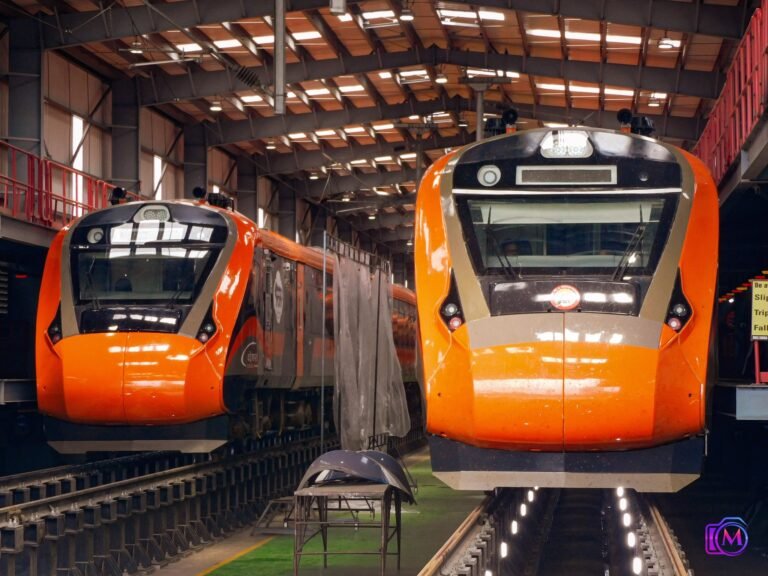
To modernize rail travel across the country, the Indian Railways introduced the first indigenously designed and manufactured semi-high-speed train, Vande Bharat Express which symbolises the Indian Railways ambition for advanced, efficient, reliable and convenient rail travel. The train is designed to run at a maximum speed of 180kmph.
The initiative is part of the government’s Make in India program, aiming to enhance domestic manufacturing and infrastructure. The Vande Bharat trains offer passengers a world-class travel experience. The trains have been equipped with modern amenities like accessible toilets and developed safety features such as Kavach technology.
On 15 February 2019, the first-ever Vande Bharat Express was flagged up on the New Delhi-Kanpur-Allahabad-Varanasi route. The trains operate at a speed of 160 kilometres per hour. Currently. At present, 136 Vande Bharat trains operate across the Indian Railway.
5. Namo Bharat Rapid Rail (Vande Metro)
Originally inspired by the design of Vande Bharat, The Namo Bharat Rapid Rail (formerly Vande Metro) trains are designed for intercity travel. The trains are capable of reaching speeds of up to 130 km/h. In September 2024 PM Modi inaugurated the Namo Bharat Rapid Rail services between Bhuj and Ahmedabad. In November 2024 a successful trial was conducted between Ahmedabad and Mumbai at a speed of 130 kmph.
Future Outlook
1.Investment and Modernization
Substantial Investment: Indian Railways plans to invest ₹17.4 lakh crore (approximately $210 billion) by 2025 to streamline its operations, including high-speed rail projects
2. Infrastructure Expansion
New Tracks: The plan includes constructing 100,000 km of new railway tracks over the next 20 years
3.Train Modernization
Vande Bharat Trains: Indian Railways aims to produce 400 new Vande Bharat trains over the next three years.
Introduction of Hydrogen Trains: The hydrogen train project aligns with Indian Railways’ goal of achieving net-zero carbon emissions by 2030. The trials of the Hydrogen train will soon be conducted on the Jind-Sonipat route in Haryana. These trains will utilise Hydrogen fuel cells to gain power supply.
Technological Advancements
AI Integration: In coming years the railway plans to implement advanced traffic management systems and AI-powered predictive maintenance tools to improve operation frequency, and safety and reduce downtime.
Conclusion
In order to satisfy the expanding needs of the country’s transportation industry, Indian Railways keeps up with technological developments and modernisation. The Indian Railways is making notable progress in enhancing efficiency, sustainability, and safety with projects like the Kavach safety system, electrification targets, and the construction of high-speed train projects. The engineering prowess of the Indian Railways is further demonstrated by infrastructure projects like the Chenab and Anji Khad Bridges. Indian Railways’ dedication to improving connectivity and offering a better travel experiences is further evidenced by the ongoing expansion of the Vande Bharat Express and the launch of the Namo Bharat Rapid Rail. With the help of substantial investments, these advancements have the potential to make the railway network more dependable, and sustainable.
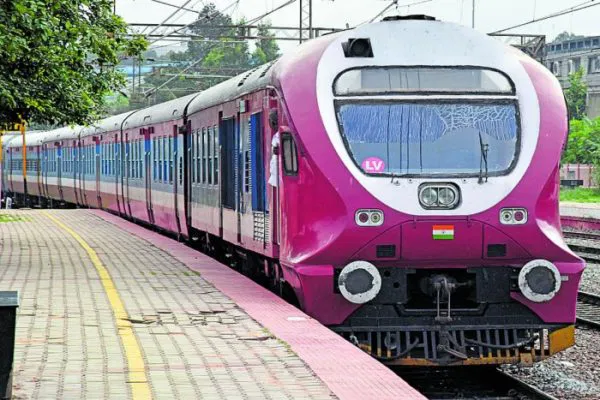
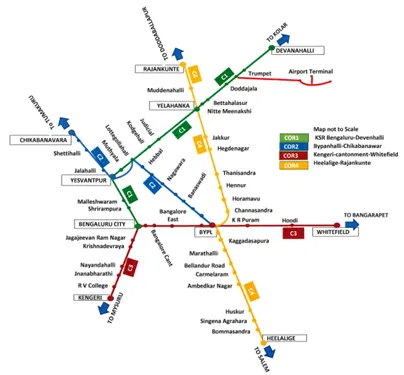
Bengaluru (Metro Rail News): The Bengaluru Suburban Rail project advanced as Karnataka’s Rail Infrastructure Development Company (K-RIDE) opened technical bids for the contract to supply 19000 MT of head-hardened rails and 3 firms have submitted bids for the same contract.
The rails will be of 60E1 – 1080 grade as specified in Indian Railway Specification T-12-2009.
These rails will undergo a specialized heat treatment process to ensure:
Enhanced strength
Reduced residual stress
Increased track durability
Lower maintenance requirements
K-RIDE floated a tender for this contract in September 2024 with a Rs. 135.30 crore estimate and a 1-year deadline.
Bidders
ArcelorMittal Espana S.A
Mitsui & Co., Ltd.
Saarstahl Rail
Scope of Work
The 19000 MT of head-hardened rails will be utilised for the Bengaluru Suburban Rail project’s Corridor 2 (Mallige Line) spanning 23.86 km from Baiyyappanahalli to Chikkabanavara and Corridor 4 (known as Kanaka Line) which spans 46.88 km and links Heelalige – Rajanukunte.
KRIDE’s Brief Scope: Supply of 19000 MT 60E1 UIC 60 1080 HH Grade Rails for Bengaluru Suburban Railway Project
Track Related contracts for BSRP status :
This is the 3rd track-work-related contract for the entire Bengaluru Suburban Rail project which has reached the technical bid opening stage. The other two contracts are mentioned below:
In October 2024, 4 firms submitted bids for Corridor 2’s ballastless/ballasted track work b Benniganahalli and Chikkabanavara including Soladevanahalli Depot
In November 2024, JSPL was the only bidder for the contract to Supply of 2250 MT 60E1880 Grade Rails.
Further Information
The bids submitted by three firms have now been sent for technical evaluation. After the completion of the technical evaluation, the financial bids of the qualified bidders will be opened to reveal the lowest bidder of the contract.
Bangalore (Metro Rail News): Bangalore Metro Rail Corporation Ltd. (BMRCL) announced that URC Constructions Pvt. Ltd. had become the lowest bidder for the remaining construction work contract for Veerannapalya Station of the Blue Line.
The under-construction blue line of Bangalore Metro’s Phase 2A (ORR Line) and Phase 2B (Airport Line) projects will link the Silkboard – KR Puram – Bengaluru International Airport through 30 stations.
Financial Bid Values
Firm
Bid (Rs. Crore)
URC Construction Pvt. Ltd.
35.74
Afcons Infrastructure Ltd.
57.0
BMRCL’s Brief Scope: Construction of Veerannapalya Elevated Metro Station (Balance works) including allied works for Bengaluru Metro Rail Project Phase-2B-P1.
About the Veerannapalya Station’s Contract
Initial Contract: In November 2021, NCC Ltd. in was awarded the Veerannapalya Station’s construction Contract as a part of Package P1 of Bangalore Metro Phase 2B’ spanning 11.003 km from KR Puram to Hebbal through 8 elevated stations.
However, the construction of Veerannapalya Station was later removed from NCC’s scope due to prolonged delays caused by the relocation of an underground gas pipeline owned by Gas Authority of India Limited (GAIL).
After reallocating the gas pipeline, BMRCL floated the tender for the remaining construction of Veerannapalya Station.
This was a limited one-stage tender, meaning that BMRCL only invited financial bids from pre-qualified firms without requiring a separate technical evaluation.
New Delhi (Metro Rail News): In the fiscal year 2025-26, the Indian Railways has been allocated a capital expenditure of ₹2,65,200 crore, which reflects a substantial increase compared to the ₹45,900 crore sanctioned during the FY 2009-14 period.
Stock Market Reaction to Railway Budget 2025
Following the budget announcement, shares of key railway companies saw a sharp decline:
Company
Stock Price Drop (%)
Closing Price (₹)
IRCON
6%
207.5
IRCTC
3%
797
IRFC
5%
144
The market had anticipated a 15-18% increase in budgetary support for Indian Railways.
Provision for New Coaches in Budget 2025
Indian Railways plans to produce 17,500 Non-AC General and Sleeper Coaches to meet the increasing demand for affordable travel, as part of the Rail Budget 2025.
The statement reads “Non-AC Amrit Bharat trains with advanced features for affordable journeys have been introduced by Indian Railways. 100 such trains are under manufacturing,” as reported by ET Now.
Railway Budget 2025: L.H.B Coaches to Replace ICF Balanced Coaches
To increase the safety of passengers and provide an enhanced experience to passengers Railways plans to replace all the conventional ICF coaches with L.H.B. (Linke-Hofmann-Busch) coaches in the next 5 years.
Infra Performance in the Last Decade
In the last ten years, Indian Railways has greatly improved its infrastructure. From 2014 to 2024, it added 31,180 kilometres of track, increasing the pace from 4 kilometres per day in 2015 to 14.54 kilometres per day in 2024. Additionally, it electrified 41,655 kilometres of track during this time, which is almost double the amount electrified before 2014.
NEW DELHI (Metro Rail News): In a significant push toward digital transformation, Indian Railways has unveiled the beta version of its ‘SwaRail’ SuperApp, a unified platform designed to streamline passenger services. Released on January 31, 2025, by the Centre for Railway Information Systems (CRIS), the app is currently available for limited testing on Google Play Store and Apple App Store.
Key Features and Accessibility The ‘SwaRail’ SuperApp consolidates a wide range of railway-related services, including:
Ticket Bookings: Reserved and unreserved tickets, platform tickets.
Existing users of RailConnect and UTSonMobile can log in using their current credentials, ensuring seamless integration. The app emphasizes a clutter-free interface to enhance user experience.
Phased Rollout and Feedback Initially, only 1,000 users can download the app, with plans to expand to 10,000 users post-feedback. CRIS has urged beta testers to submit suggestions via swarrail.support@cris.org.in to refine the platform before its full launch.
Official Statements Dilip Kumar, Railway Board’s Executive Director of Information and Publicity, highlighted the app’s goal: “SwaRail not only aggregates services but redefines convenience by eliminating the need for multiple apps, offering a complete travel solution in one click.”
Context and Future Prospects The launch coincides with the 2025 Railway Budget, though no specific allocations were announced. The SuperApp aligns with Indian Railways’ broader strategy to digitize services, following the success of IRCTC and UTS platforms.
As beta testing progresses, the ministry aims to address user feedback, ensuring a robust rollout. The ‘SwaRail’ initiative underscores Indian Railways’ commitment to leveraging technology for passenger-centric innovation.
Bangalore (Metro Rail News): Bangalore Metro progressed as SYSTRA MVA Consulting has been awarded 3 major Detailed Design Consultant (DDC) contracts for Bangalore Metro Phase 3 project.
Bidding Process
Bangalore Metro Rail Corporation Ltd. (BMRCL) floated tenders for 3 DDC contracts of Bangalore Metro Phase 3 in October with a 1460 day (4 year) contract duration.
On 23 December 2024, technical bids were opened revealing that 6 firms have submitted bids for each contract. So BMRCL received 18 bids in total.
On 29 January 2025, financial bids were opened revealing that SYSTRA has become the lowest bidder for all 3 DDC contracts.
DDC- 1
Financial Bid Values
Bidder Name
Bid Value (₹)
Rank
Systra MVA Consulting
9.9 Cr
L1
L&T Infrastructure Engineering Limited
10.7 Cr
L2
Meinhardt (Singapore) Pte. Ltd.
13.2 Cr
L3
AECOM Singapore Pte. Limited
15.8 Cr
L4
SMEC International Pty. Ltd.
15.9 Cr
L5
Shirish Patel and Associates Consultants Pvt. Ltd.
24.4 Cr
L6
DDC-1’s Brief Scope: Detailed Design Consultancy Services for all Structures including Elevated Viaduct, Double Decker, Single Decker/Double Decker Stations, Entry/Exit Structures, Loops and Ramps for Road Flyovers, Subways, FOBs, Multi-Modal Integration Structure, etc. from JP Nagar 4th Phase Station (Excl) to BDA Complex Nagarbhavi Station (Incl) (from Chainage -0.330 to 16.791) of Corridor-1 for Bangalore Metro Rail Project, Phase-3.
DDC- 2
Financial Bid Values
Bidder Name
Bid Value (₹)
Bid Rank
Systra MVA Consulting
7.9 Cr
L1
L and T Infrastructure Engineering Limited
8.7 Cr
L2
SMEC International Pty. Ltd.
11.5 Cr
L3
Meinhardt (Singapore) Pte. Ltd.
11.6 Cr
L4
Aecom Singapore Pte. Limited
14.9 Cr
L5
Shirish Patel and Associates Consultants Pvt Ltd
16.6 Cr
L6
DDC-2’s Brief Scope: Detailed Design Consultancy Services for all Structures including Elevated Viaduct, Double Decker, Single Decker/Double Decker Stations, Entry/Exit Structures, Loops and Ramps for Road Flyovers, Subways, FOBs, Multi Modal Integration Structure and Depots etc. from Sumanahalli Cross Station (excl) to Kempapura Station (excl) (from Chainage: 17.473 To 30.321) of Corridor-1 for Bangalore Metro Rail Project, Phase-3
DDC-3
Financial Bid Value
Bidder Name
Bid Value (₹)
Bid Rank
Systra
10.7 Cr
L1
Meinhardt (Singapore) Pte. Ltd.
12.6 Cr
L2
SMEC International Pty. Ltd.
14.5 Cr
L3
L and T Infrastructure Engineering Limited
17.7 Cr
L4
Shirish Patel and Associates Consultants Pvt Ltd
20.5 Cr
L5
AECOM Singapore Pte. Limited
20.8 Cr
L6
DDC-3’s Brief Scope: Detailed Design Consultancy Services for all Structures including Elevated Viaduct, Double Decker, Single Decker/Double Decker Stations, Entry/Exit Structures, Loops and Ramps for Road Flyovers, Subways, FOBs, Multi Modal Integration Structure and Depots etc. from Hosahalli Station (Incl) to Kadabagere Station (Incl) with Lap Portion and Sumanahalli Cross Station, Depots at Sumanahalli and Peenya (from Chainage: -0.450 to 12.050) of Corridor-2 for Bangalore Metro Rail Project, Phase-3
About Bangalore Metro Phase 3
The routes in Bangalore Metro Phase 3 will traverse through Western Bangalore covering a total distance of 44.65 km via 2 new corridors.
Corridor Name
Route Description
Length
Total no. of Stations
Corridor 1 (Orange Line)
Kempapura – JP Nagar 4th Phase via Outer Ring Road (ORR)
Mumbai (Metro Rail News): On 28 January 2025, Mumbai Railway Vikas Corporation Ltd. (MRVC) declared M. Venkata Rao Infra Projects Pvt. Ltd. as the lowest bidder (L1) for the civil works contract related to the construction of important bridges and associated infrastructure for the proposed 5th and 6th railway lines between Borivali and Virar under Mumbai Urban Transport Project (MUTP) Phase IIIA.
Tender Title: MRVC/W/224
Tender ID: 2024_MRVC_827690_1
Contract Duration: 910 Days
MRVC’s Scope of Work
Construction Of Important Bridges (br. No. 73 & 75) In Vasai Creek, Minor Bridge (br. No.74) On Panju Island, Side Drain, Retaining Wall & Earthwork For Embankment From Bhayander Station To Naigaon Station Including Earthwork On Panju Island (ch. 43700 To Ch. 47500) In Connection With Proposed 5th & 6th Line In Between Borivali-virar Stations Of Western Railway Under Mumbai Urban Transport Project (mutp) – Phase -iiia Project.
Patna (Metro Rail News): Patna Metro progressed as DMRC has announced Rahee Infratech Ltd. as the lowest bidder for Package PT-09 which includes the installation of ballastless standard gauge tracks on Phase 1’s Priority Corridor. The priority corridor spans 6.107 km long and features 5 elevated stations: Malahi Pakri, Khemni Chak, Bhootnath, Zero Mile and New ISBT.
Financial Bid Values
Firms
Bids Value
Rahee Infratech Ltd.
Rs. 23.9 crores
Apurvakriti Infrastructure Pvt Ltd
Rs. 28.5 crores
Paras Railtech Pvt. Ltd.
Rs. 26. 9 Crores
Texmaco Rail and Engineering Ltd.
Rs. 25.8 Crores
Bidding Process
DMRC invited tenders for this contract in November 2024 with a Rs. 24.89 crore estimate and a 6-month (180 days) deadline.
On 31 December, technical bids were opened to reveal the names of bidders.
DMRC’s Brief Scope: Installation of Ballastless Track including Supply of Buffer Stop and others for Priority Corridor (Malahi Pakhri to New ISBT) for Patna Metro Rail Project.
Track- work Contracts Awarded So Far
Package
Scope of Work
Contractor
PT-09
Installation of Ballastless Track including Supply of Buffer Stop
Rahee Infratech Ltd.
PT-4R
Design, manufacturing & supply of UIC-60 Turnouts & Scissor Crossover
Voestalpine VAE VKN India
PT-7R
Manufacturing & Supply of 1200 MT 90 UTS, UIC 60, 13 m, Class A 880 Grade Rails, IRS-T-12-2009 for New ISBT Patna Depot
Steel Authority of India (SAIL)
PT-8R
Standard gauge track work (Ballasted, Embedded and Column lines) at New ISBT Depot
Nagpur (Metro Rail News): Nagpur Metro progressed as Maharashtra Metro Rail Corporation Ltd. (Maha-Metro) has announced Rahee Infratech Ltd. as the lowest bidder for the Package T-02 of Phase 2.
In March 2024, Maha-Metro invited bids for Package T-02 with a Rs. 185.00 crore estimate and a 2.5-year installation deadline. Furthermore, In November technical bids were opened to reveal that only 2 firms have bid for the contract.
Financial Bid Values
Firm
Bids
Rahee Infratech
174.19 Crore
Texmaco Rail and Engineering
217.48 Crore
Scope of Work
The scope of work under Package T-02 includes the supply and installation of ballasted tracks on 1.746 km at the grade section of Orange Line’s Reach 1A (Khapri – MIDC ESR). This at-grade section lies between Eco Park Station and Metro City Station.
In Addition, the appointed contractor will install ballastless tracks at the elevated viaduct of
Orange Line’s Reach 2A from Automotive Square to Lekha Nagar.
Aqua Line’s Reach 4A spans 5.33 km between Prajapati Square to Transport Nagar.
Maha-Metro’s Brief Scope: Design, Supply, Installation, Testing, and Commissioning of Ballasted-Ballastless track in At Grade section of Reach 1A, and elevated viaduct of Reach 2A and Reach 4A of NMRP Phase-2
Further Information
This is the second contract for which Rahee Infratech Ltd. has been declared as the lowest bidder . Earlier in May 2024, Rahee was declared as the lowest bidder for Package T-01 which included supplying ballasted tracks for Reach 1A, 1080 Grade head-hardened rails, track fasteners, and turnouts.
(Metro Rail News): On 28 January 2025, Indian Railways awarded €144 million (approx. INR 1285 cr) contract to Alstom to supply Mitrac traction components and other electrical equipment for Vande Bharat Sleeper train sets.
Scope of Work
The scope of work under this contract includes the supply of Mitrac traction components and other electrical equipment for 17 Vande Bharat Sleeper train sets.
In addition, Alstom is responsible for providing corrective maintenance of the traction and electric equipment. Furthermore Alstom will also provide support services, for a duration of 5 years.
Contract Requirement
As per the contract, Alstom will supply the systems to the Indian Railways’ Integral Coach Factory (ICF) located in Chennai.
Contract Duration: 5 Years
Alstom’s MD Statement
In view of the contract win, Olivier Loison, Managing Director, Alstom India said, “The Vande Bharat trains represent the modern face of rail-based mobility in India, and it is a matter of pride for us to yet again partner with Indian Railways in furthering their vision. Alstom has the widest components portfolio in the rail industry, which has been developed on the back of decades of experience in delivering rail solutions across the globe. Our strong manufacturing and engineering presence in India, will allow us to deliver world-class products and optimise maintenance.”
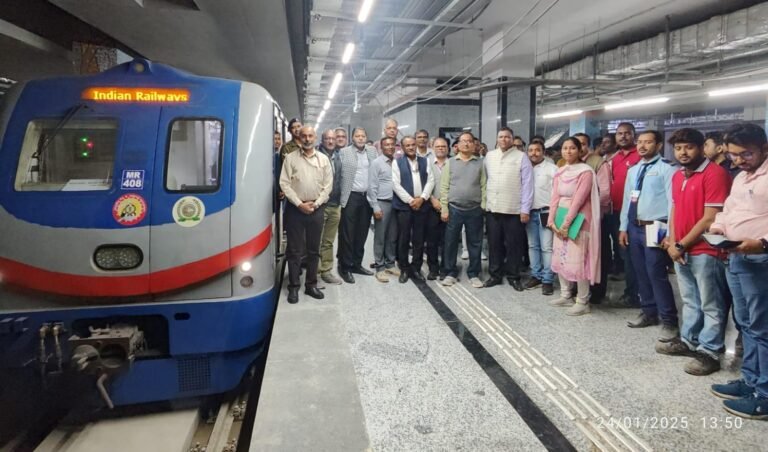
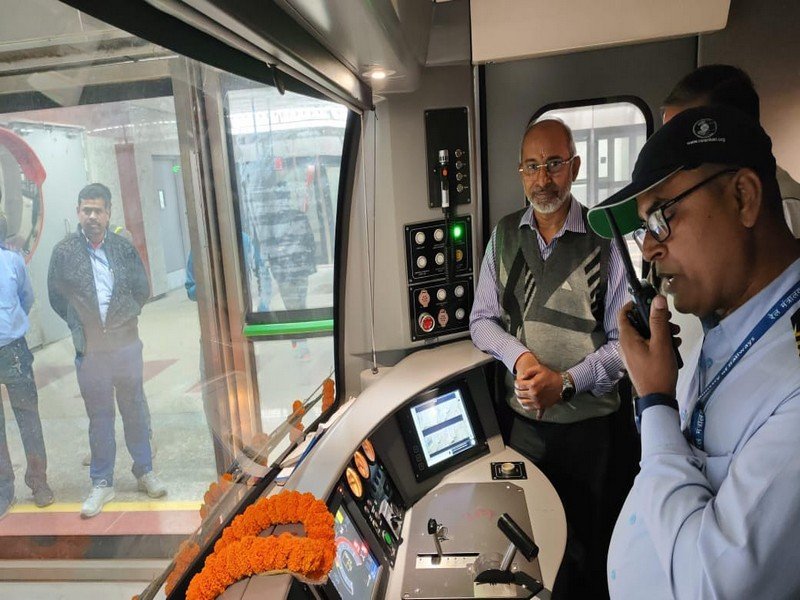
Kolkata ( Metro Rail News ): Kolkata Metro progressed as successful trials were conducted on the under Construction Line 4 (Yellow Line ) spanning 16.876 km from Noapara to Barasat featuring 10 stations and Green Line .
About the Trials on Yellow Line
On 24 January 2025, The trials were conducted on a 7.03 km stretch of Line 4 connecting Noapara and Jai Hind Biman Bandar (airport) metro stations through 4 stations.
Station
Noapara
Dum Dum Cantt
Jessore Road
Biman Bandar
Metro Railway Kolkata General Manager P Uday Kumar Reddy was also present during the trials. During the trials, P Uday Kumar Reddy also inspected the Dum Dum Cantonment station and Jai Hind Biman Bandar Metro station.
About the Trials on Green Line
On 21 January 2025, The first trial run was conducted successfully on sealdah-esplanade stretch of green line spanning 2.63 km.
Shri P. Uday Kumar Reddy, General Manager, Metro Railway and Chairman, Kolkata Metro Rail Corporation Limited (KMRCL), other senior officers of Metro Railway and KMRCL were present during the trials.







 Inauguration