Mumbai (Metro Rail News): Mumbai Metro advanced with another major contract as IRCON International – Jakson Ltd. JV has been declared as the lowest Bidder by the Mumbai Metropolitan Region Development Authority (MMRDA) for major systems under Package CA-236 of Line 4 & Line 4A spanning 35.2 km connecting Wadala- Kasarvadavali – Gaimukh.
In February 2024, MMRDA invited bids for this contract with a Rs. 1212 crore estimate. Furthermore, In November 2024, Technical bids were opened to reveal 2 bidders.
Financial Bid Values
Firm
Bid (Rs. Crore)
IRCON – Jakson JV
1526
Larsen & Toubro (L&T)
1646
Contract Scope of Work
The scope of work under this contract includes the commissioning of the following systems for Line 4:
Power Supply & Traction System
Installation and commissioning of traction power equipment
Electrical & Mechanical (E&M) System
Deployment of electrical and mechanical system
Lifts & Escalators (at 34 stations)
MMRDA’s Brief Scope for Package-2 (CA-236): Design, Manufacture, Supply, Installation, Integration, Testing and Commissioning of Power supply and Traction, Electrical & Mechanical and Lifts & Escalators including 15 years of Comprehensive Maintenance after 2 years of Defect Liability Maintenance Period for Mumbai Metro Line 4 and Extension Corridor (4A) [WADALA-KASARVADAVALI-GAIMUKH] of Mumbai Metro Rail Project of MMRDA.
Further Information
The contract can face delays as IRCON – Jakson JV submitted the bid of Rs.1526 Crore which is 25.90% higher than MMRDA’s Rs. 1212 crore estimate.
Mumbai (Metro Rail News): Mumbai Metro progressed as Larsen & Toubro ( L&T) has been declared as the lowest Bidder by the Mumbai Metropolitan Region Development Authority ( MMRDA) for 5 major systems under Package CA-234 of Line 4 & Line 4A spanning 35.2 km connecting Wadala- Kasarvadavali – Gaimukh.
MMRDA re-invited Bids for this contract in February 2024 with an estimated cost of Rs.4279.49 crores and a 19-year contract duration.
In November 2024, technical bids were opened to reveal that 2 firms had submitted bids for the contract.
Contact Details
Under this contract, L&T will be responsible for supplying the major systems mentioned below:
Supplying rolling stock (39 trains (234 coaches) consisting of 6 coaches)
CBTC signaling & train control (S&T)
Telecommunication System
Platform screen doors (PSDs)
Depot machinery & plant (M&P) for Mogharpada Depot.
Note: L&T has partnered up with Alstom Transport for the rolling stock and signalling solution.
Funding: Germany’s KfW will provide a loan of EUR 545 million for the design and construction phase, which will last 168 weeks (about 3.2 years). MMRDA will cover the maintenance for 17 years, including 2 years for handling defects.
MMRDA’s Brief Scope: Design, Manufacture, Supply, Installation, Integration, Testing and Commissioning of Rolling Stock, Communication Based Signaling & Train Control, Telecommunication, Platform Screen Doors Systems, and Depot Machinery & Plant including 15 Years of Comprehensive Maintenance After 2 Years of Defect Liability Maintenance Period of Line 4 and Extension Corridor (4A) [Wadala – Kasarvadavali – Gaimukh] of Mumbai Metro Rail Project of MMRDA.
As per the tender’s schedule, the 39 trainset has to be delivered according to the timeline mentioned below:
Batch No.
Number of Trains
Delivery Timeline (Weeks from Contract Signing)
Delivery Timeline (Years & Months)
1st Batch
1 Prototype Train
Week 52
1 Year
2nd Batch
9 Trains
Week 70
1 Year 4 Months
3rd Batch
10 Trains
Week 88
1 Year 8 Months
4th Batch
10 Trains
Week 104
2 Years
5th Batch
9 Trains
Week 112
2 Years 2 Months
Further Information
This development was recorded 3 years after Alstom Transport, the company that won the contracts for Line-4’s trains and signaling, withdrew from the project in 2022 because of slow progress in civil construction, particularly with the train depot, which still did not have a finalized location at that time.
Metro Rail News is pleased to announce that visitor registration is now open for the 5th edition of InnoMetro, a premier exhibition and conference for the rail transportation industry. The event will take place on 21-22 May 2025 at Bharat Mandapam, Pragati Maidan, New Delhi, India.
This year, the event will be focused on Promoting a Green & Sustainable Future for Metro & Railways.
As a visitor, you will have access to the expo floor, where you can witness next-generation innovations and technologies that have the potential to transform Metro systems, Railways, RRTS, High-Speed Rail, and allied sectors.
Key Highlights of the 5th Edition of InnoMetro
150+ Exhibitors and Partners
Participation from 25+ Countries
5000 sq. m. exhibit space
What InnoMetro 2025 Offers
Cutting-Edge Innovations: The exhibition will feature the latest innovations in the rail transportation industry, covering engineering, safety, signalling, and automation.
Sustainable Solutions: Discover eco-friendly innovations & solutions that promote sustainable rail transportation and reduce carbon footprints.
Business Avenues: InnoMetro’s global platform is designed to facilitate the exploration of new business opportunities within the industry for its visitors. This initiative allows participants to engage directly with startup founders and industry leaders, thereby enhancing their understanding of prevailing industry trends. Furthermore, this platform serves as a venue for discovering potential avenues for collaboration or investment.
Networking Opportunities: Engage with influential leaders within the metro and railway sectors, as the exhibition features participation from a wide array of companies that represent all facets of the industry.
Railway Infrastructure Innovation: Learn about modern technologies and advanced systems being incorporated to upgrade railway infrastructure. This includes IoT-enabled systems for real-time track monitoring, AI-based predictive maintenance for tracks, and other innovations that are being designed to maximize the utilization of infrastructural resources.
We invite professionals and stakeholders from across the rail transportation industry to register as visitors and explore the future of sustainable and modern rail transportation systems.
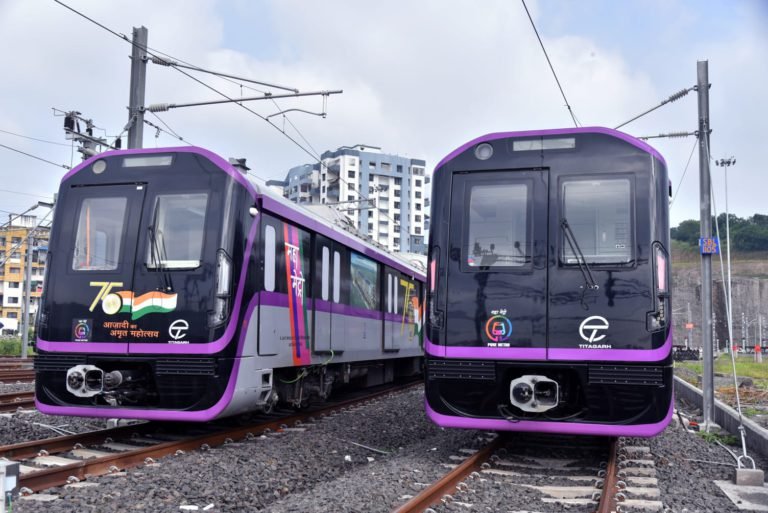
Pune (Metro Rail News): Maharashtra Metro Rail Corporation Ltd. has invited bids for the track work contract of Pune Metro’s Purple Line’s extension from Pimpri Chinchwad Municipal Corporation (PCMC) to Nigdi.
Tender Details
Tender Opening Date: 12 Feb 2025
Tender Closing Date: 10 Mar 2025
Contract Duration: 18 months from the date specified in the LOA.
Bid Security (EMD): INR 20,00,000/-
MMRCL Brief Scope: Design, Supply, Installation, Testing, and Commissioning of Standard Gauge Ballastless Track including supply of 1080 Grade HH Rails, Track Fastenings, lin9, R300 Ballastless turnouts, and other miscellaneous works for Elevated Section (PCMC to Nigdi) on North-South Corridor of Pune Metro Rail Project, Reach-1 Extension
About Pune Metro’s Purple Line
Operational route: Currently, the Purple Line of Pune Metro is operational from PCMC to Civil Court spanning 16.6 km through 13 stations.
The track work under this contract will be executed for Purple Line’s northern extension from Pimpri Chinchwad Municipal Corporation (PCMC) to Nigdi (under construction) which spans 4.519 km through 5 stations.
Stations:
PCMC
Chinchwad
Akurdi
Nigdi
Bhakti Shakti
The Purple Line’s extension from Civil Court to Swargate spanning 3.3 km featuring 3 new stations became operational in September 2024.
Another extension of the Purple Line between Swargate and Katraj spans 5.464 km via 3 stations.
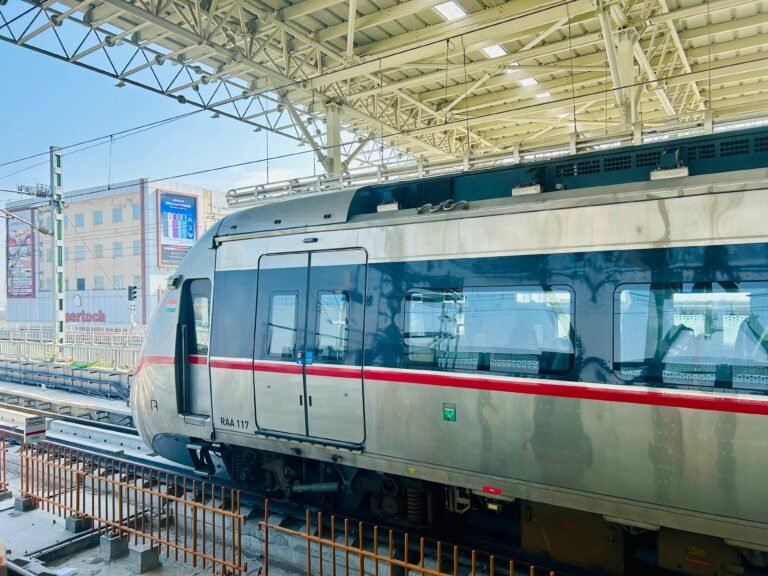
New Delhi (Metro Rail News): On 9 February 2025, National Capital Regional Transportation Corporation (NCRTC) conducted trial run on an additional 6 km stretch spanning from Meerut South to Shatabdi Nagar in Meerut.
Image Credit: NCRTC
This 6 km stretch between Meerut South and Shatabdi Nagar features 3 stations in total. The Shatabdi Nagar Station is part of the Delhi-Ghaziabad-Meerut RRTS Project. The remaining 2 stations Partapur and Rithani are a part of Meerut Metro.
Image Credit: NCRTC
Shatabdi Nagar station in Meerut is the second RRTS station on which both Namo Bharat and the Meerut Metro will operate.
Image Credit: NCRTCImage Credit: NCRTC
NCRTC’s Objective Behind the Trial
As the testing phase progresses, NCRTC will undertake thorough evaluations to assess the integrated performance of the train and its coordination with critical subsystems, including track infrastructure, signaling systems, Platform Screen Doors (PSDs), and overhead power supply systems.
About Delhi – Ghaziabad- Meerut RRTS Corridor
Currently, the Delhi – Ghaziabad RRTS Corridor is operational between New Ashok Nagar and Meerut South spanning 55 km through 11 stations.
Stations
New Ashok Nagar
Anand Vihar
Sahibabad
Ghaziabad
Guldhar
Duhai
Duhai Depot
Muradnagar
Modi Nagar South
Modi Nagar North
Meerut South
Once this section becomes operational, the Delhi- Ghaziabad-Meerut RRTS corridor section will extend up to 61 km featuring 12 stations.
Further Updates
The Meerut Metro project is also progressing rapidly on the other hand. Currently, NCRTC is also conducting trial runs between the Meerut South and Meerut Central. The entry and exit structures are nearly complete while the finishing touches are underway At Partapur and Rithani stations. Furthermore, Platform Screen Doors have been installed till Shatabdi Nagar Station.
New Delhi (Metro Rail News): Rail Land Development Authority (RLDA) has issued a Letter of Acceptance to H.G. Infra Engineering-D.E.C. Infrastructure and Projects (India) JV for a ₹2,195.68 Crore contract to redevelop the New Delhi Railway Station.
Contract Details
The Rail Land Development Authority (RLDA) invited bids for this contract with an estimated value of ₹2,469 crore and a 45-month deadline. The H.G. Infra Engineering-D.E.C. Joint Venture submitted the lowest bid at ₹2,195.68 crore and was subsequently awarded the contract.
Brief Scope of Work
Redevelopment of New Delhi Railway Station and construction of associated Infrastructure on Engineering, Procurement and Construction (EPC) Mode.
Significance of New Delhi Railway Station
New Delhi Railway Station (NDLS) serves as a prominent railway hub situated in the central area of Delhi, India. It features 16 platforms. The station facilitates the operation of over 400 passenger trains daily. The average passenger footfall at the station is approximately 500,000, with numbers potentially increasing to 600,000 during peak festival periods.
Construction Plan
According to the Rail Land Development Authority (RLDA), the project entails the construction of two Linear Station buildings located at the Paharganj and Ajmeri Gate areas.
Objective
The redevelopment of New Delhi Railway Station focuses on creating an integrated transportation hub that enhances connectivity between rail, metro, buses, and other transit systems. This transformation aims to improve passenger convenience, streamline operations, and support the city’s growing transportation needs by integrating various modes of transport.
About H.G. Infra Engineering
H.G. Infra Engineering has been involved in the construction of roads and highways across various states, including Odisha, Telangana, Rajasthan, Delhi, Andhra Pradesh, Haryana, and Uttar Pradesh.
The company is classified as an AA-grade contractor by the Public Works Department (PWD) of the Government of Rajasthan and holds SS class registration with the Military Engineer Services (MES).
Recognised as the “Silicon Valley of India,”, Bengaluru is home to large multinational technology companies and serves as a major semiconductor-centric aerospace and defence organisation. Additionally, Bengaluru houses several top-tier engineering and research institutions, along with state-owned the most prominent cities in India for high-technology-based heavy manufacturing industries.
Due to its economic potential Bengaluru has attracted intellectuals from around the country which resulted in the growth of the urban population. The city stands as India’s 3rd most populous city and the fourth most populous urban agglomeration. Serving as the capital of Karnataka Bengaluru has a population exceeding 8 million, with a metropolitan population of around 15 million.
Existing Transport Modes in Bengaluru
Over the years, Bengaluru’s infrastructure has evolved to support the city’s growth in multifaceted ways and accommodate the growing number of residents in the city. The city is already served by a rapid transit system which is also named Bengaluru Metro or (Namma Metro) which stands as India’s second-largest metro network with 75.20 km of operational route that carries about 7.5 lakh daily passengers. Additionally, BMTC manages around 6,381 buses in the city.
Increasing Traffic Congestion: Highlighting Inadequacy of Public Transport
As of March 2024, Bengaluru reported a vehicular population exceeding 1.16 crore, of which 80% comprised privately owned vehicles. The city has experienced a critical increase in private vehicle registrations over the past year. According to data from the Transport Department, approximately 6.37 lakh new private cars and two-wheelers were registered between April 2023 and March 2024, compared to 4.37 lakh during the same period the previous year (April 2022 to March 2023).
While the registration of new two-wheelers saw a 19% rise during this period, the number of newly registered private cars increased substantially. In 2022-23, around 36,000 private cars were registered, a figure that grew to nearly 1.6 lakh in the financial year 2023-24.
This paradigm shift puts a question mark on the existing transport infrastructure and necessitates an efficient system that can bridge the increasing gap between growing urbanisation and the ability of current transportation networks to cater to rising demands for connectivity.
Significance of Commuter Rail Service in Bengaluru
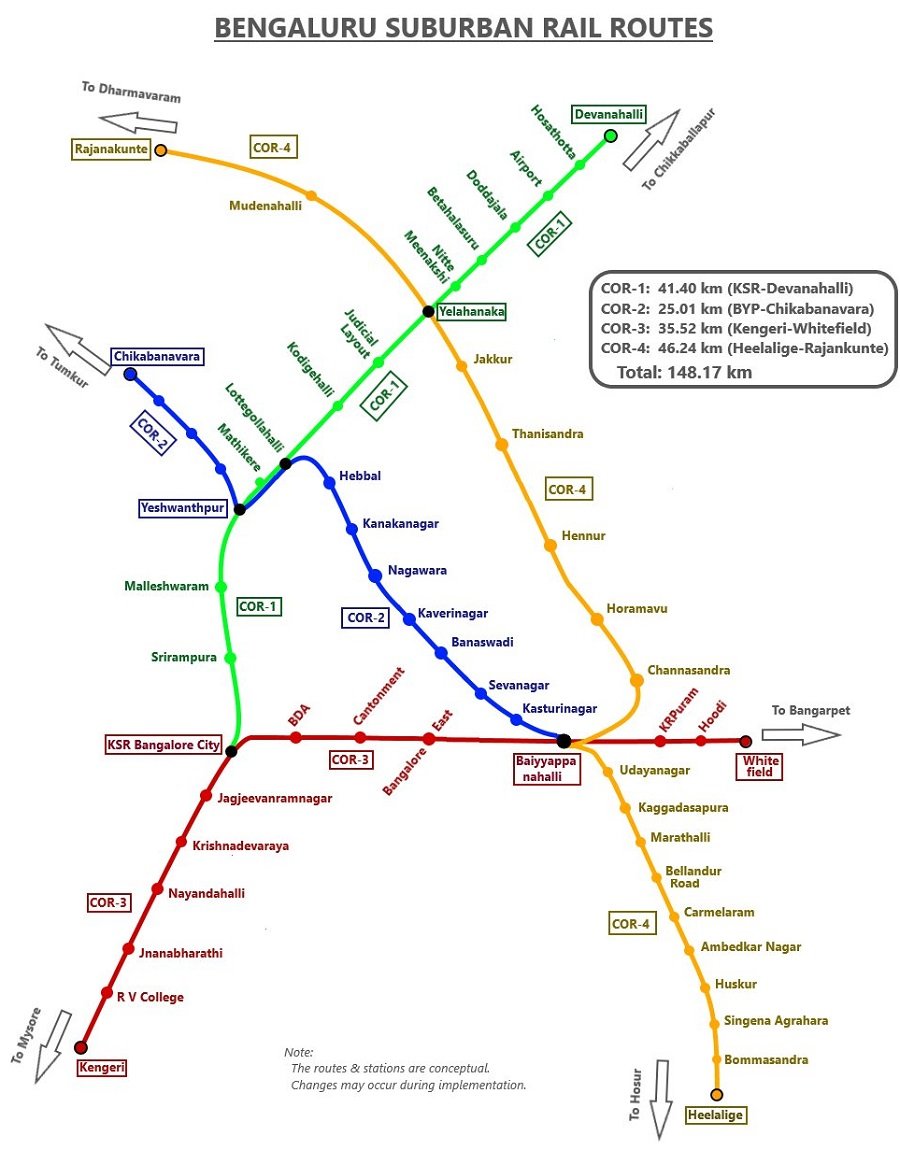
Despite the availability of various modes of transport such as buses and the metro system, the city continues to suffer from congested roads, severe traffic, and overcrowded metro services, particularly during peak hours. The commencement of the 149.348 km Suburban Rail Network will support the existing transport modes to accommodate the growing number of commuters in the city.
This article will navigate through the critical aspects of the Bengaluru Suburban Rail project while examining its potential to accelerate the city’s growth.
Bengaluru Suburban Rail Project (BSRP) Overview
The Bengaluru Suburban Rail Project (BSRP) is a 149.348 km commuter rail network. The project is currently under construction in Bengaluru, Karnataka. It will include 64 stations across 4 corridors.
Key Features Of The Project As Per DPR’s Recommendation
Parameter
Details
Coaches
Broad gauge, Air-conditioned,
Track Gauge
3660 mm (Broad Gauge)
Traction System
25KV AC, 50 Hz single-phase traction system
Signaling System
CBCTC signalling proposed for high-frequency operations
The feasibility report and the final Detailed Project Report (DPR) were prepared by RITES, which concerned the design and alignment of the network.
Approval
India’s Central Government approved the project in October 2020 with an estimated cost of ₹15,767 crore. The foundation stone for the project was laid on June 20, 2023, by Prime Minister Narendra Modi. The project is being executed by Rail Infrastructure Development Company (Karnataka) Limited (K-RIDE).
Deadline
The Bengaluru Suburban Rail Project was originally targeted for completion by 2026. However, several factors contributed to the delay in the project which may extend the completion deadline to 2027.
Update: Since Corridor-2 is in the most advanced stage, Section 4 of Corridor-2, which extends from Chikkabanavara to Yeshwantpur at a length of 7.4 km is expected to be the first section to be completed and commissioned by December 2025.
Expected Ridership
As per the Detailed Project Report (DPR), the estimated daily ridership on the study corridors is projected to be 9.84 lakh passenger trips in 2025, 13.41 lakh passenger trips in 2031, and 17.60 lakh passenger trips in 2041.
Depots
The land for establishing the depot is located at, Jnanabharathi & Devanahalli. The State Government proposed to mobilize approximately 61.27 acres of land at Devanahalli and 56.97 acres of land at Jnanabharathi for this purpose.
Land Requirement For The Project
As per the DPR by RITES, the project requires the acquisition of approximately 101.687 acres of private land. Additionally, around 326.9 acres of railway land will be used for its implementation.
Funding Mechanism
The Central Government will contribute up to 20% of the project cost, excluding land, Rehabilitation & Resettlement (R&R), and central and state taxes, as its equity contribution. The State Government will contribute an equal amount, bringing the total equity contribution to 40%.
Particulars
Amount ₹( In Crore)
% Share
Equity by Govt. of India
2479
20.0%
Equity by Govt. of Karnataka
2479
20.0%
Soft Loans from bilateral/multilateral funding agencies
7438
60.0%
Total Cost
12396
100.00%
Sub-Ordinate Debt for Central GST & Basic Customs Duty by GOI
763
–
Sub-Ordinate Debt for land and R&R by Govt. of Karnataka
1470
–
Sub-Ordinate Debt for State GST by Govt. of Karnataka
785
–
Sub-Ordinate Debt for IDC for JICA ODA Loan @1.4% by Govt. of Karnataka
353
–
Total Cost
15767
–
€500 Million Loan from KfW
On 15 December 2023, KfW Development Bank (Germany) and Rail Infrastructure Development Company (Karnataka) Limited (K-RIDE) signed a loan agreement worth €500 million (approximately ₹4,552 crore) along with a grant of €4.5 million (around ₹41 crore) for the Bengaluru Suburban Rail Project (BSRP).
The loan will support the development of the following Lines:
Corridor-1: KSR Bengaluru- Devanahalli
Corridor-3: Kengeri – Whitefield
€300 Million Loan from the European Investment Bank (EIB)
On 14 June 2024, the Ministry of Finance’s Department of Economic Affairs signed a Memorandum of Understanding (MoU) with the European Investment Bank (EIB) for a €300 million loan to support the Bengaluru Suburban Rail Project (BSRP).
According to K-RIDE, the agreement will enable the initiation of tenders for Corridor-1, Depot-2, and track and traction works.
Update: Railway Infrastructure Development Company (Karnataka), K-RIDE has successfully secured foreign funding of about Rs 7,438 crore (approximately €800 million) for BSRP.Funding Received (as of May 31, 2024):₹500 crore from the Ministry of Railways.₹665.42 crore from the State Government.Total Expenditure Incurred:₹1,031.03 crore.
The Corridors in the BSRP
The Bengaluru Suburban Railway Project will cover a total length of 149.348 km through 4 corridors. Each corridor is named after commonly found local flowers in Bengaluru and its surrounding areas. The corridors are:
Sampige Corridor: Named after the Champa flower.
Mallige Corridor: Named after the Chameli flower.
Parijata Corridor: Named after the Prajakta flower.
Kanaka Corridor: Named after the Priyardarsha flower or Kanak Champa flower.
Project Status:
Under Construction: 54.9 km
Approved: 94.4 km
Route Type:
Elevated Routes: 45.392 km
At-Grade Routes: 103.856 km
Corridor 1: Sampige Line
Route: KSR Bengaluru City – Devanahalli via Yelahanka
Update: On June 26 2024, a revised alignment plan was submitted to South Western Railway (SBC Division), and approval is currently awaited. Line 1 has been divided into two packages: Package 1A, which covers the section from Majestic to Yelahanka (17.63 km), and Package 1B, which covers the section from Yelahanka to Devanahalli (23 km).
Corridor 2: Mallige Line
Route: Baiyyappanahalli – Chikkabanavara via Hebbal
Electrical connections, drainage, and minor bridge construction.
Bridges Completed:
Five minor bridges have been constructed, with 15 more under progress.
BSRP Will Feature The Following Interchange Stations
Interchange Stations
Corridors
Bengaluru City
Corridor-1 & Corridor-3
Yesvantapur
Corridor-1 & Corridor-2
Lottegollahalli
Corridor-1 & Corridor-2
Yelahanka
Corridor-1 & Corridor-4
Benniganahalli
Corridor-2 & Corridor-4
Recent Updates On the BSRP:
Land AllocationOn April 2, 2024, South Western Railway (SWR) signed agreements with Railway Infrastructure Development Company Limited (K-RIDE) to allocate land for the Bengaluru Suburban Railway Project. SWR handed over 115.472 acres of land for Corridor-4 under a long-term lease. For Corridor 2, the allocated land was reduced from 157.07 acres to 85.707 acres. Route AlignmentThe Centre and the Karnataka government are discussing the possibility of excluding Corridor-3 (Whitefield-Kengeri) from the Bengaluru Suburban Railway Project (BSRP).On 26 November 2024, Minister of State for Railways, V Somanna, stated that the current focus is on implementing Corridors 2 and 4.
Major Contractors Involved in BSRP
Corridor
Work
Amount & Package
Firm
Corridor 2
Design and construction of an elevated viaduct of length 8.027 km from Benniganahalli to Chikkabanavara excluding station buildings
Rs. 849.97 crore
Larsen & Toubro
Corridor 4
The contract includes the construction of an elevated viaduct spanning 8.960 km and an at-grade formation covering 37.920 km along the Heelalige–Rajanukunte section.
Rs. 1040.51 crore
Larsen & Toubro
Corridor 4
The contract involves the construction of 9 stations (1 elevated and 8 at-grade) at Heelalige, Singena Agrahara, Huskur, Ambedkar Nagar, Carmelaram, Bellandur, Marathahalli, Doddanakundi, Kaggadasapura
Rs. 613 crore (Package C4A)
RVNL – Rithwik JV(Lowest Bidder)
The Major Roadblocks-Slowing The BSRP
No Bidder Participation for Rolling Stock Contract
Initially, 306 rail coaches were planned for the BSRP. K-RIDE had invited tenders for the procurement of rolling stocks in two stages: Request For Qualification (RFQ) and Request For Proposal (RFP). In the first stage, RFQ, three bidders were qualified: BHEL, BEML, and CAF/Spain. K-RIDE initiated the second stage, RFP, on December 29, 2023. However, Despite extending the deadline to August 22, 2024, no bids were received during the Request for Proposal (RFP) stage.
Currently, a proposal is under review to procure rolling stock through an equity model, with a 50:50 cost-sharing arrangement between the Government of Karnataka (GoK) and the Ministry of Railways (MoR).
Encroachment Issues
According to N Manjula, Managing Director of K-RIDE, there are 62 encroachments identified along the Baiyyappanahalli – Chikkabanavara Corridor (Mallige Line). The encroachments primarily involve private buildings and other unauthorised structures on the railway land. These encroachments need to be cleared before the construction begins. However, the clearance process is complex and cumbersome as it involves the issuance of notices and proper documentation. This bureaucratic process can delay construction activities substantially.
Utility Shifts
Corridor-2 is facing challenges in shifting utilities, particularly water and sewer lines that are managed by the Bengaluru Water Supply and Sewerage Board (BWSSB), as well as the relocation of high-tension overhead power lines. BWSSB needs to relocate 15 water lines and 17 sewer lines from the project site
Benefits Associated with the BSRP
Multi-Modal Integration: The Bengaluru Suburban Railway Project will integrate with a number of transport systems like metro, BMTC buses, railway stations, and bus terminals. The BSRP stations will have car bays, bus bays, and electric vehicle charging facilities.
Hebbal station will integrate with the new multi-modal transport hub connecting metro, bus depots, and suburban rail. Other stations such as Bengaluru City, Yeshwantpur, and Benniganahalli will also have an integration of metro services with railway stations and bus depots.
Traffic Decongestion: Once completed, the Bengaluru Suburban Rail will be capable of carrying up to 10 lakh (one million) passengers on a daily basis. This will reduce the strain on other transport modes.
Cost-Effective Travel: The BSRP is designed to offer affordable ticket prices compared to existing metro services.
Economic Growth: The approximately 149 km routes of the Bengaluru Suburban Rail Project have been strategically planned to pass through densely populated areas. This will change locations nearer to stations into integrated commercial hubs. This will boost the local economies as people will be employed and trade will increase in the surrounding areas.
Environmental Benefits: By promoting rail travel over road transport, the BSRP is expected to reduce carbon emissions and contribute to a more sustainable urban environment
Conclusion
The Bengaluru Suburban Rail Project (BSRP) is a joint initiative undertaken by the Government of Karnataka and the Ministry of Railways. K-RIDE (Karnataka Rail Infrastructure Development Company Limited), a special purpose vehicle (SPV) is executing the project. The Bengaluru Suburban Rail Project (BSRP) is the first railway initiative in India to be implemented under the National Suburban Rail Policy of 2018. With 4 Corridors the project will cover a total length of about 149 km streamlining connectivity across Bengaluru and its suburbs. The BSRP will alleviate traffic congestion in Bengaluru by reducing the number of road users by approximately 10 lakh. Despite its transformative potential the project faces critical challenges that could impact its timely and effective implementation. From land acquisition and escalating costs to coordination between multiple agencies. Environmental concerns, utility shifting, and delays in approvals further complicate the process. If these issues are tackled effectively, BSRP has the potential to not only ease the city’s transport woes but also set a benchmark for suburban rail networks across the country.
Kochi (Metro Rail News): Kochi Metro Rail Limited ( KMRL) has invited bids for the Preparation of a Detailed Project Report (DPR) for the Kochi Metro Phase III Corridor.
Tender Details
Opening Date: 4 January 2025
Closing Date: 17 February 2025
Contract Duration: 6 Months
EMD Bid Security: Rs. 1,00,000/-
Pre-Bid Meeting: 4 February 2025
Technical Bid Opening: 19 February 2025
Brief Scope of Work: Preparation of Detailed Project Report (DPR) for the Phase III Corridor of the Kochi Metro Rail Project from Aluva to Angamaly with Airport Connectivity.
About Kochi Metro
Currently, Phase 1, 1A & 1B of Kochi Metro consisting of one elevated corridor ( Blue Line ) is operational. The Blue Line spans 27.96 km from Aluva to Tripunithura through 25 stations.
Phase 2 of Kochi Metro is currently under construction. Phase 2 consists of one corridor ( Pink Line) spanning 11.2 km from JLN Stadium to Infopark II through 11 stations.
Bangalore ( Metro Rail News ): Bangalore Metro Rail Corporation Ltd. (BMRCL) has invited tenders for two major remaining architectural station finishing contracts for Reach 6 (Pink Line) of Bangalore Metro spanning 21.386 km from Kalena Agaraha to Nagawara through 18 stations.
Contract-1
Under this contract, BMRCL has invited tender for the remaining Architectural Finishing Works for Six Underground Metro Stations of RT-01 and RT-02 in the Reach-6 line of the Bangalore Metro Rail Project, Phase-2 under Package-1.
Tender Details
Estimated Tender Value: INR 29.76 Crores
Tender Security (EMD): INR 29.76 Lakhs
Contract Duration: 13 months
Pre-Bid Meeting: 14 February 2024
Opening of Technical Bid: 1 March 2025
Schedule of submission e-Tender (online only) on CPP Portal: 23.02.2025 (from 10.00 AM) to 28.02.2025 (up to 3.00 PM)
Scope Of Work
The scope of work under this package includes the Balance Architectural Finishing Works for Six Underground Metro Stations of RT-01 and RT-02 in the Reach-6 line of the Bangalore Metro Rail Project, Phase-2 under Package-1.
Stations
Dairy Circle
Lakkasandra
Langford
Rashtriya Military school
MG Road
Shivajinagar
Contract-2
Under this contract, BMRCL has invited tender for the remaining Architectural Finishing Works for Six Underground Metro Stations of RT-03 and RT-04 and one Elevated Metro Station in the Reach-6 line of Bangalore Metro Rail Project, Phase-2 under Package-2
Tender Details
Estimated Tender Value: INR 32.19 Crores
Tender Security (EMD): INR 32.19 Lakhs
Contract Duration: 13 Months
Pre-Bid Meeting: 14 February 2025
Opening Technical Bid: 1 March 2025
Schedule of submission e-Tender (online only) on CPP Portal: 23.02.2025 (from 10.00 AM) to 28.02.2025 (up to 3.00 PM)
Scope of Work
The scope of work under this package includes the Balance Architectural Finishing Works for Six Underground Metro Stations of RT-03 and RT-04 and one Elevated Metro Station in the Reach-6 line of the Bangalore Metro Rail Project, Phase-2 under Package-2.
Patna ( Metro Rail News): Johnson Lifts Pvt Ltd. has been declared as the lowest bidder by the Delhi Metro Rail Corporation (DMRC) for the contract of escalators installation for the Patna Metro Rail Project
Bidding Process
DMRC invited bids for this contract with a 1080-day deadline.
On 2 December 2024, technical bids were opened revealing 4 firms for the contract.
Financial bids were opened for the contract on 6 February 2025, revealing Johnson Lifts Pvt Ltd as the lowest bidder.
Financial Bid Values
Bidder Name
Bid Value
Johnson Lifts Pvt Ltd.
₹67.4 Cr
Otis Elevator Company (India) Ltd
₹79.1 Cr
Schindler India Pvt Ltd.
₹98.8 Cr
DMRC Brief Scope: Design, Manufacture, Supply, Installation, Testing, and Commissioning of Escalators for the Patna Metro Rail Project.
Recent Contract for Patna Metro
Recently, Rahee Infratech Ltd was declared as the lowest bidder by the DMRC for the Package PT-09 of Patna Metro. The scope of work under this package includes the installation of ballastless standard gauge tracks on Phase 1’s Priority Corridor.
Bhopal, the capital of Madhya Pradesh is the 16th largest city in India, famous for its history and cultural diversity. It was formed by Parmara King Bhoj in the 11th century.
The city has a diverse natural and artificial lake. Situated on the Malwa Plateau, just north of the Vindhya Mountain ranges, the city is famous for its diversified architecture. The city is considered one of the most crucial hubs within Madhya Pradesh. Bhopal serves as a home to numerous research and educational institutes and institutes of national importance in India namely IISER, MANIT etc. With that, the city hosts a variety of industries including automobile manufacturing, textiles, pharmaceuticals and electrical appliances.
Bhopal is also one of the greenest cities in India which reflects the city’s commitment toward sustainability. The city has been ranked as one of the Cleanest State Capitals of India for the last three years. However, major challenges arose in between this commitment when the city witnessed sudden population growth, leading to the increase in private vehicle ownership in the city. The increasing number of vehicles on the road of Bhopal increased the Air Pollution in the city.
The air quality of Bhopal became a major concern with the growing time. The Air Quality Index of the city was frequently indicating poor conditions. A recent report indicated that in 2023, for almost 140 days the AQI level of the city exceeded 300 on several occasions making the air unfit for breathing. Due to increasing urbanisation and deteriorating quality of air the city saw a need for a sustainable mode of transportation for the city like the Metro System. In September 2019 the Chief Minister of the state laid the foundation stone of Bhopal Metro.
Bhopal Metro Project
Overview
Bhopal Metro, also referred as Bhoj Metro is an under-construction Mass Rapid Transit System (MRTS) for the city of Bhopal by the Madhya Pradesh Metro Rail Co Limited (MPMRCL). The Phase 1 of the Bhopal Metro consists of 2 corridors with 28 stations in total. Phase 1 is expected to become operational by 2027.
May 2013: Rohit Associates Cities & Rails Pvt.Ltd was appointed to prepare the master plan for the Bhopal Metro Project. The master plan suggested a 105 km route with 6 corridors for Bhopal Metro out of which Lines 2 & 5 were identified for Phase 1.
December 2016: The state government approved the Detailed Project Report (DPR) of Phase 1 spanning 27.90 km.
October 2018: The DPR of Phase 1 with a route of 27.90 km was approved by the Central Government.
January 2019: The construction work on the Phase 1 of Bhopal Metro commenced.
September 2019: The Chief Minister of Madhya Pradesh laid the foundation stone of the Bhopal Metro and nicknamed it Bhoj Metro after Parmar King Bhoj.
Funding Mechanism
The Bhopal Metro Project is estimated to cost Rs. 6941.40 crores.
Loans
The project will be financed through a 400 million euro loan from the European Investment Bank (EIB) signed on December 20, 2019, and an official development assistance (ODA) loan from the Asian Development Bank (ADB).
Note: In the fiscal year 2024, the Union Ministry of Housing and Urban Affairs approved Rs 882 crore to the Bhopal Metro with an increase of Rs 269 crore from last year’s budget.Till now, the Union govt has allocated Rs 2239 crore for the Bhopal metro including this fiscal year.
Key Specification
Authorized Authority
Madhya Pradesh Metro Rail Co Limited (MPMRCL)
Speed and Track
Top Speed: 80 kmphAverage Speed: 34 kmphTrack Gauge: Standard Gauge – 1435 mm
Electrification
750 V DC Third Rail
Signalling
Communications-Based Train Control (CBTC)
Project Cost
Rs. 6941.40 crores ( Approx)
Estimated Ridership
2.20 lakh/day (2027)
Contractor’s List
Contract
Contractor
Preparation of Detailed project report (DPR) of Bhopal Metro
Rohit Associates Cities & Rails Pvt.Ltd
Package-01: Construction of Line-2’s 6.225 km viaduct from AIIMS to Subhash Nagar including entry/exit viaduct to the depot.
Dilip Buildcon Ltd.
BH-04: Construction of 3.39 km underground twin tunnels and 2 underground stations at Bhopal Junction Station and Nadra Bus Stand.
KPIL – Gulermak JV
BH-07: Ballastless Track (BLT) of Standard Gauge at Elevated and Underground sections along with Ballasted & Ballastless Track in Depot
Larsen & Toubro (L&T)
BH-IN-02: 156 Rolling Stock cars for Bhopal metros including Signaling and Train Control and Telecommunication Systems
Alstom
BH-05: Construction of 12.91 km Blue Line’s viaduct and 13 elevated stations
Afcons Infrastructure
BH-03: Construction of elevated viaduct and 6 stations between Subhash Nagar – Aish Bagh Ramp and Sindhi Colony Ramp – Karond Circle
URC Construction (Lowest Bidders)
BH-06: Construction of Subhash Nagar Depot
KEC – SAM JV (Lowest Bidders)
BH-02: Construction of 8 elevated stations on Line-2 between AIIMS – Subhash Nagar
URC Construction (Lowest Bidders)
BH-IN-21: Detailed Design Consultant for E&M works at : IN-04 (5 elevated stations) and IN-O5 (7 underground stations) on Yellow Line
Ayesa India (Lowest Bidders)
Rolling Stock
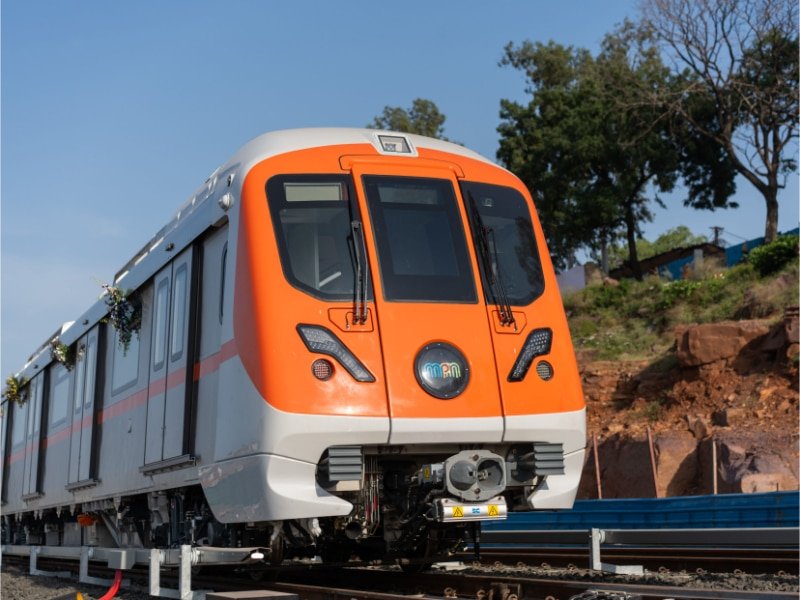
May 2022: Alstom grabbed Bhopal Metro’s rolling stock contract to supply and manufacture 27 trainsets (81 coaches) from MPMRCL.
March 2023: Alstom started the manufacturing of train sets in Savli, Gujarat. In
September 2023: Alstom delivered the first 3 coach train set for the Bhopal Metro at Subhash Nagar Depot.
Updates: Train Trials In October 2023, MPMRCL conducted the trials of the first trainset delivered by Alstom. The trials took place between Subhash Nagar Depot and Rani Kamlapati Railway Station. Further Details: Out of 27 train sets, 14 trains will be operating on Line 2 from Karond Circle to AIIMS while the remaining 13 trains will be operating on Line 5 between Bhadbhada Square and Ratnagiri Tiraha.
Status of Bhopal Metro
Operational:
0 km
Under Construction:
6.22 km
Approved
21.65 km
Proposed
77.13 km
Bhopal Metro Phase 1
Line-2 (Orange Line): Karond Circle – AIIMS
Length: 14.99 km
Type: Elevated & Underground
Status: 6.225 km is under construction between AIIMS and Subhash Nagar
Depot: Subhash Nagar Underpass (Jinsi)
Number of Stations: 16
Station Names: Karond Square, Krishi Upaj Mandi, DIG Bungalow, Sindhi Colony, Nandra Bus Stand, Bhopal Junction, Aish Bagh Crossing, Bogda Pul (interchange), Shubhash Nagar Underpass, Kendriya Vidyalaya, DB City Mall, Sangam Cinema,Rani Kamlapati Railway Station , Habibganj Naka, Alkapuri Bus Stand, AIIMS
Station Names: Bhauri Bypass/NH12 Junction, Peepainer Village (Aerocity), Airport Road, Gandhinagar, Airport Tiraha, Manubhan Tekri, Lalghati Square, Idgarh Hills, Collectorate, Cambridge School MG Hospital, Curfew Wali Mata Mandir, Kamala Park, Polytechnic Square, Roshanpura Square, TT Nagar Stadium, Mata Mandir, Jain Mandir, Sharda Mandir, Nutan College, Mansarovar Complex (Habibganj Station), Habibganj Naka, 10 No. Square, Sai Board, Vasant Kunj Bus Stop.
Line-4 (Yellow Line): Ashok Garden Auto Stand – Mother Teresa School
Number of Stations: 21
Station Names: Ashok Garden Auto Stand, Krishna Campus, Railway Station, Jumerati Road, Curfew Wali Mata Mandir, Kamala Park, Polytechnic Square, Roshanpura Square, TT Nagar Stadium, Mata Mandir, MACT Square, Panchsheel Nagar Bus Stop, Ekant Park, Sahapura Lake, Bhoj University (Chunnabhatti), IIPM Sarvadham, Mansarovar School, CI Height Nayapura Bus Stop, Sanskar Marriage Garden, Bhairagarh Chichali, Mother Teresa School
Line-6 (Brown Line): Habibganj Naka – Mandideep
Number of Stations: 12
Station Names: Habibganj Naka, RRL, BU University, Bagsewania Bus Stop, Ashima The Lake City Mall, Sri Ram Colony, C21 Mall, Scope College (Bharopur), Regional 1 / NH-12, Harigangar Nagar, Regional 2, Mandideep.
Recent Updates:
Launching of OWG Bridge
In September 2024, RKC Infratech launched the 416 MT and 65 meters long Open Web Girder (OWG) bridge for Bhopal Metro’s priority corridor which covers 7 km distance from Subhash Nagar to Aiims through 8 stations. This development took place at Habibganj Naka across the Indian Railways’ 3 main-line tracks.
Track Work Progress
Of the proposed 15 km-long track (upline and downline) between Subash Nagar and AIIMS, 14 km has been successfully completed. Work on the remaining 1 km section is currently in progress. Once completed, authorities will initiate a trial run across the entire stretch.
Inspection
In November 2024, The Managing Director of Madhya Pradesh Metro Rail Corporation Shri S. Krishna Chaitanya conducted thorough inspection of the Bhopal Metro Priority Corridor section from Subhash Nagar Station to Rani Kamlapati Metro Station.
Benefits of Bhopal Metro
Enhanced Connectivity: A metro system in Bhopal will increase the connectivity in the city by connecting key areas like educational and medical institutions, workplaces and commercial centers through a more convenient mode of transport. This enhanced connectivity will facilitate the residents of the city to commute to different areas of the city more efficiently and in less time.
Reduced Traffic Congestion: Due to rapid urbanisation and increasing population the city is witnessing major traffic congestion on the roads. A metro system will provide the residents of the city with a fast and efficient mode of transport as compared to private vehicles which will alleviate the traffic congestion on the roads of Bhopal.
Economic Growth: The construction and operation of a metro system in Bhopal will create several job opportunities in the city and will attract more business setups and investments near the metro stations which will encourage the local economy and promote economic growth of the city.
Environmental Benefits: The Bhopal Metro project will promote a more sustainable and environmentally friendly mode of transportation in the city. A metro system will provide the residents with a reliable alternative to road transport which will lower the emission of pollutants such as carbon dioxide from vehicles reducing air pollution in the city.
Challenges In Bhopal Metro
Ridership Concern: The ridership level is a primary challenge before the establishment of any metro project. For Instance, the Pune Metro is currently facing a shortfall in the daily ridership level with only 150,000 passengers compared to a projected figure of over 600,000 for 2021. The financial viability of any metro project depends on its ridership level. Hence, achieving project ridership is very important to make any project successful and sustainable for a long period of time.
Financial Constraints: Securing adequate funding for the Bhopal Metro project is critical for the MPMRCL. The delay in fund allocation can hinder the progress of the project and also increase its cost.
Integration with other modes of Transport: Integrating the Bhopal metro with the existing modes of transport like buses and rickshaws is a major challenge. To make the project successful it is very important to link the metro system with other modes of transport which will allow passengers to switch to different modes of transportation smoothly.
Encroachment Issues: The authorities have identified encroachment issues along the planned Bhopal metro development routes, particularly near main roads in areas like Jinsi and Karond. These issues can potentially impact the deadline of the project.
Conclusion
The Bhopal Metro project, implemented by Madhya Pradesh Metro Rail Corporation Limited is a notable step towards streamlining the connectivity in the state capital. With 2 corridors under construction of 6, Bhopal Metro is set to cater to over 2.20 lakh daily commuters, addressing the city’s growing demand for efficient public transport. However, the project is running behind its original deadline of commencing operation on the priority corridor due to some critical challenges. While Bhopal Metro has the potential to set a benchmark for urban mobility in smaller cities, its success will depend on careful attention to operational efficiency, ridership engagement, and integration with the city’s broader development goals.
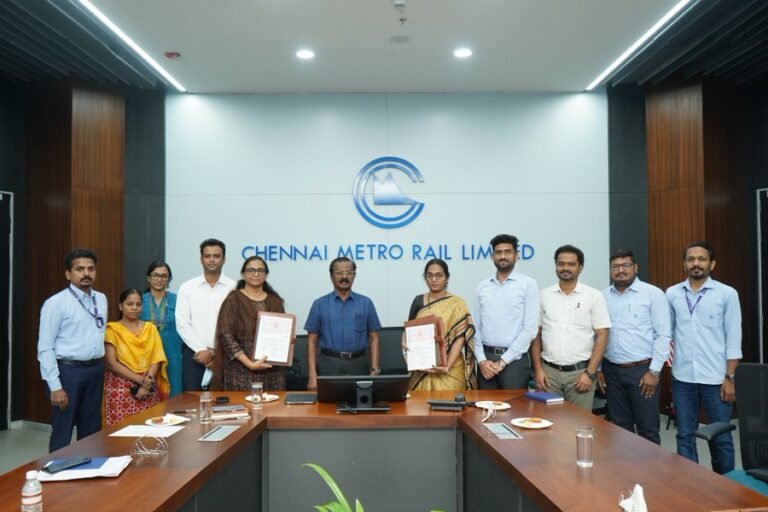
On February 06, 2025, Chennai Metro Rail Limited has signed a Contract Agreement for the Preparation of a detailed project Report for property development at MVN Nagar in Thirumangalam, Nandanam, and Thousand Lights in CMRL Phase 2 stations.
The Contract has been awarded to the consulting firm, a Joint Venture between M/s Aarvee Associates Architects Engineers & Consultants Pvt Ltd and M/s ANAROCK Property Consultants Pvt Ltd at a cost of Rs. 41.87 Lakhs (excluding GST). The Letter of Acceptance (LOA) was issued to the Joint Venture consulting firm on December 20, 2024.
In the presence of Thiru. T. Archunan, Director (Projects), the Contract Agreement was signed by Tmt. Rekha Prakash, CGM (P&D) on behalf of CMRL and by Tmt. J.K. Nandana, Associate Vice President, on behalf of M/s Aarvee Associates, along with Thiru. S. Vinoth, Vice President of M/s ANAROCK Property Consultants Pvt Ltd. Senior officials of CMRL and the Consultant were present during the occasion.
Contracts Scope Of Work
The contract includes the Preparation of detailed project Report, Feasibility Study, Market analysis, Transactional advice, Concept plans, and Land use report etc including submission of documents to CMDA/GCC for approval, preparation of Cost Estimate and Tender Documents for property development at MVN Nagar in Thirumangalam, Nandanam and Thousand Lights February 06, 2025: Chennai Metro Rail Limited has signed a Contract Agreement for the Preparation of Detail Project Report for property development at MVN Nagar in Thirumangalam, Nandanam, and Thousand Lights in CMRL Phase 2 stations
CMRL’s Vision
CMRL has planned for non-fare revenue generation along with fare revenue by integrating the property development along with the metro stations at MVN Nagar in Thirumangalam, Nandanam, and Thousand Lights. The property development at MVN Nagar will be seamlessly connected to the entry and exits of the upcoming Thirumangalam Metro station.
At Nandanam the property developments are conveniently situated near the existing metro station and opposite to MetroS, Admin Building. The Thousand Lights metro station will incorporate property developments linked to both Phase 1 and Phase 2 stations, providing enhanced connectivity and convenience. The final DPR is expected to be completed by March 2025.
Bangalore (Metro Rail News): The Bangalore Metro Rail Corporation Limited (BMRCL) has finally commenced the Land acquisition process for the Namma Metro Phase 3 project.
Land Acquisition
BMRCL has acquired 26,811 square meters of land for Corridor 1, spanning from J. P. Nagar Phase 4 to Mysuru Road Metro Station.
They have identified a total of 1,29,743 square meters of land for this corridor, which involves 777 private properties.
As per the officials, “any additional land required for the project would be acquired in coordination with the Bruhat Bengaluru Mahanagara Palike (BBMP). The entire project has been designed to ensure minimal impact on existing infrastructure, including roads, flyovers, and underpasses.”
About Bangalore Metro Phase 3
As per the BMRCL officials, Phase 3 will consist of two corridors.
Corridor
Route
Distance
Corridor 1
J.P. Nagar Phase 4 to Kempapura
32.15 km
Corridor 2
Hosahalli to Kadabagere
12.5 km
Several interchange stations will be built along these routes, including Peenya and JP Nagar on the Green Line, Mysuru Road on the Purple Line, and Sumanahalli on the Hosahalli-Kadabagere corridor.
J. P. Nagar Phase 4 will connect to the Pink Line at Bannerghatta Road. Hebbal will be an important interchange for the Blue Line, which goes to the airport, and the Red Line, linking Hebbal and Sarjapur.
Bangalore Metro Phase 3 Detailed Project Report
The Detailed Project Report (DPR) for Phase 3 includes plans for a double-decker viaduct, which has caused some delays due to changes in planning.
Project cost
The project is estimated to cost ₹15,611 crore, with ₹7,577 crore financed through loans and ₹450 crore expected from sources like advertising and naming rights for stations.
Further Updates
Preliminary geotechnical investigations have started along Magadi Road for a land acquisition project.
An official mentioned “A private company has undertaken soil testing, with the first phase covering the stretch from Mysuru Road Station to Kanteerava Studio Station, and the second phase extending from Hosahalli Station to Kadabagere Depot. Further studies will be conducted along other key stretches, including Kanteerava Studio to Kempapura and J. P. Nagar Phase 4 to Mysuru Road,”
Gorakhpur, a city in Uttar Pradesh, along the banks of the Rapti River in the Purvanchal Region is famous for its rich culture and heritage. The city is located 272 kms east of the state capital Lucknow. The city lies at an elevation of about 84 meters (276 feet) above sea level. Gorakhpur is famous for its architecture of Gorakhnath Math, a Gorakhnath temple. The city is one of the most flood-vulnerable districts in Eastern Uttar Pradesh.
Gorakhpur city has been witnessing a significant increase in population with the growing time. As of the 2020 report, the area of the city has increased from 145.5 km2 in 2011 to 226.6 km2 and31 villages have been incorporated in the municipal corporation limits increasing the population to over 1 million. Due to the increasing population, the city was declared a Metropolis city by the State Government on 22 November 2021.
However, the city witnessed some major challenges due to the population growth, one of them being traffic congestion on the roads of the city. To conquer these challenges the city recognised a need for an efficient and modernised mode of transportation which led to the proposal of Gorakhpur Metrolite, a Light Rapid Transit System (LRT) for the city of Gorakhpur, Uttar Pradesh, India.
Why a Metrolite System for the Gorakhpur City?
The development of the Metrolite project instead of the regular Metro is beneficial for the city in multifaceted ways. The Primary reasons are mentioned below:
Low Implementation Cost: Budget constraints are a crucial issue in small cities such as Gorakhpur. The cost of construction for a metro system is extremely high as compared to a metrolite system. For example, a conventional metro system costs about ₹200-300 crores per kilometre, whereas a metrolite system costs around ₹100-200 crore per kilometre. This reduction in the cost of construction makes a metrolite system less expensive, feasible, and possible for Gorakhpur.
Land Acquisition: Gorakhpur is a densely populated city which creates a major challenge before the project which is land acquisition. Due to this in Gorakhpur, it’s a critical task to acquire land for a metro system. To counter these problems, the authorities designed a metrolite system that should be appropriate for the city since a metrolite system often consists of in-grade tracks and relatively small stations, unlike a metro system and, therefore, solving land acquisition issues.
Infrastructure Limitation: The expansion capability of the existing infrastructure in Gorakhpur city is limited. To put up a heavy metro system, more land would be needed and more complex infrastructure too. However, the metrolite system infrastructure is less complex and the rolling stock used is smaller in size as well. Thus, the metrolite system is suitable for Gorakhpur city.
Gorakhpur Metrolite Project
Overview
Gorakhpur Metrolite, a Light Rail Transit System (LRT) will consist of 2 corridors and 27 stations. The Uttar Pradesh Metro Rail Corporation Ltd. ( UPMRCL) is responsible for overseeing the project. The project is estimated to cost Rs 4,672 crore.
The government of Uttar Pradesh appointed UPMRCL as the coordinator in 2017 to accommodate all the stakeholders together and start the construction work for Gorakhpur Metro Phase 1.
Development of DPR
RITES was appointed to create the feasibility report and Detailed Project Report (DPR) for the Gorakhpur Metrolite Project.
Timeline
March 2019: The RITES submitted the feasibility report and Detailed Project Report (DPR) to UPMRCL.
9 October 2020: The State Government’s Cabinet approved the DPR of the Gorakhpur Metrolite Project.
November 2021: The Union Government’s Public Investment Board (PIB) approved the DPR of the Project.
Tentative Funding Mechanism
Source of Funding
Contribution %
Amount in crore
Remarks
Central Government (Equity)
16.32%
662
Equal proportion with the state government
State Government (Equity)
16.32%
662
Equal proportion with the central government
Central Government (Subordinate Debt)
3.68%
149
For central taxes
State Government (Subordinate Debt)
3.68%
149
For central taxes
Local Bodies Contribution
N/A
200
Provided by local authorities
Soft Loans from Funding Agencies
N/A
2,233
Includes 50% from the European Investment Bank (EIB
1. Improved Connectivity: A metrolite system in Gorakhpur will connect major city areas including Gorakhnath Math, and Gorakhpur Railway Station. The enhanced connectivity in these areas of the city will facilitate a more efficient and comfortable journey for the commuters reducing the travel time.
2. Reduction in Traffic Congestion: As the population increased, the city experienced an increase in private vehicle ownership correspondingly. A metrolite system will give the city’s people a less polluting and faster mode of transportation which will decrease the traffic jams on the roads of the city, especially during peak hours.
3. Economic Growth: With a metrolite system, the infrastructure of a city like Gorakhpur will become modernised and sophisticated, which will attract more business setups in the city. The construction of a metrolite system will also create more job opportunities, which will enhance the local economies and help in the economic growth of the city.
Roadblocks in Gorakhpur Metrolite
1. Ridership Concern: A prime concern always exists in front of the implementation of every project regarding its ridership level. For Instance, every metro system in India has failed to reach the anticipated ridership. The revenue sustainability of the Gorakhpur Metrolite Project directly depends on its ridership level. In order to bring in feasibility with sustainability, the authorities concerned must devise strategies for Non-Fare Revenue.
Land Acquisition Challenges As a fully elevated system, the Gorakhpur Metrolite project calls for efficient land acquisition processes. However, securing the needed land in such a densely populated city is quite a challenge. Authorities will need to come up with thorough planning, community engagement, and compensation mechanisms to make this feasible.
Integration with Existing Transport Systems Smooth integration with existing modes of transport is essential to enhance commuter convenience and improve the overall efficiency of the transport network. The upcoming Metrolite project must establish well-planned connections with local buses, auto-rickshaws, and other public transport systems to ensure a smooth and unified commuting experience.
Conclusion
The Gorakhpur Metrolite project aims to address urban transport challenges in the city, including traffic congestion and limited connectivity. The introduction of this cost-effective and modern mode of transit would support Gorakhpur’s growth as an emerging urban centre. The project’s success will, however, depend on factors such as overcoming the hurdle of land acquisition and achieving adequate ridership. With careful planning, sustainable revenue strategies, and coordinated execution, the Gorakhpur Metrolite can be a tool to enhance urban mobility while becoming a model for transport systems in mid-sized Indian cities.