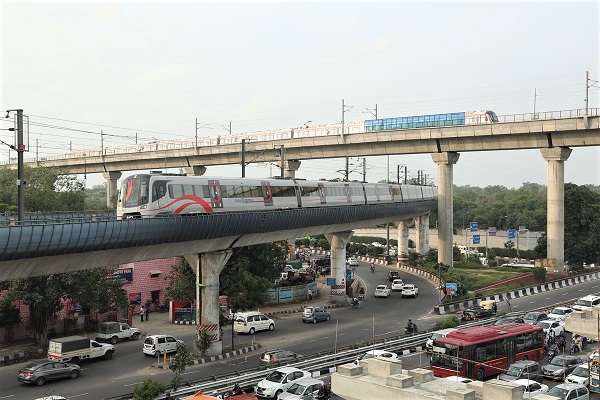
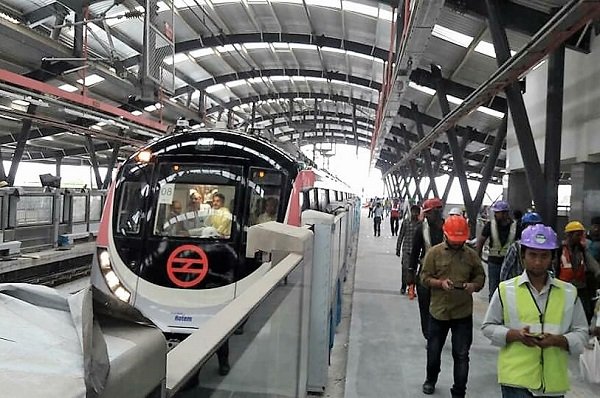
Delhi Metro | DMRC’s Airport Express line to be extended till Dwarka Sector-25

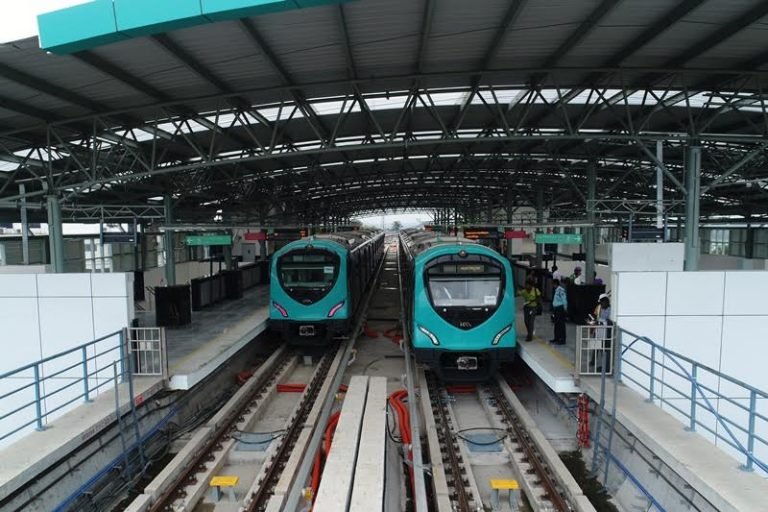
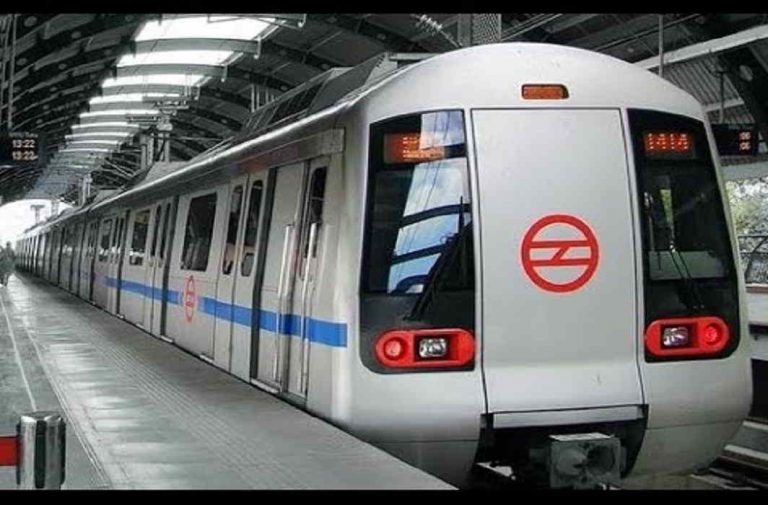
New Delhi: Delhi Metro’s Airport Express line, which connects the centre of the city to the Indira Gandhi International Airport, will now be extended till Dwarka Sector-25.
With the extension, commuters will be able to travel between New Delhi and the upcoming Exhibition-cum-Convention Centre in Dwarka Sector-25 within 25 minutes.
The Centre has been planned and is being constructed on the lines of ITPO and Indian Habitat Centre.
Delhi Metro Rail Corporation (DMRC), after receiving an in-principle nod from the Centre, has already conducted the feasibility study for the extension.
The entire stretch will have a twin box tunnel and the underground station, namely Exhibition-cum-Convention Center Metro station (ECC), is expected to have footfall of 10,000 people daily.
The DMRC worked out the budget and allotted Rs 310 crore for the design and construction of the twin tunnel by cut-and-cover method and architectural finishing of an underground Metro station.
The Corporation has given 30 months to complete the project.
The ECC, which will be able to host 5,000 to 10,000 delegates, will be around 15 minutes away from the international airport here, in close proximity to mixed use and entertainment district, with hotels available on site and within short distances.
“DMRC, after receiving an in-principle nod from the Centre, has already conducted the feasibility study for the extension,” said an official.
A source at DMRC informed that the Centre had written to the Corporation for the extension of the Airport Express Line till Dwarka sector-25, following which the feasibility survey for the same has already been conducted.
The Airport Metro corridor, at present, connects New Delhi area to the international terminal of the IGI Airport and terminates at Dwarka Sector-21.
The western part of the city does not have any such convention centre at present to organise exhibitions and seminars.
“In a bid to facilitate smooth commute of people to the fairs, events or seminars organised at the upcoming convention centre, the Union government wanted the high-speed corridor to be extended till Sector-25 Dwarka,” said the sources at DMRC.
He also added that the Airport Line extension route will help in enhancing the ridership of the airport line corridor.
The work will begin as soon as the necessary approvals are granted.
The Airport Express Line comprises six Metro stations including New Delhi, Shivaji Stadium, Dhaula Kuan, Aerocity, Terminal 3 and Dwarka Sector-21. The line has already crossed the benchmark of 50,000 commuters.

Lucknow Metro | LMRC trains equipped with latest protection systems

Lucknow: The Lucknow Metro Rail Corporation (LMRC) is equipped with most modern train protection system which ensures non collision of trains. A minimum distance between two trains is maintained through train protection system. The moment this minimum distance is crossed in the train the automatically brakes are applied.
The modern state of art, Light weight stainless steel LMRC trains run on 1435 mm Standard gauge and will carry 1574 passengers. The coach has a width of 2.9m. It is expected to reduce the journey time between 50% to 75% depending on the road conditions.
LMRC Trains are designed to run at the maximum speed of 90Kmph and at an operational speed of 80Kmph . The average speed will be approximately 33 to 34 Kmph.LMRC Train will have the most advance signalling and train control system- called the communication based train control system which can be upgraded to virtually driverless mode. The train has regenerative braking which saves 30% to 35% of traction energy.Talkback systems are provided for emergency communication between the passengers and the driver in each coach. The announcement in the train are in Hindi & English. Whereas the display will be shown in English, Hindi & Urdu. There are also route maps and LCD display systems in every coach.

Delhi Metro | Lajpat Nagar to become Delhi metro’s second biggest interchange stn

New Delhi: Delhi Metro commuters can now cheer as work is on to make Lajpat Nagar Metro station, in South Delhi, the second biggest interchange station of the Delhi Metro network. So far, Kashmere Gate on the Red Line (Dilshad Garden-Rithala) is the biggest interchange with three metro lines crisscrossing here, and hence having the highest number of commuters.Currently, work on Lajpat Nagar Metro station is at Phase-III. By October 2017, the Pink Line (Majlis Park to Lajpat Nagar) will be open. Between Majlis Park and Lajpat Nagar, there will be 18 metro stations, proving to be a boon for commuters.Post October, work will begin for Phase IV. The project will have three lines intersecting at this station, making it one of the busiest stations in Delhi.
“In Phase-IV Lajpat Nagar will be connected to the Yellow Line Huda City Centre – Samaypur Badli). The new 7.96 km corridor between Lajpat Nagar and Saket G-block will begin. This will in total make three lines meeting at this station, with which the daily ridership is also expected to go up. This will also help take the load off on already overcrowded Yellow and Red Lines,” said a senior metro official.
The Pink Line will be extended to Shiv Vihar. The 58 km-long Pink Line will then become the longest corridor in the entire Delhi Metro Rail Corporation (DMRC).Officials add that the work on Phase-IV will extend the network to outer Delhi areas as well as make the IGI airport more accessible. The proposed six corridors under the phase-IV include — Rithala – Narela (21.73 km) Inderlok – Indraprastha (12.58 km), Tughlakabad – Aerocity (20.
buy zoloft online blackmenheal.org/wp-content/languages/new/noprescription/zoloft-no-prescription.html no prescription
20 km), Lajpat Nagar – Saket G-Block (7.96 km), Janakpuri (west) – RK Ashram (28.92 km) and Mukundpur-Maujpur (12.54 km).Lajpat Nagar Metro Station to have three interchanges — 1. Kashmere Gate to Escorts Mujesar 2. Majlis Park to Lajpat Nagar (extending to Shiv Vihar) 3. Lajpat Nagar to Saket G-blockSource: DNA

Mumbai Metro | CM Fadnavis promises to extend Metro rail upto Gaimukh

Mumbai: The Chief Minister of Maharashtra Mr. Devendra Fadnavis promised Mira-Bhayander residents that Metro will be extended up to Gaimukh and assured to conduct a feasibility study immediately.
“MMRDA is meant to develop the metropolitan region and we are committed to fulfill your requirements. I promise you an integrated transport system and also a stadium at the Netaji Subhash Chandra Bose Maidan in Mira Road”, the Chief Minister was speaking at the Bhoomipujan ceremony for the 403 MLD Surya Regional Water Supply Scheme on Monday.
The Chief Minister further announced a Ro-Ro service which will carry passengers and vehicles around areas Gorai, Borivli, Bhayander Vasai etc., ”This would mean that the Mira-Bhayander area will get connectivity through Railway, Metro, Road and Water”, he said. 

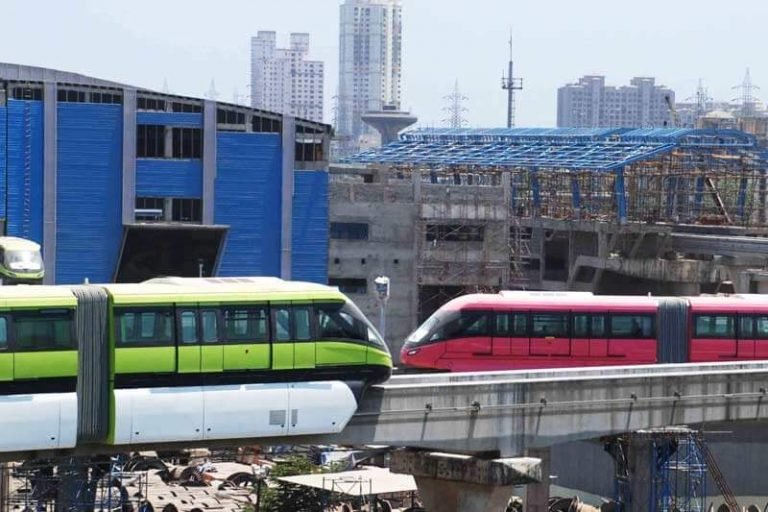
Mumbai Monorail develops technical snag, stops at Chembur station

Mumbai: Once again the monorail is back in the news and this time too for wrong reasons. The Mumbai monorail that was heading towards Chembur from Wadala developed a technical snag and stopped after reaching near Chembur station.
The incident took place at around 9-9.30 pm on Saturday and the train filled with passengers, suddenly developed technical issues.
The monorail had reached the Chembur platform halfway when it suddenly ceased to operate. Another train arriving from Wadala had to then towed the monorail to the end of the platform. All the passengers are safe and this incident is currently under investigation,’ said an MMRDA official.

Bengaluru Metro | Employees on strike, train services suspended

Bangalore: The Bangalore Metro Rail Corporation (BMRC) had temporarily suspended metro train services on Friday as employees staged a protest over alleged manhandling and arrest of two Bangalore Metro Rail Corporation Limited officials after a scuffle with security personnel. As many as four lakh commuters were stranded when they found all stations had been closed, police said. “Train service temporally stopped,” Bangalore Metro’s Twitter handle said.The services were resumed later after negotiations with police and BMRCL officials who prevailed upon the employees to withdraw the protest, officials said. BMRCL employees were demanding the release of two of their officials arrested yesterday when they got into a scuffle with Karnataka State Industrial Security Force (KSISF) personnel deployed at a station here. The Metro employees and KSISF personnel reportedly exchanged fisticuffs and abuses over a row on security checks at Sir M Visveswaraya Central College station.Sources said that BMRC Chief Pradeep Singh Kharola had instructed some station staffs to use minimum electricity and stop uses of lifts and escalators where less footfalls. Accordingly, the KSISF personnel deployed at various metro stations stopped uses of automatic security scanners and started manual security checking. A BMRC employee found that the KSISF allowing some commuters without proper checking then he told the deployed security personnel to check the commuters properly to ensure security of metro property as well as other commuters. Despite of hearing and following his advice the security personnel started beating him on the spot. A video of this incident was also made viral through various means of social media like WhatsApp, Facebook etc. The victim has reported the incident to higher authorities including his colleagues but initially no action was taken. Then the employees started the protest against the management and KSISF, and demanding appropriate action against the guilty KSISF staffs.About 35 metro staff allegedly retaliated, after which six employees were arrested. Four of them have been released but the metro staff is demanding that the remaining two be let off. Two constables of the Karnataka State Industrial Security Forces were also arrested on the complaint of a Metro staffer.The employees resorted to protests after talks between KSISF and Namma Metro officials to resolve the matter failed. The services have been resumed after negotiations with the workers who were on strike was successful.

Integral Coach Factory to build ‘Make in India’ metro rail coaches for the country

Chennai: Integral Coach Factory (ICF) is itching for an on-track showdown with the world’s top coach-makers in the hope that it can provide metro rail companies in the country with the most efficient and cost-effective rakes.The Chennai coach manufacturing unit, owned and operated by the Indian Railways, has approached metro rail companies, including Chennai Metro Rail Ltd (CMRL), for a trial order of one prototype rake — coaches that form an entire train — so they may compare its performance against those manufactured by firms like Germany’s Bombardier and France’s Alstom, whose coaches Indian metro rail companies currently operate.ICF rakes, made with indigenous technology, can cost just 50% of the price of foreign units, experts said on Tuesday, as the coach-maker flagged off its first high-quality rake for the Kolkata metro in the presence of Railway Board chairman A K Mittal.A couple of CMRL officials were at ICF when Mittal flagged off the air-conditioned rake for the Kolkata metro that the coach-maker manufactured. ICF will supply a total of 26 such full trains for the Kolkata metro, 14 of which it will send by 2018.
The coach-maker has deliberated for a few years on whether eligibility conditions permitted it to take part in metro rail tenders.
buy finasteride online https://calibudsman.com/wp-content/themes/twentytwentytwo/inc/patterns/en/finasteride.html no prescription
The ministry of urban development, which has to give the green light to metros, has communicated with ICF, asking for details on the proposal, senior ICF officials said.
CMRL, a senior official of the company on Tuesday said, is already in talks with ICF for the supply of coaches, or ‘rolling stock’ in railway parlance, but currently does not have any requirement.
ICF has managed to use high-end technology like a three-phase IGBT-based propulsion system, regenerative braking (which saves 30% of energy consumed) and conical springs for smoother rides. The ICF officials said the new rake matched international standards. The cost of each rake, which can carry 3,050 passengers, is Rs 40 crore, or half the cost of an imported metro rake.
But ICF faces a challenge because the coaches it manufactures are for broad-gauge tracks and metro rail systems use standard-gauge coaches.
“We redesign the bogies and body to suit standard gauge,” a senior ICF official said. “It is not a major problem.”
Source: TNN

Hyderabad Metro | HMRL hopes to start metro train services in end of the year

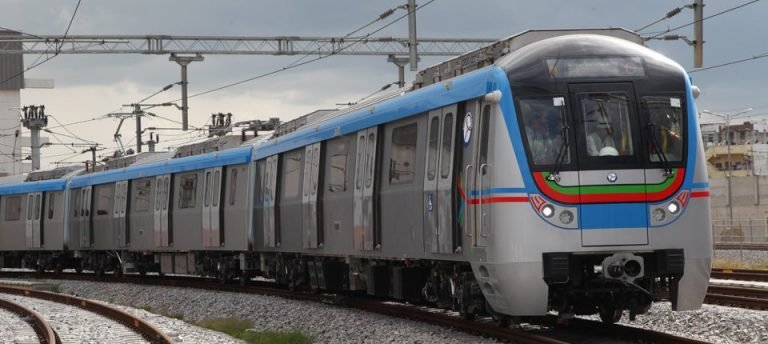
Hyderabad: The State Government has permitted the HMRL to complete the entire Hyderabad Metro Rail Project, other than the 5 km stretch in the Old City and 1 km stretch between Hitec city and Raidurg, latest by November 2018.
The original deadline for construction was ended on Tuesday.  Some delays were caused in completion of the project due to multiple court cases in acquisition of some properties at critical points. So, Government has agreed for extension of deadline by 17 months, according to Managing Director HMRL, NVS Reddy.
Further, Chief Secretary, S.P.Singh reviewed the progress of the project and noticed that that some properties to be acquired are not coming in the way of the Metro Project.
buy viagra online no prescription
He gave instructions to both the Collectors of Hyderabad and Ranga Reddy districts and Commissioner, GHMC to complete acquisition of the remaining properties for widening of roads in Sultan Bazar and Nampally.The State Government advised HMRL to gear up for launching the completed stretches of the project in the next few months and also to complete corridor-I (Miyapur-LB Nagar: 29 km) and corridor-III (Nagole-Hitec City: 27 km) by the end of this year.Source: The Hans India

Bangalore Metro | HCC JV bags Rs 797 cr order from BMRC

Hindustan Construction Company (HCC) today said its joint venture firm has bagged a contract worth Rs 797 crore from Bangalore Metro Rail Corporation.
“Hindustan Construction Company, a lead partner in the joint venture with URC Construction, has been awarded Rs 797.29 crore contract by the Bangalore Metro Rail Corporation Ltd,” HCC said in a BSE filing.
The contract is for construction of 6.
buy vidalista online https://www.mydentalplace.com/wp-content/themes/twentytwelve/inc/en/vidalista.html no prescription
340 km long elevated corridor and five elevated stations between HSR Layout station and RV Road Station.HCC’s share in the JV is 51 per cent (Rs 406.61 crore). The project is to be completed in 36 months.

Delhi Metro | DMRC launches cashless transaction facility for token/smart card recharge through QR

New Delhi: The Delhi Metro Rail Corporation (DMRC) today launched the cashless token sale/smart card recharge facility by using the Bharat Quick Response (QR) Code displayed at the Token Counters & Customer Care Centres of Metro stations. This facility was launched by DMRC’s Managing Director, Dr. Mangu Singh at Rajiv Chowk Metro station in the presence of senior officials.With this facility, the commuters will now be able to use the Bharat QR Code, which is being provided by HDFC Bank, displayed at the Token Counters/Customer Care Centres through their respective Bank’s App installed in their smartphones. All Bank wallet and savings account holders can make payments using Bharat QR by logging into their Bank App and scanning the QR code available at stations.Currently, this facility is made available at five Metro stations namely, Rajiv Chowk, Rajendra Place, Seelampur, Pitampura and Nehru Place only. Subsequently, the facility will be introduced in a phased manner at all Metro stations of the Delhi Metro network.
Speaking on the occasion, Dr. Mangu Singh, Managing Director, DMRC said, ‘The DMRC is making all efforts to push the cashless mode of transaction initiated by the Government of India. This new cashless facility is expected to provide the commuters a more convenient and fast access to the Delhi Metro network besides helping in managing the problem of change/coins at the stations.
The Bharat QR Code was recently launched by the Union Government in a bid to promote cashless transactions and this code works with all major banks in India. It is a form of a bar code that uses the bank’s information (merchant name & account number) required for the payment.Here is procedure for using the Bharat QR Code by the Delhi Metro commuters:-
  • Login to your Bank App and select to pay using the QR code option.
  • You will then need to scan the QR code displayed at token counter/customer care at the station to get the merchant details (DMRC is merchant in this case)
  • Enter the amount (for the desired token value/smart card recharge value) and confirm.
  • The transaction will be authenticated using the PIN/OTP details etc. Both the merchant as well as the customers will receive instant notification after the successful transaction.
  • If you are using Bharat QR for the first time, you will need to grant the App to access the camera on your phone.
DMRC in its bid to promote cashless transactions had taken many initiatives in recent months. Last month only, the smart card recharge/token sale facility at the TVMs through Credit/Debit cards was also introduced at the Lal Quila Metro station. DMRC had earlier also introduced the facility to recharge Delhi metro smart cards by e-wallet applications.

Mumbai Metro | Sam India bags contract to built Aarey Car Depot of Metro-III

Mumbai: The Mumbai Metro Rail Corporation (MMRC) on Thursday announced that it has appointed a Delhi-based contractor for constructing Metro car depot of Colaba-Seepz Metro-3 underground corridor. The MMRC has said that it has tweaked the plan and now 3,130 trees will be affected due to the construction of the car depot.MMRC said that it is going to keep 1,073 trees untouched in five hectares of space near the car depot which will be known as green zone. SK Gupta, acting managing director, MMRC, said, “We are going to replant and transplant the affected trees and the number of trees will be depending on the number approved by the tree authority of Brihanmumbai Municipal Corporation (BMC).”The MMRC on June 23 awarded the contract to Sam (India) Builtwell Private Limited and is going to construct depot on total of 22 hectares. The remaining land will be for the green zone and access way that will be required to connect the Metro with the alignment towards the Western Express Highway.The proposed depot work is going to be completed within 2.5 years and the estimated cost is Rs 328 crore. The contract includes construction of depot, Aarey Metro station and workshop building. The car depot is being designed for 35 rakes of eight cars.
buy vardenafil online https://blackmenheal.org/wp-content/themes/twentytwentytwo/inc/patterns/en/vardenafil.html no prescription
Meanwhile, work on the 32-km-long Metro-3 underground corridor began in October 2016 with MMRC recently announcing that it has completed around 10 per cent of the civil work.The construction of car depot inside Aarey Milk colony was challenged by environmentalists in the National Green Tribunal (NGT)They have contended that there is stay by NGT in any construction activity in Aarey colony. However, MMRC has denied the claim, saying that they are going by books and there is no stay on the same.

Make in India | BHEL ties up with Kawasaki to make steel metro coaches

New Delhi: State-run engineering firm BHEL today said that it has entered into an agreement with Kawasaki Heavy Industries Ltd (KHI), Japan, to produce stainless steel coaches and bogies for metro rail.
“To this effect, the Technology Collaboration Agreement was signed by Amitabh Mathur, Director (IS&P), BHEL and Makoto Ogawara, Senior Vice President, KHI in the presence of Atul Sobti, Chairman and Managing Director, BHEL and Yoshinori Kanehana, President, KHI,” BHEL said in a statement.
According to the statement, the agreement covers establishing state-of-the-art design, engineering and manufacturing facilities at BHEL, India, using Japanese technology.It will also entitle BHEL for technology advances and upgrades.BHEL has been a steady partner in the growth of Indian Railways for over 50 years by supplying electric as well as diesel locomotives, EMUs, and propulsion system sets and drives for the same. Kolkata Metro, the first metro in India, is equipped with BHEL-made propulsion system.KHI is a leading manufacturer of heavy equipment/products and its Rolling Stock Company has supplied EMU (Metro/Commuter) trainsets to various countries like USA, Singapore, Taiwan, Hong Kong etc., besides Japan.KHI, is also the manufacturer and supplier of Shinkansen High Speed Bullet Trains, proposed to be introduced in India on the Mumbai-Ahmedabad High Speed Rail Corridor.(This article has not been edited by Metro Rail News’s editorial team and is auto-generated from an agency feed.)

Kochi Metro | KMRL internal probe finds violation of Metro Railway Act

Kochi: An internal probe by Kochi Metro Rail Limited (KMRL) has found violation of the Metro Act by former Kerala chief minister Oommen Chandy and other Congress leaders during their “protest journey” against Chandy’s non-invitation to the recent inauguration of metro services here.The Kochi Metro Rail Limited (KMRL) today said those who had breached certain substantive provisions of the Metro Railways (Operations and Maintenance) Act, 2002 during the ‘Janakeeya Yatra’ would face legal action.
“The report of the Director (Finance), KMRL regarding the Janakeeya Yatra that took place in the Kochi Metro Rail system on June 20, was submitted to MD, KMRL today.
“It was found by the Enquiry Officer that there had been breaches of certain substantive provisions of the Metro Railways (Operations and Maintenance) Act, 2002,” a KMRL spokesperson said.In the light of the enquiry report, further legal action would be taken by KMRL following the stipulated procedures prescribed in this Act, she said.The ruling CPI(M) had sought action against Chandy and several other Congress leaders for allegedly disrupting Kochi Metro train services by undertaking the protest journey.The Kochi Metro Rail Limited had instituted the internal probe in the backdrop of reports that commuters were put to inconvenience by the protest.There were allegations that the journey undertaken by Congress workers under Chandy’s leadership had created chaos at two stations of Kochi Metro, first phase of which was launched by Prime Minister Narendra Modi on June 17.CPI-M’s Aluva Area Committee Secretary, V Salim in his complaint had demanded that a case be registered against Chandy, Leader of Opposition in the Assembly Ramesh Chennithala, KPCC President M M Hasan and local UDF MLAs and other party workers.
buy vilitra generic newonlineandblo.com/vilitra.html over the counter
The complaint charged Congress workers with having violated provisions of the Metro Railways Act while staging the protest journey in Kochi Metro.The Congress had staged the protest against the non-invitation to Chandy, saying it was the then Chandy government that had played a key role in getting the Kochi Metro project.Congress leaders had said that they had made arrangements for travel of 150 persons, including Congress leaders and the media, for the protest journey. But the party workers came in large numbers after coming to know of Chandy’s protest programme through social media, with media reports claiming it led to chaos at Aluva and Palarivatom stations.(This article has not been edited by Metro Rail News’s editorial team and is auto-generated from an agency feed.)

Jammu Metro | Divisional Commissioner reviews DPR for Metro Rail in Jammu

Jammu: Divisional Commissioner, Dr. Mandeep K Bhandari today chaired a meeting to review the progress of feasibility report for construction of Metro Rail Project in Jammu city.DIG Jammu, Ashkoor Wani, Deputy Commissioner, Kumar Rajeev Ranjan, Commissioner JMC, M. Raju, Chief Town Planner, Joginder Singh, VC JDA, RK Shavan, Director ERA, Ravinder Gupta, Chief Engineer R&B  Sudheer Shah, representatives of RITES besides other senior officers of ERA attended the meeting.The meeting discussed various aspects of first phase of the project including expected cost, routes, rail stations, over head bridges and construction technology.The Div Com stressed upon the officers to use the latest technology so that the best service can be provided to the commuters.
The meeting was informed that Stage-I, MRTS (Mass Rapid Transit System) Master Plan for study area has been completed and Stage-II, DPR for agreed Priority MRTS Corridors is in progress and would be ready by August after consultation with various stake holders. Various other issues were also discussed in connection to passenger amenities and various modalities to make the proposed project a people-friendly initiative.
The DPR comprises of two corridors in Phase-I from Kheri to Exhibition ground (11 km) and Barnai to Bari Brahmana Railway Station (25 km).