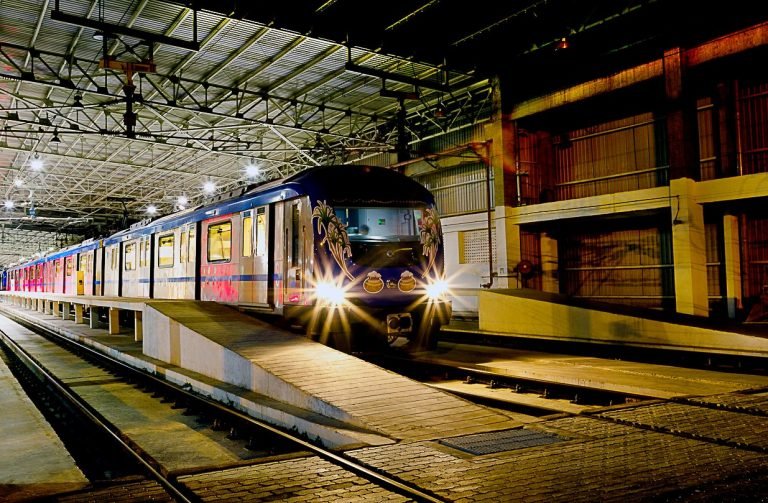
Chennai Metro introduces monthly pass with unlimited rides

Chennai, Metro Rail News: Chennai Metro Rail Limited (CMRL) has introduced a monthly pass that allows commuters unlimited rides
The new card will cost ₹2,500, with a refundable deposit of ₹50.

According to the official If a commuter buys this new monthly card, he can travel anywhere on the 45-km stretch and take any number of rides. He can take rides for 30 days. The card itself is valid for three months; he can recharge this card in case he wants to continue using it,”.

Chennai Metro has a smart card that provides a 10% discount) and a trip card that offers a 20% discount and allows people to take a fixed number of rides between two stations). While smartcards were introduced for commuters to avoid waiting in queues.

Currently, there is a daily tourist card which allows people to take unlimited rides in Rs. 100.

The new monthly tourist card is for office goers and tourists who use the metro rail facility multiple times a day.

Too expensive’

V. Subramani from Traffic and Transportation Forum (TTF) said that while the monthly card was a welcome move, it was expensive. “They could bring it down by ₹1,000; if they do, it will bring in more passengers,” he added.

Urban Mobility Development in India needs to look beyond costs

‘A developed country is not a place where the poor have cars, it’s where the rich ride public transportation.’ – Gustavo Francisco Petro Urrego

Public transport infrastructure is an important indicator of progress in global economy where growth opportunities are linked to the mobility of people, goods and information. India currently ranks 44th in the World Bank’s Logistics Performance Index, a relatively high score compared to other countries at similar income levels. This number matters not only to the transport sector, but to India’s economy as a whole.

Global population is continuing to expand and is expected to reach over 8 billion by 2030. According to the United Nations, emerging markets accounted for nearly three quarters of the world’s urban population in 2015. India stands out as a country which will need extensive infrastructure enhancements, given that its already-high population density will increase by 22 percent by 2030. Estimates suggest that India will be home to a whopping 452 people per square kilometer.

Managing the Urbanization process is likely to be the single biggest challenge that will confront policy makers in India over the next decade.

Emerging economies such as India must build and develop new infrastructure to meet basic requirements. According to Rural Access Index (RAI) developed by the World Bank, there are still nearly 301 million people who do not have access to public transport in India. Entirety of the country’s high-density rail corridors face severe capacity constraints. Moreover, freight transportation costs by rail are much higher than in most countries, as freight tariffs in India have been kept high to subsidize passenger traffic.

As stated by the Indian Government, India requires around $4.5 trillion worth of investments until 2040 to develop infrastructure in order to improve economic growth and community wellbeing.

Only Mass Urban Transport solutions can provide India’s urban commuters with competent mobility

Nobody will disagree that the best thing that happened to Delhi in recent years is the metro rail. Metro has altered the character of the city in many locales. In Mumbai, the electric train service is touted to be the lifeline, catering to almost 80 percent of citizen trips.

The cost of travel, especially for the poor, has increased considerably. Walking or cycling has become risky or impractical with expanding urban sprawl. The increasing number of personal vehicles is the leading cause for environmental degradation.

What is required is a balanced focus on extending transportation infrastructure, as well as leveraging smart technology solutions. The task list is long to improve and extend public transportation infrastructure in Indian cities. The government of India is investing in various national, state and local initiatives to improve public transportation. There is also a necessity to leverage smart technology solutions to quickly improve the efficiency and capacity of public transportation, in order to establish a high quality public transportation system.

While public transport systems should be able to match the demand, they also need to be self-sustaining in terms of revenue

The P&L debate is now soundless

There is always a debate on ways to make the entire system economically viable. Most metro operations begin with low occupancy rate but as the network grows, it attracts more people from all around the city, bringing down the cost per passenger trips. Take the example of Mass Transit Railway (in Hong Kong) and Delhi Metro Rail Corporation’s (DMRC). Mass Transit Railway is a major public transport network serving Hong Kong and is one of the most profitable metro systems in the world. It had a fare box recovery ratio of 187 percent in 2015, the world’s highest.

The level of profitability of a transit system is usually measured using the fare box recovery ratio, which is the difference between the revenue collected as fares from the users and the operating expenses.

DMRC’s earnings per kilometer have gone up by 74 percent since 2014, India’s highest. The DMRC has also been able to meet the target for the last fiscal year. According to a statement by Union Minister of Housing and Urban affairs, the government may not even increase fares till 2020, as a result of this achievement.

Building an innovative financing framework

It is necessary to consider innovative urban transportation financing as part of a comprehensive framework, rather than individual projects. At present, Government’s flagship urban development schemes including the Smart Cities Mission and AMRUT (Atal Mission for Rejuvenation and Urban Transformation), funds are only a fraction of the required investment available. For instance, under the Smart Cities Mission, Government has allocated $14 billion for 100 cities disbursed over five years, with equal contributions from the central and state governments. This amount is by no means sufficient. Thus, grants are to be used as a starting point to attract funding from external sources.

Local authorities, including urban transport, state-owned enterprises and the Union government should become more receptive to private investors. Climate investors can also provide new sources of funding.  In December 2016, Mexico City became the first sub-national Government in Latin America to issue a green bond, which was then used to finance sustainable transport projects, including improvements to the city’s metro system. The good news is that when there is a challenge to design projects that can attract private sector interest, World Bank provides help to governments to design better urban rail PPPs.

The framework should seek to achieve maximized social-economic benefits to the society through implementation of the most cost-effective option for urban transportation.

Leverage the advantages of localization

The Make in India programme significantly reduces the cost of metro rail projects by localizing manufacturing. India has already proved that it has a huge reservoir of talent and infrastructure required to create cost-efficient metro networks, which have become a benchmark technically, economically and environmentally, for urban mobility all over the world.

But localization needs to go beyond manufacturing mechanical parts. It needs to cover design, manufacturing and procurement, which can reduce the cost of metro projects as well as the lead time. The reduced cost and time to execute will allow for the faster execution of projects and improve customer satisfaction.

The number of jobs, short-term and long-term, that a metro project creates should also be considered while calculating the cost effectiveness of a metro project. A solid localized footprint is the way forward for all the metro operators that view India as a place for innovative mobility solutions.

Finally, there is no substitute for experience. Metro projects are best handled by companies which have been doing this all over the world and are well poised to bring their global expertise to India. They can be quality guarantors with their proven track record as a provider of advanced mobility solutions with high standards in safety and efficiency.

A robust urban rail system will be a huge advantage for growing Indian cities. A combination of the correct metrics, procurement and industry policies, along with effective planning can make metros a shining example for the rest of the world. Metro rails can win any argument owing to their comparative cost advantage. Let the wagon roll!

This article was first published in money control.

DMRC becomes world’s 5th largest metro network in the world

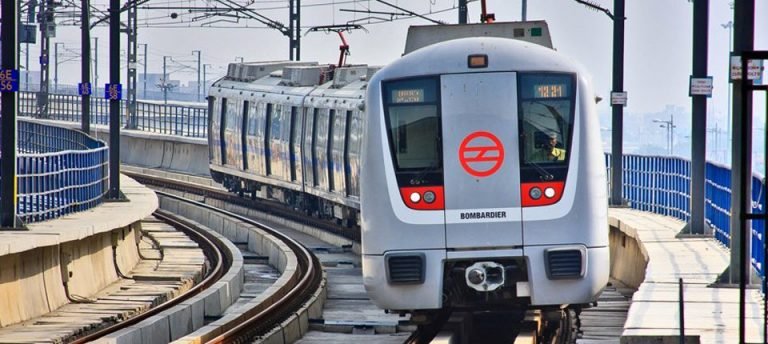
Delhi, Metro Rail News: On 9 March 2019, PM Narendra Modi Flags off the extension of the Blue Line section of the Delhi Metro in Noida, After this Delhi Metro Rail Corporation (DMRC) has now become the fifth largest metro network in the world after Beijing, Shanghai, Moscow and London.

With the addition of six stations on the Blue Line route, The operational network of the DMRC reached over 375 km

Blue Line extension section flagged off by PM Narendra Modi through remote during an event held in Greater Noida on March 9.

Durga Shanker Mishra, Secretary, Ministry of Housing and Urban Affairs tweeted “Hon’ble PM inaugurates the 6.7 Km Metro section from Noida City Centre to Sector-63 Electronic City. Now, with an operational network of 375 kkms, DMRC becomes world’s 5th largest metro network after Beijing, Shanghai, Moscow & London. Heartiest congratulations to Team DMRC!,“”.

The Blue line extension is a completely-elevated section with six stations-Sector 34, Sector 52, Sector 61, Sector 59, Sector 62 and Noida Electronic City. This bring the Blue Line close to the recently-opened Aqua Line.

Jaipur Metro will be extended to Ramganj

Jaipur, Metro Rail News: The Government of Rajasthan, has decided to extend underground corridor of Jaipur Metro Phase (I) B up to Ramganj Chaupar in the Walled City area, increasing its total length by nearly 600 meters.

Currently, Jaipur Metro Rail Corporation (JMRC) is constructing an underground of Jaipur Metro Phase-IB corridor which has a length of 2.4km from Chandpole to Badi Chaupar. As per the information, the decision was taken in a high-powered committee, headed & chaired by chief secretary D B Gupta.

After this, the total length of the corridor would be approximately 3 km after it is extended from Badi Chaupar to Ramganj. The estimated cost Rs 280 crore expenditure to construct this additional underground corridor.

Mr. Gupta, Cheif secretary Said “The state government will be spending Rs 160 crore to extend this corridor. It already has Rs 120 crore in the account, which was taken as loan from Asian Development Bank (ADB) and not been utilised so far,”.

The extension proposal will be sent in the cabinet for the final nod. It was also decided that the state government will fund the Jaipur Metro Phase II project in same meeting, proposed between (Ambabari to Sitapura) and not invite private players to develop this project on Public Private and Partnership (PPP) mode.

“The state will seek financial assistance from Centre to construct the Phase-II corridor. Both Centre and state would invest 50- 50% to develop the project,” he added.

After the change in government, launching metro phase-II has revived as metro was the ambitious project of chief minister Ashok Gehlot in his previous tenure. The JMRC prepared its first DPR in 2011 during the Congress government’s tenure. However, the project has no development even after seven years.

The official said, To review the detailed project report (DPR) of Jaipur Metro Phase-II, the (JMRC) has already proposed to appoint the Delhi Metro Rail Corporation (DMRC).

After terminating the contract of French company EGIS Rail SA, the corporation has decided to initiate the process of reviewing a revised DPR.

JMRC official said “The previous firm has approached to the court after its contract was terminated. Now, we have decided to initiate the process to give work to DMRC which had earlier prepared the DPR of Jaipur metro phase-I,”.

In 2014 the cost of the project estimated was nearly Rs 10,000 crore to construct nearly 24-km-long corridor. the (DMRC) had proposed a total 24- km long route that includes 10-km underground and 14-km elevated corridor for phase-II. The JMRC is expecting that project cost will increase from 5% to 10%, based on the market price

NMRC to introduce 50 feeder buses on 16 routes from March 15

Noida, Metro Rail News: To provide seamless and easy last mile connectivity Noida Metro Rail Corporation will introduce 50 low-floor, air-conditioned, disabled-friendly feeder buses across 16 new routes in Noida and Greater Noida, officials said on March 12, 2019.

The new routes for the buses of Noida Metro Rail Corporation (NMRC), which primarily operates the Aqua Line of the metro rail between the twin cities, will replace the current 12 routes on which they run.

Mr. P D Upadhyay, Executive Director, NMRC said: “The NMRC will be running a fleet of 50 feeder buses which will be plying on these new routes from March 15 (Friday),”.

It is being done to cater to all the operational metro stations of the Aqua Line in Noida and Greater Noida, he added.

Of the 16 new routes, seven will be covering Noida area, three each for Greater Noida, Greater Noida West and another three between Noida and Greater Noida, the NMRC said in a statement.

Bus route

The seven routes in Noida include Sector 74 (Cape Town) to Sector 51 metro station, Sector 51 metro station to Sector 137 metro station, Sector 51 metro station to Sector 12/22 (Ring Route), Sector 51 metro station to Sector 32 (RTO Office), Sector 55/56 (Indian Oil Colony) to Sector 51 metro station, Sector 142 metro station to Sector 51 metro station and Sector 142 metro station to Botanical Garden metro station, it said.

The three routes covering Greater Noida include Sharda University Outer Ring Route, metro’s Depot station (GNIDA) to Kasna, Dadri railway station to Gautam Buddha University via Kasna, the statement said.

According to the NMRC, three routes which will be providing feeder bus service to Greater Noida West include Gaur City (Greater Noida West Sector 1) to Sector 51 metro station, Greater Noida West (ACE City) to Sector 51 metro station and Greater Noida West (Sampooranam) to Sector 51 metro station.

Another three feeder buses will run on three routes between Noida and Greater Noida, including NSEZ Metro station to Kasna via AWHO, NSEZ metro station to Dadri via SurajPur and Botanical Garden metro station to Depot station via Greater Noida Authority.

“These routes will be covering almost all the metro stations of the Aqua Line and their nearby areas. It will immensely benefit commuters who have to rely on other modes of local transport to reach the nearest metro stations,” the NMRC said.

“The areas covered by the new routes include prominent residential societies, hospitals, university campuses and important corporate and government offices that fall along the alignment of the NMRC metro corridor,” it said.

Buses Features

The NMRC claimed that its air-conditioned buses are India’s first “true low-floor” buses and are equipped with features like GPS, intelligence transport system, electronic ticketing machines, passenger information system, announcement and digital display, three CCTV cameras, panic button and accessibility for disabled people.

There are a total of 21 metro stations on the 29.7-km all-elevated corridor of the Aqua Line, built for Rs 5,503 crore, of which 15 are in Noida and remaining in Greater Noida.

Navi Mumbai Metro Receives two metro trains

Mumbai, Metro Rail News: The Navi Mumbai Metro (Line 1) owned by
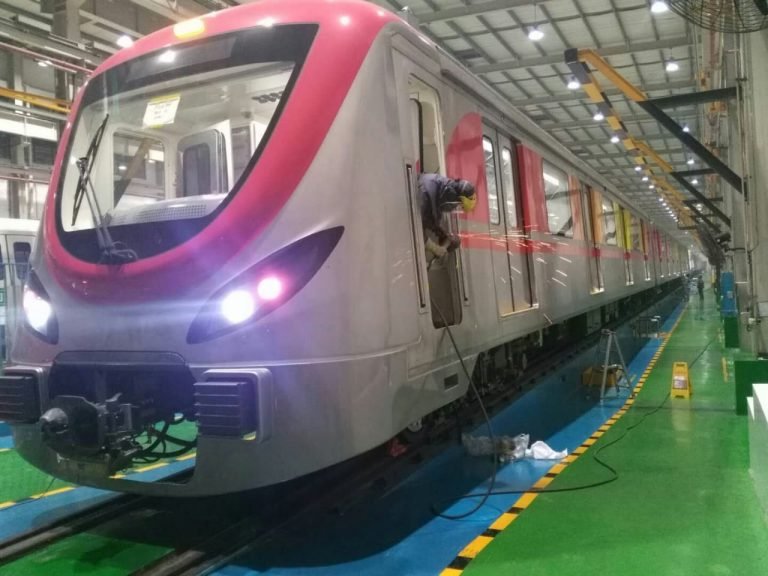
City and Industrial Development Corporation (CIDCO) received two metro trains from China on March 11, 2019, having the three-coach formation manufactured by China Railway Rolling Stock Corporation (CRRC) at Zhuzhou. These trains have reached at the Mumbai port from China and reached to Navi Mumbai Metro’s Taloja depot for further testing and commissioning activities.

Navi Mumbai Metro Line 1
Navi Mumbai Metro ( Line 1)

According to the plan, there will a total of eight trains which will be run in the 11.1 km long corridor between Belapur and Pendhar under the Navi Mumbai Metro project. Three more trains are expected to arrive in May and another three trains in August this year. It will have eleven stations and a depot-cum-workshop which is being developed at Taloja.

“the trial runs of these trains may begin in September-October as soon as contractors hand over stations,” Said CIDCO officials. Each metro train will have a three-coach-formation- Two DM (driving motor) cars-one in the front and the other in the rear, while the middle coach will be T (trailer) car.

Glimpse of Navi Mumbai Metro Train

The Navi Mumbai Metro rail project has been delayed much beyond schedule. The first phase of the project covers a distance of 11.1 km and it will have a total of 11 stations. This corridor will connect Belapur Railway Station to Pendhar Station near Taloja where the CIDCO is developing metro depot-cum-workshop. The cost of phase-I is estimated to Rs.3,063.63 crores.

Deepak Hartalkar, Cidco superintending engineer for Navi Mumbai Metro Project Said “The kits will be assembled at the depot. Individual coach testing will be done, followed by integrated testing. Once the stations are ready, we will roll the trains for track testing with safety inspections,” .

The Navi Mumbai Metro project started in 2011 at a cost of Rs 3,000 crore, has missed several deadlines and a new deadline of 2020 has been set for commissioning of the project. The work on the elevated span has been almost completed and the work on stations, signalling systems etc. are in progress.

The Navi Mumbai Metro project has been divided into four phases. The second phase has been planned between Khandeshwar and Taloja MIDC. The third phase will connect Pendhar and Taloja MIDC and the fourth phase will connect Khandeshwar and the upcoming Navi Mumbai International Airport (NMIA) near Panvel.

14 CMRL Underground Station receive IGBC’s Platinum Rating

Chennai, Metro Rail News: Fourteen underground stations including the last section of 45 km long Phase I opened in February, Indian Green Building Council (IGBC) has awarded with its highest Platinum Rating. A certification awarded for adopting green and user-friendly measures in a public facility

Now Chennai Metro has 32 stations which bagged the award in phase one project as part of its commitment to bring in sustainable green initiatives in its infrastructure.

The stations that have been awarded IGBC’s Platinum Rating are

The Stations are Washermenpet, Mannadi, High Court, Central, Government Estate, LIC, Thousand Lights, AG-DMS, Teynampet, Nandanam, Saidapet, Pachaiyappa’s College, Kilpauk and Nehru Park.

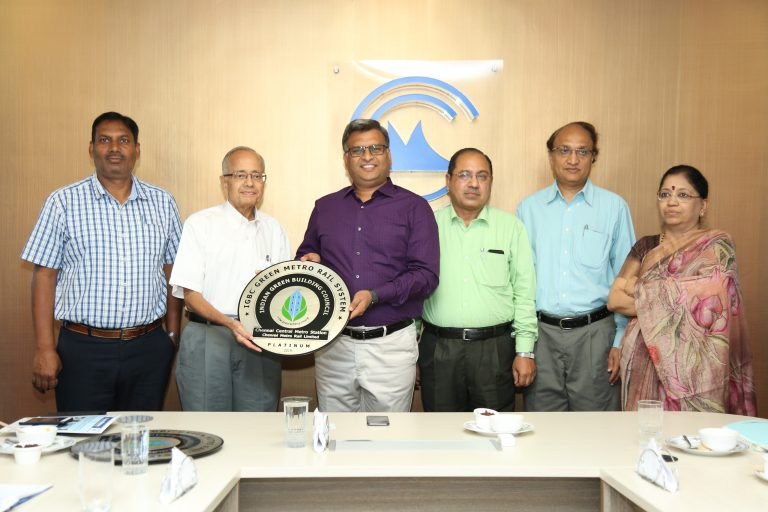
IGBC Chennai Chapter Chairman C N Raghavendran handed over the plaques and certificates for 14 stations to CMRL Managing Director Pankaj Kumar Bansal on March 12, 2019.

Mr. Pankaj Kumar Bansal , MD, Chennai Metro Receiving Certification
Mr. Pankaj Kumar Bansal , MD, Chennai Metro Receiving Certification from IGBC

CMRL Directors Sujatha Jayaraj (finance), Rajeev Narayan Dwivedi (project), L Narasim Prasad (I/C systems / operations) along with senior officials, contractors and IGBC consultants were present.

Some of the aspects of the phase one project which led to bagging the award included the design reflecting functional aesthetics, user friendliness, energy efficiency with station architecture that is environmentally friendly, salient features like rain water harvesting, harnessing solar energy, universal access to physically challenged commuters, last-mile connectivity through NMT (non-motorized traffic), energy efficient design, 32.5 per cent of regenerative energy fed back to the grid achieving an EIRR (Economic Internal Rate of Return) of more than 16.22 per cent.

Prior to this, IGBC’s Platinum Rating was awarded to 13 elevated and five underground stations of Chennai Metro namely Thirumangalam, Anna Nagar East, Anna Nagar Tower, Shenoy Nagar and Egmore. CMRL’s Administrative Depot is also LEED-NC 2009 Gold Certified since 18 May 2018.

MMRDA floats tenders to introduce three more Monorail passenger coaches

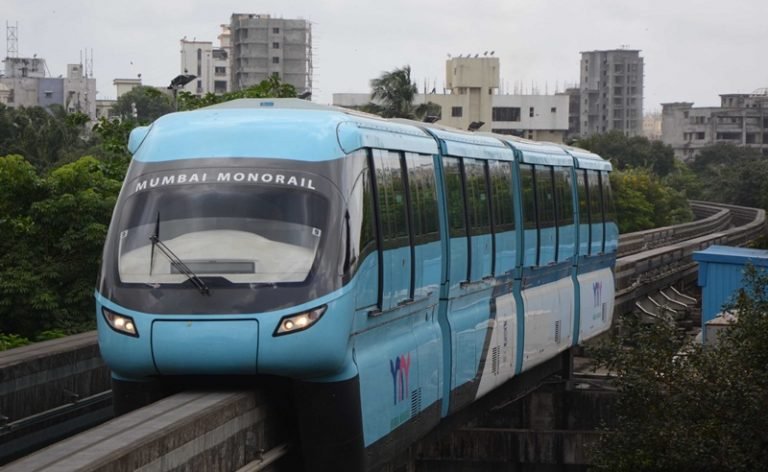
Mumbai, Metro Rail News: The Mumbai Metropolitan Region Development Authority (MMRDA) plans to introduce five more Monorail
passenger coaches within the next four or five months.

The MMRDA has floated tenders for spare parts of three passenger coaches and expects to award the contracts soon. The new addition of passenger coaches will help the MMRDA to run Monorail services at intervals of every 12 to 15 minutes.

Only four passenger coaches are in operation now, and services run at a frequency of 22 minutes. The services run for nearly 16 hours, from 6 a.m. to 10 p.m., which puts a lot of stress on the four rakes.

According to our the sources, The passenger coaches are sent to the depot every afternoon for inspection to ensure that none of the parts of the rakes is overused and affects the frequency of services at peak hours.

“Once we have nine rakes, we will be able to spare two rakes and run seven, thus increasing the frequency. The first two are expected to be inducted by April.” Said , A senior MMRDA official. Commercial operations on the entire corridor started on March 4 with the launch of the Monorail’s Phase 2, connecting Wadala to Jacob Circle.

The daily ridership of the service change through the week, but crossed the 30,000 mark on Sunday. MMRDA officials said the service could potentially carry nearly one lakh passengers every day, but ensuring frequency of services was a challenge.

A senior MMRDA official said, “The service will take some time to settle. We are watching commuter patterns and waiting for more rakes to be inducted.”

The MMRDA is also trying to procure 10 new passenger coaches and bids will be invited soon. The train coaches will take at least 12 to 15 months to be operational from the time of the order being placed.

‘Metro man’ E Sreedharan appointed principal advisor to J&K MRTCs

Jammu, Metro Rail News: The Jammu and Kashmir Governor administration approved Jammu Mass Rapid Transit Corporation (JMRTC) and the Srinagar Mass Rapid Transit Corporation (SMRTC) i.e J&K MRTCs for two capital city.

According to the official, On 10 March 2019, The J & K Governor administration has approved the appointment of “Metro Man” E Sreedharan as the principal advisor to two mass rapid transit systems (J&K MRTCs) to be built in Jammu and Srinagar,

The Metro Man: E Sreedhran

E Sreedharan is a civil engineer and retired IES (IRSE) officer popularly known as the “Metro Man” for changing the face of public transport in the country with his leadership of building the Konkan Railway and the Delhi Metro. he has a vast experience in the implementation of mass rapid transit systems within the country.

In 2015 he appointed by former UN Secretary General Ban-Ki-Moon to serve on the United Nations High Level Advisory Group on Sustainable Transport for three years.

According to the official, Mr Dheeraj Gupta is chairman and Kumar Rajeev Ranjan is the chief executive officer-cum-managing director for both Jammu & Srinagar MRTC, who is Principal Secretary to Government, Housing and Urban Development department.

Jammu and Srinagar MRTC would have administrative secretaries of the finance department, transport department, chief executive officer, J&K Economic Reconstruction Agency, additional chief executive officer and managing director, MRTC Jammu and Srinagar, the nominee of Union Ministry of Housing and Urban Affairs (MoHUA) and other experts on the board.

According to the official, MRTC Jammu and Srinagar will address the issue of urban mobility in the state in a holistic manner to provide hassle-free travelling throughout the capital city.

Maha Metro to launch Ticketing Service From Today

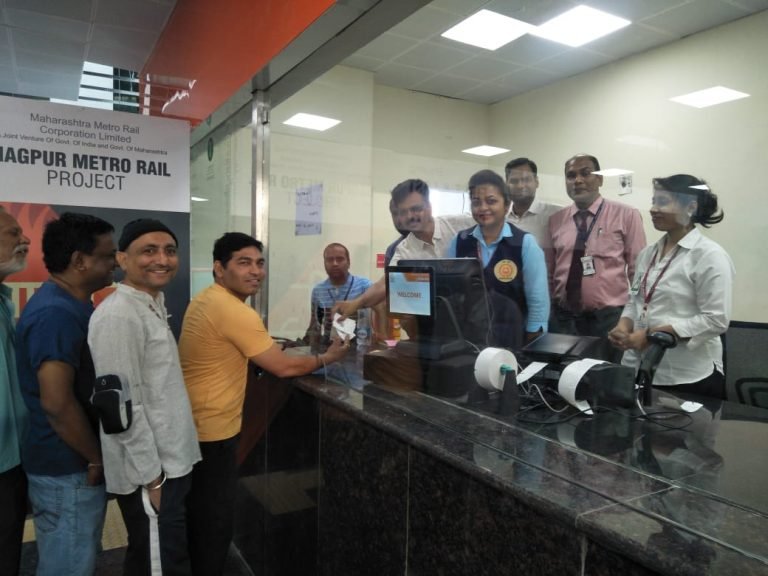
Nagpur, Metro Ril News: After successfully conducting Aabhar (Thanks-Giving) Rides for two continuous days for Nagpurians, Maha Metro is all set to launch Ticketing Operations from today (March 10). The response to not just the Aabhar Rides, but also to the fact that Nagpurians fully followed all the established norms prompted Maha Metro to launch Ticketing Service.

Nagpurians showed exemplary discipline and stood in queues for either buying the tickets or even getting into the platform, also prompted Maha Metro to start Ticketing Services. So, the commuters would now have to buy tickets before boarding the Train from Metro Stations being operated between Khapri and Sitabuldi Interchange Station.

The Fare structure and the discounted fare for first month for the stretch between Khapri Metro Station and Sitabuldi Interchange Station has already been announced by Maha Metro earlier. As per the discounted fare the amount to be paid for a journey between Khapri Metro Station and Sitabuldi Interchange Statio would be Rs 20. Similarly, the fare between Khapri to Airport Station and Airport to Sitabuldi Interchange has been fixed at Rs 10.

The commercial operation would start from Sitabuldi Interchange Station beginning 8 am. The rides have been slotted for 8 am, 9.30 amd and 11 am in the pre-noon session and at 3.30 pm, 5 pm and 6.30 pm in the second half of the day. The passengers would have to buy tickets from ticket counters at all the five stations of Khapri, New Airport, Airport SOuth, AIrport and SItabuldi Interchange Station.

Every commuter will have to go through the process of scanning QR code at the Automatic Fare Collection (AFC). The commuters would have to scan the ticket at the AFC gate to proceed ahead towards the platform. Most importantly, the commuters would have to pay the exact fare for the journey they wish to undertake. If the fare is less than the journey undertaken, the commuters would have to pay the difference.

Metro had organised Aabhar (Thanks-Giving) Ride the day after the Metro was dedicated to public two days back. For two full days hundreds of Nagpurians took full advantage of the Rides and the number of those who availed the same exceeded 20,000. The tremendous response given by the citizens prompted Maha Metro to start commercial operations.

With laucnh of ticketing operations, Maha Metro has fulfilled its promise of starting full-fledged passengsr services for the citizens of Nagpur. Maha Metro urges Nagpurians to take full advantage of the services

Centre Approves Rs. 12,020 Crore Surat Metro Rail Project

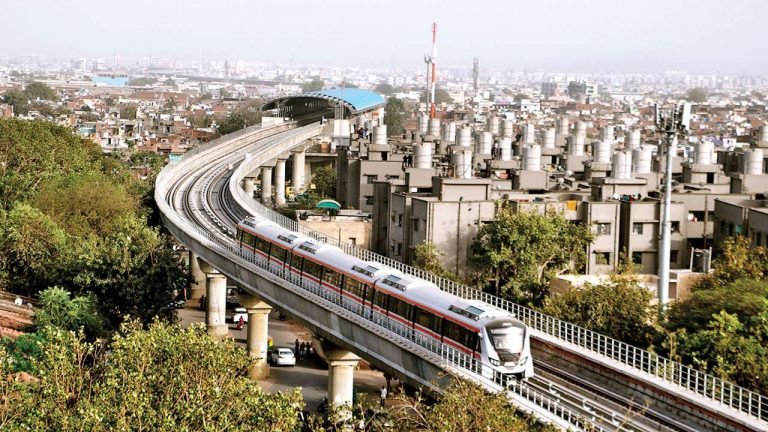
New Delhi, Metro Rail News: The Government of India has approved the Surat Metro Rail Project comprise two Metro Rail corridors with a combined length of 40.35 km.

The Centre has approved two corridors of the Surat Metro project, which will be executed at an estimated cost of around Rs 12020.32 cr.

According to the statement The Union Housing and Urban Affairs Ministry said the project will be implemented by the Gujarat Metro Rail Corporation (GMRC) and completed in 5 years.

Benefits of the project

This project will provide continuous availability of affordable, reliable, safe, secure and seamless transport system in the urban agglomeration of the city. It will reduce the accidents, pollution, travel time, energy consumption, anti-social incidents as well as regulate urban expansion and land use for sustainable development. The Metro will provide Eco friendly and sustainable Public Transport to residents, commuters, visitors and travelers.  

Surat Metro Rail Project

Some of the highlights of these corridors are as follows

Surat Metro corridor-1, Sarthana to Dream city line is 21.61 Kms comprising of  underground corridor of 6.47 km &  elevated corridor of 15.14 km, which will connect 20 metro stations (via Sarthana, Nature park ,Kapodra, Labheshwar chowk area, Central Ware house , Surat Railway station, Maskati hospital, Gandhi baug, Majura Gate,Roopali canal, Dream city). 

Surat Metro corridor-2, Bhesan to saroli line is 18.74kms and is completely elevated corridor which will connect 18 Metro stations. (via Bhesan, Ugat Vaarigruh, Palanpur road, LP Savani School, Adajan Gam,Aquarium, Majuragate, Kamela Darwaza, Magob & Saroli)

Dream city and Bhesan depot will fulfill the maintenance facilities of Surat metro rail Project.

The population of around 69.36 lakh of Surat Municipal Corporation, Out Growth Area & Urban Agglomeration is expected to be benefitted by Surat Metro Rail Project  directly and indirectly.

The proposed corridors will be having Multimodal Integration, and will have feeder network of Bus, Intermediate Public Transport (IPT) and Non-Motorized Transport (NMT). 

The residential areas, commercial, and industrial areas along this Metro Rail corridors shall be immensely benefitted by this project as the people of these areas will be able to travel on trains from their own neighborhoods to reach different areas of the city conveniently.

The project will be financed mainly through equity from the Centre and state govt on 50-50 basis and loan from bilateral and multilateral agencies.

This project will provide continuous availability of affordable, reliable, safe, secure and seamless transport system in the urban agglomeration of the city.

PM Modi flags off Noida City Centre-Electronic City section of Delhi Metro’s Blue Line

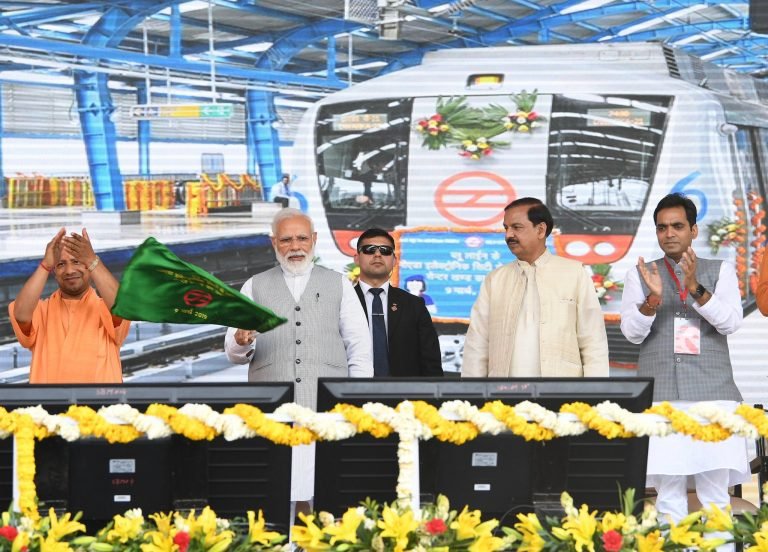
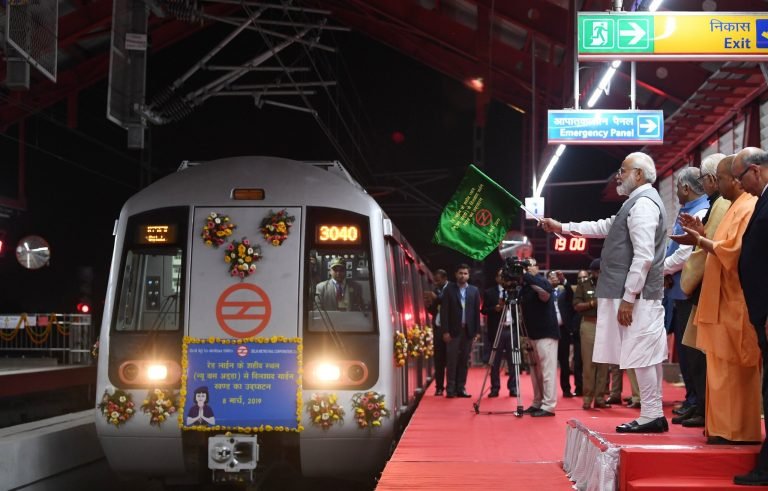
Noida, Metro Rail News: On March 9, 2019, Prime Minister Shri Narendra Modi flagged off the Noida City Centre-Noida Electronic City section of Delhi Metro‘s Blue Line via remote today in Noida.

Passenger services on this section will begin today at 4 pm after it recently got the necessary safety approval from the Metro Rail Safety Commissioner.
The fully elevated section between Noida City Centre and Noida Electronic City consists of six stations – Sector 34, Sector 52, Sector 61, Sector 59, Sector 62 and Noida Electronic City. The metro stretch will benefit the people of Noida.

Passenger operations begun on the Blue Line Extension from NOIDA City Centre to NOIDA Electronic City.
Passenger Services begun on newly opened blue line extension

Frequency

The frequency on the 6.675 km link will be 5.26 minutes in the peak hours, and the running time between the City Centre and Electronic City stations is 12.23 minutes

Fare

The DMRC has fixed the regular fare between the two stations at Rs 30, while the concessional fare for Sunday and national holidays will be Rs 20. The elevated section has six stations — Sector 34, Sector 52, Sector 61, Sector 59, Sector 62 and Noida Electronic City.

This extended corridor will now bring the Blue Line close to the recently-opened Aqua Line, which connects Noida and Greater Noida. The Sector-52 station of the Blue Line is very close to the Sector-51 station on the Aqua Line which is operated by the Noida Metro Rail Corporation (NMRC).

Facilitating last-mile connectivity between the two lines, authorities are planning to connect the two stations. There is a distance of around 300 metres between Sector 51 metro station in the Aqua Line and Sector 52 station in the Blue Line. There is likely to be a dedicated pathway between the two stations as well as a carriage-way for e-rickshaws, officials said.

The new section will provide a convenient and faster mode of transport for the residents of Noida. It will also decongest the roads and provide an environment-friendly mode of transport. The 6.6km long section is an extension of Delhi Metro’s Blue Line. After the opening of this section, the Dwarka Sector 21 – NOIDA Electronic City Blue Line has become 56.5 km long.

The PM also laid down the foundation stone of 1,320 MW thermal power plant in Khurja, Uttar Pradesh and 1,320 MW power plant in Buxar, Bihar via video link. The Buxar Thermal Power Plant will be based on Supercritical Technology with two units of 660 MW each, equipped with latest emission control technology to protect the environment and has high efficiency.

Delhi Metro’s Red Line extension from Dilshad Garden to Shaheed Sthal (New Bus Adda) was formally inaugurated by Prime Minister at Ghaziabad on Friday. Passenger services on this section began from 8 am onwards today (March 9).

Out of the 8 stations on this section, 6 stations (Raj Bagh, Major Mohit Sharma Rajendra Nagar, Shyam Park, Mohan Nagar, Arthala, and Shaheed Sthal (New Bus Adda) have station buildings on both sides interconnecting at the concourse level and with station platforms through FOBs.

PM Modi inaugurates Red Line extension of Delhi Metro

Ghaziabad, Metro Rail News: Prime Minister Narendra Modi on March 8, 2019, inaugurated the 9.4-km-long Dilshad Garden-New Bus Adda section of Delhi Metro’s Red Line which will open for public on March 9, 2019 at 8 am.

It will take the rapid transit network into the interiors of Ghaziabad for the first time.

“Passenger services on the Red Line extension from Dilshad Garden to Shaheed Sthal (New Bus Adda) in Ghaziabad will start from 8 am on Saturday,” DMRC’s ED for Corporate Communications Anuj Dayal said.

Dilshad Garden-New Bus Adda section comprises eight stations Shahid Nagar, Raj Bagh, Rajendra Nagar, Shyam Park, Mohan Nagar, Arthala, Hindon River Station and New Bus Adda.

This section will be an extension of the 25.09-km Rithala-Dilshad Garden corridor or Red Line, which has 21 stations. After opening of this section, the entire Red Line will become 34.72 km.

Metro Train Frequency

“Trains will be available at a peak hour frequency of six minutes and twelve seconds on the Dilshad Garden New Bus Adda section. A total of 35 six-coach trains will be used on the entire Rithala New Bus Adda Red corridor. The total journey from Dilshad Garden to New Bus Adda will take about 16 minutes,” Dayal said.

Ticket office machine

“All the station buildings have at least two TOM (Ticket Office Machine) counters with one counter located at a lower height for facility of differently-abled commuters,” the DMRC said.

This would be the second metro corridor in Ghaziabad, after the Blue Line, which links Delhi to the neighbouring city in Vaishali.

The extension of Delhi Metro’s Red Line will connect residents of Ghaziabad to with various parts of the National Capital Region (NCR).

“Currently, commuters have to rely on other modes of transport from Dilshad Garden to reach Sahibabad and further to Ghaziabad. Now with extension of metro, connectivity to Mohan Nagar from Dilshad Garden could also improve considerably,” he told reporters during a preview of the new corridor.

After the opening of this section, the Delhi Metro network will span 336.6 km with 244 metro stations. The DMRC’s span in Uttar Pradesh would be 52.85 km.


Prime Minister has laid the foundation stone of country’s first RRTS

Ghaziabad, Metro Rail News: The Hon’ble Prime Minister, Shri Narendra Modi today laid the Foundation Stone for the construction of India’s first Regional Rail between Delhi-Ghaziabad-Meerut and Meerut Metro at Sikandarpur, Ghaziabad. Uttar Pradesh Chief Minister, Hon’ble Shri Yogi Adityanath and Hon’ble Minister of State for External Affairs, Shri V. K. Singh were also present on the occasion.

Hon’ble Minister of State with independent charge of the Ministry of Housing and Urban Affairs, Shri Hardeep Singh Puri led the program of foundation stone laying of RRTS and Meerut Metro services in Meerut where the local MP and MLAs were present.

The RRTS corridor is being built at a cost of Rs 30,274 crore and is planned to be operationalized by 2024.

Hon’ble Prime Minister, Shri Narendra Modi said, “Giving a new way to next-generation urban infrastructure, foundation stone was laid for Delhi-Ghaziabad-Meerut Regional Rapid Transit System (RRTS) today. This will the first RRTS project built with a cost of Rs 30,000 crore. Rapid rail and metro both will be running on this corridor in Meerut. Once this is completed, Delhi-Meerut journey will be covered in less than an hour. Of this RRTS, commuters suffering will be removed and traffic system will be streamlined.”

In an immense relief from the road congestion and pollution faced by the commuters travelling between Delhi and Meerut, the RRTS, Regional rail will cover the 82km stretch in less than 60 minutes. It will offer high-speed, high-frequency, safe, reliable, comfortable & green public transit. The operating speed of RRTS would be 160kmph and average speed of 100kmph. The frequency of the trains would be between 5-10 minutes and there would be an RRTS station at every 5-10km.

Addressing the gathering in Meerut, MoHUA minister, Shri Hardeep Singh Puri said, The population in cities is increasing rapidly. Therefore, public transport and intercity linkages are a must. If you make a rapid transit system, there would be many people who would prefer living in Meerut and NCR and come to Delhi for work. I am confident that RRTS project would be completed on time and will improve the ease of living of people living in Meerut and nearby areas along with improving the region’s economic situation.

The RRTS will pass through some of the most densely populated sections in Delhi and Meerut. Starting from Sarai Kale Khan in Delhi, the corridor will go up to Modipuram in Meerut, joining many urban cities such as Anand Vihar in Delhi, Sahibabad, Ghaziabad, Muradnagar and Modinagar in Uttar Pradesh.

Meerut Metro: In a unique feature, the Meerut Metro services with 12 stations on 18 kms stretch between Modipuram and Meerut South stations on RRTS infrastructure will meet the local mobility needs of citizens of Meerut besides providing efficient regional connectivity. The arrangement of Meerut Metro on RRTS infrastructure would also result in an overall cost saving of approximately Rs 6,300 crore.

While the Meerut Metro would mostly be elevated, it would run underground in high density areas like Bramhapuri, Meerut Central, Bhaisali and Begumpul.

The RRTS trains will be equipped with all modern features like Air-conditioned travelling, CCTV surveillance, Mobile/Laptop Charging points, Luggage space etc. All stations and trains will have universal access for the differently abled. Each train will have a Business Class and a Ladies coach.

RRTS stations will be seamlessly integrated with other transport modes like Airport, Railway, Metro, ISBTs and will be connected seamlessly through Elevators, escalators, travellators etc. All three corridors of phase I of RRTS will be inter-operable, thus does not require changing of train to go from one corridor to another.

It will also lead to significant time saving compared to existing modes of transportation. A rail-based travel mode operating with the best in class command and control systems, would offer a safe and reliable transport option. It is also expected to increase the share of public transport along with opening up of new markets and opportunities for people across the region.

Delhi-Ghaziabad-Meerut RRTS corridor is first of the three prioritized corridors planned for implementation in Phase-1. The other two are Delhi-Gurugram-SNB-Alwar and Delhi-Panipat Corridors.