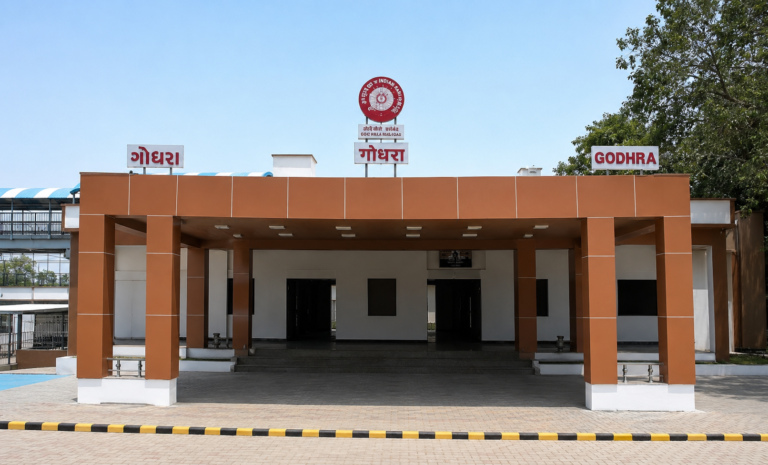
PM Modi inaugurates redeveloped Godhra Railway Station under Amrit Bharat Station Scheme

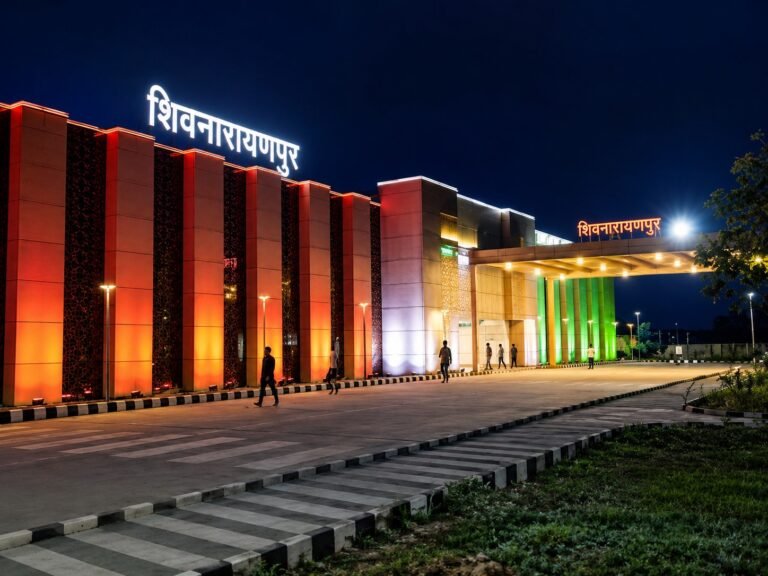
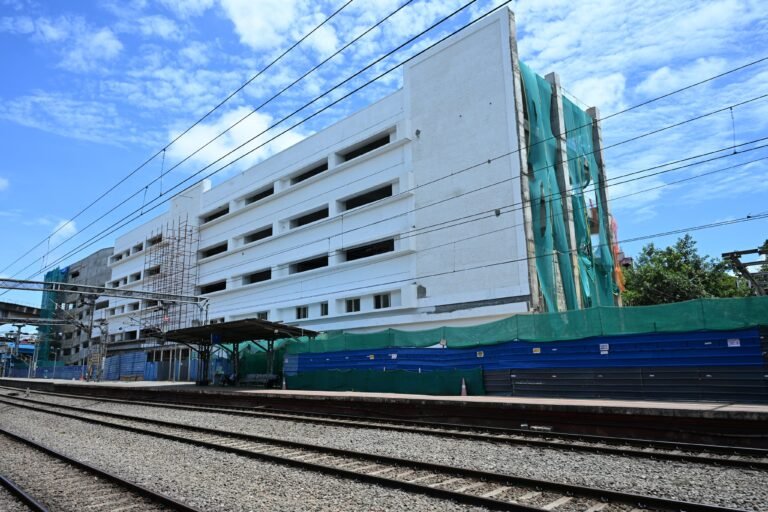
GODHRA (Metro Rail News): Godhra Railway Station has entered a new phase after its redevelopment under the Amrit Bharat Station Scheme. Prime Minister Narendra Modi virtually opened the upgraded station, which has been modernized at a cost of Rs 7 crore. This upgrade includes better passenger facilities and improved accessibility. The redevelopment aims to make travel more comfortable and to transform the station into a modern transport hub for the region.

Station gets a modern makeover

The redevelopment has changed several parts of the station to enhance passenger convenience. Some of the key upgrades include:

  • A new 1,000 sq m modern station façade   
  • A 700 sq m concourse hall  
  • A dedicated ladies’ waiting room  
  • A new second entry gate with a 650 sq m station building  
  • A 1,500 sq m circulating area to improve traffic flow and passenger access  

Better facilities for passengers

The project has also upgraded platforms and passenger amenities throughout the station. The improvements include:

  • Nearly 6,000 sq m of new platform surfacing on Platforms 1, 2/3, and 4/5  
  • Around 3,000 sq m of covered platform sheds to shield passengers from heat and rain  
  • Modern drinking water facilities  
  • Clean and upgraded toilets  
  • Tactile tiles for visually impaired passengers  
  • Digital passenger information systems  
  • New station signs  

The station also features expanded circulating areas, a new approach road, dedicated scooter parking, improved traffic management, upgraded waiting halls, lifts for senior citizens and people with disabilities, and enhanced passenger amenities. 

Part of a nationwide station redevelopment program

Vadodara Divisional Railway Manager Raju Bhadke said the redevelopment shows Indian Railways’ commitment to create modern, accessible, and passenger-friendly railway stations. He noted that the upgraded station will provide a safer, more comfortable, and convenient travel experience while supporting the region’s economic growth. Officials also mentioned that this project is part of the Amrit Bharat Station Scheme, which aims to upgrade railway stations across the country with modern infrastructure, better passenger facilities, and improved connectivity.

Also Read: Indian Railways introduces world’s longest Hydrogen Train
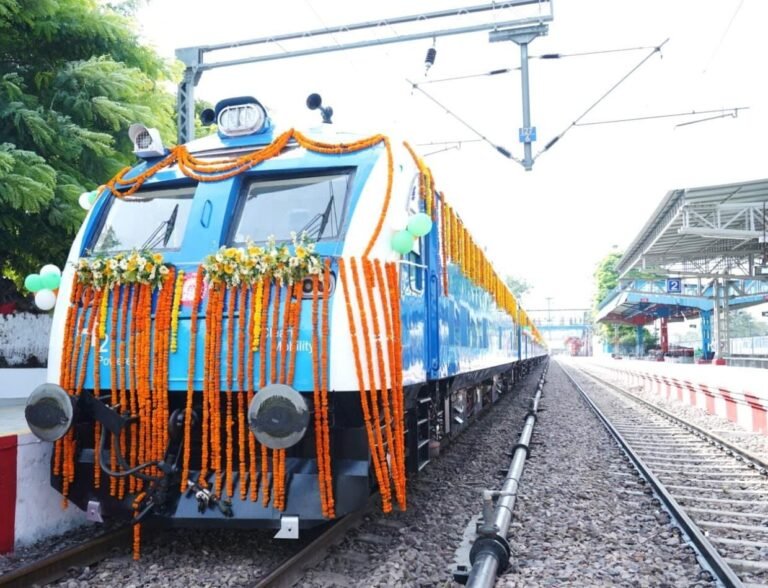
Indian Railways introduces world’s longest Hydrogen Train
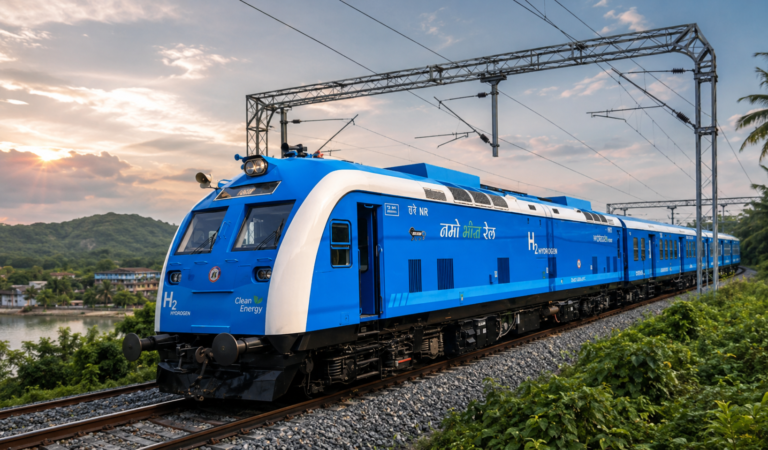
JIND (Metro Rail News): Indian Railways has created history with the launch of its first indigenously built Hydrogen Train. Prime Minister Shri Narendra Modi flagged off the hydrogen train at Jind Railway Station in Haryana. After the launch PM Modi said, “Today, the country has received its first hydrogen train from here. You may recall, and even today, we read and hear, that India’s first train ran between Mumbai and Thane. Similarly, in the coming future, whenever hydrogen trains are mentioned, the names of Jind, Sonipat, and Haryana will inevitably be included.” Highlighting the significance of the “Make in India” initiative, he hinted that the country will continue building more hydrogen trains indigenously. 

This train features ten coaches with eight passenger cars, with the capacity of carrying around 2,600 passengers and two Driving Power Cars (DPC) positioned at either end of the train. The total traction capacity stands at 2,400 kW, as each DPC generates 1,200 kilowatts (kW) of power which is enough for the train to operate seamlessly. The designed maximum speed of the train is 110 kmph but it operates at 75 kmph on the Jind–Sonipat route. 

India’s largest railway hydrogen storage and refuelling facility has also been built at Jind to support the operations. This specialised facility is capable of storing up to 3,000 kg of hydrogen at a time to keep the train fueled and running efficiently.

The train has been developed under the leadership of Indian Railways with design approval and technical specifications prepared by the Research, Design & Standards Organisation (RDSO). The train’s theme and exterior was designed by Integral Coach Factory (ICF) while M/s Medha Servo Drives integrated and developed the train. 

With this launch, India has become one of the few countries that have the capacity to operate hydrogen-powered trains. PM Modi also stated that the hydrogen train running on the Jind-Sonipat route is the most powerful and longest hydrogen train in the world.

The Union Minister for Railways, Shri Ashwini Vaishnaw was also present at the launch and addressing the public during the speech he said, “Today, India has joined the select group of countries where the complete technology for hydrogen trains is available. In Haryana, rail projects worth ₹18,000 crore, 100% electrification, reconstruction of 34 stations, 16 Vande Bharat and 8 Amrit Bharat services are giving new momentum to development.”

Also Read: India’s First Hydrogen Train gears up for launch on 17th July

HBL Engineering wins Rs 24 cr ICF contract to supply on-board Kavach equipment for Indian Railways

CHENNAI (Metro Rail News): HBL engineering has received a Rs 24 cr contract from the Integral Coach Factory (ICF) in Chennai. This contract is for supplying and installing on-board Kavach Loco Equipment (Version 4.0). The order supports the rollout of India’s homegrown train protection system across the railway network. The contract includes the supply, installation, testing and commissioning of the on-board Kavach Loco Equipment (Version 4.0)

Project Overview

InformationDetails
CompanyHBL Engineering Limited
Contract ValueRs 24 crore (Excluding GST)
Completion Date31 March, 2028

Under this agreement, HBL Engineering will oversee the full deployment of the onboard Kavach system on locomotives. The scope of work includes:

  • Supply of On-board Kavach Loco Equipment (Version 4.0)  
  • Installation of the equipment on locomotives  
  • Testing of the system  
  • Final commissioning to prepare the equipment for operation  

The company will carry out the project in phases over the next few months and complete all work by the end of March 2028.

Supporting railway safety

Kavach is India’s Automatic Train Protection (ATP) system. It enhances railway safety by assisting loco pilots, preventing Signal Passing at Danger (SPAD) incidents, and automatically applying brakes when necessary. This latest contract contributes to the ongoing expansion of Kavach throughout the Indian Railways network as the national transporter updates its signaling and safety systems.

About HBL Engineering

HBL Engineering, previously known as HBL Power Systems, produces a variety of batteries, including lead-acid, nickel-cadmium, silver-zinc, and lithium batteries. The company also manufactures railway and defense electronics and offers technology solutions for the rail sector.

In its latest quarterly results, HBL Engineering reported a 41.8% increase in consolidated net profit compared to last year, reaching Rs 63.75 crore. Revenue from operations rose by 27% to Rs 604.12 crore during the fourth quarter of FY26.

Also Read: PM Modi to launch India’s First Hydrogen Train tomorrow: All about the Jind-Sonipat Project

Big Rail Boost tomorrow: PM Modi to inaugurate 75 Redeveloped Stations & new railway projects

NEW DELHI (Metro Rail News): In a major push for infrastructure development, Prime Minister Narendra Modi will inaugurate 75 redeveloped railway stations under the Amrit Bharat Station Scheme, including Jalandhar Cantt in Punjab. On this historic day for Indian Railways, the Prime Minister will visit Haryana, Chandigarh, and Punjab, where he will also dedicate and lay the foundation stone of multiple mega infrastructure projects worth thousands of crores in national highways, railways, healthcare, education, and roads.

Developed at a total cost of approximately ₹1,570 crore, this massive initiative of redevelopment has transformed these stations into modern, passenger-friendly facilities. While the upgraded stations feature state-of-the-art amenities, their designs also thoughtfully incorporate architectural elements that reflect the unique local culture and heritage of each region.Major revamped stations:

Jalandhar Cantt Station

Standing out as a crowning jewel of this grand inauguration is the spectacular transformation of the 110-year-old Jalandhar Cantt station into a world-class facility.

The Prime Minister will personally visit the venue to dedicate the upgraded ₹125-crore Jalandhar Cantt station to the nation. Capitalizing on the significance of the venue, he is also expected to use this historic station as a central base to virtually inaugurate the remaining 75 completed Amrit Bharat stations across the country.

Hitech City Railway Station 

Meanwhile, a digital leap forward awaits southern commuters as Prime Minister Shri Narendra Modi virtually inaugurates the newly upgraded Hi-Tech City railway station on July 17.

Serving as a vital commuter lifeline on the Hyderabad MMTS network in Telangana, this station sits strategically at the heart of the region’s booming IT corridor—surrounded by tech landmarks like the Cyber Towers, Mindspace, and the HITEC City Metro Station. Given its high-profile location, the successful redevelopment of this bustling transit hub marks a crowning milestone for the nationwide Amrit Bharat Station Scheme.

Among the other notable revamped stations to be inaugurated under the scheme are Maharashtra’s busy Nandura railway station, which handles more than 4,000 passengers on a daily basis, and Delhi’s Modi Nagar railway station. The upgrades also include Odisha’s Kesinga railway station, Rajasthan’s prominent Jaisalmer and Dausa railway stations, and Uttar Pradesh’s Vindhyachal railway station alongside its Panki Dham railway station, which connects thousands of devotees to the sacred Panchmukhi Shri Hanuman Temple.

New Daulatpur Chowk-Kartoli Rail Line 

The newly constructed Daulatpur Chowk-Kartoli rail line, at a cost of around ₹830 crore as part of the Nangal Dam-Talwara-Mukerian project, will also be inaugurated on July 17 by the PM. This Rail line will enhance rail connectivity between Punjab and Himachal Pradesh, benefiting Hoshiarpur and Una districts and improving access to key religious sites and remote areas with a faster and more reliable transportation option.

Launch of New Kartoli-Ambala and Amritsar-Varanasi Train Services 

The Prime Minister will inaugurate the Kartoli-Ambala train service to enhance connectivity in Punjab, Haryana, and Himachal Pradesh, along with the Amritsar (Chheharta)-Varanasi service, linking two of India’s significant spiritual hubs.

Also Read: Hyderabad Metro to add more coaches and strengthen last-mile connectivity 

Shashi Tharoor urges Kerala CM for metro in Thiruvananthapuram

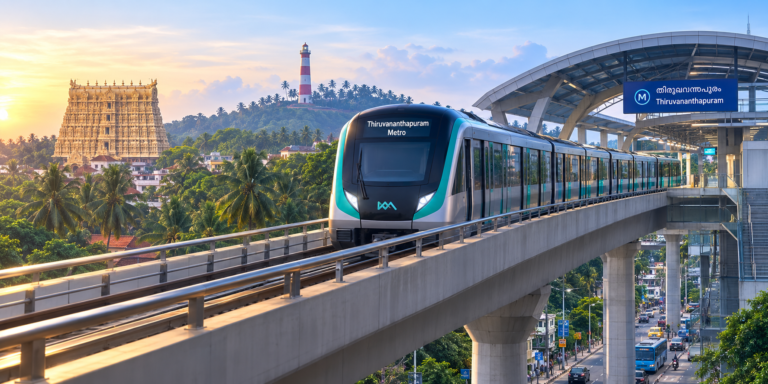
THIRUVANANTHAPURAM (Metro Rail News): Shashi Tharoor, the Member of Parliament (MP) from the Thiruvananthapuram constituency, has written to the Chief Minister of Kerala V.D. Satheesan, about the urgent need of a metro in the city and an extension plan for the metro. The letter is in view of the recently submitted Detailed Project Report (DPR) of a fully elevated 31 km metro project for Thiruvananthapuram. 

According to The New Indian Express, Tharoor wrote a letter to the Chief Minister describing the urgency to decongest the city. He suggested that a comprehensive metro network with extension plans to Technocity (Technopark Phase IV), Vizhinjam International Seaport and the city’s eastern parts over the next 5-8 years should be announced by the government with plans for last-mile connectivity.

Earlier this month, the DPR of the Thiruvananthapuram Metro was submitted by the Delhi Metro Rail Corporation (DMRC) to Kochi Metro Rail Limited (KMRL), the implementing agency. Before the submission of the final DPR, Tharoor urged the CM to give consideration for an underground metro along the busiest routes of the city. 

Debate over Underground Section

The announcement of a fully elevated corridor has initiated a debate over an elevated metro stretch over underground metro construction. An underground metro construction would reduce the land acquisition requirements, which might lessen the project time, as the process is much time consuming. Moreover, it can decrease the traffic disturbance and landscape disruption caused during above ground construction.

While the underground metro seems like a better option, it is not economically viable. It increases the cost of construction by at least three to four times more than the elevated metro construction. Further, the geological complexities also make the construction of underground metro challenging. 

Also Read: DMRC submits DPR of Thiruvananthapuram Metro Project

Hyderabad Metro to add more coaches and strengthen last-mile connectivity 

HYDERABAD (Metro Rail News): With passenger demand continuing to rise, the Hyderabad Metro Rail Limited plans to increase its capacity by adding more metro coaches to its fleet. In this regard, the Additional Managing Director (AMD) Shri B. Ajith Reddy chaired a review meeting with senior officials from different metro departments to evaluate the operations and developments of existing Metro corridors. 

He directed the officials to initiate talks with manufacturers to arrange more metro coaches at the earliest highlighting the need for safe and convenient travel for the passengers. During the meeting he asked the officials to develop new plans to further enhance connectivity for the travellers. He also added that measures should be taken to maintain and expand the skywalks and other connecting routes between railway and metro stations. The safety measures being implemented for passengers by metro rail security department were also discussed. 

Analysing the 69 km Hyderabad Metro Phase I, the AMD reviewed the passenger amenities, last-mile connectivity, safety measures, parking facilities, station cleanliness, and crowd management strategies. He also stressed the need to incorporate existing transport options with the metro network to strengthen last mile connectivity for the passengers. He further stated that the existing vehicle facilities should be expanded and asked the officials to coordinate with RTC and Transport Department officials to explore suitable solutions. 

During the meeting Shri B. Ajith Reddy announced that he plans to personally visit the site and evaluate the station operations and maintenance. He also reviewed the development of proposals for the Public Rapid Transit System (PRTS) in high-density areas such as Hitec City, Raidurg, Gachibowli, Financial District, and Kondapur. 

The meeting was attended by Chief Electrical Engineer Mr. D.V.S. Raju, Chief Signaling & Technical Engineer Mr. Swapan Kumar Das, Chief Project Manager Mr. B. Anand Mohan, General Manager Mr. M. Vishnuvardhan Reddy, Chief Engineer Mr. Y. Saipareddy, General Manager (Security) Sri Srinath Reddy and other senior officials. 

Also Read: DMRC floats electrical tender for Rithala-Kundli Corridor (Phase IV)

PM Modi to launch India’s First Hydrogen Train tomorrow: All about the Jind-Sonipat Project

HARYANA (Metro Rail news): India’s first Hydrogen Train will hit the tracks for its official launch by Prime Minister Narendra Modi on 17th July. This will be the first time in the history of Indian Railways that a train will run on hydrogen fuel. This development marks a crucial milestone in green rail mobility.

The Prime Minister will flag off hydrogen train from Jind Railway Station in Haryana. The train will run through Jind Junction, Gohana Junction, and Sonipat. This project directly supports the National Green Hydrogen Mission and advances the nation’s net-zero carbon emission goals. 

The ten-car, hydrogen-fuel-cell-based trainset is built to handle heavy commuter traffic. It can carry up to 2,600 passengers per trip and has a designed top speed of 110 kmph, though it will operate at a maximum service speed of 75 kmph. The Hydrogen train has been developed by RDSO (Research Design & Standards Organisation)

To connect local communities along the corridor, the train is scheduled to stop at 12 proposed halts: 

  • Jind City
  • Pandu Pindara Junction
  • Lalit Khera Halt
  • Bhambhewa
  • Isapur Kheri Halt
  • Butane Halt
  • Khandrai Halt
  • Rabrah Halt
  • Lath Halt
  • Mohana
  • Barwasni Halt
  • Sonipat New

To support Hydrogen powered train operations, India’s largest railway hydrogen storage and refueling facility has been set up at Jind, Haryana. This specialized facility is capable of storing up to 3,000 kg of hydrogen at a time to keep the train fueled and running efficiently.

Also Read: DMRC floats electrical tender for Rithala-Kundli Corridor (Phase IV)

DMRC floats electrical tender for Rithala-Kundli Corridor (Phase IV)

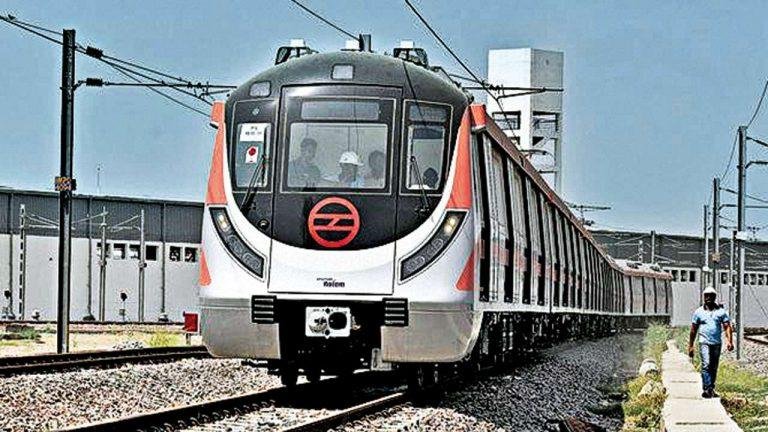
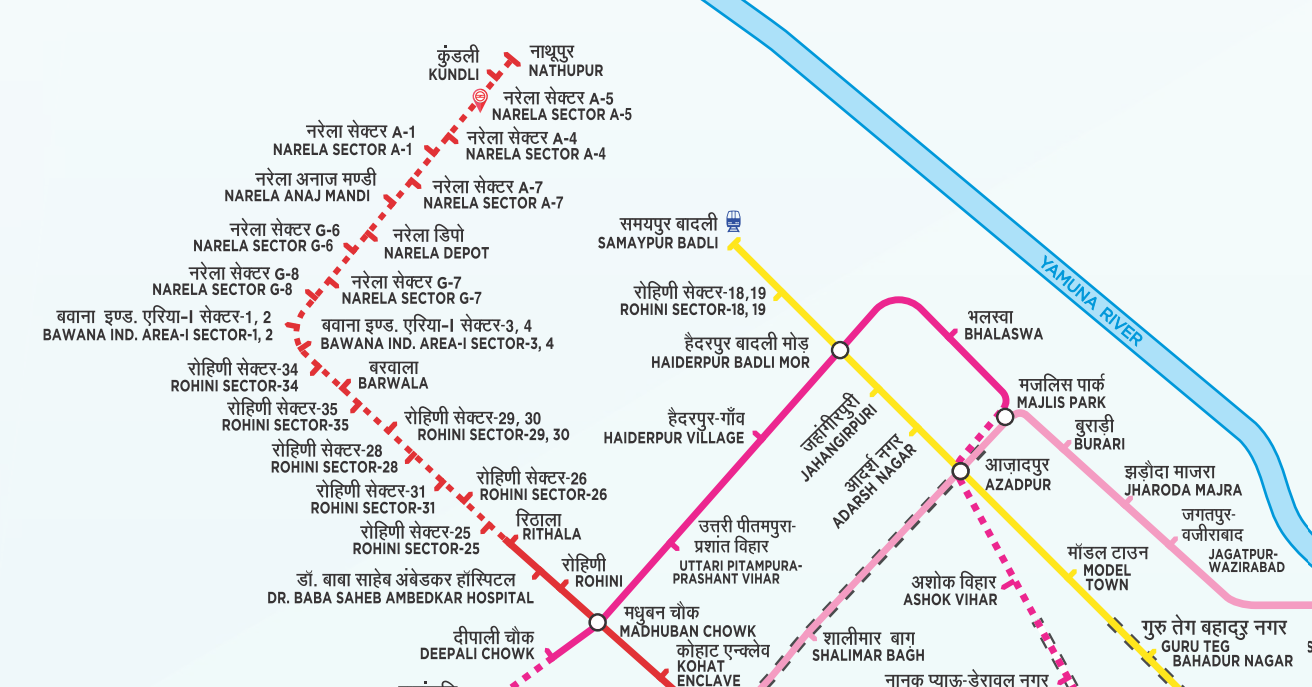
DELHI (Metro Rail News): Delhi Metro Rail Corporation (DMRC) has invited bids for electrical tender for the Delhi Metro Phase IV extension of the Red Line from Rithala to Kundli (Nathupur). The approximate cost of the work is ₹18.97 Crore and the time period for the completion of work is 18 months.

Tender Information

InformationDetails
Tender No.D2EUD-05
Approximate Cost of Work18.97 Cr.
Completion Period18 Months
Pre-Bid Meeting July 28, 2026 (11:00 hrs.)
Bid Submission OpeningAugust 11, 2026 (09:00 hrs.)
Bid Submission DeadlineAugust 17, 2026 (15:00 hrs.)

Scope of Work

The scope of work of the contract includes the supply, installation, testing & commissioning for shifting / raising the height of 400KV D/C Transmission Lines of PGCIL (NR-1) & DTL infringing near MCD’s WtE Bawana Plant in Rithala – Kundli (Nathupur) Corridor of Delhi Metro Phase-IV Project.

About Rithala – Kundli (Nathupur) Corridor

image 10

The Red Line (Line 1) extension from Rithala to Kundli (Nathupur) is a part of the Delhi Metro Phase IV project. The proposed extension has a length of 26.463 km, with 21 stations. The Red Line was the first operational line of the Delhi Metro and with the proposed extension, it will surpass the length of 60 kilometers.

Also Read: Delhi Metro: DMRC to carry out feasibility study for Keshav Puram to Rohini Double-Decker Corridor

Delhi Metro: DMRC to carry out feasibility study for Keshav Puram to Rohini Double-Decker Corridor

DELHI (Metro Rail News): The Delhi Metro Rail Corporation (DMRC) plans to conduct a feasibility study for a proposed double-decker Metro and flyover corridor between Keshav Puram and Rohini Sector 34. The study will explore if the combined project can enhance connectivity while better utilizing limited urban space.

This proposed corridor is part of Delhi metro Phase-5B and will cover a distance of 16.5 km. DMRC estimates that this is going to cost around Rs 2.08 cr and it is expected to complete within 6 months. 

Project at a glace 

DetailsInformation
ProjectDouble-Decker Metro and Flyover Corridor
Metro Phase Phase-5B
Route Keshav Puram to Rohini Sector 34
Length16.5 km
Estimated Cost Rs 2.08 cr

The proposed design features an elevated Metro line on the upper level and a flyover or elevated road on the lower level. The goal is to use the available space more effectively and decrease traffic congestion along the route. The consultant will look into various aspects of the project, including:

  • Alignment options  
  • Structural feasibility  
  • Construction methods  
  • Traffic demand  
  • Utility shifting requirements  
  • Commercial viability  

The study will also assess the need for supporting road infrastructure such as entry and exit ramps, loops, cloverleaf interchanges, directional ramps and other traffic management structures at important junctions.  

Route passes through densely populated areas

According to DMRC, the proposed alignment crosses through busy and heavily developed areas, including Keshav Puram and several sectors of Rohini. The study will examine the existing Metro infrastructure, flyovers, underground utilities, land availability, and heavy traffic before recommending the best alignment.

Traffic surveys and transport modeling to begin soon

The selected consultant will conduct detailed traffic and transport surveys as part of the study. These will include:

  • Traffic volume counts  
  • Turning movement counts  
  • Origin-destination surveys  
  • Public transport surveys  
  • Road inventory surveys  
  • Speed and delay studies  

The consultant will also perform limited topographical checks at critical locations as needed. Using this information, the consultant will prepare a transport model to estimate current and future traffic demand and create an initial design to integrate the Metro corridor with the proposed road infrastructure.

Cost, environmental impact, and final recommendation

The study will also include a concept-level structural assessment, construction feasibility analysis, and preliminary land requirement estimates. Additionally, the consultant will prepare indicative project cost estimates, conceptual bills of quantities, comparison of different structural options, cost-benefit analysis and environmental impact assessment. Based on the findings, the final report will recommend the best alignment and assess whether the proposed double-decker Metro and flyover corridor is technically and commercially feasible. 

Also Read: Noida International Airport to get direct Namo Bharat RRTS and Bullet Train connectivity

Noida International Airport to get direct Namo Bharat RRTS and Bullet Train connectivity

NOIDA (Metro Rail News): Plans are underway to transform Noida International Airport in Jewar, India’s newest aviation hub, which became operational on June 15, 2026, into a major multi-modal transport center where passengers can seamlessly switch between flights, trains, and metros. The first major corridor Ghaziabad-Jewar Namo Bharat (RRTS) corridor, has entered the Detailed Project Report (DPR) stage. Meanwhile, the airport railway station is currently under construction, while the Delhi-Varanasi Bullet train corridor and its further extension to Siliguri are still in the planning phase.

The Ghaziabad-Jewar Namo Bharat corridor is expected to cut travel time to 40-50 minutes and Bullet train infrastructure projects aim to connect the airport to the National Capital Region (NCR), Uttar Pradesh, and Eastern India.

The fourth Nammo Bharat regional rapid corridor cost around Rs. 20,640 Cr. 

The Ghaziabad-Jewar RRTS corridor has reached the DPR phase, promising to reduce travel time between Ghaziabad and Jewar to around 40-50 minutes at a speed of 180 kmph and is estimated to cost around Rs 20,640 crore. The stations proposed along the corridor are:

  • Ghaziabad
  • Ghaziabad South
  • Greater Noida West-Sector IV
  • Greater Noida West-Sector II
  • Knowledge Park V
  • Surajpur
  • Pari Chowk
  • Ecotech VI
  • Dankaur
  • YEIDA North-Sector 18
  • YEIDA Central-Sector 21
  • Jewar Airport

India’s second major Bullet Train Route integrates with Jewar 

The 813-km long proposed Delhi–Varanasi bullet train corridor will connect Delhi and Varanasi through 13 stations. According to the proposal the train will connect  Noida Airport, Mathura, Agra, Lucknow, Prayagraj, and Varanasi.

The proposed Delhi-Varanasi train project is expected to reduce the time between Jewar and Lucknow to 40 minutes and Delhi to Lucknow in two hours. The project was announced by Finance Minister Nirmala Sitharaman in the Union Budget for 2026-2027.

There was an extension plan of Delhi-Varanasi corridor extending to Siliguri. If it happens it will be a major connecting window of the Northern and Eastern part of the country to the Capital city.

This development will not only boost accessibility and reduce road congestion but also accelerate economic growth, attract investments, and enhance the quality of life for residents across the NCR. By positioning Noida at the forefront of India’s modern mobility revolution, these projects mark a significant leap towards a faster, smarter, and more connected future.

Also Read: North Central Railway invites bids for Rs 227.40 crore Consultancy Contract in Prayagraj

North Central Railway invites bids for Rs 227.40 crore Consultancy Contract in Prayagraj

PRAYAGRAJ (Metro Rail News):  North Central Railway has invited bids for providing Project General Management Services (PGMS) for the Chief Administrative Officer (Construction), Prayagraj. The consultancy contract aims to support the planning, execution and monitoring of railway infrastructure projects being implemented under CAO/Construction, North Central Railway. The estimated cost of the project is Rs 227.40 crore.

Tender details

Details Information 
Tender Number CEN-HQ-2026-27-01 
Estimated CostRs 227.40 crore
Earnest Money Deposit (EMD)Rs 4.55 crore
Completion Period60 months
Pre-Bid Meeting17 July 2026, 11:00 am
Bid Submission Deadline10 August 2026 up to 3:00 PM

Scope of work

Request for Proposal for Providing Project General Management Services for CAO/CON/ North Central Railway, Prayagraj. 

About Prayagraj Junction

Prayagraj Junction, earlier known as Allahabad Junction, opened in 1859. It is one of the oldest railway stations in northern India. The station became an important rail hub because it connects northern and eastern India. Today, it is one of the busiest railway stations in the region. During Mahakumbh 2025, Indian Railways operated more than 17,000 trains, highlighting the station’s key role in handling one of the world’s largest gatherings.

Also Read: Southern Railway invited bids for Re-development of Ernakulam Town Station

Bhopal Metro gains traction as Afcons erected Blue Line’s first segment

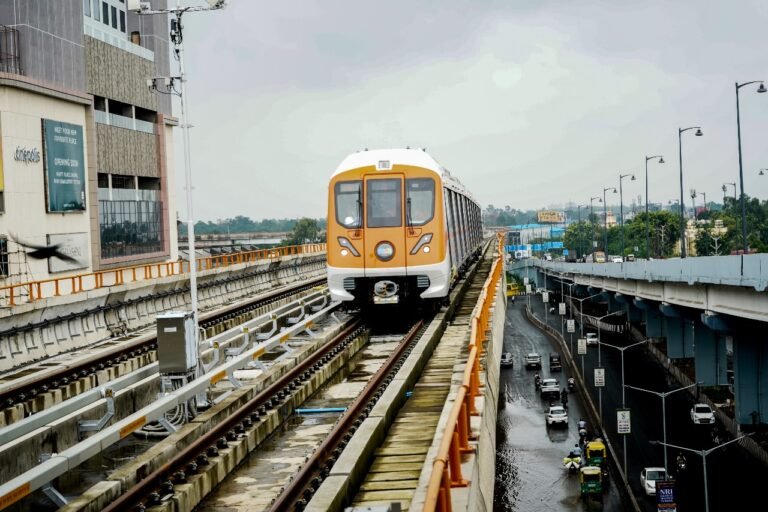
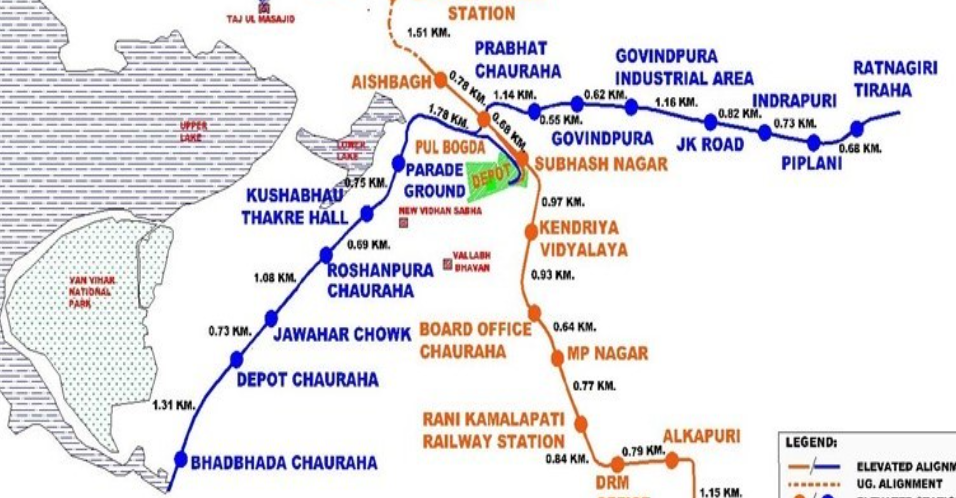
BHOPAL (Metro Rail News): The construction work of Bhopal Metro’s Blue line picked pace with the launching of the first segment of elevated section at the Piplani Chauraha. The entire Blue Line will be an elevated corridor connecting Bhadbhada with Ratnagiri, covering a 12.9 km route. The launching of the segment was undertaken by Afcons Infrastructure Ltd. 

image 9

The engineering team of Afcons used a launching girder, or launching gantry for the commissioning of the first segment at the Piplani Chauraha. The launching girder is a massive mechanical crane which places the pre-cast concrete for the fast construction of the metro viaduct. During the launch of the segment, S. Nakkiran, the Project Director at Afcons, MPMRCL Director works and other officials were present. 

The Madhya Pradesh Metro Rail Corporation Ltd (MPMRCL) awarded the project contract for the construction of the elevated stations along the Blue line to Afcons Infrastructure in December 2024, at a cost of 1006.74 Crore. The company is constructing the Corridor as an Engineering, Procurement and Construction (EPC) contractor. 

About Bhopal Metro

Bhopal Metro is a mass rapid transit system projected to serve as an urban mobility solution for the city of Bhopal, the capital of Madhya Pradesh. The project is under construction with two lines proposed. A common depot for these lines has been developed at Subhash Nagar. The metro is currently operating at a priority stretch covering AIIMS to Subhash Nagar in the Orange Line.

Also Read: RITES awarded Patna Metro’s consultancy contract 

RITES awarded Patna Metro’s consultancy contract 

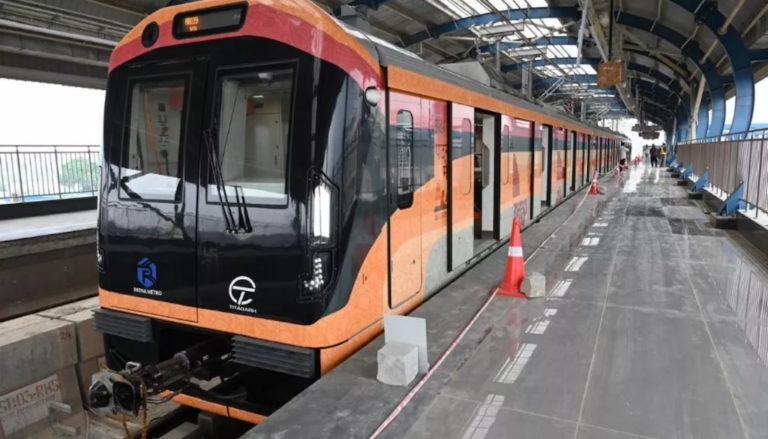
PATNA (Metro Rail News): Rail India Technical and Economic Services (RITES) has bagged a ₹79.22 Crore consultancy contract from the Patna Metro Rail Corporation (PMRC). The contract involves the consultancy for the execution of the construction projects of the Patna Metro. 

The scope of the work includes providing consultancy services for the implementation of the Patna Metro construction project. The time period for the execution of the project is 68 months. 

InformationDetails
ContractorRITES
Contract Value₹79.22 Cr.
Completion Period68 Months

The consultancy project is projected to support the development of the Patna Metro system. The project has been delayed for a long duration and it is operating on a priority corridor consisting of five metro stations. This month on 4th July, two new stations were inaugurated by the Chief Minister Samrat Choudhary extending the network to Malahipakri.

About Patna Metro

Patna Metro Rail Project is a mass rapid transit system projected to connect the city of Patna. The project is under construction with a priority corridor serving as the operational route. The underground section of the project is currently under construction and work on the elevated section is taking place simultaneously. The complete proposed stretch is projected to expand the metro network to 32.5 km, with 24 stations.

Also Read: Southern Railway invited bids for Re-development of Ernakulam Town Station

Southern Railway invited bids for Re-development of Ernakulam Town Station

ERNAKULAM (Metro Rail News): Southern Railway has invited open e-tender on an EPC (Engineering, Procurement, and Construction) basis, for Re-development of Ernakulam Town Station(Balance work),carrying an estimated project cost of ₹156.43 Crore. 

Tender Information

InformationDetails
Tender Number  CE-CN-ERS-SD-01-2026-EPC 
Estimated Cost  1564262007.39 (₹156.43 Crore)
Tender Validity 120 days
Pre-Bid Meeting  22/07/2026 15:00
Tender Submission Deadline 12/08/2026 up to15:00 Hrs
Completion Period 20 Months

Scope of work

Re-Development of Ernakulam Town Railway Station’s balance work on EPC (Engineering, Procurement, and Construction)mode.

About the Project

The project aimed at transforming the  Ernakulam Town Railway Station into a world-class, airport-like facility. Upgrading the Ernakulam Town Railway station will absorb a significant portion of Kochi’s rail traffic, reducing the burden on the heavily congested Ernakulam Junction (South) station.The modernized hub will create a vibrant commercial zone, generating new retail jobs and boosting local business growth in the Kaloor and Kacheripady areas.The new station is designed to connect different modes of transport. It features a direct skywalk to the nearest Kochi Metro station, as well as easy connections to local bus stops and auto-taxi stands. This is one of the most important ongoing projects for Southern Railway.

Also Read: Telangana’s new ₹5.63-Crore Komuravelli Railway station is all set for inauguration