



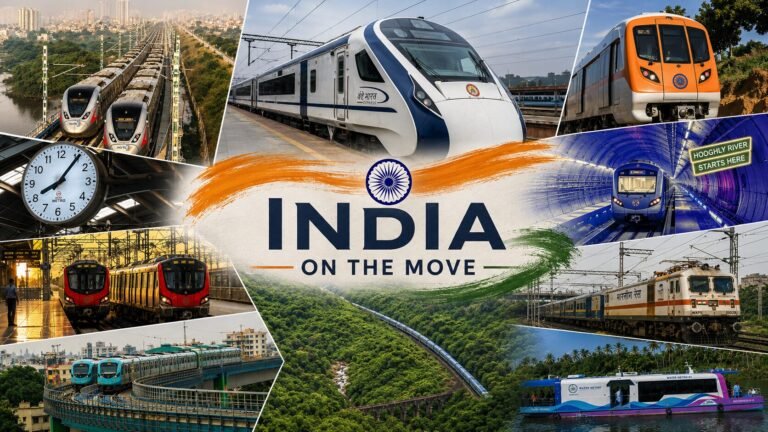
NEW DELHI (Metro Rail News): In the 79 years since independence, railways have stood at the forefront of development and unification of India. It has expanded its network to more difficult terrains and remote corners of the country. Moreover, it has recorded a massive amount of freight loading and passenger mobility. The expansion continued in the metro sector, with the country reaching the milestone of 1,000 km of network and the launch of India’s first Namo Bharat RRTS corridor. Besides, a new chapter in the nation’s rail development is being written as India’s first bullet train project as the project inches closer to becoming a reality, with a projection to be inaugurated in 2027.
Since independence, India has transformed from being dependent on other countries for rail equipment to manufacturing its own products. India’s own ATP system, ‘Kavach’, is a prime example of this feat, which is a “Made in India” solution developed specially for Indian conditions. Who could have imagined that India would construct an underwater metro line? However, India’s oldest metro network, the Kolkata Metro, registered its name in the history books yet again by overcoming this engineering challenge. As we discuss engineering challenges, one name that can not be overlooked is the ‘Konkan Railway’. The Konkan Railway project had over 2,000 bridges and 90 tunnels, making it one of the most challenging projects of Indian Railways.
The progress in the rail mobility sector is opening a pool of opportunities for India. The enhancement in the railway sector has fostered economic growth and attracted financial investments. This article will discuss the major achievements of the Indian railway mobility sector, including metro expansion and Namo Bharat RRTS. It will further describe India’s leap in railway technology and the contribution of railways in India’s development. In the end, we will provide a critical remark on the shortcomings of the sector, outlining the focus areas for future development. This article will emphasise that India is always on the move and the rail mobility sector has been a catalyst in defining mobility in the country.
Railways: Legacy to Longevity
In April 1853, India’s first train was inaugurated from Thane to Bombay. Railways became a major carrier in keeping India together during the struggle for independence. Now, as we celebrate our 80th Independence Day, the railway is still bringing India closer than ever. Indian Railways has efficiently undertaken the loading of huge freight and handled significant passenger mobility. In recent years, Indian Railways has introduced new initiatives such as Vande Bharat trains, the Amrit Bharat station redevelopment programme, and India’s indigenously developed Kavach system as a step to modernize the railway sector. Largely, the railway is India’s legacy, which is keeping India on track for longevity.
The weekly brief metro & rail professionals read.
Railway Expansion: Carrying the Whole Country Five Times Over
Indian Railways has expanded railways to remote corners of India. The work is remarkable, as the railway is now accessible in some of the most difficult terrains and climatic conditions in the country. In the year 2026-27, Indian Railways carried the whole country five times over. It handled the mobility of over 741 crore passengers during the year, which is equivalent to five times the population of the country. India’s freight loading also gained momentum as they loaded freight weighing equivalent to almost 25 thousand ‘Statue of Unity’ (67 thousand tonnes) in FY 2026-27. The total freight loaded for the year was around 1,670 million tonnes. The overall revenue of Indian Railways also expanded to ₹80,000 Cr. in FY 2026-27, marking a major boost for the economy.
Konkan Railway: Engineering Marvel of Indian Railways
2,286 bridges were constructed, and 91 tunnels were carved for India’s most complex railway project spread across around 739 km. This engineering marvel of Indian Railways is now known as the ‘Konkan Railway’ which is constructed along the most difficult terrain along the Western coast of India. The ambitious project crossing mountains and rivers, was constructed under the leadership of E. Sreedharan, popularly known as the ‘Metro Man’ of India for his contribution to the Delhi Metro Rail project.
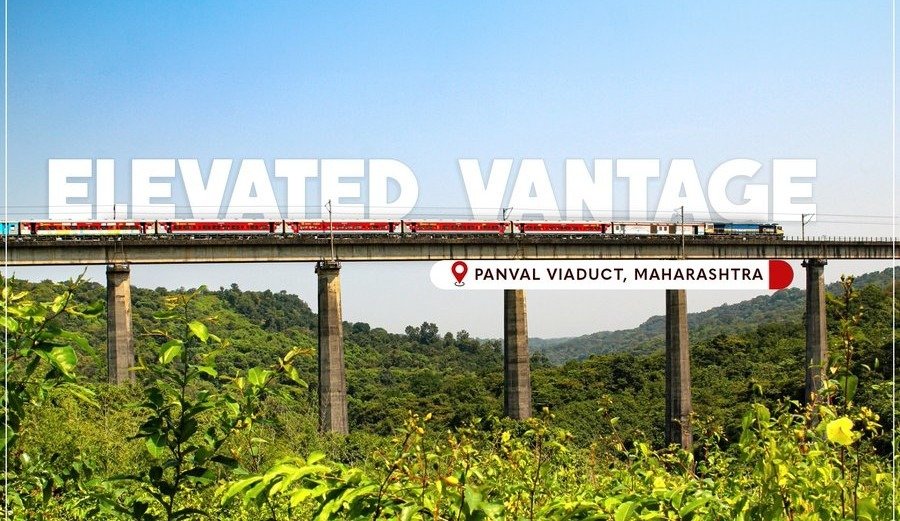
(Image- Panvel viaduct, tallest viaduct of Konkan Railway with length of 64 meters)
The project had a total of 2,286 bridges, including 190 major bridges and 1701 minor bridges. The Panvel viaduct, one of the tallest viaducts in Asia with a height of 64 meters, was also a part of this project. Besides this, the project had 91 tunnels covering almost 84.5 km in length. The trains pass through these bridges and tunnels during the journey, providing a special visual experience to the passengers.
Vande Bharat and Amrit Bharat Trains: Redefining Rail Travel
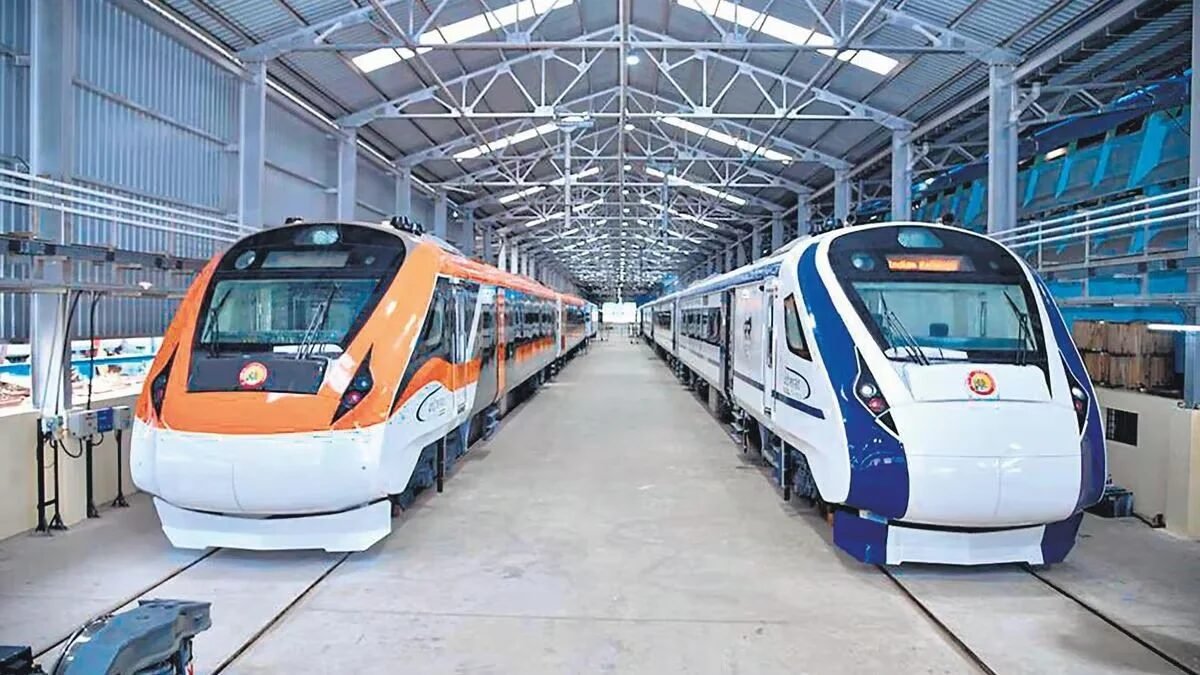
India is writing a new chapter in railway mobility through India’s premium semi-high-speed train, Vande Bharat, and India’s affordable long-distance train, Amrit Bharat. Both these trains have changed the conventional Indian Railways rolling stock with a modern, exquisite interior and exterior look. Vande Bharat is India’s fastest long-distance train with a maximum speed of 180 kmph. Moreover, it provides exclusive features enhancing commuters’ experience. It is also a major milestone of India’s ‘Made in India’ initiative. Amrit Bharat, on the other hand, facilitates travelling at an affordable rate through low fares and greater connectivity.
Railway Electrification: Standing Ahead of Developed Countries
Making a major leap in railway upgradation, India achieved 99.6% electrification, leading railway electrification ahead of several developed countries including the UK, Japan, Russia and China. 15 of the 19 railway zones have achieved 100% electrification while the work on the remaining section is in progress. The achievement signifies Indian Railways’ determination towards reducing its carbon footprint. As per the Ministry of Railways’ report, Railways used 185 crore litres less diesel in 2024-25 than it used in 2014-15. The achievement is also notable if we look at India’s large railway network and that most of this work was expedited while loading dense traffic across the operational lines.
Kavach: India’s Indigenous ATP System
For a long time, India was dependent on foreign imports for railway technology. In addition to having a negative impact on India’s foreign exchange reserves, the imported technologies were also not suitable for the Indian terrain and ecosystem, as they were not developed keeping in mind the challenges of the Indian environment. Clearly, India needed an indigenous technology made specially for approaching the challenges of the Indian conditions. This demand paved the way for India’s indigenously developed Automatic Train Protection (ATP) system, ‘Kavach’.
Kavach is India’s indigenously developed ATP system. Certified to Safety Integrity Level 4 (SIL-4), the optimum level of safety integrity, Kavach ensures the highest safety standards for train operations. Kavach has strengthened the reliability of rail operations with its ATP mechanism. The upcoming Kavach 5.0 upgrade is expected to strengthen the Mumbai suburban network with a reduced train headway distance.
India as a Railway Product Manufacturer
India’s made-in-India railway products are making a mark in the global market. In the initial years, India was heavily dependent on other countries for the import of railway products. However, in recent years, India is domestically manufacturing much of the railway equipment. India is also developing the intricate electronic and propulsion systems indigenously, further strengthening the ‘Made in India’ initiative. Indian rolling stock manufacturers, including BEML, Titagarh and ICF, are leading the country on the road to self-reliance with their projects facilitating the growth of India’s railway manufacturing. Moreover, India is building an export-oriented ecosystem. In the present, India’s railway products are exported across southeast asian region, and this development is making India a viable candidate for exporting railway products to European and other overseas markets.
Amrit Bharat Stations: Modernizing Indian Railway Stations
The Government of India announced the Amrit Bharat Station Scheme (ABSS), which identified 1,337 stations for the station redevelopment program. So far, multiple redeveloped stations have been inaugurated, and the work progress has gained momentum across most of these identified railway stations. The ABSS is changing the landscape of the Indian Railways with modernized stations, strengthening sanitation, modern infrastructure, and accessibility through this program. The program is currently under implementation. It will be implemented in a phased manner. The first station to be redeveloped under this scheme in 2021 was Gandhinagar railway station with a hotel constructed above the station, boosting TOD.
Hydrogen Train: An Initiative for Green Technology
India’s first train running on hydrogen fuel was inaugurated on 17th July 2026. The train is running on the corridor covering Jind to Sonipat in Haryana. This development marks a major leap towards greener railway technology and the net-zero carbon emission target for India. The train is among the longest hydrogen trains in the world. This train was developed indigenously in India, with the design prepared by Research, Design and Standards Organization (RDSO) and the train’s theme and exterior designed by Integral Coach Factory (ICF). India’s largest hydrogen storage facility is also established at Jind station for this hydrogen train project.
Metro: Redefining Urban Mobility
Mass Rapid Transit systems are expanding across Indian cities. The total operational metro network in India has crossed 1,000 km. It is shaping India’s urban mobility landscape to a completely new dimension. India has now expanded the metro network to 26 cities, with projects extending to tier-2 cities. The largest metro network in the country, Delhi Metro, has become the backbone of the capital city, crossing over 400 km in length. It has seamlessly carried an average of 64.60 lakh daily passengers in 2025. The metro systems have shown remarkable efficiency and technology. Here are some major developments in the sector:
Surpassing the Milestone of 1,000 km Metro Network
India has emerged as the world’s 3rd largest metro network by overtaking Japan with a network of almost 1,077 km covering 26 cities across the country as of June 2026. It has expanded the network at a remarkable pace with metro connectivity to several major cities. The growth has boosted India’s urban mobility, attracting financial investments and infrastructural development in proximity to metro systems.
The budget for metro expansion has also increased, with the budget allocation for FY 2026-27 at ₹30,942 crores. The metro development has redefined urban mobility for many Indian cities with fast, safe, and efficient commuting.
| INDIA’s Metro Network (as of June 2026) | |||
| S. No. | State/UT | City | Operational Length (Km) |
| 1 | Delhi & NCR | Delhi | 416 |
| 2 | Noida | ||
| 3 | Ghaziabad | ||
| 4 | Faridabad | ||
| 5 | Ballabgarh | ||
| 6 | Bahadurgarh | ||
| 7 | Greater Noida | ||
| 8 | Gurugram | ||
| 9 | Karnataka | Bengaluru | 96.1 |
| 10 | Telangana | Hyderabad | 69 |
| 11 | West Bengal | Kolkata | 72.98 |
| 12 | Tamil Nadu | Chennai | 54.245 |
| 13 | Rajasthan | Jaipur | 12.1 |
| 14 | Kerala | Kochi | 28.48 |
| 15 | Uttar Pradesh | Lucknow | 22.878 |
| 16 | Meerut | 21 | |
| 17 | Kanpur | 15.12 | |
| 18 | Agra | 6 | |
| 19 | Maharashtra | Mumbai (including Navi Mumbai) | 101.43 |
| 20 | Nagpur | 40.022 | |
| 21 | Pune | 33.23 | |
| 22 | Gujarat | Ahmedabad | 68.5 |
| 23 | Gandhi Nagar | ||
| 24 | Madhya Pradesh | Bhopal | 7.3 |
| 25 | Indore | 6.2 | |
| 26 | Bihar | Patna | 6 |
| TOTAL | 1076.585 | ||
Delhi Metro: The Backbone of India’s Capital
The people living in Delhi cannot imagine their lives without the Delhi Metro. Considered the backbone of India’s capital city, it has become India’s largest metro network, covering 416 km (including the rapid metro in Gurugram) with 303 stations as of July 2026.
Delhi Metro started operations on 25th December, 2002, on an 8.4 km stretch from Tis Hazari to Shadara. The work was undertaken at a rapid pace under the leadership of E Sreedharan (the same person who led the Konkan Railway project). Now, the network has expanded across 12 lines, providing seamless connectivity across the National Capital Region (NCR) with world-class infrastructure and enhanced last-mile connectivity.
Kolkata’s Underwater Metro
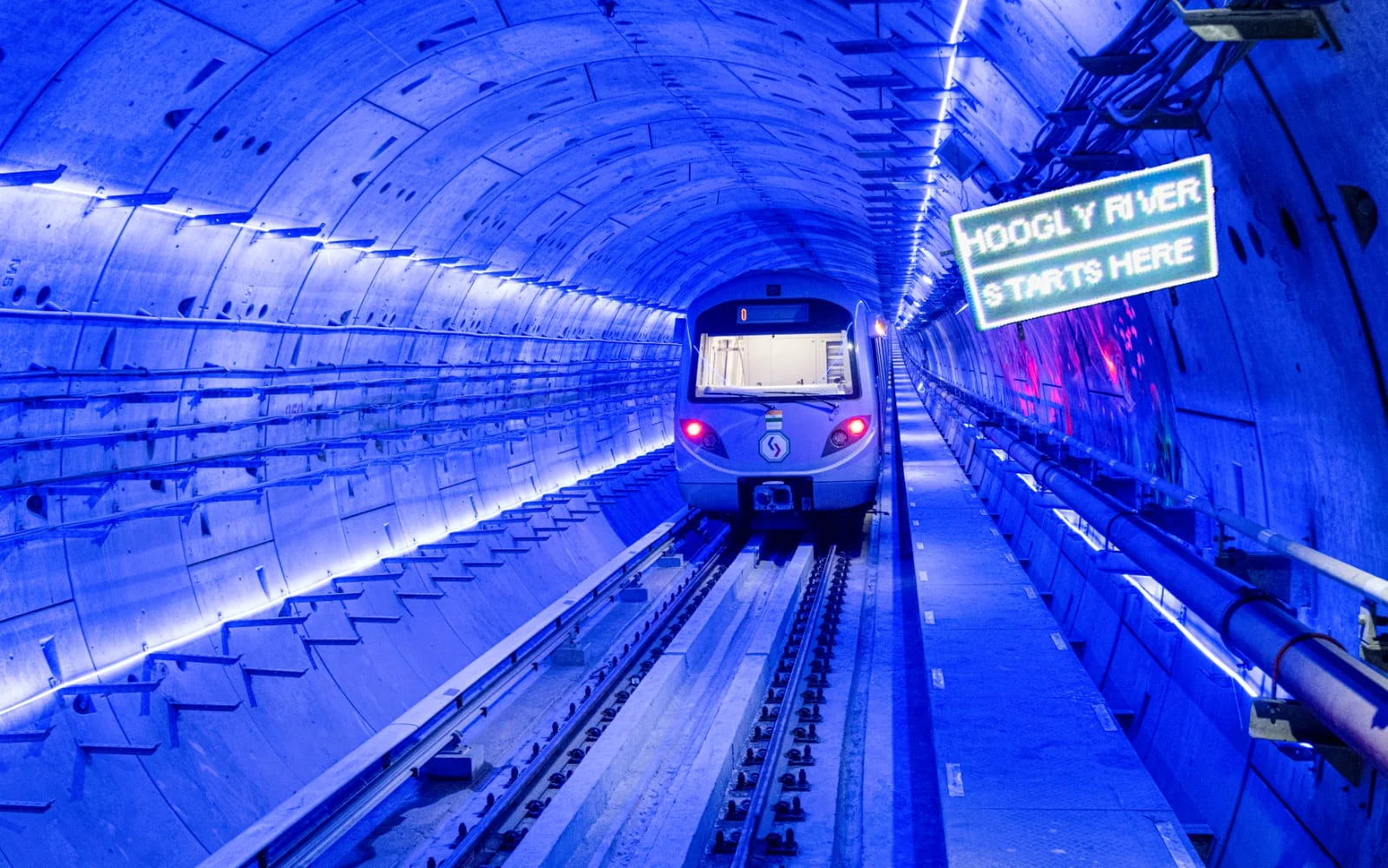
Kolkata became India’s first operational metro network in 1984. Despite lagging behind in metro development afterwards, it registered its name in history books for yet another time. It became India’s first underwater metro, achieving remarkable engineering excellence. The Kolkata metro’s Green Line project from Howrah Maidan to Esplanade faced a major roadblock that demanded the construction of a metro line under the Hooghly River. This paved the way for the development of India’s first underwater metro route. The project was inaugurated in March 2024. Further, the Howrah metro station also emerged as the deepest metro station in India after this development, with a depth of around 33 meters, surpassing Delhi Metro’s Hauz Khas station.
Water Metro: Boosting Multi-Model Integration
The Kochi Metro Rail Limited (KMRL) strengthened multi-model integration in Kochi through the introduction of Kochi Water Metro. This became India’s first water metro and laid the foundation for future water metro projects. In a major announcement, the Maharashtra government also announced the world’s largest water metro system in Mumbai. The Ministry of Ports, Shipping and Waterways (MoPSW) has also undertaken feasibility studies across 18 locations for development of the water metro network. The water metro will foster mobility through multi-modal sources by integrating land sources, including metro, buses and railway to water bodies. The use of electric ferries is initiating eco-friendly commuting.
Driverless Metro Operation
India introduced its first driverless metro operation, Unattended Train Operation (UTO), on Delhi Metro’s Magenta Line in December 2020. The mechanism behind this is the use of Grade of Automation Level-4 (GoA-4) through the Communication Based Train Control (CBTC) system. At present, around 29% of Delhi Metro runs through UTO with driverless operations on the Magenta Line and Pink Line. Further, there are plans for driverless operations in the new Phase IV corridors of the Delhi Metro.
NCMC: “One Nation, One Card”
The National Common Mobility Card (NCMC) was launched in March, 2019 to integrate travel through metro, rail, bus, water metro, and other public transport operators and retail outlets through a single card. The motto of this card is “One Nation, One Card”. The card is indigenously designed in India by the National Payments Corporation of India (NPCI). It is currently functional across 11 metro projects and bus corporations. The technology used for this integration is qSPARC (Quick Specification for Payment Application of RuPay Chip).
Expansion to Tier-2 Cities
In 2025, three cities joined India’s expanding metro network. These cities were Patna, Bhopal, and Indore. These cities are rapidly growing in both population and as economic hubs. Yet, these cities and other cities, including Lucknow, Kanpur, Meerut, Kochi, and Jaipur, fall in the category of Tier-2 cities. Now, they are also becoming a part of India’s metro network.
In the initial years, the focus of metro development was on major cities (tier-1 cities) such as Delhi, Kolkata, Mumbai, Hyderabad, and Chennai, but now the metro is also shaping the future of urban mobility across tier-2 cities. There is still uncertainty about the feasibility of these high-budget infrastructural projects, but another side of the argument is that these projects would be a necessity based on the growing population of the tier-2 cities. Moreover, it will be difficult to introduce these developments after further escalations in the city’s population and infrastructure development.
Namo Bharat RRTS: Strengthening Regional Connectivity
India’s first semi-high-speed Regional Rapid Transit System (RRTS) connecting Delhi to Meerut via Ghaziabad is redefining mobility in the NCR. The Namo Bharat RRTS project was announced to decongest the national capital by introducing fast and convenient travel from Delhi to its satellite cities. National Capital Region Transport Corporation (NCRTC) is serving as the implementing agency of the Namo Bharat project. At present, there are three priority corridors around Delhi in the first phase of the Namo Bharat project. These projects are Delhi-Ghaziabad-Meerut, Delhi-Gurugram-SNB-Alwar, and Delhi-Panipat-Karnal.
The RRTS can run at a maximum speed of 180 kmph and an operational speed of 160 kmph. It uses a double-tap Automatic Fare Collection (AFC) system for the premium coach facility. The train uses the European Train Control System (ETCS) Hybrid Level-3 for signalling and operation. This advanced technology fosters safety across the fast corridor. Moreover, the corridor is planned to have a TOD model, which is currently being planned by the authorities.
Further, seven Namo Bharat corridors are planned to decongest Delhi. However, currently there is only one operational network, and some networks are in the initial stages before development. Recently, NCRTC submitted the DPRs of four Namo Bharat projects in NCR. In the upcoming years, this Namo Bharat train will be a catalyst in the development of the national capital.
Bullet Train: A New Chapter in India’s High-Speed Rail Dimension
A major leap in the Indian railway sector will be the Mumbai-Ahmedabad High-Speed Rail (MAHSR), which is expected to be inaugurated in 2027. High-speed rail refers to trains that can run at a speed beyond 250 kmph. The implementing agency of the project is National High Speed Rail Corporation Limited (NHSRCL). The first segment of the corridor, spanning from Surat to Bilimora, is expected to be open by August 2027. Later, the rest of the segments will be operational in a phased manner.
The bullet train B28 (Bharat-made bullet trainset), is currently being made in India by BEML for operation at a speed of 280 kmph. The bullet train corridor is using state-of-the-art technologies for the development of India’s fastest train. Further, a proposal for seven high-speed rail corridors across India has been proposed to strengthen the network.
The Gaps Remain: Focus Areas in Railway Mobility Sector
This study’s ends will remain open if light is not shed on critical remarks on the focus areas in the railway mobility sector. Despite incredible growth, there are several shortcomings in the Indian railway mobility sector. In the final section of this article, we will discuss these shortcomings and the focus areas for railways in India.
Focus on Dense Areas: Enhancing Efficiency of Railways
One of the most challenging targets for Indian railways is increasing the efficiency of railways across densely populated areas. Railways have faced several issues related to management and efficiency in densely populated areas. This should be a major focus area for the Indian Railways. It must maintain efficiency in these areas by introducing proper planning, implementing strict rules for free riders, maintaining sanitation, deploying platform safety during high mobility, and deploying the Kavach system across the corridor.
Focus on Deadline: Ensure Work Within Stipulated Time
Railway projects are high-budget infrastructural projects which require huge amounts of money, land, and raw materials. Therefore, it is often observed that these projects are delayed for various reasons, resulting in cost escalation and inconvenience to the people. A major example of cost escalation is the Mumbai-Ahmedabad high-speed rail project, where the cost of the project increased by 83% from the initially sanctioned amount due to four years delay in construction. A similar pattern is observable across various other metro projects where the cost escalated due to delays. These cost escalations must become a focus point for the government and proper planning should be executed to meet the project deadlines.
Focus on Energy Alternative: Zero Carbon Emission
The focus on alternative renewable energy resources should be an important area for the Indian Railways, as if we do not reduce our dependence on non-renewable sources, it will create an energy crisis in the future. Non-renewable sources are not going to remain forever, and if the railways do not switch to alternative sources in a timely manner, then India may become a part of this energy crisis.
In recent years, Indian Railways has taken multiple projects for the goal of zero carbon emissions. The 99.6% electrification record, introduction of hydrogen trains, and other eco-friendly alternatives are paving the way for greener growth. However, it must be noted that 100% electrification is not equal to zero carbon emissions, as we produce most of our electrical energy through fossil fuels. Railways should inculcate green initiatives including solar, wind energy, and other alternative sources to reduce dependence on fossil fuels.
Focus on Self-Reliance: Indigenous Railway Technology
Another major focus area should be the domestic manufacturing of railway rolling stock, railway equipment, technology, propulsion systems, and other railway products in India. To enable this, we must increase the expenditure on research and development and foster growth through removing barriers for companies. Technologies like signalling systems must adapt to Indian conditions and not just replicate the operations from European countries or other developed countries on Indian ground. This goal is to align with the ‘Made in India’ initiative.
Focus on Transit-Oriented Development: TOD Model
Transit-Oriented Development (TOD) refers to building residential and commercial infrastructure around the metro and RRTS corridors and stations, aligning development with commuter-friendly infrastructure. The development fosters businesses and economic activities around the corridors and becomes a major source of non-fare revenue. However, at present, India is not utilizing this model in its projects. It has given priority to this model in the Metro Rail Policy 2017, announced a major project across Delhi Metro, and given a TOD plan for Namo Bharat. Besides all these, there are not many projects in the country, and the potential still remains unutilized.
Conclusion
The Indian railway mobility sector has grown exponentially in the last 79 years, demonstrating growth from steam engine trains to the upcoming high-speed trains. India’s growing metro network also contributes towards redefining urban mobility across the country. The railways have been the backbone of the Indian transport system, thereby keeping the country together. In the last 79 years, the system faced several roadblocks but came up with the most advanced solutions. The primary examples are the Konkan Railway project and the Kolkata metro’s underwater metro line. The system advanced itself with the coming technological advancements and integrated new technologies to the network. The world is still evolving, and thus the railways must work on the focus areas and build an ever-growing network, keeping India on the move.
Written by: Dev Pradhan