



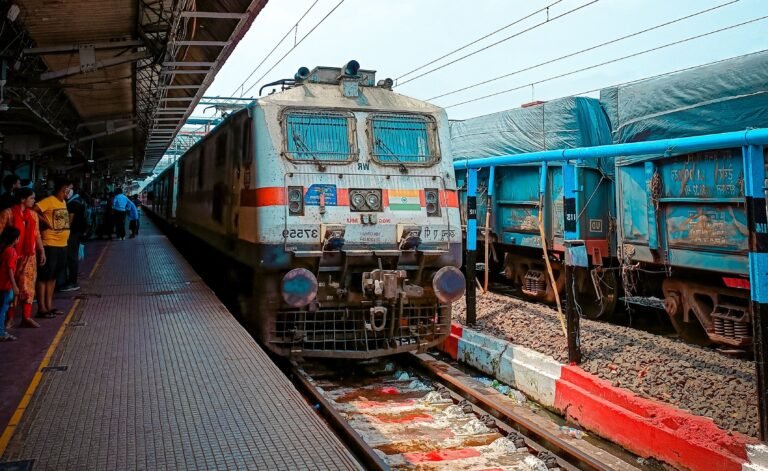
NEW DELHI (Metro Rail News): Indian Railways continues the phased implementation of its indigenous Automatic Train Protection (ATP) system, Kavach, across the network. The system received formal approval in 2020, with field trials beginning in 2016.
This update came during a discussion in the Lok Sabha between Union Railway Minister Shri. Ashwini Vaishnaw and Tamil Nadu MP Shri D. Ravi Kumar. Shri Kumar had enquired details on the rollout, including a zone-wise status with focus on the Southern Zone. No complete zone-wise progress report has been shared so far.
Kavach 4.0 has been successfully commissioned mainly on high-density corridors, particularly sections of the Delhi–Mumbai and Delhi–Howrah routes (around 2,569 route km). Earlier, Kavach version 3.2 was deployed on about 1,465 route km of the South Central Railway. Kavch 4.0 was approved by RDSO on 16, July 2024.
What is Kavach?
The weekly brief metro & rail professionals read.
Kavach is India’s indigenously developed Automatic Train Protection system. It helps loco pilots keep trains within prescribed speed limits by automatically applying brakes if the pilot does not respond in time. It also supports safer operations in poor visibility and bad weather.
Current progress and challenges
According to officials the Kavach system requires RFID tags along the tracks, optical fibre cables, telecom towers, equipment at stations and block sections, and fitment on locomotives. These technical requirements make the installation complex and time-consuming.
Another major hurdle is the training programmes. Specialized training programmes on Kavach are being conducted at centralized training institutes of Indian Railways. By now more than 94,000 technicians, operators and engineers have been trained on Kavach technology. This includes about 57,000 Loco Pilots & Assistant Loco Pilots.
Current progress of installation of Kavach 4.0 on each route
| Section | Progress (Rkm) |
| Delhi-Mumbai route: | 1,344 Rkm |
| Tilak Bridge – Junction cabin – Palwal – Mathura –Nagda –Vadodra-Virar section (Except Mangalmhudi – Panchpipliya) [Passes through Rajasthan also] | 1248 |
| Vadodara – Ahmedabad section | 96 |
| Delhi–Howrah route: | 1,146 Rkm |
| Chipyana – Tundla – Kanpur – Subedarganj section | 563 |
| Kanpur – Lucknow section | 71 |
| DDU(FOC)-Bhabua Road section | 50 |
| Sasaram – Pheser section | 43 |
| Gaya – Sarmatarn- Nimiaghat section | 159 |
| Chota Ambana – Bardhaman – Howrah section | 260 |
(from ministry’s written reply)
Safety Improvements
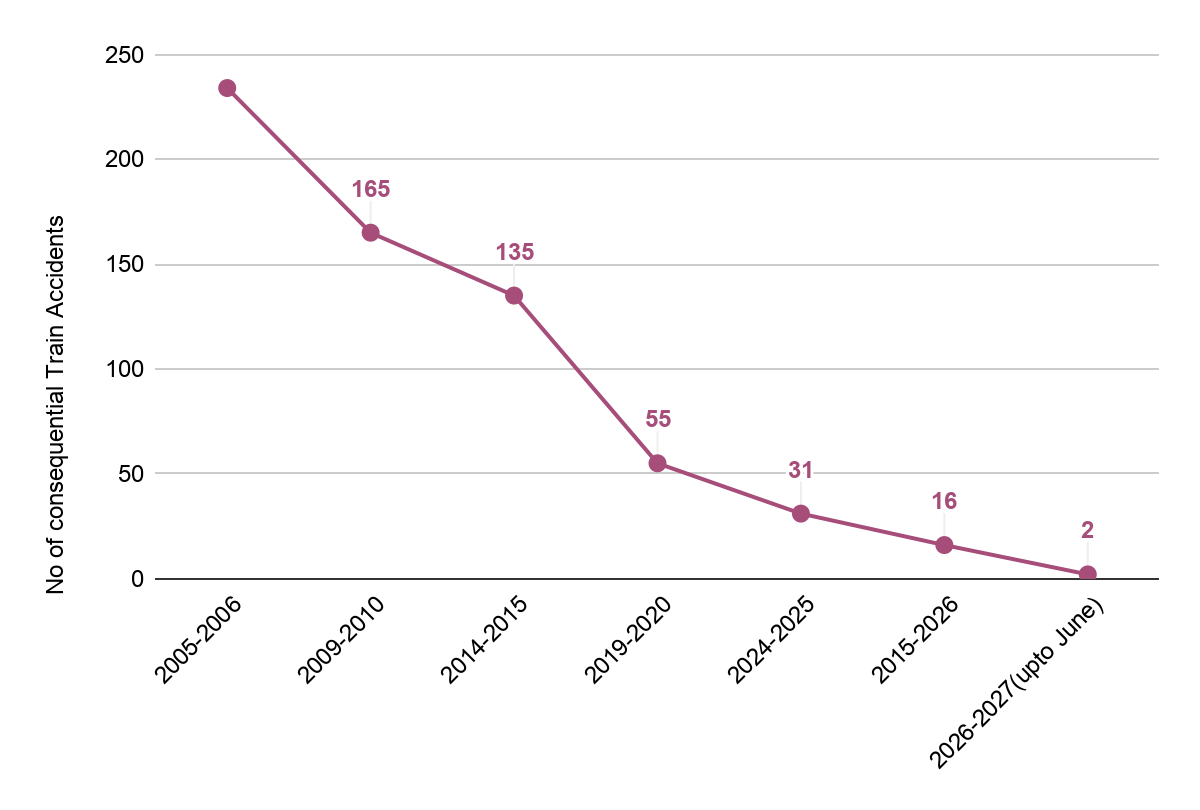
Despite the gradual rollout, the Ministry has reported a sharp drop in consequential train accidents. The number fell from 135 in 2014-15 to 16 in 2025-26 — an overall reduction of about 88%. In the current financial year (up to June 2026), only two such accidents were recorded.
The Ministry continues to prioritise Kavach expansion on key corridors while addressing the technical and logistical challenges of nationwide deployment.
Also Read: Chennai Metro records highest-ever monthly ridership of 1.06 cr