




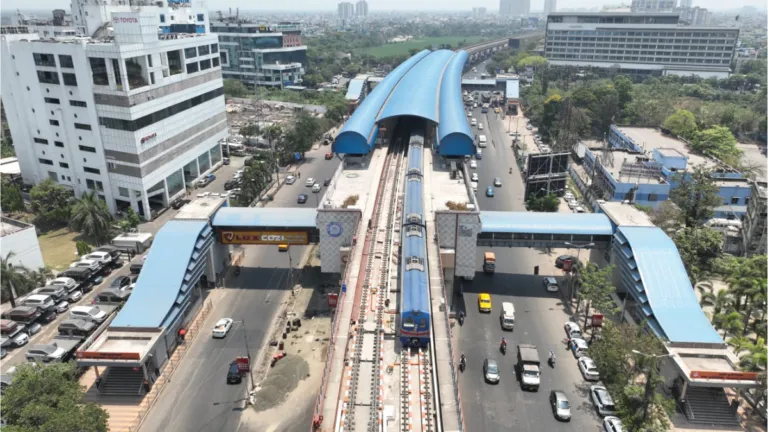
West Bengal (Metro Rail News): In a major step towards modernizing urban transport in West Bengal, the state government has appointed RITES (Rail India Technical and Economic Service) to conduct a comprehensive feasibility study for a proposed Aerial Metro connecting Asansol and Durgapur.
The initiative is being led by Urban Development & Municipal Affairs Minister Agnimitra Paul in collaboration with the Asansol Durgapur Development Authority (ADDA). The decision was officially announced after an administrative review meeting held on Saturday, July 18, 2026.
RITES will carry out detailed technical, spatial, traffic, and demographic studies to finalize the elevated metro alignment. Actual construction work will begin only after the state government reviews and approves the final feasibility report.
Proposed Features of the Asansol-Durgapur Aerial Metro
Get the Daily Metro & Rail Brief
Join 125,000+ metro and rail professionals. Project updates, new tenders and contract awards from across India, in your inbox every day.
The proposed Asansol-Durgapur Aerial metro is a major 40 to 45 km elevated transit system designed to completely transform travel across West Bengal’s industrial heartland.
Metro will run along the region’s main commercial belt, linking crucial hubs like Asansol, Raniganj, Durgapur, and the Kazi Nazrul Islam Airport in Andal.

Its main goal is to give commuters a fast, smooth alternative to the heavily crowded National Highway 19 (NH 19), effectively cutting down massive traffic jams, clearing up highway bottlenecks, and providing seamless last-mile connectivity for everyday travelers.
Why do Asansol and Durgapur need this Aerial Metro?
The proposed Asansol-Durgapur Aerial Metro is expected to become the backbone of Asansol’s transformation into a modern smart city. With high-capacity public transport, the region aims to attract greater investments in technology, real estate, and retail sectors.
Both Asansol and Durgapur are major industrial and commercial hubs with heavy daily commuter and freight traffic. An aerial metro will significantly reduce road congestion, cut travel time between the two cities, and lower vehicular pollution.
This metro project is not an isolated initiative. It forms part of a larger infrastructure push by ADDA, which also includes a new logistics hub and a recently surveyed bridge over the Damodar River.