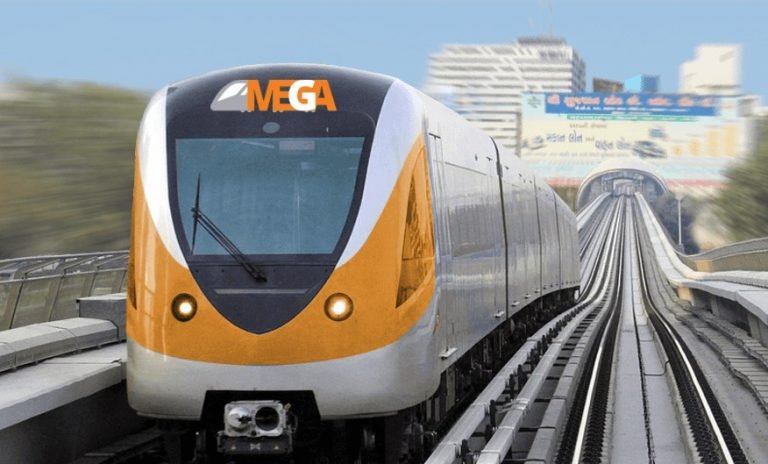
Surat: The journey of metro seems too long with Metro Link Express for Gandhinagar and Ahmedabad (MEGA) for the smart look, during the Metro train’s high power committee meeting in 2018, it was said that the work may start as soon as possible but it seems suspicious as the MEGA metro work is still pending and half the time has passed.
Due to changes in central government’s policies regarding the metro, DMRC had to work on renewal of its draft. The metropolitan municipal administration is focussing on a financial provision in the received draft and arranged to mobilize resources for income generation. The consultancy of Metro link express from Gandhinagar to Ahmedabad (MEGA)
Unless the project is reached from MEGA to state government its difficult to proceed the work, if the project is forwarded from MEGA to state government they will renew it and after the green signal of state government, the metro file will reach the center where I will get its final approval and the only the metro work on the site will begin.
Last year, the deputy chief minister Nitin Patel had said in the meeting of hypower committee in Gandhinagar that the work of Surat metro project will start in 2018. The goal was set that, two corridors will be built by 2022 was fixed, half the time of project has passed and according to the speed of project work, people suspect that the work will start by the end of 2018.
Transportation will be three-tier
The smart transportation system in the city is being focussed by the municipal administration. The municipal administration is helpful in this project, once the metro train will start the three tires public transport service will be implemented in the city. According to CEPT survey, the traffic congestion will reduce and the public transport such as buss line and auto rickshaw will remain connecting service. The metro is expected to get a huge traffic of 2.5 million people from the day it will start.
Changes made
After the change in the policies of the center, the administration had many changes in the draft. These include the sale of properties as a metro surcharge on House tax and overload on the sale. Apart from this, the provision of FSI for the land on the metro route has also been made, for this additional financial resources will be settled by NMC for the operation of the metro.
Two corridors are proposed in the metro project in which the first corridor is 21 km which will have 20 stations and another corridor which is 18 km with 18 stations. According to the new guidelines, value capture financial provision will increase the value of properties. With the construction of metro stations commercial, the cost of the area of five hundred meters will be increased around the corridor. In the metro corridor, it will be the responsibility of the municipal corporation for building four stations.
LUCKNOW: The DPR of the Blue Line of the Metro will be sent to the government on Wednesday. The Lucknow Metro Rail Corporation (LMRC) has completed its preparations. After the approval of the government, the Lucknow Metro Rail Corporation (LMRC) will start the final survey work of Vasant Kunj from Charbagh. With this, the final alignment will also be made. This work is expected to take one month. The Delhi Metro Rail Corporation (DMRC) had sent the DPR of the Vasant Kunj (Blue Line) portion of the Lucknow metro and four months before the LMRC was prepared two months ago. After this LMRC had kept it in sanction to the Metro Board meeting in Chennai.
route map of Lucknow metro (photo: LMRC)
It was approved at the board meeting but the minutes were not released. Minutes of the meeting were released from Delhi yesterday. In the evening the Lucknow Metro Rail Corporation got its minutes. The work of the LMRC was halted without the minutes. Now with the minutes, the LMRC will send the proposal to the state government for its DPR approval. All the metro stations will be set in the survey. Also, it will also know which key will be taken for its land. LMRC MD Kumar Keshav said that after final approval of the DPR, the work of final alignment will start.
MD Kumar Keshav said that after final approval of the DPR, the work of final alignment will start.
The 17th metro train has left for Lucknow. 17th train from the factory of Alstrom located in Sri City, Chennai, has been sent on July 8. It is expected to reach Lucknow by July 22. Three trains will survive after its arrival. So far, 16 trains have been reached in LRRC’s Transport Nagar based depot. LMRC is buying 20 trains from Alstrom. LMRC MD Kumar Keshav said that all the 20 trains will come by September.
LMRC MD Kumar Keshav said that all the 20 trains will come by September.
Hyderabad: Telangana government has already started identifying corridors for Phase II Hyderabad Metro project with work on metro corridor Phase I nearing completion. It is expected that the work is will be wrapped by March 2019. The focus in Phase II metro corridor will be offer connectivity to airport from all corners of the city.
The work on Phase I will be completed expect the stretch in old city area. For Phase II the length of the corridor is yet to be finalised, but officials informed that they will share the details once plan is chalked out.
As per initial details, top priority will be given to have excellent connectivity to airport in the Phase II plan. The stretch identified is from Raidurg ((Biodiversity Park) to Shamshabad and Falaknuma to airport.
Chief secretary Shailendra Kumar Joshi shared that there is a difference between Metro Phase I and Phase II projects. While Hyderabad Metro Phase I was done under private public partnership as per PPP model, Phase II will be completely done by state government.
Joshi also stated that metro rail service work on Phase I corridor starting from MGBS to Falaknuma will be completed by state government. Joshi added that the ground work for the said metro line is done as it will be undertaken for old city corridor.
For Phase II efforts are made to mobile funds in order to save time, ensuring work is carried out as per the timeline.
Delhi Metro Rail Corporation (DMRC) was asked to prepare a Detailed Project Report (DPR) for metro phase II. Given the fact that preparing DPR is an ardent task as it takes time to prepare the entire report, the municipal administration requested for a Preliminary Project Report (PPR). DMRC has already submitted the PPR to the state government.
As per the PPR submitted by DMRC, they have suggested to construct 30km corridor from Biodiversity Park to Shamshabad.
Additionly a 26km stretch from BHEL to Lakdikapul and five km from Nagole to L B Nagar.
As per the PPR submitted by DMRC, they have suggested to construct 30km corridor from Biodiversity Park to Shamshabad. Additionly a 26km stretch from BHEL to Lakdikapul and five km from Nagole to L B Nagar.
The estimated cost for the project is around 10,000 crores and government has already started mobilising funds. They have approached funding agencies like Japan Cooperation Agency. It is expected that 60% investment will come from funding agencies.
State government is keen to speed up work on Phase II as it will help is reducing traffic problems in several areas.
HYDERABAD: On 10 July bids on private-public partnership mode have been finalized to develop the integrated smart parking management system (ISPMS) at the 24 Metro rail stations which will be operated from Miyapur to Nagole stretches to 30-km, said Hyderabad Metro Rail Limited (HMRL). Now there will be no more free parking at all operational metro stations. In order to tackle the haphazard parking at metro stations hindering the free movement of vehicles, it is the best decision taken by higher authorities to introduce a new system.
Hyderabad Metro Rail Ltd. (HMRL) Managing Director said in press release, “Three companies have placed their bids, Zruti Solutions, in technical collaboration with Agile Parking Solutions Pvt Ltd, a company with international smart parking experience, got selected as the license.”
Reddy said that Investment by Zruti solutions will be about Rs 8 crore and will create ‘on-street smart parking facilities’ at the Metro stations, maintain and operate them and would also pay HMRL a sum of over Rs 7 crore as licence fee over a 20-year period.
HMRL officials added that the project envisages creating a smart parking system that utilizes technology for information, payment and enforcement. A firm would be selected that will provide IT-based smart parking solution which is automated, cost-effective, secure, environment-friendly, energy efficient and must entail minimum human intervention for day-to-day parking management duly providing aesthetically designed parking sheds.
In November 2017 Prime Minister Narendra Modi had inaugurated the 30-km stretch between Miyapur and Nagole, out of which 72-km-long elevated Hyderabad Metro Rail Project. And the brand name was given as ‘Park Hyderabad,’ the Integrated Smart Parking System of HMRL would be based on a comprehensive digital solution, which would handle the entire task of parking issues without any human intervention.
Reddy said that “It will have a citizen mobile app which provides real-time information from all the on-street smart parking lots at the Metro stations.”
He also added that two-wheeler and four-wheeler owners/drivers by using their GPS can digitally check the availability of their desired parking lot before they travel to any Metro station.
He further said that, “They can simply use the service through their smart phones and the system would display the available bays to park their vehicles in about 4,000 two-wheeler parking bays and 400 four-wheeler parking bays at the Metro stations. The users can then book vacant colour-coded bay numbers and use their allotted parking bays through either electronic payment or cash payment.”
Park Hyderabad – Integrated smart parking technologies to Hyderabad city at Metro Rail stations. pic.twitter.com/0CRzMIeVpx
He further stated that the parking fees is very less just Rs 3 per hour for a two-wheeler and Rs 8 per hour for a four-wheeler and all transactions would be digitalized ensuring transparency. Parking violations would be detected both electronically and manually and compliance would be ensured by security personnel of the private licencee under the supervision of the traffic police. The parking areas at the Metro stations, which would be aesthetically developed with shelters, would also have free Internet connectivity and other such more facilities. The attractive smart parking lots would become hubs of activity with CCTV cameras linked to a central command and control centre.
There is also mobile app would be created for the purpose of tracking parking slot availability through simple directions and real-time information on the ISPMS.
New Delhi: As cities move ahead in accomplishing ‘Smart Cities’ mission, urban transport has gained topmost investment priority. Ironically, water and waste disposal and safety to solid waste management have taken a backseat with cities rushing to meet the mission.
The urban housing ministry that presented a study to the parliamentary standing committee has shared that a total of 99 cities are part of this mission. It is expected that approximately 2 lakh crore worth of investment will be made with over Rs 33,000 crore (16.6 per cent) is proposed for urban transport. This clearly hints that urban transport gets the highest share over other issues.
Incidentally, solid waste management is a very concerning issue for most urban cities. But interestingly, only 2.4 per cent (Rs 4,896 crore) of the total investment is spent towards solid waste management. Another important insight is that even the investment on storm water drainage and social sectors is very low that comes to around 2.5 per cent (Rs 5,100 each) for each of the listed areas.
Couple of core components of Smart City infrastructure elements also comprises of assured electricity supply, efficient urban mobility and public transport, sanitation including solid waste management, affordable housing and safety and security of citizens, assured electricity supply to name a few. Whilst a lot of of these components are also covered and funded through other programmes like AMRUT and Swachh Bharat Mission, cities were free to take account of them also under the Smart City programme.
Area based development comes seconds to urban transport and is also the second most important in term of priority of investment in the programme. The proposed investment is around Rs 30,600 crore. As part of area based development, cities pick and choose one area and develop it fully so that the model can be replicated in all other parts of the city.
Major highlights as per ministry are-
3,183 projects worth Rs 1.45 lakh crore are in various stages of implementation.
Projects worth Rs 4,960 crore have been completed.
Work has started on other projects worth Rs 23,000 crore while the tendering system is in progression for the rest.
Prime Minister Narendra Modi’s government has floated one of the flagship programmes -Smart City Mission. The time duration fixed for the programme is five years that is 2015-16 to 2019-20 as per the Mission statement and guidelines, which add that it may be continued subsequently after an assessment. The first lot of 20 cities was selected on January 1, 2016.
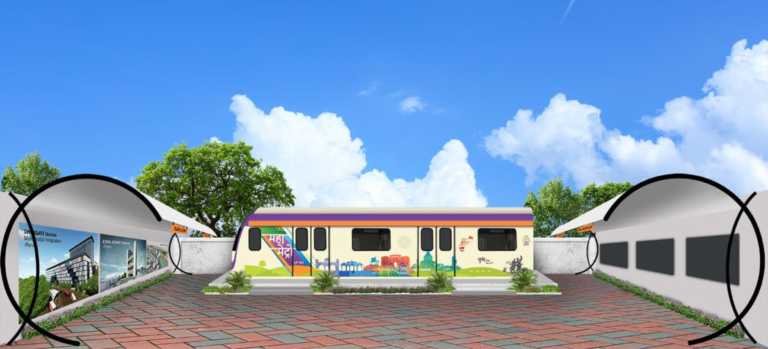
Pune: From next month the citizens will now be able to get a better idea of Pune metro. At JM road the Maha Metro Rail Corporation has planned to set up an information center and this will be a replica of metro rail coach.
The center will work as a platform and it will provide information about Pune’s metro project to citizens. It will be equipped with the information system with an LED screen.
Brijesh Dixit, MD of Maha metro while addressing a news conference here on Monday said that the “citizens can walk in and get their queries addressed at the center. It aims to provide comprehensive information about the Pune metro project including latest developments, updates, salient features, stations and routes among other things.
Brijesh Dixit, MD of Maha metro while addressing a news conference here on Monday said that the “citizens can walk in and get their queries addressed at the center. It aims to provide comprehensive information about the Pune metro project including latest developments, updates, salient features, stations and routes among other things.
This facility is expected to be open on 15th August from 7 AM to 11 PM. Its entry will be from Balgandharva side of Chatrapati Sambhajji park. For the ease of the citizens, an information gallery is also being planned on the premises and it will also help to understand the features of this project as well.
To highlight the monuments, structure, and flavor of Pune the coach graphics have been specially designed.
One coach is provided with two AC’s which will be capable of heating and cooling. The temperature inside the coach is controlled automatically in the passenger area and is fixed at 25 degree Celsius with 65% relative humidity at all times.
Artwork displaying ‘Rolling Stock Features’, mixed in acrylic sheets will also be displayed on the walls of the coach. These artworks will provide detailed information about the salient features of metro train coaches, a statement issued by metro rail.
A depiction of driving cabs, wherein citizens can visualize the interiors of the actual cab and its controls is another highlight of this model. Apart from this, an automatic self-opening/closing bi-parting sliding door will be there in this coach which will function exactly the same it does in real metro coaches.
Hyderabad: There is very good news for Hyderabad Metro commuters now they can ride a bike on rent from Miyapur Metro Station. At Miyapur station with 20 bikes, Hyderabad Metro Rail Limited and Wickedride.com, a private company launched the bike rental scheme. With very affordable price commuters have to pay just Rs 4 per km as charges for riding the bike and there are no waiting charges. Users need not to be worry about fuel as the company provides the fuel and the fares will be calculated as per the Odometer reading on the bikes. These vehicles will provides both gears and gear-less facility for the convenience of people. The main focus is to reach to the last mile connectivity to Metro passengers. HMRL Managing Director NVS Reddy said that soon after alighting at Miyapur, a passenger can ride a bike to office or home and get back the vehicle.
HMRL MD Mr.NVS Reddy launching Drivezy self drive bike sharing services at Hotel Taj Vivanta, Begumpet on July 5th, 2018. pic.twitter.com/wgJdmhcGmH
At starting, it was being launched at Miyapur station and the company has also plans to extend the services at other stations on the Ameerpet route. He also said that there are also planning to launch electric bicycles for cycling enthusiasts is going on.
HMRL MD Mr.NVS Reddy inaugurated Drivezy self drive bike sharing services with a fleet of 125 Activa bikes in collaboration with HMRL & LTMRHL for first/last mile connectivity at Hotel Taj Vivanta, Begumpet on July 5th, 2018. pic.twitter.com/jlGAUVjF3Z
Wickedride.com vice-president Shamanth H said that the service was operational in Bengaluru with about 3,800 bikes at 30 Metro Stations. “The response has been phenomenal and we expect Hyderabadis will also ride the bikes on rent.” Users have to register their names either online or offline and if there is any problem, they can contact the call centre.
There were plans to launch electric vehicles for last mile connectivity. A few companies have evinced interest and after the Telangana government introduces the Electric Vehicles Policy, things would be taken forward, Mr Reddy said.
1 of 5
He said that the instructions have also been issued to the TSRTC to increase the number of buses, at currently the 56 buses being operated on different routes.
New Delhi: South Korean President Moon Jae-In and the Prime Minister of India Narendra Modi came on Monday for the inauguration of Samsung Facility to manufacture mobile phones.
Samsung has recently opened a 35-acre electronic facility at Noida sector 81. Samsung invited Jae Yong on Sunday and she departed on Sunday and had discussed on then expand of Indian smartphone in the market.
Both the leaders visit Delhi Metro at Mandi House and took the blue line to Noida for the inauguration. Some people were shocked to see both the leaders together in the metro station and some got anxious to see the leaders. Some glimpses from the journey on the Delhi Metro shared by the Prime Minister of India via his twitter page-
PM Modi and South Korean President Moon Jae-In took ride on Delhi Metro
1 of 4
People were so happy to see them but the metro station got little more crowded than usual to see the leaders this led to hassle at the metro station.
Before going to Inauguration both the leader visit Gandhi Smriti to pay tribute to Mahatma Gandhi.
At the programme, the Prime Minister spoke about the importance of digital technology all over India and how technology is bringing convenience and enhancing transparency.
He also mentioned in his speech about the efforts to popularise digital payment and making India digitalized country and to connect rural areas with high-speed internet and improving good literacy.
The South Korean President today attending a reception at Rashtrapati Bhawan with Ram Nath Kovind and he visited Swaminarayan Akshardham Temple on Sunday.
It was the first meeting of South Korean President to India after he became President. The whole meet will surely lead to new agreements.
Mr. Alain Spohr had joined Alstom Transport India on 1 September 2017 as Managing Director for India and south Asia cluster based in Bengaluru, India. As the Managing Director of Alstom India and South Asia, Mr. Alain Spohr is responsible for expanding the Alstom footprint in the country and for ensuring optimized delivery for on-going projects. Mr. Spohr brings with him over 35 years of experience and has been associated with the Alstom group in France on and off since 1982. He has since held several positions heading different business verticals and practices.
In his last role, Mr. Spohr was the MD & CEO of the GE/Bharat Forge Joint Venture and the India Country Leader for Steam Power Systems at GE Power. Under his leadership, the company executed a $150 million turbine project within stipulated time and budgets and scaled up its knowledge center in the areas of project management, engineering, construction and commissioning. Mr. Spohr’s strong exposure in Industrial and factory operations helped guide GE through rapid localization, cost reductions and clearing backlogs leading the company to secure unprecedented and significant market share.
Mr. Spohr’s rich career in India spans over 14 years which not only gives him a keen understanding on the country’s business environment but also its culture and growth trajectory. He holds a degree in Mechanical Engineering from France.
In an interview with Metro Rail News, he categorically replied on various questions about business strategy and expansion plan of Alstom Transportation India. Here are our communication excerpts:
At the outset please accept our heartiest congratulation on successful delivery of 15 metro train sets to Lucknow Metro Rail Corporation (LMRC). When another train sets is expected to deliver?
Thank you. We are committed to take mobility in India to a higher orbit. Delivering 15 metro trains to Lucknow Metro Rail Corporation (LMRC) is an important milestone in Alstom’s journey and we are committed to delivering the next set of trains within the stipulated timelines.
Before starting any further query, we would like to know about your company vision, mission and working culture?
To become our customers’ preferred partner for transport solutions by 2020 is the global vision of the company. To achieve this vision, Alstom’s commitment is to deliver top quality solutions that are tailored to meet customers’ expectations.
This means that all our actions involve adopting clear priorities, increase our speed of execution that differentiates us from our competitors, and become able to report the achievement of our business objectives. This drives our work culture with compassion.
What is your working experience with Alstom?
In the 36 years that I’ve been a part of this company, a major chunk of it in India, in various Country Business Leadership functions involving project management, engineering, and industrial operations. With Alstom, my role is not just to nurture and build the business here in India and South Asia, but also to take mobility in India to the next level. To be such a crucial part of people’s lives and to get technology to improve the way we move around is a stupendous, most fulfilling challenge. There’s much to do, much to learn.
What is Alstom’s India strategy?
So far, in India, Alstom is known for the metro projects in Kochi, Lucknow, Jaipur, Bengaluru and Chennai. It entered in the Indian market decades ago with its LHB technology for coaches for the premium Shatabdi and Rajdhani trains. In the mainline network, Alstom’s Signaling & Power Supply Systems are a part of Eastern Dedicated Freight Corridor.
The company’s footprint is further strengthened with the new fully-electric locomotive factory in Madhepura in Bihar which is the largest FDI that Indian Railways has ever entered. The high horse power locomotives manufactured there will be the most advanced in the Indian railways fleet. We are proud to be associated with the Indian Railways for this project.
We are keen to forge several partnerships like these to upgrade the mobility infrastructure of the country. Besides, there are several projects and initiatives by the Ministry of Rail focusing on signaling upgradation, upgradation of rolling stock and electrification which are likely to have a positive impact for Alstom.
We want our mobility solutions to be considered as the benchmark technically, economically and environmentally for mobility in the country. Combined with this is our strategy to make India our manufacturing hub for international markets, having successfully delivered export projects out of SriCity this year.
In line with our growth and investment plans, we have chalked out our recruitment plan for India too. We are building a talent pool that can cater to the dynamic needs of the industry in an efficient and responsible manner.
Alstom aims to bring India’s Manufacturing hub to International market will be a full field?
It is already happening. Sri City, near Chennai, is our state-of-the-art manufacturing facility that manufactures and supplies rolling stock for the current metro projects running in the country. From here, expansion across current metro systems will continue to be strong drivers for Alstom’s business in India. Our aim is to make Sri City, Alstom’s export hub, and our Bengaluru center the innovation hub for mobility solutions.
Alstom is highly aligned to make in India. Is its alignment is really beneficial for ‘Make in India’ project?
Make-In-India has been a strong propeller of growth in the manufacturing space. It has encouraged companies to manufacture their products within the country and increase the amount of investment in the country.
Alstom has been a strong proponent of this initiative and our solid localized footprint in the country is a testimony of this policy.
Our Kochi, Bengaluru, Chennai and Lucknow metro projects were all executed out of our Sri City plant and our engineering Centre in Bengaluru. The Kochi Metro project was in fact the first example of a 100% Made in India metro project where we executed end-to-end solutions ahead of schedule – power, tracks, signaling, rolling stock at all.
Alstom delivered 15th train set to Lucknow Metro from Sri City plant (Photo: ALSTOM India)
Our Madhepura project is yet another exemplary endorsement of the Make-In-India initiative, not just because of the manufacturing and localisation component but the level of social upliftment that project has brought to the region. Around 90% of the components used in the manufacturing of the locomotives are locally manufactured and Alstom is setting up an infrastructure base in Madhepura to invite our supply chain partners to set up their manufacturing units around the e-loco plant to optimize production and supply processes.
‘Make in India’ has renewed our commitment to make long-term investments in India and strengthen plans and delivery on ground. It is really good for business.
How has Alstom played a crucial role in Indian Railways?
We have been a part of India’s mobility journey for over five decades, and we hope to continue in the same track.
Alstom believes in working closely with the Government to contribute towards nation-building. Our manufacturing unit in Madhepura in partnership with the Indian Railways is the largest FDI in Indian Railways, to build 800 state-of-the-art fully electric locomotives. The speed, power and efficiency of these newly built locomotives will redefine the heavy freight transportation in the country.
Make in India Electric Locomotive by Alstom from Madhepura Facility
This contract requires two maintenance depots in the country – one in Saharanpur and the other in Nagpur. The modern depot at Saharanpur is ready and about to commence operations. The depot will help in the upkeep of locomotives with predictive maintenance technology. It will also act as a training center for loco pilots and contribute towards skilling India.
Our work on Dedicated Freight Corridor, is another project we are proud to be associated with. This corridor will decrease traffic in the mainline network and increase speed and efficiency of freight movement.
With such a comprehensive array of partnerships to improve the rail infrastructure of the country, with a billion plus population, the work is far from over. We take pride in our work done so far and simultaneously acknowledge the challenges that lays ahead of us.
Alstom has successfully designed Kochi Metro under ‘Make in India’ project was first project under ‘Make in India’ program. Share your experience with this project.
Alstom-built metros for Kochi are the first to have been entirely designed in Bengaluru and manufactured at Sri City supporting the Government’s ‘Make in India’ campaign. Hon’ble Prime Minister of India, Shri Narendra Modi, inaugurated the project. It reinforced our vision to become the preferred partner of cities, countries and operators and provide our advanced mobility solutions. Alstom scored a lot of industry-firsts with the Kochi Metro Project.
Kochi Metro Rail
It was the first Communication-Based Train Control (CBTC)-based metro to be commissioned in India. CBTC controls the movement of trains precisely, allowing more trains to run on the line at higher speeds in total safety. Our goal was to deliver an innovative and effective mobility solution for the people of Kochi.
Alstom is investing a lot in India, while other MNC company dares to invest. What such fascinate you in India for such a huge investment?
Any business venture should make commercial sense. When we consider investing in a country we evaluate market potential, availability of talent and government support. India’s market potential is high because the country requires rapid modernisation, adoption of newer, safer and more sustainable technology, due to quick urbanisation.
Large structural changes need constant support. Metro Rail News publication can help maintain the optimism and enthusiasm of engineers, officials and people associated with this dynamic industry.
Geographically, India is strategically located that also helps us to assuredly deliver projects across Asia, Middle East and even beyond. We also have been able to tap into the large, skilled talent pool available in the country – bright, young minds that are helping us develop sustainable solutions for projects worldwide. We employ close to 3,600 people in India which makes it our biggest centre of operations after France.
With the Government’s Make in India and Skill India initiatives, we find our business goal completely aligned with the country’s vision. I do not know about other companies but conducting business in India and from India makes sense for us.
Apart from publishing daily news updates on Metro Rail News portal, Our Monthly Magazine covering chronicle development in urban transport in India. How do you think we can partner with railway industries across the country to popularize their project developments?
Large structural changes need constant support. Your publication can help maintain the optimism and enthusiasm of engineers, officials and people associated with this dynamic industry.
For more details, please read Metro Rail News (Monthly) Magazine.
Bengaluru: The Bangalore Metro Rail Corporation Limited (BMRCL) is now eyeing greater investment from private companies. The metro rail corporation is trying to reach out to interested companies to fund metro rail projects. Recently Infosys Foundation has agreed to offer Rs 200 crore for the development of Konappana Agrahara station (Electronic City-2).
Bangalore Metro Rail Corporation Ltd is reaching to corporate houses to fund metro projects like the Outer Ring Road that fall under the tech corridors. This partnership works out as a perfect win-win situation for both the BMRCL and the companies.
The companies investing in the metro project get lot of advantages like reduced traffic congestion in the locality where their office is situated. Besides, it also means better and safer traffic congestion for commuters. These companies also get an opportunity to be part of the metro project and infrastructure development taking place in the city.
In lieu of the funding, BMRCL on their part offer retail space at the metro station for 30 years. The metro corporation also offers advertisement and naming rights. The funding companies only have to abide by the specifications by BMRCL with regards to maintenance of the station.
The stretch between Silk Board Junction and KR Puram along ORR which is 4,200 crore elevated line spanning 17 km will be the first such metro project that would be employing an innovative financing formula. The cabinet has stated earlier while approving the ORR metro project that around Rs 1,100 would have be raided using innovative financing method. It is expected that the tender for the ORR metro line would be finalised at the earliest.
On the other hand the RV Road Station to Bommasandra which is 19.6km stretch, is heading towards meeting its deadline. Work is in full swing and the project is on schedule. The Bangalore metro elevated rail network project rail project on this stretch is likely to complete by 2021 at an estimated cost of Rs Rs 1,794 crore.