Hyderabad : Hyderabad Metro Rail About two lakh passengers are expected to take the Hyderabad Metro Rail on a average every day by the third month of operations, once the initial rush of curious commuters wanting to experience the service subsides. Metro Rail estimates that taking the train will cut travel time by 30 minutes to one hour compared to the road journey. It is also less polluting than the road commute.
According to a study conducted by JNTU-Hyderabad in 2016, it takes 60 minutes to travel 13 kilometres in the city if there are no traffic jams and the average speed of vehicles is 12 kmph. Bad roads and traffic management is the reason for this. A more recent study by the traffic wing found that the average speed in the city has increased from 12 kmph to 20kmph after junctions were closed, U-turns introduced and barricades set up by L&T in the middle of the roads were removed following completion of the Metro Rail works.
Bangalore Metro Rail Corporation (BMRC), a special purpose vehicle with equal share ownership under Govt. of India and Govt. of Karnataka State looking for following positions:-
Name of post: Graduate Civil Engineers
Vacancies: 80 posts
Educational Qualification: Engineering Graduate in Civil Discipline from Government Recognized University / Institute.
Selection Process: The Recruitment process will be made strictly as per merit, on the basis of Written Examination. Short listed candidates will be called for verification of the original documents and Kannada test. The written test will be conducted by the Karnataka Examinations Authority and will be held on Sunday the 28th January 2018.
How to Apply: Eligible Interested candidates are required to apply online through BMRCL Website. The last date for submission of online applications is 15/12/2017 up to 6:00 PM.
Mahametro managing director Brijesh Dixit said that the earlier state power generation company Mahagenco was to generate solar power for Nagpur Metro. “It was costing us Rs7.50 per unit and hence we decided to go for self generation in open access captive mode,” he added. Mahametro will tie up with Solar Energy Corporation of India (SECI), a central government undertaking, for solar generation. “We will go only for SECI registered companies. The current rate offered by SECI is Rs4.50 a unit. We have made it clear that we want power at less than this rate,” Dixit further said.
Nagpur Metro needs 14MW solar power to meet 65% of its energy needs. Earlier, Mahametro had decided to float a tender for entire 14MW. Now, it will install of solar panels in stages. “The first tender will be only for three stations in the at grade section- Khapri, New Airport and Airport South — which will be used by public from January 2018.
The rate of solar power is reducing by the day and we want to take advantage of this trend. We will increase our solar capacity as and when required,” the MD said.
The advantage of open access captive mode is that no permission is required from Maharashtra Electricity Regulatory Commission (MERC). “Earlier, we wanted to
generate power under solar roof top policy. The problem is that there is a cap of 1MW under this policy. We had filed a petition in MERC to remove the cap for us as a special case but were not successful,” he told TOI.
Mahametro plans to install solar panels atop its stations and along the boundary wall of the at grade section. Nagpur Metro is the first one in the country to go for solar power right from inception. Other Metro installed solar panels atop their stations much after commence of commercial operation. Mahametro’s green initiative has been lauded by foreign lending agencies.
Nagpur: Another accident at the Nagpur metro construction site took place on Friday when an iron cage of a pillar collapsed at Munje Square, Sitabuldi. The accident created panic among locals but everyone escaped unhurt.
The Maharashtra Metro Rail Corporation (MMRC) contractors were constructing metro rail pillars on the stretch between Munje Square and Anand Talkies square on war footing level.
The first iron frame made for the construction of a concrete pillar lost its balance. To tackle this, a crane was called to hold the pillar. But it failed to lift the pillar and hence, it fell down. The collapse resulted in a huge traffic jam which was eventually managed by the traffic officials.
“The cage was being placed on the foundation when something went wrong and it started tilting slowly. Within minutes, it collapsed on the road. It narrowly missed a passing autorickshaw carrying passengers. For 45 minutes, the road was not closed for traffic. Police from Dhantoli and Sitabuldi stations responded late,” TOI quoted an eyewitnesses.
Talking about this incident, Mahesh Kumar, Director (Projects) of Mahametro said, “As soon as we realized the reinforcement cage was coming down, we stopped the traffic. All safety measures were taken. The cage was held by a hydra machine. Due to some reason, the hydra delivered a jerk to the cage and it lost its balance and started tilting towards the road. Our engineers immediately asked the people present to vacate the area and we blocked the road for traffic”.
Hyderabad: Days ahead of the Global Entrepreneurship Summit in Hyderabad where Prime Minister Narendra Modi is expected to commission two stretches of the metro rail, Larsen & Toubro has sought additional time of more than two years to complete the project by November 2019. However, Telangana government has agreed to give the engineering firm further time only till November next year to complete the project.
The company, which had a deadline of July 2017 for completing the 72-km metro rail project that will criss-cross Hyderabad in three corridors, has managed to complete only two stretches of about 30 km, which are likely to become operational on November 28.
Thirty eight months after it had threatened to pull out of India’s largest metro rail project citing unfavourable business environment in Telangana, L&T Metro Rail (Hyderabad) has sought compensation for the delay in handing over land parcels as per the concession agreement.
The company has sought certain concessions as compensation for delays by government in providing continuous right of way (RoW) that affected the project’s viability. “We have agreed to time extension till November 2018 based on the report of independent engineers,” said NVS Reddy, managing director of Hyderabad Metro Rail, a Telangana government arm that oversees metro rail project’s implementation.
“As regards the cost overruns and additional financial support, there are some disputes and correspondence is going on,” he said.
L&T, which is also building five grade-A retail malls under transit oriented development (TOD), is seeking concessions such as cheaper power, longer sub-lease rights on TOD, security costs at metro stations, compensation for delays and scope of change, along with time extension. The company is also exploring various nonfare revenue generating initiatives to turn the project, which suffered huge time and cost overruns, viable ahead of the targeted time frame for completion.
The elevated metro rail project, for which a concession agreement was signed in September 2010, saw a cost overrun of nearly ₹4,000 crore, taking the project cost to more than ₹20,000 crore from ₹16,375 crore estimated earlier.
The earlier estimated project cost, which included cost of rail system and TOD, was to be funded by a term loan of ₹11,478 crore, equity capital of ₹3,439 crore and viability gap fund of ₹1,458 crore from the government. “As there have been delays from the government’s side in providing continuous RoW, the company has applied to the government for interim extension of time of scheduled completion date up to November 2019, keeping in view the present progress of the project,” the L&T management told its shareholders in a latest communique, a copy of which was seen by ET. “Rigorous follow up is on with the state government for favourable resolution of the power, sub-lease, security, compensation for delays and scope change, time-extension and other issues pending with the government,” the L&T management said.
Kochi: The Kochi Metro Rail Ltd (KMRL) is set to re-launch the public bike sharing system, offering free rides to commuters from six main metro stations to various spokes. In June last, the bike sharing system was launched by a private bicycle club with the backing of the KMRL. However, it failed to find many takers. The cycles at racks at places like Kaloor even got rusted.
“We’re taking over the scheme and re-launching it so as to benefit metro commuters in a major way. The commuters, instead of walking to the destinations near metro stations, can take a free cycle ride. We’ll deploy 40 new bicycles at six main metro stations in the city soon,” said a KMRL spokesperson.
The KMRL would also utilise the existing racks located at Menaka (opposite Gateway Hotel), south railway station (Vivekananda road next to station entrance), north railway station (under the bridge) and Kaloor (opposite private bus stand, KK Road) as various spokes. “The commuters can leave the bicycles here. The cycles can be taken from any of the six stations or rack and returned to any desired rack or at the six stations. The commuter should ensure the bicycle is locked (number lock facility) after returning it. The number lock code will be provided via SMS,” the spokesperson said.
The initiative is part of the efforts to develop non-motorised transportation (NMT) facilities and includes setting up of dedicated cycle tracks, pedestrian corridors and walkway-cum-recreational spaces. The KMRL had identified spaces for dedicated cycle corridor at different sections like M G Road, Boat Jetty, Panampilly Nagar, Kadavantra, CUSAT and Fort Kochi. To woo commuters to cycling, a point-system-based public bicycle sharing scheme is also being planned. The commuter will be given discount for metro train travel upon completing a particular level of hours.
The DMRC’s daily average ridership came down to 24.2 lakh in October from 27.4 lakh in September, translating to a fall of around 11%. The Blue Line, considered the metro’s busiest, lost over 30 lakh commuters, according to data shared by the DMRC in response to an RTI query.
The 50-km corridor connects Dwarka to Noida. The metro currently has 218-km network across Delhi-NCR. The fall, in terms of absolute numbers, was over 19 lakh on the Yellow Line, another busy corridor which connects Gurugram (earlier Gurgaon) to north Delhi’s Samaypur Badli, DMRC said.
Ridership has come down several notches below the numbers observed in recent years, bucking a trend of rise on the back of launch of newer sections.
Hyderabad: The Hyderabad Metro Rail Ltd. (HMRL) would launch a mobile app, TSavaari, on the launch day of November 28, in which Prime Minister Neradra Modi , Chief Minister K. Chandrasekhar Rao and top officials are expected to take part at Miyapur depot.
The mobile app would provide a comprehensive transport solution, with information on all modes of transport for a journey whether it is a TSRTC bus, MMTS train, metro trains and later even private carriers, said senior metro rail officials, requesting anonymity. Commuters downloading the app would get an update on the nearest TSRTC bus stops and efforts have been on to provide live information on the bus frequency. Apart from ticket tokens that can be purchased at counters at all the stations, a prepaid card of ₹200 would be made available for passengers.
Hyderabad Metro rail launched ‘Tsavaari app’
But the common smart card ticket for buses, metro rail and even the MMTS trains would take many months from now.
The authorities of South Cenatral Railway (SCR) have clearly said there has been no discussion, till now, with either the State government or the metro rail officials on the integration of the services. Given this, there is no question of having a combined ticket for now.
“We have not been informehd of the metro rail services’ launch; so there is no change in our schedules as such,” said a senior railway official, unwilling to be quoted.
Chennai : In less than 10 years, metro rail commuters will be able to enjoy a driver’s view from a metro train as Chennai Metro Rail Ltd (CMRL) is planning to introduce driverless trains in the city along the lines that will be built under phase 2. The trains will operate completely on automatic mode while personnel from the operations control centre (OCC) monitor overall operations. A metro rail official said the ministry of housing and urban affairs was in the process of finalising a policy that would give metro rail operators in the country operational guidelines for driverless trains.
the policy will include the procedure for safety certifications and the list of documents required to be submitted for operating such trains. CMRL will lay down operational procedure for mitigation during emergencies and provide train specifications.
“These trains will not have driver’s cabin. Instead, passengers will be able to stand at the end of the train,”
the official said. Officials said driverless trains will reduce human error. “Driverless trains will be safe and reliable. In case of emergencies, OCC will immediately take over,” the official said. Phase-2 of the project will cover a distance of 108km with 104 stations in three corridors at a cost of Rs 44,000 crores. CMRL has submitted a detailed project report to the Centre for approval and is likely to sign an agreement with Japan International Cooperation Agency for funding in the first quarter of 2018. The phase is expected to be completely operational in 10 years. Metro rail officials said the absence of an operator will be replaced by a number of safety features that ensure smooth running of the trains.
Basic features may include CCTV cameras to monitor critical systems in and out of the trains including the overhead electric (OHE) cables, improved communication systems for commuters to directly talk to staff in OCC, centralized traffic control signalling systems instead of block signalling system that is in use currently. Officials said even in phase-1, train operators have little work to do, as operations are mostly controlled from OCC. “At present, the train operator only operates the doors of the train and clicks a ‘start’ button for the train to move. These are minor parts of the operations that can be done from the OCC,” an official said. “During non-peak hours, we make the operators run the trains on manual mode because we want them to be trained,” the official added.
MANILA Philippines: The party-list organization Bayan Muna asked the Supreme Court (SC) on Thursday, November 23, to resolve its almost-3-year-old petition to nullify the fare increase for Metro Manila’s train systems and to have commuters refunded
Bayan Muna, the petitioner, asks the Supreme Court to resolve the petitition it filed in January 2015 to nullify the transportation department order for a fare increase for the train systems. File photo by Mark Zaludes/Rappler.
“The recent accidents” involving the Metro Rail Transit 3 (MRT3) and Light Rail Transit (LRT) lines 1 and 2 are proof that the fare increases ordered by the Aquino administration did not improve the condition of the trains.
“Despite the much-questioned and much-protested fare hike, [the trains systems] continue to give [their] passengers poor and unsatisfactory service,” said the petitioner.
“It continues to experience technical problems that endanger the safety of the riding public.
News about its malfunctions has now become so common and complaints from the public have been increasing,” the motion read.
In January 2015″ Bayan Muna filed the petition with the SC “saying Department Order Number 2014-04 of the Department of Transportation and Communication (now Department of Transportation) was against the Constitution.
The department order allows an additional P11 to the base fare of both the MRT and the LRT, with an additional P1 for every kilometer. Four other petitions seeking the same relief were filed after.
The petitioners also said then Transportation Secretary Emilio Abaya had no quasi-judicial power to determine fare rates for the trains – it was the Land Transportation and Franchising Board that had that power.
“In almost three years of this fare hike, we saw that nothing significant happened to the supposed service improvement in the MRT3/LRT Lines,” the motion read.
Aquino spokesman Edwin Lacierda said in 2015 that increasing the fare was the “right thing to do” – because it meant lessening government subsidy for the train fares in Metro Manila, so more funds will go to projects in the Visayas and Mindanao.
“From P12 billion, we are lessening that subsidy to P10 billion. So of those P2 billion that we can save, we are going to allocate the resources outside of [Manila] in other areas like Visayas and Mindanao. I know that it’s difficult for those who are riding the public to see that,” Lacierda said then.
Kochi: While this is its internal deadline, it may take up to December 2019 to complete all the works and do trial runs, official sources said. The 95-metre-long balanced cantilever structure being built over the tracks at the Ernakulam Junction railway station will be ready by August 2018. Pending works, beginning with reconstruction of the Champakkara bridge into a four-lane structure, and extending the metro viaduct on the 1-km stretch up to Pettah would be over by June 2020, if land was handed over by December as scheduled, they said.
Completing the 1.5-km-long Pettah-SN Junction corridor would take another six months (December 2020) if land was made available in another six months. The subsequent shifting of utility pipelines and cables would take another six months.
The DMRC has already awarded the work to reconstruct the Champakkara bridge. But piling has not begun due to the delay in land acquisition and rehabilitation of traders from the adjacent market.
The bridge can be realised in another 30 months (by June 2020) if land is made available by the district administration. Constructing the bridge is the most critical task in the entire corridor the sources said.
The contractor shortlisted recently to execute pending works on the MG Road-Pettah corridor, CVCC, has deployed three hydraulic rigs at Ernakulam South and two at Thykoodam for piling. Two more rigs will be mobilised within a fortnight for piling for the metro station near Ernakulam Junction railway station and within the station premises.
Meanwhile, DMRC is readying to commence piling at Vyttila Junction within a fortnight, to take the metro viaduct from SA Road to the Vyttila Mobility Hub. The viaduct will stretch over the six-lane flyover proposed by the PWD at the junction. Priority will be accorded to building a pillar located near the flyover.
Faced with pressure from the DMRC, the contracting firm Era Ranken has begun launching pier caps in the 1.20-km-long viaduct being built on the Vyttila Hub-Kunnara Park stretch. Inordinate delay by the firm in completing the work had invited much criticism.
Hyderabad: The upcoming Hyderabad Metro Rail will set a benchmark amidst all other metros in the country for the consideration it has lent in setting up special facilities catering the differently-abled folks.
Sri. Kalvakuntla Taraka Rama Rao (KTR), Cabinet Minister of Telangana announces that the Chief Minister of Telangana, Sri KCR has invited the PM of India, Sri Narendra Modi to formally inaugurate the Hyderabad Metro Rail project on November 28, 2017. Sri. KTR expressed that it is a challenging endeavor to execute a project of scale like Hyderabad Metro Rail. The project started in the year 2012 and the first stretch of Nagole-Mettuguda involving 8 km was ready by 2016 but the government wanted to ensure end-to-end connectivity, and in this regard, the metro is now ready for operations from Nagole to Miyapur.
Hyderabad Metro : Beautiful interior coaches (Photo: Facebook)
There are various facilities provided by Hyderabad metro for commuters, while the Secunderabad Metro Station is fully integrated, including provision of skywalks for pedestrians. Sri. KTR complimented HMRL for overcoming various challenges, in the process of executing the project.
The metro coaches will have an elevated mass transit system where people who are wheelchair bound, audio or visually impaired, or even those with speech or cognitive disability can move about freely.
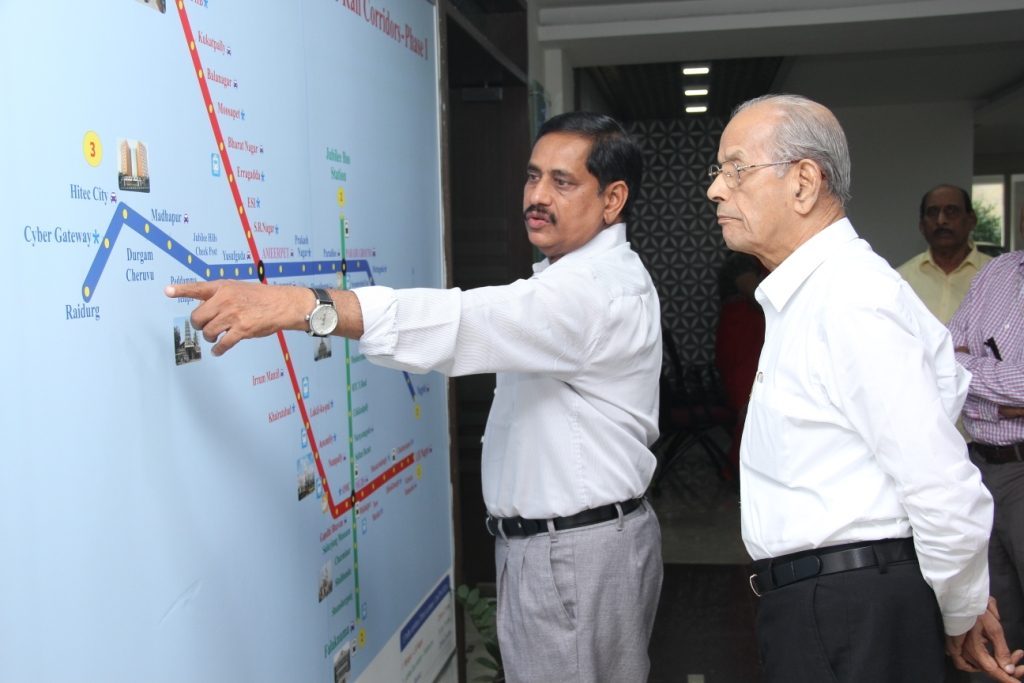
HMRL MD Mr.NVS Reddy inspecting the world class facilities at Miyapur with Serlingampally MLA Mr. Arekapudi Gandhi (Source: Facebook)
“We have considered the needs of the disabled right from the design stage itself at the ground level, entry/exits, escalators, lifts, fare gates, ticket vending machines, tiling on the platform or the signages for their convenience,” N.V.S. Reddy, HMR MD, told The Hindu.
To facilitate a barrier-free environment, the commissioned private partner L&T Metro Rail Hyderabad (L&TMRH) has fixed ramps at the road level to help wheelchairs easily manoeuver into the lifts.
Also, spacious lifts with handrails are part of the project to easily accommodate wheelchairs.
The authorities have taken special care to have a minimum gap between the train floor and platform so that wheelchair-bound passengers encounter no problems while boarding the metro.
Some of the other features include lift operating buttons with information in Braille script at all levels of the station, a tactile strip that will be fixed from the street level till the edge of the platform to aid the visually impaired navigate their way and specially designed ticket vending machines to help the speech impaired folks.
However, the best feature is the inclusion of special “grab holds” that will hold the wheelchairs steady in their designated spaces allocated in the train.
Also, all the stations will have specially assembled toilets that will assist the physically challenged with grab bars and supports. Even the automatic fare collection gates are constructed wide enough to enable easier mobility.
To cater those with partial visual impairment, cognitive disabilities and even the illiterate, special signages with images in high contrast levels will be installed to enable easy access at different areas in all stations and trains.
“Announcements would be made in three languages of English, Telugu and Urdu inside the metro rail during transit, about the arrival station, on which side of the platform the door will open and safety aspects,” added Reddy.
The Hyderabad Metro Train coaches are being supplied by Hyundai Rotem, a south Korean company.
On the occasion of the visit of French President Emmanuel Macron to Sweden, Alstom presents its electric road project at the Volvo Group headquarter in Gothenburg. This innovation contributes to cleaner mobility, and broadens Alstom’s green solutions portfolio.
In partnership with Volvo Group, Alstom participates in an Electric Road Systems project initiated by the Swedish Energy Agency, adapting its APS ground-level electrification solution currently used for trams to application for road. A demonstrator designed to power electric trucks is implemented and evaluated on a Volvo Group test track in Sweden. For this project, Alstom has provided the full electrification system, including conductive power segments built into the surface of the road. Europe (particularly Sweden, Germany, UK and France) and the US are the front-runners for the implementation of electric roads.
ALSTOM make RPS
APS is originally a dynamic feeding solution for trams, service proven in 7 networks worldwide including Bordeaux, Rio de Janeiro and Dubai, and totaling more than 30 million kilometres run. Other developments derived from APS include SRS, a system designed for the static recharge of trams and electric buses equipped with on-board energy storage. APS for road has been developed in Alstom’s sites in Vitrolles and Saint-Ouen.
“Alstom is proud to partner with Volvo Group on this innovative and green technology for electric roads. Alstom is well known in Sweden for trains and maintenance, but we are now growing in signalling and infrastructure as well”, said Rob Whyte, Managing Director of Alstom in the Nordics.
Alstom has been present in Sweden since 1999 and is one of the largest players in the Swedish railway market with more than 300 trains sold. Alstom holds several large maintenance contracts, and the work is carried out in 10 depots around the country. In Motala, Alstom has its own depot for heavy maintenance and rebuilding. Alstom is currently also delivering the new standard national traffic management system to the Swedish Transport Administration, as well as signalling solutions for Tvärbanan tramway in Stockholm.
About Alstom
As a promoter of sustainable mobility, Alstom develops and markets systems, equipment and services for the transport sector. Alstom offers a complete range of solutions (from high-speed trains to metros, tramways and e-buses), passenger solutions, customised services (maintenance, modernisation), infrastructure, signalling and digital mobility solutions.
Alstom is a world leader in integrated transport systems. The company recorded sales of €7.3 billion and booked €10.0 billion of orders in the 2016/17 fiscal year. Headquartered in France, Alstom is present in over 60 countries and employs 32,800 people.
MEGA had invited bids for the metro rail system’s rolling stock in January 2016 and received bids from four companies – Alstom, Bombardier, CRRC and Hyundai Rotem.
Out of these, only three were found to be substantially meeting the requirement of eligibility criteria.
CRRC, the fourth bidder, was disqualified on the grounds that the Chinese staterun company was not fulfilling the technical and financial eligibility criterion. The bidding process was delayed as CRRC took legal route challenging its disqualification by MEGA. According to an official statement issued by MEGA, the Gujarat High Court last week dismissed CRRC’s petition challenging its disqualification.
Hyundai Rotem will supply 32 three-car trainsets for Ahmedabad metro’s 39.259km phase 1 project. The trains will be manufactured at their Changwon plant and deliveries are expected to take place by next year,” the statement added.
The first phase will connect four corners of the Ahmedabad city with two corridors and 32 stations. While North-South corridor (18.522 km) will connect Motera Stadium to APMC, Vasna, the East-West corridor (20.737 km) will connect Vastral to Thaltej.
Ahmedabad’s new 2.90 meter wide trains will have a maximum speed of 80kmph and a carrying capacity for 782 passengers. It will be capable of running on the “driverless” unattended train operations (UTO) mode like the Delhi Metro’s new RS-10 rolling stock. Each coach will have convenient space for wheelchair users, four CCTV cameras for passenger safety, fire detectors, LED route guide indicators and a LCD passenger information display system.
With this contract, Hyundai Rotem has forayed into another Indian city after Delhi, Hyderabad, Bangalore, Jaipur and Kolkata. The South Korean company is associated with metro rail projects in these cities.






 Mahametro managing director Brijesh Dixit said that the earlier state power generation company Mahagenco was to generate solar power for Nagpur Metro. “It was costing us Rs7.50 per unit and hence we decided to go for self generation in open access captive mode,” he added. Mahametro will tie up with