Rapid Metro Gurgaon denies entry to “shabbily dressed” kids in Metro

Gurugram: On Tuesday, when it courted limelight with the chief minister officially launching its second phase in Gurgaon, Rapid Metro also found itself dragged into a controversy when it was accused of denying entry to “shabbily dressed” kids.The post was written by a commuter, Shivanya Pandey, who referred to an episode she witnessed on May 1, just a day before the inauguration, to write on Facebook that four to six poor children had been denied into IndusInd Bank Cyber City Metro station because they were dressed shabbily and sweating even though they were paying the fares. She also emailed a complaint to the National Commission for Protection of Child Rights
Rapid Metro denied doing so, saying the kids had only been turned away because they could not buy tickets. “They were politely asked to go because they did not have the money for the fare,” said a spokesperson.
“The criteria for travel in the Metro system, as per guidelines laid down by Metro Act, is for commuters to be able to furnish requisite fare either by token or valid travel card as well as comply with security guidelines. In this instance, the criteria wasn’t met.
buy kamagra gold online https://healthcoachmichelle.com/wp-content/themes/twentytwentyone/inc/en/kamagra-gold.html no prescription
Rapid Metro does not discriminate towards any citizen and our teams are trained to treat all citizen commuters with respect and dignity,” the spokesperson added.
But before that, Shivanya’s post had already elicited a strong reaction from women and child development minister Maneka Gandhi, who promised action and asked Delhi Metro managing director Mangu Singh to probe the incident.
The DMRC later clarified that Rapid Metro does not come under it. Incidentally, around 30 penurious kids travelled with the Haryana CM in the train on Tuesday during the inauguration of Phase 2. The chief minister said most of those kids had never travelled in a Metro train before.

Kochi Metro | CMRS starts inspection of Kochi Metro Rail Project

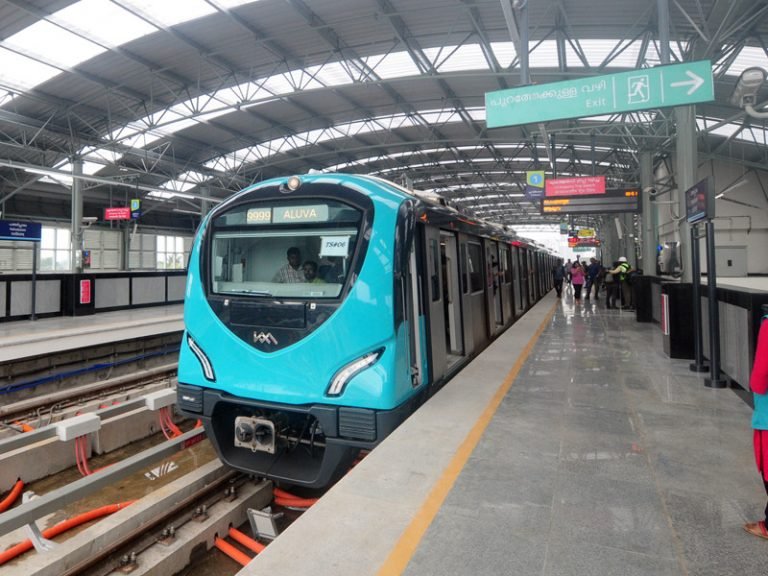
Kochi: Even as the commissioner of metro rail safety (CMRS) begins inspection of Kochi Metro Rail Project from Aluva to Palarivattom on Wednesday, the Delhi Metro Rail Corporation (DMRC) speeds up the works between Palarivattom and Maharaja’s College. A team of DMRC officials inspected the progress of the work on this stretch.
“We want to complete the work up to Maharaja’s College by September. As of the now, the track laying works are over. The traction work is in progress, and we expect to complete it by May-end. Then signalling work will have to be taken up,” said a DMRC official.
He also said that structure works of the Metro stations between Palarivattom and Maharaja’s College were over.DMRC officials said that the decision regarding awarding of various contracts for works between Maharaja’s College and Pettah was expected by May-end.Meanwhile, K A Manoharan (Bengaluru southern circle of the CMRS) and his team began inspection. KMRL managing director received the team at Aluva station. They are in the city to conduct a three-day scrutiny of Kochi Metro as part of the procedures before the commissioning of Metro train operations.KMRL said that they were ready with the safety reports issued by various agencies and all required documents for CMRS inspection.“Our senior officials explained the details to CMRS and his team. On the first day, the officials inspected the Metro viaduct, track and stations from Aluva to Muttom. This included stations at Aluva, Pulinchuvadu, Companypady, Ambattukavu and Muttom,” said KMRL spokesperson.
buy lexapro online https://lasernailtherapy.com/wp-content/themes/twentytwentytwo/inc/patterns/en/lexapro.html no prescription
She said that on Thursday, the team would inspect the track, viaduct and stations from Kalamassery to Edappally.
On the final day, they would check flawless operation and safety on the Edappally – Palarivattom stretch. They would also analyze the work and operation of operation control centre (OCC) and other facilities at the Muttom Yard, said the spokesperson.
 “Once the clearance of CMRS is obtained, the Kochi Metro will attain the status of being the first Metro project in the country to be commissioned within the shortest time span,” said a KMRL official. However, regarding completion of works on the Aluva-Palarivattom stretch, the DMRC said that they had completed almost all works at stations except those at Edappally and Changampuzha Park.
 “This will not be a hindrance for CMRS inspection. All the works will be over by June,” said the DMRC official adding that once they complete the works, KMRL will have to undertake remaining works such as doing interiors and exteriors of the building.
Source: TNN

Delhi Metro | High Courts slams DMRC, CISF after girl goes missing

New Delhi: Taking suo moto cognisance of a media report about a 19-year-old mute and hearing impaired woman going missing at the Adarsh Nagar Metro station, the Delhi High court slammed the Delhi Metro Rail Corporation (DMRC) and the Central Industrial Security Force (CISF) on Wednesday.
“How could a girl, who did not have a token, leave the Metro premises? What were they doing? Had they been vigilant, she would have not been lost. They should be hauled up for this,” a Bench of Justices Vipin Sanghi and Deepa Sharma stated.
Last Friday, the girl, her mother, and her sister were to get down from the Metro at the Jahangirpuri station but she couldn’t and was separated from her family. CISF sources said she was later seen coming out of the next Metro station, Adarsh Nagar, in a CCTV footage. She was seen exiting through the gates without a token but nobody stopped her because there was no guard deployed at the exit gate.”How could a girl, who did not have a token, leave the Metro premises? What were they doing? Had they been vigilant, she would have not been lost. They should be hauled up for this,” a Bench of Justices Vipin Sanghi and Deepa Sharma stated.On its part, the CISF spokesperson said the force had written to the Ministry of Home Affairs last year only, seeking permission to deploy a man at the exit gates, after two masked men robbed a station controller and stabbed him. Nothing, however, was done in this regard.“A robbery accused was seen walking out of the gate after attacking a DMRC staffer. After that, the CISF had requested the ministry to allow deployment at the AFC gates to keep a check on unauthorised entries. The ministry’s response is still awaited,” a senior CISF officer said.Meanwhile, the Delhi Police informed the court that they would constitute a Special Investigation Team (SIT) to ascertain the whereabouts of the girl and will expand their search to neighbouring states of Haryana, Uttar Pradesh, and Rajasthan. The cops also said that they would conduct searches at red-light areas.Appearing for the Delhi Police, counsel Rahul Mehra said there were chances that the girl was kidnapped. He said they were going to release her photo on social media and put it on auto-rickshaws.The court then directed the Delhi police to release pictures on social media in all the missing cases without fail. “The use of technology can be done to circulate photos It should be done in all cases,” the Bench said.

Lucknow Metro | Addl Secretary MoUD visits Lucknow Metro Rail Project

Lucknow: Shri Durga Shanker Mishra, Additional Secretary, Ministry of Urban Development (MoUD) today visited the Lucknow Metro Rail Project.He was accompanied by Mr. Kumar Keshav, Managing Director, Lucknow Metro and other senior officials of Lucknow Metro Rail Corporation (LMRC).The Additional Secretary first visited the Transport Nagar Metro station and oversaw the concourse, platform, Automatic Fare Collection (AFC) entry/exit gate, lift, escalator, Ticket Operating Machine (TOM), customer care, signage, facilities for the differently-abled and other passenger related focus areas in view of the start of commercial run of Metro services for the public.Shri Kumar Keshav, Managing Director briefed him about the role and responsibilities of the Station Controllers cum Train Operators (SCs/TOs)who would manage the stations and run the Metro trains. He also explained him how the Customer Relation Assistants (CRAs) will help out Metro commuters during their journey in the Metro system.Later, Shri Mishra also visited the Krishna Nagar Metro station. He appreciated the art work that has been done at the station and was happy and satisfied with the progress & work of the Lucknow Metro Rail Project.

Bombardier Sifang Transportation bags contract to build 40 high speed coaches to China

Berlin: Rail technology leader Bombardier Transportation announced today that its Chinese joint venture, Bombardier Sifang (Qingdao) Transportation Ltd. (BST), has been awarded another contract from China Railway Corp. (CRC) to supply 40 CRH1A-A new generation high speed train cars to the Nanning Railway Bureau. The new trains will become part of the ongoing integration of Guangxi’s regional high-speed railways into the national high-speed network.This new contract for five 8-car trainsets is valued at approximately 543 million Chinese RMBs (73 million euro, $79 million US) and follows a separate contract  for 144 high speed carsannounced by the JV in early March. Bombardier owns 50% of the shares in BST, and the JV is controlled by BT’s partner CRRC Sifang Co., Ltd. This latest contract is the fourteenth high speed train order that BST has been awarded since 2004.
buy orlistat online https://gilbertroaddental.com/wp-content/themes/twentyseventeen/inc/en/orlistat.html no prescription
“Our cutting edge rail technology is one of the driving forces behind the rapid development of China’s advanced high speed train network. We have already provided over 3,000 high speed train cars to the Chinese market and this latest contract is further proof of our ability to consistently leverage our expertise and experience to contribute to the development of local and national economies in regions like Guangxi.”, Jianwei Zhang, President of Bombardier China, said.
Guangxi occupies an important hub of tourism, trade and is an important link with the Association of Southeast Asian Nations. These high speed trains will help integrate Guangxi into the national network, connecting the region to neighboring cities and boosting the local economy while improving the passenger’s travel experience.The CRH1A-A train has an operational speed of 250km/h and its aluminium carbody’s design delivers improved performance and lower operating costs by reducing weight, track wear and aerodynamic drag. The train also has a unique appearance due to its innovative graphics, windows, lighting and shape, while its exceptional energy efficiency sets new industry standards for sustainable transportation and passenger comfort.The trainsets are manufactured at Bombardier Sifang (Qingdao) Transportation production facilities in Qingdao, China and feature the highly efficient BOMBARDIER MITRAC propulsion and control system, supplied by a separate Bombardier Chinese joint venture, Bombardier CPC Propulsion System Co., Ltd. (BCP).Bombardier Transportation in China is the full solution provider across the entire value chain. From vehicles and propulsion to services and design, Bombardier Transportation in China has six joint ventures, seven wholly foreign-owned enterprises, and more than 6,000 employees. Together, the joint ventures have delivered more than 3,500 railway passenger cars, 580 electric locomotives and over 2,000 metro cars to China’s growing urban mass transit markets. Bombardier also provides propulsion equipment to third party metro car builders for use in 21 Chinese cities. As a proven global full services provider, Bombardier’s joint ventures have also won orders in China to provide maintenance for 1,160 metro cars.Source: BT Press Release

Chennai Metro | CMRL calls for tender to build North Chennai metro line

Chennai: Chennai Metro Rail Limited (CMRL) has called for tenders to build elevated viaducts for standard gauge twin tracks for a 6km stretch, that would connect a part of North Chennai. A part of the phase-1 of the metro rail project, the route will have six elevated stations.Chennai Metro Rail has split the six stations into two groups for the work and has invited two tenders for each group. Tondiarpet, Toll Gate and Thangal are grouped together, while Gowri Ashram, Tiruvottiyur and Wimco Nagar will form the other group. The extension project, aimed at connecting far flung areas of North Chennai with the rest of the city, is planned for completion by 2019.Out of the total 9km line, trains will run underground in a 3km stretch from Washermenpet to Korukkupet. It will be an elevated line for the rest 6km from Toll Gate up to Wimco Nagar.

Lucknow Metro | DG Provincial Armed Constabulary of state visits Lucknow Metro

Lucknow: Shri Javeed Ahmad, Director General (DG), Provincial Armed Constabulary (PAC), Uttar Pradesh today inspected the redevelopment work of the 32, PAC Battalion campus and also visited the Transport Nagar Metro Depot.Accompanied by Shri Kumar Keshav, Managing Director, Lucknow Metro Rail Corporation (LMRC), Shri Ahmad inspected the construction of the residential quarters and the work of the non- residential buildings being carried out by Lucknow Metro at the 32nd PAC Battalion Campus near Transport Nagar. Lucknow Metro Rail Corporation (LMRC) is presently constructing 16 buildings in 30 acres of land in the campus of the PAC and is redeveloping it for 32 PAC Battalion.
buy vigora online https://gilbertroaddental.com/wp-content/themes/twentyseventeen/inc/en/vigora.html no prescription
The Director General also visited the Transport Nagar Metro Depot where he oversaw the state-of-the-art Metro facilities at the Depot. Shri Kumar Keshav, Managing Director explained him the uniqueness and characteristics of this World Class ‘Green’ Depot that has the facilities of Workshop cum Inspection Bay Lines, Stabling Lines, Depot Control Centre (DCC), Operations Control Centre (OCC), Receiving Sub –Station (RSS), Security Control Room  etc.

Delhi Metro | DMRC celebrates its 23rd Foundation day

New Delhi: The Delhi Metro Rail Corporation (DMRC) today celebrated its 23rd Foundation Day with the annual Managing Director’s awards being presented to deserving employees for their outstanding contribution to the Delhi Metro.Hon’ble Lieutenant Governor of Delhi, Sh. Anil Baijal presented the awards in the presence of DMRC’s Managing Director, Dr. Mangu Singh and other senior officials.
“Delhi Metro has achieved quite a few firsts in the country if not in the world. Project management has been of very high standard. Delhi Metro has shown to the rest of the construction agencies in the country, how to carry out project construction in highly congested areas.”, Sh. Baijal appreciated the performance of Delhi Metro and said.
Dr. Mangu Singh highlighted the various initiatives taken by Delhi Metro in the past year and said, “Last year has been a very satisfactory year as far as operations is concerned. We are transporting about 28 lakh passengers with the help of about 3,100 train trips maintaining a punctuality of 99.97 percent.”“We are a member of the prestigious COMET organisation, which is an association of the world’s big Metros. Every year, we compare the performance of the Metros. Benchmarking is done for all Metros. Every year we are featuring among the top three or four Metros in all respects,” Dr. Singh added.The Chandni Chowk Metro station was adjudged the ‘Best Metro Station’ and Sh. Shrikant, Head Station Controller, Rajiv Chowk received the Metro Person of the year award. The Metro Women of the Year Award, was given to Kumari Tara, Station Controller/Train Operator, Yamuna Bank Crew Control.Besides them, 44 more employees from various departments were awarded for their meritorious performance. An employee from the Central Industrial Security Force (CISF) was also awarded for his contribution towards maintaining security in DMRC.On the occasion, Sh. Baijal dedicated a 1.1 MWp solar power generation facility of DMRC to the nation.
buy filitra professional online https://pavg.net/wp-content/themes/twentytwentyone/inc/en/filitra-professional.html no prescription
The capacity is spread over different locations within the Metro premises such as RCC roofs, workshop sheds and parking areas at various Metro stations. With this addition, DMRC now has a total commissioned solar power generation capacity of 17 MWp, which is 27.5 percent of the total installed capacity of Delhi region. A book on the solar journey of Delhi Metro was also unveiled to commemorate the event.

Ghaziabad Metro | GDA to complete metro rail project in city on time

Ghaziabad: The Ghaziabad Development Authority (GDA) is poised to speed up the Ghaziabad Metro project with the old funding pattern in the stipulated time, new GDA Vice Chairperson Kanchan Verma has said.After presenting the GDA report before the government, the GDA Vice Chairperson sounded enthusiastic as she told IANS that “No project would be allowed to suffer for want of funds. The Metro and elevated road are our prestigious projects. These project would enhance the image of Ghaziabad on the world map.”She said the projects would be completed within a stipulated time. “Just connecting UP Gate within 20 minutes from Raj Nagar Extension would attract home buyers in this hub after this road is completed where over 20,000 homes are almost ready to move into, and from where office goers can commute to their offices in any part of Delhi and Noida from here.”“So how can we allow his project to suffer?” the new Vice Chairperson added.The officer said once the Metro project is completed Delhi University would be only 15 minutes from this city and “Ghaziabad students would be able to compete with Delhi students in Delhi University examinations. Delhi University would be the next destination of the young generation of Ghaziabad as after the Metro project is operational Delhi University would be the favourite destination for students since this line goes to Delhi University directly. How could we would allow this project to be jeopardized?
buy orlistat online https://www.parkviewortho.com/wp-content/languages/new/prescription/orlistat.html no prescription
”.“No way!” said the officer. “This project would be a reality shortly.”“Our priority is to complete our ongoing Delhi Metro Rail Corporation (DMRC) project from Dilshad Garden to the new bus stand in Ghaziabad. Our second priority is to complete the elevated road from UP Gate to Raj Nagar Extension because huge financial stakes are involved in these projects to boost Ghaziabad’s image. On the DMRC projects we have presented our case before the government that the funding pattern approved by the state cabinet has yet not been complied with by the participant departments – UPSIDC, Avas Vikas and Municipal Corporation. Government is committed to enforce the decision taken by the state cabinet.”“The government would approved our pending revised DPR (Detailed Project Report) in its cabinet meeting so that the funds would not remain a constraint in paying DMRC bills. We are sure we would overcome these problems since the government seems positive to solve these hassles,” she added.“Once our wheel comes on track, we would be able to overcome the financial troubles since we have the ample properties. According to a rough estimate we have properties for sale worth over Rs 2,200 crore in Koyal Enclave and in Madhuban Bapudham. We can generate Rs 150 to 200 crore by selling our properties to weaker sections as a survey report is reaching us by DUDA and other agencies. So our future is secure but our concern is to speed up undergoing projects of Delhi Metro Rail Corporation (DMRC) and elevated road connecting Raj Nagar Extension to UP gate which I hope would be completed within a stipulated time,” added Verma.Source: IANS

Exclusive Media Interview with Tilak Raj Seth, VP-Siemens India

New Delhi: At a time when Indian railways is in a transformational phase through the introduction of high-speed trains, rapid electrification, doubling and the introduction of metro in multiple cities, Tilak Raj Seth, Executive Vice-President of Siemens Ltd in India speaks to Media about the future of the sector in India. He also shares the German conglomerate’s growth road-map in the country, covering various segments like electrification, automation and digitization.
  • Once the Rail Development Authority is in place, do you think there will be greater clarity as far as pricing and infrastructural projects of Indian railways are concerned?
We know that rail development authority will certainly contribute to easing some of the pressure that the rail sector has, and one such pressure point is that railways have a dual role of commercial enterprise as well as social responsibility. In this dual role, sometimes, one has to make compromises. When the railway development authority is in place, railways will also be a little bit de-stressed.
In fact, on March-end, railways’ revenue earnings were more as compared to the previous year, which was possible because of the discount scheme. The dynamic pricing, discounting helped to increase freight beyond one billion tonnes and also higher passenger revenue. Overall, the total revenue was more than the previous year. So, market prudence helps.
  • Over a few years, semi-high speed has been the focus. From your point of view, with the current infrastructure, how realistic will it be for a country like India that has very old tracks and bridges to think about a semi-high-speed route?
First of all we should understand that when the rail infrastructure was getting created the world over, it was also getting created in India at the same time. We did not lag behind in terms of the beginning of the rail infrastructure. Where, we have lagged is, over the last 5-7 decades over a country like China. China, in 1950, had 22,000 kilometres and today, they have 1,21,000 kilometres. Whereas India, in 1950, had 54,000 kilometres of rail network and in 2015, we had 66,030 kilometres. You see how much we added. Today if we are nearly 67,000-plus kilometres, it is not a small number. So, whatever we want to do, we must utilise this infrastructure. Of course, this infrastructure can’t always be used for high speed, but certainly semi-high speed. Another item that we say of course, that your high-speed corridors, your semi-high speed, the operation must be inter-operable. That means the network must be inter-operable. Very, very high-speed train should be able to pass through existing infrastructure, at naturally lower speeds but at the order of the semi-high speed.
  • Coming to the Siemens mobility business, as far as Indian market is concerned, what are your expectations?
We operate in all the elements of mobility and transport business now and one of them is mainline. We are everywhere in terms of propulsion equipment for locomotives, EMUs, mainline signalling, electronic interlocking, electrification components and we are very happy that Indian Railways is regularly upgrading and strengthening its network, and its rolling stock. Railways also has ambitious plans of adding more EMUs: the Kanchrapara project, and the DFCC (Dedicated Freight Corridor Corporation). So that’s the main line. Regarding the metros, again, we are present in everywhere. We recently got an award for the signalling and electrification of Nagpur Metro, and we are practically there in every major city. We are doing 50 per cent of Delhi Phase III, Calcutta, Chennai, Greater Noida and of course we are participating in the next bid phase of various other projects. We are also doing signalling for, as mentioned Nagpur, but also for Chennai and also one of the lines in Delhi.
  • India has a huge potential of Rs 8.5 lakh crore investment coming in. What are your investment plans for the country?
We are regularly investing because there are 23 factories. I don’t think that there are many people who can claim 23 factories. We are continuously investing and expanding our footprint as required in the marketplace.
  • You compared India to China. You were involved in the Maglev Project in China. What is your take on Maglev technology set to be introduced in India?
The Maglev technology belongs to Trans Rapid, which is a company owned by the Siemens-ThyssenKrupp group. We feel that the speed of 350 km per hour (kmph) can be managed best by rail wheel high-speed (conventional) since greater speed does not give any time advantage for rail-wheel. For, higher speed one can turn to the aviation industry. We feel that 350 kmph is the limit. While we know that the Maglev can go beyond 350 kmph, it can never reach the speed achieved by aviation. To have a speed of 400-500 kmph doesn’t really make any sense.

Gurgaon Metro | CM Khattar to inaugurate Gurgaon Sec 55-56 station on May 2

Chandigarh (PTI) : A group of slum children from Gurgaon will share a ride in Rapid Metro Rail with Haryana Chief Minister Manohar Lal Khattar tomorrow.
buy cialis black online https://myhst.com/wp-content/themes/twentytwentytwo/inc/patterns/en/cialis-black.html no prescription
Jyoti Bainda, Chairperson, Haryana State Commission for Protection of Child Rights (HSPCR), said today the Commission has arranged the metro ride for 30 slum children with the chief minister.She said it would be the first ever ride of the slum children on a train.The Rapid Metro Rail project will be inaugurated by Khattar at Rapid Metro Station, Sector 55-56, Gurgaon tomorrow.“The chief minister will also interact with women village heads (sarpanch), who will also be travelling with him on the metro. He would discuss issues regarding strengthening of Panchayati Raj institutions and take feedback from them,” said an official release.

Nagpur Metro | NMRC to introduce common mobility card for Metro & Buses

Nagpur: Here is the silver lining for the daily commuters relying on public transportation in Nagpur. Come November, when Nagpur Metro rail is expected to chug off its first phase, there will be a common mobility card, by possessing which, you can hop on to city buses and metro trains without buying separate tickets.The Maharashtra Metro has tied up with SBI for the mobility card. It is based on an open loop system, which basically means that the card can be used for various purposes, including shopping.The concept of common mobility card was however initially designed for Mumbai but Nagpur is fortunate to have it first. However, since 2004, successive state governments have been promising that they would incorporate a system for seamless travel whereby commuters in the city don’t have to face the hassle of standing in ticket queues for a bus or rail ride. All you need is a smart card.However, Mumbai simply has not been able to have a smart a mobility card because the different state government agencies haven’t been able to figure out the cost-sharing formula, as to who would bear the cost of creating the infrastructure for the smart mobility card. Government officials were not sure which undertaking –the Railways, BEST, the monorail run by MMRDA, or the Metro-would pick up the tab for introducing the mobility card. The Nagpur Metro has now solved the puzzle. The estimated cost of putting up kiosks, swiping machines in buses, Metro would have cost Rs 180 crore.Last week, SBI bagged a tender from the Nagpur Metro and it would be spending the entire Rs 180 crore on the infrastructure for the common mobility card. What’s more, the bank would also give a royalty of Rs 30 crore over the 5 years to the Nagpur Metro.In return, SBI was given exclusive rights in all Metro stations besides getting the mandate to handle the entire cash transactions of the Metro. All the cash earnings from different Metro stations would be deposited in an account with the SBI.Mantralaya babus are now looking at the Nagpur common mobility card with great interest as they finally believe that the system can be introduced in Mumbai. “What we have done in Nagpur has the potential to be replicated not just in Mumbai but elsewhere in other cities in Maharashtra too,” said Brijesh Dixit, managing director of the Maharashtra Metro.Ramnath Subramaniam, executive director (strategic planning) for Maharashtra Metro, said that the USP of the mobility card was that it could also be used for shopping.He said, “A lot of banks had shown interest in this unique model since the winning consortium will get a fixed share per transaction for both fare and non-fare as also the huge intangible benefits that could accrue to the bank. In the end, SBI won the bid.”Source: Nagpur Today

Delhi Metro | DMRC to build residential flats in Delhi to sale public

New Delhi: The Delhi Metro Rail Corporation (DMRC) is all set to venture into the residential real estate market and will soon put up over 500 flats, in the Rs 60 lakh to Rs 1 crore range, for sale.A senior Delhi Metro Rail Corporation (DMRC) official said the Delhi Metro has initiated the process on this front and people will be able to book a flat, which will come up in Janakpuri and Okhla area, in a month or two.Around 460 flats would be built in Janakpuri while 90 in Okhla, tentatively within two years.
Plots have been identified, however, construction work has not yet started. Delhi Metro will soon make a formal announcement of the project.
The official said DMRC will follow the model of Delhi Development Authority (DDA) in selling the apartments, which essentially means allotment will be done through a lottery.Fifteen per cent of the flats, which will be a mix of 2-BHK and 3-BHK, would be reserved for the economically weaker section, metro said, adding that the brochures are likely to be out within a month.This will be the metros maiden foray into the residential real estate market. It is already into property development and also has a number of staff quarters.Source: PTI

Lucknow Metro | LMRC commissions automatic train wash plant successfully

Lucknow: The Lucknow Metro Rail Corporation (LMRC) today successfully commissioned the Automatic Train Wash Plant that has been built at the Transport Nagar Metro Depot. This helps metro trains entering or exiting the Depot to be cleaned automatically at the ramp using remote control from the Operation Control Centre located inside the Depot.The washing plant has rotating plastic brush to clean the side wall of train. The trains are first wet using recycled water and are then scrubbed automatically by the rotating brushes with soap water and are subsequently cleaned by raw water and finally rinsed with RO water. After wet cleaning of the train, air blowers are provided to dry the train surfaces.
buy vibramycin online www.mobleymd.com/wp-content/languages/new/vibramycin.html no prescription
It is planned in such a manner that the trains can be washed once in three day.The plant operation starts automatically by sensing the train speed. The minimum washing capacity of plant is 25 numbers of trains per day which can be increased based on future requirements.The plant is equipped with air blower facility also to clean the dust of underframe area of train. To maintain the quality of train surface, the hardness of water is removed prior to washing and soft RO water is used for washing. To avoid excessive use of water, it is recycled for reuse. Trains are moved at a slow speed of 3-5 kmph to ensure proper cleaning. Special wash mode is provided in train to maintain the requisite speed of train also to ensure proper cleaning.