Delhi Metro | DMRC starts test runs on Pink Line between I.P. Extension and Maujpur

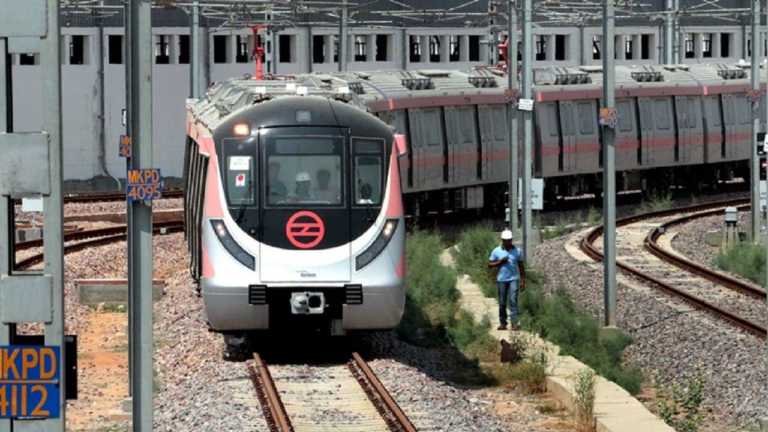
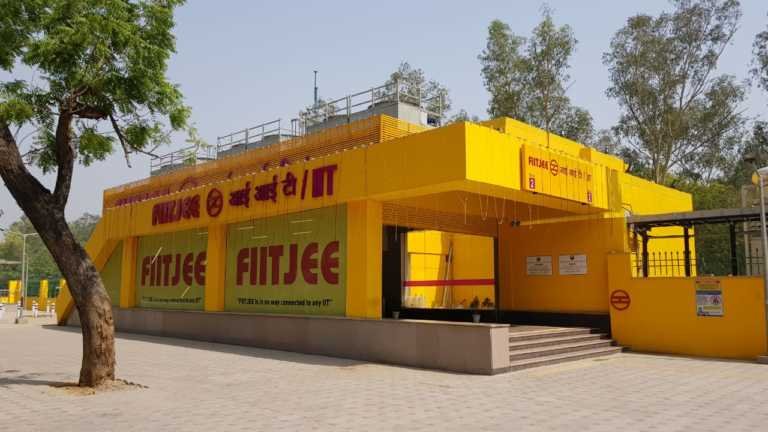
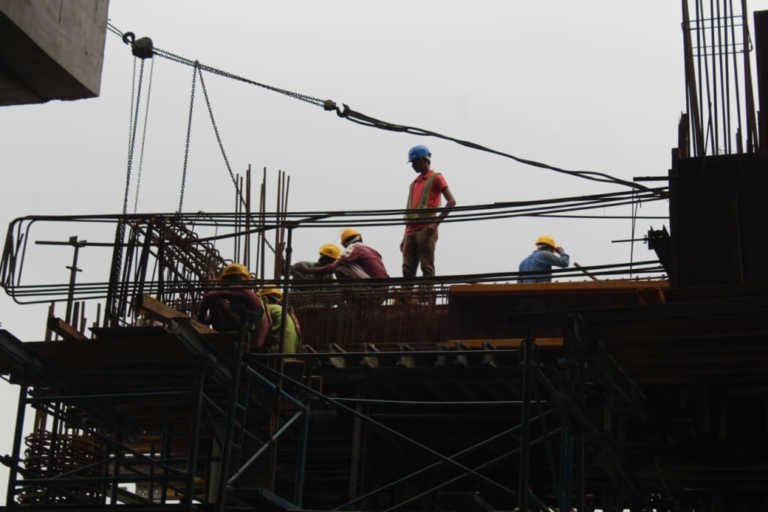
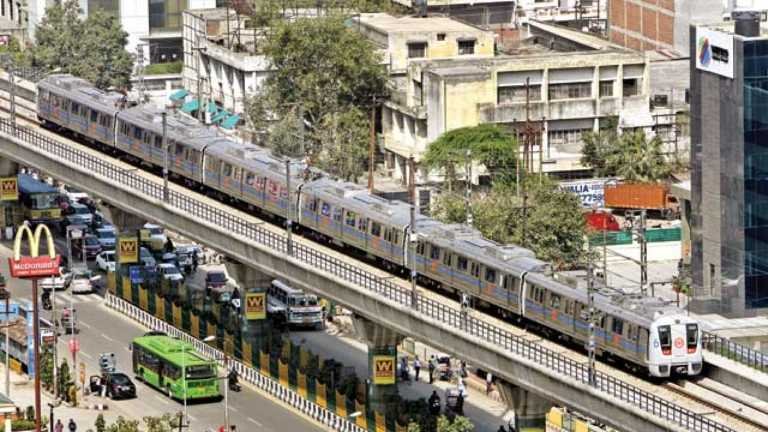
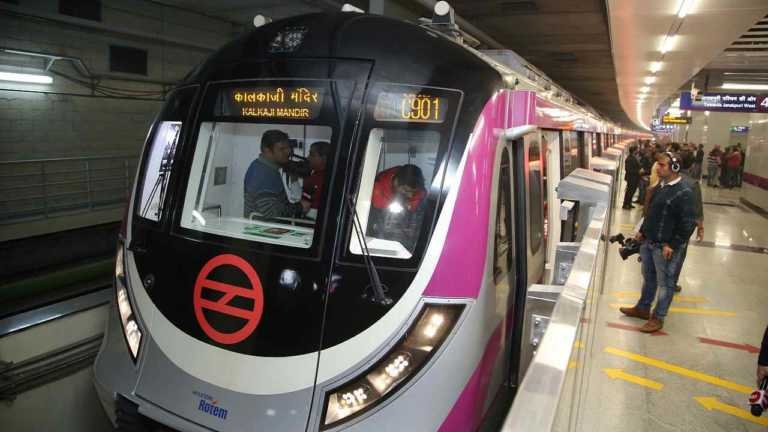
New Delhi: The Delhi Metro Rail Corporation (DMRC) today started test runs on the 10.47 kms stretch between the I.P. Extension and Maujpur elevated section of the upcoming 59 kms long Majlis Park – Shiv Vihar corridor (Line 7) of Phase-III, also known as the Pink Line. The Test Runs were flagged off by DMRC Chief Mangu Singh.According to press release, during these test runs, the interface of the Metro train will be checked to ensure that there is no physical infringement with civil infrastructure during the movement of the train on the track and also testing of various subsystems of coaches shall be done.The new signaling technology known as Communication Based Train Control (CBTC) will be implemented on this corridor and will undergo rigorous testing in stages. The response of the train at different speeds, braking of the train and the interconnection with the Operations Control Centre (OCC) will also be monitored during the trials. The behavior of the track system and the Over Head Electrification (OHE) will be checked repeatedly.This section from I.P. Extension to Maujpur consists of 09 elevated stations viz. I.P. Extension, Anand Vihar, Karkardooma, Karkardooma Court, Krishna Nagar, East Azad Nagar, Welcome, Jaffrabad and Maujpur Station.The trains for this section have already arrived and are stabled at Vinod Nagar Depot. This depot is equipped with 4 inspection bay lines, 2 workshop lines. Total 32 trains can be stabled in this depot. To minimize the occupation of land, this depot is constructed with a double deck system, in which the stabling yard has been created on both decks.This section has three interchange stations at Anand Vihar, Karkardooma and Welcome. The facility of interchange of Metro trains between line7 & line 3/4 is available at Anand Vihar and at Karkarduma Station and between line 7 & line 1 at Welcome Station. The Maujpur Station is a four (4) track station having provision of connection from Maujpur to Mukundpur, a corridor proposed in Phase-IV of Delhi Metro project.Special Spans and Sharp CurvesThis section between I.P Extension and Maujpur consists of 5 Special Spans including 2 Steel Spans over existing DMRC Red line(Line 1) and Northern Railway track between Welcome & Shahdara.Cantilever Construction (CLC) Spans of lengths total 255 mtr over Anand Vihar Railway Yard and Main line tracks were constructed over running track with 25 KVA OHE System.Due to uneven twist and turns in this alignment, Delhi Metro had to construct as many as 10 curves on this stretch that passes through very congested areas like  I.P. Extension, Anand Vihar, Welcome, Seelampur, Jaffrabad and Maujpur.Curves of less than 300 meters of radius are considered “Sharp Curves” in Urban Rail Construction. The work of building sharp curves requires great deal of engineering skills and several factors have to be kept in mind while designing special segments/spans at the concerned turn/juncture. DMRC had to form especially dedicated beds in its casting yard for casting of special segments. The segments were constructed according to the already defined ”radius of curvature” and then put on the viaduct.Cantilever piers and portals were constructed at appropriate places to provide smooth transition for the curves, wherever required to take care of the shifted alignment due to curvature.Earlier DMRC had constructed sharpest broad gauge curve on its elevated section in Gurgaon near IFFCO Chowk with at radius of 282.05 meters in Phase II and 242 meters curve on standard gauge between Okhla and Jamia in Phase III.As part of Delhi Metro’s one of the most challenging corridors of Phase 3, the construction of this section had to be completed by managing heavy traffic at various points on the Patparganj, Anand Vihar, Welcome, Jaffrabad and Maujpur.The construction in running drain, land acquisition at Patparganj, Anand Vihar, Welcome, Jaffrabad and Maujpur also posed a bottleneck during construction.Major utility diversions like shifting of water pipelines at Jaffrabad were avoided by re-aligning of station foundations. Electrical installations were shifted for the construction of Anand Vihar ISBT station.

Union Budget 2018: Center allocates Rs 7,000 crore for high speed bullet train project

New Delhi: The Mumbai-Ahmedabad bullet train project has got a Rs 7000-crore boost, showed Budget documents released on Tuesday. The Finance ministry has set aside the amount for the high-speed corridor, which until now had remained only on paper. The estimated cost of the project is Rs 1 lakh crore.The 508-km-long corridor being implemented by the High Speed Rail Corporation Limited. Last year there was no allocation made in the budget. The Bullet train is expected to cut travel time between the two cities from seven hours to close to three hours. It will run at speeds of 350 kmph with an average speed of 320 kmph. It will stop at 12 railway stations on the route.In September last year, India and Japan signed a memorandum of understanding for this big-ticket project for which Japan will lend nearly nearly Rs 88,000 crore at 0.1 per cent interest.The train will begin from Bandra Kurla Complex where it is expected to be closely connected with the metro rail having its route there. It will have a 21-km-long tunnel between Boisar and BKC, of which seven km will be underwater.The railways will require around 825 hectares of land for the project as 92 percent of the route will be elevated, six percent would go through tunnels and only the remaining two percent would be on the ground.The railways would run about around 35 bullet trains when it starts operation with about 70 trips per day. Initially, the train would have 10 coaches with a total seating capacity of 750 passengers. The train would require a cleaning time of four hours, after running for 20 hours. The government wants to start the services of the Mumbai-Ahmedabad High Speed Rail Network by August 15, 2022 to mark India’s 75th year of Independence.

Noida Metro | NMRC extends train trial run to Alpha-II metro station

Noida: The Noida Metro Rail Corporation (NMRC) extended metro train trial run from depot station to Alpha-II station from Friday.One month after the first test run of the Aqua metro line on the Noida-Greater Noida corridor, another test was held on Friday, this time the train travelling till Alpha-II station from the depot metro station.Noida Metro TrainThe four-coach test train covered nearly 2.5km at a speed of 35 km per hour during the ‘internal’ trial. It was the first time that the train has been tested outside the depot yard, where trials were being conducted since January 2.“On Friday afternoon, the train travelled from the depot (yard) and crossed three stations including depot station, Delta-I station and Alpha-II station before it returned to the depot. All went well with the extended trial. In the next few days, we will be ready to take the train further along the track,” said P. D Upadhyay, General Manager (Finance).According to NMRC official, once they receive complete power supply for the trial run, they will take the trial up to Sector 149 in Noida. Presently they are using an alternative source of power supply from the depot. This temporary 30 megawatt power is being provided by discom, RC Green. Once they have full power from the sub-station located at Sector 148, “oscillation trial” will be undertaken from February 15.

Middle East Rail returns for the 12th edition with a boom in repeat exhibitors

Dubai, UAE – Middle East Rail, the largest railway industry event across the Middle East, North Africa, South and Central Asian region, will take place on March 12th and 13th at Dubai International Convention Centre.

The show will be held under the patronage of His Highness Sheikh Mansour Bin Zayed Al Nahyan, Deputy Prime Minister, Minister of Presidential Affairs, UAE and in partnership with the Ministry of Infrastructure Development and the Federal Transport Authority – Land & Maritime.

Middle East Rail recorded 64% repeat exhibitor bookings for 2018 edition, bringing over 290 regional and international railway operators, suppliers and contractors to present their services to potential buyers and nurture professional networks.

Etihad Rail, X Rail, Greenbrier, Virgin Hyperloop, CAF, AECOM, Progress Rail, Department for International Trade, UK, are back in full force to showcase their plans for future railway systems.

Commenting, H.E. Dr. Abdulla Belhaif Al Nuaimi, Minister of Infrastructure Development and Chairman, Federal Transport Authority – Land & Maritime, UAE said: “Middle East Rail continues to attract global innovators, decision makers and industry influencers, which clearly demonstrates the show is an unmissable annual gathering to analyse the visions, technologies and partnerships needed to develop efficient railway operations. We are proud to play a leading role in providing a platform to the industry to identify problems, propose solutions, promote collaboration, develop and harness innovative technology in transportation infrastructure. This will also help us build regional railway networks on a par with the highest standards of quality, safety, and efficiency.”

Keeping up with the industry trends and to accommodate increased interest, the show has expanded in scope for the 2018 edition. The organising committee has introduced two new streams that will feature Passenger Information Systems and Transport Ticketing Systems that cater for the needs of modern passengers.

A series of interactive sessions have been designed to introduce technological disruptions and provide updates on rail contracts worth $16 billion planned to be awarded in 2018 in the MENA region – according to MEED Rail Report 2018.

Jamie Hosie, General Manager, Terrapinn Middle East, organiser of the show, said: “The railway supply market in the Middle East and North Africa region is expected to grow at over 3% annually for the next four years on the back of several big-ticket projects in pipeline. The UAE has the second largest transport pipeline in the Middle East, with 15 ongoing and upcoming railway projects worth $13.9 billion as of November 2017.The regional governments are pressing ahead with their domestic rail projects and stalled projects are going to regain momentum. Middle East Rail is the place to be to learn, network and discover new business opportunities.”

Industry experts from Europe, India, Middle East and Asia will share insights on privatisation, digitalization, modernisation and pioneering the future of Mobility 4.0. throughout two days of keynotes, open discussions and research sharing sessions.

An august roster of informative keynote speakers include: H.E. Dr. Abdulla Belhaif Al Nuaimi, Minister of Infrastructure Development, Chairman, Federal Transport Authority – Land & Maritime, UAE; H.E. Julio Gomez-Pomar, Secretary of State, Ministry or Infrastructure, Transport and Housing, Spain; Rolf Hardi, Chief Technology Officer, Deutsche Bahn, Germany, Henrik Holoei, Director General, European Commission, Belgium; AlWalid AlEkrish, VP – Programs & Projects, Arriyadh Development Authority, Saudi Arabia & Ahmed Jasem al Mansoori, Acting CEO at Etihad Rail, UAE.

Chennai Metro | State Industries Minister M. C. Sampath visits underground construction sites

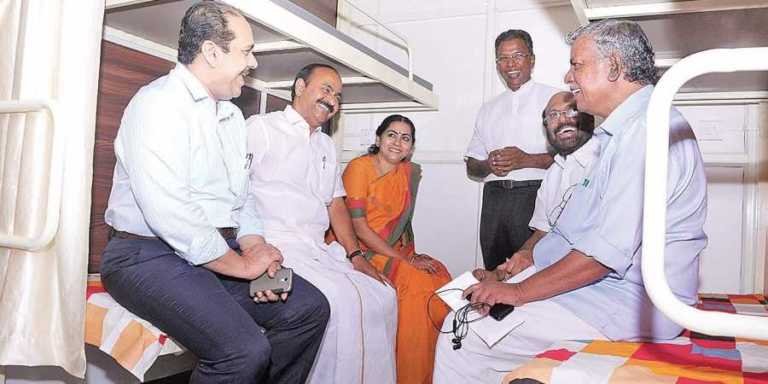
Chennai: The government of Tamil Nadu has urged the management of Chennai Metro Rail Limited (CMRL) to streamline its work in the city and complete it as soon as possible, and thus ensure that commuting is easy for the public.The Minister of State Industries, M. C. Sampath, asked the managing director of CMRL, Pankaj Kumar Bansal, to complete the works from Nehru Park to Central and from Saidapet to AG-DMS shortly. The minister, who recently visited the underground sites of the CMRL and inspected the work, expressed his satisfaction with the progress of the work and wanted the passenger services on the routes to begin soon.The stations between AG-DMK and Saidapet are receiving final touches particularly at the point of entry or exit, said the official.CMRL is planning to start the test on the Anna Salai line this week, the sources said.It is likely that the Metro Rail Safety commissioner will be invited for inspection in March.Currently, Chennai Metro Rail Limited is operating services on two routes in the city: Nehru Park to the airport and Little Mount to the airport. The first test between Nehru Park and Central Chennai covering a distance of 2.7 km was carried out on January 26. The first train was canceled in 2015 by then chief Minister J. Jayalaltihaa.According to sources, Chennai Metro Rail Limited is likely to sign a loan agreement with JICA for the phase II project and the sum is likely to be greater than the financing of the first project.JICA had financed the phase I project for approximately Rs 14,600 crore. It is likely that the CMRL will sign an agreement with JICA once the Center agrees.

Bangalore Metro | BEML to deliver 3 more metro coaches to BMRC on this Valentine day

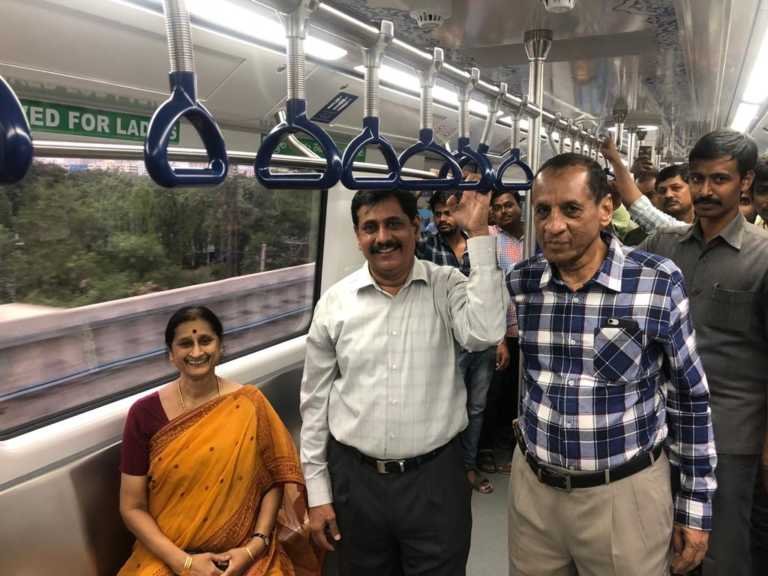
Bengaluru: It is good news for Namma Metro commuters that the much-awaited additional coaches for Bangalore Metro trains have almost arrived. The Bharat Earth Movers Limited (BEML) is likely to deliver the first set (three coaches) to Bangalore Metro Rail Corporation (BMRC) on February 14.“BEML will hand over the first three coaches to BMRCL on 14 February in the presence of Bengaluru development minister K J George. We will have to integrate the new coaches into an existing train and conduct test runs. The first six-car train will commence operations after clearance from railway safety authorities.We are expecting these procedures will be completed at the earliest and be ready for commercial operations by March,” BMRC MD Mahendra Jain said.Namma Metro’s East-West corridor (Purple Line) will get the first Metro train with six coaches, with the first compartment reserved for women. The trial run of metro train is expected to take place at night and scheduled to be completed in a month.BMRC is also likely to operate six-car trains during peak hours. Last June, the state government and BMRCL promised three additional coaches, with one coach reserved for women for at least one or two trains, by December 2017, but the deadline was missed.Metro ridership recently touched 4.11 lakh, including 2.37 lakh on the Purple Line and 1.72 lakh on the Green Line.

Indian Railways to set up metro and rail coach factory in Maharashtra

New Delhi: Indian Railways will set up a metro and rail coach manufacturing facility in Latur in Maharashtra on public-private partnership basis. The project is likely it entail investment of more than Rs 1,500 crore, a top rail ministry official said. The official said the investment and the number of coaches the facility will make is yet to be decided.
buy penegra online https://www.facebeautyscience.com/wp-content/themes/twentyseventeen/inc/en/penegra.html no prescription
Maharashtra chief minister Devendra Fadnavis and railway minister Piyush Goyal met on Wednesday and, in-principle, approved setting up a rail coach factory in Latur, the official said. The facility will cater to the demands of metro coaches in cities across India along with the captive demand from coming from Indian Railways.This plant would manufacture Electric Multiple Units for suburban trains and coaches for metros. Work on this project will be done on high priority with fast track processing of all approvals. Maharashtra government has offered several concessions, including in land and taxes.

Lucknow Metro | LMRC gets around Rs 2,000 crore in this fiscal year

Lucknow: The Lucknow Metro Rail Corporation (LMRC) approaches its March 2019 completion date, it is expecting a large amount of money to flow from the budget this year.Finance Minister Arun Jaitley announced that the Center will help Metro projects in the state. According to last year’s Budget, it is expected that Lucknow Metro Rail Corporation will obtain around Rs 2,000 crore in this fiscal year. This could be the biggest delivery so far. The funds are crucial to make imminent payments for the ongoing civil construction of the first phase of the 23km Metro corridor from the Chaudhary Charan Singh airport to the Munshipulia junction. The deadline for this broker is March 2019.The project was approved by the Center in early 2016 and has received two sums so far- Rs.
buy tadacip online https://www.ecladent.co.uk/wp-content/themes/twentyseventeen/inc/en/tadacip.html no prescription
1,140 crore in FY2017 and Rs. 1,150 crore in FY2018.The corridor has also begun construction of the high-cost airport stretch this year. The underground construction of Charbagh to the KD Singh Babu stadium, extends over the Gomti and at the TI junction, it will also need immediate funds.

Vijayawada Metro | The Union budget did not mention Vijayawada and Visakhapatnam metro rail projects

Vijayawada: Even when Chief Minister N Chandrababu Naidu, in his meeting with Prime Minister Narendra Modi last month, called for more quickly completing the Vijayawada and Visakhapatnam metro rail projects, the Union budget did not mention the projects, to great disappointment. of the state government. With this, Amaravati Metro Rail Corporation (AMRC) is contemplating opting for Public Private Partnership (PPP), to execute the Vijayawada subway project.“Given that there has been no guarantee regarding the funding of the projects, we will examine whether we can move forward with the PPP model for the Vijayawada metro,” said NPIE MD NP Ramakrishna Reddy. The PPP model is being used for the implementation of the Visakhapatnam metro. The association with private players will help a faster execution of the project, since the officials do not need to wait for the funds of the government of the Union.While the Union government had provisionally allocated Rs 100 crore in the two previous budgets, it did not make allocations in the 2018-19 disbursement since the projects have not yet received a green signal from the Union Ministry of Finance. For the record, the state government had sent the detailed report of the project of a metro project in Vijayawada, with an estimated cost of Rs 7,200 crore, about two years ago. However, the project was rejected in March 2017 by the Public Investment Board, which said that the project was not viable from a financial point of view. He asked the state government to send a new proposal according to the metro’s new rail policy.CM Naidu, in the last quarter of 2017, decided to move forward with a light rail project. Consequently, the AMRC, in January, selected the French company Systra Group for the preparation of the Detailed Project Report (DPR). An agreement between Systra Group and AMRC will be signed next week and the DPR will be ready within six months.However, what most disappointed state officials was the fact that the budget proposed the allocation of Rs 17,000 crore for a suburban transport system in Bangalore and Rs 40,000 crore for another in Mumbai. “The government of the Union can say that we do not send any proposal now, but even when we did it before everything we got was an insignificant Rs 100 crore,” noted a senior official.What they got, but we did not do it for others-The budget proposes a disbursement of J15,000 million for several works related to the extension of the metro rail project in Delhi, Chennai, Bengaluru, Ahmedabad, Nagpur and Greater Noida.Approximately 190 km of the metro rail network is proposed to the public during 2018-1919.Delhi metro- 114 km, Chennai metro: 15.5 km, Bangalore metro: 12.80 km, Ahmedabad metro: 6.3 km, Nagpur metro: 11.7 km and Gran Noida: 29.70 km.Despite the State’s call to the Union government to complete the Vijayawada and Visakhapatnam metro rail projects more quickly, the Union Budget made no mention of these.Union Finance Minister Arun Jaitley said: The Mumbai transportation system will be expanded to add 90 km of double-lane roads at a cost of more than J11,000 crore 150 kms of additional suburban network are planned in Mumbai at a cost of more than J40,000 crore. A suburban network is being planned at a cost of J17,000 for Bangalore.

Union Budget 2018: Finance Minister announces Rs 1.48 lakh crore as railway capital expenditure

New Delhi: Despite the larger belief being that the main focus of the Union Budget 2018-19 was on the agricultural economy, the infrastructure sector remained the single largest target area for Finance Minister Arun Jaitley, who termed it the “growth driver of economy” while announcing an “all-time high allocation to rail and road sectors”. Here are the highlights of the Union Budget 2018 in view of railway projects in India:-
  • ₹1.48 lakh crore has been allocated to as railway capital expenditure for Financial Year 2018-19. Most of this money will be spent on capacity expansion, since it is a priority for the national transporter.
  • About 18,000 km of rail lines will be doubled and gauge conversion is underway to eliminate capacity constraints.
  • 36,000 km of rail track renewal has been targeted in the coming year while 4,267 unmanned railway crossings on broad gauge routes are to be eliminated in the next two years.
  • A new institute will be set up at Vadodara to train manpower for high-speed rail networks.
  • Escalators are to come up at all railway stations with footfalls exceeding 25,000, while all trains are to be progressively provided with WiFi, CCTV and other state-of-the-art amenities.
  • 600 railway stations are to be redeveloped.
While noting that almost the entire network would be shifted to broad gauge, he said electrification work was also being expanded and 4,000 km are targeted for commissioning.
Rapid Rail
Proposed High Speed Rail Transit System in India
The finance minister said work on the eastern and western dedicated freight corridors was also progressing and Railways would be procuring 12,000 wagons, 5,160 coaches and approximately 700 locomotives during 2018-19.

Delhi Metro | Delhi High Court fines DMRC Rs 5,000 for delayed reply

New Delhi: The Delhi High Court on Tuesday fined Delhi Metro Rail Corporation with Rs 5,000 for delay in submitting a reply in the service matter case filed by a metro employee Priyaranjan Raj Singh against DMRC.
Delhi High Court fines DMRC
Delhi High Court’s Order dated 30.01.2018
DHC fines DMRC 002
DHC Order sheet continue from first page.
On September 25, the court had asked DMRC to file reply to petitioner’s plea seeking action against DMRC management for allegedly initiating false and arbitrary disciplinary proceeding against him.Speaking to Metro Rail News, Petitioner Priyaranjan Raj Singh, who is working as Asstt. Section Engineer in Delhi Metro said, “I have filed two petitions in the Delhi High Court against the Delhi Metro Railway Management for big corruptions in recruitment process. I am being humiliated by the DMRC Management for this act. The corrupt officers of DMRC looting the funds being received from JICA and other International funding agency including the Government departments.”“The employees who are working honestly are being targeted by Delhi Metro management. Some of employees who highlighted the corruption issues in past were removed from service illegally. I have also filed complaint in PMO on corruption issues but they did not take action against the Delhi Metro, that’s why I have knocked the door of Hon’ble Court.”, he further added.In past about 5000 metro employees were on protest raising their voice against corruption issue in Delhi Metro Rail Corporation.

Minister SP Velumani speaks with Japan & Germany on Metro rail Project

Coimbatore: The rural and administrative minister of municipal, SP Velumani, said on Wednesday that talks had been held with the Japan International Cooperation Agency (JICA) and the German development agency Deutsche Gesellschaft fur Internationale Zusammenarbeit (GIZ) to implement the railway project of metro in the city. According to sources, the first phase of the metro rail project, whose feasibility study has not yet been carried out, is likely to start at Avinashi Road, where an overflight is also approaching.“The work on the Avinashi Road overpass and the metro rail project will be taken simultaneously and working on one will not affect the other,” Velumani said when asked how both projects would be implemented on the same stretch.The minister, who inspected the soil test work for the Avinashi Road overpass here, said the state government has allocated Rs 950 crore for the construction of overpass and sanctioned another Rs 65 lakh for the testing process of soil. “We will allocate more funds when necessary,” he added. Veumani also confirmed that the design of the Ukkadam overpass had been altered as it was impossible to carry out the works until the Athupalam crossing, where L & T received an extension to operate its toll plaza until October of this year.The plan was to finish the flyover at the Athupalam crossing. Now, it would be built only until the crossing of Karumbbukadai.“We will start the work and then we will obtain permission to extend the flyby,” he told reporters here. Wednesday that the decision of the highway department to change the design of the Ukkadam overpass and activists’ concern that the project in the current form would be useless.According to the highway officials, the bids for the project were published and will open on February 5. “The project will continue for two and a half years and we expect to receive a certificate of no objection (NOC) to extend the overpass to the Athupalam crossing before that,” said an official.Meanwhile, industrialists and city-based activists expressed concern and said the highway department should delay the project and start working only after receiving the NOC from the Union’s highway and highway ministry. “Building the overpass to Karumbukkadai and then expanding it will not help, it will be a waste of money, we will have a meeting with the highway department about it,” said one industrialist in the city.The state government has allocated Rs 121.82 crore for the construction of the four-lane overpass, which would be 1.7 km long. It has also sanctioned Rs 88.61 crore for the acquisition of land as 18,526.97 square meters of private land and 13,291.75 square meters of government land are required to be acquired for the project. The flyover would have two grade separators to join the Ukkadam junction with the Perur bypass and the Sungam bypass.

MEGA Metro looking various engineering position for Metro Rail Project

Metro Link Express for Gandhinagar and Ahmedabad (MEGA) a 50:50 Special Purpose Vehicle (SPV) under joint ownership of Government of India and Government of Gujarat looking for following engineering positions for Gandhinagar and Ahmedabad (MEGA) Metro Rail Project.
  1. General Manager /Civil – 2 Posts
  2. General Manager / Electrical – 1 Post
  3. Additional General Manager /Rolling Stock – 1 Post
  4. Sr. Deputy General Manager /Rolling Stock – 1 Post
  5. Sr. Deputy General Manager /E&M – 1 Post
  6. Deputy General Manager / AFC – 1 Post
  7. Deputy General Manager / Telecom – 1 Post
  8. Manager / Platform Screen Door – 1 Post
  9. Assistant Manager / Rolling Stock – 2 Posts
  10. Assistant Manager / Lift & Escalator – 2 Posts
  11. Assistant Manager / Telecom – 1 Post
  12. Assistant Manager / Signaling – 2 Posts
  13. Assistant Manager / Traction – 1 Post
Last date to submit application for the above post is 31-01-2018For the more detail about educational qualifications, experience, age limit etc, please visit official requirement notification of Metro Rail Corporation Ltd.

Nagpur Metro | Maha Metro proposes for acquisition of 3 mt land along existing trails

Nagpur: Maha-Metro has proposed the acquisition of three meters of land along existing trails on both sides of North Ambazari Road and Wardha Road. Revealing this Dr. Brijesh Dixit, Managing Director, Maha-Metro, said that it would allow the proper development of trails and would provide a much needed vent on the roads. Against the land acquired from private individuals, an additional space index (FSI) can be provided and we have proposed the inclusion of this proposal in the Development Transfer Policy (DdD) that, in preparation of the State Government.Further explaining his idea, Dr. Dixit said that the existing trails are unusable due to the presence of utilities and that if they can be pushed further in, then we are ready to build a single identical wall that stretches in both corridors. The paths that Maha-Metro would build would fulfill their true purpose and would have no obstruction. I was interacting with journalists on Tuesday.When elaborating the point further, he stated that if his idea works, then you would not see any bus stop on the trails, as is the case today. Instead, each bus stop would have an area of ​​the bay so there is no congestion on the roads, at least on the subway routes. Additional land would be needed closer to the two-story bridge ramp, since the existing road stretch might be insufficient to allow free movement of high-altitude vehicles.As for the next budgets, the Maha-Metro has demanded Rs 2.1 billion rupees from the Government of the Union and Rs 850 crore from the Maharashtra government for the Nagpur Metro. Similarly, for Pune Metro, the amount requested is Rs 2,050 crore and Rs 850 crore, respectively. This year we received Rs 900 crore from Union Government and Rs 110 crore from Rs 200 cr requested by the state government.Financial assistance from the Union Government would also include the loan component provided by German and French institutions, while State Government subsidies would be entirely from the resources of their State. So far, a sum of Rs. Rs. 2800 million have been used in the Nagpur subway, where 60% of the jobs have been completed and the race has been completed to complete the Reach-I Khapri-Sitabuldi in November 2019.The rejection of the proposal of solar energy by MERC was a small setback, but there is a new way in which we are linked with the Central Government, the Solar Energy Corporation of India, and comes with an additional advantage. Giving details on this, Dr. Dixit said that Maha-Metro will pay for the solar energy it uses, while the rest will be sold by the Corporation to other networks. The Corporation also pays subsidies for the installation of solar panels.Krazy Castle is at stake! Krazy Castle is in the line of fire as Maha-Metro said there is no other alternative for the east-west corridor, but it crosses the water park campus owned by the Nagpur Improvement Trust (NIT) and run by M / s Haldiram.
buy ivermectin online gaetzpharmacy.com/ivermectin.html no prescription
Approximately 2.5 to 3 acres of land are required for the construction of pillars near the Subhash Nagar T point and Dr. Dixit said that everyone is in favor of the coexistence of the Metro corridor and the water park. For the last two years many deliberations have been carried out with NIT and other agencies, and now it is up to the last to make the final decision.He also said that the Detailed Project Report (DPR) of the east-west corridor was prepared long before Maha-Metro began to exist and that other alternatives such as going through the VNIT campus and other options were not feasible. Although the Metro pillars require little space, but according to the rules, the 10 meters of land below each side must be kept clear so that, in case of emergency, the crews can climb from either side and evacuate. The existing road width from point T of Ambazari to Subhash Nagar square is only 24 meters.Multimodal centers in Cotton Market, near Santra Market Two multimodal transport hubs along with subway stations would appear on the east side of the Nagpur train station. In reporting this, Dr. Brijesh Dixit said that an operations center would be near Cotton Market Square and another near the Santra market door of the train station. With it, the existing government bus station of Madhya Pradesh, on the western side of the train station would be integrated with it and also the buses of the Maharashtra State Road Transport Corporation (MSRTC) also leave from there.He also said that they also requested partial lands from the Central Railroad and the talks are currently underway. Similarly, he said that stores below the station road would fly over and also change on the east side of the train station.What he did not say is that when this project materializes, it will pave the way for the demolition of the overpass of the station’s road, which has become an inappropriate name for a fluid traffic movement. In addition, the development would provide a much needed ventilation space for the entrance and exit of the Nagpur train station from the popular western side.