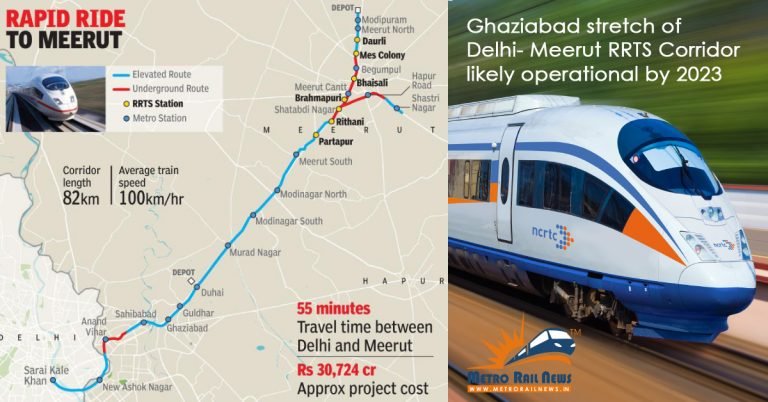
GHAZIABAD (Metro Rail News): A section of the Delhi-Ghaziabad-Meerut Regional Rapid Transit System (RRTS) corridor, from Sahibabad to Duhai, is likely to get started from March 2023. The efforts are being made by The National Capital Regional Transport Corporation (NCRTC) is working on a plan to achieve the target. The deadline for the entire project corridor Sarai Kale Khan to Meerut is March 2024.
Uttar Pradesh chief secretary is likely to conduct a meeting with all stakeholders, including the Ghaziabad Development Authority (GDA) and Meerut Development Authority (MDA) on April 29 to discuss the project said an official.
“There are three levels of monitoring or coordination committees that have been constituted to ensure that work on the proposed RRTS corridor happens without any impediment
“This is to ensure that all problems coming in the way of the corridor are addressed and solved without delays. The government wants the first RRTS train operation on the 17km route between Sahibabad and Duhai to start by March 2023. The deadline (for the entire stretch) is 2024,” the official added.
The pre-construction work on the 17km long stretch like road widening, tree cutting, geotechnical investigation, detailed designing and appointing consultant for station design is started. Civil work on the stretch will be taken up in two phases and the contract will be awarded soon, said the official.
“NCRTC needs land near Hindon Motel through which the proposed corridor will pass,” A GDA official said.
“We have apprised the Meerut divisional commissioner of the NCRTC’s request. Apart from that, a request for 8.5 acres near the elevated road at Vasundhara has been made by the NCRTC, which it plans to use for casting yard. It is being looked into,” said VN Singh, the chief engineer, GDA.
The 82 km Delhi-Ghaziabad-Meerut RRTS corridor, from Sarai Kale Khan in Delhi to Modipuram in Meerut, will have four stations in Ghaziabad — Sahibabad, Ghaziabad, Guldhar and Duhai. The cost of the entire corridor has been pegged at Rs 3,0724 crore out of which, the UP government’s share will be Rs 6,500 crore. Once completed, trains with an average speed of 100kmph will cover the 82km distance in 55 minutes
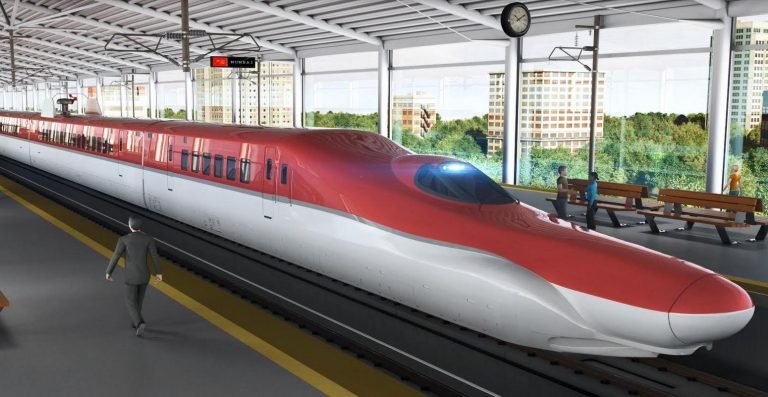
MUMBAI (Metro Rail News): Two builders from Vasai have moved the Bombay High Court against the alignment of the Mumbai-Ahmedabad bullet train project as it will require portions of their land and thus affect an under-construction 13-story residential tower project at Vasai.
The builders informed the court that 95 percent of construction is completed and around 50 flats have been sold. The petitioners, Kalash Devcon LLP, and Chetna Land Developer are independent partnership firms in the residential project and are seeking to change the alignment of the 1.1 lakh crore bullet train project.
Last week, senior counsel M M Vashi mentioned the petition before a division bench of Justice R M Borde and Justice N J Jamadar. It is likely to be heard next week.
Currently, petitioners are seeking directions to the Collector and the National High-Speed Rail Corporation Limited (NHSRCL) not to take up further steps for implementing the bullet train project unless they follow the Provisions of Right to Fair Compensation and Transparency in Land Acquisition Rehabilitation and Resettlement Act, 2013.
The petition mentation that one of the respondents to the petitions, Deepak Shah owns 10,260 sqm of land at Gokhivare village, Vasai taluka. Shah permitted Chetna Land Developer to construct a 13-story residential building with 177 flats on stilts on the land for a consideration of Rs 11.51 crore. The firm further granted development rights to Kalash Devcon LLP to construct the residential building by giving a security deposit of Rs 3 crore and 45 percent flats, through an agreement in August 2014.
Shah was granted permission by Vasai Virar City Municipal Corporation in 2014 to construct the building. Kalash Devcon LLP constructed the building and sold 50 flats.
The petition said if they did not give possession to these flat buyers, the petitioners will be hauled up for violating the provisions of the Maharashtra Ownership of Flats Act and the Real Estate Regulatory Authority Act.
That most of the buyers belong to middle-class families. They have obtained personal loans from banks/financial institutions/companies and are paying interest on the loans. Therefore, not only the petitioners but after the buyers will be adversely affected,” the petition adds.
In March 2018, the petitioners read an advertisement in a local newspaper that the Collector of Thane is planning to acquire private land by negotiation for the bullet train project. The land of about 9,450 sqm was also mentioned in the public notice, which is the area of the entire building. The petitioners have told the court that if a part of the residential tower is demolished, the whole residential building will collapse.
The petitioners further stated that they received an email in April 2018 from the assistant project manager of the NHSRCL informing them that their land is proposed to be acquired and details and clarity will be available only after a joint measurement survey is carried out.
After receiving the email, the petitioners stopped construction work. On June 12, 2018, officials from the Collector’s office and NHSRCL conducted a joint measurement survey and fixed the alignment, which would affect existing building.
The petitioners also sent a letter to the Collector and NHSRCL stating that the flat buyers are pressurising them to complete construction as there is no “stop-work” notice by any competent authority. The petition further adds that as 95 per cent of the work is completed and as the construction has come to a standstill, they made a representation to NHSRCL pointing out the “hardship caused”. The petitioners have spent approximately Rs 33.51 crore on the land cost, obtaining various permissions, architect’s fee and cost of construction.
SpaceX and Tesla CEO Elon Musk’s less-than-a-year-old Boring Company, a venture dedicated to vanquishing traffic by quickly building futuristic underground high-speed mass transit systems is received “verbal government approval” for two 35 mile high-speed underground tunnel projects connecting Baltimore and Washington, D.C. He promised, one-day transport travelers between New York and the nation’s capital in 30 minutes.
In view of large-scale infrastructure projects, “verbal government approval” and “government approval” are very different things. Now Musk and the Boring Company are working through the boring part called the Loop.
On April 18, 2019, The company took a small step toward making the Loop a reality: It published a sprawling, 505-page draft environmental assessment. The report, published in conjunction with an alphabet soup of federal, state, and regional agencies, is required under environmental laws.
The underground route would be 30 to 44 feet below the surface and most parts of it will resemble the Baltimore-Washington Parkway.
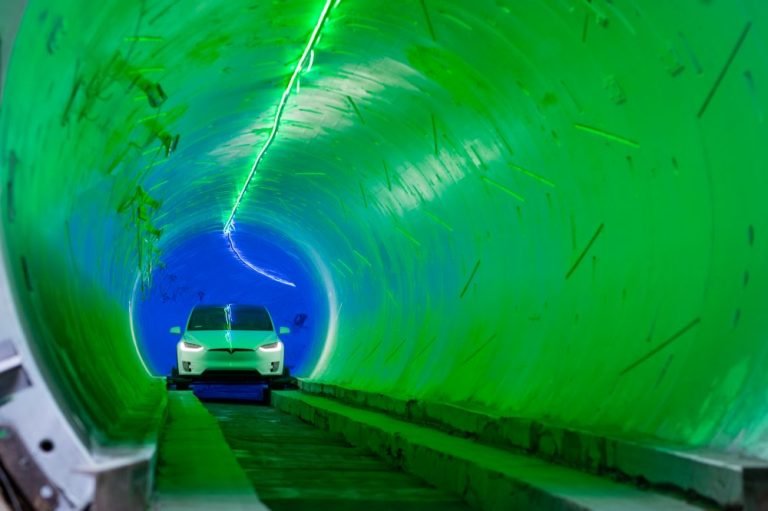
Elon Musk’s Boring Company unveils first tunnel with Tesla vehicles on ‘tracking wheels’
On completion, the two tunnels will allow autonomous Tesla vehicles to zip at super speeds of 150 miles per hour. The number of riders would be restricted to 1,000 riders per day in the initial phase and the numbers would increase after intermediate loop stations add up.
Boring Tunnel
The privately funded Loop would carry passengers between downtown Baltimore and Washington through twin 35-mile tunnels 30 to 90 feet below the surface. Battery-powered “autonomous electric vehicles,” or AEVs, would shoot passengers at speeds up to 150 mph, completing the trip in approximately 30 minutes.
Boring tunnel entrance for car
Seventy ventilation shafts, housed in nondescript brown huts built on the surface of the route, would help passengers breathe—and serve as emergency exits. Fares would be “comparable to public transportation,” the company writes.
Project’s timelines
According to the report, the time table for two tunnels including excavation of 2,000,000 cubic yards of soil would be 20 months.
The construction work covering stations and two 70 ventilation shafts would take 23 months. The project is expected to kick off after environmental review and regulatory approvals which may come within this year.
Competition from other transportation options
The company says the project is needed because the wider DC region is plagued by terrible traffic. But the company notes that the Loop would face competition from many other transportation options: highways, including I-95; intercity buses; trains from Maryland Rail Commuter Services, or MARC, which transports riders between DC and Baltimore in just over an hour; and Amtrak.
Gauntlet of government approvals
Car moving in boring tunnel
Before it can stick a tunnel-boring machine in the ground, however, the project will need to run a gauntlet of government approvals, including from the Maryland Department of Transportation, the District of Columbia Department of Transportation, the federal Department of Transportation, the city of Baltimore, the National Park Service, the Army Corps of Engineers, and potentially Maryland legislators. It would need to pass muster with regional water and environmental authorities. (The assessment includes a lengthy interlude on the project’s effects on local dragonfly species.)
A View of Boring tunnel
It might need a set of purpose-built regulations for its new tech, approved for the Federal Railroad Administration. And it would be subject to a handful of public comment periods—the first of which began Thursday with the posting of the draft assessment. (Go ahead! Submit your public comments here!)
The Boring Company’s technology hasn’t been fully demonstrated, and the company is still working to speed up tunnel boring tech and reduce the costs of digging tunnels. In December 2018, Musk showed off a 1.1-mile prototype of the Loop system in a SpaceX parking lot in Hawthorne, California—a prototype that wasn’t quite finished.
Boring Tunnel Exit
Company fans, reporters, and government officials offered rides on a Tesla Model X mounted in the test tunnel said the trip was notably bumpy; the vehicle only hit speeds of 50 mph. (Unimpressed transportation officials from Virginia reportedly called the system “a car in a very small tunnel.”)
“The bumpiness will not be there down the road,” Musk told the Los Angeles Times in December. “It will be as smooth as glass. This is just a prototype. That’s why it’s just a little rough around the edges.”
Other loop project status
The Boring Company’s other ventures have been mired in politics and bureaucracy. The company abandoned a proposed Loop project in West Los Angeles after a legal challenge from a local neighborhood association. Its high-speed airport connector in Chicago, once championed by outgoing Mayor Rahm Emanuel, faces an uncertain future after the city elected a new mayor who has not been shy about her opposition to the project. Two other projects—one small system inside the Las Vegas Convention Center, and another proposed Loop to Dodger Stadium in LA—are also making their way through local approval processes.
Criticism of over-promising by Boring company
The Boring Company signage is displayed at the tunnel entrance before an unveiling event for The Boring Company Hawthorne test tunnel December 18, 2018 in Hawthorne, California. Musk’s Boring Company is set to bag two high-speed underground tunnel projects connecting Baltimore and Washington, D.C
However, many analysts are skeptical about how Boring Company would deliver on the timelines. Musk’s company is known for offering awesome delivery dates and aggressive timelines. But the ground reality is quite different.
One example is the company’s deal with the city of Chicago to build a high-speed tunnel. The project of underground transportation loop was to connect downtown Chicago and O’Hare Airport for 18 miles.
Musk said in June 2018 that digging for the project would start in three months and the project would be complete in 18 to 24 months if regulatory approvals are in place.
Despite the promise, nothing has progressed. A year later the Chicago project is nowhere near approval.
“I would consider it dead,” commented Gilbert Villegas, alderman for 34th Ward.
Villegas said despite a team of smart, young engineers, digging tunnels in such tiny periods would be too ambitious.
Rebuffing criticism that the Baltimore tunnel plan is car-centric and is drifting away from the Hyperloop model, Musk’s infrastructure company backers point to the varied benefits.
They say the privately funded transportation system would create a significant public benefit in terms of decreased commute times, reduced urban congestion, decreased trip times, low fares, and decreased pollution. The Boring Company signage is displayed at the tunnel entrance before an unveiling event for The Boring Company Hawthorne test tunnel December 18, 2018 in Hawthorne, California. Musk’s Boring Company is set to bag two high-speed underground tunnel projects connecting Baltimore and Washington, D.C. Photo: Getty Images/Robyn Beck
A Teslarati blog also extrapolated the tunnel plan as a prelude to the loop system in the East Coast. It said, if approved, the Boring Company will be tasked with building a hyperloop system for the D.C.-Maryland route.
That loop will press into service autonomous electric vehicles that can transport passengers at speeds of 150 mph. It claimed that East Coast tunnels will be compatible with hyper-loop technology and may allow speeds of over 600 mph for passenger commuting.
LUCKNOW (Metro Rail News): Lucknow Metro Rail Corporation (LMRC) and the transport department decided that the transport department will make autorickshaw stands near all Metro stations for better connectivity to residential colonies or offices in a meeting on April 19, 2019.
There is no adequate space around 17 of the 21 Metro stations for the creation of stands, however, The authorities are confident about building the stands within a month. These include prominent stations like KD Singh stadium, Lekhraj, Vishwavidyalay, IT College, Badshahnagar, Hazratganj, Husainganj and Charbagh.
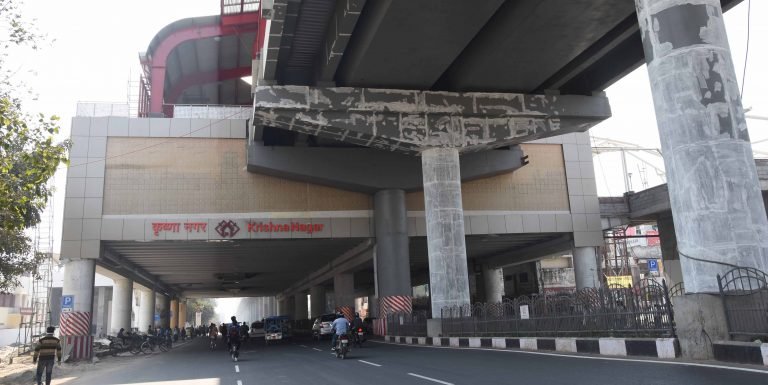
Most of the area is occupied by shops, leaving no space for constructing auto-stands in Hazratganj. Near Singarnagar Metro station, grocery markets and shops are lined up, leaving no possibility for constructing auto-stands. LMRC could also face a challenge at Charbagh Metro station due to heavy traffic movement and encroachment by street vendors. However, stations like CCS airport, Munshipulia, Krishnanagar, Mawaiyya, and Durgapuri have vacant areas around them for autorickshaw stands.
For the time being due to the absence of proper feeder service, commuters either have to walk long distances or depend on e-rickshaws, autorickshaws, and tempos that group to stations and park near gates, hampering traffic on roads.
“We are looking for appropriate locations to make autorickshaw stands.
If it is not possible to make the stands at the stations, we will find space near them, so that commuters won’t have to walk for long after de-boarding the Metro” An LMRC official said,
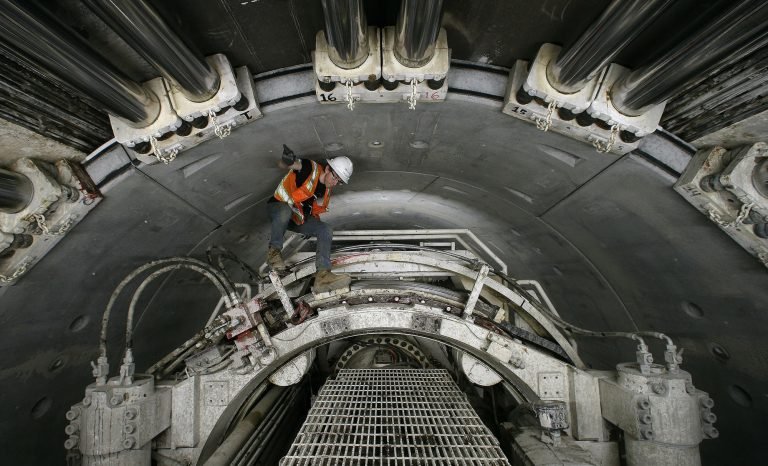
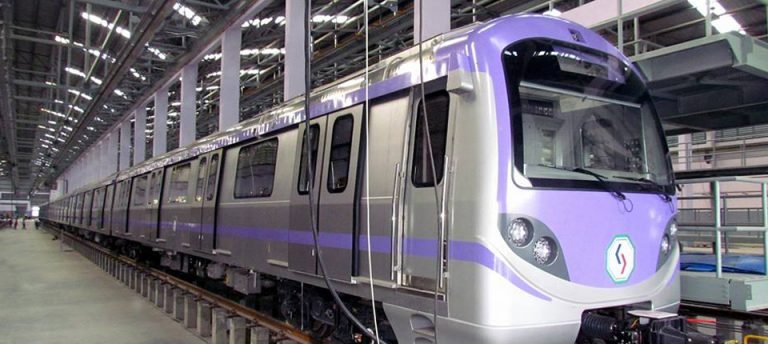
KOLKATA (Metro Rail News): The Kolkata East-West Metro corridor tunnel boring machine (TBM) Chandi started burrowing on April 19, 2019, after a 5 day break.
The TBM machine building the westbound corridor between Esplanade and Sealdah now enters the premises of the 114-year-old Kolkata Municipal Corporation (KMC) headquarters.
The TBM Chandi had stalled around 4m from the KMC headquarters on 5, SN Banerjee Road at 6 pm on 13 . Since March 26, It had been digging non-stop and burrowing 200m from the SN Banerjee Road-JL Nehru Road crossing.
It needed to be in “static motion” while the single track laid to run the muck car was converted to double tracks inside the tunnel some 25m below. Keeping the TBM, which weighs around 450 metric tonnes, “stalled” yet “moving” is a challenge and demands hectic technological activity to prevent subsidence.
Only one man-rider (the technical name for a muck car) was being used to offload the excavated soil all this time. A second could be used only from Friday, thus increasing the TBM’s burrowing speed courtesy faster muck disposal.
TBM Chandi was supposed to restart on April 18, 2019, but was delayed for 24 hours and begin around 11 am on April 19, 2019. Engineers of Kolkata Metro Rail Corporation (KMRC), which is implementing the 16.6km Howrah Maidan-Sector V Metro link, said the TBM could now build 12 rings or 18m a day instead of 8 rings or 12m a day. A single man-rider disposes of 50 cubic meters of muck generated during a day’s burrowing.
An engineer said that now that two man-riders are being deployed and the speed of tunnelling will increase. Now, The TBM is expected to dig non-stop till Sealdah. Over the next five days, Chandi should complete digging the 50m length of the civic headquarters.
KMRC has started strengthening the grand entrance of the colonial structure with iron props. KMRC official said that the building is fairly well maintained compared to the wobbly edifices elsewhere on SN Banerjee Road. But the arch at the main entrance on the SN Banerjee Roadside is vulnerable. The slightest soil subsidence would harm this key element of the colonial façade. The 2.45km stretch between Esplanade and Sealdah is the last leg of the underground tunnelling of East-West Metro.
NEW DELHI (Metro Rail News): Delhi Metro Rail Corporation Limited (DMRC) to install new equipment in its trains to monitor the health of train, which will detect faults in the major components of the rake and trigger an alarm.
The new equipment would make maintenance of metro trains more scientific and less dependent on manual intervention.
Mr. S. S. Joshi, director, rolling stock, DMRC said: “We are moving from time-based maintenance of trains to condition-based maintenance,”. He explains, at present different components of a train have a fixed maintenance schedule, during which they are checked.
Although, DMRC wants to place a system where components at risk of developing a glitch could be detected as early as possible and rectified,” he added.
“We are going to install special equipment in trains to monitor the health of systems so that maintenance can be optimised,” the director said. Primarily the major components that this on-board equipment will monitor are bearings, wheels, springs, suspensions, etc.
“This equipment will also ensure that we don’t do unnecessary maintenance where it is not required,” he added. Currently, all trains are microprocessor controlled and the latest equipment that DMRC plans to install will make the whole system more state-of-the-art.
“If any component is faulty, we will get information about the fault in advance thanks to the new equipment,” Joshi said. The on-board health monitoring equipment will also constantly keep a check on different on-board systems and components.
“For instance, some equipment will be able to gauge overheating of a component and will generate an alarm, and if needed, the train would be withdrawn from service,” the director explained.
Joshi said that the new equipment will also monitor the air-conditioning inside the rakes. “In a six-coach train, if two air conditioners are not working the train can still be operated but with our latest on-board equipment, this information will immediately go to the Operations Control Centre,” he said.
VIJAYAWADA (Metro Rail News): France-based infrastructure consulting firm Systra, had submitted its draft Detailed Project Report (DPR) to construct Vijayawada Metro rail.
Systra representative will meet Amarvathi Metro Rail Corporation (AMRC) officials to discuss on draft DPR after which the final DPR could be expected. AMRC will then provide agreement to the report.
There was a lot of delay in submitting the DPR. Systra officials allocate the delay to the extension of one of the corridors till new capital city i.e. Amravati.
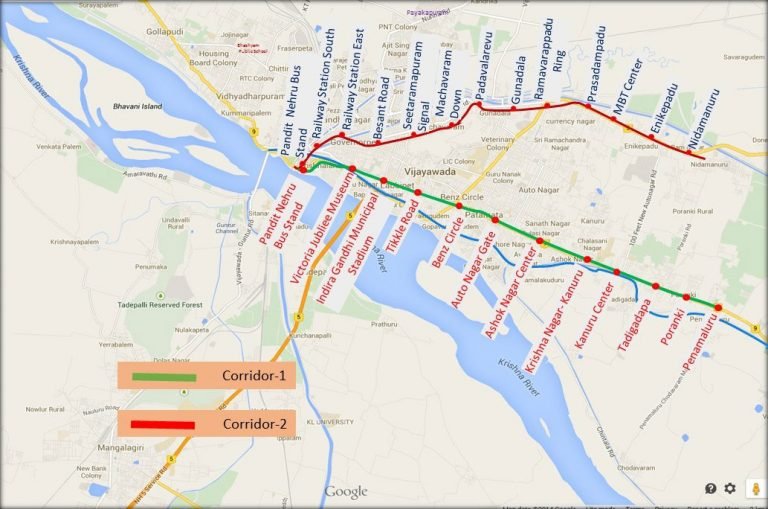
According to the new DPR, Now Vijayawada Metro Rail track will be 77.2 km long with three corridors, Instead of 26 km with two corridors which were proposed in the first DPR.
AMRC officials will raise some queries and they would be discussed on the April 29 meeting based on the draft DPR.
Proposed corridors for Vijayawada Metro in DPR
1st Corridor – Pandi Nehru Bus Station (PNBS) – Nidamanuru- Gannavaram
2nd Corridor – PNBS-Penamaluru
3rd Corridor – Railway station – Jakkampudi
In 2018, Systra group started working on the DPR and formed a consortium with RITES, a central government organisation for these activities to prepare DPR. The Systra group was finalised by AMRC after evaluating various bids submitted by several firms. Systra had experience in working as a consultant for metro rail projects in China, Malaysia, the Philippines, and Australia.
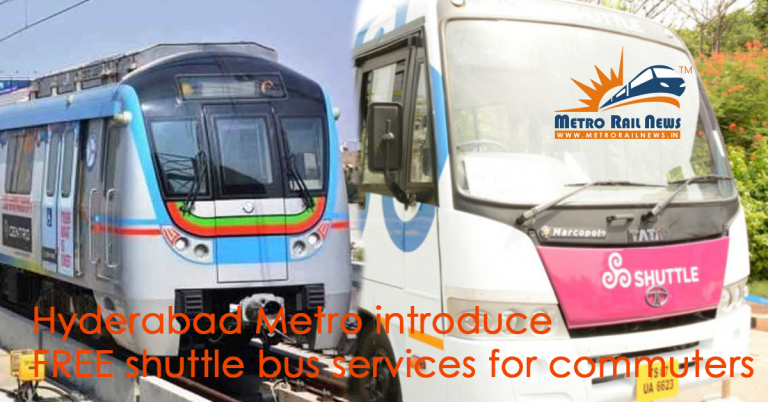
HYDERABAD (Metro Rail News): The Hyderabad Metro Rail (HMR) has introduced shuttle buses from Durgam Cheruvu station for the commuters to improving the last mile connectivity for the passengers.
The buses are being run to Gachibowli and financial district. In the Beginning, the HMR is running the bus services at free of cost. The buses will be available every 15 minutes.
These shuttle bus services will be operated from 8 am to 12 noon and from 4 pm to 9 pm on weekdays. Moreover, 12 IT companies have come forward to provide transport to their employees for metro stations from Hitec City and Durgam Cheruvu.
The shuttle bus services come to a great relief to the employees who can now travel directly to the office from the station without having to hail shared autos or other transport.
The Hyderabad Metro is planning to launch more such services to increase the metro ridership. On the other hand, the metro witnessed 2.60 lakh patronage on Wednesday in connection with IPL cricket match at Uppal stadium.
Kolkata (Metro Rail News): The Delhi Metro Rail Corporation (DMRC), One of the fastest growing Metro network in the world believe that Kolkata Metro Rail Corporation (KMRC), which was formed to build the East-West corridor could have been as effective as DMRC and completed the project in five years had it not lost its autonomy.
The Kolkata East-West Metro corridor construction is now in the 11th year. The phase-I of the project is ready for operations, while the other section will take at least two years more to start the services.
DMRC MD Mangu Singh said on April 17, 2019, at a symposium on infrastructure development and management organised by the RCG School of Infrastructure Design & Management, IIT-Kharagpur “Both DMRC and KMRC were modelled on the same principle, with the urban development ministry and the respective state having 50% stake each. DMRC stayed that way and avoided becoming either a state or central public sector undertaking (PSU). A board-run company found its own dynamism with its independent decision-making mechanism. But with Bengal off-loading its 50% stake to the Railways, KMRC became a central PSU. And that slowed down the project as systemic flaws in PSUs trickled in,”.
Now Railways holds 74% stake and rest is with the Urban development ministry in KMRC. It needs to go by the book and conform to multiple norms by being a central PSU. KMRC needed the ministry’s nod to disburse funds beyond a certain value or make an appointment. Even for land acquisition, they were dependent on the ministry, he added.
On the other hand, DMRC has the mandate to enter into direct negotiation with the land-owner for purchasing the land required for the project. Since the Delhi government is 50% stakeholder in DMRC, it played a pro-active role in clearing roadblocks to land acquisition.
Government of West Bengal has no financial stake in the project so that It had no compulsion to facilitate land procurement and it stuck to its stand against acquisition and proposed realignment that delayed the project, said an official.
“The project languished for years until Calcutta HC salvaged it,” a KMRC official admitted. Another key factor behind the Delhi Metro sticking to timelines was making contractors equal partners in the project and scheduling funds release in such a way that it did not ever dry up.
“In normal circumstances, there are hundreds of ways to stop funds flowing to contractors. But we have not allowed that in DMRC. Timely payment to contractors has accelerated work. While the first 190 km of Delhi Mero took 14 years, the second 190 km took only seven,” said Singh.
“Leadership also played a critical role, Having technocrat at the helm of the affair first E Sreedharan, and then, Mangu Singh helped in proper and timely decision-making that ensured the project progressed at a fair clip,” Said DMRC official.
PUNE (Metro Rail News): The Joint venture of Hindustan Construction Company Ltd (HCC) and Al Fara’a Infraproject working on the Pune Metro rail project, has shown the door to the 100 employees protesting the non-payment of salaries in the past five months.
On April 18, 2019 the JV’s project manager asked the beleaguered workers to ac The marching orders were issued by Project Manager Anil Birajdar After He had called the employees for a meeting at the Metro office (functioning out of a container) in Vallabh Nagar.
While the employees were told not ask too many questions and just accept what was being offered, they were told that the predicament was the outcome of the contracted companies not getting their funds from Maharashtra Metro Rail Corporation Ltd (MahaMetro).
The move is in sharp contrast to the resolution within a month, the spokespersons of both the companies talked of on Wednesday, when Pune Mirror took up the issue for the story “100 MahaMetro employees protest unpaid salary of five months, strike work” (published on April 19, 2019).
It is also in stark variance to the series of assurances given by the companies over the past months to the workers who cover wide-ranging job profiles. Understandably, the cornered workers are petrified.
On one hand, they do not want to lose out on their dues, on the other, they are insecure that once out of this job, they may lose favor with the construction industry for which their services are tailored. Yet S Marne, one of the affected employees of HCC-Al Fara’a explained, “Most of our expertise is related to Metro work in the construction industry. If they terminate us, it is unlikely we will find employment with any other enterprise in the field. Notwithstanding this, we’ve decided to stay firm on our decision to fight for our rights and retrieve all our dues immediately.”
Scoffing at what is being offered another brave-heart from the group, Abhijeet B asked, “What will a month’s salary do for us? We’ve worked hard at our job and earned the money due to us. They’re just compelling us to resign, though we are willing to come to a settlement and continue working on the Pune metro project.
“The employee salaries for one month have been paid with immediate effect. The issue of the remaining outstanding will be resolved within a fortnight. We are committed to paying all our employees and any rumors contrary to this position are strongly refuted. We have received requests from some workers, who wish to quit. The full and final settlement of these employees will be done as per the company policies.” Said Al Fara’a spokesperson in an e-mailed response to queries.
Time being, clearly unwilling to be drawn into the internal issues of its contractors, MahaMetro officials have washed their hands off the fate of the 100 employees who worked on the Pune Metro project for a year now.
“Our role has ended having requested Al Fara’a to release the dues to the employees. That’s as much as we could do. The ultimate decision rests with HCCAl Fara’a which are responsible for the hiring and firing of these employees,” Said Hemant Sonawane, GM (corporate communications), MahaMetro.
Our prime concern is the progress of the project, he added. “If there is any kind of disruption or delay in our work and they fail to show the progress we will have to terminate the contract with them and replace them with some other company. We’ve already issued such notices to them earlier over delays and will be doing so again, shortly. We have to fulfill our commitment to having the trial run rolling by end-December.” He reiterated that MahaMetro has been paying the contracted JV in advance and has no pending dues owed to them.
HYDERABAD (Metro Rail News): The Hyderabad Metro Rail (HMR) Limited is targeting to carry 1 Million (10 lakh) passengers a day in the next two years from the 2.33 lakh passengers now.
The officials are confident of completing the last leg of the route connecting the Jubilee Bus Station in Secunderabad with the Mahatma Gandhi Bus Station in the Old City by Nov 2019.
HMR Managing Director NVS Reddy said that the Metro had carried 5.20 crore passengers so far since its launch while addressing a conference on infrastructure organized by the Hyderabad Software Exporters’ Association (HYSEA) on April 19, 2019
He said the government is building shopping and entertainment infrastructure around the Metro stations to help passengers cut down on the time they spend on the roads.
“The works on the 30-km Metro stretch connecting the IT hub areas with the international airport would begin later this year” he added
“It would change the way people commute to their workplace. They can reach the airport in just 20 minutes,” he said.
He said We proved sceptics wrong by making a novel public-private partnership to build the Metro a success. The financial burden on the State government is very low.
Karuna Gopal, President of Foundation for Futuristic Cities, said urban areas needed both soft and hard infrastructure. “You need to have soft infrastructure that ensures friendly governance.
You need to negotiate with the States to meet the housing targets,” she said.
KOCHI (Metro Rail News): The Kochi Metro Rail Ltd (KMRL) will set up a separate parking lot for cycles at the stations to improve last mile connectivity of Kochi Metro. according to KMRL officials, will not only ensure last mile connectivity but also encourage cycling, the most environment-friendly transportation.
The passengers can reach the Metro station on their bicycles, park the vehicle free of cost at the stations and can travel in the Metro to their preferred destinations. KMRL will also provide a locking mechanism at its Metro stations along with bicycle stands with parking. In begning, there will be 22 locations at various stations, except for Maharajas Metro Station.
“Metro commuters can now park their bicycles at the designated locations safely before the travel.
Passengers can avail this facility free of cost. Six cycles can be parked at a time,” said KMRL authorities.
Earlier, the KMRL had launched a public bicycle-sharing programme in 2017. However, the programme had only a few takers, forcing the agency to relaunch it in 2018. As part of the plan, cycles were kept at major locations at Menaka Jn, on Vivekananda Road, Ernakulam North Railway station, Kaloor and at Kaloor-Kadavanthra Road. However, most of the cycles remained unused because of the lukewarm response from the public.
New Delhi: The Delhi Metro Rail Corporation (DMRC) first metro line i.e Red line, from Shahdara to Tis Hazari is all set for the makeover. It has decided to renovate all the 21 stations on the line between Rithala and Dilshad Garden. The newly opened section between Dilshad Garden and Shaheed Sthal will not take part in the renovation.
The renovation work will begin with Dilshad garden, Jhilmil and Mansarovar stations. by March 2020, The restoration and the retrofitting are expected to be complete. The rest of 18 stations would be taken up in the phases. The work would take time because only a few hours would be available for carrying out the renovation in an operational corridor.
According to the sources, DMRC will start the process by rectifying the water seepage problem on the tracks by replacing expansion joints and removing cable troughs, etc. The exterior of the stations will be renovated by applying a new color theme. The interiors will be repaired and the ground floor of the stations will be replaced with granite flooring, and platforms will be given chemical polishing.
It will carry out large-scale development work outside the station including maintenance, beautification of the parking area, footpath, etc. As per the latest specifications, new signage will be installed. The conventional lighting will be replaced by LEDs.
“The maintenance of the Red Line poses more challenges than the other lines as many stations here are at ground level, which results in more dust coming inside. Many are near low lying areas, which result in sewage and rainwater entering stations,” said DMRC official.
“World over, newer metro corridors are always found to be aesthetically better and technologically state-of-art, such as in London, Berlin, etc. DMRC, however, has taken a decision to rejuvenate our first line,” a senior official added.
CHENNAI (Metro Rail News): Chennai Metro Rail Limited (CMRL) to install CCTV surveillance to improve security and to keep an eye on passengers and parking staff at parking lots soon. the reasons for the decision to install CCTV cameras are complaints of passengers assaulting parking staff.
officials said “There have been three to four cases where a few passengers hit the parking staff in the last few months demanding a particular spot. The problems arise due to the Chennai Metro reserves a specific spot for passengers who have taken a monthly pass. Hence, those who park on an hourly basis are allotted space only on a first-come-first-served basis.
CMRL official Said that They get agitated because the parking space gets full or they refuse to wait till they get the monthly pass or token checked.
Two weeks back, a passenger hit staff at the Alandur station, because he wanted a specific spot to park his car, while that was reserved for a vehicle with a monthly pass. The passenger came for a compromise later and paid the hospital expenses for the staff.
In another case, a passenger slapped a parking unit staff member, as the former refused to wait in the line to get the pass checked. But passengers who have taken monthly pass claim that the staff make them wait longer to check every vehicle.
The Chennai Metro plans to install about 2-6 cameras in all 32 stations in the 45-km network of phase I, depending on the size of the parking lot and how it is built. “Some stations will need only two, but some parking lots are built in an L-shape, which will need about 3-4. We will also know if our staff misbehave with passengers,” he added.