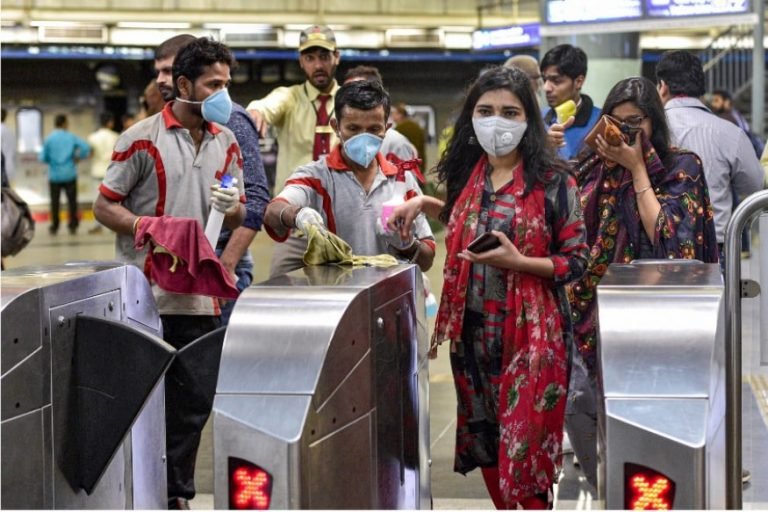
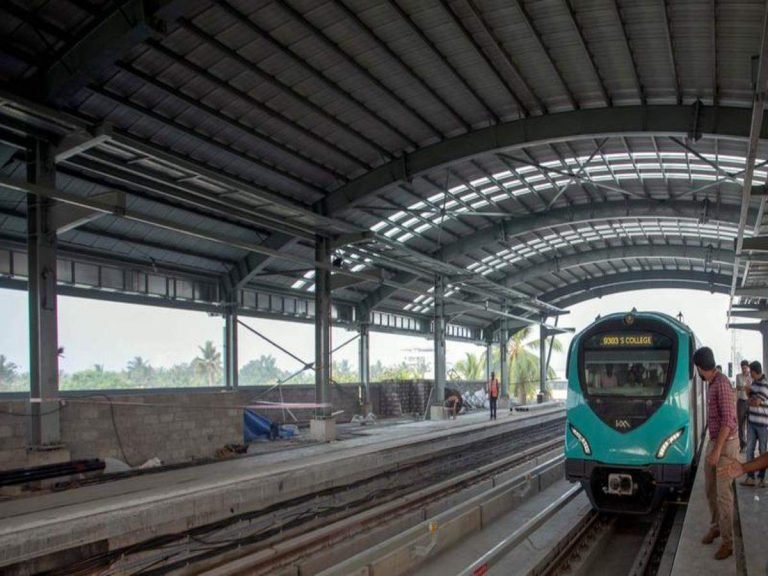
New Delhi: Prime Minister Narendra Modi has flagged-off the Delhi-Faridabad Metro Line that would allow hassle free travel for around two lakh daily commuters between the national capital and the industrial hub in Haryana.The extension of the Delhi Metro connects Badarpur to Escorts Mujesar in Faridabad.The total cost of the project from Badarpur to Escorts Mujesar is nearly Rs. 2,500 crore. Out of this, Rs. 1,557 crore was borne by the Haryana Government, the Centre contributed Rs. 537 crore, while the Delhi Metro provided Rs. 400 crore.The nine stations in this section include, Sarai, NHPC Chowk, Mewala Maharajpur, Sector 28, Badkal Mor, Old Faridabad, Neelam Chowk Ajronda, Bata Chowk and Escorts Mujesar. buy kamagra polo online https://lasernailtherapy.com/wp-content/themes/twentytwentytwo/inc/patterns/en/kamagra-polo.html no prescription
All these are elevated and located on either side of the Delhi-Mathura Road (NH-2).“The nine-station metro corridor which was 95 per cent indigenously built will provide people a safe, affordable, quick, comfortable, reliable, environment-friendly and sustainable transport facility,” a Haryana government spokesperson said.Haryana Chief Minister ML Khattar, addressing a press conference on Saturday, had thanked the Prime Minister for “gifting” the Metro service which would take the city to “another level of progress” with better connectivity with other NCR towns.He had also said that the Prime Minister would be announcing the go-ahead for connecting Gurgaon with Faridabad by Metro.
NEW DELHI (Metro Rail News): The Integral Coach Factory (ICF) will be manufacturing 740 coaches for Train 18, a Semi high-speed railway service. These coaches may cost Rs 4,000 crore to 4,300 crores.
Minister of
Railways and Commerce & Industry Piyush Goyal, in a written reply to a
question in Lok Sabha today, said that the production schedules for 2019-20,
2020-21 and 2021-22 involve the manufacture of 160, 240 and 240 coaches,
respectively, for the train sets at Integral Coach Factory (ICF). Two coaches
have already been put into service.
Train 18 is
a semi high-speed, fully air-conditioned service with quicker acceleration and
contemporary passenger amenities such as on-board infotainment, GPS-based
passenger information system, CCTV, automatic sliding doors with retractable
coach footsteps and zero-discharge vacuum-based bio-toilets.
At present,
Train 18 runs on the New Delhi-Varanasi and New Delhi-Sri Mata Vaishno Devi
Katra sectors.
Train 18, also known as the Vande Bharat Express, is fashioned along the lines of the Shatabdi. However, since it is a semi high-speed service that offers additional amenities and operational advantages to passengers, its fare is higher than that of Shatabdi trains.
It was designed and built by Integral Coach Factory, Chennai, under the Indian government’s Make-in-India initiative.
MUMBAI (Metro Rail News): Architecture students from the Rachna Sansad Academy of Architecture and Pillai College of Architecture are hoping to transform the areas around the upcoming Metro-3 (Colaba-Bandra-Seepz) stations by designing cycling paths, pedestrian zones, and plazas.
The Mumbai Metro Rail Corporation (MMRC) and Observer Research Foundation (ORF) recently announced the winners of a student competition on station area management. The winning entries proposed designs for Siddhivanayak, Marol Naka and Worli stations. Sayli Udas-Mankikar from ORF said, “We had 51 teams comprising 250 students from across the Mumbai Metropolitan Region (MMR) who participated in the competition.
They went through intense workshops, after which 16 teams presented their ideas to the jury, which included the MMRC.” In the plan for Siddhivinayak Metro station, which won the first prize, students proposed a 1.3-km cycle path around the station and a 30-meter pedestrian zone in Khed Galli, the road along the back entrance of the station. buy avanafil online https://pridedentaloffice.com/wp-content/themes/twentytwentyone/inc/en/avanafil.html no prescription
Vaishnavi Iyer, a student from Rachna Sansad, said, “The cycle path will connect 16 academic institutions in the area.”
For Worli station, another team from Rachna Sansad proposed to reduce the Annie Besant road from 3 lanes to 2 lanes on either side and in turn increase the footpath width on both sides. Students from Pillai College proposed three plazas around Marol Naka station which would make more space for commuters coming in and out of the station.
R Ramana, executive director (planning), said, “The students came up with several ideas that can be upscaled and replicated. We will curate these ideas and use them while finalizing plans.”
HYDERABAD (Metro Rail News): Coinciding with the second anniversary of the Hyderabad Metro Rail, Municipal Administration and Urban Development Minister KT Rama Rao will flag off the Hyderabad Metro services on the Hitec City – Raidurg section at 10 am on Friday.
This is after the Commissioner for Metro Rail Safety accorded permission for the commercial launch of services. CMRS Janak Kumar Garg conducted the mandatory checks and safety tests over the last two days and issued the Safety Certificate for the opening of the Hitec City-Raidurg stretch of Corridor 3 (Blue Line) for passenger operations.
Rao, along
with Transport Minister P. Ajay Kumar, will flag off the train from the Hitec
City station at 10.15 am and by the train to Raidurg. Regular passenger
services up to Raidurg will start a few hours after that.
KTR himself took to Twitter to announce the launch of the new service and said the Metro was already carrying about 4 lakh passengers per day.
The 1.5km stretch from Hitech City to Raidurg would add another 40,000 commuters initially and cover many more IT/ITES establishments in this part of the city, he said
Over the last two years, the Hyderabad Metro, the world’s largest metro in PPP models and India’s second-largest metro network, had carried 12.5 crore passengers, he said.
With 99.8%
punctuality and high on several parameters, Hyderabad Metro was selected as the
Number One Metro in the world in passenger satisfaction by global public
transport operator Keolis, Rao added.
Of late,
DMRC has been receiving 77 MW of solar power from Madhya Pradesh’s Rewa Ultra
Mega Solar. It has a total capacity of 750 MW and is one of the largest
single-site solar power plants in the world.
He said, “Lately, we have realized that we have a huge potential for solar power. DMRC is using 107 MW of solar power. We have installed solar rooftops on all our station buildings and depots. Today, we produce about 32 MW”.
He said, “We have tied up with an ultra-mega solar power plant in Madhya Pradesh. The success of that plant can be attributed to DMRC’s involvement as we are a reliable power purchaser (of solar power). As much as 77 MW is being produced by Madhya Pradesh today”.
He said Delhi Metro has been sensitive to both financial and environmental sustainability. “Right from the design to construction or actual performance during operations, the aspect of sustainability was always been kept in mind. We also went ahead with the most modern rolling stock that was available and where energy efficiency was the maximum. Our trains had regenerative braking systems”.
Singh said Metro is the most energy-efficient form of transportation. “If a passenger travels by Metro and consumes one unit of energy, he will consume 22 units for the same journey by car. We carry 55 lakh passengers every day on our system. Imagine the energy savings”.
DMRC is also the first organization in the world in the railway sector to have registered as a CDM project. DMRC has been certified by the United Nations as the first metro rail and rail-based system in the world to receive carbon credits for reducing greenhouse gas emissions as it has helped to reduce pollution levels in the city by 6.3 lakh tonne every year, thus helping in reducing global warming.
NEW DELHI (Metro Rail News): The Delhi-Meerut rapid rail corridor will be seamlessly connected with Delhi Metro stations, inter-state bus terminals as well as Indian Railways stations. As part of the multi-modal integration (MMI) of the regional rapid transit system (RRTS) project in the national capital region, the Delhi-Meerut RRTS corridor will be integrated with Delhi Metro stations at several stations.
This will facilitate easy interchange between the rapid rail network to other modes of public transport such as Delhi Metro, bus terminals and Indian Railways. The National Capital Region Transport Corporation (NCRTC), which is developing and implementing the RRTS project, will provide MMI of the RRTS network with other modes of transport wherever possible across the corridors.
According to details shared by NCRTC, the MMI plan of the Delhi-Meerut RRTS corridor is as follows:
Multi-modal integration of Delhi-Ghaziabad-Meerut RRTS:
The Sarai Kale Khan RRTS station will be integrated with the Delhi Metro Pink Line at the Sarai Kale Khan-Nizamuddin metro station and also with ISBT Sarai Kale Khan. This will provide connectivity to Sarai Kale Khan, Jangpura and Maharani Bagh areas of Delhi
The Anand Vihar RRTS station will be integrated with the Delhi Metro Blue Line and Delhi Metro Pink Line (planned corridor) at the Anand Vihar metro station. It will also be linked with the Anand Vihar Railway Station, Anand Vihar ISBT, as well as the Kaushambi Bus Terminal. buy flexeril online https://sextherapyhawaii.com/wp-content/themes/twentytwentyone/inc/en/flexeril.html no prescription
This will provide connectivity to Anand Vihar, Kaushambi, Rishabh Vihar and Karkardooma areas of Delhi
The New Ashok Nagar RRTS station will be integrated with the Delhi Metro Blue Line at the New Ashok Nagar station. This will provide connectivity to New Ashok Nagar, Mandoli, Mayur Vihar areas of Delhi
The Sahibabad RRTS station will be integrated with the proposed Vasundhara Sector 2 metro station as well as the Sahibabad Bus Terminal. This will provide connectivity to Surya Nagar, Sector 16, Sector 12, Vasundhara and Ghaziabad areas of Uttar Pradesh
The Ghaziabad RRTS station will be integrated with the Delhi Metro Red Line at the New Bus Adda metro station. This will provide connectivity to Ghaziabad, Hindon Vihar, Patel Nagar, Mukund Nagar, Jassipura and Raj Nagar Extension areas of Uttar Pradesh
The priority
section of the 82-km long Delhi-Ghaziabad-Meerut RRTS corridor has been
identified from Sahibabad to Duhai. This 17 km long section has been targeted
for operations by the year 2023. The civil construction work on this route is
in full swing. The complete corridor from Sarai Kale Khan of Delhi to Modipuram
in Meerut has been targeted for operations by the year 2025.
LUCKNOW (Metro Rail News): Shri Atul Kumar Garg has been appointed as the Director (Rolling Stock & Systems) of Uttar Pradesh Metro Rail Corporation (UPMRC). Having done B.E in Electrical Engineering from IIT Roorkee (1985 batch) with first rank, he is also registered with the Engineering Council (UK) as Charted Engineer. He is also a member of The Institution of Engineering & Technology (UK).
Shri Atul Kumar Garg is a dynamic and accomplished professional having 30 years of experience in Power Systems for Metro & Railway Projects apart from spearheading role as Power Systems Manager with Parsons International Limited, Doha Metro Project. He belongs to the 1986 batch of Indian Railways Service of Electrical Engineers (IRSEE), Govt. of India. He has the exposure of working at senior management prestigious positions of various Metro Projects across the globe like Doha Metro, Dubai Metro, Delhi Metro, Etihad Rail and Central Organization Railway Electrification, India.
He has vast expertise in managing all stages of Railway Power
Supply Projects like scope definition, coordinating details with design
consultants, completing design & reviews, tender invitations, contract awards,
budgeting and supervising installation along with testing & commissioning
works.
Shri Atul Kumar Garg also has extensive experience in mobilizing
and judiciously management of resources in the domains of planning, designing,
quality management and monitoring to ensure project accomplishment within the
defined time frame and cost implications. He has been instrumental in
spearheading the entire project management initiatives right from
conceptualization & project planning to delivery and execution.
Due to his exceptional time management skills with the proven
ability of quickly prioritizing, coordinating and consolidating tasks he was
considered and appointed as the new Director (R&S), Uttar Pradesh Metro
Rail Corporation (UPMRC).
The 8th International Railway Summit, a unique three-day networking and knowledge-sharing event for the global rail sector, concluded in New Delhi on 22 November. The summit, which was supported by the International Union of Railways (UIC), featured a full timetable of high-level debate, bespoke one-to-one meetings, and a variety of networking functions.
Delegates representing international, national, and local governments and associations, rail operators, infrastructure owners, and expert innovators and suppliers gathered at the Hyatt Regency hotel to share ideas and insight.
The European Union’s Commissioner for Transport, Violeta Bulc, presented her vision for the future of transport planning. Mrs Bulc strongly promoted rail as the backbone of a multimodal transport system and advocated global standards for railways.
Vinod Kumar Yadav, Chairman of India’s Railway Board remarked that rail will need to do more to keep up with the demand created by rapid population growth. Mr Yadav went on to elaborate on the megaprojects that will revolutionise the nation’s passenger and freight operations in the coming years.
François Davenne, UIC’s Director General, sent delegates a special message, which focussed on the implications of rapid population growth. Christian Chavanel, UIC’s Director of Rail System, chaired the conference programme, and described the shared objectives of UIC and the International Railway Summit: promoting innovation and best practice worldwide.
Throughout the two-day conference, thought leaders tackled the implications of population growth, from pressure on capacity and safety, to passenger experience, the value of high-speed rail, and investment strategies.
Alongside the conference, the world’s key rail sector buyers and carefully selected technical experts took part in over 100 pre-arranged one-to-one meetings, which were tailored to the participants’ requirements and expertise.
In addition, Indian Railways welcomed delegates to technical visits exploring divisional railways’ control centre and New Delhi train station, where delegates visited surveillance and train control rooms.
Evening functions were also an integral part of the summit, a chance to make friends and build partnerships. A welcome reception and dinner at the Hyatt Regency was held on the evening of 20 November. The following evening, 21 November, delegates enjoyed a meal at Kheer restaurant in New Delhi’s Aerocity.
The 9th International Railway Summit will take place in Warsaw on 19-21 February 2020. Organisations interested in learning more about International Railway Summit and about how they can participate in the event can visit http://www.irits.org or contact the organisers, IRITS Events.
Metro Rail News was the official Media Partner for the 8th International Railway Summit
The U.S. Green Building Council (USGBC), creators of the LEED green building
rating system, announced that registration is now open for Greenbuild India, which will be held February 6-7, 2020 in
Bengaluru at the ITC Gardenia.
Greenbuild, held annually in the United
States since 2002, is the world’s largest conference experience dedicated
to green building. Greenbuild India brings together Indian and global industry
leaders, experts and frontline professionals dedicated to sustainable building,
making Greenbuild the ideal space to learn about groundbreaking green building
products, services and technologies in the region.
“Greenbuild India offers a forum for the green building
community to hear from leaders on their vision about the future of green
building in India, learn about current research and best practices and connect
with peers and market leaders” said Kim Heavner, vice president, Conference
& Events, U.S. Green Building Council.
Greenbuild India will feature a powerful opening plenary and
inspiring keynote speakers who will set the stage for discussions. The
conference program offers robust learning opportunities through education
sessions featuring green building experts covering a wide variety of
sustainability topics, including LEED v4.1,
waste reduction and building performance. Those looking to dive deeper into
green building strategies can join a pre-conference technical workshop on Feb.
5. Attendees will also have an opportunity to attend the annual Greenbuild
Celebration event, the Leadership Awards Ceremony, Women in Green Luncheon and the
USGBC Leadership Luncheon.
The conference offers three tracks of compelling education
programming and include:
Greenbuild has become the premier convener for the green
building industry, and it is where the future of the green building movement is
shaped. The ideas and passions of the green building community come alive each
year at Greenbuild. It is where inspiration happens, business relationships are
cultivated, innovation is recognized and celebrated and where people from
around the globe come to reconnect and remind each other why they do what they
do – and why they work hard every day to create better buildings, cities and
communities. Preview the 2020 conference by checking out USGBC’s new series “It Takes a Village to Save a
Planet,” highlighting the work of local
leaders who will be presenting at Greenbuild India.
For more information on Greenbuild India 2020 and to register, visit http://greenbuild.usgbc.org/india, follow @GBCI_India and @USGBC on Twitter and tweet hashtag #GreenbuildIndia to join the conversation.
Metro Rail News is Official Media Partner for Greenbuild India 2020
About Greenbuild The ideals and passion of the green building community come alive at
Greenbuild. Greenbuild brings together industry leaders, experts and frontline
professionals dedicated to sustainable building in their everyday work, and a
unique energy is sparked. Three days of extensive educational programming,
workshops and ample networking events provide unrivaled opportunities to learn
about the latest technological innovations, explore new products and exchange
ideas with other professionals. Greenbuild is a multi-year recipient of IMEX
Green Meetings Award. For more information, visit http://greenbuild.usgbc.org and
follow us on Twitter @Greenbuild, and Facebook at facebook.com/Greenbuild.
About U.S. Green Building Council (USGBC) The U.S. Green Building Council (USGBC) is committed to a prosperous and
sustainable future through cost-efficient and energy-saving green buildings.
USGBC works toward its mission of market transformation through its LEED green
building certification program, robust educational offerings, a nationwide
network of chapters and affiliates, the annual Greenbuild International
Conference & Expo, and advocacy in support of public policy that encourages
and enables green buildings and communities. For more information, visit usgbc.org and follow us
on Twitter @USGBC, and Facebook at facebook.com/USGBC.
Matrix
Comsec – a leading manufacturer and provider of Telecom
and Security solutions – has been awarded the Dun & Bradstreet
Business Excellence Award 2019 in the mid-corporate segment for excellence in the Electrical and Electronic Goods category.
Matrix received this award for achieving superlative all-round performance in
terms of quality and efficiency in all functions including R&D,
manufacturing, marketing, sales and finance.
SME
Business Excellence Awards 2019 is a joint initiative by Dun & Bradstreet
and RBL Bank for recognizing and felicitating the leading SMEs and mid-corporates
in India. The
awards were presented on 20th November 2019 at Hyatt Regency, New Delhi.
On winning this prestigious award, Ganesh Jivani, Chief Executive of Matrix said, “Matrix is
focused on designing and manufacturing world-class cutting-edge Security and
Telecom solutions for modern organizations. Matrix offers these solutions in
more than 50 countries including many first-world technologically advanced
nations. With 250+ R&D engineers and world-class infrastructure and
equipment, Matrix is committed to R&D and cutting-edge products. This
award is a validation of Matrix’s world-class innovation and design
capabilities. I thank all our customers and channel partners for their trust in
Matrix and congratulate the entire Matrix team for this outstanding
achievement. This recognition would encourage us to work harder towards
building future technologies and products.”
There were stringent yardsticks and tough
competition in all the sectors as the awards were decided by eminent jury on
various parameters of performance and best–practices across the industry. The
parameters considered for the awardees were total income, net profit, net
worth, net profit margins, growth in total income, growth in net profit, return
on net worth and return on assets, among others. Front-runners in various
categories were chosen on the basis of a composite score of the weighted
parameters.
This
is the tenth edition of the Dun & Bradstreet SME Business Excellence Awards
to recognize the contribution of high-performing Indian SMEs and their
contributions to increasing the adoption of technology by organizations across
the country. The Awards showcased the achievements of the winners on a
nationwide platform, and also lend them global credibility through the D&B
worldwide network. The event was graced by senior management from SMEs,
government institutions, banks, financial institutions and tech companies.
About
Matrix
Established in 1991, Matrix is a leader in Security and
Telecom solutions for modern businesses and enterprises. As an innovative,
technology driven and customer focused organization, the company is committed
to keep pace with the revolutions in the Security and Telecom industries. With
around 40% of its human resources dedicated to the development of new products,
Matrix has launched cutting-edge products like Video Surveillance Systems –
Video Management Software, Network Video Recorder and IP Camera, Access Control
and Time-Attendance Systems as well as Telecom Solutions such as Unified
Communications, IP-PBX, Universal Gateways, VoIP and GSM Gateways and
Communication Endpoints. These solutions are feature-rich, reliable and conform
to the international standards. Having global footprints in Asia, Europe, North
America, South America and Africa through an extensive network of more than
2,500 channel partners, Matrix ensures that the products serve the needs of its
customers faster and longer. Matrix has gained trust and admiration of
customers representing the entire spectrum of industries. Matrix has won many
international awards for its innovative products.
KOLKATA (Metro Rail News): The Kolkata Metro Rail Corporation (KMRC) is going to increase the city’s metro fares after six years. The revision of the rates will come into effect from December 5, 2019. buy viagra online no prescription
With new fares, KMRC will charge Rs 5 for 2 km of journey. Rs 10 for every 2-5 km of distance, Rs 15 for 5 -10 km of a journey and Rs 25 for distance above 20 km of the journey.
The minimum existing fares start from Rs 5 for a journey of 0-5 km. The fare will get an increase to Rs 10 after 5 km from December 5.
Here are
Kolkata Metro’s new fares:
0-2 km: Rs 5
2-5 km: Rs 10
5-10km: Rs 15
10-20km: Rs 20
Above 20 km: 25
The
existing rate of the Kolkata Metro are:
0-5 km: Rs 5
5-10 km: Rs 10
10-20km: Rs 15
20-25 km: Rs 20
25 and above: Rs 25
According to media reports, the decision to hike fares of the Kolkata Metro has been taken to provide better services to passengers, and to improve the efficiency of the transport.
Kolkata Metro fares are one of the lowest in the country. With a fare of Rs 40 for 10 km distance, Chennai Metro Rail is the costliest in the country. As for Delhi Metro, the fare is Rs 30 for a 10 km distance.
Established
in 1984, Kolkata metro is the oldest metro service in India. The Kolkata Metro
covers a distance of over 27 km from Noapara to Kavi Shubhash station.
Moreover, the bus transport of Kolkata is also one of the cheapest in the country. The minimum fare of ordinary buses in the metropolis is Rs 7, while that of minibusses is Rs 8. Air-conditioned bus services cost Rs 20 or Rs 25 in the initial stage.
In India,
the metro rail system is operational in 10 cities till now: Kolkata, Delhi,
Bengaluru, Gurugram, Mumbai, Chennai, Jaipur, Kochi, Hyderabad, and Lucknow.
MUMBAI (Metro Rail News): PM Narendra Modi ambitious Mumbai-Ahmedabad bullet train project, the National High Speed Rail Corporation (NHSRC) issued a tender worth Rs 1,800 for construction of the Bandra-Kurla Complex (BKC) terminus, which is estimated to cost.
According to the MMRDA, The contractors will be finalized by May 2020.
We don’t anticipate any major hurdles to the project despite the change in the government in the state.
Official’s Said that the 508km bullet train has several benefits in terms of employment generation and investment opportunities. Maharashtra politics is not vindictive as in other states. We are hopeful of a smooth execution of the project.
the BKC terminus is to be built underground, above it will be erected the IFSC building. The tender for the project had been delayed as the MMRDA had sought relaxation in the height for the buildings in BKC so the centre could have more floors—the height of buildings in BKC had been capped at 61m and the MMRDA wanted the limit increased to 96m.
The idea behind pushing for more floors is to maximize the generation of revenue from the financial services centre. “The issue has been resolved last and the NHSRCL has already floated the tender for the BKC terminus,” said metropolitan commissioner R A Rajeev.
IFSC building will come upon a 50-hectare plot, while the underground terminus will be built on approximately 4.9 hectares.
“The terminus will have three island platforms to accommodate six trains simultaneously. Each platform will be 480m long to accommodate 16-car train,” said a senior MMRDA official.
“The contractor will be finalised by May 2020 and will take at least two years to construct the terminus with cutand cover techninology.”
Initially, only four platforms will be used, but provision has been made for two more in case a high-speed train is run on the Mumbai-Nagpur route. An official said, “The lying time for the train is 20-25 minutes, hence the need for six platforms.”
The terminus will have three basements: The first level will have the ticketing area, passenger amenities and clearance, the second level will have room for all utilities, including AC plants and other train-related systems, and the platforms will be on the third level. The terminus will be integrated with the Metro 2B Dahisar-BKC-Mankhurd corridor, while they plan to also link it with the underground Metro 3 Colaba-Bandra-Seepz network is yet to be worked out.
The foundation stone-laying ceremony for the project was done in September 2017, in Ahmedabad and PM Modi has set August 15, 2022, as the deadline for services to commence. However, there are indications that Phase I may operate only between Billimora and Ahmedabad on this date as the land acquisition poses a serious challenge in Maharashtra.
DELHI (Metro Rail News): The National Capital Region Transport Corporation (NCRTC) which is implementing agency RRTS Project in India has issued the civil tender for the underground section Anand Vihar to Vaishali of Delhi-Ghaziabad-Meerut RRTS Corridor on Monday.
Scope of work
Tender floated are for design and construction of tunnels of Delhi portion by Tunnel Boring Machine from New Ashok Nagar Ramp, New Delhi to Sahibabad Ramp of Ghaziabad Uttar Pradesh.
The civil construction for Package I (Vaishali to Ghaziabad) and Package II (Ghaziabad RRTS station to Duhai) have been already started.
NCRTC official Said that this will be the first project and once constructed Delhi will have its first rapid rail services. The project will have an underground station at Anand Vihar. The Rapid Rail Transit System (RRTS) station will be made by Cut and Cover Method.
According to the source, around 11.53 km stretch of the Delhi-Ghaziabad-Meerut RRTS corridor will be underground in which 5.8 km long section will start from New Ashok Nagar RRTS station (Elevated) to stretch before BEL, Ghaziabad will be underground. While, the remaining 5.73km long section after Brahmapuri Meerut Metro Station (Elevated) to Begumpul RRTS station (before MES Colony Metro Station -Elevated) will be underground.
The Sarai Kale Khan and New Ashok Nagar will be work on the multi modal integration (MMI) model for the upcoming RRTS corridor and NCRTC have been engaged in Detailed Design Consultant (DDC) for the these two elevated rapid rail station. Delhi’s Jangpura will be the NCRTC’s Master Operation Control Centre for the entire Phase I RRTS project.
According to the official Jungpura will also have the Master Operation Control Centre of the Phase-I RRTS corridors for all the three initial corridors of NCRTC. The works of Utility diversions in the Delhi portion of Delhi – Ghaziabad – Meerut RRTS Corridor near Sarai Kale Khan, including shifting/diversion of existing water supply pipelines, sewer and stormwater drains, shifting/modification of electric lines and relocation of various telecom utilities are in progress
The total length of the entire Delhi Ghaziabad Meerut corridor is 82 km. However, the NCRTC is currently working on the 17 km priority section between Sahibabad to Duhai Eastern Peripheral Expressway (EPE) including Duhai Depot, which is expected to be operational by March 2023.
While the officials said the full 82km long corridor from Delhi’s Sarai Kale Khan to Meerut’s Modipuram will be operational for the public by March 2025.
Besides, the three RRTS station that will be constructed in the city will make travel easy for the commuters as the station will be integrated with all the modes of transport such as Delhi Metro, Anand Vihar Inter State Bus Transit (ISBT), railway station, Kaushabmi Bus Terminal to facilitate seamless travel.
“The opening of this section will seamlessly connect the Ghaziabad RRTS station with New Bus Adda Station metro station, while Sahibabad RRTS station will integrate with proposed Vasundhara Sector 2 Metro station and Bus Terminal,” said the official.
Further all the rapid stations that will become up in Delhi will have an interconnection facility with Delhi metro station.
The speed of rapid rail is 100 kmph per hour and the commuters travelling from Delhi to Meerut will reach in one hour instead of four hours.
The 17 km priority section of will have a total number of 14 RRTS stations at Sarai Kale Khan (Elevated Station),New Ashok Nagar (Elevated Station), Anand Vihar (Underground Station), Sahibabad (Elevated Station), Ghaziabad (Elevated Station), Guldhar (Elevated Station), Duhai (Elevated Station), Muradnagar (Elevated Station), Modi Nagar South (Elevated Station), Modi Nagar North (Elevated Station), Meerut South (Elevated Station), Shatabdi Nagar (Elevated Station), Begumpul (Underground station), and Modipuram (Elevated Station). The corridor will also have two Depot-cum-Stations at Duhai and Modipuram.
Jammu (Metro Rail News): JKERA (J&K Economic Reconstruction Agency) and RITES Limited-a Government of India Enterprise have signed a memorandum of undertaking (MoU) to preparation and updations of Comprehensive Mobility Plan (CMP), Alternative Analysis Report (AAR) and Detailed Project Report (DPR) as per new Metro Policy 2017 and Metrolite Policy 2019 in cities of Jammu and Srinagar on Monday.
The agreement was signed between Ms. Avny Lavasa, IAS & Chief Executive Officer, JKERA on behalf of the Government of Jammu & Kashmir and Piyush Kansal, Executive Director, RITES Limited.
The Government of Jammu and Kashmir has decided to engage RITES Ltd to provide consultancy services for preparation CMP, AAR, and DPR. The updated CMP and AAR, in light of the new metro Policy 2017 is a prerequisite for approval of the final DPR of Metro Rail Project by the Central Government.
In July 2019, Shri Dheeraj Gupta, Principal Secretary, Housing and Urban Development Department, said that the first priority is getting the approval of the metro rail project from the Central Government. Options are open for multilateral funding agencies to be part of the project, apart from central assistance. The central government is pushing for such mass rapid transport corridors as part of futuristic vision so funds would not be a problem.
Kumar Rajiv Ranjan, Managing Director of Mass Rapid Transport Corporation Jammu and Srinagar; Sanjay Gupta, Director Land Management, Jammu Development Authority (JDA); Bachan Lal Bhagat, Director ERA Jammu; Anil Raina, Senior Town Planner, Jammu; PP Arora, TO to CEO ERA; Lokesh Gupta, Incharge Deputy Project Manager, ERA; Raman Sharma, Senior Architect, JDA; Tarun Jain, Deputy General Manager RITES Ltd and other officials were also present during the signing of the agreement.
Updated CMP and AAR, in light of new Metro Policy 2017 is a prerequisite for approval of the final DPR of Metro Project by the Government of India.
KOLKATA (Metro Rail News): Metro Railway has written to the Commissioner of Railway Safety (CRS) to extend its November 30 deadline by three months for unveiling East-West Metro’s Salt Lake stretch. Last Thursday, Metro Railway authorities wrote to the chief commissioner of railway safety, Shailesh Kumar Pathak, urging the commission to extend the validation period beyond November 30 since it was clear that the truncated commercial services can’t start by Saturday.
On Friday, Union minister Babul Supriyo had told the media that he had had a word with the Railway Board on the issue and was told: “there won’t be any problem in extending the clearance for a few days. buy vidalista online https://herbalshifa.co.uk/wp-content/themes/twentytwentytwo/inc/patterns/en/vidalista.html no prescription
” Metro Railway officials said they, too, believed the CRS would extend the validation period to accommodate a December launch.
But another
section wondered if this was possible since the CRS functioned under a
different ministry. On July 22, Pathak had inspected the 5km elevated Sector
V-Salt Lake Stadium stretch and on August 2, he issued the conditional safety
nod and wrote, “Public carriage of passengers on this line should be introduced
by 30.11.2019, otherwise Metro Railway administration shall have to approach
the commission for revalidation of this section.”
Although the East-West Metro project is being implemented by Kolkata Metro Rail Corporation (KMRC), operations will be handled by Metro Railway, which runs the north-south section and which has been conducting a series of pre-commissioning trials for nearly two months. Even on Monday, a one-day preparedness trial was held and senior officials from various operation-related departments of Metro Railway, including principal chief operations manager Satyaki Nath, inspected the section.
On October 31, during the second round of service trials, the officials had conducted similar inspections and expressed satisfaction with the result. However, Suneet Sharma, Eastern Railway’s general manager who is also officiating as GM, Metro Railway, ordered a 10-day “failure drill” from November 8.
“The section
has been going through one trial after another and now we will be missing the
CRS’ deadline,” said an official. Most new Metro lines are unveiled a fortnight
to the CRS deadline. But in East-West Metro’s case, there’s no time for
formalities, like compiling a report and intimating the Railway Board and the
CRS about the preparedness, following which a notification is issued by the
Railway Board.