Bids invited for 210 Delhi-Meerut RRTS coaches

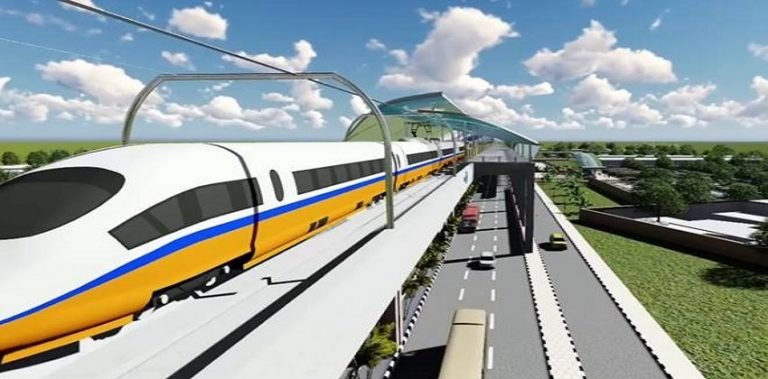
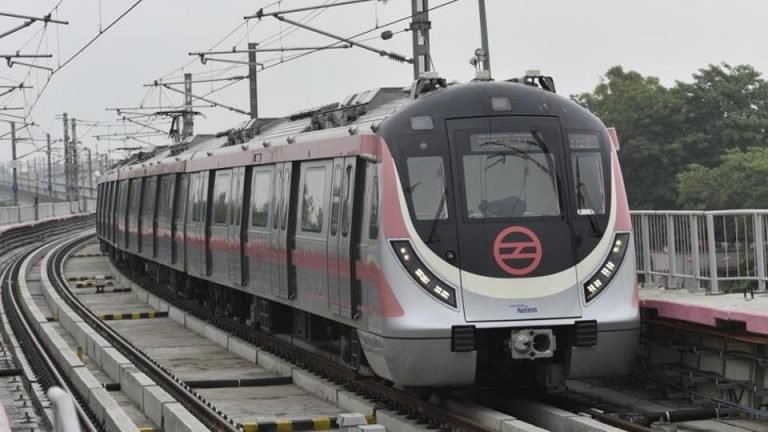
DELHI (Metro Rail News): India’s first RRTS corridor to have top-class train sets procured under ‘Make In India’ guidance! The Delhi-Meerut regional rapid transit system, which will decrease the distance between Delhi-Meerut to just 55 minutes will have ‘Make In India’ rolling stock. NCRTC which is mandated for executing the RRTS project in the NCR has invited bids for the rolling stock of the Delhi-Meerut RRTS corridor. Chief Public Relation Officer Sudhir Sharma, NCRTC said that the last date for submission of the bids is March 11, 2020.

A total of 210 coaches are being procured for the corridor works, for the RRTS project. Sudhir Sharma added, 30 RRTS train sets comprising 6 coaches will be made operational for the local services, where ten train sets comprising 3 coaches will be made operational for the city services in Meerut. Being a part of the bidding process for the rolling stock of the RRTS corridor, foreign firms interested in the infrastructure project will also be allowed to join. The procurement of the rolling stock is being made by PM Narendra Modi’s flagship ‘Make In India’ guidance.

The 82 km Delhi-Ghaziabad-Meerut RRTS project will boast of 160 kmph capable coaches and will be executed in phases, in the two cities. With 22 stations out of which 16 will be the regional stations and 6 stations will be in Meerut. The lead phase of Delhi-Meerut RRTS which is 17-kilometre long Sahubabd-Duhai locality has been expected to start operations by 2023.

The RRTS stations like Sarai Kale Khan, Anand Vihar and Sahibabad will be combined with different modes of public transport such as metro, bus terminals, Indian Railway stations for facilitating the multi-modal combination for commuters. It was reported that the final design for the Sahibabad station will also be prepared by the end of this month and work will be commenced soon.

Chennai Metro gets 12,722 Sqm Land by GCC for Phase II

CHENNAI (Metro Rail News): The Greater Chennai Corporation (GCC) has decided to give 12,722 sqm of land worth Rs 41.99 cr for its phase-II construction to CMRL. The land owned by the civic body, adds an Amma canteen, two parks, an open playground with a portion of a road.

Besides the land cost, Chennai Metro Rail would have to bear the cost of reconstructing these facilities at a different location along with taking permission from the govt wherever over 5% of open land is being transferred. In November, the decision was taken in the corporation council meeting as follows.

As per the documents, six parcels of the corporation’s land would be given.

  • In region 6, the GCC has decided to take over the 657sqm of land permanently for the construction of Ayanavaram station. This includes the corporation’s ward building and a portion of a road. This portion cost is Rs 1.18 cr.
  • In region 13, Chennai Metro will receive 1,203 sqm of land, That is a third of Dr Muthulakshmi Reddy park which the civic body initiated in 2010. The GCC will give the area to CMRL in conditions that the park is brought back to its original condition after work is done.
  • In region 6, the GCC has decided to provide two more parcels of land for construction work of Perambur Market metro station. For this, 42 sqm accommodates an Amma canteen, which Chennai Metro rail Ltd. would have to relocate to another area.
  • In region 70, 1,361 sqm of metro rail will be given permanently and 2,515 sqm temporarily. This land abuts a part of the Murasoli Maran park that the transport agency would have to repair after construction work is completed. The GCC has also informed that CMRL constructs a building for them. These parcels would cost Rs 21.56 lakh and Rs 6.5 cr.
  • In region 9, for construction work of Tirumailai metro station, a shopping complex-cum-toilet over 108 sqm run by the GCC will be awarded to metro rail for Rs 1.55 cr. CMRL will have to replace and reconstruct the complex. In the region, CMRL will take 1,751 sqm permanently and 5,224 sqm temporarily for construction work of Greenways Road metro station. This will cost CMRL Rs 20.4 cr.

The GCC does not have an elected council for the last four years. The special officer is commissioner G Prakash.

L&T infra Awarded DDC contract for 3 Stations of Delhi-SNB RRTS corridor

New Delhi (Metro Rail News): on Friday, Larsen & Toubro Infrastructure Engineering Ltd. received a letter of acceptance (LOA) from the National Capital Region Transport Corporation (NCRTC) for providing detailed design consultant (DDC) worth Rs 6.75 crore for the design of three stations including viaducts of 164 km long Delhi–SNB (Shahjahanpur-Neemrana-Behror) RRTS corridor.

NCRTC issued Letter of Acceptance to L&T infra for 3 Station of the Delhi-SNB RRTS corridor DDC Contract

L&T infra needs to providing civil, architectural and E&M works for the design of Udyog Vihar, Sector-17, Rajeev Chowk and elevated viaduct between IDPL Complex Ramp (Gurugram) to Rajiv Chowk Ramp for Delhi-SNB RRTS corridor.

The NCRTC invites tender was floated on 24th August 2019 vide reference no. DA/DD/COR-OF/011 and the technical bid was opened on 19th November 2019. After the opening of financial bids on 12th February 2020, L&T Infrastructure Engineering Limited has emerged as the lowest bidder (L1).

The 106 km long Delhi-SNB RRTS corridor will be elevated for about 71 km i.e 11 stations, the remaining 35 km i.e. 5 stations will be built underground, mostly in Delhi & Gurugram.

This corridor will connect with other RRTS line in Sarai Kale Khan and will be interoperable, facilitating commuters’ movement from one line to another without the hassle of changing trains.

The Delhi-SNB Regional Rapid Transit System (RRTS) corridor will enhance transport infrastructure by given a fast, safe, comfortable and reliable mobility option to the residents of Delhi, Gurugram, Rewari, Manesar, Daruheda, Bawal, and nearby areas.

The fast commuting connecting Delhi to nearby regions will be immensely beneficial in decongesting Delhi and its roads, providing citizens with the choice to live & work in different regional nodes to lead a better quality of life.

The corridor is planned to be constructed in about 5 years’ time excluding 1 year of pre-construction activities at a base construction cost of Rs 24,975 crores, financed by Government of India (20%), concerned State Governments (20%) and bilateral/multilateral funding agencies (60%). Once built, the corridor is expected to bring down the travel time between SKK-SNB in less than 70 minutes (106 km). The daily ridership on this corridor is predicted to be 8.5 Lakhs in 2025. For more information, be stay connected with our Delhi-SNB RRTS section.

UPMRC New Tech to expedite metro work

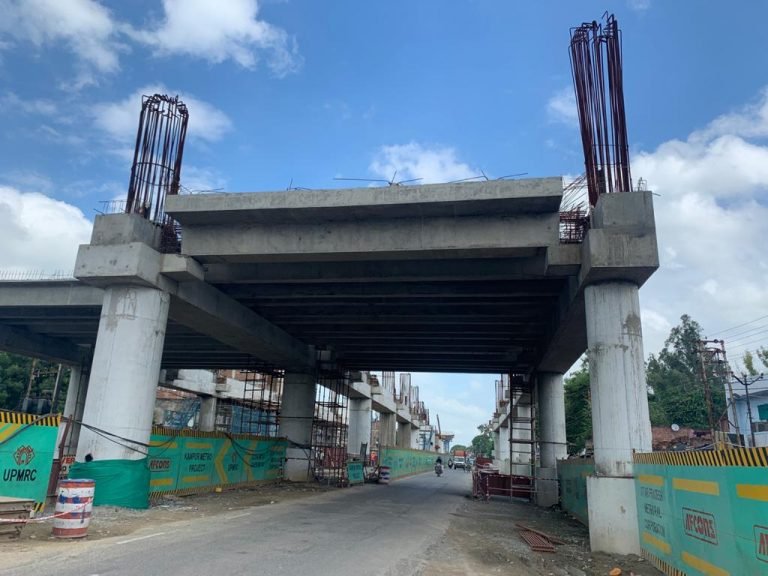
KANPUR (Metro Rail News): Uttar Pradesh Metro Rail Corporation (UPMRC) has initiated a new technique to speed up the ongoing construction work of Kanpur Metro project and assures the safety of the workers at the site and the common people.

On Saturday a UPMRC official said that since the starting, its civil engineers, based on their experience from the Lucknow Metro Project, we’re trying to innovate civil construction work techniques while executing the Kanpur Metro Project. Earlier he said that concourse slab of the elevated station, a portion just above the road was constructed on sacrificial shutters were laid over the erected precast beams.

The station concourse slab will now be constructed the new innovative technology. The slab with beam will be built in advance at the casting yard and placed at the assigned place. By the help of this technique, the work will gain momentum, and simultaneously safety-related apprehensions will be reduced. Along with this, the outer beauty of the stations will also be improved”, an official added.

As per the source in MRC, the civil work of the KMP is progressing at full-speed from the starting. According to a result of the state-of-the-art technology, UPMRC is completely confident that the construction of the Priority Corridor between IIT-Kanpur and Motijheel would be finished within the stipulated time frame.

During three months since the construction work commenced on Kanpur Metro at the IIT-Kanpur gate, above 500 piles and 35 pillars have been prepared under the project. Concurrently he casting of the U-girder is also continuing in the casting yard.

Kolkata East-West Metro remaining section to be completed in 10 Months

KOLKATA (Metro Rail News): Kolkata East-West metro corridor underground tunnelling work is to take 10 more months to be finished,  an international expert committee appointed by the KMRC announced on Friday.

Also, the safety of the people residing in dilapidated buildings – many of that was built over 120 yrs ago, in one part of the route is a cause for concern, Leonard John Endicott said a geotechnical expert and committee head.

“The biggest challenge is that many buildings in the area are in poor condition. Our concern is the safety of the people,” he added further.

“The corridor tunnelling work was postponed after one of the two tunnel boring machines hit an aquifer on August 31, 2019, in Bowbazar area leading to severe ground subsidence and the collapse of buildings, will resume in full swing in a day or two,” said Endicott.

With the TBM getting destroyed beyond repair in the accident, the work will have to be finished with one tunnel boring machines only. The existing TBM has been moved a few rigs to check for all safety parameters put in place to assure that there is no repeat of the earlier incident. “We are supercautious,” Endicott said.

Earlier to that accident at Bowbazar, two TBMs were working parallelly, boring tunnels for the up and down lines of the East-West Metro corridor. “It will take around five months for the TBM to go up to Sealdah from Bowbazar. Then, it will take three months for the TBM, which is a huge machine, to turn around.

“It will take another two months for the machine to dig on another side and reach up to the point where the first TBM had cut the tunnel,” the geotechnical expert stated. He told that the working TBM had been upgraded and it now has 50% more capacity to assure that the ground holds throughout tunnelling work.

“Special measures have been taken to ensure that water does not seep into the tunnel,” he said that the adding that work will be stopped within 60 minutes of noticing any abnormality throughout tunnelling in the area.

The damaged TBM, which Endicott said is a “write-off”, will be dismantled and carried away from the underground shaft. The Calcutta High Court had allowed restart of tunnel-boring work for the East-West Metro corridor, on February 11.

According to a report by IIT-Madras, the court’s division bench directed the Kolkata Metro Rail Co., the executing agency for the project, to resume operations in Bowbazar, in consultation with the institute. The bench including Chief Justice TBN Radhakrishnan and Justice Arijit Banerjee had ordered a suspension of tunnelling work till further orders, in September last yr.

After three months, the KMRC because of a report made by the expert committee moved the court seeking its permission to restart the works. On a prayer by an NGO to get the expert committee report vetted by an independent agency, the KMRC requested IIT-Madras to analyse its findings. The institute, in its report mentioned that tunnel-boring work could be resumed.

The 4.88 km first phase of the East-West Metro, linking Sector V in Salt Lake with Yuva Bharati Krirangan Stadium begin operational on February 13. Inaugurating the operation, Railway Minister Piyush Goyal had said the whole 16.5 km stretch of the corridor – from Sector V to Howrah Maidan – is likely to be ready in 2 yrs. The Kolkata East-West Metro corridor was earlier scheduled to be finished by June 2021.

Patna Metro corridor 2 consultancy contract awarded to AECOM

Patna, India (Metro Rail News): The joint venture (JV) of AECOM Singapore Pte Limited and AECOM India Pvt. Ltd. emerged as the lowest bidder (L1) for the detail design consultancy (DDC) contract of the corridor 2 of Patna Metro Rail project.

DMRC issued the Letter of Acceptance to the JV of AECOM Singapore Pte Limited and AECOM India Pvt. Ltd for the contract worth Rs 17.27 crore on Feb. 18, 2020.

Scope of work

The scope of work includes providing detail design consultancy (DDC) services for civil, architectural and building services including electrical and mechanical (E&M) works for Corridor 2 of the Patna Metro Rail Project (Phase I). According to the contract, the AECOM has to complete the work in 4 years.

In Nov 2019, The tender was floated by DMRC and the tender value was estimated to Rs 27.50 crore.

The total length of the corridor 2 of Patna Metro will be 17.64 km. Out of 5.67 km will be underground and the remaining 11.97 km will be elevated. 

This stretch will connect Patna Railway Station to New inter-state Bus Terminal with a total of 14 metro stations.

CEG Group, Jaipur based firm is currently carried out the soil testing work at 10 locations on the corridor of Patna Metro Rail project.

Delhi Metro Rail Corporation (DMRC) has been appointed as General Consultant for the Patna Metro Rail and given the responsibility to execute the entire phase-I project of Patna Metro. 

Civil construction work tenders will be floated after the change of suggested alignment in Metro corridors.

CRRC bags 216 coach rolling stock order for Bangalore Metro phase-2

BANGALORE (Metro Rail News): China’s State-Owned CRRC Corporation Ltd. successfully awarded the bid to provide 216 new coaches from Bangalore Metro Rail Corporation Limited (BMRC). The contract won by CRRC Nanjing Puzhen Co Ltd. for the stainless steel body 216-cars for 73.95 km long Bangalore Phase-2 project in India, which set a record for CRRC to get the highest number of vehicles and complete orders in the Indian metro rail market. 

The Bangalore Metro Project is the 3rd metro rail project in India after Mumbai and Noida. The successful bid of the project shows Puzhen’s active response to the national “Belt and Road” initiative, execution of the “going global” plan of the equipment manufacturing industry, the landing of CRRC’s “internationalization” strategic layout, and Puzhen’s endless deep cultivation of the international market. Remember, the real responsibility and the responsibilities to fulfil the mission.

Out of the total 216 Coach, 126 coach (21 train x 6 coaches) will be utilized for the namma metro phase I extension line, and the remaining 90 (15 Train x 6 coaches) will be used for new lines.

This coach is a stainless steel body, 1435mm standard track, including DC 750 three-track power. The driverless level of the DTG signalling vehicle is GoA2 level. 

The new line CBTC vehicle is needed to reach GoA4 level. All vehicles meet 75% local production requirements. Localized content requires to touch 50%. 

The first train is scheduled to deliver in 95 weeks. All trains deliveries to be finished in 173 weeks and final commissioning was done in 205 weeks with an operational condition.

Puzhen will represent China CRRC to set up new urban rail train manufacturing base in India. CRRC’s overseas companies will also manage the development of local employment and the industrial chain, and improve local railway equipment industry level, to accomplish genuine people’s aspirations, cultural integration and general development.

Kolkata East-West Metro resumes tunnelling at Bowbazar

KOLKATA (Metro Rail News): On Tuesday, the Calcutta High Court allowed the resumption of tunnel-boring work for the Kolkata East-West Metro corridor, which resumed after an aquifer burst in last year August leading to severe ground subsidence and the collapse of buildings. Almost 700 residents had to be evacuated after cracks appeared.

Accepting a suggestion by IIT-Madras, the court allowed the Kolkata Metro Rail Corporation, the executing agency for the project, to resume work between Esplanade and Sealdah stations in Bowbazar area of central Kolkata, in consultation with the institute. The division bench comprising Chief Justice of Calcutta high court TBN Radhakrishnan and Justice Arijit Banerjee had in September ordered the pause of tunnelling work till further announcement.

3 months later, the Kolkata Metro Rail Corporation, in view of a report made by its expert committee, moved the court asking its permission to restart the work. On a prayer through an NGO to get the expert committee report vetted by an independent agency, the KMRC then requested IIT-Madras to analyse its findings. The institute report stated that tunnelling work could be continued.

KMRC MD Manas Sarkar stated that this is a new beginning for us. But you could call it a symbolic start. It might take another week for the TBM to burrow steadily. For now, the experts will closely watch how the refurbished machine behaves. They may start it and then stop it again, study the parameters and so on.

Yet, truncated services among Sector-V in Salt Lake to Yuva Bharati Krirangan stadium are scheduled to commence on February 13.

Vande Bharat Express becomes the most profitable train in India

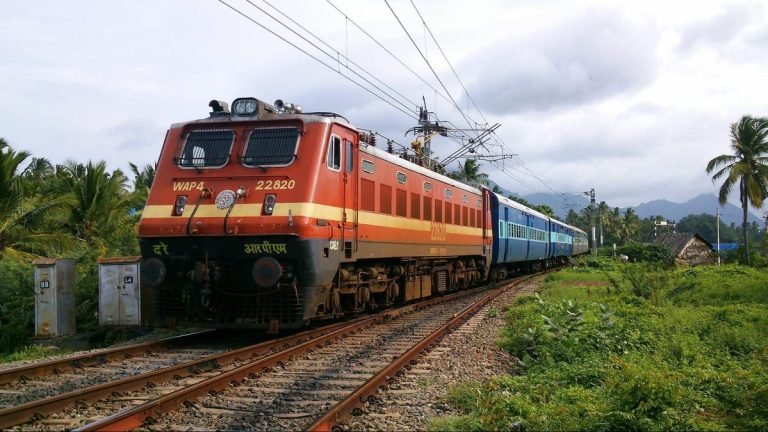
NEW DELHI (Metro Rail News): The New Delhi-Varanasi Vande Bharat Express, Prime Minister Narendra Modi inaugurated the train on February 15 last year, has completed one year in service and become most profitable train in India. This semi-high speed rail began its commercial run from New Delhi-Varanasi two days later from February 17, 2019, logging 3.8 lakh km and a cumulative earning of ₹92.29 crores with 100% occupancy, the Northern Railway stated on Tuesday.

On the basis of the details accessed by Finance Express Online, the redefined percentage occupancy for the New Delhi-Varanasi Vande Bharat Express till February 7, 2020, was 112.59%. Similarly, the redefined percentage occupancy for the Varanasi-New Delhi Vande Bharat Express on the very date was 112.91%. This shows the success of the train in just one year.

It travels the distance between New Delhi-Varanasi in 8 hrs and runs on every day of the week, except Monday and Thursday. It has 16 air-conditioned coaches. The coaches have a stainless steel car body equipped with automatic doors with sliding footsteps, onboard computers for train control and remote monitoring.

Along with that, the coaches also have a GPS-based audio-visual passenger information system, onboard hotspot Wi-Fi and comfortable and spacious seating arrangements. The New Delhi-Katra Vande Bharat Express train also boasts many modern features like bio-vacuum type toilets, wheelchair parking spaces, disabled-friendly toilets, LED lighting.

Maintenance of the train is being done by the Delhi Division of the Northern Railway.

Bids invited for Balance work of Mumbai Metro Line 2B

MUMBAI (Metro Rail News): The Mumbai Metropolitan Region Development Authority (MMRDA) has floated tenders for the balance works on Metro Line 2B from DN Nagar- Mandale with the total distance of 23.643 km long elevated corridor. The estimated expense of the fresh tender is pegged at ₹474.52 cr and it will be completed within 30 months from the date of started of a given contract.

On Wednesday the authority floated 3 separate tenders for the left works along the corridor, that include the construction of a viaduct, 15 stations and the proposed car depot at Mandale in Mankhurd.

It will provide interconnectivity between the existing Western Express Highway, Eastern Express Highway, Western Railway, Central Railway, Mono Rail, Metro Line-1 and Metro Line 2A, Metro Line 4 & Metro Line 3 under implementation.

The 1st tender is for an elevated viaduct and 5 stations work that had been given to a consortium of M/s.MBZ and M/s. RCC for Rs 521 cr. The earlier contractor completed only 4.48% of the work on the 5.9-km stretch in 30 months, sources said.

The RCC-MBZ JV had also been awarded the contract to construct the Metro car depot at Mandale at a cost of Rs 390.44 cr, where it managed to achieve only 6.98% of the work in 36 months. The MMRDA has floated a tender for all these construction works to be completed in 42 months at an estimated cost of Rs 464.75 cr.

The 3rd tender pertains to the work that had been given to Simplex Infrastructure and covers civil works on 12.7 kilometres of the corridor, commencing from ESIC Nagar in Andheri (West) to Income Tax office in Bandra Kurla Complex (BKC). The earlier contract, given for Rs 1,080 cr, also covered the construction work of 10 stations on the stretch. As per the sources, the contractor only managed to do 5.07% of the work in 30 months. In the new tender, the balance works are supposed to be completed in 30 months at a cost of Rs 1,058.71 cr.

The Mumbai Metropolitan Region Development Authority had also terminated the same company’s contract for Metro-7 for slow execution of works, for that it has since floated a fresh tender.

Mumbai Metro Line 2B is supposed to serve almost 10.5 lakh passengers daily once it is commissioned. The line was expected to be operational by 2021, but because of the issues with contractors, the new deadline is the end of 2022.

Delhi Metro launches 250 News e-rickshaws at 12 metro stations

New Delhi, India (Metro Rail News): In a significant boost to provide last-mile connectivity to metro commuters, Delhi Metro Rail Corporation Limited (DMRC) on Feb 19, 2020, extended the facility of e-rickshaw services to 12 more stations spread across the Metro Rail network.

With this, the total tally of stations where such facilities available to 29 with an operational fleet of over 1000 e-rickshaws.

A K Garg, Director (Operations), has flagged off a fleet of around new 250 e-rickshaws, from Patel Nagar Metro. 

These e-rickshaws will be plying from 12 metro stations, i.e. Qutab Minar, Ghittorni, Arjangarh, Nawada, Shadipur, Patel Nagar, Nangloi, Nangloi Railway Station, Govindpuri, Harkesh Nagar Okhla, Moolchand and Botanical Garden between 6.00 am to 11.00 pm every day.

“Till date, to facilitating over one lakh passengers to reach their destinations/stations daily, 800 e-rickshaws being operated from 17 Metro stations. With this addition, the number of e-rickshaws has gone beyond 1,000, covering 29 metro stations,” the DMRC said in a statement.

Twelve more stations are likely to be added in the next 2-3 months wherein around 500 more e-rickshaws will be put into service to strengthen the last mile connectivity

These GPS enabled rickshaws called “SmartEs” having covered cabin and full front windscreen, will provide the last mile connectivity within a radius of 3-4 km around Metro stations. 

The fares have been kept very nominal at a base price of Rs 10 for the first 2 KM and Rs 5/- for every subsequent KM. The commuters can also book vehicles through the SmartE application and pay digitally for their rides, the official said.

In recent years, DMRC has introduced many eco-friendly initiatives to ensure a robust last-mile connectivity system, which enables the commuters to prefer non-polluting public transport modes over personal vehicles. 

MMRDA floated tender for ropeway project

MUMBAI (Metro Rail News): The MMRDA has floated a tender for the proposed ropeway project of the corridor-I between Mahavir Nagar metro station on Metro Line-2A (Dahisar to DN Nagar) to Pagoda in Gorai village on the basis of design, finance, build, operate, and transfer (DFBOT). The authority has programmed a pre-bid meeting of interested firms on February 25 to review the project and assess their suggestions in detail.

As per the MMRDA, the length of this ropeway corridor is around 7.2 km and will have 8 stations. It is aimed at providing direct connectivity to villagers living in Gorai and Marve with the Metro Line-2A. Presently, the citizens here have to cross the creek through a ferry boat regularly to take public transport facilities. The implementation of ropeway service will give an alternative aerial transport mode as last-mile connectivity.

The metro line-2A is supposed to begin construction work by 2020. So far, around 77.62% of the metro civil work is over.

The state-directed in July 2019 the MMRDA to start work on the ropeway project. The erstwhile BJP govt led by former Chief Minister Devendra Fadnavis had asked the Indian Port Rail and Ropeway Corporation Limited (IPRCL) to draft a detailed project report.

Reportedly, in the submitted work plan, the IPRCL had cited the efficacy of New York, Columbia and Turkey ropeways, operating successfully and on the same lines, Mumbai also can introduce the ropeway it said.

UP Govt allocates 644 cr for Kanpur & Agra Metro Project

UTTAR PRADESH (Metro Rail News): The Uttar Pradesh govt in its new Budget 2020-21, introduced in the state Assembly on Tuesday, State Finance Minister Suresh Khanna presented the budget, has laid emphasis on developing metro networks, along with airports and expressways, besides fixing a target to build four lakh houses for weaker sections by March 2021.

Kanpur Metro is a rail-based mass transit system which is under the construction for the city of Kanpur, and extendable to the Kanpur metropolitan area. The feasibility study for the project was done by RITES in June 2015. The study was developed to control traffic woes and congestion, which are hampering the growth, development, and prosperity of the city area. The tenders were floated for the elevated viaduct between IIT to Motijheel. 

Shri Yogi Aditya Nath, the Chief Minister of Uttar Pradesh, allocates a budget of Rs 358 crores towards Kanpur metro phase 1. Construction is in full swing as UPMRC aims to complete phase 1 at a faster pace, as compared to Lucknow metro.

The fourth-largest city in the Indian state of Uttar Pradesh. The feasibility study was conducted in 2016, with the govt allowing the project in early 2019. The Agra Metro is set to consist of two metro lines, with a total length of about 30 kilometres (19 mi). The state budget allocates Rs 286 crore proposed for the construction work of Agra Metro Rail Project.

Besides, there are also many proposals for Metro Rail projects in Gorakhpur and other cities and an arrangement of Rs 200 crore is proposed for the purpose.

Delhi-Meerut RRTS gets 900 crores by UP Govt

LUCKNOW, INDIA (Metro Rail News): Boosting regional connectivity in NCR, the UP govt has allotted Rs. 900 Crore to country’s first Regional Rapid Transit System in the state budget. Previously this year the GoI has allotted Rs. 2,487 crores to RRTS in the union budget.

The Prime Minister of India laid the foundation stone of the Delhi-Meerut RRTS corridor on 8th March 2019. With the meticulous planning and expertise of the National Capital Region Transport Corporation (NCRTC) team the construction work was started immediately. The distance of Delhi-Ghaziabad-Meerut RRTS Corridor is 82 kilometres long. The construction work on the 17 km priority section of the Delhi-Ghaziabad-Meerut RRTS corridor is going on in full swing. The construction work of pillars has been underway between Sahibabad and Duhai. First girder (segment) for the viaduct of Delhi-Meerut RRTS Corridor has been casted at NCRTC’s casting yard located at Vasundhara, Ghaziabad. The viaducts will also be soon visible on the ground. The operation on the main section is proposed from March 2023. The main section has four stations which are Sahibabad, Ghaziabad, Guldhar and Duhai.

At the same time construction work is in progress at other sections as well, initial pile load test is underway among Shatabdi Nagar to Modipuram. Tenders have been floated for carrying out an initial pile load test in Delhi section from Sarai Kale Khan to Anand Vihar Terminal. Tender for design and development of tunnels of Delhi portion by Tunnel Boring Machine from New Ashok Nagar Ramp, New Delhi to Sahibabad Ramp in Ghaziabad has additionally been floated.

Engagement of Detailed Design Consultant for Sarai Kale Khan and New Ashok Nagar RRTS stations including the Multimodal Integration scheme and setting up a stabling yard at Jungpura, Also New Delhi is underway.

Over a design speed of 180 km/h and operational speed of 160 km/h, the RRTS trains will be different and one of its kinds in India. The aerodynamic coaches will be self-propelled on electric traction with 25KV AC System. The RRTS trains are being structured with state-of-the-art advanced technology. The Delhi – Ghaziabad– Meerut RRTS will be immensely helpful in curbing pollution in the zone. The high-speed rail will promise to cover the distance among Meerut and New Delhi in under 60 minutes.

The National Capital Region Transport Corporation, the implementing agency of RRTS is a JV of the Govt of India (50%) and State Govt’s of Haryana (12.5%), NCT Delhi (12.5%), UP (12.5%) and Rajasthan (12.5%). It is mandated to design, construct, finance, operate and manage RRTS in NCR and works under the administrative control of Ministry of Housing & Urban Affairs, GOI.