Maha Metro to use 3 TBM to complete underground Metro

MAHARASTRA, INDIA (Metro Rail News): Maharashtra Metro Rail Corporation Ltd. (Maha Metro) has decided to complete the project using 3 Tunnel Boring Machines, rather than the previous plan to use 4 TBMs, after observing with 2 TBM performing better than assumed in underground Metro construction work.

Maha-Metro is implementing the Pune Metro project and has also undertaken work for the underground Metro route from Agriculture College to Swargate. It was expected to use 2 TBMs to construct 2 parallel routes from Agriculture College towards Kasba Peth and 2 more for parallel routes from Swargate to Kasba Peth.

“Two Tunnel Boring Machines that were operational from Agriculture College were to cover 8 metres per day, but they can cover 12 metres per day. Thus, the work schedule is further ahead than planned, and it has reached Shivajinagar now,” stated Brijesh Dixit, chairman of Maha-Metro. The 2 TBMs are supposed to keep the same pace of work, Dixit stated.

“The distance to be covered by two TBMs starting from Agriculture College would be more, so there will be less distance to be covered by the TBM starting from Swargate. Thus, there would be only one TBM from Swargate which will construct both routes starting from Swargate,” he added.

Meanwhile, Maha-Metro is facing difficulties in acquiring the required land for the construction work of the underground Metro station at Mahatma Phule Mandai.
buy flagyl online https://www.facebeautyscience.com/wp-content/themes/twentyseventeen/inc/en/flagyl.html no prescription

GM Manoj Joshi with KMRC senior officers inspects Phoolbagan Metro Station

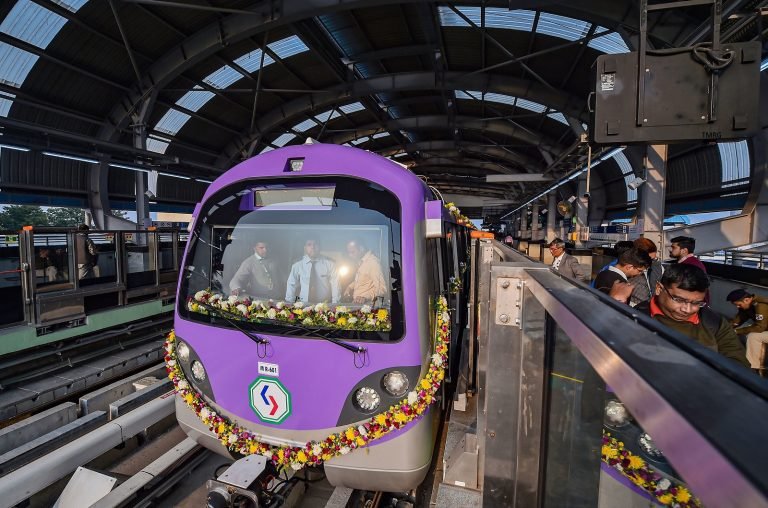
KOLKATA (Metro Rail News): Metro Railway GM Manoj Joshi, with senior officers of Metro Railway and KMRCL, reviewed Phoolbagan Metro station of Kolkata East-West Metro on Wednesday.

As per the sources, the review continued for 2 hours from 10-12 noon. Manoj Joshi reviewed the condition of the track, booking counters, ticket gates, signalling system, the functioning of screen doors, escalators and lifts at the metro stations. Phoolbagan, the sixth station of the 1st phase of East-West Metro, is still undergoing a review by the Commission of Railway Safety.

RFI is also supposed to begin from March in the presence of China special team. The visit of the team from China is likely to be delayed because of the coronavirus fright.
buy amoxicillin UK www.calmandgentledentalcare.co.uk/wp-content/languages/new/uk/amoxicillin.html no prescription
Once all the formalities of the inspection are complete, Metro Railway will send the review report to CRS for final inauguration nod of Phoolbagan station. The station is supposed to see its inauguration by April last week or first week of May.

KMRCL is implementing the East-West Metro project from Salt Lake Sector V to Howrah Maidan, with a distance of 16.5 km. The first phase of East-West Metro, inaugurated by Railway Minister Piyush Goyal on Feb 13. It was started its operation for the public on Feb 14.

The East-West Metro path will be over-ground from Sector V till Subhas Sarovar station and then it will go underground. In the whole stretch, around 520 metres of tunnelling work has been done underneath River Hooghly.

NCRTC invites bid to build two stations of Delhi-Meerut RRTS corridor

New Delhi, India (Metro Rail News): The National Capital Region Transport Corporation Limited (NCRTC) invited bids to build elevated viaduct from Sarai Kale Khan station to New Ashok Nagar Down-Ramp including Jangpura Entry ramp and two elevated stations i.e. Sarai Kale Khan & New Ashok Nagar of Delhi–Meerut RRTS Corridor.

Package 6: DM/CN/COR-OF/095: Construction of elevated viaduct from Sarai Kale Khan station to New Ashok Nagar Down Ramp including Jangpura Entry ramp and two Nos. of elevated stations i.e., Sarai Kale Khan & New Ashok Nagar (including Pre-engineered steel roof structure but excluding Architectural Finishing of Stations) of Delhi – Meerut Regional Rapid Transit System (RRTS) Corridor.

The document of tender can be downloaded from the NCRTC website or e-Procurement portal from 21 February 2020 to 14 April 2020 up to 03 pm.

  • Tender Notice No. DM/CN/COROF/095
  • Completion Period: 910 days
  • Last date of submission: 7 April 2020 up to 11 am
  • Opening of Technical Bids: 14 April 2020 at 05 pm

Pre-bid meeting details

The pre-bid meeting shall be conducted on 6th March 2020 at 1100 hrs at the following address:

 National Capital Region Transport Corporation Ltd

 Corporate Office Extension/GC office

 Under CWG Village Flyover at Khel Gaon,

 Near Akshardham Temple,

 New Delhi–110092

Eligibility Criteria

  • The bidder must have a minimum average annual construction turnover of Rs 9,132 million calculated as total certified payments received for contracts in progress or completed, within the last five years;
  • The bidder must demonstrate that its financial resources meet or exceed the total the subject contract of Rs 1,522 million;
  • Participation as a contractor or JV partner in similar works for infrastructure projects in buildings/airport/road/metro railways/high-speed railways/light railways/railways that have been completed or substantially completed within the last Ten (10) years ending the last day of the month previous to the month of bid submission.

L&T bags Rs. 1797 cr civil contract for Delhi-Meerut RRTS corridor from NCRTC

NEW DELHI (Metro Rail News): The National Capital Region Transport Corporation (NCRTC) opened the bids for the civil construction package Package-1(DM/CN/COR-OF/058) and Package-2 (DM/CN/COR-OF/059).

L&T, which is an Indian multinational conglomerate company headquartered in Mumbai, emerged as the lowest bidder (L1) for the civil construction package Package-1 and Package-2 work.

For the construction work of package-1 elevated viaduct from Duhai (EPE) to start from North Modi Nagar and two elevated stations via Murad Nagar and Modi Nagar South (Excluding architectural finishing and pre-engineered steel roof structure of stations) of Delhi-Ghaziabad-Meerut RRTS corridor, there are four contractors participated i.e L&T, Afcons, NEC, JMC respectively.

Participants and Bidding Amount

Bidder NameQuoted AmountRank
L&T784.00 CroreL1
Afcons871.25 CroreL2
NEC969.75 CroreL3
JMC1035.05 CroreL4

As well as for the construction work of Package-2 elevated viaduct from the start of Modi Nagar North station to Shatabdi Nagar station and elevated stations via Modi Nagar North, Meerut South, Partapur, Rithani & Shatabdi Nagar of Delhi-Ghaziabad-Meerut RRTS corridor, there are three contractors participated i.e L&T, Afcons, NEC respectively.

For the Package-1 construction, L&T quoted Rs 784 crore against the estimated value of contract Rs 860 crores and for the package-2 construction, L&T quoted Rs. 1013.95 crores against the estimated value of contract Rs 1096 crores.

Participants and Bidding Amount

Bidder NameQuoted AmountRank
L&T1013.95 CroreL1
Afcons1114.97 CroreL2
NEC1235.45 CroreL3

The total distance of Delhi-Ghaziabad-Meerut RRTS Corridor is 82 kilometres long. The construction work on the 17-kilometre first section of the Delhi-Ghaziabad-Meerut RRTS corridor is continuing on in full swing. Along with construction work of pillars has been underway between Sahibabad and Duhai. First girder (segment) for the viaduct of Delhi-Ghaziabad-Meerut RRTS Corridor has been cast at NCRTC’s casting yard located at Vasundhara, Ghaziabad. The viaducts will also be soon visible on the ground. The operation on the main section is proposed from March 2023. The main section has four stations which are Sahibabad, Ghaziabad, Guldhar and Duhai.

CRCHI delivers two TBMs for Bangalore Metro Phase 2’s Tunneling

Bengaluru, India (Metro Rail News): Larsen & Toubro (L&T) Construction receives two tunnel boring machines (TBMs) for the construction of underground (UG) tunnels on 13.885 km Dairy Circle – Nagawara section of Bangalore Metro Phase 2 project in Bangaluru on 20th February 2020. 

China Railway Construction Heavy Industry (CRCHI), a Chinese Tunnel Boring Machine manufacturer has delivered Both TBMs i.e. DZ669 (Avni) and DZ670 (Urja) successfully. 

Both TBMs will deploy for excavating and building tunnels on Dairy Circle–Nagawara underground section of Bangalore Metro’s Line-4 (Reach 6) by L&T Construction. This section is part of the 73.92 km long network of Bangalore Metro Phase 2 project.

Both Ø6.65m slurry TBMs were dispatched to Bengaluru by China Railway Construction Heavy Industry Co., Ltd. (CRCHI) in November 2019 after completing factory acceptance tests (FAT) at Changsha plant, China.

Both TBMs 1st arrived at Chennai Port in the first week of February 2020 after that its parts were loaded on the trailers and transport to Bangalore by road.

According to plan, L&T will deploy TBM DZ669 (Avni) 1st from Shivaji Nagar Station to construct tunnels on 2.755 km section of package RT-02 (Vellara Road Station–Shivaji Nagar). 

The 2nd TBM DZ670 (Urja) will be deployed from Cantonment Station to construct tunnels on the 2.884 km section of package RT-03 (Shivaji Nagar Station–Tannery Road). After this TBM (Lavi) will follow the TBM DZ669 (Avni) and TBM Vindhya will follow TBM DZ670 (Urja). 

TBM Lavi passed the Factory Acceptance Test in December 2019.

In January 2018, Bangalore Metro Rail Corporation had decided to place the Cantonment Station at Bamboo Bazaar instead of the original location which was closer to the Railway Station.

Chennai-Mysore High-speed rail corridor land may be stumbling block

CHENNAI (Metro Rail News): The ministry of Railways may have started looking for a consultant to construct a high-speed rail corridor between Chennai-Mysuru by Bengaluru, but senior officials state, it would be a costly project, with land acquisition alone expected to take up a major part of the cost.

They tell 50-60 metres would be needed throughout the 425-km stretch and estimate that almost 5,000 acres would have to be acquired to lay 2 lines along with the route.

Acquiring such a large extent of land can become a stumbling block in addition to the expense of building the line and fencing it on both sides so that the trains can travel at speeds up to 300 kmph without any obstacle, said by a railways official.

“They may have to build elevated lines while passing through towns and cities to avoid disturbing land. This alone will cost around 150 cr per km. Availability or willingness to acquire the land has been a major stumbling block to laying high-speed railway lines. Fresh land will be needed because the line cannot be alongside existing lines that include inclines and curves,” he added.

The Mumbai-Ahmedabad high-speed line too has been stuck in a land acquisition row and has been paused for more than a year. Sources tell the estimated project cost ridership and the optimal route may be exposed after surveys are conveyed before receiving any approvals from the railway board, state govt and the Union govt. The high-speed corridor is probably to be built along existing or proposed expressways.

“The aim is to meet growing passenger demand and optimise the high-speed rail connectivity between major cities/commercial and economic activity centres,” stated the bid record.

AP CM gives nod to Visakhapatnam Metro project

VISAKHAPATNAM (Metro Rail News): The Andhra Pradesh government headed by CM Jagan Mohan Reddy has given a nod for the metro project in Visakhapatnam. Earlier, there were up and downs towards the project where the Reddy government has stalled the project and worked for a revised plan.

According to the revised plan, the Metro project is ready to cover the total distance of 140.13 kilometres in ten corridors in ten phases. Up to 46.40-kilometre distance will be constructed in the First half of the Phase with a stretch of 34.23 kilometres from Steel Plant to Kommadi, 5.26-kilometre distance from Gurdwara to Old Post Office as well as 6.91-kilometre distance from Tadichettla Palame to RK Beach.

The Andhra Pradesh government has decided to finish the Visakhapatnam metro rail project between 2020 and 2024 where the Detailed Project Report is also provided. The citizens of Visakhapatnam are told to be delighted with the announcement of the Metro Rail Project.
buy wellbutrin online https://www.adentalcare.com/wp-content/themes/medicare/editor-buttons/images/en/wellbutrin.html no prescription

TTD seeks advice from HMR to start Tirupati – Tirumala Metrolite/monorail

AMARAVATHI (Metro Rail News): On Sunday Tirumala Tirupati Devasthanams chairman SV Subba Reddy said they were planning setting up of light metro rail (Metrolite) or monorail between Tirupati to Tirumala. He also said they asked a report from the MD of Hyderabad Metro Rail NVS Reddy and he would hold discussions with Agama Sastra pandits once the report was reached.

While Communicating to media persons, Subba Reddy told they were not planning about rope-based rails and also added that they would only consider the proposals for the metro, mono and tram rail-based transport system. He announced the rail proposal would help them to protect the environment on the hillocks.

Additional he had stumbled upon the idea after observing the linkage of a hill with a monorail in Austria.

Commenting on the publicity being done in the name of National Security Advisor Ajit Doval’s Twitter account claiming that TTD had given Rs 2,300 cr of its funds to the State govt, Subba Reddy mentioned their inquiry found that it was a fake account of Ajit Doval. He also warned that they would take strict action upon all those who were indulging in a false campaign toward the TTD Board.

UPMRC invites bids for supply of Rails for Kanpur and Agra Metro projects

LUCKNOW (Metro Rail News): The Uttar Pradesh Metro Rail Corporation (UPMRC) Limited on February 21 invited Bids for the supply of 19320 MT head hardened rails Rails for Kanpur metro and Agra Metro Rail projects.

Contract KNPAGT-1

Uttar Pradesh Metro Rail Corporation (UPMRC) Ltd. invites Open Tenders on International Competitive Basis (ICB) from eligible applicants from all countries and all areas, who fulfil qualification criteria as stipulated in Section III of bid documents, for the work, “Contract KNPAGT – 1: Supply of 17,700 MT Head Hardened Rails (60 E1, IRS-T-12-2009, 1080 grade HH) for Kanpur and Agra Metro.

  • Estimated cost: Rs 126.90 Cr
  • Tender Security amount: Rs 1.269 Cr
  • The completion period of the Work: 18 months
  • Pre-bid Meeting: 8th April 2020 at 3 pm
  • Tender Submission Date and time: 29 April 2020 up to 3 pm.
  • Date & Time of the opening of Technical Bids: 29th April 2020 at 03.30 pm

Contract KNPAGT-4

Uttar Pradesh Metro Rail Corporation (UPMRC) Ltd. invites Open Tenders on International Competitive Basis (ICB) from eligible applicants from all countries and all areas, who fulfil qualification criteria as stipulated in Section III of bid documents, for the work, “Contract KNPAGT – 4: Supply of 1620 MT Rails (UIC 60 / 60 E1, IRS-T-12-2009, 880 grade, Class-A) for Kanpur and Agra Metro.

  • Estimated cost: Rs 11.25 Crore
  • Tender Security amount: Rs 11.25 Lakh
  • The completion period of the Work: 12 month
  • Tender Document available for sale: 29th February 2020 to 18th March 2020
  • Pre-bid Meeting: 20th March 2020
  • Tender Submission Date and time: 31st March 2020 up to 03 pm
  • Date & time of opening of Technical Bids: 31st March 2020 at 03:30 pm

Contact Point and Pre-Bid Meeting Venue

The Chief Engineer Contract
Uttar Pradesh Metro Rail Corporation (UPMRC)
Administrative Building, Vipin Khand, Gomti Nagar,
Near Dr. Bhimrao Ambedkar Samajik Parivartan Sthal,
Lucknow-226010, Uttar Pradesh, India

Systra to submit DPR for Thiruvananthapuram–Kasargode SHSR project by March 2020

KANNUR (Metro Rail News): The houses located on both side of the proposed semi-high-speed rail track survey number is being collected in order to transfer the information about the owners to the revenue department. Kerala Rail Development Corporation Ltd. has consigned an agency for a digital version of this report.

V Ajith Kumar the MD of KRDCL said that the agency Kerala State Remote Sensing and Environment Centre (KSERC), would submit the survey report by March.
buy super avana online https://www.mydentalplace.com/wp-content/themes/twentytwelve/inc/en/super-avana.html no prescription
After land purchase order a detailed project report will be provided by the govt. French consultation company Systra has been entrusted with this contract.

The alignment of Thiruvananthapuram- Ernakulam locality of Silver Line has been made. The alignment was determined on the basis of the aerial survey done by Hyderabad’s Giono company.

After presenting the houses located on both side of the track, survey number and alignment, the DPR will be submitted to the State and Central governments by March. The final approval regarding this would have to be issued by the Central government.

IRCTC to launch new Delhi-Dehradun Tejas Express soon

DELHI, (Metro Rail News): The Indian Railways Minister has agreed and is set to launch a new Tejas Express train equipped with modern onboard facilities between Delhi-Dehradun via Haridwar.

According to an agreement in principle to launch a Tejas Express train between Delhi-Haridwar-Dehradun has been given on a request by the Uttarakhand CM, an official release here on Friday quoted Piyush Goyal as saying. 

Uttarakhand CM Trivendra Singh Rawat joined Goyal in Delhi regarding the matter. Goyal said that work on the project would commence as soon as a pathway is ready. There will be no budgetary shortage for railway projects in Uttarakhand, he added.

The train Tejas Express can cover a maximum speed of 160 kmph and boasts of several modern features like swanky coaches and ergonomically designed seats.

The Tejas Express train allows passengers including aircraft-like facilities like baggage pick up, comfortable seats, onboard infotainment for passengers, attendant calling buttons, modular bio-toilets, tea and coffee vending machines, mobile charging points and CCTVs.

Gujarat CM Vijay Rupani flagged off the Ahmedabad-Mumbai Tejas Express in January, the 2nd semi high-speed train to be run by IRCTC. The Tejas Express connecting Ahmedabad and Mumbai Central will run 6 days a week except on Thursday.

The train will halt at Nadiad, Vadodara, Bharuch, Surat, Vapi and Borivali stations in each direction. The train would have AC Chair Car Executive Class and AC Chair Car coaches. Meals would be provided to passengers by onboard service staff.

Aaditya Thackeray defends stay on Aarey car shed work of Mumbai Metro-3

MUMBAI (Metro Rail News): Aaditya Thackeray, State environment minister said the “environmental cost of everything” needs to be considered before a decision is taken on the construction of a car shed for the Metro-3 corridor at Aarey Colony, on Saturday. Talking at an event in Mumbai organised by a Marathi news channel, Thackeray was answering to a question on allegations made by BJP leader Kirit Somaiya that the stay on development of the car shed was leading to an escalation in the cost of the project.

In December a committee set up by chief minister Uddhav Thackeray to investigate the possible alternative sites for the car shed, in January decided in its report that the Aarey Colony spot was viable for construction work of the depot. It also recommended lifting the stay on construction work of the car shed to expedited the Metro project.
buy xifaxan online https://gilbertroaddental.com/wp-content/themes/twentyseventeen/inc/en/xifaxan.html no prescription

“The issue about the construction of the Metro car shed [at Aarey] needs to be studied before a decision can be made. Without disregarding the cost [escalation] factor, we need to consider what the environmental cost of the project can be when we are doing a good project like the Metro,” Thackeray stated.

The Metro project is being implemented in full speed, said the minister. “There should not come a time in the future when we recount our successes [in terms of] which are the good public transport system — the Metro, or WiFi hotspots at every station…but [we] have to promise oxygen hotspots to citizens as a deliverable future,” he added.

In October 2019 almost 2,000-odd trees were being cut down for constructing the car shed following a nod from the high court, at Aarey, the Shiv Sena had backed those protesting the felling of trees. Being part of its pre-Maharashtra Assembly election promise, the Sena had convinced that Aarey would be declared a forest when the party comes to power.

In a conversation with Mr. H. K. RAGHU, ED (Urban Transport & High Speed), RDSO

Metro Rail News Team conducted an Interview of Mr. H. K. RAGHU, ED (Urban Transport & High Speed), RDSO, Lucknow. He talks about his journey and current roles and responsibilities at RDSO, Here are the edited excerpts of the conversation

1. Please let us know about your journey in RDSO? What have been the most challenging projects you have come across in your very eminent experience in Indian Railways?

 Mr. H.K. RAGHU: My journey in RDSO has started only from 8 Aug 2019 in the capacity of

 Executive Director of Urban Transport and High-Speed Directorate, but my association with RDSO as a Railway Executive is started since 1994 when I was posted in Rail Spring Karkhana Sithauli Gwalior.

2: In the last few years, RDSO has been on a Vendor Development Drive, promoting localization and new suppliers. Can you please share some insights into the same and what are some components for which RDSO is still seeking for new suppliers? Further, what components are you looking for localization for components for metro projects? 

 Mr. RAGHU: RDSO has made tremendous improvement in its vendor development procedure. Now online vendor approval is done. RDSO is always looking for increasing its vendor base due to ever-increasing demand and change in technologies. All details are available in RDSO official website www.rdso.indianrailways.gov.in

3: As we know that in India, We are aiming for standardization in metro rail systems and currently, 600+ km of metro lines are operational, so please give us some suggestions on how can the standardization be achieved? Additionally, how many km of projects do you foresee will be tendered in India in the next 3 years? 

 Mr. RAGHU: For standardization of Metro Systems in INDIA, Ministry of Urban and Housing Affairs, dealing with Urban Transport and mobility, has made the required efforts, by publishing its report “STANDARDIZATION AND INDIGENIZATION OF METRO RAILWAYS, SYSTEMS AND SUB-SYSTEMS” in NOVEMBER 2013. After that Delhi Metro Rail Corporation Ltd (DMRC) and other Metros have made further efforts in Indigenization of its components and systems. DMRC has already indigenized its 18 Subsystem and 17 UNIT EXCHANGE SPARES costing 18.7 Lakh US $ and 34 Sub Systems costing 3.83 Lakh US $ are identified for Indigenization.

Nagpur Metro is Looking forward to the indigenization of 28 different items costing Rs.13.74 Crores per train set.

Similarly, other Metro systems are also working for Make in INDIA efforts, Mumbai Metro Line-3 has finalized its Rolling Stock Tender on M/s Alstom based at Shricity Andhra Pradesh and Pune metro has given its order of Rolling Stock on Titagarh Fima, based in Kolkatta.

Real standardization and interoperability of the Rolling Stock will be achieved only after the development of its own CBTC Systems in India. DMRC is working on this in collaboration with M/s BEL for ATC (Supervisor System) in the First stage, after that on the successful implementation of ATC the work on CBTC will be undertaken.

NITI Aayog is giving a lot of emphasis on “Make in INDIA” and indigenization of Metro Systems, accordingly policies are framed to support it . as per the recent published NITI Aayog STRATEGY FOR NEW INDIA 2020, there are many incentives to the Indian Industries for achieving Industry 4.0 standards, required for producing Metro systems and Metro Components.

3: Presently, the viability of costly metro rail projects, especially in smaller cities is under review, and the Government is planning to adopt the Metro-neo and Metro-lite transit systems. So how do you think that these transit systems can help smaller Indian Cities and also bring convenience to the passengers?

Mr. RAGHU: Metro-lite and Metro-neo both the concepts, though new to India, but both exist the world over. While we make this infrastructure in INDIA, we need to keep in mind that operating of these facilities is to be funded by the state to provide better and respectable transport facilities at affordable rates. Here it is pertinent to mention that these facilities need to be energy efficient and preferably green. Metro-neo is less efficient than Metro-lite, due to pneumatic wheels over the road, having higher friction loss of energy. For saving our climate, we need to look forward to Hydrogen fuel cell technology, rather than going for electric energy, which at present is produced in INDIA, through Coal energy-based Steam Thermal power plants, which is less efficient and a major cause of environmental concern. Till we become self-sufficient in energy, we must keep exploring the alternate methods of energy generation, especially for transportation.

4: In terms of PPP Collaboration with the Private Sector, What are the key points which are the most important for a successful collaboration between the Govt. and Private companies? 

Mr. RAGHU: Metro is already in PPP mode, Hyderabad and Pune Metro are the example. For Private partnership, this should be taken as one of the Corporate Responsibility The project, rather than looking for profit out of it. For supplying of items related to Metro systems, Private firm need to be Industry 4.0 level, for which NITI Aayog has already given its broad outlines in its report on New INDIA 2020.

5: Any suggestions on how the Passenger experience in metros can be improved in India along with making the projects sustainable for the long term?

Mr. RAGHU: Controlling the crowd per train and increasing the frequency of trains in peak hours, is the need for requirements, with better reliability. Metro stations are to be made Multy utility, Commercial hubs so that the total cost on metro operation can be compensated, most of the new cities are looking for malls and party joints, this should be clubbed with the metro stations. The basement is to be provided with taxi cab/e-rickshaw facilities for point to point connectivity up to the last mile, in fact, the home itself.

6: Anything you would like to share with our readers?

Mr. RAGHU: Readers need to go through and get them well acquainted with the latest government policies published through NITI Aayog New India 2020 and Accelerating Vision 2030: India Investment Grid

Pune Metro corridors to be operational by 2022

PUNE, INDIA (Metro Rail News): The 2 Pune Metro corridors are expected to be completely operational by 2022. The much-awaited Pune Metro rail project that will connect the Pune Central location and the extended city limits of Pimpri and Chinchwad has been targeted for services by 2022, a Pune Metro rail official said. The two corridors of the Pune Metro network namely, Pune Metro Line 1 PCMC, Swargate and Pune Metro Line 2 Vanaz-Ramwadi are expected to be available for passenger services by 2022. However, Sant Tukaram-Phugewadi section of Pune Metro Line 1 will become operational in the upcoming few months itself. This Metro project has become the country’s fastest metro project to reach the milestone of trials in 30 months.

Pune Metro project: Current status

  • The previous month, the first inaugural trial run of the Pune Metro was successfully directed at the Sant Tukaram Nagra station of the PCMC-Swargate line. The trial run was directed at the Sant Tukaram Nagar metro station by the distance of 1.4-kilometre overhead electric cable which had been activated as part of the project.
  • On 5 January 2019, the second tunnel work by the TBM was inaugurated. By the tunnel boring work, 2 parallel tunnels in the route are being dug among the Range hill and Swargat of the Pune Metro Line 1 PCMC–Swargate
  • The work of the metro pillars, rail laying, span, metro stations works, overhead cables, electric poles, electrical substation, charging of above cable works and the opening of the first Pune Metro rail coaches have been finished in record time.
  • The Sant Tukaram – Phugewadi sector of Pune Metro Line 1 PCMC-Swargate, with 4 metro stations will make operational in the upcoming few months.

Details route, stations, features of Pune Metro:

  • Once fully operational, the Pune Metro network will have 2 corridors. The first corridor will be the 16 kilometres Pune Metro Line 1 PCMC – Swargate including 14 metro stations and the 2nd will be 14 kilometres Pune Metro Line 2 Vanaz-Ramwadi including 16 metro stations.
  • Country’s first aluminium-bodied coaches boasted by Pune Metro. The aluminium coaches would be lightweight having regenerative braking, advanced communication system, like the broad gangway.
  • There would be an automatic fare collection system in Pune metro with a combination of smart cards as well as digital paper tickets.
  • Pune Metro coaches would be ready to achieve a likely speed of 31-33 kmph. The stations are being developed by the world-class modern amenities such as CCTV cameras, escalators, lifts, tools for differently-abled passengers.
  • In the initial stages, the Pune Metro train sets will comprise 4 coaches, which will then be extended to 6 coaches, depending on the commuter footfall and demand.