Mumbai Metro 3: MMRC completes nearly 100% Breakthrough

MUMBAI (Metro Rail News): The Mumbai Metro Rail Corporation (MMRC) has said that it is only nine more breakthroughs away from achieving 100% tunnelling for Mumbai Metro 3 project. Once it completes nine more breakthroughs, it will complete the tunnelling. MMRC said that it has achieved 32 breakthroughs, a length of about 48-km out of the total length of 54.5-km.
“MMRC is only nine more breakthroughs away from achieving 100% tunnelling. The remaining nine breakthroughs will be achieved in package Nos. 1, 3, 4, and 6,” the Metro Corporation said in a statement.

Subodh Gupta, Director (Projects), MMRC said that the tunnelling process in Mumbai is extremely challenging as the alignment passes through densely populated parts.

“Tunnelling in Mumbai is extremely challenging as the alignment passes through densely populated and congested parts of the city. In addition, there are high-rise, heritage, and dilapidated buildings; flyovers, metro viaducts, and railway lines in close proximity. The entire alignment passes through rocky strata. To achieve this task 17 TBMs were working simultaneously at one stage”, He said. Recently, MMRC achieved a 32nd breakthrough of the 1.10-km long tunnel from Siddhivinayak north shaft to Dadar Metro Station.
The overall progress of Dadar Metro Station is 61%. Package-4, which consists of Dadar, Siddhivinayak, and Shitladevi Metro Stations, showcases an overall 94% tunnelling progress and 95% of the excavation work.

KMRL completes all major surveys for regenerating canals in Kochi

KOCHI (Metro Rail News): Kochi Metro Rail Limited has completed all the major surveys for the coveted IURWTS (Integrated Urban Regeneration and Water Transport System) project aimed at regenerating the canals in Kochi.
KMRL undertook the project last year on the orders of the state government and awarded the work to Antea Nederland BV (Netherlands) for the development of the concept, master planning and detailed design. KMRL is reviving six major canals in the city named Edapally Canal, Chilavanoor canal, Thevara – Perandoor canal, Thevara canal, Market canal. and Konthuruthy canal. 
“KMRL has completed all major surveys within a short span of time. Detailed Project Report has been prepared and submitted for approval to the State Government. We have lined up the course of action including cleaning of canals, rehabilitation of affected persons, shore protection and canal oriented developments, thus bringing life back to the canals in Kochi ” said Alkesh Kumar Sharma, MD, KMRL.
Alkesh Kumar Sharma who is also the Additional Chief Secretary for special projects in the state added that KMRL has big plans for the city. “Through this project, we will bring these canals to the erstwhile glory which shall be reminiscent of the nostalgic past where navigation was possible. KMRL is also looking to develop more lung spaces along the banks of these canals” he said.
KMRL has completed the most advanced LIDAR survey for getting the topographic details and to map the sub drains, which are falling into the canals. It has also completed the Social Impact Assessment Study, water quality studies and Bathymetric Survey.
Geotechnical bore-hole investigation at 56 identified locations for understanding the soil characteristics and lithology along the canals is nearing completion. The major portion of floodplain analysis and water-balancing studies is being done in the Netherlands and the same is expected to be completed by the end of this month.
 As the project area falls under the CRZ zone, KMRL had submitted an application before the Ministry of Environment, Forest and Climate Change and ministry has sanctioned the Terms of Reference for various mandatory clearance to be obtained. Kerala State Pollution Control Board has approved the Consent to Establish (CTE) and wildlife clearance from the forest department is expected shortly. The application for Wetland clearance has been submitted by KMRL to Kochi Corporation.

Land identification and acquisition proposals are also progressing fast. As part of the social upliftments aspects of the project, persons residing along the canals banks will be resettled in a full-fledged housing complex that is being built to accommodate all those homeless. The land has been identified in kakkanad and the acquisition process is progressing fast.
As part of Urban, Regeneration KMRL has plans to implement Canal Oriented development (COD) Projects. The activities included are initial cleaning, widening, deepening to maintain the cross-section for flood mitigation and navigation, and bank protection and regular protective measures. 
KMRL is planning to make the canals navigable to the possible extent and it will have intermodal connectivity with the Kochi Metro Rail, Water Metro and the road network. KMRL also envisages on developing water sports facilities, sports complex etc.
Special focus will be given to the development of sewerage systems and their management. Sewage management is addressed by laying primary sewer networks along the canals and the secondary networks to individual households.

L&T emerges as the lowest bidder for Delhi – Meerut RRTS Line’s Package 7

NEW DELHI (Metro Rail News): Larsen & Toubro today emerged as the lowest bidder for the construction of around 12 km long elevated Package 7 of the 82.15 km Delhi – Meerut RRTS Line, after officials from the National Capital Region Transport Corporation (NCRTC) opened financial bids submitted by different infrastructure companies.
This section on the main-line with 5 stations consists of 2 disjointed parts on either side of Meerut city and will be connected by the underground Package 8 for which technical bid evaluation is underway.
The work includes the northern end of Shatabdi Nagar to Brahampuri DN Ramp with 1 station at Brahmapuri (approx 2 km) Begumpul UP Ramp to Modipuram with 4 stations at MES Colony, Daurli, Meerut North and Modipuram (approx 10 km)NCRTC had invited tenders for this package in April 2020 with an estimate of $103.72 million (approx. Rs 757.23 crore) with a work completion period of 910 days (2.5 years). Technical bids had been opened in July to reveal 5 bidders.

Tender No: Package 7 – DM/CN/COR-OF/108
Scope of the work includes Construction of elevated viaduct from the end of Shatabdi Nagar Station to Brahmpuri DN ramp and from Begumpul UP Ramp to Modipuram end including Modipuram Depot entry Ramp and 5 elevated stations of Delhi – Ghaziabad – Meerut RRTS Corridor. 4 out of 5 stations in this package – the ones at Brahmapuri, MES Colony, Daurli and Meerut North – will exclusively serve Meerut’s local metro system and serviced by ten 3-coach Bombardier trains

The details of the bid are as follows :

Firms along with bid values submitted by them:

Larsen & Toubro (L&T) Ltd. – Rs. 723.35 crores

Afcons Infrastructure Ltd. – Rs. 736.46 crores

NCC Ltd. – Rs. 749.22 crores

Dineshchandra R. Agrawal Infracon Ltd. – Rs. 758.39 crores

DBL – Sam India JV – Rs. 774.82 crores

Indian Railways receives 120 applications in response to private train RFQ

NEW DELHI (Metro Rail News): Firms like L&T, GMR, Welspun are among the 15 companies from which the Railways has received over 100 applications in response to the Request for Qualification (RFQ) for PPP in passenger train operations, according to a statement issued by the ministry. Out of the 15 applicants, 14 are Indian firms while one is a Spanish company. The firms which have made the applications for the clusters include Arvind Aviation, BHEL, Construcciones y Auxiliar de Ferrocarrriles, S.A, Cube Highways and Infrastructure III Pvt Ltd, Gateway Rail freight Limited, GMR Highways Limited, Indian Railway Catering and Tourism Corporation Limited, IRB Infrastructure Developers Limited.

The others are L&T Infrastructure Development Projects Limited, Malempati Power Private Limited, Megha Engineering and Infrastructures Limited, PNC Infratech Ltd, RK Associates and Hoteliers Pvt Ltd, Sainath Sales and Services Pvt Ltd and Welspun Enterprises Limited. In all 120 applications have been received for the 12 clusters, from 15 applicant firms,” the ministry said in a statement. It may be noted that Ministry of Railways (MOR) had invited Request for Qualifications (RFQ) for private participation in the operation of passenger train services over 12 Clusters comprising 140 Origin Destination pair of routes through the introduction of 151 modern trains to increase high-quality trains operated on the network, it said.

This includes 12 applications each for the Delhi 2 and Mumbai 2 clusters, 11 for the Bengaluru cluster, 10 applications each for the Prayagraj, Secunderabad, Jaipur and Delhi 1 cluster and nine each for Chandigarh, Howrah, Patna, Mumbai 1 and Chennai. The Railways had invited RFQs for private participation in the operation of passenger train services over 12 clusters comprising 140 pairs of routes through the introduction of 151 modern trains on the network. This is the first major initiative to attract private investment for running passenger trains over the Indian Railway network. The project is expected to entail private sector investment of about Rs 30,000 crore. The private entities for undertaking the project would be selected through a transparent two-stage competitive bidding process comprising of Request for Qualification (RFQ) and Request for Proposal (RFP).

“The RFQs for 12 clusters were published on July 1. MoR will expeditiously complete the evaluation of applications and RFP documents will be made available to the qualified applicants by November 2020. MoR has targeted to award all the clusters by February 2021,” it said.

Union Cabinet approves Rs 8,575 crores for Kolkata East-West Corridor Metro project

NEW DELHI (Metro Rail News): The Union Cabinet on Wednesday approved the railway ministry’s proposal to construct the Kolkata East-West Metro Corridor project at a revised cost of ₹8,575 crores. The metro project is expected to ease congestion, improve urban connectivity and offer cleaner mobility solution for daily commuters in Kolkata. The total length of the route under the project is 16.6 km, comprising 12 stations. This will include the construction of a metro corridor between Salt Lake Sector-V to Howrah Maidan in West Bengal.

The project is being implemented by a special purpose vehicle Kolkata Metro Rail Corp. Ltd set up under the Ministry of Railways. Railway Minister Piyush Goyal said that the project was approved 12 years ago, with an investment cost of ₹4,000 crores. However, there were delays and the project was stuck due to land acquisition and other issues. The project work started afresh in 2015, in coordination with the state and the central government.

“This project will take mass rapid transport to new heights in Kolkata and will be completed in 14-15 months,” Goyal said in a virtual briefing. An official statement said that the pre-pandemic target for completion of their project was December 2021. “Efforts are being taken to minimise the impact of the pandemic on completion of the project. The project includes immense technological challenges like tunnel below river Ganges which is the 1st transportation tunnel in India under any major river as well as Howrah station, which is one of the deepest metro stations in India,” it said. The trainsets are being made by state-owned by BEML, giving a boost to the government’s vision of a self-reliant India, the minister added.

The project will create transit connectivity between the business district of Kolkata with the industrial city of Howrah in the west and Salt Lake City in the east through a safe, accessible and comfortable mode of public transport.“Since this corridor connects three most important parts of the Kolkata Metropolitan Area. This will connect important landmarks like Howrah, Sealdah, Esplanade and Salt Lake Sector-V which is an IT hub,” the statement said, adding that the project will integrate multiple modes of transport like the metro, suburban railways, ferry and bus transport by constructing interchange hubs.

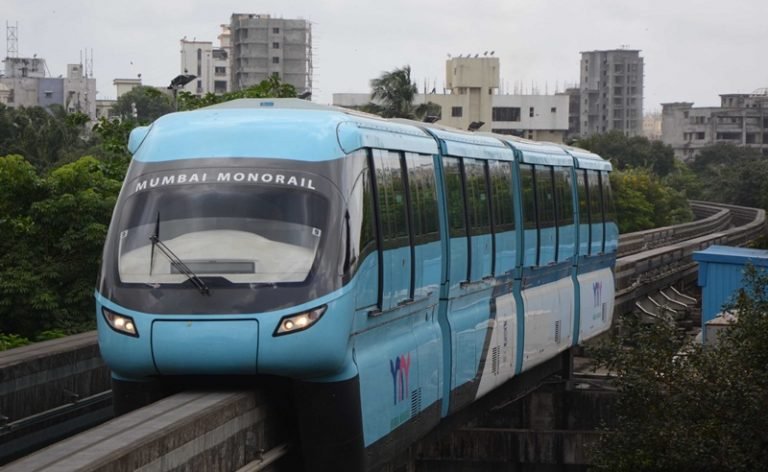
Many firms including few international ones keen for Mumbai Monorail rake bid

MUMBAI (Metro Rail News): After scrapping the last bid in which two Chinese companies had shown interest in manufacturing rakes for the Mumbai Monorail, the Mumbai Metropolitan Region Development Authority (MMRDA) has received a good response from national and international companies in its revised tender.
MMRDA had widened the scope of the tender to suit the Central government’s ‘Atmanirbhar Abhiyan’ or self-reliance policy. According to a senior official, national companies like Bharat Earth Movers Ltd (BEML), Bharat Heavy Electricals Limited (BHEL), Titagarh Wagons, Medha and ABB Group, and international companies like Cosmos, Intamin and Chinese companies CRRC Corporation Ltd and BYD Co Ltd have shown interest in manufacturing the 10 rakes. CRRC and BYD were the two companies that had participated in the last bid. However, MMRDA scrapped it, stating that the firms were asking for too many changes. This is MMRDA’s third attempt at procuring rakes.

The first bid was floated in early 2019. The 10 additional rakes are crucial to improve the frequency of the monorail and attract more commuters. “The tender document has been modelled in line with Atmanirbhar Abhiyan and Make in India policy, and also the government order of July 2020, where countries sharing land borders with India have to register with the government,” said an MMRDA official.
In July 2020, the Centre said that companies from nations that share a border with India will be barred from bidding for government contracts for goods and services until they register with the industry department. It said the decision was taken to “strengthen the defence of India and national security”.
The official, who did not wish to be named, said that MMRDA has received more than 150 queries on technical, financial and contractual clauses of the tender document. The last date for bid submission is November 3. The Mumbai Monorail is a 19.5-km corridor between Chembur and Jacob Circle.

Struggling L&T Metro asks for Financial assistance from Telangana Government

HYDERABAD (Metro Rail News): L&T, the promoter of the Hyderabad Metro rail, has sought financial assistance from the Telangana state government to save it from a wrenching cash crisis triggered by the coronavirus lockdown. The financial bailout will enable the metro corporation to stand on its feet and avoid huge losses, said people familiar with the matter. Hyderabad Metro was closed for months together during the lockdown. The metro rail has been operating at 50 per cent capacity since resuming operations.

Even so, commuters have been staying away for fear of contracting COVID-19, and this is preventing the metro from scaling up operations, making any recovery difficult. A Hyderabad Metro Rail (HMRL) official spokesperson said: “Due to the huge financial burden on us we are exploring different options with stakeholders. Though inevitable this situation has caused serious financial loss.” L&T didn’t respond to queries. The amount of “financial assistance” being sought has not yet been made public although the spokesperson said the losses were “serious”. An estimated loss of Rs 300 crores is thought to be incurred on the L&T Metro according to sources.

An official said, “our primary focus is to continue operations adhering to safety norms to keep passengers safe,” and did not reveal the exact amount sought. The Telangana government, itself facing a severe financial crunch, has been keeping mum on the matter. The sources knowing about the developments told that the state government is in a bind because it knows that the promoter, L&T, could well attempt to take recourse to the ‘force majeure’ clause in the concession agreement to threaten to walk out of the project in the case of unforeseen events.

Hyderabad Metro can invoke the clause to not abide by the terms of the agreement in the case of unforeseen events as defined under the section on force majeure. However, there is a catch: the metro was non functional for 169 days and the force majeure clause can be invoked if the metro remained shut for 180 days. This is seen as the reason why it has sought financial assistance instead of taking the force majeure clause.

Kochi Metro to achieve 60% Energy neutrality by December

KOCHI (Metro Rail News): Kochi Metro Rail Limited is well on its way to achieving 60% energy neutrality by utilising solar energy and in line with its objective to achieve energy neutrality, KMRL has successfully commissioned 3 large-scale solar power generation systems in the past two years.
“The first phase of the project, which is 2.670MWP in capacity and capable of generating 36.5 Lakhs Unit/Year was implemented through RESCO (Renewable Energy Service Company) in 2018. This contributed to 60% of the total energy consumed at that point in time”, a statement said.
However, the neutrality was reduced by half to 30% with the opening of new stations in the Maharajas-Thykoodam stretch.
KMRL will be commissioning an additional 5.4MWP capacity system on its buildings and tracks in 2020 to increase the output to 1.57 Crore Units/Year and maintain 60% energy neutrality.
“We are pushing for maximising the solar energy generation. We have a Solar Energy Policy in place. We are installing solar plants in all our areas, as far as possible, to gain green and clean power. The same will be replicated in the Water Metro Project also.” said Alkesh Kumar Sharma, KMRL’s Managing Director.
“KMRL has already completed the installation of solar panels at Thykoodam Metro Station. Work is progressing at Vyttila, Petta, South, Kadavanthra and Elamkulam. There are also plans to install solar panels at JLN Metro Station’s rooftop of the corporate office and Track and ramp area at Muttom Depot”, an official said.
The installation of rooftop solar panels will be completed by mid of November 2020 and the rest of the work by December 2020.
This initiative has brought down carbon emissions by 13,302 Tonnes a year, which is equal to planting 5,33,033 trees.

DMRC plans to create better spaces outside Delhi Metro stations

NEW DELHI (Metro Rail News): Since its inauguration in December 2002, the Delhi Metro, in the last 18 years, has become a lifeline for the Delhiites. It has made the life of lakhs of daily passengers easier with its smooth connectivity and world-class facilities at several stations. But the moment one steps out, the hassle-free ride in the Metro often turns into a nightmare due to traffic congestion, with buses, auto-rickshaws, e-rickshaws, cars, hawkers and commuters jostling for space. Integrated multimodal public transport systems outside most of the stations in a city as vast as Delhi still remain a distant dream. This, however, is all set to change soon at over 70 busy stations.

The Delhi Metro Rail Corporation (DMRC), is going to develop ‘multimodal hubs’ at 78 stations under the Phase-I, II & III corridor projects to segregate pedestrian and vehicular zones as part of its seamless travel plan involving various modes of transport. Under the Multimodal Integration (MMI) project, the DMRC would develop a separate path for pedestrians, parking space for auto-rickshaws, bikes and cars, a disabled-friendly transport hub with separate bus bays and aligned pick and drop points for non-motorised vehicles outside the stations. 

The main focus of the project will be to ensure seamless integration of Metro stations with all public transports within a 300-metre radius from the Metro station. The existing roads, including pavements, will be redeveloped and bays, walkways, and adequate signages will be installed to guide the commuters. Besides, designated points for three-wheelers, separate lanes for app-based cabs will be created for safe last-mile connectivity. The DMRC has already developed a similar model at the Chhatarpur, Mandi House, Hauz Khas, Dwarka stations.

Kolkata Metro to get its first underground metro station after 25 years

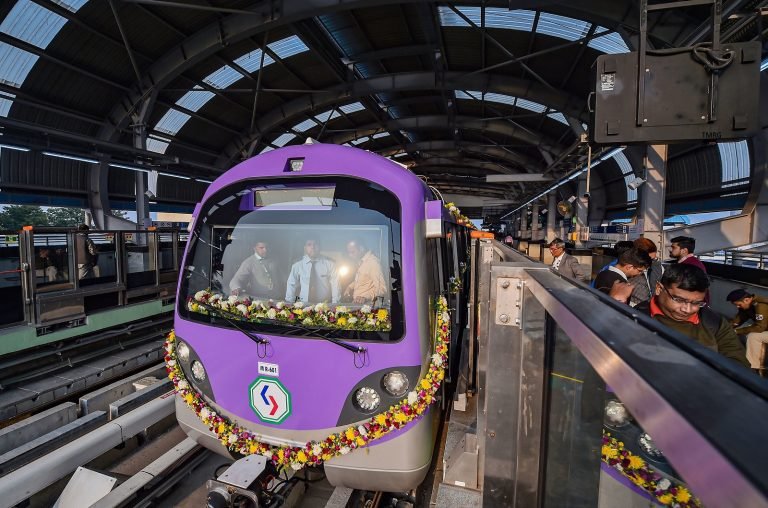
KOLKATA (Metro Rail News): Kolkata Metro will get an underground metro station after 25 years on Sunday as the East-West line will be extended till Phoolbagan, an official said. The Phoolbagan metro station is the first underground one to be opened on the line that will connect Sector V to Howrah Maidan, he said. Railway Minister Piyush Goyal will flag off the first train from Phoolbagan through a video link, the official said on Saturday. Services of the East-West Metro began earlier this year between Sector V and Salt Lake Stadium in the first phase.

Commercial services between Phoolbagan and Sector V will commence from Monday, an official said. Owing to the COVID-19 situation, there will be no formal function at the venue. The underground MG Road metro station on the North-South line was opened in September 1995. All metro stations opened after that are either elevated or at grade-level. The Commissioner of Railway Safety (CRS) granted authorisation for extension of services from Salt Lake Stadium to Phoolbagan station in June.

Local TMC MP Sudip Bandopadhyay and MLAs Sashi Panja and Sadhan Pande, both ministers in the state government, will not participate in the programme according to sources. According to the Kolkata Metro, Bandopadhyay and the two local MLAs have been requested to join the virtual event of the inauguration. Bandopadhyay said he was unhappy with the way the Railway Ministry had tried to “bypass” the state government.

Bandopadhyay said he was out of Kolkata and could not join the event. He also said that during Banerjee’s tenure as the railway minister, she used to invite the state transport minister despite having political differences with the then Left Front government. Panja, however, said she is yet to receive an invitation or letter from the Metro. The Kolkata Metro said that as the programme is being held online and no inauguration ceremony was being held, the local MLAs and MP were requested to join the event.”There is no proper inauguration ceremony. Everything is happening through video conference. So there is no invitation of any sort. The local MP and the MLAs have been requested to participate in the video conference,” a senior Metro official said. On February 13, the 4.88-km-long first phase of the East-West Metro got functional.

The public representatives of the TMC gave that event a miss as well, protesting against the absence of Chief Minister Mamata Banerjee’s name from the invitation card for the programme. Senior TMC MP Kakoli Ghosh Dastidar, Fire Services Minister Sujit Bose and Bidhannagar Municipal Corporation Mayor Krishna Chakraborty were invited but had stayed away in protest. According to a senior Metro official, completion of the East-West corridor is likely to be delayed by up to one year due to an accident caused by an aquifer burst in the Bowbazar area during drilling operations in August 2019. The 16.6-km-long rapid transit system, connecting the twin cities of Kolkata and Howrah, may be completed by mid- 2022.

Kolkata Metro awaits CRS nod for Dakshineswar stretch

KOLKATA (Metro Rail News): Kolkata Metro has applied for inspection of the Commissioner of Railway Safety (CRS) for extension of the existing north-south service to Dakshineswar. CRS, under the ministry of civil aviation, gives the safety nod for any new railway project. Rail Vikas Nigam Ltd (RVNL), implementing the project, was eyeing pre-Puja commissioning, especially after the state government’s request.

“We have applied for CRS inspection. Hopefully, after the CRS’ inspection and clearance, the section can be unveiled by mid-November,” said an official. Engineers and labourers are working for more than 12 hours a day to give finishing touches to the stations and tracks. The two stations — Dakshineswar and Baranagar — are ready. “Decorative work of the interiors are being done. The stations are almost complete and ready for CRS inspection,” said an official.

The two new elevated stations are disabled-friendly, fitted with elevators and escalators. There are ramps leading to the ticket counters.
As for the tracks, the laying work is over. The final alignment is being fixed. Some patchwork is left. The 4.2km track-laying on the viaduct was completed in September, following which cables for supplying electricity to the ballast-less tracks were being fitted. A crossover has been being installed to connect the Noapara carshed with the Dakshineswar-bound tracks.

The added section promises to ferry people living in north Kolkata. There’s a passenger interface with the Dakshineswar suburban railway station that runs parallel to the Metro tracks. The state government had earlier requested Metro Railway to complete the extended service by September so that the vacuum created by the demolished Tallah bridge could be filled.

Union Finance Ministry working to raise funds for RRTS

NEW DELHI (Metro Rail News): The Finance Ministry is in talks with the Japan International Cooperation Agency (JICA) and the World Bank to raise funds for the Regional Rapid Transit System (RRTS) between Delhi and Alwar. The project is the first of three planned RRTS lines, alongside the 192km Delhi-Gurugram-Rewari-Alwar line and the 103km Delhi-Sonepat-Panipat Corridor line. The lines, upon completion, will offer 160km/hr service between New Delhi and Tier 2 cities in adjoining states, with trains operating at five to 10-minute intervals.

The project will be developed in three phases. Reports highlight that the funding will be for the first stage of 107km from Sarai Kale Khan to SNB Urban Complex (Shahjahanpur, Neemrana, Behror). It should be noted that the first RRTS between Delhi-Ghaziabad-Meerut is already under implementation. The Asian Development Bank (ADB) is financing the Delhi-Meerut line in four trances between August 2020 and May 2025. It will be combined with US$1.89 billion of funding from the Indian government and US$1 billion from co-financers. Sharad Saxena, ADB’s principal transport specialist, was stated saying that efficient and integrated transport solutions are critical for managing rapid urbanization and ensuring balanced urban development in the region.
India is seeking $2 billion from JICA and another $1 billion from the World Bank to finance the project. Sources say that the total project cost for the Delhi-Alwar route could be up to Rs 36,000 crore while the project has attracted strong interest from global manufacturers. It said representatives from Siemens, Alstom, Bombardier, CAF, Mitsubishi and Hyundai-Rotem were among 40 global companies represented at a pre-bid conference organized by NCRTC.

Vinay Kumar Singh, the NCRTC managing director, recently said, “As a first of its kind project for India, global expertise will be needed from countries that operate similar systems such as Paris’ RER, London’s Crossrail, Cernanias in Madrid and regional services in Berlin, Tokyo and Beijing”.

Delhi Metro sees 100% occupancy on 5 sections, DMRC appeals to avoid unnecessary travels

NEW DELHI (Metro Rail News): The Delhi Metro resumed its full-fledged operations from 12th September 2020 onwards with new norms of social distancing in place owing to the Corona pandemic, which has significantly reduced the number of persons to be carried in a train (occupancy) which should be around one-fifth of the earlier capacity to ensure social distancing.  
To provide better occupancy in the changed scenario, DMRC also introduced peak hour frequency of trains from 8 AM to 8 PM, doing away with the concept of off-peak hours from 11 AM to 4 PM where services were available with fewer trains/trips earlier. In addition, the public was also advised to avoid unnecessary travel as far as possible and stagger travel timings for office/home/other works to the extent possible to ‘Break the Peak’ for their own convenience and more judicious utilisation of the capacity cum occupancy being offered by the DMRC to the public as per the new norms.
“However, in recent days, it has been observed that certain sections of the Metro network as given below are showing a trend where occupancy is touching 100% mark during morning and evening peak hours. Whereas, during off-peak hours the occupancy in the same sections is in the range of 30-50% only, leaving ample scope for people to stagger their travel from peak hours to the extent possible and have hassle-free travel with social distancing in place'”, said the DMRC.

The Sections are :
Dilshad Garden to Shastri Park
Mundka to Kirti Nagar
Kirti Nagar to Mandi House
New Bus Adda to Dilshad Garden
Escorts Mujesar to Badarpur

“Such a pattern during peak hours, if it continues and is repeated on the other sections too in the coming days may lead to long queues outside the stations due to regulated entry which is essential for ensuring social distancing inside station premises and closing of gates etc. thereby, further increasing the journey time and inconvenience during travel’, the Metro Corporation said.
Therefore, the general public is once again requested to ‘break the peak’ by staggering their travel timings to decongest the peak hours and avail the additional capacity available during off-peak hours for their own convenience and safety amidst the Corona pandemic. Ever since the resumption of services, people have broadly co-operated with the DMRC and have followed all-new travel protocols in place thereby, resulting in Line utilisation in the range of 9-10 Lakhs in recent days, which is in line with the current expectations and social distancing requirements.

Kochi Metro’s latest feature: Ticket with QR Code

KOCHI (Metro Rail News): In its attempt to promote cashless transactions Kochi Metro Rail Limited has added one more feature for the benefit of commuters. Metro users can generate a ticket with the QR Code on their mobile phones through Kochi 1 app. One can use this QR code at the AFC gate and travel.
“This mode is completely cashless and does not require any interface with Ticket Office Operator. At present Kochi Metro has more 80,000 Kochi 1 card users. For non-card users, Metro has already taken measures such as Cash boxes and digital payment modes. With this passengers can directly enter the platform without standing in queues at ticket counters”, an official told Metro Rail News.
“We are promoting and encouraging contactless and cashless travel in Metro. The current scenario demands such modes of transactions. We are committed for providing a safe and clean metro for Kochiites.” said KMRL MD Alkesh Kumar Sharma.
On average, 9000 commuters are using the metro every day according to official data.

A person has to download the Kochi1 application from Play Store (for Android) or App Store (for iOS users) in order to make use of the above-mentioned facility.