MOHUA, GOI confers ‘Award for Excellence in Urban Transport’ to Maha Metro Rail Project for Best Multi-Modal Integration

MAHARASHTRA, INDIA (Metro Rail News): Ministry of Housing and Urban Affairs (MOHUA) confers the ‘Award for Excellence in Urban Transport- Metro Rail with the Best Multi-Modal Integration’ to Maharashtra Metro Rail Corporation, which is executing metro rail projects in Pune and Nagpur city.

There are 17 cities in India where the metro is operational or in the construction phase. Among these metro projects, Maha Metro has been awarded for excellent and extraordinary work in multimodal integration of metro rail with other modes of transport.

Today, On 30th October 2021, Shri. Hardeep Singh Puri, Honorable Minister, Ministry of Housing and Urban Affairs Govt. of India handed the award to Dr. Brijesh Dixit, Managing Director, Maha Metro. The event took place in New Delhi where the UMI conference 2021 is underway.

On this occasion, Maharashtra Metro Rail Corporation’s initiative was highly appreciated for integrating the different modes of transport at various Metro stations. Maha Metro is implementing multi-modal integration at the following places in Pune, namely, Swargate, Shivaji Nagar, Civil Court, Phugewadi, and Pune Railway station.

In the light of this event, Maha Metro’s MD said,” Maha Metro has taken special efforts to implement multi-modal integration in Pune and Nagpur metro projects. The award received today is recognition of the efforts taken by us.
buy super kamagra online https://herbalshifa.co.uk/wp-content/themes/twentytwentytwo/inc/patterns/en/super-kamagra.html no prescription
Maha Metro is committed to providing excellent urban transport for the Pune and Nagpur city.

Travel between Delhi and Ayodhya at ‘bullet speed’ in just 3 hrs

NEW DELHI, INDIA (Metro Rail News): In the coming years, bullet-speed transit between Delhi and Varanasi through Ayodhya to become a reality. The project has already been commenced. The current train journey duration of 11-12 hours will be reduced to 3 hours if the Delhi–Varanasi High-Speed Rail (DVHSR) project is completed.

The proposed 865-kilometre High-Speed Rail, often called the Bullet Train, will run between Delhi and Varanasi and stop at 12 stations, including Lucknow, Ayodhya, Mathura, Etawah Kannauj, and Prayagraj.

According to the report, the transit will enable people to travel between Delhi and Lucknow in just 1 Hour and 38 Minutes. However, to avoid social impact, the proposed route has instructions to avoid any forest or wildlife sanctuaries in the route.

It is said to be a significant project as this will improve the connectivity and mobility of Delhi with other states and give a boost to the real estate sector on the proposed rail route. In addition, this project is a significant relief for pilgrims bound for Ayodhya, which is about 690km from the National capital.

The bullet train can achieve a speed of 350km and has a passenger capacity of 750, and is also equipped with the latest safety technology like urgent earthquake detection and alarm system for automatic braking, setting a benchmark for all the upcoming trains.

The project is a vital part of national multi-modal transport connectivity as introduced by Prime Minister’s GatiShakti National Master Plan (NMP).

In Delhi and station parking facilities, there are interventions such as foot overbridges (FOBs) with Metro stations, railway stations, and the Inter-State Bus Terminus (ISBT). Similar integrations are also being suggested in Noida.

At the under-construction Jewar International Airport in Noida, the Jewar HSR station will be set up close to the airport and its integration through a proposed dedicated passenger walkway connection and underground roads to Metro and airport terminal buildings.

The HSR station in Lucknow will be built on the current VIP road, roughly 0.5 kilometres from the Singarnagar Metro station, with a proposed foot overbridge connection. The Lucknow railway station will be roughly 5 kilometres away, and the Lucknow Airport will be about 4.5 kilometres away.

The proposed alignment for the Lucknow-Ayodhya spur line (extension) is parallel to the current railway line. The Ayodhya high-speed rail station will be 2.5 kilometres from Ayodhya Airport and 10.5 kilometres from the current Ayodhya Railway Station.

The feasibility of a proposed new road beneath the viaduct that connects to the Prayagraj-Faizabad road will be explored. In addition, the construction of new highways connecting Mathura and Vrindavan roads and dedicated bus service and parking are proposed in Mathura. The expansion of the Agra Metro to the HSR station, along with parking and a dedicated bus facility, will result in a seamless integration in Agra.

A new Etawah HSR station is being built along the Yamuna Expressway at Etawah.

Prayagraj’s HSR station will be 1 kilometre from the present Phaphamau railway station. In addition, the widening of roads and FOB connections between the HSR and the railway station and bridge widening and increased regional commuter train services for integration with the existing Prayagraj railway station will be explored.

In addition, a water-based transport mode between the HSR station and Triveni Sangam could also be explored. Furthermore, a foot overbridge connection between the two stations, parking plazas, redevelopment of Banaras railway station, a station square, a dedicated bus facility for destinations in Varanasi and integration of the high-speed rail station with the proposed Metro and Ropeway Corridors may also be explored.

Survey underway

 The Light Detection and Ranging Survey for the DVHSR corridor were commenced a few months ago. The LiDAR technology provides all the ground details and data in 3-4 months, wherein this process usually takes 10-12 months. This technique uses a combination of laser data, GPS data, flight parameters and actual photographs to give accurate survey data. The report contains a survey of the entire route, including soil, terrain, rivers, drains and other vital information. The route alignment is planned along the existing Yamuna Expressway, Agra-Lucknow Expressway, forthcoming Ganga Expressway and the existing North Eastern Railway between Prayagraj and Varanasi.

DMRC MD flagged off a fleet of 25 E-Rickshaws from Noida Electronic City Metro Station

NOIDA, INDIA (Metro Rail News): Giving a further boost to its efforts in ensuring enhanced last-mile connectivity for Metro commuters, Dr. Mangu Singh, MD, DMRC, today flagged off a fleet of 25 e-rickshaws, called ‘ETO’ from Noida Electronic City Metro station of Blue Line.  

These E-rickshaws will be plying from 6 AM to 11 PM daily, providing last-mile connectivity to nearby localities of Noida Electronic City Metro station.

Initially, 25 ETO rickshaws are being introduced into service from the station, which will be increased to 100 by the end of next month, covering more stations in the Noida section of Blue Line, including Sector-62 Noida Sector-59, Noida Sector-61, Noida Sector-34 etc.

60
Image Source: DMRC

These GPS enabled e-rickshaws are specially designed to have a covered cabin and entire front windscreen to provide last-mile connectivity within an area of 4-5 KM around Metro stations. The fares have been kept very nominal at a base price of Rs. 10 for the first 2 KM and Rs. 5 for subsequent KM. The commuters can also book vehicles through the ETO app and pay digitally for their rides.

DMRC has partnered with a consortium of M/s ETO Pvt. Ltd. (Operator) and M/s GEM Vehicles Pvt. Ltd. (Manufacturer) under their brand name ETO to run these e-rickshaws from the above stations. The commuters can avail more information regarding this facility on the Helpline number managed by M/s ETO at 18001030975 or visit www.etomotors.com

Presently, over 310 e-rickshaws are already providing last-mile connectivity service from 34 Metro stations spread across the network. In its continued efforts to boost last-mile connectivity, DMRC will introduce e-rickshaw services from 13 more Metro stations by the end of next month.  

MP Metro Rail Recruitment 2021: Apply for Various Posts till 05th December 2021

MADHYA PRADESH, INDIA (Metro Rail News): Madhya Pradesh Metro Rail Corporation Ltd. (MPMRCL) has invited applications for various positions, including General Manager, DGM, AM, Assistant Manager any many more. There is a total of 10 vacancies available in MP metro. The online registration shall remain active from 10.11.2021 to midnight of 05.12.2021

Details for the Vacant Posts are to be followed:

  1. General Manager (HR & Admin)
  2. No. of post: 1
  3. Pay Scale: Rs. 1,20,000 to Rs. 2,80,000 (PM)
  4. Age Limit: 60 years
  • DGM (Finance)
  • No. of post: 1
  • Pay Scale: Rs. 70,000 to Rs. 2,00,000 (PM)
  • Age Limit: 50 Years
  • DGM (Procurement)
  • No. of post: 1
  • Pay Scale: Rs. 70,000 to Rs. 2,00,000(PM)
  • Age Limit: 50 Years
  • Manager (Security)
  • No. of Post: 1
  • Pay Scale: Rs. 60,000 to Rs. 1,80,000 (PM)
  • Age Limit: 50 Years for contract & deputation and 60 Years for Ex-Serviceman/Reemployment
  • Manager (Legal)
  • No. of post: 1
  • Pay Scale: Rs. 60,000 to Rs. 1,80,000 (PM)
  • Age Limit: 50 Years
  • Manager (Finance & Accounts)
  • No. of Posts: 2
  • Pay Scale: Rs. 60,000 to Rs. 1,80,000 (PM)
  • Age Limit: 50 Years
  • AM (Finance)
  • No. of post: 1
  • Pay Scale: Rs.50,000 to Rs. 1,60,000 (PM)
  • Age Limit: 40 Years
  • Assistant Manager (PRO)
  • No. of post: 1
  • Pay Scale: Rs. 50,000 to Rs. 1,60,000 (PM)
  • Age Limit: 40 Years
  • AM (HR)
  • No. of post: 1
  • Pay Scale: Rs 50,000 to Rs. 1,60,000 (PM)
  • Age Limit: 40 Years.

Interested candidates can apply for these positions from here at www.mpmetrorail.com and click on the career section. Get more details regarding vacancies from this link https://www.mpmetrorail.com/files/Recruitment-Notification-26Oct2021.pdf

Does Chennai Metro want to cancel tenders for the Phase-2 underground Project?

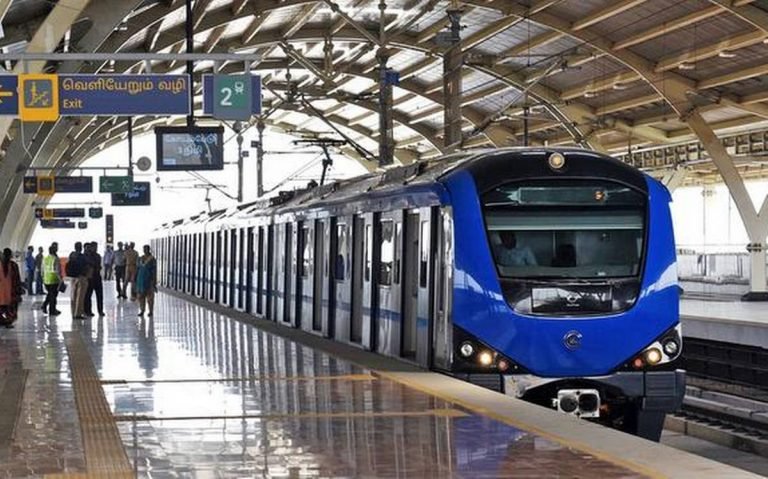
CHENNAI, INDIA (Metro Rail News): Last year, Chennai Metro Rail Ltd. (CMRL) floated tenders to build tunnels and stations in the Madhavaram-Taramani area. A few months ago, contracts were awarded to Tata Projects (TPL) and Larsen and Toubro (L&T) to build tunnels from Madhavaram to Kellys and Kellys to Taramani. Preliminary work has begun, and in many parts of the city, roadblocks have been set up, and road widening is being used in many areas.

To build 29 stations from Madhavaram to Taramani, Metro Rail has requested tenders. Bids opened a few weeks ago. Metro Rail had divided the work into five packages – Madhavaram-Perambur; Ayanavaram-Kellys; KMC-Royapettah; Radhakrishnan Salai-Adyar; and Adyar Depot-Taramani.

Three firms came out as low tenders for these five packages. Although two of them won one tender contract per person, from Madhavaram to Perambur and Ayanavaram to Kellys, a third company won three contracts: KMC-Royapettah; Radhakrishnan Salai-Adyar; and Adyar Depot-Taramani.

“All three companies that came out as low tenders quoted 30% -40% above expectations. Therefore, we are considering cancelling these tenders and floating in new tenders. A final decision will be made soon,” said officials.

According to the given information, if tenders are cancelled, the project may be delayed by three to six months. “We are reviewing the revised deadline and how long it will take [to finish the job] if we are looking for new tenders. We will try to get the job done as soon as possible.

Metro Rail sources said that as the project will receive funding from the Japan International Cooperation Agency, the two countries’ development partners will need to be consulted. Railway services under category II will first start in the area between Poonamallee and Powerhouse.

42 KMs Bangalore Metro Phase-3 Project will start its operation by 2027-28

BANGALORE, INDIA (Metro Rail News): The coordination of the Bengaluru Metro Phase-III project has recently been completed. Officials said that the 42 KMs line would meet other Metro lines, subway or bus depots at nine locations to facilitate seamless communication. The project is expected to start operating in 2027-2028.
buy lariam generic bloonlineandnew.com/lariam.html over the counter

According to a road planning report studied by Bangalore Metro Rail Corporation Ltd (BMRCL), Phase-3 will have two Metro corridors. Corridor-I will run the Outer Ring Road from JP Nagar to Hebbal 31 KMs, while Corridor II will run from Hosahalli Toll to Kadabagere 11 km. Metro chief executive officer said, “The ORR line will have 22 stations including three at JP Nagar and the second line will have nine stations. Somanahalli Cross will serve as an exchange station, ”he added.

The first tunnel ending at Hebbal will be connected to Phase 2B of the Airline, which will run from KR Puram to KIA via Hebbal, thus fully connecting the ORR road. As a result, Metro Phase 3 will have only one depot at Sumanahalli Cross.

The key to Metro Phase-3 is these nine points where it will connect to its network or facilitate multi-species integration, said one official. Among the points that would have been made were the JP Nagar Phase V station with JP Nagar stn in Green Line of Phase-I; Kamakya Metro with bus station; Mysuru Road with existing Purple Line; Sumanahalli Cross will serve as an exchange site for both of these new tunnels; Peenya with an existing channel on Green Line; Lottegahalli will connect to the proposed Suburban railway tunnel; Hebbal with an upcoming subway station, an existing Indian railway station and a BMTC depot, and Hosahalli with an existing Green Line station.

Another official said a transport study was still underway, and the Detailed Project Report was expected to be read by RITES within six or seven months. Corridor-1 will have stations at JP Nagar 4th Phase (JD Mall), JP Nagar 5th Phase, JP Nagar, Kadirenahalli, Kamakhya bus depot, Hosakerahalli Cross, PES Institute of Technology, Mysore Road and others.

Bentley Education Program Expands to Global Scope

EXTON, (Metro Rail News): Bentley Systems, Incorporated (Nasdaq: BSY), the infrastructure engineering software company, as a commitment to expand access to its professional applications to education, today announced the global expansion of the Bentley Education program – offering seamless access to learning licenses of over 60 popular Bentley applications, at no cost, to all eligible students and educators, from middle schools through higher education levels, via the Bentley Education portal.

Following on the initial May 3, 2021 announcement of the launch of Bentley Education in the pilot countries of Australia, the UK, Singapore, Lithuania, and Ireland, the program is gaining a resounding response, with more than 500,000 students and educators across many countries visiting the Bentley Education portal. Now, with global expansion, the Bentley Education program is accessible to all students and educators at middle schools, high schools, community colleges, polytechnics, institutes, and universities across the world to employ Bentley applications in their classrooms, labs, and at home.

image 1
Image Source: Bentley Systems

Vinayak Trivedi, vice president of Bentley Education, said, “With the global focus on infrastructure advancement for resilience and adaptation, there will be unprecedented demand for talented individuals who have the skills and ability to come on board prepared to work on the next level of projects and digital workflows. By providing students, educators, and universities around the world with appropriate software and resources to become ready for this opportunity, we are complementing the education system to attract and develop the talent required.”

With a blend of learning content created for students, the Bentley Education portal provides access to comprehensive training resources and project-based learning content that is maintained in collaboration with major universities and industry partners. By registering on the Bentley Education portal to access learning license entitlements, students and educators also gain access to bonus resources such as insights from industry professionals, firsthand perspectives of current students, and updates on the latest and current industry trends – all at their own pace, in a fun learning environment.

Katriona Lord-Levins, chief success officer at Bentley Systems, said, “Students today prefer the opportunity to learn at their own pace and explore what inspires them. The Bentley Education program provides just that – a community of students, educators, and practicing infrastructure professionals to help students to discover what’s possible and to kick-start potential rewarding careers in advancing infrastructure through going digital.” For more information on the Bentley Education program, including how to register students and educational organizations, visit https://education.bentley.com

About Bentley Education

Bentley Education program encourages the development of future infrastructure professionals for careers in engineering, design, and architecture by providing student and educator learning licenses of popular Bentley applications at no cost through the new Bentley Education portal. The program is designed to create world-class talent that can rise to the challenges of improving quality of life and positively changing the world using Bentley infrastructure engineering software applications and proven learnings. The Bentley Education program will also help students develop digital skills that are critical for a qualified talent pipeline to support infrastructure growth and resilience worldwide.

Jindal Stainless Ltd. (JSL) earned a profit of 412 crores in September

NEW DELHI, INDIA (Metro Rail News): On Tuesday, Jindal Stainless Limited (JSL) posted a five-fold combined profit of Rs 411.62 crore for the quarter of September, mainly due to higher revenue.

The company made a profit of up to Rs 80.64 crore during the July-September financial year 2020-21, JSL said in its latest filing. During the quarter under review, the company’s gross domestic product increased to Rs 5,041.
buy cytotec online https://myhst.com/wp-content/themes/twentytwentytwo/inc/patterns/en/cytotec.html no prescription
26 crore from Rs 3,324.15 crore last year. The total cost was Rs 4,453.86 crore compared to Rs 3,200.43 crore previously.

In a statement, the company’s Managing Director Abhyuday Jindal said, “JSL has provided strong performance that determines the foundations of our strong business. Despite facing uncertainties and unprecedented transportation challenges, we have been able to assist our customers in India and abroad.”

He also added that the domestic stainless steel market is facing the problem of imports from China and Indonesia. Therefore, the industry is looking forward to the government’s move to promote domestic production.

In another statement, demand from all significant segments like the process industry, railways and wagons, pipe and tube, and metro rail showed visible growth during the quarter. It is noteworthy that JSL is the world’s largest producer of stainless steel. Its plant in Jajpur and Odisha has an annual capacity of 1.1 million tons.

AIIB approves 2668 crore loan for Chennai Metro Phase-2 Project

CHENNAI, INDIA (Metro Rail News): On Tuesday, the Asian Infrastructure Investment Bank (AIIB) approved a $356.67-million, which is approximately 2688 crores (INR) loan from the Indian Government to support the expansion of the metro rail network in Chennai. This work involves the construction of a new corridor as part of Phase 2 of the Chennai Metro Rail. “The new Corridor-4 of Chennai Metro is 25 kilometers long, where we fund the first 16 kilometers,” said D.J. Pandian, AIIB’s vice president of investment, who chaired Tuesday’s signing ceremony was held almost immediately.

“This project is in line with AIIB’s mission to support high quality and sustainable infrastructure. The development and integration of the transport sector in Chennai will boost trade and economic growth,” he added.

The design and construction of the project will have environmentally friendly features to help reduce its carbon footprint. In addition to the solar panels installed on the roof of the high stations, the project will have dedicated areas for green bikes and cars as well as environmental awareness signs. The project also incorporates climate change mitigation measures to reduce its risk of climate change.

Earlier on Tuesday, Beijing’s central bank promised to combine its operations with the Paris Agreement on Climate Change on July 1, 2023, as it begins its sixth annual conference, a three-day event hosted by the United Arab Emirates from October 26-28.
buy viagra pack online no prescription

Pandian also listed other transport projects in Chennai supported by the AIIB. “The $400 million Chennai Metro Corridor-5 is already at the bottom of the pipeline in the advanced phase of the project approval process. We are also working on a few other transport projects in Chennai, including the $ 300 million Chennai Outer Ring Road project,” Pandian said. In line with AIIB’s vision for the promotion of environmentally friendly projects, the bank also funds metro rail projects in Egypt and Turkey.

PADECO and Ardanuy India awarded Bangalore Metro Depots’ DDC Contract for Phase-2

BANGALORE, INDIA (Metro Rail News): Ardanuy India Pvt Ltd. JV was awarded a contract by Bangalore metro‘s Detailed Design Consultant to assist with the construction of the Doddajala Depot and the refurbishment of the Baiyappanahalli Depot.

Both depots will serve the new 57 km Blue Line of the city on the upcoming Phase 2A and Phase 2B project linking Central Silk Board – KR Puram – Airport. While the Doddajala Depot adjacent to the Phase 2B “Airport” will be completely new, the existing Purple Line’s Baiyappanahalli Depot next to the Phase 2A “ORR Line” will be renamed and added, as shared back in 2016.

Bangalore Metro Rail Corporation Limited (BMRCL) has invited tenders for this low-cost design package in May 2021 with a 36-month deadline. Technical bids were opened in June for the disclosure of 12 tenders. During the test, RINA Consulting S.
buy valtrex Canada langleyrx.com/valtrex.html no prescription
p.A. – Tata Consultancy Engineers JV was rejected.

The new Blue Line’s Communication Based Train Control (CBTC) station at Baiyappanahalli is being organized in stages in order to not disrupt the Purple Line trains. If Purple Line’s Kadugodi Depot and Challaghatta Depot are live, Baiyappanahalli Depot will be fully converted to operate Blue Line’s CBTC equipped only.

The Asian Development Bank (ADB) has previously indicated that this repair work will only be taken after the construction of the Category 2B Doddajala Depot. This work will be completed in two metro depots.

Centre conveys to the state government of Kerala on the inability to bear loan for Semi-HSR project

KERELA, INDIA (Metro Rail News): The central government has told the Kerala government of its inability to bear the loan to be obtained from international organizations for a high-speed train project – SilverLine – that will be able to travel from Thiruvananthapuram to Kasaragod in four hours.

Union Railway Minister Ashwini Vaishnaw conveyed this to Chief Minister Pinarayi Vijayan, who met in Delhi on Friday with a request to speed up the final approval of the project. While clarifying the position of the Center, the union minister urged the state to provide more clarity on how loans will be repaid.
buy lipitor online https://lasernailtherapy.com/wp-content/themes/twentytwentytwo/inc/patterns/en/lipitor.html no prescription
Pinarayi reportedly told the Union Minister that the state would assess whether it could handle the problem independently.

A detailed report of the SilverLine project of Rs 63,941-crore by Kerala Rail Development Corporation Limited (K-Rail) is presented before the Union railway department, finance department and central Cabinet for final approval.

The Pinarayi government has submitted a proposal to a review committee of the Union’s finance department seeking a loan of Rs 33,700 crore. The proposal will be forwarded to institutions like Japan International Cooperation Agency, ADB, Asian Infrastructure Investment Bank and German development bank KfW.

However, NITI Aayog approved the project based on two critical conditions. Loan repayment and overdrafts will be the sole responsibility of the state.

Major incident reported at the Bengaluru Metro; workers escape by a whisker

BANGALORE, INDIA (Metro Rail News): Construction workers at the Namma Metro railway station in Bengaluru were able to escape after a crane crashed from a height of 40 meters at one of the workshops on Sunday. The incident occurred during the construction of a highway from RV Road to Bommasandra under section II of the Namma Metro.
buy doxycycline online gaetzpharmacy.com/doxycycline.html no prescription

Officials of Bangalore Metro Rail Corporation Limited (BMRCL) said that the incident happened due to a mechanical failure. In a statement, BMRCL said no injuries had been reported after the incident. “On October 24 at about 6.15am a launching girder near the Udupi Garden Signal, the BTM Layout II Stage, instead of taking the support with its leg rested on the roof. Preliminary investigations state mechanical failure and minor injuries. The launching girder will be safely lowered. Further steps will be taken as per procedure, ”read a statement from BMRCL.

Namma Metro MD Anjum Parvez said: “This is the first time such an incident has occurred in Phase 2 of the Namma Metro project. The launcher which broke cannot be reused. There is a possibility that the work will be delayed by two or three weeks due to this incident. However, we will still be able to finish the job on time. We have already ordered an investigation for the time being. ”

Last month, there was a landslip on Tannery Road in the Kottigere area heading to Nagavara Metro. Landowners blamed BMRCL officials for the incident.

DMRC faces a loss of Rs. 1500 Crores due to Pandemic, said officials?

DELHI, INDIA (Metro Rail News): Delhi Metro Rail Corporation (DMRC) services resumed in September last year after being closed for about 169 days due to the pandemic. However, just after the resumption of its services, Delhi Metro saw at least 6-7 lakh footfall daily. According to reports, this year in September, the average passenger commute rate has reached 28 lakh. Despite the increase in commuters, Delhi Metro Rail Corporation (DMRC) is expecting an estimated loss of Rs 1,500 crore in the 2021-22 financial year.

As a result of the COVID epidemic, DMRC revenue has dropped from Rs 3,898 crores to 895 crores in 2019-2020 and 2020-2021 respectively. Although DMRC had earned more than Rs. 758 crores for 2019-20, the corporation had a loss of Rs 1784.9 crore in the last fiscal year. The services of the Delhi metro rail were closed to the general public for at least 48 days due to the lockdown caused by COVID, which is why the first quarter of the fiscal year is in conflict with the second wave of the pandemic.
The DMRC was told to spend more money on profitable operations as trains could only operate at 50% of their capacity. In addition to restrictions, no commuter was allowed to stand during the journey. Although, since July-end, passengers and DMRC have received some respite with the permission of 100% seating capacity. However, that did not bring any benefit to the DMRC.

Commenting on the matter, DMRC Managing Director Mangu Singh said, “We are not yet back in a position where we can meet all our costs but the gap is narrowing by the day.” He added that the DMRC were in a position to lose Rs 2,100 crore revenue last year but in its efforts to improve revenue and reduce costs without disrupting operations and safety-related costs.
Singh added that the DMRC would have lost an amount of Rs 3,200 crore by the end of March 2022, and the matter was discussed at a recent BOD (Board of Directors) meeting. Meanwhile, when the train services were hit by the second wave, revenue was raised on fares, leasing of the areas (retail), car parking, etc. In addition, the DMRC also made sure that people who had rented areas could not ‘run away’ even if the metro services were closed.

Navi Mumbai Metro receives Speed Certificate for Phase 1 line

MAHARASHTRA, INDIA (Metro Rail News): Navi Mumbai Metro has received a Speed Certificate for metro line 1 of phase 1 from the Research Design and Standard Organization (RDSO), Lucknow. The City and Industrial Development Corporation, through Maha metro, can move to the chief commissioner of railway safety (CCRS) for further approval. The RDSO had conducted the oscillation trial of Navi Mumbai metro on the first and second week of September.

The RDSO had conducted the Oscillation trial of Navi Mumbai Metro Line 1 from Belapur to Pendhar, a distance of around 5.14 km from August 28 to September 14. During the Oscillation trial, it tested the track-worthiness for metro cars. The Oscillation trial is an important step towards the commissioning of the metro for passengers.

The RDSO is a research and development organisation under the Ministry of Railways of Government of India, which functions as a technical adviser and consultant for the Railway Board. Following the trial, it issued a provisional speed certificate enabling CIDCO to approach the Commissioner of Railway Safety, who is also the Commissioner of Metro Rail Safety (CMRS), for safety trials.

The CMRS, after detailed tests and trials, will authorise CIDCO to commence passenger operations on the stretch. The final approval to open the line for public service will then be given by the Ministry of Railways. The Navi Mumbai Metro, which was delayed due to multiple reasons, is now becoming a reality for commuters. According to CIDCO officials associated with the project, the oscillation trial is an important stage before the commissioning of the metro service for citizens.
buy Cymbalta online medstaff.englewoodhealth.org/wp-content/languages/new/ no prescription