



Introduction: The Race to Build More Than Just Faster Trains
People often judge the high-speed train by one thing: how fast it can travel. But the real achievement lies in everything that makes that speed possible. The train must be stable at these high speeds, respond accurately to signals, maintain power efficiently and have safe braking. It must also be able to run for many years without affecting passenger comfort or safety. Behind every successful high speed rail service is a complex system of engineering, manufacturing, testing and maintaining. India is now working towards creating this.
The Mumbai-Ahmedabad High-Speed Rail (MAHSR) project commonly known as the bullet train project is the first large step towards implementing dedicated high speed rail services within the country. The government has also published plans to implement seven new high speed rail lines in the Union Budget 2026-27. This shows that high speed rail is gradually becoming a key part of the overall transport strategy in India.
However, India also needs to build trains, specialised components, manufacturing units, testing units and trained maintenance teams. That the order for rolling stock worth ₹5,432 crore for the Mumbai-Ahmedabad corridor has been awarded to Bharat Earth Movers Limited is a great move. An Indian manufacturer will now play a pivotal role in the country’s first bullet train programme. This will also provide an opportunity for the industry to gain insight into this complex technology. The question is no longer just about whether India can run trains at 320 kmph but if they can build the industrial capabilities and technical expertise to design, manufacture, maintain and upscale high speed rolling stock.
Bullet Train: Why the Train Matters as Much as the Track
High-speed rail means a system of passenger railways which is designed to run at speeds much higher than those of ordinary railway services. Worldwide, high-speed lines are usually defined as those with speeds exceeding 250 kmph, though the exact figure can differ according to the infrastructure and the way the services are operated. Different from conventional railways, which usually carry both passengers and freight, dedicated high-speed lines make use of infrastructure that has been built especially for fast passenger trains.
Get the Daily Metro & Rail Brief
Join 125,000+ metro and rail professionals. Project updates, new tenders and contract awards from across India, in your inbox every day.
Such lines need tracks that have been carefully engineered, an advanced signalling system, a dependable power supply and specially designed rolling stock. The train itself is one of the most important parts of the system. When travelling at high speeds, even minor engineering flaws can have serious results. The design has to take into account aerodynamic resistance, vibration, the interaction between the wheels and the track, braking performance, passenger comfort and the ability to respond to emergencies. Components that function satisfactorily on conventional trains may have to be considerably redesigned in order to be suitable for continuous high-speed operation.
A different system must be used to maintain high speed rolling stock. Specialised equipment is required to measure components of the train that runs at 320kmph. Well trained technicians are needed, along with well controlled maintenance centres. Regular checks must be carried out to ensure everything mechanical, electrical and electronic is working. The move to high speed rail systems in India is particularly relevant as we see urbanisation increasing and more economical activity across our large cities.
High speed rail will reduce journey times between business centres, industrial parks and education centres. It can also act as an alternative to flying on certain routes. The National Rail Plan looks at how we can develop the railways in the long term up until 2030. High speed rail is seen as a part of the future transport network for passengers in the country. It does not intend to replace traditional and suburban rail but instead complement these services.
Seven Corridors: A Wider Vision for High-Speed Rail Connectivity
The Union Budget 2026-27 gave high-speed rail a significant place in India’s infrastructure plans. It announced a record capital outlay of ₹2,78,000 crore for Indian Railways, reflecting the importance of railway investment in the country’s wider economic development strategy. Among the major announcements was the development of seven high-speed rail corridors. Together, the proposed routes cover nearly 4,000 km and are expected to attract investments of approximately ₹16 lakh crore. The government views these corridors as growth connectors that can improve movement between important cities and economic centres. The proposed network includes:
| Proposed corridor | Indicative travel time |
| Delhi-Varanasi | 3 hours 50 minutes |
| Varanasi-Patna-Siliguri | 2 hours 55 minutes |
| Chennai-Bengaluru | 1 hour 13 minutes |
| Bengaluru-Hyderabad | Around 2 hours |
| Chennai-Hyderabad | 2 hours 55 minutes |
| Mumbai-Pune | 48 minutes |
| Pune-Hyderabad | 1 hour 55 minutes |
The southern routes have been described as part of a high-speed rail triangle or diamond, linking Chennai, Bengaluru and Hyderabad. In western India, the Mumbai-Pune and Pune-Hyderabad connections are expected to strengthen links between major commercial and industrial centres. The northern and eastern routes aim to connect Delhi, Varanasi, Patna and Siliguri.
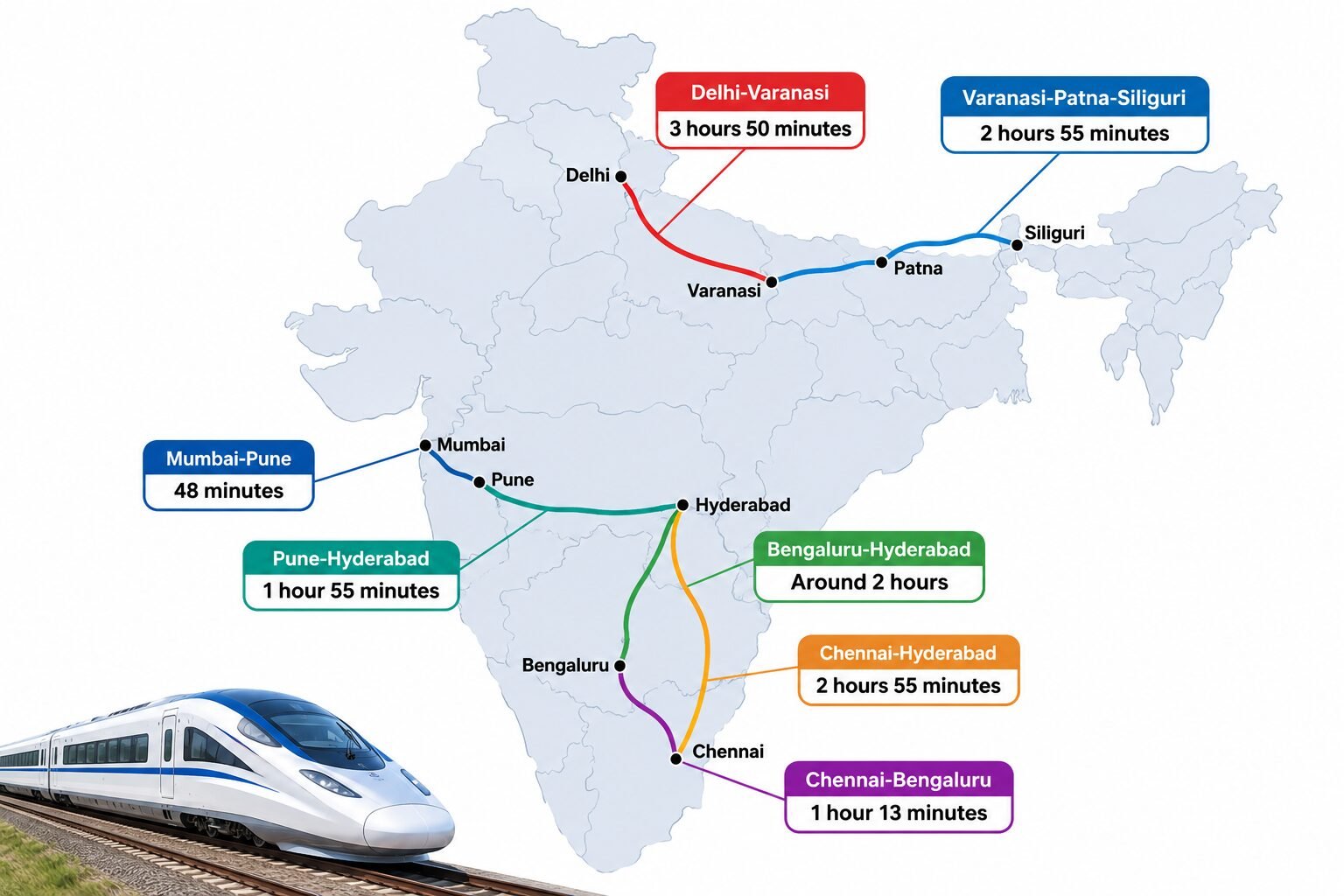
The ideas put forward indicate that we will have an extensive High Speed Rail Network. However, there is still time to go before we start building or purchasing any rolling stock. Each line will need planning, feasibility, land and environment studies, funding and tech decisions. The scale of the proposed network also raises an important question: how will India ensure that future corridors do not become a collection of separate projects with different designs and maintenance requirements? Standardisation will be important.
The Mumbai-Ahmedabad Bullet Train Project: India’s First Major Test
The Mumbai-Ahmedabad High-Speed Rail project is the foundation on which India’s future high-speed rail capabilities are being developed. The approximately 508-km corridor connects Mumbai in Maharashtra with Ahmedabad in Gujarat. It is being developed with technical and financial assistance from the Government of Japan and is based on Japanese Shinkansen technology and operating practices. The project is designed for trains operating at speeds of up to 320 kmph, with a design speed of up to 350 kmph.
This is substantially higher than the design speed of 180 kmph associated with Vande Bharat trains. The corridor is being constructed primarily on an elevated viaduct. Its stations will incorporate controlled entry points, baggage scanners, door-frame metal detectors and CCTV surveillance. These measures reflect the security requirements of a dedicated high-speed passenger system.
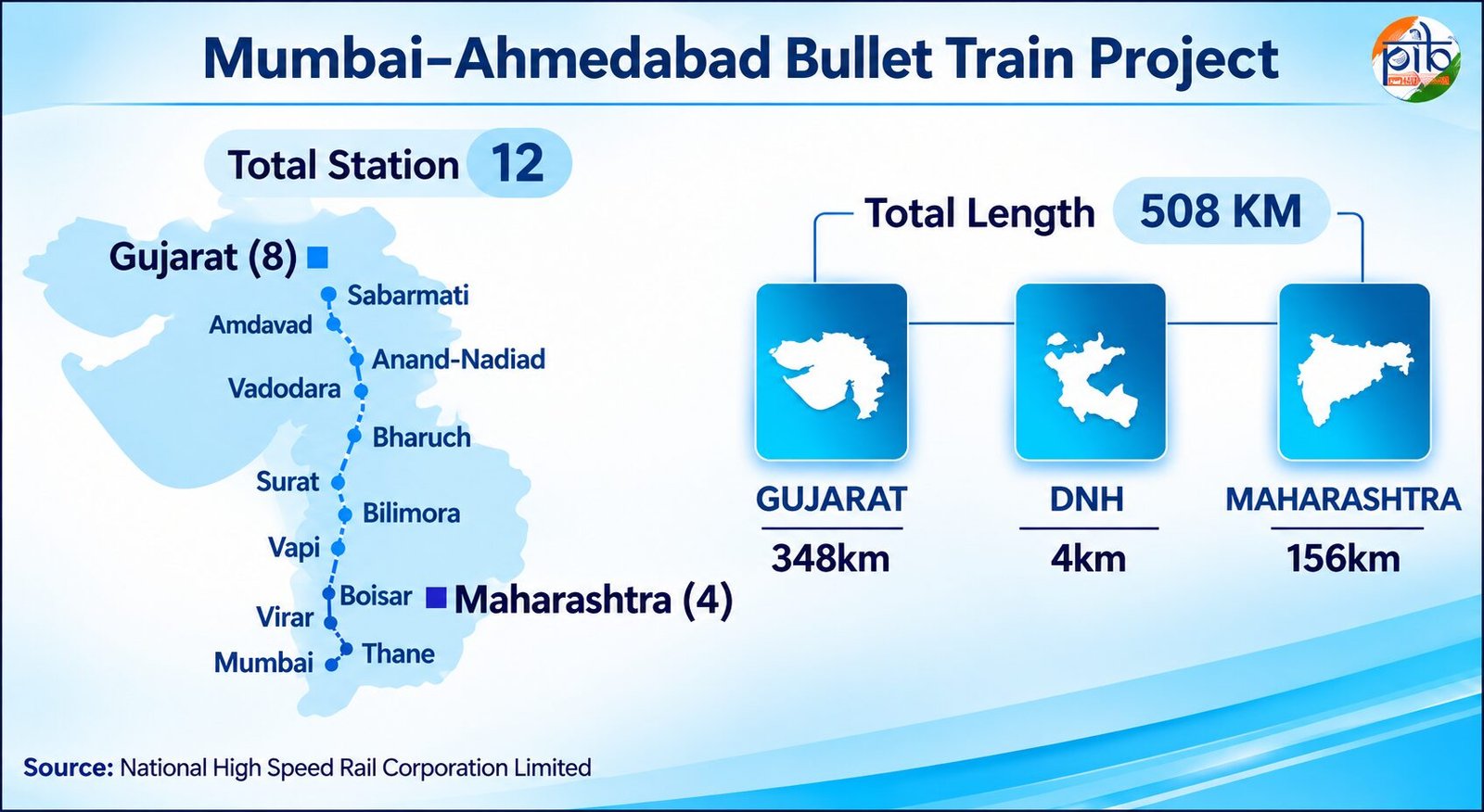
But the project is also an engineering and manufacturing exercise. It involves developing expertise in high-speed track construction, overhead electrification, traction power, signalling, rolling stock and long-term maintenance. The experience gained here is expected to influence the design and execution of future corridors. For the rolling stock sector, the most significant development is the effort to manufacture India’s first bullet train sets domestically.
BEML’s ₹5,432-Crore Contract: A Major Step for Indigenous Rolling Stock
On 16 September 2026, the National High Speed Rail Corporation Limited (NHSRCL) awarded the rolling stock contract for the Mumbai-Ahmedabad project to BEML Limited. The Letter of Acceptance covers Package MAHSR-BRS-1 and has a value of ₹5,432 crore. The contract includes the design, manufacture, supply, testing, commissioning and comprehensive maintenance of the trainsets for the 508-km corridor. It is an important step in bringing domestic manufacturing into India’s high-speed rail programme.
BEML has been developing the country’s first bullet train, known as the B28, at its Aditya High-Speed Rail Complex in Bengaluru. The specialised facility was inaugurated by Union Railway Minister Ashwini Vaishnaw on 25 April 2026 at BEML’s Tippasandra campus. The complex is dedicated to high-speed rail manufacturing and is designed for the development of B28 coaches. During the inauguration, the Railway Minister highlighted the complexity of high-speed rail technology and described its domestic development as an important milestone for Indian engineering.
The project is being worked under the larger goals of Make in India and Aatmanirbhar Bharat in order to decrease dependency on imported systems and grow the industry of designing, building and maintaining rolling stock within the country. Designing and building a high speed train is much more challenging compared to a regular passenger train.
There are many factors that need to work closely together such as the train body, bogie, traction, braking, electrical, control systems and onboard passenger services. All of these will have to operate well at high speeds. This means the success of the B28 programme will depend on how well the trainsets perform during testing, commissioning and normal operation.
B28 Bullet Train Takes Shape: First Coach Undergoes Squeeze Test
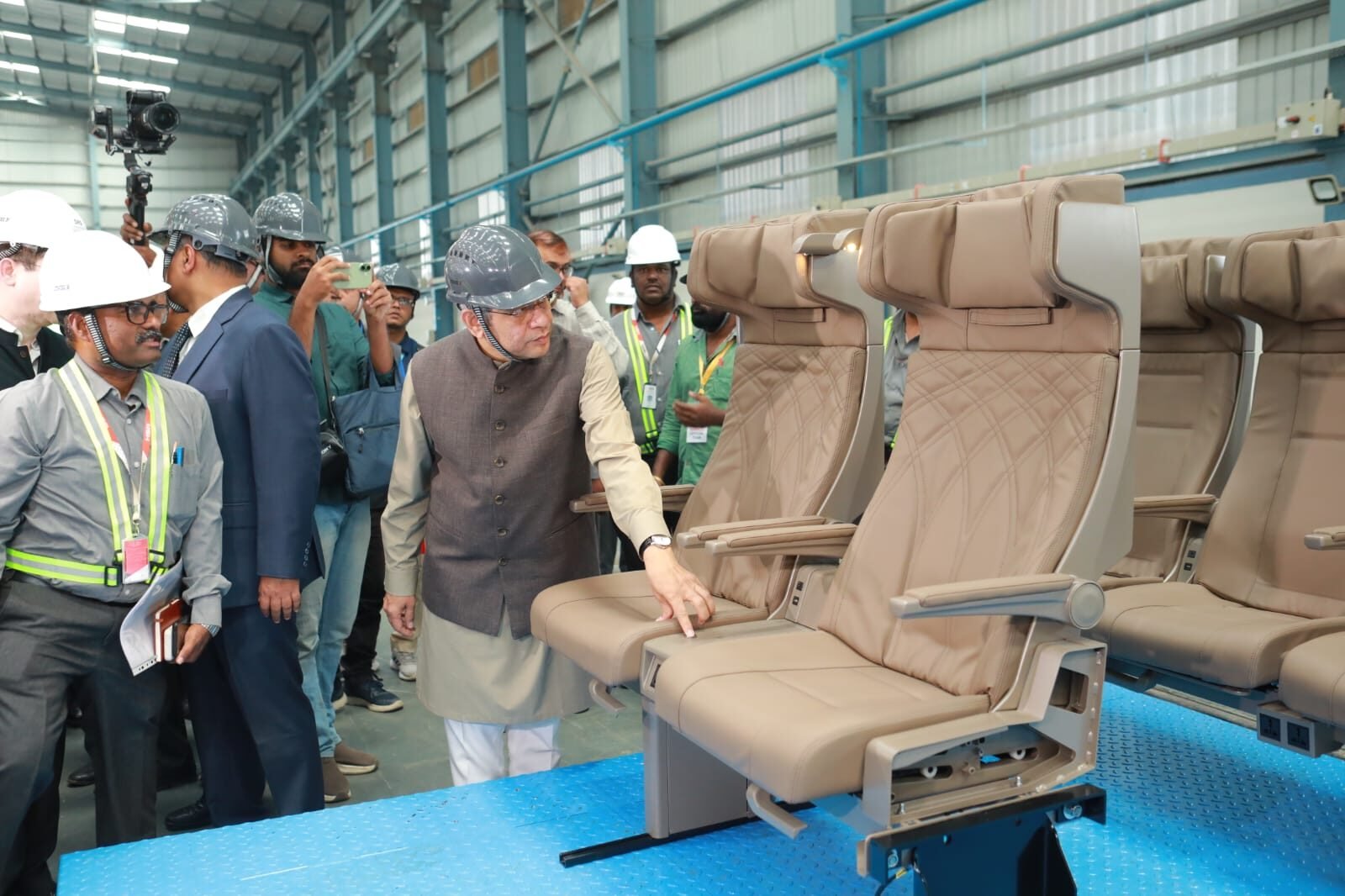
India’s first indigenous bullet train, B28, reached another milestone as its first coach underwent a squeeze test at BEML’s manufacturing facility in Bengaluru. Railway Minister Ashwini Vaishnaw visited the facility on 1 November 2026 to review the train’s development for the Mumbai-Ahmedabad High-Speed Rail corridor.
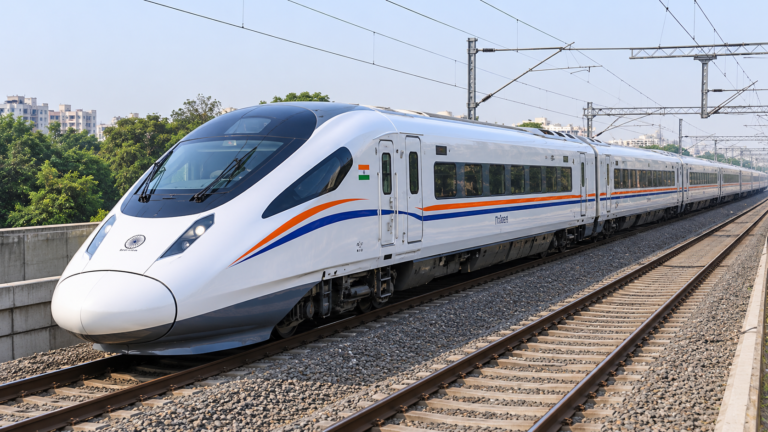
The eight-car trainset, comprising four motor cars and four trailer cars, will have a length of around 202 metres and a passenger capacity of approximately 557. It is designed for a maximum test speed of 280 kmph and an operational speed of 249 kmph. The train will feature seven standard-class coaches and one executive-class coach, along with space for two passengers with reduced mobility.
BEML has incorporated several passenger comfort and performance features, including advanced HVAC systems, sound insulation, noise-damping coatings and an aerodynamic design developed using Computational Fluid Dynamics (CFD) simulations. The train will operate on a 25 kV AC traction system and use regenerative braking to recover energy during deceleration. The ongoing development of B28 marks an important step in India’s effort to build indigenous high-speed rolling stock capabilities.
Inside the Technology: What Makes a Bullet Train Different?
The performance of a high-speed train depends on several systems working together. Its design must minimise resistance, maintain stability and deliver reliable power while allowing passengers to travel comfortably.
Aerodynamics and structure
Air resistance is a significant factor when running trains at higher speeds. The front shape, coach coupling and undercarriage will affect how the air flows around the train. Good aerodynamics can help reduce air resistance and noise.
The train body should be strong but light. Materials should be chosen and engineering techniques used to make sure that the train can handle pressure differences; vibrations and forces from braking and accelerating.
Bogie and suspension
The bogie is used to support the train body and attach it to the wheels. This becomes very important when a high speed train is being designed to ensure stability, comfort and wheel-rail interaction.
The suspension needs to dampen vibrations and provide good ride comfort. The engineers need to make sure the wheels are stable on varying track conditions and when going round corners.
Traction and braking
For high speed trains there needs to be strong and reliable traction systems to accelerate and sustain the required speeds. The braking system must provide a controlled rate of slowing down and work well when in emergencies.
Regenerative braking can also help to increase efficiency by capturing some of the kinetic energy and converting it into electrical energy. This can then be fed back into the system, depending on the traction system design.
Signalling and train control
High-speed operations require continuous and reliable communication between the train and railway control systems. Drivers cannot depend on conventional lineside signals in the same way as on slower routes, particularly when trains cover long distances at high speeds.
Advanced signalling and train protection systems provide movement authorities, monitor train speed and help prevent unsafe operating conditions. Their integration with onboard equipment is essential for safe and predictable services.
MAHSR’s Technical Backbone: Power, Track and Infrastructure
The Mumbai-Ahmedabad corridor uses several systems based on Japanese Shinkansen engineering practices. These systems are being introduced in India as part of the country’s first dedicated high-speed rail project.
Overhead electrification
The corridor will have more than 20,000 overhead electrification masts. Its 2×25 kV traction system uses Shinkansen-style overhead equipment and cantilever designs. This arrangement supports the high power requirements of trains operating at elevated speeds.
Traction and power supply
The project includes 12 traction substations, two depot traction substations and 16 distribution substations. These facilities will support the supply and distribution of electricity across the corridor and its maintenance infrastructure.
Track system
The project is introducing Japan’s J-Slab ballastless track technology in India for the first time. Unlike conventional ballasted tracks, which use loose stones beneath the sleepers, slab track uses a concrete-based structure to support the rails. The system is designed to provide stability and reduce the need for certain routine track-maintenance activities. Its construction, however, requires precise engineering and strict quality control.
Dedicated Track Construction Bases are also being developed to store and handle rails, track slabs, machinery and other equipment. These facilities will support the movement of materials and the execution of track works. The combination of track, power and signalling systems will determine how reliably the rolling stock performs. A high-speed train cannot deliver its intended performance if the infrastructure around it is not designed to the same standard.
Maintenance: The Other Half of High-Speed Train Operations
A high-speed train’s performance does not end when it leaves the factory. Its reliability depends on how well it is inspected, serviced and maintained throughout its operating life. The MAHSR corridor will have three rolling stock maintenance depots at Surat, Thane and Sabarmati. Their planned areas reflect the different maintenance roles assigned to each facility.
| Maintenance depot | Approximate area | Main role |
| Surat | 38 hectares | Daily and regular inspections; unscheduled maintenance |
| Thane | 58 hectares | Daily and regular inspections; unscheduled maintenance |
| Sabarmati | 82 hectares | Inspections, unscheduled maintenance, bogie and general overhauling |
Surat will be the smallest of the three depots, while Sabarmati will be the largest. The facilities at Surat and Thane will support daily inspections, regular servicing and unscheduled maintenance. Sabarmati will have these facilities as well as provisions for bogie and general overhauling.
This division of responsibilities is important because high-speed rolling stock requires a planned maintenance cycle. Minor defects must be identified before they affect train performance or safety. Equipment such as brakes, bogies, traction systems, doors and onboard electronics need regular inspection.
The depots will also incorporate measures to manage water and energy use. These include rainwater harvesting, wastewater treatment systems, efficient water fixtures and solar panels. Such facilities can help reduce the environmental footprint of maintenance operations.
Measuring equipment and preventive maintenance
The MAHSR project will use advanced measuring equipment to inspect track, power supply, signalling and telecommunication systems. The data collected will help identify changes in infrastructure conditions and determine when preventive maintenance is required.
The equipment may be installed on passenger trains or dedicated inspection trains. It will be designed to operate at the maximum operational speed, allowing measurements to be collected without requiring every inspection to take place at much lower speeds.
This approach is particularly relevant for high-speed rail. Track geometry, overhead equipment and signalling systems must remain within strict operating limits. Regular measurement can help maintenance teams identify developing problems before they lead to service disruptions.
From Imported Technology to Domestic Manufacturing
India’s high-speed rail ambitions are closely linked to its effort to develop a stronger domestic railway manufacturing base. The MAHSR project is receiving Japanese technical assistance, but it is also creating opportunities for Indian companies, engineering institutions and research organisations. The B28 programme at BEML’s Aditya complex is one part of this effort.
The wider manufacturing ecosystem includes specialised components, construction machinery, slab-track materials and equipment required for high-speed rail infrastructure. Integral Coach Factory (ICF), in collaboration with BEML, is also involved in the development of indigenous high-speed trainsets designed for speeds of up to 280 kmph. This work is expected to strengthen domestic knowledge in train design and production.
Indian manufacturers are increasingly taking up work that was previously dependent on specialised overseas suppliers. Long-span steel truss girders, slab-track materials and heavy construction equipment are among the areas where domestic manufacturing capabilities are developing. The localisation effort also extends to engineering and design.
Indian agencies are working with IITs on design variations and dynamic analysis. Advanced simulation tools and design charts are being developed to strengthen the country’s ability to undertake complex high-speed rail engineering. The aim is not simply to manufacture a train within India. It is to develop the ability to understand, test, modify and maintain the technology.
Engineering Innovations Along the Bullet Train Corridor
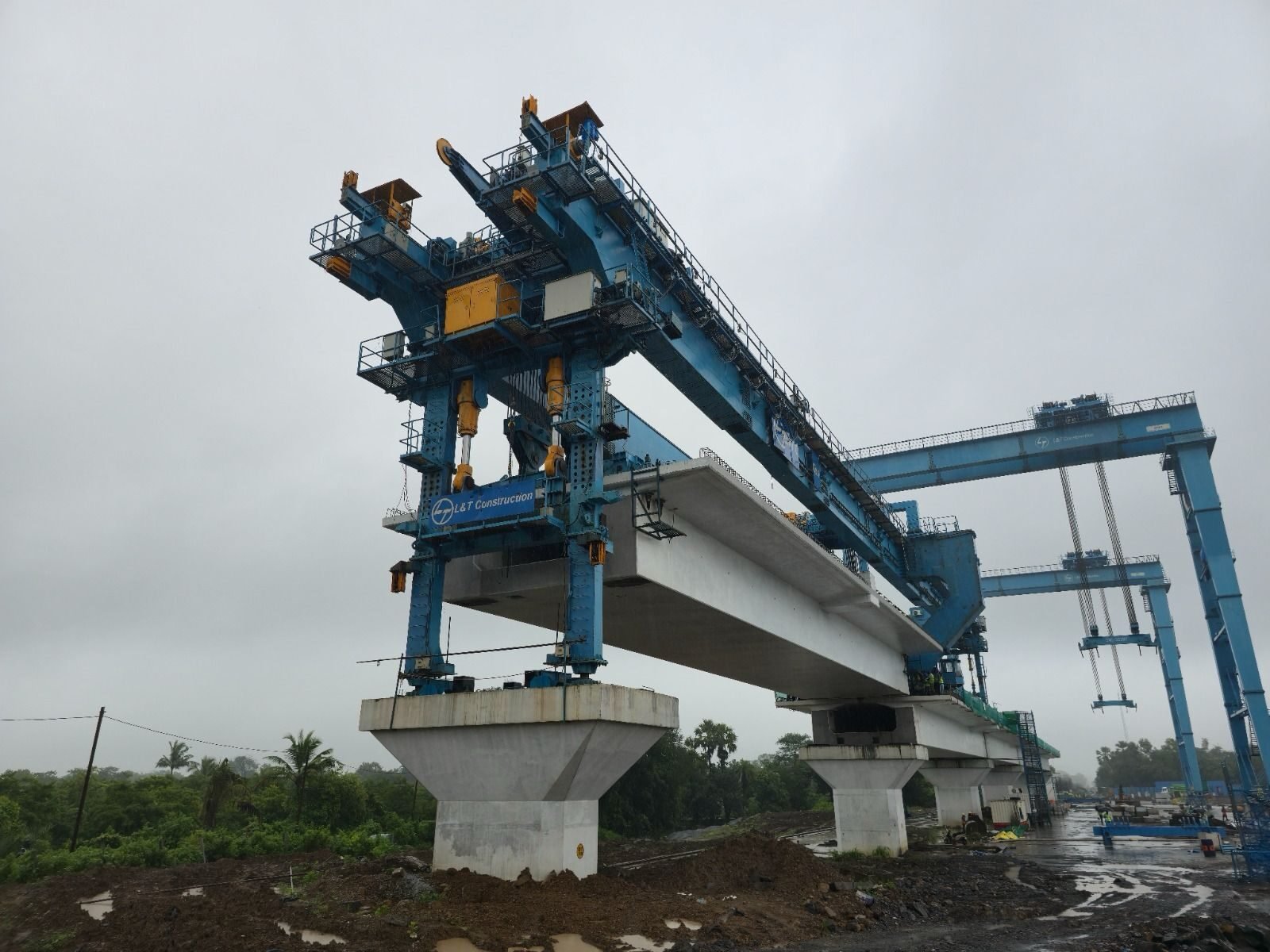
The Mumbai-Ahmedabad project has also introduced construction and engineering methods that could influence future railway infrastructure projects. One notable example is the use of the full-span launching method for placing 40-metre prestressed concrete box girders weighing approximately 1,000 tonnes. The method allows a complete span to be launched in a controlled operation, with the stated objective of completing a launch within around 16 hours. The project has also involved the development of heavy construction machinery in India. Indigenous equipment used for full-span launching is an important example of how infrastructure projects can create demand for specialised domestic engineering.
Noise barriers are being installed along the elevated corridor to reduce the impact of train operations on nearby residents. Their design and installation are important because high-speed trains can generate significant aerodynamic and operational noise. Other innovations include simulation tools for overhead electrification and pantograph interaction, as well as models for traction power supply design developed with IIT Delhi.
These tools help engineers assess how equipment will perform under different operating conditions. An underground station is also being constructed with provision for a future 90-metre-high building on the same foundation. The design reflects an effort to consider future urban development while planning major transport infrastructure. The project has introduced an indigenously developed Rail Turnover Prevention Device (RTPD) to improve safety during derailment-related situations. Such developments show how high-speed rail construction can create opportunities for Indian companies to develop specialised railway equipment.
Training a Workforce for a New Railway System
Technology alone cannot run a high-speed railway. The system also requires engineers, technicians, operators and maintenance staff who understand its operating requirements. Around 1,000 Indian engineers and skilled workers have received training in Japanese methods. Track works are being carried out under the supervision of trained personnel, helping transfer technical knowledge to the domestic workforce. A dedicated track training facility has also been established at Surat. It will support initial training and regular refresher courses.
This is a necessary investment. High-speed rail maintenance requires a different level of precision from conventional railway maintenance. Workers must understand the relationship between track condition, train behaviour, electrical systems and onboard equipment. Training will also become more important as additional corridors move towards implementation. A larger network will need a steady supply of skilled personnel, standardised procedures and institutions capable of providing specialised technical education.
Challenges in Developing High-Speed Rail Rolling Stock in India
India’s progress in high-speed rail manufacturing is encouraging, but the transition from conventional rolling stock to bullet trains will not be straightforward. Several technical, financial and institutional challenges remain.
1. The challenge of mastering complex technology
High-speed rolling stock is among the most technically demanding forms of railway manufacturing. Its design involves advanced aerodynamics, lightweight structures, high-performance bogies, traction systems, braking equipment and sophisticated onboard electronics.
Developing these systems requires years of testing and operational experience. Domestic manufacturing does not automatically mean that every critical component can be designed and produced locally from the beginning. India will need to build expertise gradually, while ensuring that technology transfer and collaboration translate into genuine domestic capabilities.
2. Testing and certification
A high-speed train must undergo extensive testing before it can enter passenger service. Tests must examine its performance at different speeds, braking behaviour, stability, ride quality, noise levels and compatibility with infrastructure.
The train and the corridor must also work as an integrated system. A rolling stock design that performs well in isolation may require adjustments when tested with actual track, power supply and signalling equipment.
India will therefore need strong testing and certification capabilities. These facilities must be able to assess high-speed trains against demanding safety and performance standards.
3. Building a reliable component supply chain
A trainset consists of thousands of components, many of which are specialised. Developing a domestic supply chain for these parts will take time and sustained investment.
The challenge is not limited to producing the components. Manufacturers must also maintain consistent quality, meet delivery schedules and provide long-term technical support.
If critical components remain dependent on a small number of overseas suppliers, the domestic industry may continue to face supply and maintenance risks. Localisation must therefore extend beyond final assembly to include important subsystems and specialised materials.
4. Maintenance costs and operational reliability
High-speed trains require specialised depots, diagnostic equipment and trained staff. These facilities involve significant capital investment, while regular maintenance adds to operating costs. The three MAHSR depots will provide the infrastructure needed for inspection and overhauling. However, their long-term effectiveness will depend on the availability of spare parts, maintenance data and trained personnel.
For future corridors, planners will need to consider maintenance requirements from the design stage itself. A train that is fast but expensive or difficult to maintain may become a financial burden over its operating life.
5. Scaling up production
The B28 programme is an important starting point, but future corridors will require a larger manufacturing ecosystem. If the seven proposed corridors progress, demand for trainsets, spare parts and maintenance services could increase substantially. Manufacturers will need to expand production capacity without compromising quality. They will also need to coordinate with infrastructure developers so that rolling stock specifications match the requirements of each corridor.
A common design philosophy could help. Standardised components and maintenance procedures may simplify procurement, training and inventory management. However, standardisation must still allow for differences in terrain, soil conditions, route geometry and local operating needs.
6. Financial viability and passenger demand
High-speed rail projects involve substantial investment in both infrastructure and rolling stock. Their financial sustainability will depend on passenger demand, ticket pricing, operating costs and the ability to attract travellers from existing transport modes.
A high-speed service may offer considerable time savings, but its success will depend on whether passengers find the fares affordable and the service convenient. Station access, frequency and integration with local transport will also influence ridership.
The proposed corridors will therefore require careful demand assessment. The experience of the Mumbai–Ahmedabad project will be important in understanding how high-speed services fit into India’s travel market.
The Maglev Question: How Far Can Train Speeds Go?
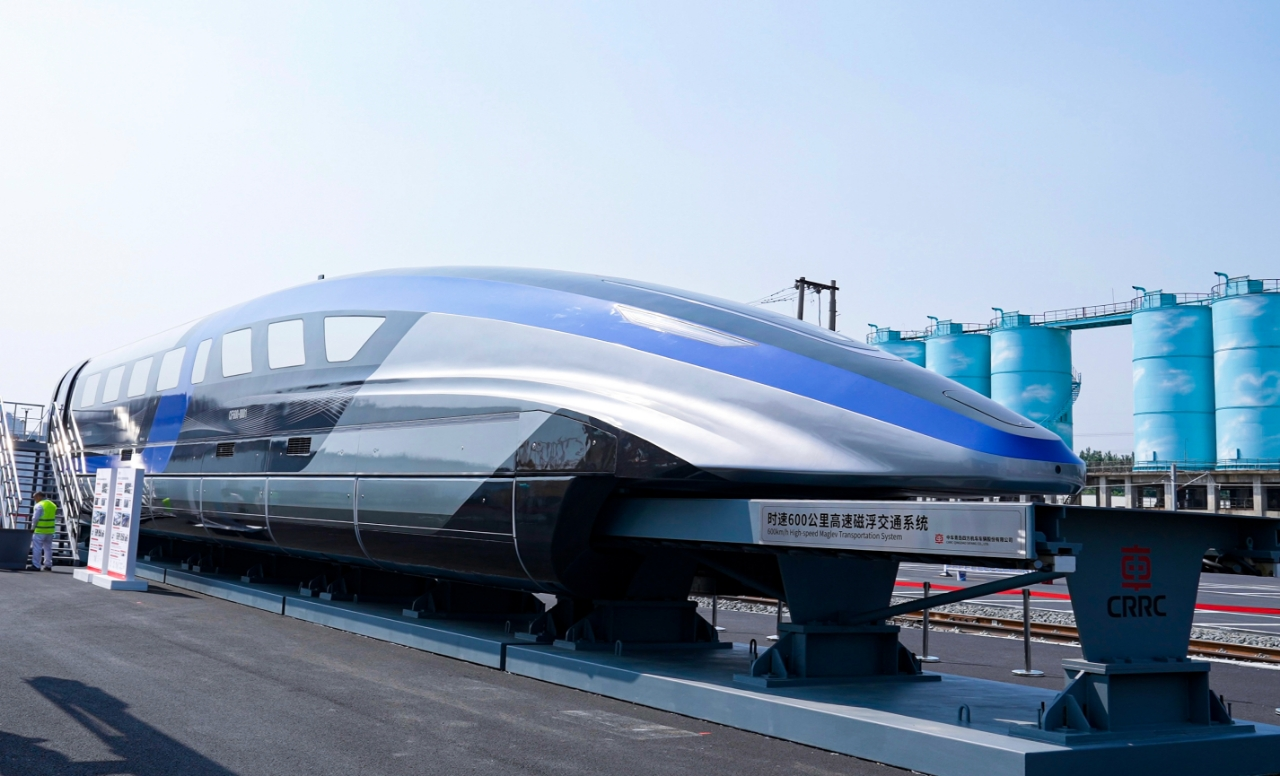
While India is developing conventional wheel-on-rail high-speed trains, research in other countries is exploring even faster transport technologies. Magnetic levitation, or Maglev, is one such approach. Unlike conventional trains, Maglev systems use magnetic forces to lift the vehicle slightly above the guideway. This removes direct contact between wheels and the running surface, reducing friction associated with wheel-rail interaction. With less mechanical contact, Maglev technology can support very high speeds. However, aerodynamic resistance remains a major challenge as speed increases. The system also requires dedicated guideways and specialised infrastructure, making it fundamentally different from conventional railway networks. China has continued to demonstrate the potential of this technology through experimental high-speed tests. A Maglev train at Donghu Laboratory in Hubei province reportedly reached 800 kmph in 5.3 seconds during a trial on a one-kilometre test track. It then came to a halt over the following 200 metres. The trial followed earlier tests in which the train reportedly reached 650 kmph in seven seconds and later achieved speeds of 700 kmph and 798 kmph. These results demonstrate the acceleration potential of experimental Maglev systems.
China is not the only country developing the technology. Japan and South Korea have also invested in Maglev research and operations. Shanghai’s commercial high-speed Maglev service began operating in 2003, making it an early example of the technology being used for passenger transport. However, Maglev should not be viewed as a direct replacement for the high-speed rail systems India is currently developing. Its infrastructure requirements, costs and operating model are different. For India, the immediate priority remains building a reliable wheel-on-rail high-speed network and developing the domestic manufacturing capabilities needed to support it. Maglev’s research is nevertheless worth watching. It shows how railway technology may evolve over the coming decades and highlights the importance of investing in research rather than relying only on established systems.
Conclusion: Building the Capability Behind the Speed
India’s high-speed rail programme is entering an important phase. The Mumbai–Ahmedabad project is providing the first major opportunity to develop experience in dedicated high-speed infrastructure, while the BEML rolling stock contract marks a significant step towards domestic train manufacturing. The development of the B28 trainsets, the Aditya manufacturing complex, specialised maintenance depots and indigenous construction equipment indicates that the programme is beginning to create an industrial base around high-speed rail. Training initiatives and collaboration with IITs are also helping build the technical knowledge required for future projects.
The seven corridors announced in the Union Budget 2026–27 suggest that the government’s ambitions extend well beyond the first bullet train route. If these plans move forward, India will need to expand its manufacturing capacity, strengthen its component supply chain and establish a much larger pool of trained engineers and technicians. There are, however, risks. High-speed rail demands heavy investment, reliable passenger demand and long-term maintenance commitments. Domestic production must meet strict safety and performance standards, and localisation cannot be measured only by where a train is assembled. The real test will be how much technology, design knowledge and manufacturing expertise Indian companies can develop and retain.
For now, the most important outcome of the Mumbai-Ahmedabad project may not be the speed of its trains alone. It may be the experience India gains in designing, manufacturing, testing and maintaining an entirely new category of railway equipment. If that experience translates into reliable products, competitive manufacturing and a sustainable supply chain, high-speed rail could become more than a premium transport service. It could help create a new generation of Indian railway engineering.
If the costs, technical challenges and passenger demand are not managed carefully, however, the programme could struggle to deliver value at the scale envisaged. India’s bullet train ambitions are therefore as much about building industrial capability as they are about reducing travel time. The journey towards 320 kmph has begun, but the country’s long-term success will depend on what it can build and maintain at home.
Also Read: Surat Bullet Train Station’s Diamond-Inspired Design Revealed as Mumbai-Ahmedabad Corridor Advances
Project OverviewHigh-Speed Rail in India – Information, Route Map, Fares, Tenders & Updates
 Read nextBullet Train: First Service in 2027 on Surat-Vapi Section, Indigenous B28 Track Trials by Mid-2027, Says Vaishnaw21 Nov 2026
Get alerts for big metro and rail stories Openings, trials, fares and approvals. Two or three a day at most; turn them off any time.