



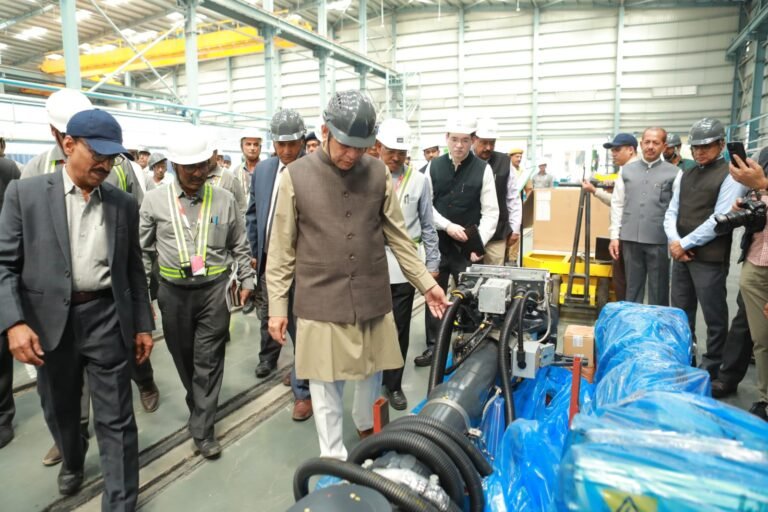
BENGALURU (Metro Rail News): India’s first indigenous bullet train B28 is witnessing the squeeze-test of the first coach at BEML facility in Bengaluru for the Mumbai-Ahmedabad Bullet Train corridor, nudging towards its expected completion in the near-future. Railway Minister Ashwini Vaishnaw visited the BEML facility on November 1, 2026 to review progress of the making of B-28, while witnessing the successful testing of structural strength of the train body and its resistance to wind pressure.
Inside India’s first indigenous Bullet Train
| Particulars | Details |
| Train’s Length | 202 metres |
| Total Cars | 8 (4 Motor Cars, 4 Trailer Cars) |
| Type of Coaches | 7 Standard-Class Cars (3*2 seating)1 Executive-Class Car (2*2 seating) |
| Maximum Testing Speed | 280 km/h |
| Regular Operational Speed | 249 km/h |
| Passenger Capacity | 557 Passengers |
The single 8 coaches-train can be integrated with the other train having a similar number of coaches to get the final 16-coaches strains in the future.
How would the B28 be easily accessible for all
Get the Daily Metro & Rail Brief
Join 125,000+ metro and rail professionals. Project updates, new tenders and contract awards from across India, in your inbox every day.
To ensure that the train’s body and interior are suited to India weather conditions and passenger needs, several design and accessibility features have been incorporated into the B28. The steps taken for the passengers’ comfort are:
- 2 seats space is incorporated in the seating design for the Persons with Reduced Mobility (PRM)
- Seats are ergonomically designed, providing adequate legroom
- The interior lighting is LED supported
- Overhead baggage racks are available to provide room for the loads carried by commuters
- Additional floor-mounted luggage stands for bigger size luggage
- Power outlets for laptops and mobile devices
- Modern bio-digester toilets with minimal effluent
- Wide windows at every seat row
- The sealed, single-piece gangway allows passengers to move comfortably between cars
- The train floor is aligned with the platform height to facilitate level boarding
- Retractable footsteps integrated into the doors help minimise the horizontal gap between the train and platform.
- PRM-friendly seating and toilet
- Doors designed for wheelchair movement
- Braille-enabled information signage
How is the Bullet Train going to make the journey smooth and safe

The interior body has been designed deviating from usual architecture to make the journey less obstructible for the passengers. To reduce noise inside, sound insulation in the car body and floor structure, noise-damping coatings, skirts, bogie covers and fairings have been incorporated to reduce strain on the young and old alike. Each car is equipped with 2 HVAC (Heating, Ventilation, and Air Conditioning) units to provide comfortable temperature while travelling.
To keep the people on-board informed throughout the journey, LCD displays will be there inside the cabin to access information in English, Hindi and any regional languages. A Wi-Fi based infotainment system is installed to keep the passengers entertained while also being updated about any recent important information. Automatic announcement systems are set up to guide the commuters through public addresses and audio-based notices. Emergency talk-back units will be available for the general people to communicate any sign of mishappening to the concerned authorities and for the officials to respond back in time while being there at vestibules.
An Intelligent On-Board Control system is going to be present for the drivers at both ends of the car to help them in coordinating with the operation control centre better and making prompt-decisions.
The enhanced weather-supported design of B28
The train operates on a 25 kV, 50 Hz single-phase AC traction system supplied through heavy compound catenary. Its regenerative braking system helps recover energy during braking, contributing to greater energy efficiency. The train’s outer body and its nose have been optimised using Computational Fluid Dynamics (CFD) simulations, which help better understand how air flows around the train.
The aerodynamic design helps in reducing the air pressure and resistance against the body when it pushes forward, further helping the tunnel pressure waves, sonic boom and turbulence to be less impactful on it. The HVAC rooftop profile, roof panels and airflow deflectors are the features of the trains outer structure to enable easy movement while decreasing the chances of damage to the surface area.
Also Read: Ashwini Vaishnaw Announces Bullet Train Plans, Vande Bharat Sleeper Boosts Rail Connectivity
Project OverviewHigh-Speed Rail in India – Information, Route Map, Fares, Tenders & Updates
 Read nextJupiter Wagons Ltd Secures ₹324 Cr ACT2 Wagon Orders from GATX India and Chetak International 2 Nov 2026