



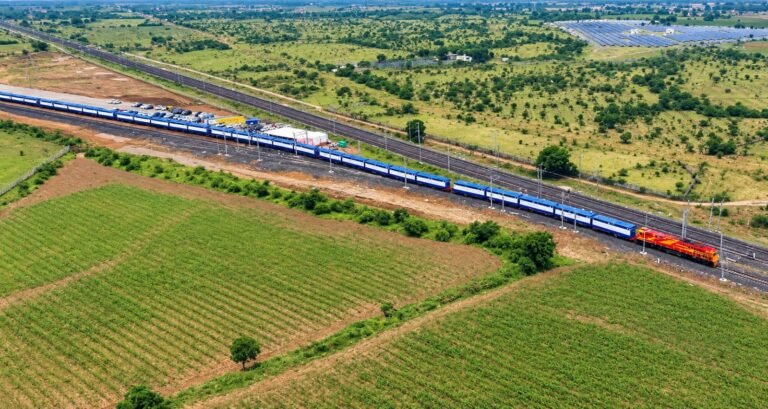
GUJARAT (Metro rail news): Railway Minister Ashwini Vaishnaw on Wednesday flagged off a salt-loaded freight train from Shivlakha Gati Shakti Cargo Terminal (GCT) in Kachchh to Mithapur. It is made of lightweight stainless steel containers designed to make salt transport easier.
The new containers aim to address some of the problems that come with moving salt in conventional railway wagons, including moisture and difficulties during loading and unloading.
Railway designed new stainless steel containers for salt transport
Salt is a major commodity in Gujarat, particularly in the Kachchh region. But moving it by railway has not always been straightforward. Vaishnaw said conventional wagons add significant weight to the overall load. Salt can also absorb moisture during transport, which can make the cargo wet and create problems during loading and unloading.
The new stainless steel containers aim to address these issues. The containers are lightweight and have separate arrangements for loading and unloading:
The weekly brief metro & rail professionals read.
- Salt can be loaded from the top.
- It can be unloaded from the side.
- The stainless steel design can help deal with moisture during transportation.
- Their lower weight can allow more efficient use of the train’s carrying capacity.
The first salt-loaded freight train using the new system was flagged off from Shivlakha GCT to Mithapur.
Shivlakha Gati Shakti Terminal gets operational
The salt train flag-off came as Vaishnaw inaugurated the Shivlakha Gati Shakti Cargo Terminal in Kachchh. The terminal is expected to give salt producers and other businesses in the region a direct facility for handling cargo by rail. This can reduce the need to depend on road transport for moving goods to railway loading points. The location is also important because Kachchh has a large salt-producing industry and sits close to Gujarat’s major ports and industrial areas.
The event also marked the launch and expansion of five Gati Shakti Cargo Terminals across Gujarat. Vaishnaw inaugurated Shivlakha GCT, while three terminals were dedicated to the nation. These are:
- Bhimasar GCT – Kachchh
- Devaliya GCT – Morbi
- Chandisar GCT – Banaskantha
The Railway Minister also laid the foundation stone for the Linch GCT in Mahesana. The terminals will add more locations for businesses to load and send goods by rail. They are also expected to improve links between Gujarat’s industrial centres, ports and markets in northern India.
Railway commissioned 150 Gati Shakti Cargo Terminals
Indian Railways has now commissioned 150 Gati Shakti Cargo Terminals across India, according to Vaishnaw. The GCT programme focuses on bringing freight facilities closer to industries and production centres.
For businesses, the idea is simple- reduce the distance between where goods are produced and where they enter the railway network. The new terminals can also help reduce pressure at existing freight points and improve the movement of goods towards ports and the northern hinterland.
Kachchh railway network also expanding
The GCT push comes alongside a wider expansion of railway infrastructure in Kachchh. Vaishnaw said projects worth around ₹5,600 crore are currently under way in the region. Major works include capacity expansion and doubling on routes connecting:
Samakhiali – Bhachau – Gandhidham – Adipur – Bhuj
The Samakhiali-Bhachau section has already been expanded to four lines. The Gandhidham-Adipur section has also been expanded to four lines. The Adipur-Bhuj section is being doubled. The Railways has also completed the conversion of the Bhuj–Naliya route from metre gauge to broad gauge. A new broad-gauge line from Naliya to Jakhau Port has also been sanctioned. Further development is planned towards Vayor, Luna, Hajipur and Desalpar.
Why the freight push matters
Kachchh has a large industrial base, salt production and important port-linked activity. Better rail connectivity can help businesses move larger volumes of goods over longer distances. The region also has strategic importance because of its proximity to the international border. Improved railway infrastructure can support both industrial and defence requirements.
However, the success of the new GCTs will depend on how much cargo businesses actually shift to rail. Better terminals alone will not be enough. Local road links, regular train services and efficient loading and unloading will also matter.
DFCs to support freight movement
Vaishnaw also highlighted the role of Dedicated Freight Corridors in improving goods movement. The expanded freight network can allow goods trains to move more efficiently and reduce pressure on routes that also carry passenger trains. The Railways is also working to expand freight connectivity in the east-west direction.
Mumbai-Ahmedabad bullet train update
Vaishnaw also provided an update on the Mumbai-Ahmedabad High-Speed Rail project. Construction on the Vapi-Surat section is targeted for completion by December 2026. Testing and other related work will follow. He also said the first coach of India’s indigenous high-speed train has been prepared and is undergoing various tests.
Also Read: Assam Achieved 100% Railway Electrification on BG Network in Just 12 Years