




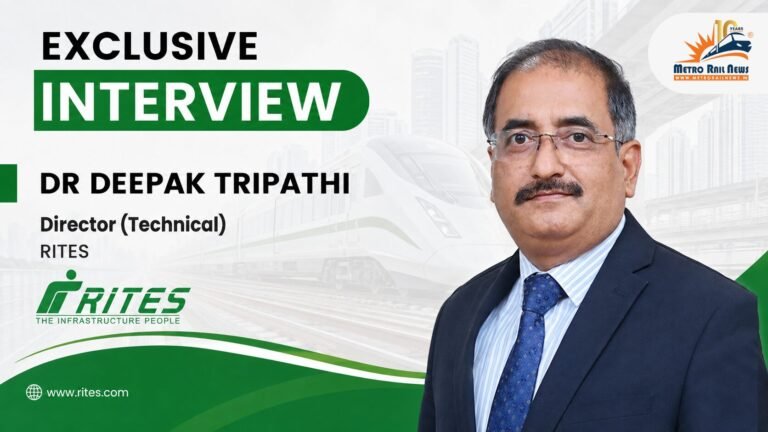
Metro Rail News conducted an exclusive interview with Dr. Deepak Tripathi, who is currently holding the position of Director (Technical) at RITES. During the conversation, Dr. Tripathi shared his inspiring journey of how his passion for trains led him to join one of the world’s largest railway systems: Indian Railways. Apart from that, the conversation shifted to various aspects of RITES, which today stands as the exporting arm of Indian Railways. Dr. Tripathi mentioned the company’s contributions to metro rail development, railway modernisation, quality assurance, exports, and international consultancy. Speaking about international expansion, he outlined RITES’ strategy to promote Indian railway technology globally, including the development of standard-gauge Vande Bharat trainsets for export markets. Here are the edited excerpts:
1. You have over three decades of experience across Indian Railways, KRCL and now RITES. Could you walk us through the key milestones of this journey and what drew you to a career in railway engineering?
My passion for trains and railway systems can be traced back to my childhood. I fondly remember the view of a small railway station in my township, the sight of steam locomotives hauling meter-gauge trains. My frequent train journeys, the rhythmic chugging of the engines, and the shrill whistle echoing through the countryside left an indelible impression on my young mind. As the years passed, this childhood fascination evolved into a clear aspiration. During my graduation, I became determined to join the Indian Railway Service not merely as a career choice, but as an opportunity to contribute to one of the world’s largest and most complex railway systems. The prospect of serving an organisation that connects every corner of India, unites millions of people every day, and plays a pivotal role in the nation’s economic and social development deeply inspired me.
This aspiration became a reality after I completed my post-graduation in Engineering and Management from NITIE, now redesignated as the Indian Institute of Management, Mumbai. Despite receiving attractive career opportunities from leading multinational corporations and prominent private-sector organisations, I made a conscious and deliberate decision to join the Indian Railway service. I firmly believed that it offered the ideal platform to pursue my lifelong passion for railways while applying my engineering knowledge and management education to serve the nation.
Get the Daily Metro & Rail Brief
Join 125,000+ metro and rail professionals. Project updates, new tenders and contract awards from across India, in your inbox every day.
Looking back, it remains one of the most defining decisions of my professional life. It marked the beginning of a remarkable journey that has allowed me not only to fulfil a childhood dream but also to contribute to the modernisation, expansion, and global outreach of India’s railway ecosystem.
Over the past three decades, I have been fortunate to work across diverse domains of the railway sector, from operations and maintenance to infrastructure, rolling stock, technology, quality assurance, consultancy and international business. Looking back, I believe my most significant contribution has been building new capabilities, introducing innovation, and creating sustainable business models that continue to deliver value.
At Konkan Railway, I had the opportunity to build several new business verticals from the ground up, including rolling stock, railway operations and maintenance, workshop infrastructure, technology services and international business. One of the landmark initiatives was establishing KRCL’s international business programme, which led to the successful export of trainsets and railway operations to Nepal and laid the foundation for long-term railway cooperation between the two countries. Another was patenting SMART Yard Technology for train safety, working on the Anti-Collision Device project that ultimately evolved into Kavach (TCAS), besides promoting Industry 4.0 and AI-based applications for railway operations and manufacturing.
Since joining RITES as Director (Technical) in 2023, my focus has been on strengthening three strategic areas: Technical Services, Quality Assurance, and Exports & International Business. I also served as Director (Projects) in RITES for one year with additional charge.
In RITES, I have also been working on building a foundation for long-term sustainable growth of the company, managing a complex business environment and riding through the new technology wave. The visible outcomes are many, but sharing a few:
In Quality Assurance, we have expanded beyond the railway sector into defence, oil and gas, chemicals and other industries. While introducing digital technologies, AI-enabled inspection systems and value-added services such as Independent Safety Assessment and Independent Engineering. The Quality Assurance Division of RITES has now significant International Outreach, including its presence in Sri Lanka, Indonesia and other countries.
In Technical Services, we are expanding locomotive leasing, industrial railway operations and maintenance, ropeway consultancy, and lifecycle management solutions for metro rail systems and Vande Bharat trainsets.
Internationally, our strategy has been to reposition RITES from a line of credit-driven business model to one based on competitive international bidding, strategic partnerships and diversified funding mechanisms. This has significantly strengthened our engagement across Africa, South Asia and Latin America and helped position Indian railway technology and manufacturing on the global stage.
While I have been honoured with recognitions such as the Minister of Railways’ National Award for Outstanding Service, the Best Innovation Award, the Lal Bahadur Shastri Award, the Outstanding Author Award from Emerald Publications (UK), Director General’s Medals, commendations from the Government of Nepal and two Presidential Awards, I regard these as recognition of the collective efforts of the exceptional teams I have had the privilege to work with.
Ultimately, I believe my greatest achievement has not been any single project or award, but the opportunity to contribute to the transformation of India’s railway ecosystem through innovation, institution building, technology leadership, international collaborations and leading the Indian Rail industry’s global outreach. It has been deeply fulfilling to help strengthen India’s railway capabilities while also showcasing Indian expertise as a trusted global partner.
2. RITES’ role has been crucial in India’s metro rail expansion across multiple cities. Could you highlight some of the flagship metro projects RITES has been associated with?
RITES lives by its motto, ‘Future Ready,’ with ‘Innovation-Execution-Transformation’ as our mantra and our source of energy. This has led, over the past five decades, RITES to become the country’s only company that works in all segments of transportation and infrastructure consultancy, with its footprints in every state and corner of India and its outreach extending to more than 55 countries.
RITES pioneered the development of metro and urban mobility infrastructure in India, starting in 1998 with the first metro projects in the country (DMRC Phase 1 and Phase 2). We continued to drive the metro and urban mobility planning, design, and project execution industry until the sector matured in India.
- Started with Delhi Metro (DMRC) Phase 1 in 1998 and then Phase 2, Phase 3, and the Airport Line.
- 2,000 km+ of metro systems in 30 cities; multimodal integration studies of 38 metro stations.
- Bangalore; Ahmedabad Phase 1 & 2; Pune; Nagpur; Haryana Orbital Rail Corporation.
- Detailed Design Consultancy for Ahmedabad, Bangalore, Bhopal, Indore, Surat, and Pune Metro.
- DPR, EIA, and SIA for metros at Delhi, Jaipur, Hyderabad, Kochi, Kanpur, Agra, Meerut, Allahabad, Jammu, Srinagar, Gorakhpur, Guwahati, Thane, Gurgaon, Chennai Metro-II, Navi Mumbai Lines 2, 3 & 4, and LRT projects at Vijayawada, Bangalore, and Bhopal.
- Structural Health Monitoring of Kolkata Metro.
Not limiting ourselves to India, we also dared to move beyond national boundaries and undertook projects overseas.
- PMC for the Light Rail Transit System in Mauritius.
- Feasibility study for Bahrain Metro.
- Kampala Urban Traffic Improvement Plan.
- Urban transport study in Indonesia.
- Projects in Botswana, Gabon, Trinidad & Tobago, etc.
Now, we understand that the country’s metro and urban mobility sector is passing into the next phase. With so much infrastructure created and already in operation, and much more to come, there is a huge gap in demand versus supply for asset management.
We have already taken up this challenge by building in-house capabilities in the areas of rolling stock O&M, metro and urban mobility systems O&M, and retrofitment and technology upgrades. This is the mission of RITES for the coming years to recreate the same success that we achieved in building infrastructure.
Bridging the technology gap (which already exists) and keeping pace with technological developments across the world is another challenge we have decided to undertake. These include:
i. Rolling Stock Technologies
ii. Equipment/System Technologies
iii. AI/Digital Technologies
To achieve these objectives, we are pursuing international and domestic collaborations (experts, industry partners, and institutions) for rolling stock and equipment technologies. Also on the cards is creating in-house capabilities and initiatives such as Project Abhikalp for AI/Digital Technologies, Mission AI, and IT Ready RITES.
3. Beyond metros, RITES has a long legacy in mainline railway consultancy, rolling stock, and infrastructure. How would you describe RITES’ overall contribution to modernizing Indian Railways?
RITES has played a pivotal role in the modernization of Indian Railways by serving as its premier multidisciplinary engineering and consultancy organization. Over the past five decades, RITES has contributed across the entire railway value chain from planning, feasibility studies, design and engineering to project management, quality assurance, rolling stock, workshops, signalling, electrification, station redevelopment, logistics, and operations & maintenance. This includes 15,000+ km of railway infrastructure work and 1,000+ km of bridge and tunnel work. Some of the important projects include the development of the National Rail Plan (NRP), the J&K Railway Line Project, the Bogibeel Bridge Project, DFC, the National High-Speed Corridor, etc.
It has consistently introduced global best practices, advanced technologies, and sustainable engineering solutions, enabling Indian Railways to improve safety, operational efficiency, capacity, and passenger experience while supporting the transition towards a modern, technology-driven transportation system. LiDAR-based drone surveys, technology-enabled Structural Health Monitoring Systems (SHMS), AI-enabled machine vision-based inspection systems for rails, and a web-based portal for process quality assurance connecting more than 150 plants manufacturing track items.
As Indian Railways embarks on transformative initiatives such as high-speed and semi-high-speed rail, dedicated freight corridors, digitalization, AI-enabled asset management, and green mobility, RITES continues to play a strategic role by providing integrated, innovative, and future-ready solutions. On these fronts, RITES has initiated key programs such as Project Abhikalp, AI Ready RITES, and IT Ready RITES, developing technologies like BIM and Digital Twin, AR/VR, machine vision-based solutions, and 3D printing.
REMCL, the joint venture company of RITES and Indian Railways, is entrusted with the ‘Net Zero’ carbon target by 2030, venturing aggressively into renewable energy. Its newly created ‘Green Mobility’ vertical also aims to bring green technology solutions to the railway and transport sectors in India.
Today, RITES is not only supporting the modernization of Indian Railways but is also helping position India as a trusted global partner in railway infrastructure, mobility solutions, and sustainable transport.
4. RITES has also been involved in rolling stock export and international business, including locomotive and coach supplies to other nations. How does RITES balance domestic priorities with its growing international portfolio?
RITES, as an organization, has different business verticals with dedicated resources and capabilities to undertake projects in different sectors of railways, transportation, and infrastructure. These include Rail & Metro; Highways; Buildings, Ports & Airports; Urban Engineering; Technical Services; Quality Assurance; and Exports. RITES also has the ‘RITES Videsh’ initiative to undertake international consulting projects, which draws resources from the respective verticals.
Apart from this, RITES has its subsidiary, ‘RITES Afrika Limited,’ headquartered in Botswana. It also has regional international offices in Abu Dhabi, Guyana, and the Philippines, apart from project sites in Mozambique, Sri Lanka, and Bangladesh. It is also expanding its reach by opening new offices in Ghana and South Africa.
So, for exploring business opportunities, leading project execution, and promoting exports, RITES has dedicated verticals, and that takes care of meeting the requirements of both domestic and international business.
5. RITES and Indian Railways are reportedly developing a standard-gauge version of the Vande Bharat train for international markets. Could you tell us more about this initiative?
RITES, working as an export arm of Indian Railways, has contributed to the development and export of various rolling stock, aligned with the Ministry of Railways’ vision of promoting indigenous manufacturing and enhancing railway exports under the “Make in India” and “Atmanirbhar Bharat” initiatives.
Vande Bharat, the first indigenously developed semi-high-speed trainset matching global standards, has become a flagship product of Indian Railways. RITES, with the support of the Ministry of Railways, is working to promote this flagship product in other countries. Since the launch of the first Vande Bharat by the Integral Coach Factory (ICF), RITES started working to develop a broad-gauge version in 3 kV DC for Chile, as Chile is the only country in the world, other than India, with a significant electrified section on broad gauge.
With the development of standard-gauge railways in some of the African countries and also in Southeast Asia, RITES has taken up the assignment of designing and developing semi-high-speed Vande Bharat trainsets in standard-gauge (SG) format, with the support of ICF and the Ministry of Railways.
The proposed project would involve the design and development of Vande Bharat trainsets for standard-gauge operation with a design speed of 200/160 kmph, leveraging the successful Vande Bharat platform. Key features of the project include the conversion of the existing broad-gauge (BG) Vande Bharat coach design to an SG configuration, development of standard-gauge (SG) bogies, adaptation of shell and propulsion systems, international-standard interiors, and consideration of interoperability and compliance with international standards for standard-gauge markets.
However, the scheme for development is still under finalization.
6. Countries such as Bangladesh, Sri Lanka, and Nepal have already shown interest in the Vande Bharat platform. What specific engineering or design changes are required to make the train export-ready for these markets?
So, these neighbouring countries, though they have broad gauge, are still to be electrified. The Vande Bharat has been developed as a semi-high-speed platform on 25 kV electric traction. This is one of the primary reasons RITES is exploring Latin American and African markets. We expect some electrification projects to come up in these countries in the near future.
7. India has evolved from being a net importer to becoming an emerging exporter of railway products. What do you consider the primary factors behind this transformation?
Today, India has a very mature and robust rail & metro industry in terms of technology, development, manufacturing capabilities, and capacities, and can be compared with any of the leading global suppliers in China, Europe, and North America. The credit for this goes to the investment that has taken place in the last decade in building high-capacity and modern rail & metro infrastructure and systems in India. This includes semi-high-speed rail, metro and urban rail transit, and intercity services like NCRTC. We have almost all global companies operating in India, and domestic companies have also grown in the process, whether in rolling stock, equipment, or infrastructure products and technologies.
The impetus for export promotion by the Government of India, proactive engagements at the G2G level with different countries and regions, export-linked incentives, and a favourable geopolitical environment have been the great enablers.
The component suppliers have aggressively expanded their presence with global OEMs as clients, supported by the fact that many global OEMs now have a presence in India and already source from the country. There has also been a significant push by RITES for exports from OEMs such as Indian Railway Production Units, BHEL, and BEML from the public sector, as well as wagon manufacturers from the private sector. Some private-sector companies have also been aggressively pursuing exports.
RITES has also made significant efforts to regain export business in the past 2-3 years through a multipronged approach involving direct marketing, international competitive bidding, and the development and customization of rolling stock products. Some recent wins include an EIB-funded project for 200 BG coaches for Bangladesh Railways, an AfDB-funded project for the supply of 10 Cape-gauge diesel locomotives to CFM, Mozambique, a contract signed with the National Railway of Zimbabwe (NRZ) for the supply of Cape-gauge locomotives and wagons, the supply of Cape-gauge locomotives to International Coal Ventures Limited, ‘In Service’ ALCO for Cape-gauge and standard-gauge markets, and a few orders won from South African companies and one from Australia.
For the refurbishment and O&M market, there has not been much outreach as of now, but the Indian industry jointly has a huge opportunity in this space due to the pool of experts we have, the capability to produce spares, and the large number of big and small companies with decent capabilities. However, for this, the Indian industry has to mature, as it is currently dominated by MNCs.
For rail infrastructure projects as well, both domestic and international collaboration are key. We need to have a combination of consultant, execution agency, and financier. This is the model on which the industry works globally – you conceive and develop the project report, arrange financing, execute the project, hand it over, and maybe also operate it for some time.
Broadly, talking about RITES and its associated companies, we see immense potential for us in South Asia, Africa, Latin America, and Southeast Asia.
8. What policy, technological, or manufacturing improvements do you believe are necessary for India to establish itself as a leading global exporter of railway products and engineering solutions?
Broadly speaking, exports of rolling stock have three fundamental elements: 1. Access to markets 2. Availability of the right products 3. Financing. All three are equally important, as most companies from China, Europe, and America compete as much on liquidity as they do on products. The liquidity enables them to promote their product specifications while also providing market access. RITES had also enjoyed a similar advantage when exporting through funding support from the Government of India. However, now that access to the Indian Line of Credit (LOC) is restricted, we face challenges in all three elements.
So, whatever the intervention whether policy, strategic, or operational it has to ultimately address these requirements. We need enablers such as G2G engagement, policies to provide market access to Indian OEMs, incentivising Indian Railways, PSUs, and private companies to supply cost-competitive products of global standards, developing a portfolio of diverse products and platforms by OEMs and component suppliers, and creating an ecosystem for access to easy finance, including innovative financing mechanisms such as commodity exchange. Several initiatives have been taken by RITES in this direction over the past few years.
9. Could you walk us through the vision of RITES over the next five to ten years, particularly in the context of India’s Viksit Bharat infrastructure roadmap?
While RITES has a vision to become a globally respected, technology-driven engineering and transport infrastructure consultancy, it aims to play a pivotal role in realizing the vision of Viksit Bharat 2047. Over the next five to ten years, our focus will be on supporting India’s infrastructure transformation by delivering integrated solutions across railways, metro systems, highways, ports, airports, urban mobility, logistics, and renewable energy. We aim to leverage digital technologies, artificial intelligence, asset management systems, and sustainability-driven engineering to enhance efficiency, safety, and resilience while contributing to India’s ambition of developing world-class, multimodal transport infrastructure.
At the same time, RITES is committed to strengthening India’s position as a global infrastructure partner. Building on our proven expertise in more than 55 countries, we will expand our international footprint by promoting Indian engineering capabilities, railway technologies, rolling stock, and project management expertise across emerging markets in Africa, Southeast Asia, the Middle East, and Latin America. We also see significant opportunities in technology consulting, inspection and certification services, exports, and lifecycle asset management, enabling us to create long-term value for our clients while supporting the Government of India’s vision of Make in India, Atmanirbhar Bharat, and enhanced global economic engagement.
10 What messages would you like to convey to the stakeholders in the rail ecosystem and the readers of Metro Rail News magazine
We all need to work towards a shared vision of building a robust, self-sustainable, home-grown ecosystem for complete life-cycle management of metro and urban mobility infrastructure/systems that not only takes care of the long-term needs of the nation but also provides a robust solution for other countries around the world. We need to make a shift from mere adoption to adaptation, and then to co-development and fundamental research.
For this, we need interventions at the government policy level, institutional level, and business entity level, with the participation of both the public and private sectors. This has to happen in phases: develop or bring in the best-in-class technologies, systems, and processes in the country; nurture and make these part of the Indian ecosystem; and then promote them to the outside world. This vision also requires the participation of global companies and would require us to create a win-win for all stakeholders. Each one of us, whether government, institution, industry, or individual, has to play a role in this shared vision.
The exciting news is that so many developments are happening in various areas, and even our foreign partners are endorsing the vibrancy of the Indian rail & mobility sector, something not seen anytime before. They are more than willing to join hands. On the other hand, during my visits to various countries, especially in Africa, Latin America, and the Middle East, I have seen a strong desire to learn from the Indian experience and collaborate with Indian enterprises for the development of rail and mobility sectors in their countries. There cannot be a better time for us, and we should not miss this opportunity.
And I must say with full conviction that we at RITES are willing and capable of providing a platform to work towards this shared vision for both Indian and international organizations.