



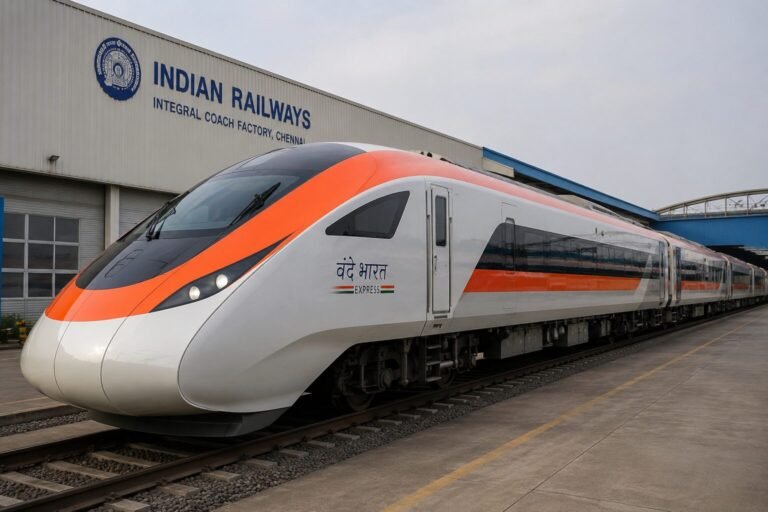
DELHI (Metro Rail News): The Parliamentary Standing Committee on Railways tabled its 10th report in the Lok Sabha on Monday, 10 August 2026, focusses on boosting domestic manufacturing of bullet train components and expanding skilling programmes that involve international expertise.
The committee also recommended accelerated indigenisation of high speed rail components and institutionalised capacity building by expanding training programmes at High speed Rail Training institute , Vadodara with International expertise.
The Panel highlighted the importance of accelerating indigenisation of high-speed rail components and technology transfer under the Make in India initiative and direct Indian Railways to conduct a comprehensive study of well-established, efficiently operating high-speed rail networks globally and apply best practices to India’s upcoming projects.
The committee welcomed the expansion of India’s High-Speed Rail (HSR) footprint. The seven proposed corridors spanning around 4,000 km, are expected to attract investment of around ₹16 lakh crore.
The weekly brief metro & rail professionals read.
proposed corridors
- Mumbai-Pune
- Pune-Hyderabad
- Hyderabad-Bengaluru
- Hyderabad-Chennai
- Chennai-Bengaluru
- Delhi-Varanasi
- Varanasi-Siliguri
To avoid the delays and cost overruns faced by the Mumbai-Ahmedabad project, the panel strongly recommended that land acquisition, utility shifting and all statutory clearances must be completed before projects are officially sanctioned or funded.
Updates on Mumbai-Ahmedabad High-Speed Rail (MAHSR) Project
The 508-km Mumbai-Ahmedabad corridor was originally approved in 2015 at an estimated cost of ₹97,636 crore based on feasibility studies. Costs have risen significantly due to taxes, cess and inflation. A revised estimate is currently undergoing final sanctioning.Full corridor completion depends on finalising civil structures, track laying, electrical systems, signalling networks and trainset deliveries.
The first stretch of operations is scheduled to commence on the 97-km Surat-Vapi segment by August 2027. This stretch will run on the indigenous B28 trainset manufactured by BEML, capable of operational speeds up to 280 km/h. Japan is developing its E10 series Shinkansen trains, but the timeline for their supply remains unconfirmed. To avoid waiting, India has opted to deploy domestic trainsets first.
The Ministry confirmed that Commercial operations will feature an affordable, socio-economically calibrated fare structure to ensure high passenger patronage on both short-distance regional trips and full-corridor journeys.
Project Overview