Home Blog Page 63

Kochi Metro: KMRL Invites Bids for Third Rail System & Associated Works in Phase 2

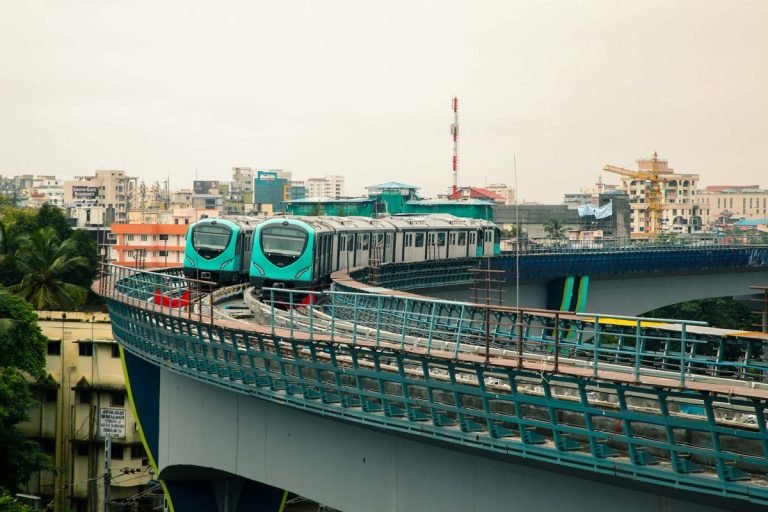
KOCHI (Metro Rail News): Kochi Metro Rail Limited (KMRL) has issued a tender for the design, supply, installation, testing, and commissioning of the Third Rail Traction Electrification System and related works for Phase 2 of the Kochi Metro project.

Phase 2 of Kochi Metro will have one corridor (Pink Line), spanning 11.2 km and connecting JLN Stadium to Infopark II through 11 stations.

Scope of Work (Tender Brief):
The selected contractor will be responsible for Design Verification, Detail Engineering, Supply, Installation, Testing And Commissioning Of 750V DC third Rail Traction Electrification, Including Traction Substations (Tss), Auxiliary Substations (Ass) And Associated Scada Systems For Phase -Ii Of Kochi Metro Rail Project. 

Tender Details

FieldDetails
Tender No.KBE-04/2025
Tender ID2025_KMRL_782298_1
Tender Reference No.KMRL/PROC/TENDER/2025-26/039
Completion Period24 months from the date of the Letter of Award / NTP (Notice to Proceed)
Pre-bid Meeting Date14.08.2025
Last Date & Time for Submission of Tender08.09.2025
Bid SecurityINR 1.77 crores

The construction of the Pink Line is being undertaken by Afcons Infrastructure at a cost of ₹1,141.32 crore.

According to Shri Loknath Behera, Managing Director of KMRL, the project is being implemented in two phases:

  • Phase 1: Covers the first five stations between JLN Stadium and Kakkanad, scheduled for completion by June 30, 2026.
  • Phase 2: The remaining stations are targeted for completion by December 2026.

The Pink Line (JLN Stadium – Infopark II) passes through densely built-up areas, where providing an overhead catenary system (OCS) would require additional vertical clearance. The third rail system eliminates overhead wires, which makes it more suitable for narrow viaducts.

To get real-time updates on metro and railway tenders, join our WhatsApp Community  https://chat.whatsapp.com/FhRoGfM8zUl4secYj1ZQDT

Bhopal Metro: MPMRCL MD Inspects AIIMS-D.R.M Section of Orange Line

BHOPAL (Metro Rail News): The Managing Director of Madhya Pradesh Metro Rail Corporation, Mr. S. Krishna Chaitanya, conducted an on-site inspection encompassing the route from AIIMS to D.R.M. Station on 2nd August 2025. During this inspection, he evaluated critical operational elements, including the station entry and exit points, the system room, and the control room. Mr. Chaitanya provided directives to ensure the timely completion of all ongoing work.

GxW9Hn XsAE6cqh

On July 31, Mr. S. Krishna Chaitanya also conducted a comprehensive on-site inspection of the Bhopal Metro Depot, situated at Subhash Nagar. Shri Chaitanya emphasised the importance of completing the remaining critical tasks with a focus on facilitating the operations of the metro train services.

GxMVBNMW0AEKWFT
GxMVAuiW4AA Uia

The Bhopal Metro Phase 1 comprises 2 corridors, 28 stations in total. Phase 1 is expected to become operational by 2027. The Bhopal Metro Project is estimated to cost Rs. 6941.40 crores. 

Line Route Length Total No of Stations 
Line-2 (Orange Line)Karond Circle – AIIMS14.99 km16
Line-5 (Blue Line)Bhadbhada Square – Ratnagiri Tiraha 12.91 km14
AD 4nXc9xbcIVPwLpSa4m 2krzPbZXrN 3pChbHNW6ZNM0riKwPkdh4exVwP I0D Jn2YbXSlVXYc7hmL1kJoe xmFQWy28ldjOHziEIJauG8TAArK9jxb1CIXKtepeWQfoLVA0kKyFlsw?key=t4yM3 3UcL v0OakOc7rpQ

The work on the Bhopal Metro Rail Project is progressing rapidly. Recently, the Research Design and Standards Organisation successfully completed Oscillation and Emergency Braking Distance (EBD) trials for the Bhopal Metro’s rolling stock, which Alstom India is supplying. To know more about this news: Click Here

To get real-time updates on metro and railway tenders, join our WhatsApp Community  https://chat.whatsapp.com/FhRoGfM8zUl4secYj1ZQDT

Railways to Implement Kavach System on 14 New Routes

In an effort to prevent train collision incidents, the Indian Railways has announced the implementation of the advanced ‘Kavach’ system along the 14 routes, including the Birlanagar – Udimorh rail section, which spans 102 km. The Railway Board has given approval to a budget of ₹309.26 crore for the installation of the Kavach system across 14 strategic rail sections.

The implementation of Kavach technology is scheduled to commence shortly, with the aim of completing the project by the year 2025. This initiative will encompass key routes within the Prayagraj, Jhansi, and Agra railway divisions. This initiative aligns with Prime Minister Narendra Modi’s “Zero Tolerance for Safety” policy

Some of the included routes have been mentioned below : 

  • Shikohabad-Farrukhabad (103.58 km) 
  • Dholpur-Sarmathura (70 km)
  • Bhandai-Udimod (113 km)
  • Lalitpur-Khajuraho (164 km)
  • Khajuraho-Mahoba (64 km)
  • Et-Kaunch (13 km)
  • Ligarh-Harduaganj (14 km)

Kavach is an Automatic Train Protection (ATP) system designed to prevent collisions by regulating prescribed speeds and providing real-time alerts to train operators.  This system facilitates not only speed management but also enhances operational safety for trains during dense fog conditions or technical failures. 

Recently, in a major development, Indian Railways commissioned the indigenous railway safety system Kavach 4.0 on the Mathura-Kota section of the high-density Delhi-Mumbai route. 

Union Minister for Railways Shri Ashwini Vaishnaw said, “Railways has indigenously designed, developed, and manufactured the Kavach Automatic Train Protection System, taking inspiration from Hon’ble PM Shri Narendra Modi Ji’s ‘Atmanirbhar Bharat’ vision. Kavach 4.0 is a technology-intensive system. It was approved by the Research Designs & Standards Organisation (RDSO) in July 2024. Many developed nations took 20-30 years to develop and install train protection systems. The commissioning of Kavach 4.0 on the Kota-Mathura section has been achieved in a very short timeframe. This is a very big achievement.”

To get real-time updates on metro and railway tenders, join our WhatsApp Community  https://chat.whatsapp.com/FhRoGfM8zUl4secYj1ZQD

Centre’s Contribution to Chennai Metro Phase 2 Crosses ₹8000 Cr 

CHENNAI (Metro Rail News): The Chennai Metro Phase 2 has received extensive financial support from the centre. So far, the central government has released the funds of over ₹8,000 crore for the project. For the current fiscal year, the central government allocated about ₹8,445.80 crore, of which it has released ₹3,000.00 crore. This funding will expedite the progress of Phase 2, which includes the construction of 3 new corridors.

  The total funding for Phase 2, amounting to ₹63,246 crore, is secured from the Central Government, the State Government, as well as bilateral and multilateral loans. 

Minister of State for Urban Affairs, Tokhan Sahu, provided insights in the Lok Sabha regarding the funding released for various Metro Rail projects across the country, including the Chennai Metro Rail project.

Financial YearTotal Allocation by CentreAmount Released
2024–2025₹5,219.57 crore₹5,219.57 crore
2025–2026₹8,445.80 crore₹3,000.00 crore
Total Released So Far₹8,219.57 crore

In response to another question by AIADMK MP M. Thambidurai in the Rajya Sabha, Мг. Sahu said, “The Central government has approved Chennai Metro Rail’s phase-II project as a 50:50 Joint Venture Project, for 118.9 km at a cost of 63,246.4 crore in October 2024. Physical and financial progress of the project as on June 30, 2025, is 44.33% and 40.43% respectively.” as reported by The Hindu. 

The Cabinet of the Central Government approved the under-construction Chennai Metro Phase II project in October 2024. The Phase 2 of Chennai Metro encompasses 118.9 km and consists of three new corridors. As of the latest reports, the Phase II project has achieved a physical progress of 44.33%. 

Corridor Line Route Length 
Corridor-3Indigo Line Madhavaram Milk Colony to Siruseri SIPCOT-II45.4 km
Corridor- 4Orange Line Lighthouse to Poonamallee Bypass26.09 km 
Corridor-5 Red LineMadhavaram Milk Colony to Sholinganallur44.6 km 

Chennai Metro Rail Limited is planning to inaugurate the first elevated stretch of corridor 4, which connects Poonamallee to Porur by December 2025. 

To get real-time updates on metro and railway tenders, join our WhatsApp Community  https://chat.whatsapp.com/FhRoGfM8zUl4secYj1ZQDT

DFCCIL and MIGA Strengthen Ties to Accelerate Infrastructure Investment in India’s Rail Logistics Sector

In a move to accelerate investment in India’s logistics infrastructure, Shri Praveen Kumar, Managing Director of the Dedicated Freight Corridor Corporation of India Limited (DFCCIL), held a high-level meeting with Ms. Ariane Di Iorio, Director at the Multilateral Investment Guarantee Agency (MIGA), a member of the World Bank Group. The meeting was also attended by senior officials from MIGA’s team.

GxLxP7sbwAATfW5

The discussion focused on exploring strategic financing and risk mitigation avenues for DFCCIL’s ongoing and future infrastructure projects. Currently, EDFC is completely operational, while the last leg of WDFC is expected to be commissioned by December 2025.

GxLxP73b0AAQfP1

The commencement of dedicated freight corridors will decongest the existing lines and improve frequency of passenger trains. In addition, the DFCs will lower the logistics costs in India, which is currently higher than standard.

GxLxP7raEAA5Jii

DFCCIL: A National Priority Project

Established in 2006 under the Ministry of Railways, DFCCIL is tasked with the development, operation, and maintenance of Dedicated Freight Corridors (DFCs) in India. The DFCs will improve freight movement by decongesting existing railway lines and enabling faster, energy-efficient, and more reliable freight transport.

DFC Corridors

  • Western DFC (1,506 km) connects Dadri in Uttar Pradesh to JNPT in Maharashtra.
  • Eastern DFC (1,337 km) stretches from Ludhiana in Punjab to Sonnagar in Bihar.

Total project cost is estimated at over ₹1 lakh crore (~USD 12 billion), co-financed by international institutions like the Japan International Cooperation Agency (JICA) and the World Bank.

As of mid-2025, DFCCIL has commissioned over 2,000 km of freight corridors, improving average freight train speeds from 25 km/h to over 60 km/h, and drastically reducing transit times and logistics costs. Implementation of infrastructure connectivity across the country. With freight demand in India projected to grow at a CAGR of 8-9% in the next decade, efficient rail logistics will be vital in reducing India’s logistics cost to 8% of GDP from the current 13-14%. DFCCIL’s expanded corridors will play a pivotal role in achieving this objective.

To get real-time updates on metro and railway tenders, join our WhatsApp Community  https://chat.whatsapp.com/FhRoGfM8zUl4secYj1ZQDT

ST Engineering Wins Rail Contracts for Singapore’s Thomson-East Coast Line Extension 

 ST Engineering announced that its Urban Solutions business has been awarded two contracts from Singapore’s Land Transport Authority to provide rail electronics solutions for the new Thomson-East Coast Line Extension (TELe), which comprises four stations.  

For the first contract, ST Engineering Urban Solutions will provide a communications system and access management system for the TELe. The scope for the second contract covers the delivery of a data communication system and platform screen doors (PSDs) as part of a consortium with Alstom, which will provide its UrbalisTM signalling system. 

These contracts are expected to commence in the third quarter of 2025. Both projects involve replacing and upgrading existing systems for the Tanah Merah, Expo, and Changi Airport stations, as well as deployment at the future Changi Airport Terminal 5 station. 

“Our Smart Mobility business has been a longstanding contributor to the advancement of  Singapore’s rail network, delivering proven technologies and expertise to enable reliable,  efficient and safe rail operations. The Thomson-East Coast Line Extension presents a unique  challenge with its combination of existing and new stations, and we will leverage our experience, technical and engineering capabilities to ensure smooth deployment,” said Gareth  Tang, Acting President, Urban Solutions at ST Engineering. 

Collectively, the communications systems and data communication system will form the digital nerve centre of TELe’s rail operations, enabling timely data transmission for real-time coordination across trains, stations and operation control centres. The access management system will secure restricted areas in the stations, such as the train operation control centre,  enhancing the security and resilience of critical rail infrastructure.

ST Engineering Urban Solutions will also provide over 230 sets of PSDs for the four stations that will serve as safety barriers between the station platform and train track, and as environmental barriers to retain cooled air within the underground stations. 

Part of Singapore’s 2040 Land Transport Master Plan, the 14-km TELe comprises four stations, of which three will be converted from existing stations on the East-West Line. When completed, the TELe will provide a direct MRT connection between Changi Airport and the city centre,  cutting travel times and providing more seamless journeys for commuters and tourists.  

These latest wins build on the rail contracts that ST Engineering Urban Solutions has secured in Singapore this year, including supplying rail electronics solutions for the Cross Island Line and upgrading the mobile network for the Downtown Line, further strengthening its global track record of more than 200 rail projects in over 50 cities. 

1st Section of Kochi Metro Phase 2 to be Operational by June 2026

KOCHI (Metro Rail News): Despite the delays, the construction works of Kochi Metro Phase 2 are progressing at a steady pace. Kochi Metro Phase 2 includes an 11.2 km long new metro line (Pink Line) connecting JLN Stadium – Infopark II.

The construction of Pink Line is being executed by Afcons Infrastructure at Rs 1141.32 crore. According to Shri Loknath Behera, Managing Director of Kochi Metro Rail Limited (KMRL), the project is being implemented in two phases. The initial phase covers the first five stations of the proposed corridor connecting JLN Stadium to Kakkanad and is scheduled for completion by June 30, 2026. The remaining five stations will be developed in the second phase, with a target completion by December 2026.

Shri Loknath Behera, Managing Director of Kochi Metro Rail Limited (KMRL), attributed the delay primarily to heavy monsoon rains and challenges in relocating underground pipelines along the alignment.

The Government of India accorded “In principle approval for the Phase-II of the Kochi Metro Rail Project from JLN Stadium to Infopark via Kakkanad at the cost of Rs. 1957.05 crore.

Hon’ble Prime Minister laid the Foundation stone of Phase-II of the Kochi Metro Rail project on 01 September 2022 in the presence of Hon’ble Governor and Chief Minister.

S.No.SourceAmount (Rs. in crore)% Contribution
1GoI Equity274.916.23 %
2GoK Equity274.916.23 %
3SD for CT by GOI (50%)63.853.77 %
4SD for CT by GOK (50%)63.853.77 %
5Loan from bilateral/ multilateral agencies1016.2460.0 %
Total cost excluding Land, R&R and PPP component1693.74100.00 %
6SD by GOK for Land Including R&R cost82.68
7State Taxes to be borne by GoK94.19
8IDC for Loan & Front End Fee39.56
9PPP Component46.88
Total Completion Cost1957.05

A key highlight of Phase-II of the Kochi Metro Rail corridor is its focus on multimodal integrationT he metro alignment will be strategically integrated with the city’s bus transport system, the Kochi Water Metro, and the public bicycle-sharing network. 

This strategic expansion is expected to enhance urban mobility in Kochi, particularly by improving connectivity to Kakkanad, a rapidly growing IT and administrative hub. Once operational, the Pink Line will play a vital role in decongesting traffic and providing efficient, eco-friendly transit options for daily commuters.

To get real-time updates on metro and railway tenders, join our WhatsApp Community  https://chat.whatsapp.com/FhRoGfM8zUl4secYj1ZQDT

TuTr Hyperloop & BEML Sign MoU to Develop Hyperloop Technology in India

TuTr Hyperloop Private Limited, a technology startup formed at IIT Madras, has entered into a partnership with Bharat Earth Movers Limited (BEML), a public sector undertaking under the Ministry of Defence, to develop hyperloop technology in India jointly.

The MoU was signed by Lingaraj V. Viraktamath, Head of Corporate Technology Planning & Alliance Management at BEML, and Aravind S. Bharadwaj, Director & CEO of TuTr Hyperloop. 

According to PTI, BEML will serve as the principal manufacturing partner for TuTr Hyperloop. This collaboration is aimed at developing a prototype pod that can transport passengers and cargo at high velocities.

“This partnership is a step forward for India’s efforts in high-speed transportation,” said Shantanu Roy, Chairman and Managing Director, BEML. “It aligns with the goals of Viksit Bharat 2047 and Atmanirbhar Bharat by supporting transport systems built with Indian engineering and manufacturing,” as reported by ET Infra. 

The Hyperloop is an advanced mode of transportation which is designed to reduce travel time between cities. At its core, the system involves passenger or cargo pods that move through low-pressure tubes at incredibly high speeds, enabled by magnetic levitation (maglev) and electric propulsion.

This concept was first introduced in 2013 by Elon Musk, who published a white paper outlining the technical feasibility and potential advantages of such a system. Since then, several private companies and research institutions have been working to transform this vision into reality. 

However, the Hyperloop is still in the experimental stage, and numerous challenges remain. These include infrastructure development, regulatory approvals, passenger safety, and the economic feasibility of large-scale deployment.

To get real-time updates on metro and railway tenders, join our WhatsApp Community  https://chat.whatsapp.com/FhRoGfM8zUl4secYj1ZQDT


Titagarh to Manufacture Rolling Stock for Mumbai Metro Line 6

MUMBAI (Metro Rail News): Titagarh Rail Systems Limited has received a Letter of Acceptance (LoA) from NCC for the rolling stock contract worth Rs 1,598.55 crore for Line 6 of the Mumbai Metro.  Metro Line-6 spans 15.31 km between Swami Samarth Nagar and Vikhroli (EEH).

Untitled design 2025 08 04T151635.985

Titagarh Rail Systems will be responsible for the design, manufacturing, supply, installation, integration, testing, and commissioning of rolling stock for Mumbai Metro Line 6. The contract also includes 5 years of comprehensive maintenance, following a two-year defect liability maintenance period.

NCC has subcontracted the rolling stock part of the Package 1-CA-232 to Titagarh. NCC bagged Package 1-CA-232  from Mumbai Metropolitan Region Development Authority (MMRDA) in July 2025. To know more about this News: Click Here.

Originally the Package 1-CA-232 of Line 6 includes the  Design, Manufacture, Supply, Installation, Integration, Testing and Commissioning of Rolling Stock, Communication Based Signaling & Train Control, Telecommunication, Platform Screen Doors Systems and Depot Machinery & Plant including 5 Years of Comprehensive Maintenance After 2 Years of Defect Liability Maintenance Period of Line 6 [Swami Samarth Nagar to Vikhroli (EEH)] of Mumbai Metro Rail Project of MMRDA.

To get real-time updates on metro and railway tenders, join our WhatsApp Community  https://chat.whatsapp.com/FhRoGfM8zUl4secYj1ZQDT

PM Modi to Inaugurate Yellow Line of Bangalore Metro on 10 August 

BANGALORE (Metro Rail News): Prime Minister Narendra Modi will inaugurate the much-awaited Yellow Line of Bangalore Metro, which spans 19.15 km between R.V. Road and Bommasandra on 10 August. Additionally, PM Modi will also lay the foundation stone for the 44.65-km Phase-3 expansion of the Bengaluru Metro on the same day. 

Union Minister for Home and Urban Affairs Manohar Lal Khattar said, “I am pleased to announce that the Hon’ble Prime Minister of India has kindly agreed to inaugurate the Yellow Line and lay the foundation stone for Phase-3 on August 10,” as reported by The Indian Express.

This development came after the Commissioner of Metro Railway Safety (CMRS) gave the statutory safety clearance to the Yellow Line of Bangalore Metro. This approval paves the way for the commercial operation on the Yellow Line. To know more about this, Click Here. 

The Phase 3 expansion of Namma Metro aims to enhance connectivity in western Bengaluru through the addition of two elevated routes, totalling 44.65 km in length.

Corridor Route Length Total No of Stations 
Line 1Kempapura – JP Nagar 4th Phase32.15 km22 Stations 
Line 2 Kadabagare – Hosahalli12.5 km9 Stations 

Local Member of Parliament Tejasvi Surya marked the event as a “landmark moment for Bengaluru South” and expressed gratitude to the Prime Minister for emphasizing public transportation in the region. He stated, “With an investment of nearly Rs 20,000 crore allocated to Metro infrastructure specifically for this area, we are exceptionally appreciative of Prime Minister Modi’s unwavering focus, dedication, and commitment to enhancing Bengaluru South’s public transport system,” as reported by The Indian Express. 

The Yellow Line and Phase-3 projects are projected to benefit approximately 2.5 million commuters in the southern region of the city, thereby improving overall urban mobility in Bangalore.

To get real-time updates on metro and railway tenders, join our WhatsApp Community  https://chat.whatsapp.com/FhRoGfM8zUl4secYj1ZQDT