



ਇਹ ਖ਼ਬਰ ਸੁਣੋ
0:00
Abstract
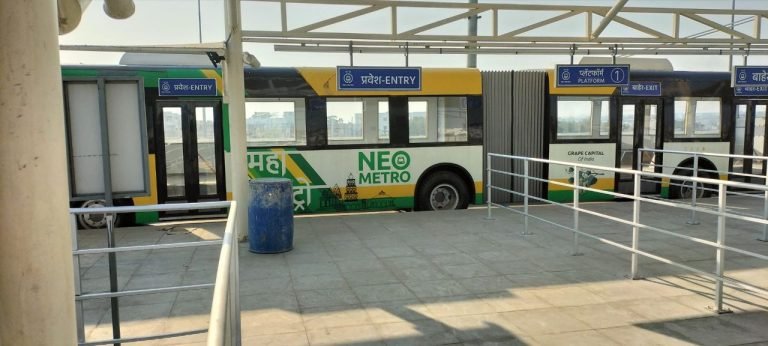
Metro Neo at Nashik is likely to be the first in India. It is designed to cater to the needs of smaller cities and costs much less than heavy metro rail systems, which are prevalent in many cities in India. The project will comprise a mass transit system along two corridors to provide comfortable, safe, reliable, and fast connectivity between important activity centres and transit hubs; and meet the rising transport demand in the city. The metro neo will have articulated or standard electric coaches with rubber tires and an overhead traction system. It will run on an entirely elevated corridor with a curb guidance system. These electric coaches will also be capable of running on the proposed feeder routes using built-in batteries, which will allow them to run without overhead traction for about 20 km. The batteries will be charged while the trains operate with overhead traction eliminating any need for separate charging stations. Metro Neo for Nashik Metro Neo is an innovative transport system that will be implemented in India in Nasik by Maha Metro for the first time. The detailed project report (DPR) prepared by Maha Metro is awaiting clearance from Union Cabinet. It is seamless, fast, reliable and cost-effective. It will provide a travel experience of international standards at par with Metro systems. It is an articulated / bi-articulated trolley bus system with overhead electric traction. The buses will be air-conditioned with an automatic door closing system, level boarding, comfortable seats, passenger announcement and an information system with an electronic display.It is a state-of-art, comfortable, Energy efficient, minimal noise pollution and environment-friendly system. It has been designed to negotiate sharp curves and steep gradients with minimal rehabilitation requirements. The system can be upgraded to Light Metro with incremental cost input per traffic demand. It is an innovative and pioneering project in India and will be the first MRTS to run on rubber tyres. The government of India 2019 constituted a committee, under the chairmanship of Dr Brijesh Dixit, MD of Maha Metro, for the standardization of detailed specifications for a Rubber-Tyred Mass Rapid Transportation System for implementation across India. AC electric coaches (carrying capacity of180/240 passengers) powered by over-head 600-750 V DC power supply will ply in Nasik. Metro Neo for WarangalKakatiya Urban Development Authority (KUDA) had asked Maha Metro to prepare the DPR of Warangal Metro. Maha Metro recommended using Metro Neo technology and prepared the DPR accordingly. As a result, it saved Rs 2,000 crore of KUDA and made Warangal Metro feasible. KUDA has submitted the report to Telangana Government, which will forward it to the Central Government after vetting it. Project DetailsNashik Metro, also known as Metro Neo, with two electric trolleybus lines totalling 32 km, is a bus rapid transit system proposed to be built in Nashik, Maharashtra, jointly by the Maharashtra Metro Rail Corporation Limited (Maha-Metro), City and Industrial Development Corporation (CIDCO) and Maharashtra Industrial Development Corporation (MIDC).Electric bus coaches on this unique system will be 25 meters long, run on rubber wheels and have a maximum capacity to carry 250 passengers simultaneously. Overall system capacity is estimated at 15000 PPHPD (Passengers Per Hour Per Direction). Coaches will draw power from an overhead electrical (OHE) system on the elevated portions and use battery power while operating on the at-grade (road) sections. Nashik Metro Phase 1’s detailed project report (DPR) was prepared by RITES Ltd. and approved by Maharashtra’s cabinet in August 2019. However, its approval is currently pending by the Central Government. The state government hopes to receive a loan for its development from the European Investment Bank (EIB).Specifications
- Operational : 0 km
- Under Construction : 0 km
- Approved : 0 km
- Proposed: 32 km
- Estimated Project Cost: Rs. 2100.60 crore
- Deadline: Not Announced
- Length: 10 km
- Type: Elevated & At-Grade
- Depot: Satpur (7.5 acres)
- Number of Stations: 10
- Station Names: Gangapur, Jaipur, Ganpat Nagar, Kale Nagar, Jehan Circle, Thatte Nagar, Shivaji Nagar, Ashok Stambh Panchavati, CBS, Mumbai Naka.
- Length: 10 km
- Type: Elevated & At-Grade
- Depots: 2 along Nashik Road (5.70 & 4.0 acres)
- Number of Stations: 20
- Station Names: Gangapur, Dhruv Nagar, Shramik Nagar, Mahindra, Shaneshwar Nagar, Trimbak Rd, Satpur Colony, MIDC, ABB Circle, Parijat Nagar, MICO Circle, CBS, Sharda Circle, Dwarka Circle, Gayatri Nagar, Ambedkar Nagar, Rupnagar, Nehru Nagar, Datta Mandir, Nashik Road Railway Station
- Two corridors are planned initially. Corridor one, Gangapur to Mumbai Naka, length 10 KM and ten stations (Gangapur, Jaipur, Ganpat Nagar, Kale Nagar, Jehan Circle, Thatte Nagar, Shivaji Nagar, Panchavati, CBS, Mumbai Naka). Corridor two, Gangapur to Nashik Road, length 22 KM and 15 stations (DHRUV Nagar, Shramik Nagar, Mahindra, Shaneshwar Nagar, Satpur Colony, MIDC, ABB Circle, Parijat Nagar, MICO circle, CBS, Sharda Circle, Dwarka Circle, Gayatri Nagar, Samta Nagar, Gandhi Nagar, Nehru Nagar, Datta Mandir, Nashik Road). CBS will be an interchange station where both corridors meet.
- There will be two feeder corridors. Feeder corridor one will run between Satpur colony – Garware - Mumbai Naka. Feeder corridor two will run between Nashik Road – Nandur Naka – Shivaji Nagar.
- Electric Bus Coaches will be 25 /18 meters long, and the carrying capacity is 200/300 passengers. The buses will have rubber-tyre and draw power from the overhead electric wire having 600-750 V DC supply. The buses will take power from overhead electric wire through a railway/tram-like system.
- The buses will be air-conditioned with an automatic door-closing system, level boarding, comfortable seats, a passenger announcement system, and a passenger information system with an electronic display. In addition, the stations will have a staircase, lift and escalators with passenger information displays. The station entry and exit will be provided on both sides of the road to avoid road crossing by passengers.
- Feeder Bus (12 m) battery-powered will run on the existing road on the two feeder routes i.e
- Mumbai Nakka via Garware to Satpur Colony (12 km) and
- Nashik station to Shivajinagar via Nandur Nakka (12km). The feeder bus batteries will get charged while operating on the main corridors, enabling seamless travel with broader coverage. No separate charging facility will be required.
- The metro-Neo system is a unique concept adopted for the 1st time in this country. It is comfortable, rapid, Energy efficient, less noisy (compared to diesel buses), and environment friendly. The capacity of the main corridors will be 15000 PHPDT (Peak Hour Peak Direction Traffic). The system has been designed for headway (peak hour) 2 minutes, i.e. a new service after every two minutes.
- The total cost of the project is Rs 2100.6 crore. Govt of Maharashtra, CIDCO and NMC share (Rs 552.19 cr) and Govt of India share (Rs 307.06+80.5 cr), total govt share Rs 939.3 cr. And remaining 1161.3 will be a loan component.
- The proposed rapid transit system in the Nashik Metropolitan Region (the greater Nashik Metro or Metro Neo) is expected to reduce traffic congestion and provide direct connectivity to Nashik city from its suburbs. The Greater Nashik Metro will connect suburbs of Nashik city like Deolali, Nashik Road, Rupnagar, Nashik Airport, Sinnar, Igatpuri, Gangapur Road, Trimbakeshwar, Dindori, Bhagur, Niphad, Adgaon, Ghoti Budruk and Girnare.