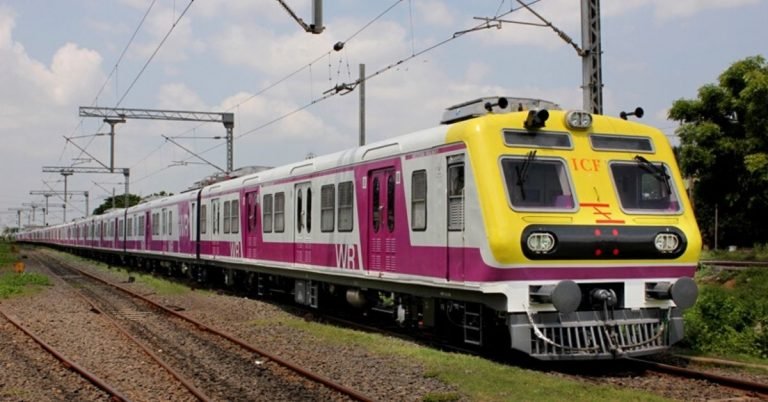
Rahee Wins track contract for Bangalore Suburban Railways’ Corridor 2

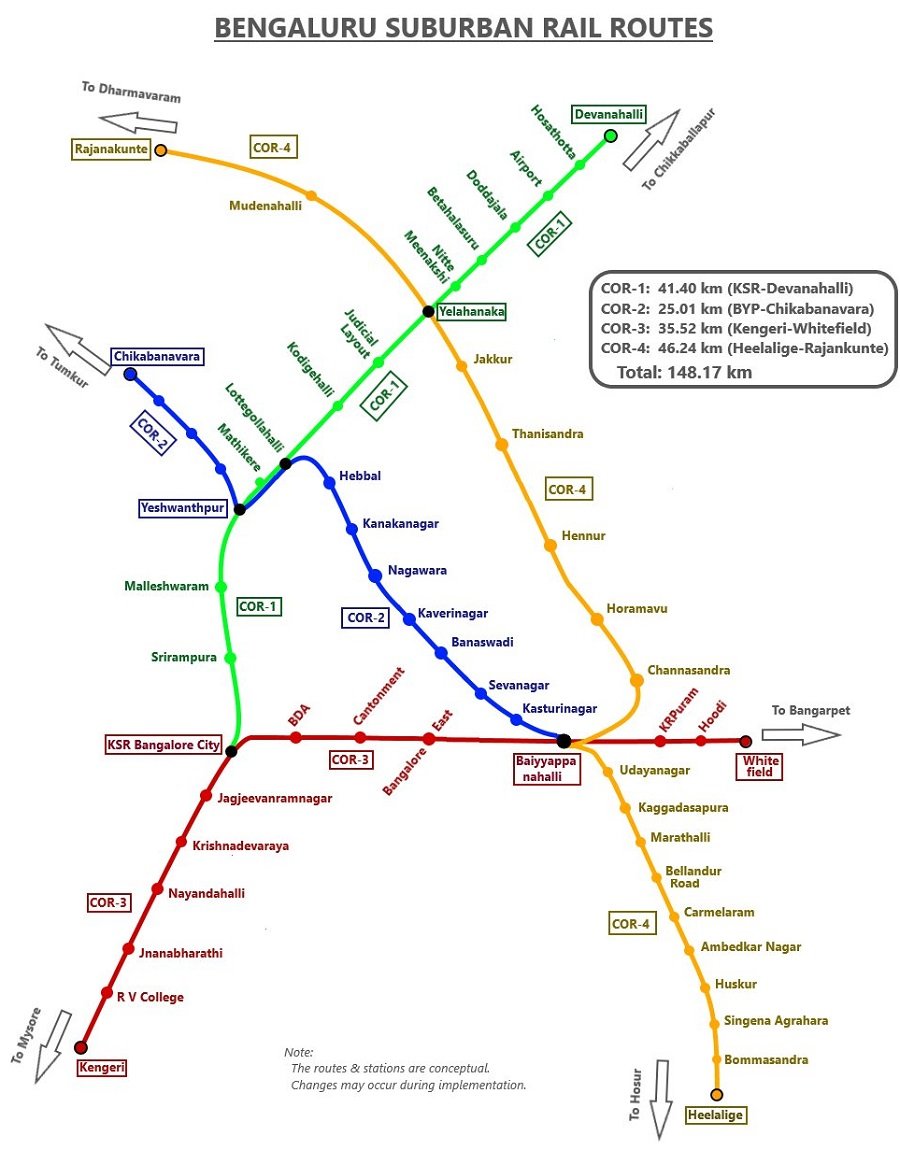
Bangalore (Metro Rail News): The Bangalore Suburban Railway project advanced as  Rail Infrastructure Development Company Karnataka Limited ( K-RIDE) has announced Rahee Infratech Limited as the lowest Bidder for the track contract of Bangalore Suburban Railways’ Corridor 2, which connects Benniganahalli and Chikkabanavara. 

BengaluruSuburbanRailRouteMap

Financial Values 

Firm Bids 

Rahee Infratech Limited

₹ 103.9 Crore

Texmaco Rail and Engineering Limited

₹ 137.8 Crore 

Bidding Process 

K-RIDE invited bids for this contract in 2024 with a 730-day deadline. Technical bids were opened on 29 October 2024, revealing that 4 firms had submitted bids for the contract. 

Technical Evaluation of the submitted bids took place on 5 April 2025. However, 2 firms out of 4 got rejected during this stage.

On 11 April 2025, financial bids of the technically qualified bids were opened, and further it was declared that Rahee Infratech Limited is the lowest Bidder for the contract. 

Contract’s Scope of Work 

The awarded contractor will be responsible for the installation of ballastless tracks on Corridor 2 of the Bangalore Suburban Railway Project. Additionally, the contract also includes the Ballasted and Special Tracks in Soladevanahalli Depot. 

K-RIDE Brief Scope: Design, Supply, Installation, Testing and Commissioning of Ballastless, Ballasted Track, Fastening System and Turnouts in Corridor 2 from Benniganahalli to Chikkabanavara Chainage (-) 1413 to Chainage 27029, including Ballasted and Special Tracks in Soladevanahalli Depot. 


Visit InnoMetro 5th Edition: India’s Leading Expo for the Rail Transportation Industry and Experience the Latest Technologies & Innovations in Rail Safety, Infra, Signalling, and AI.

Date: 21-22 May 2025

Venue: Bharat Mandapam, Hall No. 4, New Delhi

Get Your Free Visitor Pass: https://innometro.com/visitor-registration/

State Govt. Allocates Rs.12,000 Cr for Jaipur Metro’s Line 2 

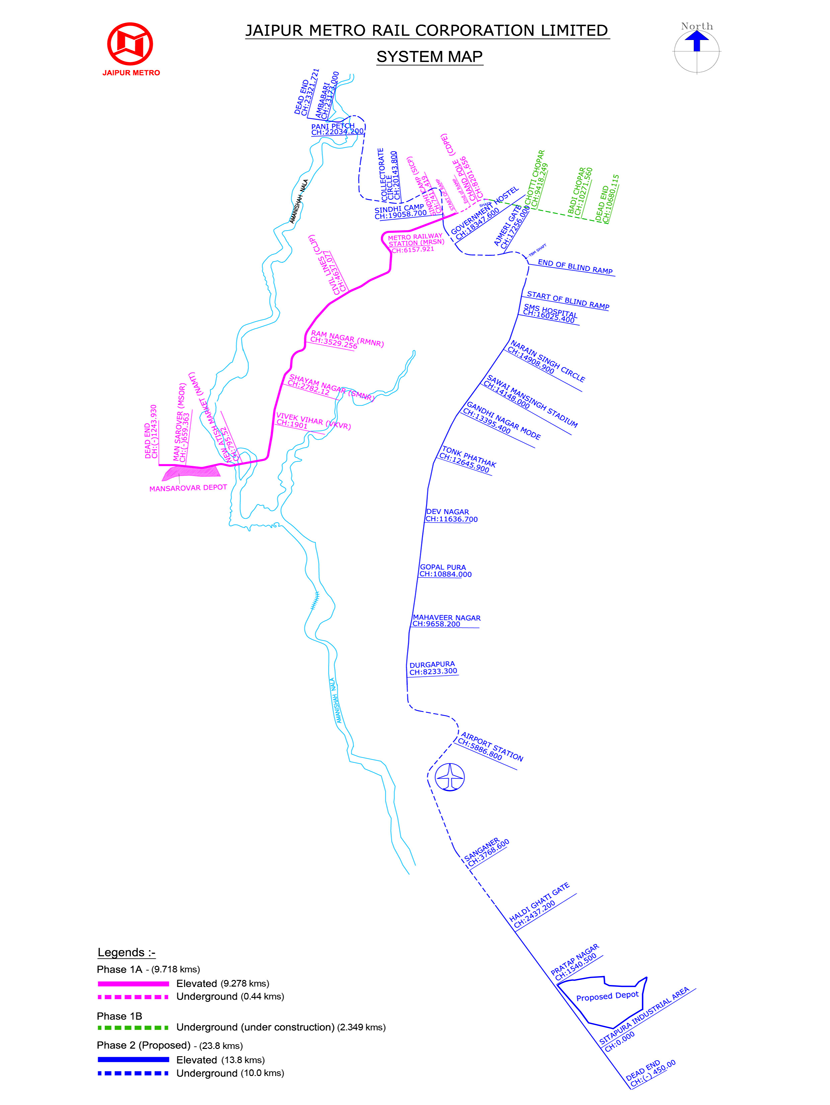
Jaipur ( Metro Rail News): Jaipur Metro Project progressed as Rajasthan State Government has announced allocation of Rs.12,000 crore for the construction of Jaipur Metro Line 2, which will connect Sitapuri- Ambabari – Vidhyadhar Nagar. 

As per the Finance Minister Diya Kumari’s statement, the project will be executed by the newly formed Rajasthan Metro Railway Corporation (RMRC), which is a joint venture between the  Central Government and the state government. 

Official Statement from Finance Minister 

Finance Minister Diya Kumari stated, “RMRC would undertake the construction of Metro Line 2 connecting the Sitapura Industrial Area and Ambabari, further extending till Vidhyadhar Nagar. The project would cost Rs 12,000 crore” 

Future Projection 

With this development, RMRC had begun the preparation of the revised Detailed Project Report (DPR) for the Jaipur Metro Line 2’s Sitapuri to Ambabari section. Furthermore, JMRC is preparing another DPR for Line 2’s Ambabari to Vidhyadhar Nagar stretch. 

Regarding this, a Metro official stated “The DPR is virtually complete. Now, it’s incumbent upon the state govt to approve the DPR and grant clearance for the construction works”.


Visit InnoMetro 5th Edition: India’s Leading Expo for the Rail Transportation Industry and Experience the Latest Technologies & Innovations in Rail Safety, Infra, Signalling, and AI.

Date: 21-22 May 2025

Venue: Bharat Mandapam, Hall No. 4, New Delhi

Get Your Free Visitor Pass: https://innometro.com/visitor-registration/

Connecting the Pink City: The Evolution of Jaipur Metro

Exploring Jaipur: The Pink City 

Jaipur, the capital of Rajasthan, also known as Pink City is famous for its vibrant pink-hued buildings, rich history, and architecture. Established in 1727 by Maharaja Sawai Jai Singh II, the city is renowned as one of India’s earliest planned urban areas. The city was designed by architect Vidyadhar Bhattacharya, following the principles of Vastu Shastra. In 1876 the city was painted pink to honour the visit of the Prince of Wales, which resulted in its famous nickname, the Pink City. 

Jaipur is a major tourist destination and cultural hub in India. It is known for its vibrant festivals and rich heritage. The city’s economy primarily depends on tourism, handicrafts, and gemstone trading. 

slider01 april 2016

Need for Metro System for Pink City

  • Increasing Population: Over the years, the city’s population has seen significant growth which positioned Jaipur 10th most populous city in the country. As of 2011, the city had a population of 31 lakhs and it is projected to be 81 lakh in 2031. This exponential rise in residents necessitates a public transportation system to efficiently accommodate increasing commuter demand.
  • Traffic Congestion: The city’s vehicular density has reached alarming levels, with approximately 25,048 vehicles per square kilometre, far exceeding the state average of 4,299 vehicles per square kilometre. This surge in vehicles has led to severe congestion, particularly in areas like Chandpole, which witnesses a daily influx of 330,000 vehicles. Consequently, the average travel time in Jaipur has increased to 28 minutes and 28 seconds per 10 kilometres. This critical situation highlights the urgent need for a faster and more efficient transit solution.

To address these concerns, the Jaipur Metro Rail Project was introduced to provide a sustainable and efficient urban transport solution.  The article studies the operational route of the Jaipur Metro and also aims to provide insights into its expansion plan as Pink City expands.

WhatsApp Image 2025 02 26 at 12.08.16 a12c2c47

Jaipur Metro: A New Era of Connectivity 

The Jaipur Metro project comprises two planned corridors: the East-West Corridor and the North-South Corridor. It is the fifth metro rail system in India, following successful projects in Delhi, Mumbai, Bengaluru, and Kolkata. As an Urban Mass Rapid Transit System (MRTS), Jaipur Metro currently operates a single corridor spanning 11.91 km.

1683481414820

Development of  DPR for  Jaipur Metro Rail Project

The Detailed Project Report (DPR) for the Jaipur Metro Rail Project was initially submitted by the Delhi Metro Rail Corporation (DMRC) in March 2010. It included two corridors:

  1. Corridor-1: Durgapura to Ambabari
  2. Corridor-2: Mansarovar to Badi Chaupar
Revisions and Changes:
  • April 2011: The DPR was revised, extending Corridor-1 to Sitapura Industrial Area instead of ending at Durgapura.
  • March 2012: A decision was made to bifurcate the DPR into two phases:
    • Phase I: Mansarovar to Badi Chaupar
    • Phase II: Sitapura Industrial Area to Ambabari)

JMRC Incorporation: For effective implementation of the Jaipur Metro, A Special Purpose Vehicle (SPV), Jaipur Metro Rail Corporation ( JMRC) was incorporated on 1 January 2010. 

Jaipur Metro 1
images 2

Phase 1

Overview 

Phase 1 of the Jaipur Metro project consists of a single corridor, the Pink Line, spanning 11.98 km (operational). It has been planned and implemented in four sections:

PhaseRouteLengthTypeStatusOperational Since
Phase 1AMansarovar to Chandpole9.63 kmElevated & UndergroundOperationalJune 3, 2015
Phase 1BChandpole to Badi Chaupar2.35 kmUndergroundOperationalSeptember 23, 2020
Phase 1CBadi Chaupar to Transport Nagar3.41 kmElevatedUnder ImplementationTBD
Phase 1DMansarovar to Ajmer Road1.35 kmElevatedUnder ImplementationTBD

Note: The Phase-1C and Phase-1D extensions of Jaipur Metro’s corridor 1 were officially announced by the Rajasthan state government in the 2022–2023 budget as part of the metro expansion plans.

Key Specification 

Speed and Track 
Top Speed: 80 kmphAverage Speed: 32 kmphTrack Gauge: Standard Gauge – 1435 mm
Electrification 25 kV, 50 Hz AC OHE
SignalingCab Signalling/Distance to Go
Rolling Stock 40 coaches (10 train-sets x 4) supplied by BEML

Route Information 

Jaipur Metro Operational Route
Phase 1A and Phase 1B

Line-1 – Pink Line: Mansarovar – Badi Chaupar

DescriptionPhase-1A (Mansarovar to Chandpole)Phase-1B (Chandpole to Badi Chaupar)Total Phase-1 (Mansarovar to Badi Chaupar)
Elevated Route Length (in km)9.1309.13
Underground Route Length (in km)0.52.352.85
Total Route Length (in km)9.632.3511.98
Elevated Stations808
Underground Stations123
Total Stations9211
Total Project Cost (₹ in Crore)2,0231,1263,149

Stations Names: Mansarovar, New Aatish Market, Vivek Vihar, Shyam Nagar, Ram Nagar, Civil Lines, Railway Station, Sindhi Camp and Chandpole, Chhoti Chaupar, and Badi Chaupar

Jaipur Metro Under Implementation Route 


Phase 1C

Line-1 – Pink Line: Badi Chaupar –  Transport Nagar (Phase 1C)

DescriptionDetails
Total Route Length (in km)3.41
Underground Route Length (in km)2.65
Elevated Route Length (in km)0.76
Number of Stations2
Estimated Project Cost (₹ in Crore)980.08

Station Names: Ramganj Chaupar (underground) & Transport Nagar (elevated)

Phase 1D 

Line-1 – Pink Line: Mansarovar to Ajmer Road Chauraha  (Phase 1D)

DescriptionDetails
Total Route Length (in km)1.35
TypeElevated
Number of Stations1
Estimated Project Cost (₹ in Crore)204.81
Estimated Project Cost (₹ in Crore)980.08

Station Names: Ajmer Road Chauraha

Jaipur Metro Phase 2 (Proposed Route)

Overview

Initial Planning and DPR Bifurcation

The concept of Phase 2 for Jaipur Metro emerged when the Detailed Project Report (DPR) was bifurcated into Phase 1 & Phase 2. The updated DPR in 2012 proposed a 23.099 km route from Sitapura Industrial Area to Ambabari, comprising 5 underground and 15 elevated stations.

Revisions in 2014

Further modifications were made to the DPR in April and July 2014 to adjust the metro alignment for Jaipur Airport’s Air Funnel and ensure connectivity to the Collectorate.

Impact of Metro Rail Policy 2017

With the introduction of the Metro Rail Policy 2017, new guidelines and elements had to be considered. As a result, the 2011 DPR was deemed outdated and could not be implemented.

DPR Update in 2020

In 2020, the Delhi Metro Rail Corporation (DMRC) updated the DPR, proposing a 23.51 km fully elevated route (Orange Line) with 21 elevated stations. The estimated project cost at the January 2020 price level was ₹4,602 crore, including Interest During Construction (IDC).

Further Modifications in 2024

In 2024, the Government of Rajasthan announced an extension of the metro line northwards from Ambabari to Vidhyadhar Nagar, adding approximately 7 km. This change led to the reconsidering of the entire Phase 2. As a result, Jaipur Metro Rail Corporation (JMRC) restructured the project into:

  • Phase 2A: Ambabari – Sitapura
  • Phase 2B: Ambabari – Vidhyadhar Nagar
Review of DPR in 2024

In November 2024, JMRC appointed RITES Ltd. to review the Jaipur Metro Phase 2 project’s DPR, considering the latest modifications and feasibility aspects.

Tentative Route of Phase 2

 Ambabari – India Gate (Sitapura Industrial Area)

DescriptionDetails
Total Route Length (in km)23.51 km
TypeElevated
Number of Stations21
Estimated Cost (₹ in Crore)4,602 (including IDC)

Station Names:  Ambabari, Pani Petch, Subash Nagar, Collectorate, Chandpole (interchange), Government Hostel, Ashok Marg, SMS Hospital, Narayan Singh Circle, Ram Bagh Circle, Tonk Phatak, Gandhi Nagar Raiway Station, Dev Nagar, Mahaveer Nagar, Durgapura, B2 Bypass, Sanganer Sethu, Pinjarapole Gaushala, Haldi Ghati Gate, Kumbha Marg and India Gate

Financial Performance of Jaipur Metro As per the 14th Annual Report of JMRC

The Jaipur Metro Rail Corporation (JMRC) continues to face financial challenges due to high recurring expenses on salaries, administrative costs, and depreciation. The company reported operational losses despite revenue generation from fare and non-fare sources. However, due to profit from the sale of land, JMRC managed to achieve a net profit of ₹14,329.51 lakh for the financial year 2022-23. The detailed financial performance is outlined in the table below:

ParticularsAmount (₹ in lakhs)
Total Revenue (excluding grant)2858.39
Less: Total Expenses (excluding depreciation & finance cost)7234.96
Operating loss before depreciation & finance cost4376.57
Add: Depreciation (net of amortization of grant)8363.11
Operating loss after depreciation before finance cost12739.68
Add: Finance Cost (Interest)3347.38
Operating loss after depreciation & finance cost16087.06
Less: Grant-in-aid from RTIDF8156.57
Loss before Exceptional Item and Tax7930.49
Less: Exceptional Item and Tax22260
Net Profit14329.51

Comparison of Financial Performance (₹ in lakhs)

ParticularsFor the year ended on 31st March, 2023For the year ended on 31st March, 2022
Total Income₹13,207.41 lakh₹12,669.73 lakh
Revenue from Operations₹2,544.60 lakh₹1,324.77 lakh
Other Income (including interest)₹313.79 lakh₹136.77 lakh
RTIDF Grant-in-aid₹8,156.57 lakh₹9,000.00 lakh
Deferred Capital Grant Amortized₹2,192.45 lakh₹2,208.19 lakh
Total Expenses₹21,137.90 lakh₹20,994.50 lakh
Revenue Expenses for the Year₹7,234.96 lakh₹6,141.34 lakh
Depreciation and Amortization₹10,555.56 lakh₹10,515.48 lakh
Finance Cost (Interest)₹3,347.38 lakh₹4,337.68 lakh
Profit / (Loss) before Exceptional Item and Tax(₹7,930.49 lakh)(₹8,324.77 lakh)
Exceptional Item₹22,260.00 lakh₹0.00 lakh
Tax Expenses (Net)₹0.00 lakh₹0.00 lakh
Profit / (Loss) after Tax₹14,329.51 lakh(₹8,324.77 lakh


Non-Fare Box Revenue Earned During 2022-23 as per the 14th annual report of JMRC

ItemRevenue (₹ in Lakh)Percentage
License fee from advertisement rights351.0752.17%
Lease Rent from Indoor Mobile Coverage License63.199.39%
License Rent from Parking41.046.10%
Lease Rent from Rooftop Tower50.847.55%
Lease Rent from Retail Spaces53.848.00%
Other112.9816.79%
Total672.96100.00%

Ridership & Fare Box Revenue 

Date/PeriodRidership (per day)Total RidershipFare Box Revenue (₹)
01.04.202225,582
31.03.202335,768
FY 2022-23 (Total)1,34,08,53118,55,57,094
FY 2022-23 (Average)36,736
01.04.2023 – 31.08.202346,868
04.09.202355,674

Impact of Jaipur Metro

1. Improved Urban Mobility 

With Jaipur’s population expected to reach 81 lakh by 2031, the Jaipur Metro will reduce dependency on private vehicles and streamline connectivity in the Pink City. Once Phase 2 becomes operational, it will further enhance connectivity to Jaipur Airport, commercial hubs, and densely populated areas like Vidhyadhar Nagar.

2. Environmental Benefits

Jaipur Metro’s expansion has the potential to make the city cleaner and greener by reducing reliance on private vehicles. As more commuters shift to the metro, there will be a decline in vehicular emissions, which will result in improved air quality.

3 Economic Growth and Urban Development

The Jaipur metro will enhance connectivity to business and industrial areas like Sitapura, increasing employment opportunities and commercial activity. Additionally, properties near metro corridors tend to appreciate in value, attracting investments in real estate and retail infrastructure.

4. Low Ridership Levels

Although Jaipur Metro’s ridership has grown over the years, it still operates below its full capacity. State government officials acknowledge that delays in metro expansion have affected daily ridership, which for a long time remained between 19,000 to 25,000 passengers. However, in recent years, ridership has gradually increased to 55,000 daily passengers.

Conclusion

The Jaipur Metro has improved urban mobility and offered a reliable and efficient transit system for the city. While Phase 1 is operational and expanding, the progress of Phase 2 remains pending, affecting planned connectivity to key areas like Sitapura Industrial Area and Vidhyadhar Nagar. The delay in Phase 2’s implementation has slowed the expected benefits of extended metro coverage, including improved access to commercial and residential hubs. The timely execution of Phase 2 will be essential to meet Jaipur’s growing transportation demands, reduce traffic congestion, and enhance connectivity for daily commuters and businesses.

HBL-Shivakriti Consortium Receives LoA for two KAVACH System Contracts 

HBL-Shivakriti Consortium has secured two major KAVACH contracts worth approx Rs. 500 Crore (Combined Value) from the Western Railways and North Central Railways. The company has received LoA for both the contracts. 

Contracts Details  

  1. From Western Railways 
Contract Value Rs. 244.68 Crore
Contract Duration 730 Days from LoA 

HBL-Shivakriti Consortium will be responsible for the provision of the KAVACH System in the Viramgam–Rajkot–Okha section of the Rajkot Division under this contract. 

  1. From North Central Railways
Contract Value Rs. 255 Crore
Contract Duration 700 Days from LoA 

The awarded contractor will be responsible for implementing the KAVACH System in the Dholpur–Bina section of the Jhansi Division as per this contract. 

Visit InnoMetro 5th Edition: India’s Leading Expo for the Rail Transportation Industry and Experience the Latest Technologies & Innovations in Rail Safety, Infra, Signalling, and AI.

Date: 21-22 May 2025

Venue: Bharat Mandapam, Hall No. 4, New Delhi

Get Your Free Visitor Pass: https://innometro.com/visitor-registration/

Bids Invited for Civil Contract of Pune Metro’s Swargate- Katraj Extension 

Pune (Metro Rail News): Maha-Metro has invited bids for the first civil contract for the Pune Metro’s Purple Line extension from Swargate to Katraj, which spans 5.464 km.

Tender Details

Opening Date 9 Apr 2025
Closing Date 21 May 2025
Tender Id P1A-UGC(R)/2025(ICB) 
EMD Rs. 8,43, 00,000/-
Contract Duration 42 Months from LoA 
Pre-Bid Meeting 25 April 2025 

Scope of Work: Design and Construction of Underground Stations at Market Yard, Padmavati, Katraj Stations & Associated Tunnels in Stage I And Stations at Bibwewadi & Balaji Nagar in Stage II of the Swargate-Katraj Section of the Pune Metro Rail Project

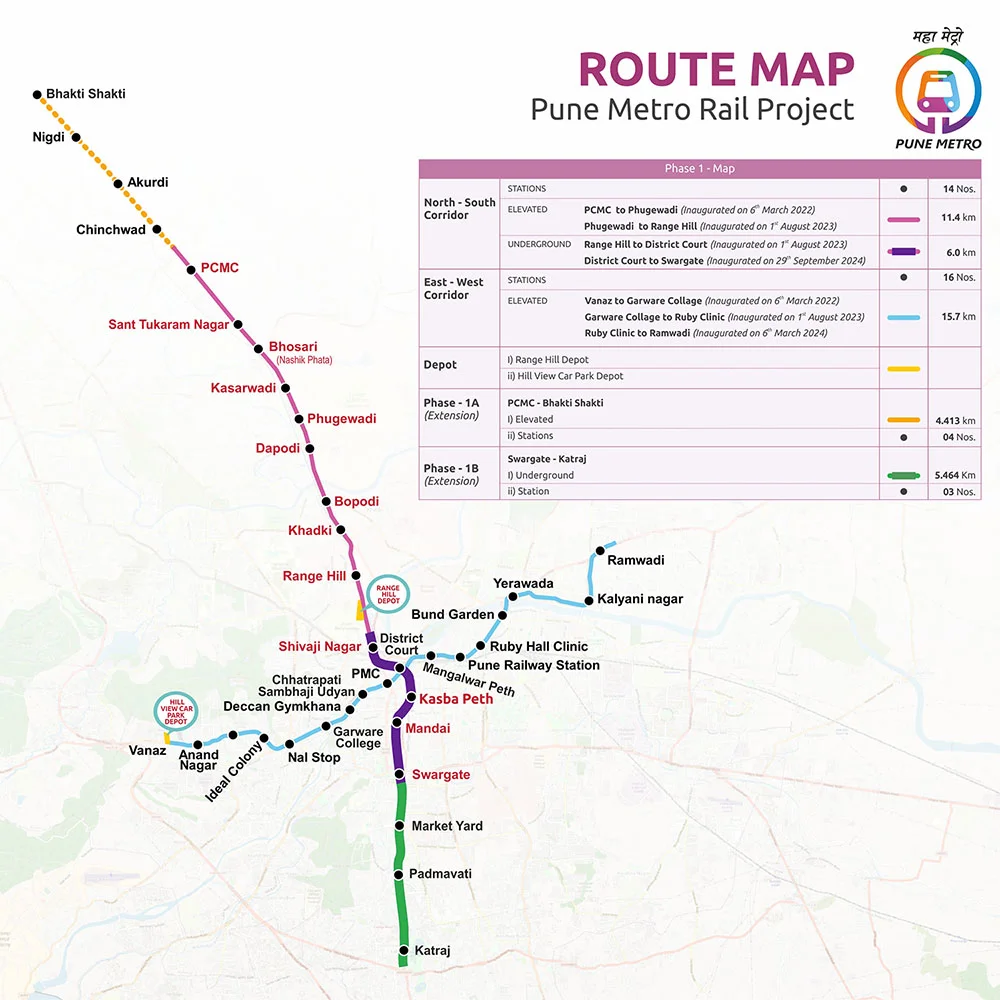
About Pune Metro’s Purple Line 

route map english1

Operational route: Currently, the Purple Line of Pune Metro is operational from  Pimpri Chinchwad Municipal Corporation (PCMC) to Swargate, spanning 16.59 km through 13 stations.

In September 2024, the Purple Line’s extension from Civil Court to Swargate became operational. This section spans 3.3 km and features 3 new stations.

Purple Line’s northern extension between PCMC and Bhakti Shakti (under construction) covers 4.519 km. 

The extension from Swargate to Katraj spans 5.464 km and features 3 stations. The tender has been invited for the same section. 

Women Driving Change: Smt.Ashwini Bhide’s Leadership in Mumbai Metro Line 3

Metro Rail News conducted an exclusive interview with Smt Ashwini Bhide, Managing Director of Mumbai Metro Rail Corporation Limited (MMRC) During the interview, MD highlighted the critical aspects of the Mumbai Metro Line 3 project, including the challenges and operational deadlines of Phase 2A and Phase 2B of Line 3. Ms. Bhide also elaborated on the project’s impact on reducing traffic congestion, last-mile connectivity initiatives, and revenue generation strategies through non-fare box sources. She further shared her insights on the role of women in the infrastructure sector, the challenges they face, and the need for leadership programs to empower more women in urban infrastructure development. Here are the edited excerpts:

1. To begin with, could you share with us your journey in public service and how you decided to pursue a career in civil services?

➡️ Reflecting on my journey spanning over the 27 years, I would say, it has been a rewarding and transformative experience. I have contributed to one of the most ambitious, complex and mega urban infrastructure projects in the city from Coastal Road project as AMC of BMC, Mumbai Metro Line 3 as MD of MMRC, Eastern Freeway, the elevated road to International Airport, several flyovers on major arterial roads and rail over bridges including Milan ROB as well as the first phase of Mumbai Monorail with MMRDA.

➡️ I did my BA in literature from Willingdon College in Sangli, and while pursuing my postgraduation in Pune, I began preparing for  UPSC exams. One of my relatives who worked at the Mantralaya had informed me about IAS as a career option. Back then, the usual route for meritorious students was medical or engineering. But I thought I should do something different. My journey began with challenges that included an information deficit in an era without the internet. By following two or three years of preparation, I passed the UPSC exam in 1995 and took first place among the female candidates, something I had never anticipated. I believe that nobody can stop one from achieving success once one makes a decision and begins taking organised steps.

➡️ The path has been filled with growth, challenges, and valuable lessons. The journey has been marked by opportunities that allowed me to expand my skills and contribute meaningfully in executing these diverse infrastructure projects in a city like Mumbai. While there were inevitable challenges along the way, each obstacle served as a stepping stone, pushing me to adapt, learn, and innovate. Overcoming these challenges has not only strengthened my skills but also deepened my resilience and determination.

 2. Given the underground nature of Line 3, what technical challenges did the project face, and how were they resolved? 

➡️ The Metro-3 Corridor is one of the most complex and difficult urban infrastructure projects executed in the financial capital of the country. MMRC has used state-of-the-art technology during the execution of the project to protect existing buildings and heritage structures along the alignment route. It’s the first time in India that a project deployed 17 TBMs, which were working simultaneously at a time. The 26 underground stations on the Corridor were constructed by using the cut-n’-cover method (19 stations) and a combination of New Austrian Tunnelling and cut-n’-cover methods (7 stations).

➡️ The challenges faced while constructing the stations are varied – locations were in close proximity of congested areas, dilapidated buildings, heritage precincts, flyover, metro lines etc. The most daunting task was tunnelling beneath the Mithi River. However, the teams of experts and engineers surmounted such challenges by using the latest technical know-how and engineering expertise.

➡️ Most of the stations of Metro-3 are constructed below existing roads. To ensure smooth movement of traffic, MMRC had installed steel decks and deployed traffic marshals in coordination with traffic department and MCGM to provide uninterrupted services to citizens while carrying out the construction work.

➡️ The resettlement and rehabilitation is yet another major aspect of this iconic Colaba-Bandra-SEEPZ Metro-3 Corridor. While implementing the project, about 2,856 hutment dwellers have been provided with permanent rehabilitation at Kurla and Chakala and the remaining 734 families, which were on private land (legal title holders), will be provided accommodation in-situ in three buildings – K2, K3 and G3 – which are being constructed at Kalbadevi and Girgaon.

➡️ With the help of advanced technology and a team of experts, MMRC has successfully carried out all the tasks ensuring that there is minimum inconvenience to Mumbaikars during the construction of Metro Line-3.

 3. With the 12.69 km section of Mumbai Metro Line 3 already operational, what is the current status of the project, and when do you anticipate it will be fully operational

➡️ The overall phase-2 progress from BKC to Cuffe Parade stands at 93.1%. We are in the process to open part operations of Phase-2 from Dharavi to Acharya Atre Chowk which is called the Phase-2A, consisting of 6 nos of metro stations. Phase 2A is expected to offer a Commissioner for Metro Rail Safety (CMRS) inspection in the month of March and subsequent commissioning.

➡️ Simultaneously, the works on the remaining stretch, which is phase 2B from Science Centre to Cuffe Parade, are in full swing. The project is expected to be fully operational by July 2025.

 4. What impact has Line 3 had on reducing traffic congestion so far, and how do you see it supporting the city’s long-term transportation needs? 

➡️ Once the corridor is fully operational, it will certainly revolutionise urban mobility in the city, transforming the daily commute for the Mumbaikars. Phase-1 from Aarey JVLR to BKC provides connectivity to both domestic and international airport terminals, as well as to BKC.

➡️ Phase 2B will connect Central and Western railways via CSMT and Churchgate stations. Line 3 will provide connectivity to 6 major business and employment centers, including Nariman Point, Cuffe Parade, Fort, Lower Parel, BKC, and SEEPZ/MIDC. Also, easy access to over 30 educational institutes, 13 hospitals, 14 religious places, and over 30 recreational facilities.

➡️ It will also provide connectivity to the parts of the city that are unconnected by rail-based transport networks like Worli, Kalbadevi, Girgaon, and more. By providing a fast, reliable, and efficient transportation option, we expect to reduce traffic congestion, decrease travel time, and promote economic growth. This project will also catalyze infrastructure development, stimulate urban renewal, and enhance the overall quality of life for Mumbaikars.

 5. What distinguishes Mumbai Metro Line 3 from other metro lines in the city? What modern technologies have been integrated to improve safety and operations

➡️ Mumbai Metro Line-3 (Colaba-Bandra-SEEPZ) is the first and only fully underground metro in the city. It offers fully air-conditioned, ergonomically designed coaches for the utmost commuter comfort. Closed doors for coaches and full-length platform screen doors for additional safety. We have used an attention – low vibration system in the track to ensure the safety of heritage buildings. Apart from this, we have installed one of the tallest escalators at the Airport station.

➡️ We have also accomplished tunneling beneath the Mithi river using precast concrete segment rings incorporating a specialized mushroom-type EPDM gasket, which we believe is the 1st of its kind in the world.

 ➡️ Besides this, CAMS Predictive Maintenance module implementation using AI and several innovative features, including advanced signaling systems and high-capacity trains, have been used for Line 3. We’ve also incorporated sustainable design elements, such as energy-efficient systems. Additionally, our stations are designed with universal accessibility and safety features, ensuring a comfortable, safe, efficient and secure travel experience for all commuters.

 6. What steps is MMRC taking to provide last-mile connectivity and encourage greater usage of the metro?  

➡️ MMRC is working to create better last-mile connectivity for commuters. We’re exploring options for integrated last-mile connectivity solutions and have taken up Multi-Modal Integration (MMI) works in coordination with all other stakeholders and service providers at Aqua Line (Metro-3) stations, ensuring seamless connectivity and convenience for passengers.

 7. How has the Mumbai Metro Line 3 performed in terms of revenue generation so far? What measures are MMRC implementing to ensure the long-term financial viability of the project? 

➡️ MMRC aims to generate revenue through non-fare box sources. The revenue streams include generating revenue through station naming rights, renting retail/commercial spaces at stations, through advertising etc.

 8. As a woman leader in the infrastructure sector, what challenges have you faced, and how have you managed to resolve them? 

➡️ The infrastructure sector is a complex and challenging field, and I believe a woman leader faces several challenges by navigating it through daily. I would say that many old learnings came in handy for me while dealing with challenging factors over the years. It needed a lot of energy and patience. Though all of it has been a life-changing experience with a lot of interventions—socially, location-wise and infrastructure-related.

 9. What measures do you think shall be taken to encourage more women to take on leadership roles in urban infrastructure, particularly in metro projects? 

➡️ I believe that the urban infrastructure sector is very engaging and that a woman entering this sector could experience significant career progression.

➡️ In my opinion, there’s a crucial need for empowerment programs and training programs that equip women with leadership skills, resource mobilization strategies, and advocacy techniques. These programs will empower them to navigate challenges and become even more effective leaders.

 10. What measures could be taken to better support women in the infrastructure sector, both at the policy level and in workplace culture? 

➡️ Women continue to face numerous challenges in the workplace that hinder their professional growth and advancement.

It is important to recognize that addressing these issues requires a collective effort and a sustained commitment to change. Employers, employees, and society as a whole must take action to address these issues and create a more equitable and inclusive workplace.

 11. What message would you like to convey to the reader of Metro Rail News? 

➡️ I am delighted to connect with you through this platform on the progress and developments of Metro Line-3 project. We encourage you to stay connected with us for more updates, as we promise to continue delivering efficient, safe, and sustainable transportation to the Mumbaikars.


Analysing the Role of Last-Mile Connectivity in the Success of Metro Systems

Introduction

A well-functioning metro system is more than just a network of rail lines and stations; its success depends on efficient last-mile connectivity. India’s central government has invested heavily in metro rail networks to counter urban traffic congestion. Although these networks have improved travel experiences for millions of citizens, they have struggled to achieve the projected ridership mentioned in DPRs. In some cases, ridership has reached only 10% of the expected numbers (UITP India, 2021).

Projected & Actual Metro Ridership in India

AD 4nXeCbAYqsIEmkqPyIe dUCS5D2RV6eBqXhUbicB AbbdTGWsiAonVdSjaaMcXrR1huaUv3n6Y4YMw5zFytw6jXNsMchHDVWmoG A1LIMa5oEXh7JD59BEVucU8RPbekmkyu01rt1kiLm0Ls1RbXCoUI?key=JHI2XDuybjWZN1mf2iaCl

One of the major hindrances to metro use is cost. However, even in segments that have the economic ability to use the metro, there is a crucial problem from the last-mile issue, which discourages many commuters. The convenience of accessing metro stations and reaching final destinations defines the overall usability and efficiency of the system. Research done by WRI India in Bengaluru indicates that about 70% of surveyed potential metro commuters avoid using the metro system owing to problems pertaining to inconvenient access.
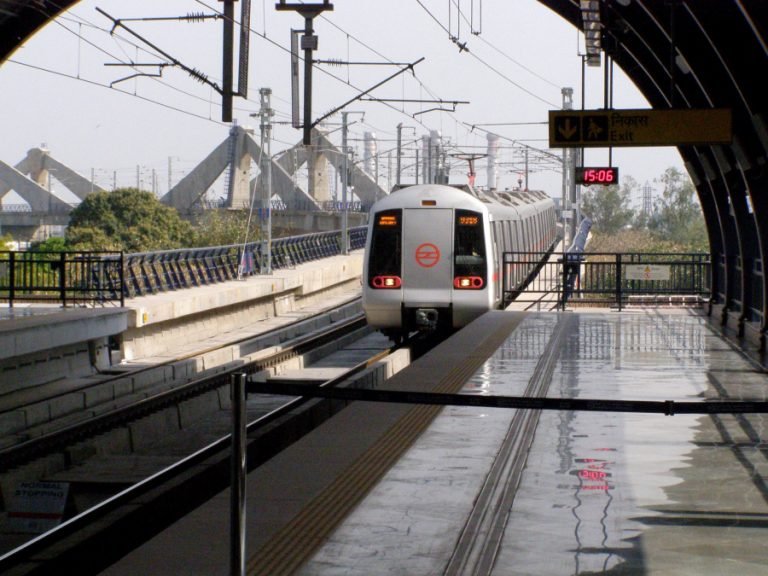
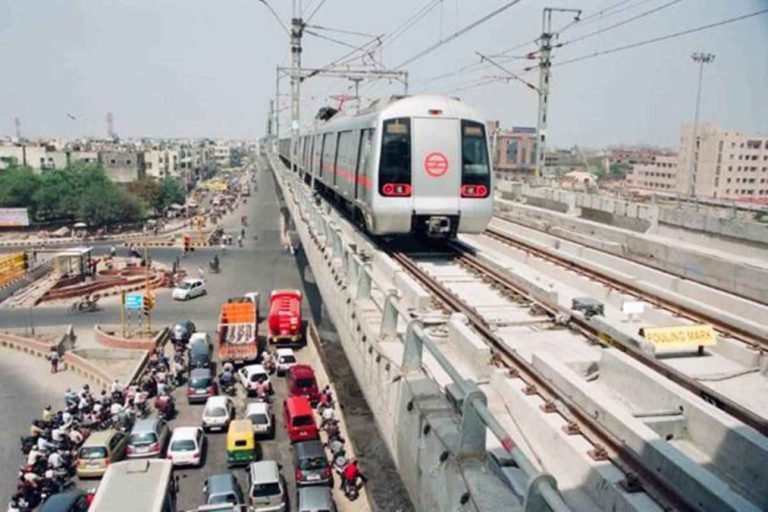
 In India, where urban congestion is a major challenge, well-planned last-mile solutions can encourage public transport adoption, reducing traffic congestion and pollution. This study aims to elucidate the role of last mile connectivity in backing the metro projects.
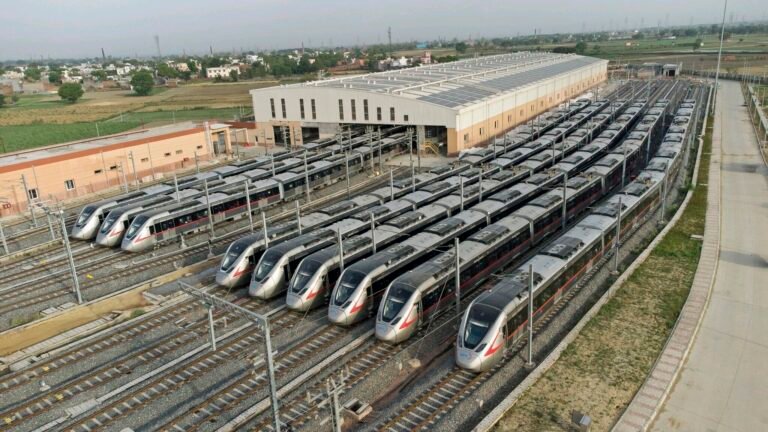
Need for Last-Mile Connectivity in Metro System

Last-mile connectivity of metro systems is needed to enhance the efficiency and accessibility of urban transportation. This article elaborates on some of the major reasons behind this requirement.

  1. Boosting Efficiency and Ridership: Efficient last-mile options like feeder buses, e-rickshaws, hire bikes, and e-scooters facilitate the ease and convenience of travel to the metro stations for commuters. Studies indicate that cities with strong last-mile solutions witness up to a 20-30% increase in metro ridership.
AD 4nXdWsr5f07Zprk6w5JEJbLrOVA2LxrETctv8peuha7 pCx7PaivsD9sRf0Vlg1NkbbrTOt62mMVesfYBvtaxAcaR AcSmQzvZpjwhBcFMi51C3exq JSTXFf5RfCh6qVxDw5L6GS4gRSCXTPyOgSuA?key=JHI2XDuybjWZN1mf2iaCl
  1. Enhancing Commuter Convenience: According to a 2021 report by RITES Ltd., 30% to 40% of metro users in urban areas face accessibility issues while reaching metro stations because there are not enough feeder services. Low-income communities and the disabled are majorly affected, with them experiencing problems due to the non-availability of low-cost last-mile transport. 
  2. Reducing Traffic Congestion and Pollution
    By providing reliable and cost-effective last-mile transportation, cities can encourage a shift from private vehicles to public transport. Improved public transport can lower the reliance of commuters on private vehicles. Decreasing the number of private vehicles will lower air pollution,

Role of Metro Rail Policy 2017

To address this problem, the Indian central government has given priority to last-mile connectivity improvements to increase metro rail ridership. The Metro Rail Policy of 2017 made it compulsory that comprehensive last-mile service planning be done for metro projects to get central financial aid. Moreover, the appraisal guidelines of upcoming projects include feeder bus route plans, as described by the Ministry of Housing and Urban Affairs in 2017. The efficient last-mile connectivity promotes the transition from personal vehicles to public transport.

Case Studies on Last-Mile Connectivity

1.Delhi Metro: India’s Largest Metro System

Delhi, the capital of India, operates one of the world’s largest and fastest-expanding metro networks. The Delhi Metro has evolved as a key urban transportation system over 2 decades by connecting not only the city but also surrounding areas such as Gurgaon, Noida, and Faridabad. Presently, the Delhi Metro Rail Corporation (DMRC) runs a network of around 395.248 Km with 289 stations. Delhi Metro’s feeder services have increased overall ridership by 12%, particularly benefiting women by providing safer and more reliable transit options.

AD 4nXfjO zTzdFuM8UzmqnV86UZa6Byc60ixyxEvAD4yoT7x8mDZY9UY3w95uG1Pc8t8qzxJ59WqZJGUrhJQ39vtQ0AUY1y2QTZ2s1SEKtLmIwV0iGqn1eY4omwM0U1MKYdNbhiBF74U7lMNs2N5eJwHA?key=JHI2XDuybjWZN1mf2iaCl

Initiatives by DMRC to Facilitate Last-Mile Connectivity 

  •  E-Auto Services: In July 2024, the Delhi Metro Rail Corporation (DMRC) improved last-mile connectivity with the introduction of over 1,100 electric auto-rickshaws (e-autos). Out of a total of 2,299 e-auto licenses provided to the DMRC by the Transport Department, 1,183 e-autos have been successfully registered. Around 40 DMRC stations are currently making possible the functioning of these e-autos.                                      
Last Mile Connectivity
  •  Bike Taxi Integration via Mobile App: In November 2024, a specially tailored initiative was drawn up by DMRC to address the needs and preferences of women metro passengers. DMRC launched bike taxi booking facilities directly through Delhi Metro’s official mobile application, DMRC Momentum (Delhi Sarthi 2.0). Passengers can make use of two forms of Bike taxis, viz., SHERYDS– for women, by women and RYDR– for all passengers.
AD 4nXfBP9Cgk9LlfmWT6WpbzcpLTNXOgfZIwlnBway8VaMEd fo1cncgw5DhAVjyM5Epu5GQALX qp9xhZHDAY 1bG yubd9n25SGscS8cbqCRQRkDCaIlSsXZs SlmvdssG6ZzDnh096UfZ5sCyKRONJM?key=JHI2XDuybjWZN1mf2iaCl

3. Policy for Allocation of Spaces: In August 2024, DMRC launched a new policy to allocate and provide spaces for first and last-mile services at metro stations. This initiative is designed to enhance accessibility and increase revenue through partnerships with service providers.

Current Status of Last-Mile Connectivity Services Provided by DMRC

Type of Last-Mile ServiceNumber of Stations Where the Service is Available
E-Rickshaw – Services2 stations.
Pedal Cycles 18 stations.
Battery Operated Cycles43 stations
E- AUTO Services 40 stations
  • Lack of Integrated Planning: Indian urban transport networks are inward-oriented, with no coordination with feeder transport networks. 
  • Inadequate Infrastructure: About 40% of Indian metro stations lack well-built bus bays or special auto zones, a cause of traffic congestion around exit points of the station.
  • High-Costs: The 2022 Centre for Science and Environment (CSE) report showed that Indian city last-mile travel costs were 30-40% of the overall trip cost, thus decreasing the feasibility of utilizing metro services.

Impact of Good Last-Mile Infrastructure

  1. Expanded Role of Women: The price of not having adequate access to metro systems is steep. The International Labour Organisation (ILO) has estimated that increased access to safe transport can increase the participation rate of women in developing countries by 16.5%.
  1. Reduced Traffic Congestion: A good last-mile infrastructure will be beneficial in multifaceted ways. It will not only attract more commuters but also reduce the no. of private vehicles which will result in and low carbon emissions.
  1.  Impact on Travel Time and Costs: A study by World Resources Institute (WRI) on Delhi’s urban mobility indicates that commuters spend 40% of their total travel time and 48% of their travel cost covering just 18% of the total travel distance required to reach public mass transit modes like the Delhi Metro.

Conclusion

The success of Indian metro networks largely rests on properly integrated last-mile connectivity solutions. This absence of last-mile infrastructure discourages ridership. Addressing these concerns via feeder buses, e-rickshaws, bikes, and taxis can help go a long way towards encouraging metro uptake. Cities that have successfully scaled up last-mile solutions have attained 20-30% ridership growth. 

Investment in last-mile infrastructure, given top priority by the Metro Rail Policy 2017, will enhance access, reduce congestion, and facilitate gender-inclusive public mobility, which could add 16.5% to women’s participation rate. The development of improved last-mile infrastructure is required in order to unleash the full potential of metro rail systems in the country.

From Infrastructure to Inclusivity: Insights from NCRTC’s Finance Director

Metro Rail News conducted an email interview with Ms. Namita Mehrotra, Director of Finance at the National Capital Region Transportation Limited (NCRTC). In the course of the interview, Ms. Mehrotra provided insights into her professional journey and articulated the critical role of Public-Private Partnerships (PPP) in the success of large-scale infrastructure projects, including metro and Rapid Rail Transit System (RRTS) initiatives. Furthermore, she discussed the increasing engagement of women, not only in leadership positions but also in operational roles within the sector. Ms. Mehrotra also elaborated on the impact of the Delhi-Meerut RRTS corridor on fostering sustainable development and promoting polycentric economic growth. Here are the edited excerpts from the interview.

1. Can you share your journey as Director/Finance, NCRTC? What inspired you to pursue a leadership role in NCRTC?

At NCRTC, I have had the opportunity to contribute to a transformative urban mobility project, Namo Bharat, that will set a benchmark for public transport in India. Working towards the long-term financial sustainability of the organisation excites me tremendously. In the initial stages, with a new project financing structure, there were a few challenges. Creating a team of professionals was another important activity. There were 3 multilateral banks to deal with, and rules and regulations had to be set up. It was an opportunity to draw on a clear slate, and I enjoyed it immensely. Before joining NCRTC, I had worked at Delhi Metro in the first phase, had experience in infrastructure-related policy and financing, and PPP structuring in addition to my administrative role in various capacities. 

040A6601

2. How has your experience been as a woman in a senior leadership role in a traditionally male-dominated sector?

As it is true for many other sectors, the transportation and infrastructure sector has traditionally been male-dominated, but I have always believed that domain expertise, strategic thinking, and a results-driven approach matter more than gender. As a woman in this leadership role, I consider myself fortunate that equity has been the hallmark of our functioning at NCRTC.

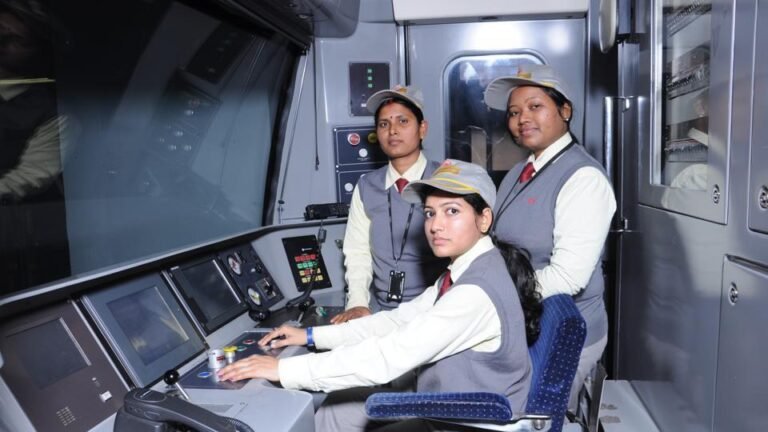
Over time, there have been positive shifts in the industry, with more women stepping into leadership as well as technical roles. The young women working for Namo Bharat are a great inspiration indeed. Young girls, including recent graduates, driving the Namo Bharat trains or taking on engineering roles in the field, be it tunnelling, inspecting installed bearings and so on, are setting examples for others to follow.

With time, companies and institutions are becoming more aware of the need for gender diversity, and initiatives to create inclusive work environments are gaining traction. However, there is still a long way to go, and the key is to provide opportunities, mentorship, and equal access to leadership positions.

3. What are some of the challenges you faced in your career, and how did you overcome them?

I have seen that each project or assignment brings its own set of challenges — be it structuring innovative funding mechanisms, achieving policy consensus from multiple stakeholders, or aligning project timelines with financial disbursements. Setting up the systems at DMRC, learning about alternate funding, setting up mechanisms for project funding through debt, setting up policy frameworks, and hand-holding for PPP projects all involved diverse challenges but were exciting to work for.

4. What are the key financial strategies that NCRTC is implementing for the success of the Delhi-Meerut Namo Bharat project?

For a large-scale complex infrastructure project like Delhi-Meerut Namo Bharat, financial sustainability is a top priority. This involves revenue generation as well as cost optimisation. This involves initiatives such as Innovative Contracting Models like long-term operations and maintenance contracts to leverage private sector efficiency as well as cost optimisation including Risk Mitigation Strategies for financial risk operationalisation of Value Capture Financing (VCF), implementing transit-oriented development (TOD) and commercial revenue streams to supplement farebox revenue. This holistic approach ensures the financial health of the project while reducing the burden on public resources.

5. What role do Public-Private Partnerships (PPP) play in funding and executing metro and Namo Bharat projects?

Public-private partnerships (PPP) can play a crucial role in the success of new-age mobility solutions by bringing efficiency, innovation, and additional funding sources. Private sector involvement can be in various forms, such as complete investment, construction and operations or outsourcing O&M activities to private players under long-term contracts for cost efficiency; engaging private players for design, manufacturing, and maintenance of rolling stock under structured contracts; and leveraging station areas and depots for commercial activities to generate non-fare revenue.

A well-structured PPP model ensures balanced risk-sharing while maintaining service efficiency and quality. PPPs have not been adopted significantly in the metros, especially due to the lumpy capital investment. However, we do have examples of full-fledged PPPs in the Hyderabad and Pune Metro projects. I would like to mention two path-breaking initiatives that we have undertaken to bring in private sector efficiency in the operation and maintenance of Namo Bharat. Through an international competitive bidding process, we selected Deutsche Bahn (DB) RRTS India for 12-year comprehensive O&M of Namo Bharat. DB RRTS India is a subsidiary of Deutsche Bahn AG, the national railway operator of Germany.

This is the first of its kind of contract in the country, in line with the vision of the Metro policy 2017, which envisages and encourages Public Private Partnership to capitalize on the resources, expertise, and entrepreneurship available in the private sector.

Another innovative step that we have taken is bundling the 15-year maintenance of rolling stock with its supply contract, which has been awarded to Alstom. This strategy has not only allowed us to optimise the lifecycle cost of the rolling stock but also transfer of knowledge and best practices to the country.

6. How do you see the role of women evolving in the metro and rail transportation sector?

Women are gradually making their mark in the metro and rail sector, not just in leadership but also in technical and operations roles. The industry is witnessing a shift, with more women taking up roles in engineering, finance, operations, and policymaking.

Organizations are also now recognizing the need for diversity in decision-making and operational efficiency. With increasing automation and technology-driven solutions, traditional barriers are being removed, enabling women to contribute significantly to infrastructure development.

Namo Bharat serves as a prime example of how gender inclusivity is being embedded into the core of transport infrastructure. The design and implementation of Namo Bharat prioritizes women’s safety, convenience, and accessibility.

Moreover, women have been integral to the leadership and execution of Namo Bharat, with women engineers spearheading complex civil works, digital innovation, and high-tech systems integration. This shift reflects a broader industry trend where women’s involvement is not just in passenger-facing roles but also in critical decision-making and operational functions.

With the increasing representation of women at leadership levels and technical functions, the sector stands poised to benefit from their unique perspectives, contributing to more sustainable, efficient, and future-ready transport systems.

7. What initiatives shall be taken to encourage more women to take up leadership and technical roles in infrastructure projects?

To encourage more women to take up leadership and technical roles, the industry needs to focus on providing industry exposure and leadership training to young professionals; ensuring flexible work environments within Government policy framework, safety measures, and equal opportunities for career advancement; and encouraging women to take up STEM education and specialized certifications in transport and infrastructure finance. For example, many young women, straight out of college, have been provided extensive training and are now working in crucial roles like Train Operators and Station Controllers for efficient O&M of India’s first Namo Bharat project.

8. Are there any initiatives within NCRTC to promote gender diversity and inclusion?

At NCRTC, we have implemented extensive women-centric initiatives to ensure inclusivity and safety on the Delhi-Ghaziabad-Meerut Namo Bharat corridor. Namo Bharat trains feature a dedicated women’s coach, reserved seating, CCTV surveillance, and well-lit stations with nursing rooms and women’s restrooms.

Our efforts include hiring 88 women in operational roles, with women comprising 44% of the operator’s workforce. NCRTC also supports women from local communities along the Namo Bharat corridor through initiatives under the Japan Fund for Prosperous and Resilient Asia and the Pacific (JFPR).  500 women have been provided e-mobility training and vocational skills, and more than 900 girls have received self-defence training.

Gender-responsive efforts extend to training/ outreach programs for public transport staff, which play a crucial role in gender sensitization & mindset evolution, and providing gender-inclusive amenities in the new-age mobility solution i.e. Namo Bharat.

9. As the Namo Bharat projects expand to other cities in India, how do you envision their potential to strengthen urban transportation?

The expansion of Namo Bharat projects to other cities in India is a step towards building a sustainable and efficient regional transport system. The key impacts include sustainable and polycentric economic growth; job creation along the transit corridors; planned urban development; faster access to healthcare, education, employment and leisure; and reduction in congestion and carbon emissions through a shift from private vehicles to public transport. With a robust funding strategy and integrated planning, Namo Bharat has the potential to reshape regional mobility in India and contribute to sustained economic growth.

10.  What message would you like to share with the readers of Metro Rail News?

Metro and rail transportation are at the forefront of urban transformation in India. As we move towards sustainable mobility solutions, collaboration among policymakers, industry leaders, and financial institutions will be key. An integrated transit and economic development approach is the way forward. This is also the idea behind the Hon’ble Prime Minister’s visionary National Gati Shakti Master Plan.

For the young professionals, I would encourage them to explore opportunities in infrastructure financing, project development, and policy planning. The future of urban mobility depends on innovation, inclusivity, and financial sustainability, and I am excited to see how the next generation of leaders will drive this change.

From Commuters to Leadership Roles: Women’s Growing Participation in Metro & Railways

Introduction

The metro and railway sector has long been a male-dominated industry, but in recent years, women’s participation has been steadily growing. As cities expand and public transport systems become more essential, it is crucial to examine the challenges and opportunities that influence women’s roles in this field.

Despite making up a great share of metro and railway commuters, women remain underrepresented in the workforce. Societal norms, workplace policies, and safety concerns often discourage them from pursuing careers in this sector. Issues such as limited late-night work opportunities, inadequate facilities, and gender-based stereotypes continue to act as barriers.

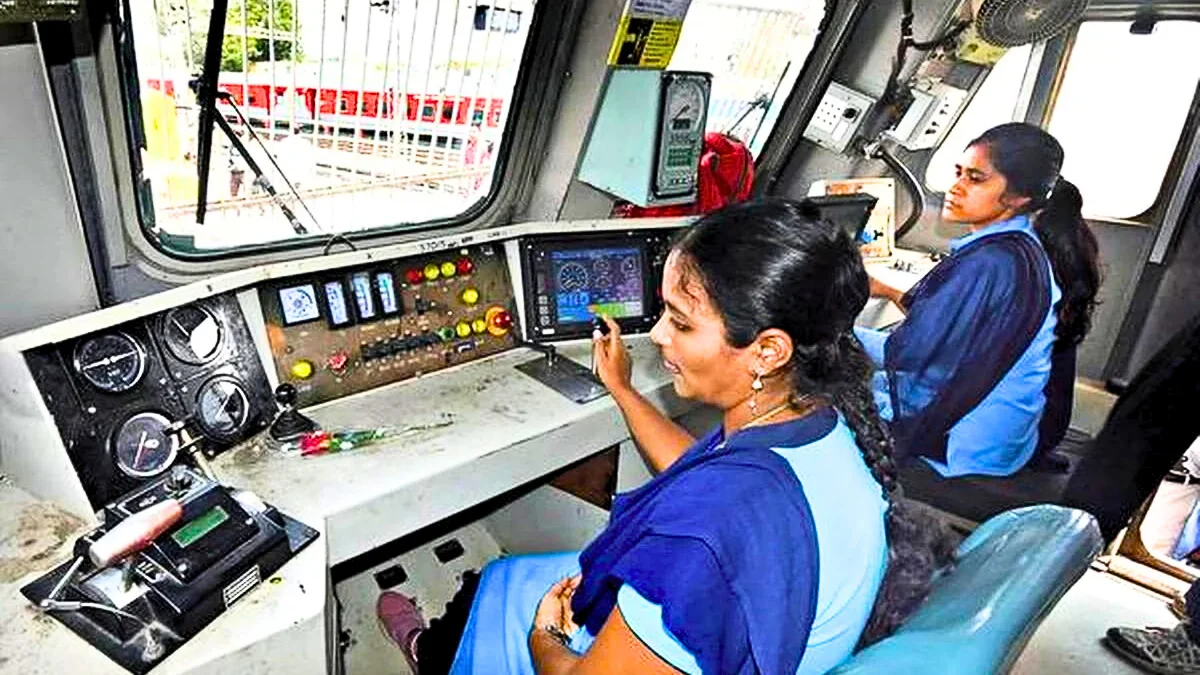
motorwoman 1

However, change is underway. Women are stepping into roles as train operators, engineers, and station managers, challenging stereotypes and advocating for inclusive workplaces. By addressing workplace safety, improving facilities, and promoting equal opportunities, the sector can become more accessible and diverse.

This article illustrates women’s participation in India’s metro and railway industry, examines the existing challenges and identifies ways to create a more inclusive environment. The goal is to create a future where rail networks not only connect cities but also empower women while ensuring equal opportunities across all roles in this evolving industry.

38199976 2159977290682117 7871547543048421376 n 696x464 1

Current Landscape of Women In India 

Women’s Increasing Share in India’s Population 

According to the most recent data from the United Nations World Population Prospects, India’s total population is estimated to be approximately 1.42 billion individuals, with women constituting roughly 48%  of this total, which corresponds to an estimated 680 million women. By the year 2036, it is projected that the population of India will reach 1.522 billion, with a marginal increase in the female percentage to 48.8%, compared to 48.5% recorded in 2011.

AD 4nXeooa1y9CYjKp5Um69WYuU 6GL2GzdhOlYFb3c6jefxtEBK5AGSMr79BaSwNkH71bWDd1BVmgMFnSDmf qoWc3eFMIbhXVe25 AE7Vtk1owqf9AD 4nXeamMB3CToZxk7 SX69GmMofwecAS2zQ Yn7fRaX1c596iWUF8A

Rise of Women in India’s Workforce

Between the fiscal years 2017-18 and 2023-24, India observed a significant increase in the Female Labor Force Participation Rate (LFPR) and Work Participation Rate (WPR) for women, accompanied by a decline in the female unemployment rate.

Female Labor Force Metrics (2017-18 vs. 2023-24)

Metric2017-182023-24
Work Participation Rate (WPR) (%)22%40.30%
Labor Force Participation Rate (LFPR) (%)23.30%41.70%
Unemployment Rate (%)5.60%3.20%
Untitled design 44 1

Employability Rate in India: 2014 to 2025

Employability refers to the set of skills, qualities, and attributes that enable an individual to secure, retain, and advance in employment. According to a report from the Statista Research Department, the proportion of women deemed employable in India saw a decline in 2025 compared to the preceding year. 

AD 4nXfa9g9DziwunWyqi19grBIDN2kTq6RVSOo1yhmt7Jkn rcXVh8qhGV5PBBhidGtafn 7lBHaCAxQOOM1FcPY2k Beo XcBgWVLigPCgGDqhvBzavFW5zUqqNelhRCRyEnpCq3UdIrCPUriAXNGDYh8?key=afjSuX7EUq6JAvsJPS5VXJN

Women’s Share In Indian Railways

In December 2024, Railway Minister Ashwini Vaishnaw reported to the Lok Sabha that, as of March 31, 2024, Indian Railways employed a total of 99,809 women. This workforce includes 2,037 women who are serving as loco pilots.

GI6k2E9bcAA7E0z 1

Impact of Women’s Increasing Participation

Since women in India cover a substantial portion of over 48% of the population, this means they hold great potential that can serve as a driving force for India to propel it towards its course of becoming a developed nation by 2047. As more women come into leadership & operation roles in the rail transportation sector, it will create a more inclusive work environment at every level and encourage other women to come forward and contribute to the growth of the nation. Below are some critical impacts that emerge from this trend: 

  1. Boost to Economy: India has the world’s youngest population, and it aims to become the 3rd largest economy by 2030, which is only possible with active participation. They serve as key drivers in the achievement of the Sustainable Development Goals. A study by the UN India indicates that, by facilitating women’s participation in the economy on an equal footing with men, India could boost its GDP by 16%, with the potential for a remarkable 60% increase thereafter.
  2. Improved Passenger Safety and Service: The increasing presence of women in leadership positions within metro and railway operations presents an opportunity to enhance the emphasis on safety protocols and customer service.  For example, the Delhi Metro has reserved its first coach exclusively for women since 2010, Female professionals can contribute to the design and implementation of initiatives, including gender-sensitive security policies. Such measures can enhance the security and comfort of public transportation for all passengers. 
  3.  Innovation in Infrastructure and Design: The incorporation of women into the metro and railway workforce introduces a diverse range of perspectives and ideas in the planning and operation of metro and rail systems. This approach includes the design of gender-inclusive station layouts, such as designated seating areas and childcare-friendly zones, as well as the implementation of digital solutions that cater specifically to the mobility needs of women commuters.
  4. Operational Efficiency and Inclusive Management: As an increasing number of women take on operational and managerial positions, the presence of diverse leadership can enhance decision-making processes and lead to more effective resource allocation. This diversity is likely to foster innovative problem-solving approaches in critical areas such as scheduling, maintenance, and crisis management within the rail transportation network.
  5. Cultural Impact: The greater visibility of women metro and rail employees can act as a good role model for generations to come. Visibility is a key contributing factor in breaking existing stereotypes, thus leading to more women entering the transport industry.
  6. Improved Policy and Investment Outcomes: An increased representation of women within decision-making bodies of metro and railway authorities uplifts the capacity to advocate for policies that work on inclusivity and safety. This representation can subsequently promote greater public investment in women-centered initiatives.
Women train operator working in Delhi metro rail corporations 1

Barriers to Women’s Entry in the Rail Transportation Sector

Women who seek to establish careers in the rail transportation sector face a range of barriers encompassing cultural, institutional, and practical dimensions. Key obstacles include:

  • Cultural and Gender Stereotypes: The enduring perception of rail transport as a predominantly male-oriented industry often serves as a common but critical roadblock for women considering careers within this sector. Furthermore, traditional societal norms may contribute to the view that technical and operational roles are ill-suited for women, thereby reinforcing barriers to entry.
  • Limited Access to Training and Skill Development: The lack of accessible specialised training, certification, or apprenticeships in technical roles for women presents a substantial barrier. This situation not only restricts their opportunities to enter fields like driving or engineering but also hinders their ability to advance within these sectors. Addressing these disparities is crucial for creating a more inclusive and diverse workforce. The government should invest in programs that provide equal access to training and create pathways for women to excel in these traditionally male-dominated areas.
  • Lack of Role Models and Mentorship: The limited representation of women in leadership and technical positions within the rail industry presents a challenge for aspiring female professionals. This underrepresentation may hinder their ability to visualize a clear career trajectory and obtain the necessary mentorship essential for professional development.
  • Safety and Work Environment Concerns: Women face various concerns about their personal safety, whether it be working in late night shifts or working in isolated work areas, which can hinder their participation in operation roles, Additionally, inadequate workplace facilities and inflexible work policies is another barriar in women’s ability to balance professional and personal responsibilities.
DPrEZyBV4AAm8Dr 1 1

Role of Metro in Empowering Women; the Inside Story By Ritu Agarwal Sharma, Joint General Manager/ Delhi Metro Rail Corporation

Organizations play a crucial role in empowering women in the workforce by creating an environment that supports equality, opportunity, and growth. As difficult as the question may seem, “What women want”, DMRC has been able to connect several dots to reach towards the answer.

As somebody who has been working with the Organisation for more than 16 years, I have seen several management styles, but all with a clear concern to support and encourage our women workforce. Currently approximately 0.9% workforce is female in the organization, which is definitely less than the desired figure, the ratio is due to technical nature of jobs within organization and is a result of in-general skewed ration of female in engineering or other technical training, However, DMRC has taken efforts to improve this ratio in recent times and actively encourages female employees to take up training and frontline roles for improving their representation at higher level.

Recently, our management, on gauging the difficulties faced by women, formed a committee for understanding women’s satisfaction level within the Organisation and work towards developing an equitable and just work environment where women can feel happiness. Being a member of the committee I was able to meet several women workforce and realized their problems and felt overwhelmed by the kind of juggling we women have to undergo, but as its said, if you can’t measure you can’t correct so sure the higher management commitment is evident in giving female this opportunity of being heard.

Some of the initiatives and policies that have helped to secure DMRC as a great place to work for Females are as follows: –

1. Promoting Equal Opportunities:

DMRC has made strides in ensuring that women have access to leadership roles. The appointment of female heads in departments like HR, Finance, and Architecture is notable and points to the organization’s growing commitment to women’s career advancement.

2. Inclusive Policies and Benefits:

Our management has believed that developing and implementing policies that promote gender equality is key to empowering women. On hearing women through committee proceedings, one thing was evidently clear that most of the women talked about concerns related to child care and DMRC has actively adopted Child care, let’s review DMRC in comparison of other government organizations: –

S. NoOrganisationChild care policyApproving byRemarks
1.   NTPCYesReporting bossBasic +DA+HRA paid
2.   BHELYes Limited perks
3.   Bharat Electronics LimitedNo But good creche facility
4DMRCYesBoss of reporting bossBasic+DA+HRA paid

It is evident from the above that DMRC’s paid childcare leave policy is a standout example, offering women the opportunity to balance both career and family responsibilities. This support is crucial for women in a demanding workplace.

3. Women-Satisfaction Surveys:

The ongoing surveys to gauge women’s satisfaction and their challenges are critical for continuous improvement. Mentorship programs and leadership training initiatives also help women navigate their careers in male-dominated industries.

4. Safe and Supportive Work Environment:

DMRC goes the extra mile by ensuring safety and security, especially for women working in frontline roles such as train operators. Providing cab facilities for late shifts and designing rosters to cater to women’s safety needs are examples of how DMRC addresses work-life balance and safety concerns.

5. Training and Development Programs:

DMRC’s commitment to training and development is evident in its programs, including gender sensitization efforts for all employees. The desire to launch more leadership and professional development programs for women shows how DMRC seeks to actively support the growth of women in the workplace.

6. Championing Diversity and Inclusion:

The organization actively promotes diversity and inclusion with public-facing measures like reserved coaches for women. There’s still work to be done in terms of improving diversity in hiring and career advancement, but DMRC’s current efforts are commendable.

7. Work-Life Balance and Flexibility:

DMRC is a public service transport provider; hence, given the organisation’s prime role in transporting people, providing flexible work time to anyone has been a challenge. Organizations like BEL and NTPC have a half-hour flexible work hour policy for their female employees and help women manage both their professional and personal lives, increasing job satisfaction and retention. This flexibility of timing and policies like WFH is often crucial for women who are balancing careers and family responsibilities.

8. Recognizing and Celebrating Women’s Contributions:

Acknowledging and celebrating women’s achievements in the workplace can boost morale and inspire others to strive for leadership positions. The “Woman of the Year” award is a meaningful way of recognizing the contributions of female employees and inspiring others to take leadership roles. Further celebration of Women’s Day at a large scale has been a practice of the organisation to show women that this organisation cares for you.

Successful Models of Inclusivity in Rail Transport: 

Kochi Metro’s Inclusive Workforce Initiative

AD 4nXfWFkFMhdXz8Ohw7mTB8zhSCebjKtoFuzGKWGi x45inHwU7iNRTZQBBCzijp7vmQNz 8gb86xgJGaSe9D0kvCix0U SqKXADm9Kj6ht5GMv0MMUWaKienKpKhthTg6q2qfNVHYCvd4BjvtYjZ hmo?key=afjSuX7EUq6JAvsJPS5VXJN
  1. Partnership for Empowerment: Kochi Metro Rail Limited (KMRL) has established a partnership with the Agence Française de Développement to enhance the recruitment and training of women in various technical roles. This collaboration aims to broaden opportunities for women in management, station control, train operation, engineering, and other essential sectors.
  1. Impressive Workforce Composition: Approximately 80% of the Kochi Metro team comprises women who fulfill various roles, including cleaning staff, ticket machine operators, train drivers, and station managers. This composition illustrates the sector’s commitment to gender inclusivity and the establishment of an environment that supports women’s contributions at every level of the organization.

Central Railway’s Pink Station: A Benchmark in Women-Led Inclusivity

Central Railway’s New Amravati station achieved milestone by becoming the first station within the Bhusaval Division and the third station across Central Railway to be designated as a Pink Station. This designation is notable as the station is entirely operated by a female workforce, thereby establishing a new benchmark for operational inclusivity within the railway sector.

Conclusion

The increasing participation of women in India’s metro and railway sectors is gradually transforming an industry that has historically been male-dominated. Initiatives such as the strategic collaboration between Kochi Metro and Agence Française de Développement, as well as the development of Central Railway’s New Amravati Pink Station, exemplify how targeted efforts can create a more inclusive and supportive work environment. These advancements, alongside flexible work policies and childcare support offered by organizations such as the Delhi Metro Rail Corporation (DMRC), demonstrate a commitment to addressing the challenges that women encounter in balancing professional and personal responsibilities. 

Although challenges remain in overcoming cultural stereotypes, limited training opportunities, and safety concerns, these successful models provide valuable insights for promoting change. Ultimately, this evolution within rail transport not only enhances service delivery and operational efficiency but also aligns with broader national objectives, which aim for sustainable and inclusive growth for a prosperous future.

DMRC Floats tender for Civil work contract of Inderlok to Indraprastha Corridor 

Delhi ( Metro Rail News): Delhi Metro Rail Corporation (DMRC) has invited tender for the civil work contract  D2C-01 of Delhi Metro Phase 4’s Inderlok to Indraprastha corridor. 

Tender Details 

Opening Date7 Apr 2025
Closing Date19 May 2025
Tender Id2025_DMRC_855903_1
Approximate cost of workRs. 117.16 Crores 
Contract Duration 32 Months 
Pre-bid Meeting17.04.2025
EMD₹ 58,58,000

DMRC Brief Scope: Design and Construction of elevated viaduct, ramp from chainage CH: – 514.012 to CH: 440.000 and one elevated station i.e. Inderlok including Architectural finishing, plumbing and Pre-engineered steel roof structure & roof sheeting works (including Entry/Exit structure at station) of Inderlok to Indraprastha corridor of Delhi MRTS Phase-IV project.

Recent Updates in Delhi Metro Phase 4 

DMRC has recently announced that the development of the Lajpat Nagar – Saket G Block Metro Line (a spur of the Golden Line) will become India’s first metro segment specifically designed to operate with three-coach trains. This 8-kilometer corridor will be recognized as the second smallest metro line within the Delhi Metro network.


Visit InnoMetro 5th Edition: India’s Leading Expo for the Rail Transportation Industry and Experience the Latest Technologies & Innovations in Rail Safety, Infra, Signalling, and AI.

Date: 21-22 May 2025

Venue: Bharat Mandapam, Hall No. 4, New Delhi

Get Your Free Visitor Pass: https://innometro.com/visitor-registration/

Delhi Metro to Feature India’s 1st 3-Coach Metro Line

Delhi (Metro Rail News): The Delhi Metro’s Lajpat Nagar – Saket G Block Metro Line (A spur of the Golden Line) will come up as India’s first metro corridor designed to operate with 3-coach trains. As part of Delhi Metro Phase 4, this 8 km corridor will be the second smallest metro line in the Delhi Metro network.

A First for India: 3-Coach Metro Trains

 Unlike conventional metro systems that typically utilize 4, 6, or 8-coach configurations, this line comprising three coaches has been specifically designed to accommodate short-distance urban travel. 

The Lajpat Nagar–Saket G Block corridor is being developed with a thorough analysis of passenger flow patterns. The implementation of a smaller train configuration offers a cost-effective and agile solution that will increase the operational efficiency and provide a high frequency of service to meet the needs of daily commuters.

The adoption of a smaller train format results in reduced energy consumption per trip, thereby representing both an environmentally responsible choice and a financially sound decision. 

Delhi Metro’s Lajpat Nagar – Saket G Block Line

DMRC has recently secured funding for three metro lines, including the Lajpat Nagar – Saket G Block Metro Line in Phase 4. They signed a loan agreement worth ₹ 4309.53 crores with the Japan International Cooperation Agency (JICA).


Visit InnoMetro 5th Edition: India’s Leading Expo for the Rail Transportation Industry and Experience the Latest Technologies & Innovations in Rail Safety, Infra, Signalling, and AI.

Date: 21-22 May 2025

Venue: Bharat Mandapam, Hall No. 4, New Delhi

Get Your Free Visitor Pass: https://innometro.com/visitor-registration/

Join NCRTC: Recruitment for Operations & Maintenance Staff, Assistant Manager, and General Manager 

National Capital Region Transport Corporation (NCRTC) has announced a job vacancy for three Positions, including Operations & Maintenance Staff, Assistant Manager and Group General Manager. The job’s Description has been mentioned below:

Job 1  

Job Title: Requirement of Operations & Maintenance Staff On a Direct Recruitment Basis 

Date of commencement of online registration/submission of application 24/03/2025
Closing date of online application 24/04/2025 
Tentative date of Computer-Based Test (CBT) May 2025 

Job 2

Job Title: Requirement of Assistant Manager ( Computer Science) on Deputation Basis 

PostLevelPay Scale (Rs.)Number of Vacancy/ (ies)Maximum Age as on (19/03/2025) Nature of Employment
Assistant Manager (Commuter Services)E250000-160000 (IDA) 0156 Years Deputation Basis

Job 3 

Job Title: Requirement of Group General Manager (Signalling & Telecom) on Deputation Basis.

AD 4nXcch GhKwmD1RMIEAqFf8FyvqQHMt6QufpvKJ7Pll8GXc4F vYjRveNLHYLvSMLwMjJCA4YzaGo HedmgMoAA1FflVCSugxCy

Visit InnoMetro 5th Edition: India’s Leading Expo for the Rail Transportation Industry and Experience the Latest Technologies & Innovations in Rail Safety, Infra, Signalling, and AI.

Date: 21-22 May 2025

Venue: Bharat Mandapam, Hall No. 4, New Delhi

Get Your Free Visitor Pass: https://innometro.com/visitor-registration/

DMRC Enhances Last Mile Connectivity Through ‘Smart Door-To-Door Travel ’ Feature 

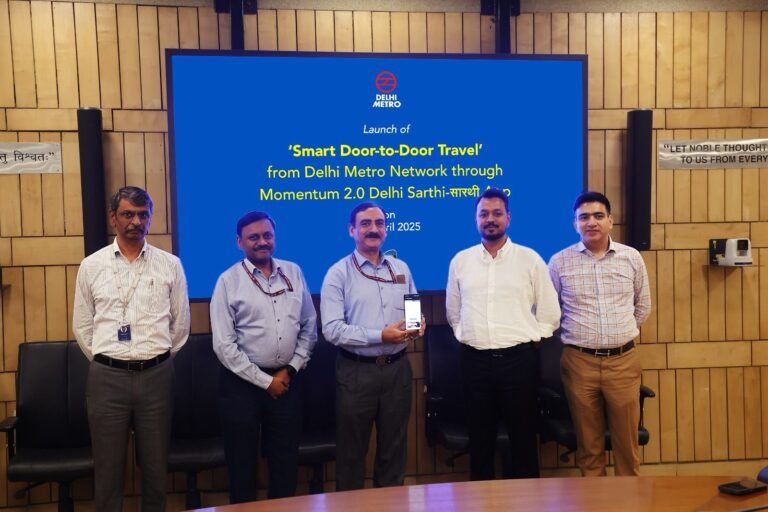
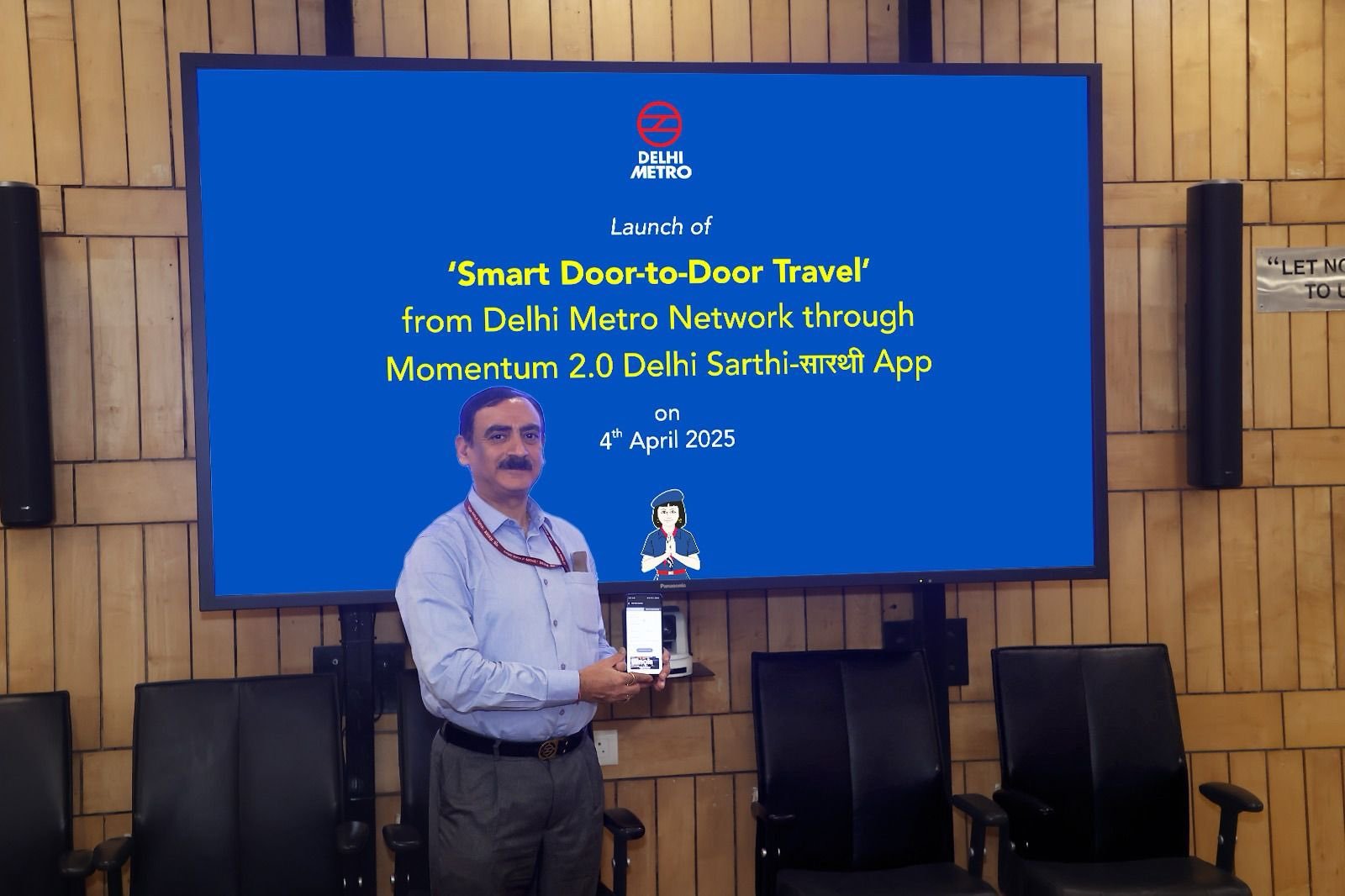
Delhi Metro Rail Corporation (DMRC) has launched an integrated travel solution on the ‘DMRC सारथी Sarthi-Momentum 2.0’ app, enabling commuters to book bike taxis and auto-rickshaws for first and last-mile journeys along with metro tickets in a single transaction.

GnsN1pNXsAAy5BH

Developed in collaboration with Autope Payment Solutions Ltd., this initiative eliminates the need for multiple bookings and bridges the crucial gap between metro stations and final destinations, enhancing commuter convenience.

DMRC Objective Behind this 

The service offers commuters a one-stop solution for metro tickets and last-mile travel, ensuring quicker, cost-effective, and reliable connectivity with seamless ride access through DMRC’s trusted platform.

How It Works:

1. User enters the destination; the app suggests the nearest metro stations and best first/last-mile transport options.

2. A bike taxi or auto-rickshaw is booked for pickup from the user’s location to the nearest metro station.

3. Before reaching the destination station, another ride is booked for last-mile connectivity.

4. If the metro station is within walking distance, the app does not suggest a vehicle. A walking navigation option will be available soon.

DMRC Partnership with Rapido & SheRyds

DMRC has partnered with Rapido for bike taxis and auto-rickshaws and with SheRyds, a women-led startup offering bike taxi services exclusively for female metro commuters.

Official Statement from DMRC, MD 

Commenting on the launch, Dr. Vikas Kumar, Managing Director, DMRC, said, “With the launch of this integrated service, we are addressing one of the most pressing challenges in urban commuting—first and last-mile connectivity. Sarthi-Momentum 2.0 makes metro travel more accessible, efficient, and convenient for all.”

Official Statement from Autope CEO 

Sh. Anurag Bajpai, CEO, Autope Payment Solutions Ltd, added, “Our partnership with DMRC signifies a leap forward in smart urban mobility. By leveraging technology, we are making public transport more seamless and commuter-friendly.”

Visit InnoMetro 5th Edition: India’s Leading Expo for the Rail Transportation Industry and Experience the Latest Technologies & Innovations in Rail Safety, Infra, Signalling, and AI.

Date: 21-22 May 2025

Venue: Bharat Mandapam, Hall No. 4, New Delhi

Get Your Free Visitor Pass: https://innometro.com/visitor-registration/

DMRC & JICA Ink ₹ 4309.53 crore Loan for Delhi Metro Phase 4 

Delhi (Metro Rail News): Delhi Metro Rail Corporation (DMRC) has announced that they have received financial closure for the three remaining corridors of Delhi Metro Phase 4. 

  • Inderlok – Indraprstha
  • Saket G Block – Lajpat Nagar
  • Rithala – Narela – Nathurpur

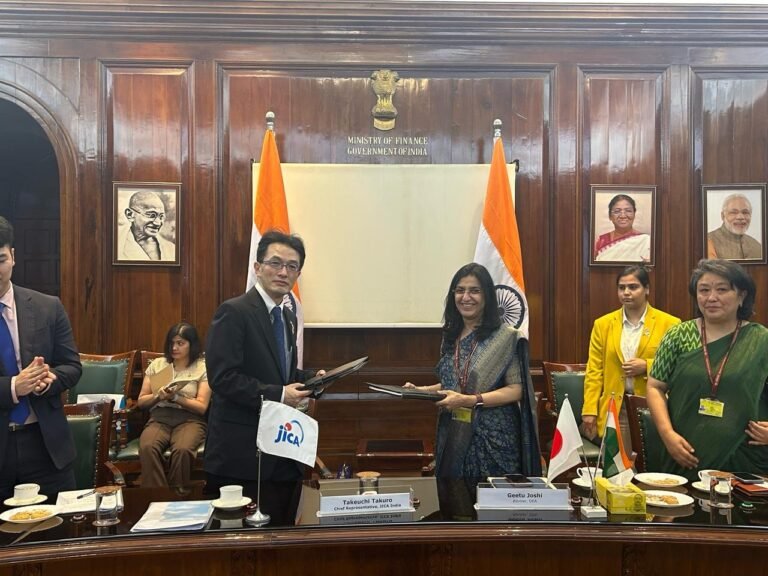
DMRC has achieved the financial closure through the signing of the first tranche of the loan agreement between the Government of India and the Japan International Cooperation Agency (JICA).

LA Signing2 4.jfif 1

 The Government of India and the Japan International Cooperation Agency (JICA) have signed the loan agreement of  ₹ 4309.53 crores ( Equivalent to about 79,726 million Japanese Yen). 

JICA has provided financial cooperation for the Delhi Metro project since its initial stages,  impacting mass transportation in India’s national capital and surrounding areas. 

Official Statement from JICA 

Commenting on the occasion, Mr. TAKEUCHI Takuro, Chief Representative of JICA India, stated, “The rapid increase in urbanization and vehicle ownership in Delhi has led to severe traffic congestion and environmental challenges. The expansion of the Delhi Metro network is a critical step toward addressing these issues by providing a reliable, efficient, and eco-friendly mass transit solution. JICA remains committed to supporting India’s efforts in developing sustainable urban infrastructure, and this project will contribute significantly to improving the quality of life for Delhi’s residents.”

Future Projection

Following this development, the tendering process is expected to advance, leading to the initiation of construction activities.

Visit InnoMetro 5th Edition: India’s Leading Expo for the Rail Transportation Industry and Experience the Latest Technologies & Innovations in Rail Safety, Infra, Signalling, and AI.

Date: 21-22 May 2025

Venue: Bharat Mandapam, Hall No. 4, New Delhi

Get Your Free Visitor Pass: https://innometro.com/visitor-registration/