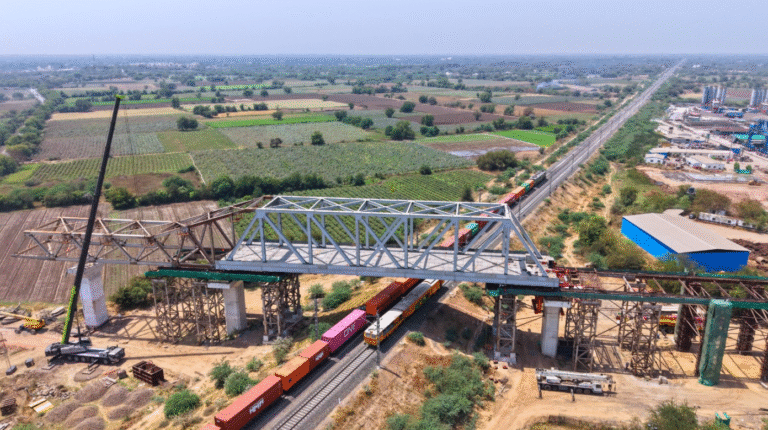
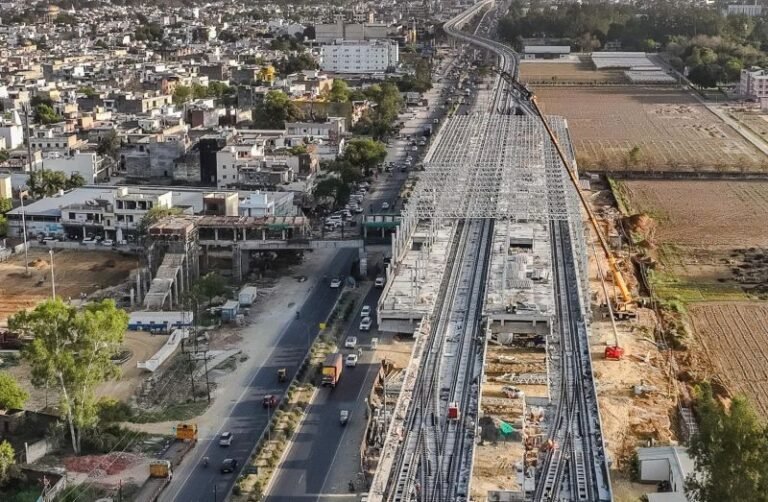
Mumbai-Ahmedabad Bullet Train Project (MAHSR)progressed with the launching of the 7th Open Web Girder (OWG) bridge spanning 70 m over the two Dedicated Freight Corridor tracks near Vadodara, Gujarat.
This is the seventh steel bridge out of the planned 28 steel bridges planned for the Mumbai-Ahmedabad Bullet Train corridor.
About the 7th OWG Bridge
The launching operation was completed within a 12-hour timeframe, employing intermittent blocks on the DFCC tracks.
The steel bridge weighs 674 metric tons, measures 13 meters in height and 14 meters in width.
The Bridge was fabricated at a workshop in Durgapur, Kolkata, and subsequently transported to the installation site using trailers.
The bridge was launched utilising a 49-meter-long launching nose, which has a weight of approximately 204 metric tons.
The fabrication of the bridge incorporated an estimated 28800 units of Tor-Shear Type High Strength (TTHS) bolts, which were subjected to C5 system painting, and included elastomeric bearings, all designed to ensure a lifespan of 100 years.
The steel structure was assembled at an elevation of 18 meters from the ground on temporary trestles and was pulled into position by employing the automatic mechanism of two semi-automatic jacks, each with a capacity of 250 tons, utilising mac-alloy bars.
OWG Bridges Completed so Far for Mumbai–Ahmedabad Bullet Train
This is the seventh steel Bridge out of the planned 28 steel bridges planned for the Mumbai-Ahmedabad Bullet Train corridor.
Sr.No
Location
Length ( In meters)
Weight ( MT)
1
Across National Highway 53, Surat
70
673
2
Over the Vadodara-Ahmedabad main line of Indian Railways, near Nadiad
100
1486
3
Over the Delhi-Mumbai National Expressway, near Vadodara
230 (130 + 100)
4397
4
Near Silvassa in Dadra & Nagar Haveli
100
1464
5
Over Western Railways, Vadodara
60
645
6
Over two DFCC Tracks and two Western Railways tracks, Surat
100, 60
1432
7
Over two DFCC tracks, near Vadodara
70
674
Total
10,771
Visit InnoMetro 5th Edition: India’s Leading Expo for the Rail Transportation Industry and Experience the Latest Technologies & Innovations in Rail Safety, Infra, Signalling, and AI.
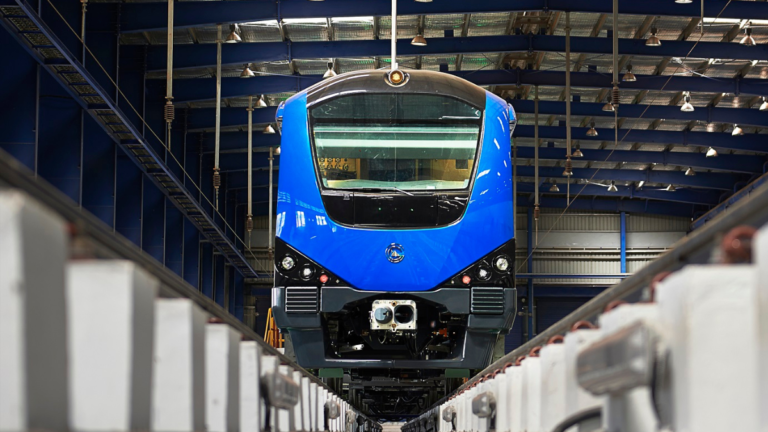
Chennai (Metro Rail News): Chennai Metro project progressed as 4 firms submitted bids for the electrical & mechanical (E&M), plumbing and fire protection contract C4-E&M-06 of Line 4. This corridor of the Chennai Metro spans 26.09 km from Light House to Poonamallee Bypass through 30 stations.
In November 2024, Chennai Metro Rail Ltd. (CMRL) invited bids for this contract with a 1630-day (4.46-year) deadline.
The scope of work outlined in this contract encompasses the system installations at eight of the ten underground stations on Line 4.
Stations: Light House, Kutchery Road, Alwarpet, Bharatidasan Road, Boat Club, Nandanam, Panagal Park, and Kodambakkam.
Note: All the stations mentioned above are under construction by ITD Cementation India as part of packages UG-01 (5.15 km) & UG-02 (4.87 km), which were awarded to ITD Cementation in January 2022.
CMRL’s Brief Scope: Supply, installation, testing, commissioning and training of electrical, plumbing and fire protection works for 8 underground stations from Light House metro to Kodambakkam metro including bored tunnel between stations, cut & cover box, u section and ramp (chainage 0 -173 m to 9+949 m) for Corridor- 4 Chennai Metro Rail Project Phase II.
Further Process
The bids submitted by the 4 firms have been sent for technical evaluation. After the technical evaluation, the financial bids of the technically qualified bidders will be opened to announce the lowest bidder for the contract.
Visit InnoMetro 5th Edition: India’s Leading Expo for the Rail Transportation Industry and Experience the Latest Technologies & Innovations in Rail Safety, Infra, Signalling, and AI.
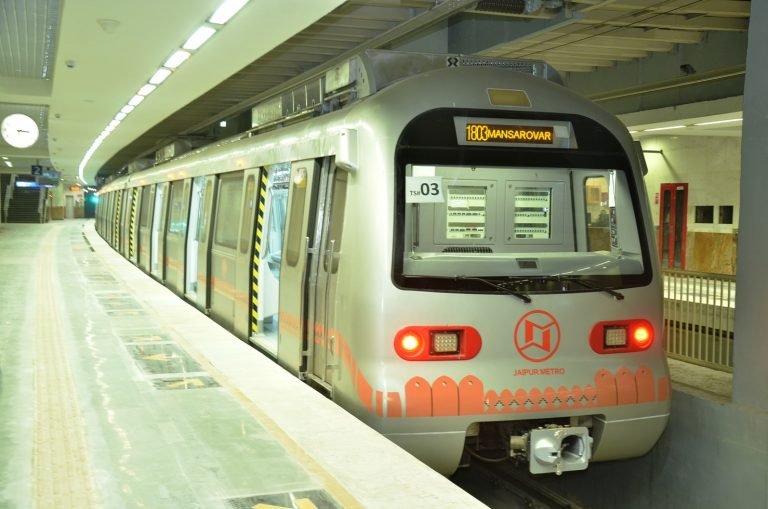
Jaipur (Metro Rail News): In November 2024, the Jaipur Metro Rail Corporation appointed the Rail India Technical and Economic Service (RITES) to develop the detailed project report for the Jaipur Metro Phase 2 at Rs. 4.6 crore. As per the official of JMRC, RITES has submitted the draft of the DPR. However, the CM of Rajasthan, Shri Bhajan Lal Sharma and his team have suggested some changes regarding the route and station locations.
Once the revised Detailed Project Report (DPR) is finalised, it will be forwarded to the Union Government for approval. The next step will involve signing a Memorandum of Understanding (MoU) to initiate the construction phase. Only after the MoU is in place will tenders be floated for construction work. Officials estimate that this entire process could take around three to four months to complete.
Provisions in the Draft DPR of Jaipur Metro Phase 2
The Jaipur Metro Phase 2 will cover a total of 40km route and feature 35 stations.. This corridor will start from Sitapura and conclude at Sikar Road. The entire project is expected to cost about Rs. 10,000 crore. Out of 35 stations, 1 station will be underground while 34 stations will be elevated. After completion, the project is expected to cater to about 2.5 million commuters.
Visit InnoMetro 5th Edition: India’s Leading Expo for the Rail Transportation Industry and Experience the Latest Technologies & Innovations in Rail Safety, Infra, Signalling, and AI.
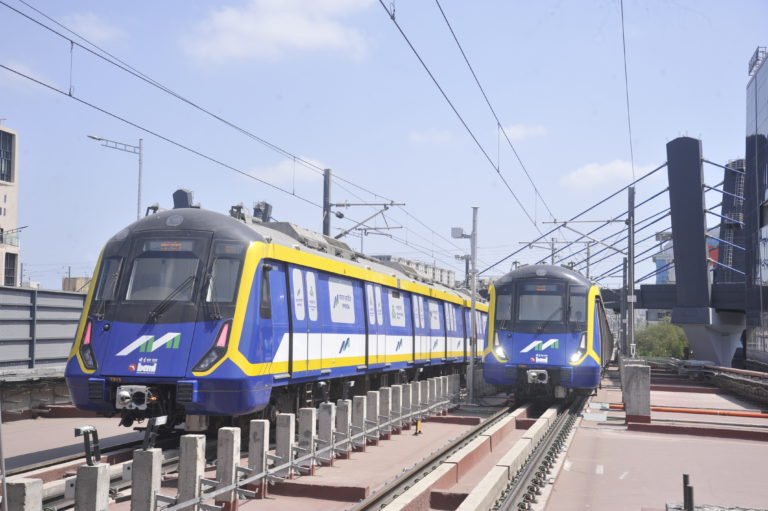
Mumbai (Metro Rail News): The Mumbai Metropolitan Region Development Authority (MMRDA) has started trial runs on the Mandale-Mankhurd stretch of Mumbai Metro Line 2B on Wednesday. The primary objective of this trial was to examine the rolling stock’s interaction with civil infrastructure.
Originally, the Mumbai Metro Yellow Line covers a distance of 23.643 km from D N Nagar to Mandale through 20 stations. The trials are underway on a 5.3 km stretch from Diamond Garden to Mandale. This section covers 5 stations:
Diamond Garden
Shivaji Chowk
BSNL
Mankhurd
Mandale
This trial aims to scrutinise the critical systems, including tracks, signalling, and rolling stock. These trials are instrumental in assessing communication-based train control (CBTC), telecommunication infrastructure, platform screen doors, and automatic fare collection systems.
The commercial operations on this section will only commence after receiving the clearance certificate from CMRS.
Progress on India’s Largest Metro Depot
The trains for the Yellow Line will be maintained and serviced at Mandale Depot, which is India’s largest Metro Depot. The construction of Mandale Depot is already 98% complete. The depot featured the capacity to house 72 metro rakes.
Visit InnoMetro 5th Edition: India’s Leading Expo for the Rail Transportation Industry and Experience the Latest Technologies & Innovations in Rail Safety, Infra, Signalling, and AI.
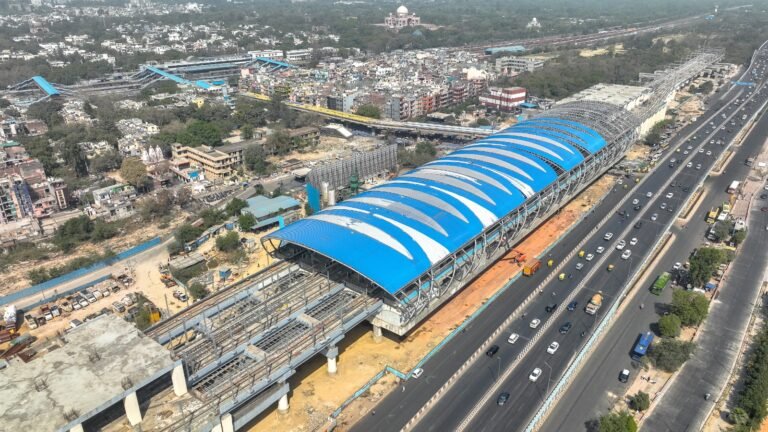
Delhi (Metro Rail News): The Delhi – Ghaziabad – Meerut RRTS project has progressed with the completion of track laying work at Modipuram, which is also the last Namo Bharat station (towards Meerut) of this corridor.
Key Features of Modipuram RRTS Station
Modipuram RRTS Station is strategically located along National Highway-58. In addition, it serves as an important terminal for both the Namo Bharat (RRTS) and Meerut Metro services.
The station comprises three platforms, of which two are dedicated to semi-high-speed Namo Bharat trains and one is for Meerut Metro services.
With a total length of 215 meters and a width of 34 meters, the station is designed to manage high passenger volumes efficiently.
The Passenger movement is facilitated through eight staircases, eight escalators, and six lifts to ensure smooth access across levels.
Current Status of Delhi–Meerut RRTS
The Namo Bharat trains are currently operational along a 55-kilometre stretch between New Ashok Nagar in Delhi and Meerut South, covering 11 stations.
Recently, the National Capital Region Transport Corporation (NCRTC) announced the successful electrification of the section between New Ashok Nagar and Sarai Kale Khan. NCRTC plans to make the entire corridor operational by June 2025.
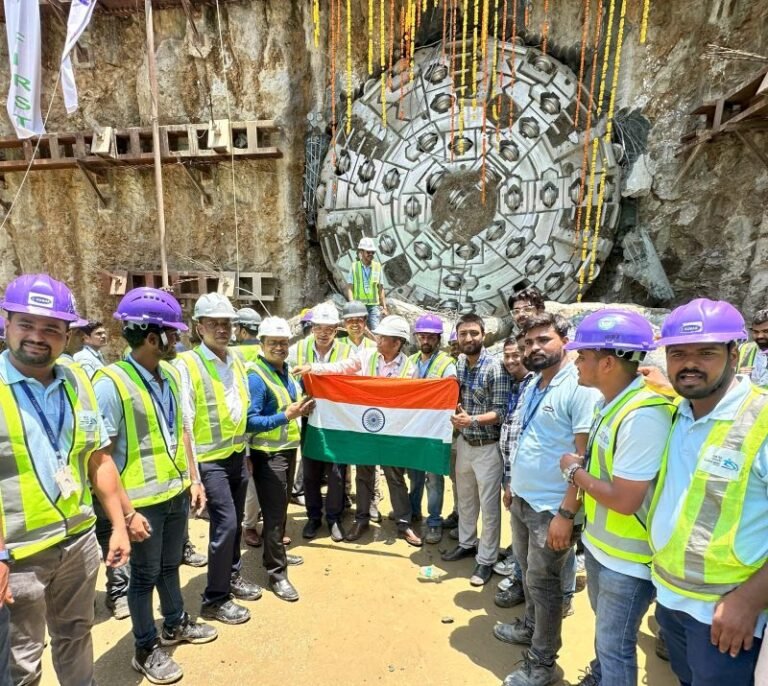
Mumbai (Metro Rail News): J Kumar Infraprojects (JKIL)’s TBM Disha has achieved a tunnel breakthrough at Airport Colony Station on Line 7a (Red Line) of Mumbai Metro within the package CA-48.
Image Credit: Prashant Joshi
TBM Disha’s Drive for Mumbai Metro’s Red Line
TBM Disha, designated as T62, is a dual-mode Terratec tunnel boring machine with a diameter of Ø6.68 meters. It was launched for the construction of the approximately 2.49-kilometre up-line tunnel from Chhatrapati Shivaji International Airport’s Terminal 2 towards the Airport Colony Station. The work was carried out within package CA-48. J Kumar Infraprojects bagged Package CA-48 at Rs. 1,998 crore from the Mumbai Metropolitan Region Development Authority (MMRDA) in 2019.
Mumbai Metro Line 7A
The 3.4-km-long Line 7A of Mumbai Metro serves as an extension to the Red Line 7 corridor that currently connects Dahisar East to Gundavali in Andheri East.
This segment will comprise 2.5 km of underground track and 0.94 km of elevated track, featuring two strategically located stations: Airport Colony (elevated) and CSMIA Terminal 2 (underground).
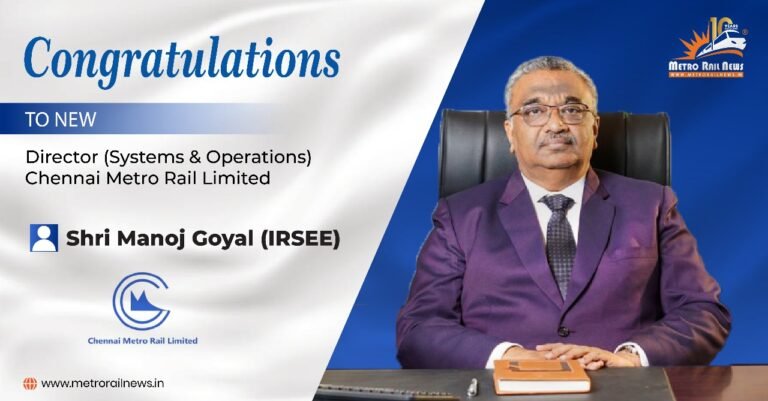
Chennai (Metro Rail News): Chennai Metro Rail Limited (CMRL) has appointed Shri Manoj Goyal as its new Director of Systems and Operations. A distinguished officer from the 1990 batch of the Indian Railway Service of Electrical Engineers (IRSEE), Mr. Goyal brings with him a wealth of knowledge and experience spanning over three decades in Indian Railways.
Academic Background
Shri Goyal holds a degree in Electrical Engineering from the Dayalbagh Educational Institution (Deemed University), Agra. He further enhanced his academic credentials with a part-time MBA from the Jamnalal Bajaj Institute of Management Studies, University of Mumbai, and an M.Phil from Dr. D.Y. Patil University, Navi Mumbai.
Professional Background
Over his 33-year career in Indian Railways, Shri Goyal has held several key positions. He served as Divisional Railway Manager (DRM) in Bhavnagar, Gujarat, for two years and played a pivotal role as Chief General Manager (Systems) for five years in the Ahmedabad Metro Rail Project. He also contributed to the Mumbai Railway Vikas Corporation, where his role was primarily focused on the modernisation and improvement of EMU maintenance facilities in the Mumbai suburban rail network.
Before joining CMRL, he served as Chief Administrative Officer for the Dahod Loco Factory Project, under Western Railway, based in Mumbai. His expertise spans Railway Rolling Stock, Traction Systems, and Electrical and Mechanical Systems, which positions him as a valuable asset to the Chennai Metro’s leadership team.
Bangalore (Metro Rail News): Rail Infrastructure Development Company Karnataka Limited ( K-RIDE) revealed Jindal Steel and Power Ltd. as the lowest bidder for the track supply contract of the Bangalore Suburban Railway Project.
Bidding Process
K-RIDE floated tender for this contract in 2024 with a 365-day deadline. Technical bids were opened on 13 November 2024, revealing that only one firm had submitted bids for the contract.
The Technical Evaluation took place on 5 April 2025. On 11 April 2025, financial bids were opened, and Jindal Steel and Power Ltd. was declared as the lowest Bidder for the contract.
Contract Details
Jindal Steel and Power Bid Value: ₹ 20.6 Cr
Contract Duration: 365 Days
K-RIDE Brief Scope: Supply of 60E1 (UIC 60), 880 Grade Rails as per IRS-T-12-2009 (Latest with all A&C slips), for Bengaluru Suburban Railway Project
About Bangalore Suburban Railway Project
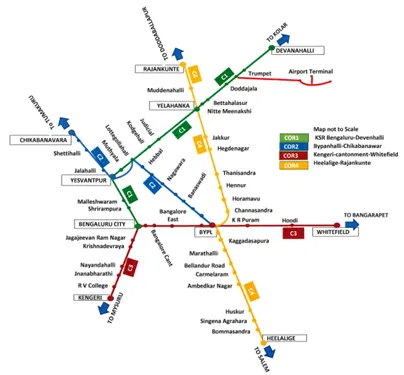
Bangalore Suburban Railway Project is an under-construction commuter rail network which spans 149.348 km and consists of 4 Corridors.
Corridor
Line
Route
Length
Corridor 1
Sampige Line
KSR Bengaluru – Yelahanka – Devanahalli
41.478 km
Corridor 2
Mallige Line
Baiyyappanahalli Terminal – Chikkabanavara
24.866 km
Corridor 3
Parijaata Line
Kengeri – Whitefield
35.52 km
Corridor 4
Kanaka Line
Heelalige – Rajankunte
46.285 km
Visit InnoMetro 5th Edition: India’s Leading Expo for the Rail Transportation Industry and Experience the Latest Technologies & Innovations in Rail Safety, Infra, Signalling, and AI.
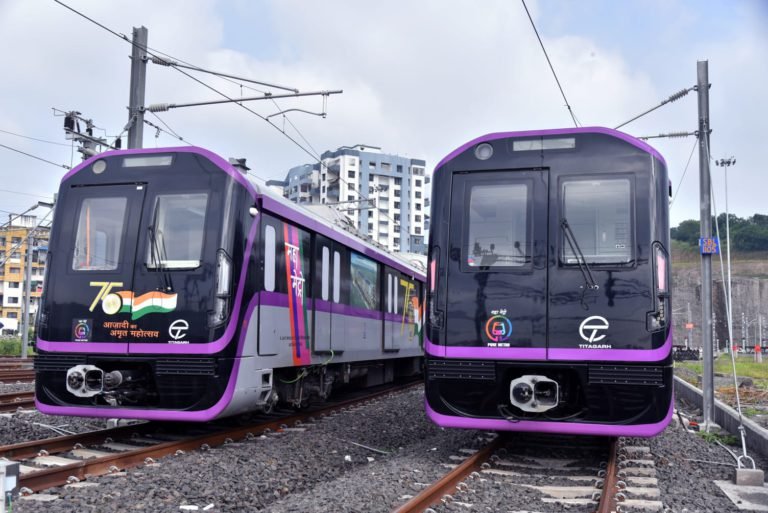
Pune (Metro Rail News): The Pune Metro project progressed as the state government has agreed to finance the additional cost of Rs. 683 Crore for the 2 new stations, namely Bibwewadi and Balaji Nagar station, introduced on the Pune Metro’s Purple Line extension from Swargate to Katraj, which spans 5.464 km.
Back in January 2025, Maharashtra Urban Affairs Minister Madhuri Misal proposed two new stations on the Purple Line’s extension from Swargate to Katraj.
The primary objective for proposing the two new additional stations along the Swargate to Katraj extension was to address the persistent traffic congestion in Pune.
This development comes after the Maha-Metro invited bids for the first civil contract for the Pune Metro’s Purple Line extension from Swargate to Katraj.
About Tender Floated by Maha-Metro
Recently, Maha-Metro floated tender for the first civil contract of Swargate to Katraj extension.
The contract’s scope of work included the Design and Construction of Underground Stations at Market Yard, Padmavati, Katraj Stations & Associated Tunnels in Stage I and Stations at Bibwewadi & Balaji Nagar in Stage II of the Swargate-Katraj Section of the Pune Metro Rail Project
Visit InnoMetro 5th Edition: India’s Leading Expo for the Rail Transportation Industry and Experience the Latest Technologies & Innovations in Rail Safety, Infra, Signalling, and AI.
Mumbai (Metro Rail News): Mumbai Metro is going to witness a development as the Mumbai Metropolitan Region Development Authority (MMRDA) has been planning to conduct the trial runs of Line 2B ( Yellow Line), which spans 23.643 km from D N Nagar to Mandale through 20 stations.
An MMRDA Official mentioned, “Last week, we successfully electrified the overhead equipment. As a step towards making the metro corridor open for the public, trial runs would commence from Wednesday,”
About Trial Run
MMRDA has been planning to conduct the trials on the 5.3 km stretch of Line 2B. The trials are expected to be undertaken between Mandale and Diamond Garden, featuring 5 stations.
Stations
Diamond Garden
Shivaji Chowk
BSNL
Mankhurd
Mandale
Future Projection
After successful preliminary test runs, the Research Design and Standards Organisation (RDSO) of the Indian Railways will be invited to certify the system for the subsequent phase, which involves engaging an Independent Safety Assessor.
Subsequently, the Commissioner of Metro Rail Safety (CMRS)will evaluate the system and, upon satisfactory assessment, will certify it as suitable for public operations.
Visit InnoMetro 5th Edition: India’s Leading Expo for the Rail Transportation Industry and Experience the Latest Technologies & Innovations in Rail Safety, Infra, Signalling, and AI.
The National Capital Region Transport Corporation (NCRTC) has achieved another milestone in the Delhi-Meerut RRTS Project with the commencement of trial runs on a 5 km stretch between New Ashok Nagar and Sarai Kale Khan.
This development signifies the introduction of Alstom’s semi-high-speed trains, referred to as Namo Bharat, to the southern terminal at Sarai Kale Khan.
About Trials
The NCRTC team conducted a trial operation utilizing the Namo Bharat Train. The train began its journey with a low-speed run at 10 km/h from New Ashok Nagar on the down-line tracks. During this trial, the train traversed the 1.35 km Yamuna River Bridge.
Objective Behind Trials
The primary objective of the initial run was to assess Schedule of Dimensions (SOD) clearances and to observe the train’s interaction with the civil infrastructure.
This assessment was essential to ensure that there were no physical obstructions along the designated route.
About New Ashok Nagar – Sarai Kale Khan section
The section connecting New Ashok Nagar to Sarai Kale Khan was developed by Afcons Infrastructure as part of Package 6. A minor segment of this package, specifically the Ramp at New Ashok Nagar, became operational in January 2025, as a part of 13 km stretch connecting Sahihabad, Anand Vihar, and New Ashok Nagar.
Earlier this week, the installation and energization of the 25kV AC overhead equipment (OHE) system were successfully completed by IRCON International, as a part of Package 19.
The Sarai Kale Khan station has been designed with a forward-thinking architectural vision, intended to function as the terminal station for the Delhi-Dharuhera and Delhi-Panipat Regional Rapid Transit System (RRTS) lines.
Visit InnoMetro 5th Edition: India’s Leading Expo for the Rail Transportation Industry and Experience the Latest Technologies & Innovations in Rail Safety, Infra, Signalling, and AI.
India,7th largest and the most populous country in the world necessitates a high level of transport accessibility. The total length of its railway network exceeds 68,000 km, which positions it as the 4th largest Railway network after the US, China, and Russia.
The Indian government has recognised rail transport as a key driver for enhancing passenger and freight mobility. India believes in the creation and expansion of its own facilities and technology transfer with mandatory localisation under the national programme Make in India.
Initiatives to Deploy High-Speed Trains In India
In 1960, the Railway Board of India initiated a study to increase train speeds, which were then limited to 96 km/h (60 mph) on broad gauge tracks.
A phased speed improvement plan was set, that aimed to extend train speed to 120 km/h (75 mph) initially and 160 km/h (99 mph) in the long term.
The Rajdhani Express began operations in 1969 with diesel locomotives, It became India’s first high-speed service, reaching 120 km/h (75 mph).
The launch of the Shatabdi Express in 1988, powered by WAP-1 electric locomotives, further advanced rail speeds to 130 km/h (81 mph).
Vande Bharat: A Landmark Project Under the Make In India Initiative
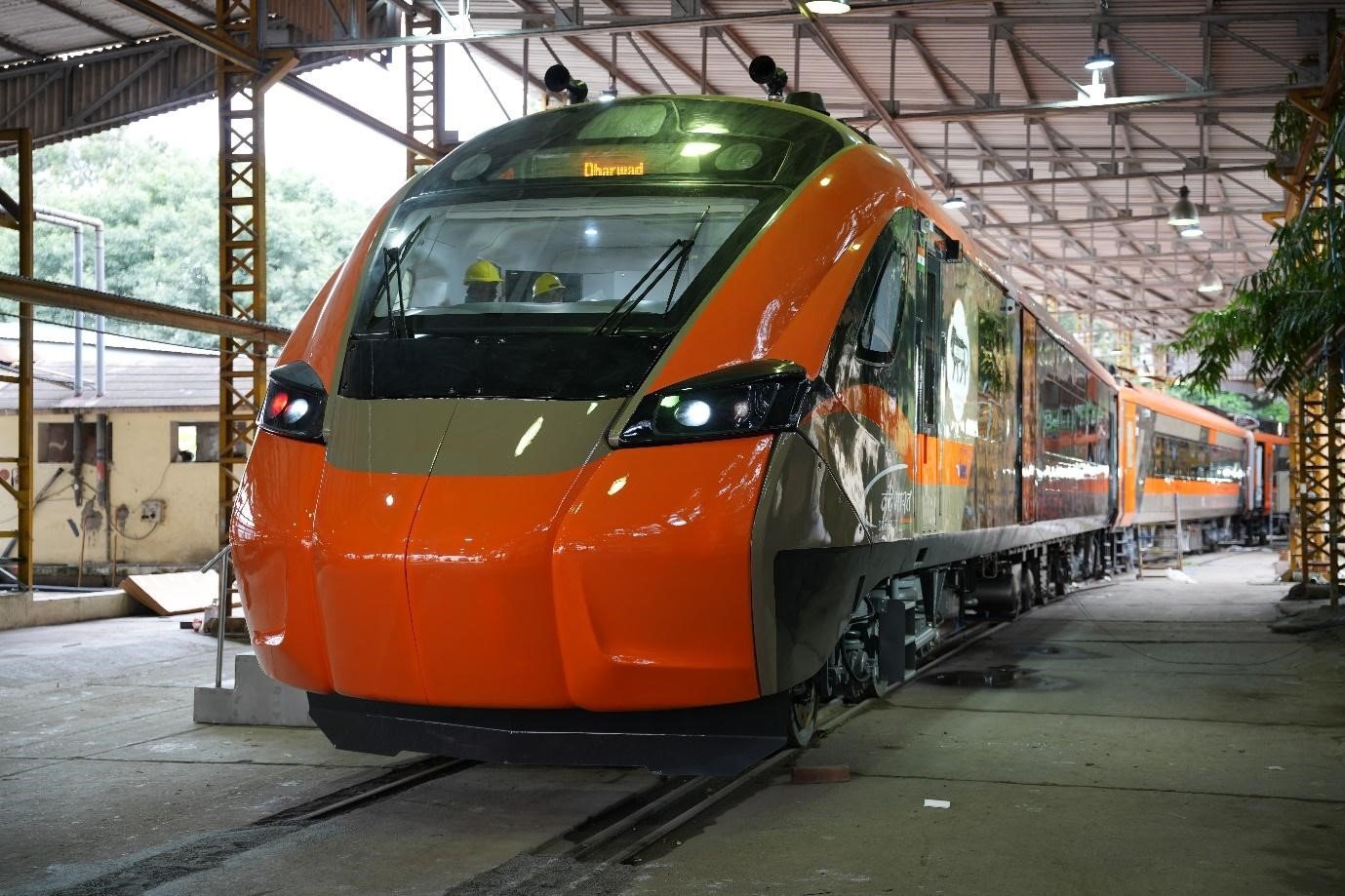
Vande Bharat Train formerly known as Train 18 recorded its name in the history of railways by becoming the nation’s first semi-high speed train touching the speed of 180kmph. The thing that made this project unique was the Vande Bharat Train was manufactured indigenously which also outlined the nation’s engineering prowess and self-reliance in the face of modern transportation demands. The success of this project also signified the success of the Make in India initiative
Significance: The Vande Bharat trains were introduced as a modern alternative to the Shatabdi Express. It promised a more efficient and faster travel experience. They were designed to complete the same journey in 15% less time. While these semi-high-speed trains are capable of reaching a maximum speed of 180 km/h, the existing Indian railway tracks are not built to support such high speeds consistently.
Key Factors Behind the Success of Vande Bharat Trains
Feature
Vande Bharat
Conventional Express Trains
Innovative Traction System
Electric traction motors are distributed under alternate coaches, connected to a pantograph drawing power from the overhead electrification system. This allows for superior acceleration and deceleration.
A single locomotive at one end of the train provides power to the entire train. Requires turning around the locomotive at terminals or turnaround points.
Power Distribution
Consists of 16 coaches, with 8 motorized coaches providing a total of 12,000 HP.
Power is concentrated in the locomotive, which provides approximately 6,000 HP for the entire train.
Speed & Performance
Maximum speed of 160 km/h with the potential for future upgrades. Faster acceleration and deceleration due to distributed power.
Maximum speed of 130-150 km/h with potential upgrades, but typically slower acceleration and deceleration than Vande Bharat.
Comfort & Passenger Experience
Features reclining seats, modern interiors, improved suspension, Wi-Fi, air conditioning, and more passenger space for a premium experience.
While comfortable seating is available, conventional trains (e.g., Shatabdi) lack the advanced features, modern design, and passenger-focused amenities found in Vande Bharat.
Development Phase (2016-2019):
The project started after foreign proposals for semi-high-speed trains were not successful. The Integral Coach Factory (ICF) in Chennai designed and built the Vande Bharat Trainsets in just 18 months.
The train was initially named Train 18 and was designed to operate at speeds up to 180 km/h (112 mph) during trials, with a maximum operational speed of 160 km/h (99 mph)
Train 18 is based on the stainless steel body of Alstom’s LHB passenger cars localised in 2001.
Vande Bharat Train Features
Cost Efficiency: Priced at $14 million, the new train was 40% cheaper than comparable foreign models.
Naming and Launch: Originally named Train 18, it was rebranded as Vande Bharat Express and commissioned in February 2019.
Speed and Performance: During trials, the train achieved a top speed of 183 km/h, making it the fastest in India. However, infrastructure constraints limit its operational speed to 130 km/h.
Advanced Features: The train’s distributed traction power system provides an acceleration of 0.8 m/s², enabling it to outperform Rajdhani and Shatabdi Express trains at 130 km/h, despite the lower top speed.
Vande Bharat 1.0 Production
Only two Vande Bharat 1.0 trains were produced between 2019 and 2022.
Vande Bharat 2.0:
To unleash the potential of the Vande Bharat Train Series, Indian Railways took a step forward and launched the new avatar of Vande Bharat: Vande Bharat 2.0. The second-generation Vande Bharat train was developed and tested amidst the COVID-19 pandemic. On 21 January 2021, M/s Medha Servo Drives Ltd. received an order of Rs 2211 crore from the railways to manufacture 44 Vande Bharat trains having 16 coaches. Prime Minister Shri Narendra Modi flagged off the first trainset of the Vande Bharat 2.0 version on September 30, 2022, from Gandhinagar to Mumbai.
This upgraded version was equipped with a range of advanced features over its predecessor. With the new upgrade, Vande Bharat Train could achieve a speed of up to 180 km. It was also lighter, weighing 392 tons instead of the earlier 430 tons.
The Key Features of Vande Bharat 2.0
Improvised Safety
Passenger safety has been a top priority for Indian Railways. The new generation Vande Bharat Trainsets were equipped with indigenously developed Automatic Train Protection System Kavach (Train Collision Avoidance System).
Additional Safety System
Emergency Windows
4 emergency windows were added in every coach for improved security.
Cameras
4 platform-side cameras, including rear-view cameras outside the coach (earlier, there were only two).
Safety Certification
New coaches have Level-II safety integration certification for better train control.
Fire Safety
Improved fire safety with an aerosol-based fire detection and suppression system in all electrical cubicles and toilets.
Floodproofing
Superior floodproofing for under-slung electrical equipment, now capable of withstanding floods up to 650 mm (earlier 400 mm).
Emergency Lighting
4 emergency lighting units in every coach for backup during electrical failures.
Enhanced Passenger Amenities
Indian Railways extended its expertise from safety to providing a better travel experience to passengers. This includes
Feature
Details
Riding Comfort
Enhanced riding comfort with a 3.5 riding index.
LCD TVs
32-inch LCD TVs replacing the earlier 24-inch TVs.
Passenger Information System
Equipped with a Passenger Information and Communication System.
Energy-Efficient ACs
15% more energy-efficient ACs with dust-free clean air cooling of the traction motor for a more comfortable journey.
Rotating Seats in Executive Class
180-degree rotating seats for Executive Coaches.
Bio Vacuum Toilets
Equipped with touch-free amenities for better hygiene.
Other Advancements
Previously, the Vande Bharat Train used to take 145 seconds to reach the speed of 160 kmph. However, the Vande Bharat 2.0 version was capable of reaching the speed in just 140 seconds. It also included other upgrades such as:
Feature
Details
Advanced HVAC System
Equipped with a high-efficiency compressor and an Ultra Violet (UV) lamp for a germ-free air supply.
Formation Change
It Includes a non-driving trailer coach in the middle for improved acceleration and deceleration.
Signal Exchange Lights
Two signal exchange lights on the coaches for communication with way-side stations.
Vande Bharat 3.0: A Benchmark for Safety, Speed, Comfort & Efficiency
The third generation of the Vande Bharat Train Series is a new addition to the Indian Railways fleet. The Vande Bharat 3.0 model is designed for long-distance travel and features sleeper coaches. This train has 16 coaches: 11 AC 3-tier, 4 AC 2-tier, and 1 AC First Class coach. The Vande Bharat Sleeper train can carry up to 823 passengers.
BEML Rolls Out First Vande Bharat Sleeper
On 1 September 2024, Hon’ble Union Minister for Railways, Shri Ashwini Vaishnaw flagged off India’s first Vande Bharat Sleeper trainset at BEML’s Bangalore rail complex. Indian Government plans to deploy 200 Vande Bharat 3.0 by 2029. BEML formerly known as Bharat Earth Movers Limited, has been a great contributor to Indian Railways. The company has produced and supplied over 18,000 mainline passenger coaches of various types for the Indian Railways. On 23 May 2023, BEML bagged a contract worth Rs 675 crore from Indian Railways’ Integral Coach Factory (ICF) to produce India’s first 10 Vande Bharat sleeper trainsets.
Vande Bharat Sleeper Train Achieves 180 km/h in Speed Trials
The Vande Bharat Sleeper Train successfully achieved a peak speed of 180 km/h during multiple trial runs conducted between December 31, 2024, and January 2, 2025. The trials were conducted with the train in a fully loaded condition to assess its performance and stability at high speeds.
Key Trial Runs and Achievements
December 31, 2024 – January 2, 2025:
Kota – Laban (30 km run): 180 km/h achieved on January 2.
Rohal Khurd – Kota (40 km run): 180 km/h achieved on January 1.
Kota – Nagda section: The train reached 170 km/h.
Rohal Khurd – Chau Mahla section: A peak speed of 160 km/h was recorded during the run.
Key Features of Vande Bharat Sleeper Train
The Vande Bharat Sleeper Train has been designed to enhance the overall travel experience while also considering the comfort of onboard staff and train operators. The key features include:
1. Passenger Comfort & Amenities
Improved Air Conditioning – The train is equipped with an upgraded air conditioning system that allows better temperature control.
Oxygen Level Maintenance System – This feature helps maintain appropriate air quality inside the coaches.
Redesigned Toilets – The train includes modernized toilets with improved accessibility and hygiene.
New-Generation Seating – Sleeper berths and seating areas have been upgraded with improved cushioning and high-quality materials for better comfort during long journeys.
2. Facilities for Train Staff and Driver
Dedicated Cabins for Loco Pilots – The driving cabins have been designed to improve ease of operation and ergonomics for loco pilots, who spend long hours on duty.
Toilets for Drivers – To ensure convenience, separate restroom facilities have been incorporated for train operators.
3. Safety & Operational Enhancements
Advanced Safety Measures – The train is integrated with updated fire safety systems and other protective features to ensure passenger security.
Major Contract Released By Indian Railways for the Production of Vande Bharat 3.0
Version
Manufacturer / JV
Contract Details
No. of Train Sets / Coaches
Manufacturing Location(s)
Vande Bharat Sleeper Version
TMH-RVNL JV (Transmashholding-RVNL)
₹35,000 crore-36,000 crore contract + 35 years maintenance
120 train sets
Latur (Maharashtra) + Other locations
Vande Bharar Sleeper
BHEL-Titagarh
Rs 9,600 crore contract + 35 years maintenance
80 Trainsets
Vande Bharar Sleeper
BEML
Rs 675 crore
10 Trainsets
BEML, Bangalore
Aluminium-Bodied Vande Bharat (Canceled)
Alstom (France)
Indian Railways cancelled ₹30,000 crore tender for 100 lightweight train sets due to high pricing
100 train sets (planned)
N/A (Contract Canceled)
Revision in contracts
The Indian Railways has proposed a change in the contracts worth Rs 58,000 crore for 200 Vande Bharat sleeper trains. Now, each train will have 24 coaches instead of 16, but the total number of trains has been reduced from 200 to 133.
Contract for 120 Vande Bharat
In March 2023, Rail Vikas Nigam Ltd (RVNL) and Russia’s CJSC Transmashholding (TMH) secured a contract to manufacture Vande Bharat Sleeper Trains. The joint venture will now supply 80 Vande Bharat Trains instead of 120. Each train will have 24 coaches instead of the original 16.
Contract for 80 Vande Bharat
Bharat Heavy Electricals Ltd (BHEL) and Titagarh Wagons had been awarded a contract to supply 80 trains. The price for each train is set at Rs 120 crore, resulting in a total contract value of Rs 9,600 crore. This consortium will now supply 53 trains instead of 80.
Vande Bharat: A Dawn of New Age Rail Transportation
Vision for 4500 Vande Bharat: Indian Railways is planning to deploy 4500 Vande Bharat Trains by 2047 across its vast network. Currently, 136 Vande Bharat trains are operational across the country on medium & short distances.
Increasing Foreign Interest: The Vande Bharat train is gaining interest from buyers in other countries. Chile, Canada, and Malaysia want to import it because it is cost-effective. Trains with similar features from other countries cost between Rs 160 to 180 crores, while India produces the Vande Bharat for only Rs 120 to 130 crores.
Vande Bharat Operations on High-Speed Rail Corridor: India’s first high-speed rail project will connect Mumbai and Ahmedabad with bullet trains. Because of delays with the Japanese Shinkansen system, Vande Bharat trains will initially operate on this corridor. However, the Railway Ministry recently asked for bids for a European signalling system that works with Vande Bharat trains, which shows a change in strategy.
Conclusion
The Vande Bharat Train project is a key achievement under the Make in India initiative. It demonstrates India’s capabilities in indigenous train manufacturing. As the nation progresses toward its goal of becoming a developed economy by 2047, these trains are setting benchmarks for the future of rail transportation. The Vande Bharat trains are making urban and semi-urban areas more accessible By linking cities with faster and more comfortable rail services.
This has attracted businesses and investment to the regions that fall within the catchment area of Vande Bharat routes. The improved connectivity is also benefiting the tourism sector, as it is generating employment opportunities in related industries. As more routes are introduced, the trains will continue to strengthen India’s transportation infrastructure, support economic activity, and contribute to the country’s long-term development goals.
Kanpur (Metro Rail News): Kanpur Metro has achieved another milestone as the Commissioner of Metro Rail Safety (CMRS) has granted approval for the extension of passenger service on the 7km Moti Jheel to Kanpur Central Station stretch of Line 1. The entire corridor 1 of the Kanpur Metro spans 23.785 km between IIT Kanpur and Naubasta through 22 stations. Currently, passenger services are available from IIT to Moti- Jheel section.
कानपुर मेट्रो के लिए अहम पड़ाव
मोती झील से आगे कानपुर सेंट्रल तक मेट्रो सेवा के विस्तार को कमिश्नर मेट्रो रेल सेफ्टी (CMRS) की आज मंजूरी मिल गई। #KanpurMetro के अब 5 नए अंडरग्राउंड स्टेशनों वाले 7 किमी लंबे मेट्रो सेक्शन पर जल्द यात्री सेवाओं का शुभारंभ होगा। #UPMRC#UPMetropic.twitter.com/1r3N6Im8ui
— Uttar Pradesh Metro Rail Corporation (@OfficialUPMetro) April 10, 2025
Train Operations in ATO Mode
The trains will operate on Automatic Train Operation (ATO) mode instead of Automatic Train Protection (ATP) mode on this stretch, as Uttar Pradesh Metro Rail Corporation ( UPMRC) has completed the necessary procedures to operate trains on ATO Mode. Furthermore, Kanpur Metro trains are already operating in ATO mode on the IIT to Moti- Jheel section.
About CMRS Inspection
In March 2025, CMRS conducted a thorough inspection of this section. During the two-day inspection, Commissioner Janak Kumar Garg conducted a comprehensive evaluation of several critical components, including the metro track, tunnels, stations, ramps, viaducts, tunnel ventilation systems, and signaling systems.
Furthermore, Commissioner Janak Kumar Garg also conducted a speed test of the Kanpur Metro train from Moti Jheel to Kanpur Central.
The CMRS inspection was conducted on the Line 1 stretch between the Moti Jheel and Kanpur Central Station. This section features 6 stations.
Stations
Moti Jheel
Chunniganj
Naveen Market
Bada Chauraha
Nayaganj
Kanpur Central
Official Statement from UPMRC MD
Managing Director Sushil Kumar said, “With all necessary technical approvals and clearances now in place, the extension of passenger services from Moti Jheel to Kanpur Central under Corridor-1 is set to commence. Completing a nearly 7-kilometer-long underground section with five stations in such a short time, within one of the city’s oldest and busiest areas, is a remarkable accomplishment.”
Visit InnoMetro 5th Edition: India’s Leading Expo for the Rail Transportation Industry and Experience the Latest Technologies & Innovations in Rail Safety, Infra, Signalling, and AI.
Surat, the diamond city of India is located in the state of Gujarat. The city is the administrative capital of the Surat district. Located on the Banks of the Tapi River near the Arabian Sea, the city is the economic and commercial centre of South Gujarat. Surat is also known as The Silk City”, and “The Green City”. Surat is a well-established diamond and textile industry and about 90% of the world’s diamonds are cut and polished in Surat. Surat is the second largest city in Gujarat after Ahmedabad. Surat is the eighth-largest city by population and the ninth-largest urban agglomeration in India.
As per a study conducted by the Economic Times, Surat will be the world’s fastest-growing city from 2019 to 2035. As of 2024, Surat’s population is estimated at 8,330,530. Over the decades, the Surat city started witnessing major population growth due to the flourishing textile and diamond industries. The rapidly growing population rate resulted in increasing the pollution level in the “Green City” due to industrial activities and vehicle emissions. To address all these issues together the city recognized a need for a public mode of transportation that is sustainable and reliable. In response to this, a metro system Surat Metro Rail Project was introduced for the city. Surat Metro is a major infrastructure initiative aimed at transforming urban mobility in Surat and resolving major issues like road congestion and the pollution rate of the city.
Surat Metro Rail Project: From Planning to Execution
February 2010: A special-purpose vehicle named Gujarat Metro Rail Corporation (GMRC) was established for the implementation of Metro Rail Projects in Gujarat.
August 2012: Surat Municipal Corporation (SMC) approved Rs 1 crore to conduct a feasibility study for metro rail projects in Gujarat.
January 2016: Delhi Metro Rail Corporation (DMRC) was awarded a contract to prepare the Detailed Project Report ( DPR) of Phase 1 of the Surat Metro Rail Project.
January 2017: The Gujarat state government approved the DPR of Surat Metro Phase 1 comprising 2 corridors.
March 2019: The Public Investment Board (PIB) approved the Surat Metro Rail project.
March 2019: The Government of India approved the Surat Metro project with a combined length of 40.35 km.
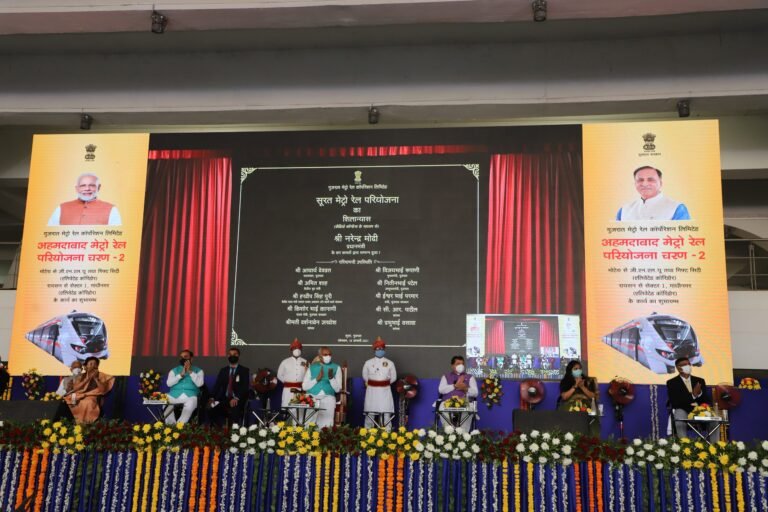
January 2021: Prime Minister Narendra Modi laid the foundation stone for the Surat Metro Rail Project.
Surat Metro: A Modern Solution for City’s Transportation
Overview
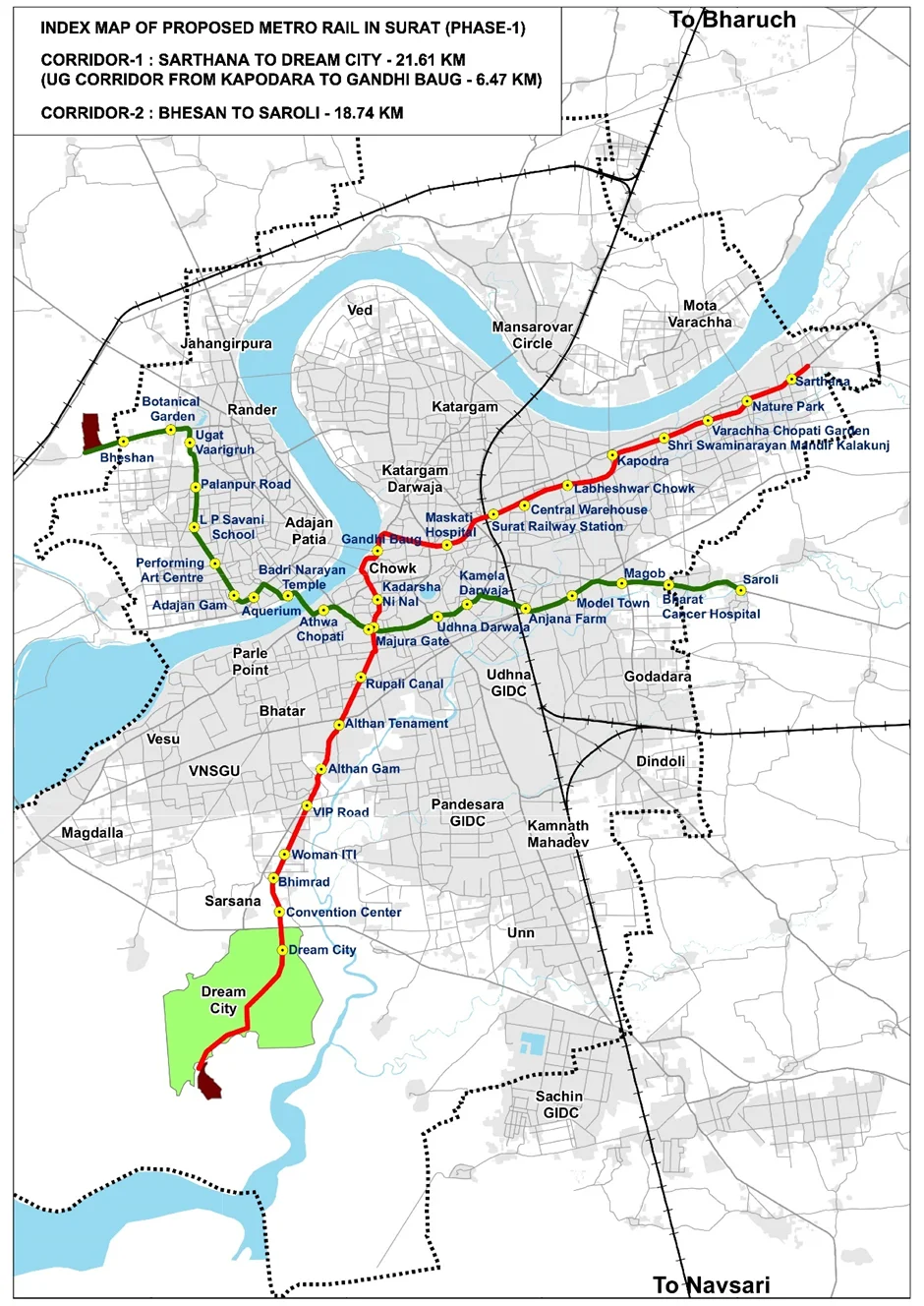
Surat Metro is an under-construction mass rapid transit system (MRTS) spanning approximately 40.35 km. The Phase 1 of Surat Metro comprises 2 corridors and 37 stations in total.
S.No.
Corridors
Underground (km)
Elevated/At Grade (km)
Total (km)
1
Sarthana-Dream City
6.47
15.14
21.61
2
Bhesan-Saroli
–
18.74
18.74
Total
6.47
33.88
40.35
Phase 1 of the Surat Metro Rail Project is expected to become operational by December 2027.
Funding Mechanism of Phase 1
S.No.
Source
Amount (Rs. in crores)
% Contribution
1
Equity by GoI
1487.53
15.70%
2
Equity by GoG
1487.53
15.70%
3
SD for Central Taxes by GoG (50%)
407.71
4.30%
4
SD for Central Taxes by GoI (50%)
407.71
4.30%
5
Loan from bilateral/multilateral agencies
5434.25
57.35%
6
Upfront VCF and proceeds from Monetization
250
2.65%
7
Total cost excluding Land, R&R, and PPP component
9474.73
100.00%
8
Subordinate Debt for Land Including R&R cost by GoG
1234
9
SD for State Taxes by GoG
677.59
10
Sub Total
11386.32
11
PPP component
452
12
Sub Total
11838.32
13
IDC for Loan
182
14
Total completion cost
12020.32
The Surat Metro Rail Project will be financed mainly through equity from the Government of India and Gujarat on a 50:50 basis and loans from KfW and AFD.
Loan from KfW
On 17 December 2021, The Government of India and the Germany Development Bank – KFW (Kreditanstalt für Wiederaufbau) signed a Rs 3,464 crore (442.26 million euros) loan for the Surat Metro Rail project.
Loan from AFD
On 21 January 2021, India’s Finance Ministry and France’s Agence Française de Développement (AFD) signed an approximately Rs. 2205 crore (€ 250 million) loan for the Surat Metro Rail Project.
Key Specification
Speed and Track
Top Speed: 80 kmphAverage Speed: 34 kmphTrack Gauge: Standard Gauge – 1435 mm
Electrification
750 V DC Third Rail
Signaling
Communications-Based Train Control (CBTC)
Estimated Project Cost
Rs.12,020.32 crore
Estimated Ridership
2.20 lakh/day (2027)
Contractor’s List
Contracts
Contractors
Package DC02: Civil construction of Bhesan Depot & Workshop
Rail Vikas Nigam Ltd (RVNL)
Package CS1: Construction of 10 stations from Kadarsha Ni Nal to Dream City (11.6 km viaduct & 10 stations)
Sadbhav Engineering – SP Singla Construction JV subcontracted to Patel Infra
Package CS2 / UG-1: Construction from Kapodra Ramp to Surat Railway Station with 3 stations. (Kapodra, Labheshwar Chowk, and Central Warehouse)
Gulermak – Sam India Builtwell JV
Package CS3 / UG-2: Construction from Surat Railway Station to Chowk Bazar Ramp (Chowk Bazar, and Maskati Hospital and Surat Railway station
J Kumar Infraprojects
Package CS4: Construction from Kapodra North Ramp to Sarthana (4.15 km viaduct and 4 stations)
Ranjit Buildcon
Package CS5: Construction from Bhesan to Majura Gate Station including viaduct ramp to Bhesan Depot (10.559 km viaduct and 11 stations)
Ranjit Buildcon – Dilip Buildcon (RBL – DBL JV)
Package CS6: Construction from Majura Gate Station to Saroli (8.702 km viaduct & 7 stations)
Dilip Buildcon Ltd (DBL)
Rolling Stock: 72 Coaches
Titagarh Rail Systems
Track-work (Line-1): Ballastless and ballasted track for Line-1
RVNL – ISC JV
Track-work (Line-2): Ballastless and ballasted track for Line-2
Rahee Infratech
Route Information
Operational: 0 km Under Construction: 41.93 km Approved: 0 km
Surat Metro Phase 1
Line-1: Sarthana – Dream City
Length: 22.77 km
Type: Elevated (15.75 km) & Underground (7.02 km)
Depot: Dream City (system’s operations control center OCC to also be built here)
Number of Stations: 20
Station Names: Sarthana, Nature Park, Varaccha Chopati Garden, Shri Swaminarayan Mandir Kalakunj, Kapodra, Labheshwar Chowk, Central Warehouse, Surat Railway Station, Maskati Hospital, Chowk Bazar, Gandhi Baug, Kadarsha Ni Nal, Majura Gate (interchange), Rupali Canal, Althan Tenament, Althan Gam, VIP Road, Woman ITI, Bhimrad, Convention Center, Dream City.
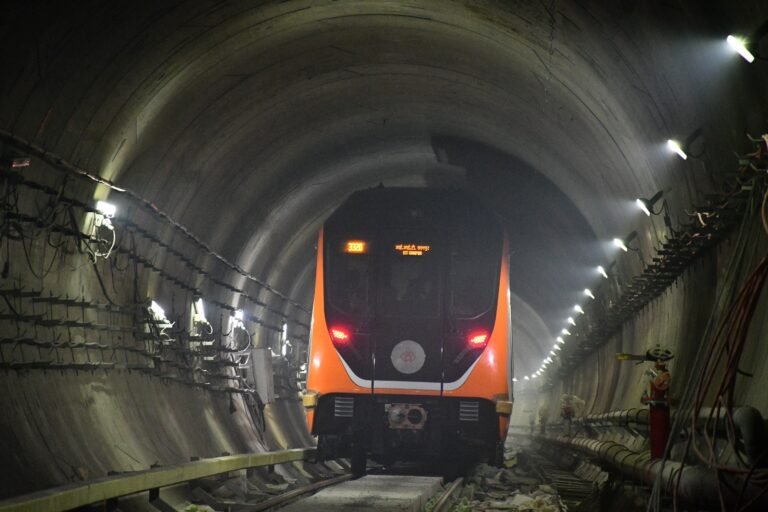
Update TBM Breakthrough In September 2024, TBM Tapi (S94) of Gulermak – Sam India Builtwell JV achieved a final breakthrough at Surat Railway Station of Line 1 under package CS2/ UG1. This was the sixth and final breakthrough for Package CS2/UG1. Furthermore, TBM Narmada working for the downline tunnel achieved its final breakthrough in August 2024.
Line-2: Bhesan – Saroli
Length: 19.26 km
Type: Elevated
Depot: Bhesan
Number of Stations: 18
Station Names: Bhesan, Botanical Garden, Ugat Vaarigruh, Palanpur Road, LP Savani School, Performing Art Centre, Adajan Gam, Aquarium, Badri Narayan Temple, Athwa Chopati, Majura Gate (interchange), Udhna Dawaja, Kamela Darwaja, Anjana Farm, Model Town, Magob, Bharat Cancer Hospital, Saroli
Recent Updates on the Surat Metro Project
Overall Progress as of 31.01.2025:
Work Item
Progress/Quantity
Overall Physical Progress
57.96%
Soil Filling
Completed
Piles Installed
118 Nos.
Pile Caps Constructed
22 Nos.
Piers Constructed
58 Nos.
Guide Wall Constructed
188 m
Diaphragm Wall Constructed
83 m
Slab for UG Stations
4188 sq.m
Tunnel Rings Installed
241 Nos.
Box Girder Segments Cast
118 Nos.
Tunnel Segments Cast
147 Nos.
Parapets Cast
860 Nos.
Impact of the Surat Metro Project
1. Enhanced Public Transportation & Ridership Growth: By the year 2046, it is projected that daily ridership will reach approximately 1.78 million passengers. The implementation of the metro system is expected to alleviate congestion on Surat’s heavily trafficked roadways, particularly in key business districts and residential areas.
2. Economic Boost & Urban Development: Surat is an economic hub of Gujarat, known for its textile and diamond industries. The metro will improve connectivity to business hubs. This will boost local commerce and encourage other businesses to set up along the corridor.
3. Multi-Modal integration: The Surat Metro project is designed to complement the Smart City initiative by incorporating principles of transit-oriented development (TOD). This Metro system will facilitate integration with the existing Bus Rapid Transit System (BRTS), municipal buses, and major railway stations. It will attract more commuters to opt for the metro.
Conclusion
The Surat Metro project is a crucial step that aims to improve urban mobility in the city and address the issues of congestion and growing transport demand. With an expected daily ridership of 1.78 million by 2046, the project is subjected to provide a structured public transit system, that will reduce dependency on private vehicles. The metro’s connectivity to key business districts, especially Surat’s textile and diamond industries, could enhance accessibility and economic activity along its corridors. Additionally, integration with BRTS, city buses, and railway stations is expected to improve multimodal transport efficiency. While the metro is a necessary infrastructure upgrade for Surat’s expanding population, its long-term impact will depend on effective execution, operational efficiency, and commuter adoption.