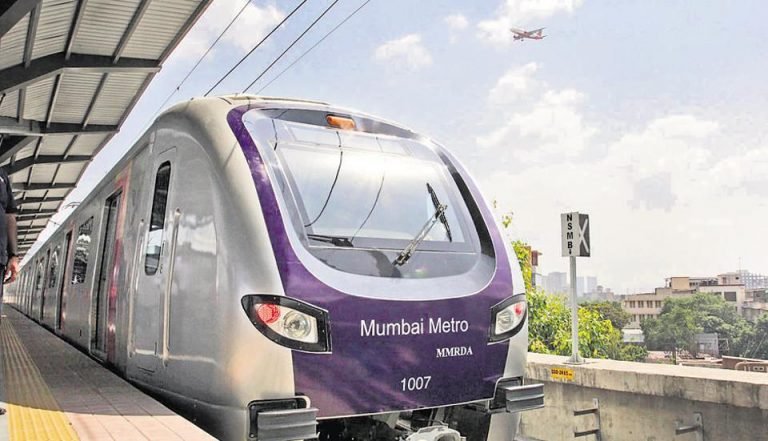
Mumbai Metro|Over 130 km of Metro lines to criss-cross Mumbai by 2020

All four lines are for now proposed to be elevated corridors costing about Rs 350 crore per km.
Mumbai: Chief Minister Devendra Fadnavis had recently announced that the state government would ensure a Metro network to connect the entire city with assistance from the Delhi Metro Rail Corporation (DMRC).The state government has drafted a new Metro rail master plan for Mumbai, which envisages six more lines and a total investment of about Rs 64,000 crore to achieve its target of rolling out a Metro network of over 130 km by 2020.Chief Minister Devendra Fadnavis had recently announced that the state government would ensure a Metro network to connect the entire city with assistance from the Delhi Metro Rail Corporation (DMRC).The Mumbai Metropolitan Region Development Authority (MMRDA), which is headed by the chief minister, has drafted a plan for four new lines, adding 60 km. Two other lines are already on the cards — the 33.
us overnight pharmacy buynoprescriptionrxxonline.net/us-overnight-pharmacy.html over the counter
5 km Colaba-Bandra-SEEPZ underground Metro and the 32 km Thane-Wadala-Kasarvadavali Metro. The 11.4-km Metro corridor from Versova to Ghatkopar has been operational since 2014.Mumbai metro future roadmapUPS Madan, Metropolitan Commissioner, MMRDA, said, “In the four new lines itself, we will add 60 km of Metro network in the city. With two other planned corridors and the first line that is operational we will be able to meet the target.” The previous Congress-NCP government had also drafted a Metro rail master plan for Mumbai over a decade ago envisaging a 146.5-km Metro network by 2021. However, while the plan was altered several times, the Versova-Andheri-Ghatkopar elevated Metro was the only line from the plan to be taken up and completed.The four new lines that BJP-led government has now planned are Andheri East to Dahisar East, Andheri West to Dahisar West, Jogeshwari Vikhroli Link Road (JVLR) to Kanjur Marg, and Bandra Kurla Complex to Mankhurd. All four lines are for now proposed to be elevated corridors costing about Rs 350 crore per km. Together, the four new Metro projects will cost of about Rs 21,000 crore. These will be constructed as cash contracts, but the government is yet to finalise sources for the funding. The Colaba-Bandra-SEEPZ underground line, for which the tendering process is already underway, will cost Rs 23,136 crore, while the Thane-Wadala-Kasarvadavali Metro, which is currently planned as a partially underground corridor, will cost about Rs 20,000 crore. The state government may, however, consider constructing the latter on an elevated stretch, substantially reducing its cost.Another Metro that was being planned for more than six years in different forms, the 40-km Dahisar-Bandra-Mankhurd line, has been dropped and will now be executed in three parts instead — Dahisar-Andheri, Andheri-Bandra, Bandra-Mankhurd. While the first and the third portions are parts of the new Metro master plan, the middle section from Andheri to Bandra is currently on hold. “We are still considering if the Andheri-Bandra Kurla Complex line should be taken up. All Metro corridors will intersect at certain points for commuters to easily change lines,” Madan said.The DMRC will give a presentation to the chief minister about the feasibility, estimated ridership, and construction methodology, for the four new lines on June 17, and will aid in preparing a detailed project report.

Delhi Metro| Delhi Metro starts buying Solar Energy at Rs.6 per Unit; Tariff to remain for 25 years

New Delhi: To establish its green credentials, the Delhi Metro Rail Corporation (DMRC) has started procuring solar energy at about ₹6 a unit, claiming that the tariff will remain at the same level for the next 25 years.

Commercial power

The move comes at a time when DMRC is saddled with high electricity costs at about ₹7/unit. The concept of the same tariff level for 25 years, though common for solar energy, has led to a situation where DMRC is paying lower tariff, albeit after including government subsidy.

Interestingly, DMRC has also started selling solar power from its residential colony at a commercial rate of ₹9/unit to the grid during day time, which is higher than ₹6/unit at which it is being procured.

During day, there is not much use for the power generated in the common areas of the residential units, Anoop Kumar Gupta, Director (Electrical), DMRC, told.

Agreements inked

“We have entered into about five-six power purchase agreements (PPAs), all of which have a pre-defined tariff for 25 years. We have entered into the PPAs to procure electricity ranging from ₹6.94 to ₹5.85,” said Gupta, indicating that the prices have been falling progressively. In the last one year, DMRC generated 6 lakh units of electricity from solar panels. Its annual consumption is 685 million units in 2014-15.

“We get the solar panels installed at a no-cost basis and only pay for the power procurement. The power producers are selected through open bidding,” he said. The players include Sukam, Purushottam, etc.

While solar power tariffs average between ₹ 5.
buy viagra capsules online no prescription
5/unit to ₹ 7/unit in the country, the Central Electricity Regulatory Commission has notified the generic “levellised” generation tariff for solar power at ₹7.04 a unit for 2015-16.

Earlier this month, ACME Solar commissioned five projects with a combined capacity of around 100 MW. The tariffs in the 25-year PPAs for these plants were around ₹5.77 a unit without any viability gap funding.

Similar projects

Last month, Azure Power commissioned a 100-MW plant in Jodhpur, Rajasthan from which power would be sold to the Solar Energy Corporation of India at ₹5.45 a unit, but this was with a viability gap funding.

Incidentally, the Indian Railways is also trying to procure solar power at ₹5.5/unit and is even experimenting with solar panels on train roofs to supply power for lights and fans.

Kochi Metro: KMRL ties up with Axis Bank to make significant revenues from ticket sales

Kochi: The Kochi Metro Rail Limited (KMRL) has broken new ground to gain substantially from the Automated Fare Collection(AFC) system by roping in a private partner to make necessary investments in hardware and software for sale of tickets besides getting assured annual royalty and a share in the business returns of the partner.Axis Bank will install the required complex hardware and software for fare collection from passengers and in addition will pay KMRL Rs. 208 cr over the next 10 years besides undertaking the entire maintenance of AFC for ten years. Axis Bank will issue co-branded cards to the users of Kochi Metro for paying the fares as well as using them for all kinds of merchandise including e-commerce. KMRL will also be paid 0.2% of Axis Bank’s gross revenues from the utlilisation of co-branded pre-paid cards outside Kochi Metro system.An Agreement in this regard was today signed between KMRL and Axis Bank in the presence of Minister of Urban Development Shri M.Venkaiah Naidu here today. CMD of KMRL Shri Elias George and MD and CEO of Axis Bank Ms.Shikha Sharma signed the Agreement.Speaking on the occasion, Shri Venkaiah Naidu said that the KMRL and Axis Bank tie up is a unique technological and business model innovation, the first of its kind in the world and beneficial to both. He said that this initiative also helps in creating a cash less system besides enabling financial inclusion. The Minister asked KMRL to consider linking the co-branded pre-paid smart cards to Pradhan Mantri Jan Dhan Yojana to deepen financial inclusion.The Minister also asked Secretary(Urban Development) to explore emulating Kochi Metro’s innovation by other Metros in the country.Kochi Metro is a joint venture of the Governments of India and Kerala being constructed at an approved cost of Rs.5,181 cr. KMRL has so far saved about Rs.800 cr through innovative procurement processes. Of the project length of 25.612 kms, 18 km is scheduled to be commissioned by June, 2016 and the rest by June, 2017.Axis Bank has formed a Consortium of service providers and will soon start work on installing AFC system.

Delhi Metro: Environmentalist Sunita Narain appreciates DMRC for environment conservation initiatives

New Delhi: Noted environmentalist and Director General of Centre for Science and Environment Sunita Narain on World Environment Day appreciated the Delhi Metro Rail Corporation (DMRC) for its initiatives towards the conservation of environment.“Delhi Metro was very much a part of the success story that Delhi became in terms of the conservation of environment in the nineties,” Dr Narain said during a function organised by DMRC to observe the world environment day.

Delhi Metro: BEML bags order worth Rs.645 Crore from DMRC

Bangalore: Bharat Earth Movers Limited (BEML) has received order worth Rs. 645 crores from Delhi Metro Rail Corporation (DMRC) for design, manufacture, supply testing and commissioning of  74  no’s broad guage Metro Cars for their RS-13 project (Rolling Stock) .In this regard, H S Anand, Director (Rolling stock) Delhi Metro Rail Corporation signed an Contract Agreement with BEML for supply of Metro Coaches in  the  presence  of S  S  Joshi,  Executive  Director  (RS), Amarendra Kumar, Chief Eletrical Engineer,  DMRC,  P Dwarkanath, Chairman & Managing Director, Aniruddh  Kumar, Director, (Rail & Metro), S Prasad, Executive Director, B L Manjunath , Chief General Manager, BEML today at Bangalore.BEML has forayed into manufacture and supply of Metro Cars during 2002 and is the reliable Make in India partner in Metro Rolling Stock, having supplied so far more than 600 Metro Cars to Delhi Metro. BEML has already supplied 150 Metro Cars to Bangalore Metro for their Phase-I. BEML is also the rolling stock supplier to the Jaipur Metro project and supplied 40 Cars, the revenue operations of which have commenced recently.With this, BEML emerged as the preferred Metro Coach manufacturer in the country to encash emerging opportunities in the Metro segment.

Kochi Metro: DMRC ready to fix imported rails for Kochi Metro Rail

Kochi: The Delhi Metro Rail Corporation (DMRC) will start placing the rails on Kochi Metro’s viaduct, starting July 15. The Metro agency is awaiting sanction from the Research Design and Standards Organization (RDSO) of the Indian Railways to carry out the work.“It’s mandatory to obtain sanction. The rails and design have to meet the specifications of RDSO. We have already approached railways. We expect to get it before July 15,” said DMRC project director Dani Thomas. Each 18m-long rail has to be lifted and placed on the viaduct. “These have to be welded together. But, we are not keen on doing such high precision work during heavy rains,” he added.The Kochi Metro requires about 7,000 metric tonnes of head-hardened rails. According to Kochi Metro Rail Ltd (KMRL) about 3,500 tonnes of rails for the project has already been imported. The remaining consignment will reach by the end of the yearImported head-hardened rails are more durable than those used by the Indian Railways. There are sharper curves on a Metro line compared with the regular railway system. The rails can withstand pressure exerted by Metro trains that will be running every five minutes. These rails are being imported from France.IRCON has secured the contract for laying rails from Aluva to Pettah. The rails are now being transported from the Cochin Port to Kochi Metro’s yards. “The transportation is being done at night to avoid traffic congestion,” said a DMRC spokesperson.However, DMRC would opt for regular rails used by the Indian Railways at Muttom yard as trains would be moving at a slow speed.The Muttom yard is expected be ready by November. The yard will have a 1km-long test track, facilities for unloading coaches and a stability shed. “We had a tough time while carrying out land-levelling works. All those issues have been sorted out and, currently, work at Muttom is progressing quickly,” said Dani Thomas.The third rail, which provides power to the train, has been imported from Germany. Kochi Metro uses the third rail traction system instead of overhead power lines. About 18,000m conductor rails have been imported.“Around 200 bundles of third rail has arrived in Kochi. Each bundle contains six pieces. This is required for the 18km Metro stretch from Aluva to Maharaja’s College.
buy wellbutrin online medstaff.englewoodhealth.org/wp-content/languages/new/wellbutrin.html no prescription
Our technical experts will inspect the consignment and take delivery,” said a DMRC official.

Delhi Metro: ITO-Mandi House section opened for public today

New Delhi: Delhi Metro Rail Corporation (DMRC) on Monday began operations on the ITO-Mandi House section. The service in the underground stretch – that is a part of the 9.37-km Central Secretariat-Kashmeri Gate line – was flagged off from the ITO station by union Urban Development Minister M. Venkaiah Naidu in the presence of Delhi Chief Minister Arvind Kejriwal.“I request everyone to use public transport and Metro services since it is an answer to the growing traffic congestion and pollution,” Naidu said.Kejriwal said his government would do everything to expand the Delhi Metro network.“I have always requested Delhi Metro’s managing director Mangu Singh to increase the number and frequency of the coaches,” the chief minister said.Delhi Transport Minister Gopal Rai was also present on the occasion. The section will be opened for the public from 6 pm on Monday.The service was flagged off after receiving clearance from the commissioner for Metro rail safety.

MEGA Metro: First 6 km metro route of Ahmadabad by 2017

The commissioning of the Ahmedabad Metrorail project is expected to take much longer than planned earlier. The first phase of the project that proposes to link the two highly populated corridors within Ahmedabad city with each other was earlier targeted to complete by 2018. However, only the first 6 kms of the 37.76-km-long Metrorail route will now be complete by end of 2017.“We will be able to commission only the first six kms by 2017. The underground section of the Metro and the alignment of the North-South and East-West Corridors (that links APMC and Jivraj Park areas in the South with Ranip in North and Thaltej Gam in the East to Vastral in the West) is expected to take longer time,” said a senior official associated with the project that saw the first Detailed Project Report (DPR) being filed in 2004, routes being redrawn at least three times and a Rs 113-crore scam recently denting the image of the project.Mumbai-based J Kumar Infraprojects Ltd has been selected to build the first 6 kms of the project between Vastral Gam and Apparel Park. This route is part of the 20.53-km-long East-West Corridor (Thaltej gam to Vastral Gam).
buy professional pack online https://www.adentalcare.com/wp-content/themes/medicare/editor-buttons/images/en/professional-pack.html no prescription
This route will connect Apparel Park with Amraiwadi, Rabari Colony, Vastral, Nirant Cross roads and Vastral Gam.Work on the piers for the metrolrail has already begun at Vastral Gam. “In a couple of weeks time, we will start the mass production of piers on this route,” the official said.The Metro-Link Express for Gandhinagar and Ahmedabad Company Ltd (MEGA) — a 50:50 special purpose vehicle of the Government of India and Gujarat government that is executing the project — has not changed the date fixed earlier for the scheduled completion of the 37.76-km-long route. “We are still looking to complete the project by end of 2018,” the official added. However, the 2018 target seems unlikely considering that the foundation stone for the project was laid in March 2015 by CM Anandiben Patel and the official announcement made then was to complete the first six kms route at the cost of Rs 611 crore by September 2016.

Jaipur Metro: Metro stations have become a new hang-out place

Jaipur: The Metro has become a new hang-out place for the citizens of Jiapur City. The scorching heat, with the maximum temperature in the city hovering at 44 degrees Celsius, couldn’t deter people from thronging the Metro stations on Sunday. According to JMRC officials, around 1 lakh passengers travelled in the Metro on Sunday.There were signs of surprise, happiness and excitement among the Metro riders from the moment they queued up in the serpentine lines till the time they exited the train.Chandpole and Mansarovar stations and Metro trains were all chock-a-block with passengers. People patiently waited in long queues as they were all excited to board the Metro for the first time.Nekchand, a policeman managing the queues of passengers at token counters, said, “I am into the Metro duty since Wednesday. I think the Sunday’s token and smart card sales are going to break earlier records. As all are excited to see the Metro stations and the train, they are very cooperative.”Navneet Sharma came from Udaipur with his family to attend a marriage ceremony on Saturday. He urged his relatives to visit a station and travel in the Metro.“Nearly 50 members of our family have come here. For most of us, the Metro train is a new thing. I am very happy and satisfied with this new service. Chandpole station which is the only underground station gives you a feel of some foreign country. Most important thing is that stations and the train are neat and clean.”Aparajita Singh, a software engineer, was seen taking a selfie with her father in the Metro. “I am sending this picture to my sister who lives in Mumbai. We are having a great time here. I must thank the authorities for converting the dream of Metro into a reality.”As the Metro train departed from Chandpole, people screamed in joy and were seen asking each other to take pictures. “My mobile phone camera does not have a selfie feature, so I asked an uncle to click my picture,” said Ridhima Kaushik, a student of a private college in Mansarovar.While the train was plying at the speed of almost 40 km/hour, people screamed again when they saw another Metro train passing their train on the parallel track.There were some passengers like Imran Ali, a labourer engaged in polishing work of semi-precious stones, who travelled between Mansarovar and Chandpole four times from 12 pm to 3 pm. “Itni garmi main fully air-conditioned train ka maja aa gaya (I enjoyed travelling in the fully air-conditioned train in this scorching heat),” he said.

Mumbai Metro: Reliance Metro One fails to comply provisions of the RTI Act 2005

Mumbai: Although Mumbai Metro One came under the Right to Information Act over two-and-a-half months ago, it is yet to voluntarily disclose information to the public.As per section 4 of the RTI Act, 2005, a public authority is supposed to disclose information voluntarily to the public, which several other bodies, to which the RTI is applicable, have done.The division bench of State Chief Information Commissioner Ratnakar Gaikwad and State Information Commissioner (Brihanmumbai bench) Ajit Kumar Jain, on March 19, had passed an order declaring RInfra-led Mumbai Metro a public authority. The bench was acting on a complaint filed by Former Chief Information Commissioner Shailesh Gandhi.Section 4 (2) of the Act reads, “It shall be a constant endeavour of every public authority to take steps in accordance with the requirements of clause (b) of sub-section (1) to provide as much information suo motu to the public at regular intervals through various means of communications, including internet, so that the public have minimum resort to the use of this Act to obtain information.”In the last one year, a campaign urging for transparency in the functioning of Mumbai Metro through sharing of information under the RTI Act as run extensively by various individuals and voluntary organisations.  Mumbai Metro is yet to come out whether it has set an internal deadline for putting up information on its website, but the query has not yet been addressed.

Kochi Metro-2015 l Recruitment of GM, AGM & Manager (Civil)

Kochi Metro Rail Limited inviting applications from eligible citizens for the following posts:-1. General Manager (Civil) – 01 post2. Addl. General Manager (Civil) – 01 post3. Manager (Civil) – 02 postsInterested person may apply in prescribed proforma by or before June 10, 2015.For more details please see Official Recruitment Notification

Kolkata Metro: Special safety & awareness campaign and health check drive orgnised

Kolkata: As a part of Passenger and Customer Facilitation Fortnight – “Railyatri/Upbhokta Pakhwada”– 26.05.2015 to 09.06.2015, in Indian Railways, a lot of passenger friendly measures have been taken in Metro Railway, Kolkata.On June 4, 2015, a Special Safety & Awareness Campaign was organized at Kavi Subhash Metro Station for the safety of the commuters and awareness leaflets were also distributed among the passengers to create awareness o­n safety. o­n this occasion, an awareness campaign was carried out by Metro employees about the usage of Safety Devices.A Special Health Check-up Camp for the Staff & Officers of Metro Railway was also organized o­n that day at Metro Rail Bhavan where about 250 employees participated.

Mumbai Metro: Reliance Metro celebrating its first anniversary

Mumbai: Three-day celebrations starting Saturday will mark Mumbai Metro’s first anniversary. There, however, will not be any fare discount for commuters.Mumbai Metro was inaugurated on June 8 last year, making it the first Metro rail of western India.As per the plans, Saturday onwards there will be exhibitions, performances and felicitation programme, among other activities.Between Saturday and Monday, there will be two exhibitions. Students of engineering and technical institutes will comprise the first exhibition at Western Express Highway station, highlighting use of technology in transportation systems. The second exhibition will be at Ghatkopar station, wherein exhibits will showcase Mumbai Metro One’s focus on customer initiatives.The third plan will have performances at the stations — concourse and platforms — as well as inside the trains, whenever possible. These will be conducted by the National Streets Performing Artists.On Saturday morning, heroes of Mumbai Metro, ie commuters who have already been recognised for their helpful acts, will be felicitated. These commuters have been helping the Mumbai Metro staff in various ways, such as by nabbing those littering, and catching hold of those clicking photos of women commuters on the sly.Differently-abled and senior citizens will be given a ride on Metro as part of the celebrations. On Monday, a cultural programme has been organised for the staff inside the Mumbai Metro depot premises at Four Bungalows.

Delhi Metro: ITO-Mandi House metro corridor to open for commuters on Monday

New Delhi:  The much awaited ITO station of Delhi Metro under the violate line will be thrown open to commuters on Monday, ending months of wait on the single line ITO-Mandi House section.According to a Senior Official of DMRC, “The ITO-Mandi House section will be opened for commercial operations for the public from 6 pm on Monday. The clearance from the Commissioner for Metro Rail Safety (CMRS) to open the section between ITO and Mandi House has been received”.Inspection of the newly constructed Metro section was done by the CMRS on June 2.Union Urban Development Minister M Venkaiah Naidu and Chief Minister of Delhi Arvind Kejriwal will be present on the occasion of flag off ceremony scheduled at 4 pm on Monday.Train services on the section is estimated to benefit 22,000 passengers daily to begin with and is expected to rise to 31,000 by 2021, enhancing DMRC’s annual revenue by Rs. 8 crore.The construction work on the single-line section was completed in January 2015. But operations on this 971-metre section were not started as safety inspection could not be carried out as per provisions of the Metro Railway General Rules.The Urban Development Ministry had amended and notified changes to the Metro Railway General Rules, 2013, to allow operations on single-line sections, which was a major stumbling block in operationalising the line.