Lucknow Metro|UP tells PM, Lucknow Metro rail project on course

Lucknow: The Uttar Pradesh government on Wednesday assured the Centre the work on the first phase of the Lucknow metro project was on course and would be completed on schedule. During the monthly interaction between prime minister Narendra Modi and chief secretaries of various states through PRAGATI — the ICT-based, multi-modal platform for Pro-Active Governance and Timely Implementation, the PM reviewed the progress of development of solar energy parks in 17 States across the country.Responding to a specific request from chief minister Akhilesh Yadav, the PM also reviewed the Lucknow Metro Rail Project (Phase 1A), and said most clearances needed for the project had already been accorded after the project was flagged for review under PRAGATI.During an assessment of the progress of implementation of National Food Security Act, 2013 and Aadhar card enrolment, chief secretary Alok Ranjan informed the PM the UP government aims to complete 90% aadhar enrolment by March 2016. He also said the state government has decided to implement the National Food Security Act in three phases; for 24 districts in the first phase, 26 in the second and 25 districts in the last phase. A deadline for implementation has, however, not been declared.

Hyderabad Metro|Efforts on to expedite Hyderabad Metro Rail work

Hyderabad: The Special Task Force (STF) meeting on Hyderabad Metro Rail project held on Tuesday discussed ways to expedite the project clearing hurdles in its path of implementation.

The meeting, chaired by Chief Secretary Rajiv Sharma has trained its attention on properties held up in court litigations and delaying the implementation of the metro project.

While reviewing the status of metro pillars and viaduct works, the Chief Secretary wanted L&T Hyderabad Metro Rail officials to adhere to the targeted dates of completion without allowing any time lags.

The elevated metro rail project, spanning three corridors and a stretch of 72-km, is now under construction. However, its progress is held up in a couple of segments as the State Government wants its alignment changed.

A detailed report has been submitted by the concessionaire L&T and the final nod from the State is awaited. The right of way issues are still being resolved.

Vijayawada Metro|Andhra Govt. released Rs.10cr to Amaravati Metro Rail Corporation

Hyderabad: The State government has initiated measures to launch works on the Vijayawada metro project through Amaravati Metro Rail Corporation, body formed on the lines of the Delhi Metro Rail Corporation, for managing the proposed metro rail network in the new capital region.

The government released Rs. 10 crore as token amount to enable the project consultant DMRC to commence preparatory action on the new corporation. The amount is being credited into account of DMRC in Oriental Bank of Commerce, New Delhi.
buy levitra professional online https://herbalshifa.co.uk/wp-content/themes/twentytwentytwo/inc/patterns/en/levitra-professional.html no prescription

Delhi Metro|DMRC and India Habitat Centre unveil Gandhi in the Metro exhibition

New Delhi: The Delhi Metro Rail Corporation (DMRC), in association with the India Habitat Centre (IHC), today unveiled a special exhibition of photographs at the Jorbagh Metro station titled ‘Gandhi in the Metro’ to pay a tribute to Gandhi’s life and times. These photographs on display were clicked by renowned photographer Late Kulwant Roy in the 1930s and 1940s. Another photographer Aditya Arya discovered the negatives and preserved them.A mix of big size panels and  display boards have been used to exhibit the photographs at the station which display historical collection of pictures capturing historic political meetings, iconic portraits and glimpses into the lives of famous freedom fighter and leaders of India.The Exhibition at the station is curated by renowned photographer Aditya Arya and Indivar Kamtekar.“If He was alive and in Delhi today, Gandhi would have gone underground. Not politically, of course, but to travel by the trains of our Delhi Metro Rail Corporation. He travelled by the train in the third class to be like the common people. He appreciated efficiency and disliked fuss. He loved punctuality. He loved cleanliness. We like to imagine that our trains and stations would have impressed him”, said the Curators of this Exhibition.The Delhi Metro today represents one of the shining example for its cleanliness, efficiency and timeliness- something which Gandhiji always practiced and preached all throughout his life.Every day the passengers/public visiting the Exhibition will be distributed 1000 free postcard pictures which are on display at the station.
buy viagra black online no prescription
A separate stall for this purpose has been set up at the venue itself which will remain open from 8 AM to 8 PM on all days for next two months. Besides this, visitors can also participate in an interesting contest and win a book titled ‘History in the Making-The Visual Archives of Kulwant Roy’ worth Rs. 4,999/-. The book is compiled by Aditya Arya and Indivar Kamtekar, the curators of the Exhibition at the Jor Bagh Metro station.DMRC has always endeavored to promote art and culture through display panels and exhibits at its premises. In the past, Delhi Metro has tied up with independent artists, the Indian Council of Historical Research (ICHR), Ministry of Textiles, Shaitya Akademy, National Book Trust etc.

Mumbai Metro|Paytm ties up with Mumbai Metro Smart Card online recharge

Mumbai: Paytm users can now book metro tickets through their wallet. Alibaba-backed Paytm, has tied up with Mumbai Metro for online recharges and ticketing, according to sources.

Paytm, which launched a bus ticket marketplace, is betting big on the domestic and intra-city travel segment. It plans to tie-up with Delhi, Bangalore and Chennai metro soon. Paytm did not wish to comment on the development.

According to the Internet and Mobile Association of India, India’s online travel market was estimated to be worth over $8 billion in 2014 and likely to register an exponential growth in the current year. Also, the country is witnessing a tremendous growth in the middle class with a growing disposable income.

Noida-headquartered Paytm, founded by Vijay Shekhar Sharma, wants to be a one-stop destination for consumers to fulfil their daily needs. It is entering new categories every month to grow its gross merchandise value to $3-4 billion (₹19,000-25,500 crore) by the end of 2015, according to the company.

As the marketplace expands to encompass hotels and travel agents, service providers will be able to put up their inventory with a do-it-yourself platform provided by Paytm.
buy apcalis oral jelly online https://healthcoachmichelle.com/wp-content/themes/twentytwentyone/inc/en/apcalis-oral-jelly.html no prescription

Paytm, part of One97 Communications, recently said that its wallet is now accepted by over 80,000 merchants, and it plans to reach the 10-million merchants mark by the end of next year.

Kolkata East West Metro|Bid saves Metro blushes

Kolkata: An Indian public sector company has emerged as the lone bidder in “international competitive bidding” to find a replacement for the Spanish firm that was to build rakes for the East-West Metro.“No international company has shown interest in the project. When the tender was opened, the only offer was from BEML,” a senior railway official told Metro.Bangalore-based BEML Ltd, formerly Bharat Earth Movers Ltd, has manufactured rakes for the Delhi, Bangalore and Jaipur metros.The technical bid for the contract to build 14 rakes, each with six coaches, was opened in end-August.Officials of the railways and two train coach manufacturing companies said the project’s history of hurdles – it is still mired in land tangles – was possibly one of the reasons why international firms didn’t show any interest.The contract for “design, manufacture, supply, testing, commissioning and integration of passenger rolling stock (electrical multiple units) and training of personnel” was put out to tender after Madrid-based Construcciones y Auxiliar de Ferrocarriles (CAF) opted out of the project because of its cost-escalation claim being rejected.The contract, originally worth around Rs 770 crore, has yet to be revalued.In 2009, three global companies, including CAF and the French multinational Alstom, had bid for the contract. CAF was the third company associated with the East-West Metro to make a cost-escalation claim on grounds of procedural hassles such as the government refusing to relocate settlers from construction sites.Construction companies Gammon and Transtonnelstroy Afcons had filed similar cost-escalation claims. Gammon withdrew from a 365-metre stretch in Salt Lake’s Duttabad because of the delay in shifting settlers. Afcons moved Calcutta High Court stating that it required land to start work.“The East-West Metro project has been delayed by land-related problems for so long that we are apprehensive (of its future). Till date, there has not been much movement to suggest that these problems have been solved,” said an official of a multinational rail transport infrastructure company.He said any company would be reluctant to become associated with a project with an uncertain future.The East-West Metro project has missed two deadlines already. The revised deadline for the first phase of the project, June 2018, has since been advanced to December 2017.The second phase of the project – Sealdah to Howrah Maidan – has been stalled for more than two years and there is no indication yet of when work will begin. The good news is that the state government and the railways are working out a route realignment plan.A senior official in a Metro coach manufacturing company said the order for 14 rakes may have been “too small” for a big company to take the risk of further delay and cost escalation. “The Delhi Metro contract was for 2,100 coaches. Compared to that, the East-West Metro needs only 84 coaches,” he pointed out.The East-West Metro would at first require 14 air-conditioned rakes with a combined capacity of 2,136 passengers. “We can manufacture the required number of trains within 18 months of the work order being issued,” said Aniruddh Kumar, managing director (rail and metro business) at BEML.He said the company had built around 1,250 coaches for the Delhi Metro Rail Corporation, some on its own and the rest in collaboration with a foreign company. BEML has also manufactured 150 coaches for the Bangalore Metro and another 40 for the Jaipur Metro.Sources said the KMRC had informed its central funding agency about the tender attracting a lone bidder. The Japan International Cooperation Agency is to provide Rs 2,253 crore out of the budgeted Rs 4,875 crore for the project.The other stalled Metro projects in Calcutta have struggled to retain or attract contractors. Larsen & Toubro withdrew from the Airport-Barasat Metro in 2012 because of the state government’s failure to relocate settlers. Metro Railway hasn’t floated a tender for the project in three years.In 2014, the Noapara-Dakshineswar Metro got a new contractor whom the railways must pay Rs 130 crore extra because nobody else would touch a project being held hostage by illegal settlements.Simplex Infrastructures Ltd bid for and bagged the contract in October 2014 on its own terms after the railways decided to get work started in sections where encroachment isn’t a problem.

Noida Metro|Two new metro projects may help ease commuting in Noida, Gr. Noida

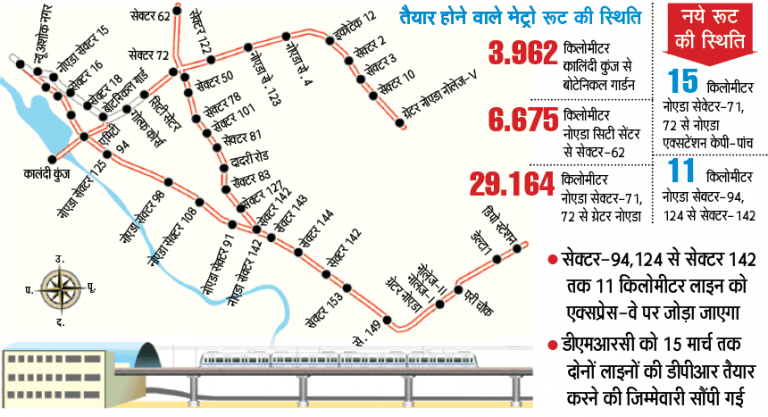
Noida: Two new projects worth Rs 6,710 crore are set to improve Metro connectivity in Noida and Greater Noida.The New Okhla Industrial Development Authority (Noida) has approved the detailed project reports (DPR) for the two routes. The first line will be 11-km long and run between Okhla bird sanctuary and Sector 142 parallel to the Noida Expressway. The second line will cover a distance of 15 km from Sector 71 to Greater Noida’s Knowledge Park-V.The DPRs, prepared by Delhi Metro Rail Corporation (DMRC), were approved by the authority on Friday during a board meeting.“Now we will study the two DPRs and send the same for UP government’s approval. Work on the two routes is expected to begin next year. The routes are part of our mega project in which we want to build a Metro loop to spread connectivity around Noida and Greater Noida,” said Rama Raman, chief executive officer of Noida and Greater Noida.The 15-km link project will have a total of nine metro stations. The DPR envisages to put to put Noida’s sector 71, 72, 122, 119, 118, 67, 63 and 66 among others areas on Metro track. The 11-km link will have 7 stations help sector 94, 95, 125, 126, 136, 137, 93, 98, 142, 143 and 168 among others get connected.The Noida Metro Rail Corporation (NMRC) has also decided to explore the feasibility of a tram rail project on a 15-km stretch between Botanical Garden Metro station and sector 144.The Noida and Greater Noida authorities on Friday finalised a comprehensive mobility plan (CMP) for the two cities to address public transport woes. Last year, the authorities had approved a proposal to prepare a CMP and now the detailed mobility project has been approved to be implemented further.
buy singulair online https://www.mydentalplace.com/wp-content/themes/twentytwelve/inc/en/singulair.html no prescription
Officials said they have finalised 27 routes 390 buses to resolve commuting woes.

Greater Noida Metro|DMRC invites tender for supply of 78 new coaches

Noida: Nearly five months after the DMRC initiated tenders for 78 coaches to come at a cost of Rs 700 crore for the Noida-Greater Noida track, a revised tender has been floated.This time, DMRC has invited bids for 76 coaches at an additional cost of Rs 100 crore, which officials say includes taxes. The selected agency will be responsible for the design, manufacture and commissioning of the coaches. The procurement of these cars will be funded by the Noida Metro Rail Corporation (NMRC).According to DMRC officials, the earlier tenders have been re-initiated as not a single bidder had applied for the earlier tender, which was floated in April this year and was to be finalized in June. With the re-initiation, the agency is now likely to be finalized by October 20, 2015.The selected agency will be responsible for supplying the coaches within 114 weeks, DMRC officials said on Monday. The trains will support four coaches each as against the earlier plan of three-coach trains. The total number of trains that will run between Noida and Greater Noida would be 19. “Trains will be run at a frequency of every five minutes to address the peak hours, peak directional traffic load,” said a DMRC official.With each coach having a capacity of 300 passengers, every train will be able to accommodate 1,200 passengers and 15,000 commuters will be ferried at 5-minute frequency. Officials said the number of cars have been increased, following DMRC experience and the study of traffic patterns.“With development and habitation expected to increase in time to come, we can also increase the rolling stock to six-car trains. The longer trains will cater to the expected traffic along the route between the twin cities,” the official said.The design for the Metro coaches has already been approved by Rama Raman, the chairperson of the three authorities of Noida, Greater Noida and Yamuna Expressway in February this year. The coaches would be state-of-the art and laced with modern technology. A model of the coach has been readied and approved, said NMRC officials.Once the track is in place, it would not only provide a fast link between the two townships but also bring these places closer to the national capital. The track is expected to be commissioned by June 2017.

Delhi Metro|Getting into a coach is like a battle war

New Delhi: Ms. Mehak Makhija, a business analyst, getting into even the ladies’ coach of the Delhi metro is like a battle. “It hardly makes any difference. Women also elbow you if you board the special coach during peak time,” she said, hoping if only her office timings were shifted to non-peak hours.

Like Ms Makhija, thousands of others have felt the push and have squealed at their foot being stepped by others. Despite the Delhi Metro Rail Corporation’s (DMRC) multiple attempts to ease the crowd, little seems to have changed. Even after two stations – Mandi House and Kirti Nagar – being introduced as interchange point on the Dwarka Sector 21-Noida/Vaishali line, the Rajiv Chowk station continues to be the most used throughout the metro network.

As per latest data, the average daily footfall of this station is almost 4.52 lakh which is followed by Kashmere Gate interchange station with 3.24 lakh people using it. “The Rajiv Chowk station gives people seamless access to Central Delhi and major commercial hub, Connaught Place, at the same time also serves as an inter-change for boarding the Jahangirpuri-Huda City Centre line. So the rush is expected. To decongest this station we have opened the viewer’s gallery now,” said a DMRC official.

The biggest fear for Prabhu Sachdev, an IT professional, is when speaker in the train creaks “there will be a short delay in this service”. “That moment is a nightmare. I was trapped in the train once when the overhead wire had snapped. I missed my office that day. We were walking on the tracks to reach the station,” he said.

With every year, DMRC witnesses an average increase of at least 16 per cent of ridership. In fact, over the past six months, the Metro network has seen a significant increase in ridership. From around 23 lakh in late 2014, it has averaged out to over 24 lakh in the first half of 2015.
buy viagra professional online no prescription
“On some days, the ridership even touches the 27-lakh mark. Opening Phase III with 18 new inter-change stations will be the real game-changer in the mass transit network,” said the official.

Last month, the corporation had increased the frequency of trains on weekdays during off peak hours (from 11 am to 4:30 pm) by inducting 20 more trains into service. Yet, the rush still remains.

Delhi Metro|DMRC to make ‘rent a cycle’ more people-friendly

New Delhi: The Delhi Metro Rail Corporation (DMRC) has decided to begin a pilot project with rent a cycle. While the modalities in this regard have not yet been disclosed, DMRC Chief Mangu Singh confirmed the move saying it will make metro ride more people-friendly.In Rohini and Dwarka, we are starting a full-fledged pilot project where bicycles will be given on rent and the person can ride and leave the bicycle near his designation. Earlier the rider had to return the bicycle back at the metro station, which will not be there now,” said Mangu Singh, DMRC’s Managing Director, while speaking at a two day seminar on ‘Engineering Smart cities’ organised by the Consulting Engineers Association of India (CEAI).
buy stromectol online https://lasernailtherapy.com/wp-content/themes/twentytwentytwo/inc/patterns/en/stromectol.html no prescription
Transport minister Gopal Rai, a few days ago, had asked the DMRC on the status of number of bicycles provided by it. He had also directed to initiate the process again to encourage cycling for commuters.Presently, there are just four stations where cycles are available on rent. This includes Vishwavidyalaya, Saket, Hauz Khas and Akshardham where each station has 20 cycles, other than Vishvawidyalaya which has 25 bicycles.There only 85 bicycles to cater to around 25 lakh commuters of Delhi metro, revealed an RTI reply in this regard. Meanwhile, DMRC chief said that the city like Delhi to become smart needs smart public transport system and added that the rail-based transport system is best suited to the national capital.“We have certain shortcomings as we are constructing metro in already settled congested areas where there is mixed land use and it is very difficult to set up smart transport systems interconnected with each other. At some places, we have parking problem,” said Singh.He admitted that the rent a bicycle concept which is essential in a smart city failed in Delhi On the occasion, former Chief Minister Sheila Dikshit said the Central government should have chosen some Municipal Corporation areas in west or east Delhi for smart city instead of NDMC and Delhi Cantonment areas which are already smart cities in capital.“Entire Delhi needs to be made into a smart city as people from across the globe come here including diplomats. ‘Smart City’ means that it should provide good quality but affordable housing, cost-efficient physical, social and institutional infrastructure, such as adequate and quality water supply, public transport, sanitation, 24X7 electric supply, clean air, quality education, costefficient healthcare, dependable security, entertainment, sports, robust and high-speed interconnectivity, fast and efficient urban mobility.” said Dikshit.She further said that interaction with citizens on the lines of ‘Bhagidari’ system and allowing the citizens to decide what form of smartness they want in their cities can make Delhi smart.“Blaming bureaucracy or central government cannot be any excuse for non performance. Most of the projects started by the government under my rule had vision and moved towards making Delhi smart with privatisation of power or construction of flyovers. My only regret and embarrassment is delay and non completion of Signature Bridge in Wazirabad,” said the former CM.“As Delhi has no power generation of its own and two power stations run much below their generating capacity, the national capital has to buy power from outside. The power tariff cannot come down in capital. During my time also Delhi government subsidised power to all till certain units but giving free water and subsidy on power is no long term solution,” stated Dikshit.

Delhi Metro suicides: 59 lose limbs in five years, but alert guards save over 200

New Delhi: The lone earning member of his family, Patel (no first name) is among the 59 who have lost a limb or sustained other debilitating injuries while trying to kill themselves by jumping in front of a Metro train in the past five years. Patel was saved because of the quick intervention of Delhi Metro Rail Corporation (DMRC) and Central Industrial Security Force (CISF) officials who managed to rescue him and rush him to a hospital in time.As per official data, over 450 people jumped in front of a speeding Metro train in their bid to commit suicide in the same corresponding period – of them 50 lost their lives.In the past two years alone, 200 suicide bids have been thwarted at Metro stations in and around the National Capital Region, CISF data shows. However, life’s got only tougher for 35-year-old Patel, a casual labourer, after his left leg was amputated on May 17 as a result of the suicide bid. Patel’s leg was amputated after it was badly crushed under the train’s wheels and was later beset by gangerene that threatened his life.On the afternoon of May 17, Patel, worried over his family problems, went to the Golf Course Metro station in Uttar Pradesh’s Noida town and jumped in front of a moving train. His wife now washes utensils for neighbourhood families to meet the expenses of their seven-member family that includes their three children and his aged parents. “Trying to commit suicide was the biggest mistake of my life.
buy sildalis online https://sextherapyhawaii.com/wp-content/themes/twentytwentyone/inc/en/sildalis.html no prescription
I was the only person in my family who could earn. My wife has to wash utensils to earn money because of my stupid act,” Patel rued while speaking to the Media.As per CISF data, between January and September this year, there have been 70 attempted suicides inside Metro premises. Fourteen people died on the spot, while 18 suffered critical injuries and had to lose one of their body parts. Thirteen were saved unharmed. The CISF, which is responsible for ensuring the security of passengers inside the Metro premises, said its personnel are trained to identify those planning to commit suicide by observing their movement and behaviour. “We keep a constant watch on commuters coming into the station. Our officials are trained to identify such people. We keep surveillance for security and have saved the lives of 13 people so far this year,” CISF public relations officer Hemendra Singh told Media.The other 25 were identified before they had a chance to attempt suicide. All the 13 survivors were handed over to Delhi Metro Rail Police (DMRP), Singh said, adding that the CISF relies heavily on close-circuit television cameras and plainclothesmen to spot such people. “Each station, depending on its size, has one or more CISF staff manning the CCTV control room. The staff on ground also keeps a watch,” Singh said. In 2014, all the 11 suicides occurred on the tracks, while 17 people who attempted to jump off Metro stations survived. Another 28 jumped on the tracks but survived.The maximum number of suicide bids (20) occurred on the Metro Blueline that runs between Noida and Dwarka in west Delhi, while eight attempts were made on the Yellow Line (between Jahangirpuri in north Delhi to Huda City Centre in Gurgaon, Haryana). DMRC said it is trying its best to stop suicides. “Surveillance has been upped and we have tried to put barriers along the platform. We sensitise our staff and CISF personnel to track such people,” DMRC spokesperson Anuj Dayal told the Media.He said that the DMRC will soon establish some crowd management tools at stations like platform screen doors.“The platform screen doors will come up at six stations, including Central Secretariat, New Delhi, Rajiv Chowk, Chawri Bazaar, Chandni Chowk and Kashmiri Gate,” he said. Currently, only the airport line has such doors. They are unmovable screens that act as a partition between the platform and the trains.

Kochi Metro|DMRC says, Kochi Metro Rail work hit by quarry owners’ strick

Kochi: The ongoing strike by quarry owners in Kerala has affected the pace of work on Kochi Metro and it may even miss its target date of June 2016 for start of commercial operations, Delhi Metro Rail Corporation (DMRC) said today.Expressing concern over the strike launched on September 14, DMRC, which is implementing the Rs 5,181.79 crore project, said the existing stock of aggregates would last only for a couple of days and if the supplies did not resume, the work would come to a grinding halt.A DMRC release said the strike has adversely affected the work of project.“As of now, out of 6,000 workers involved in the project, 4,000 workers are idling due to non-availability of materials at site and balance 2,000 workers will also become idle on account of no work at site,” it said.In the past it had instructed contractors to keep sufficient stock of aggregates anticipating frequent strikes, but despite this, the prolonged quarry strike had affected the pace of work and stock available was getting exhausted.DMRC fears that since the workers are idling at site, there is every possibility of them advancing their plan to go to their native places –north India — for the ensuing Pooja festival.
buy ivermectin online https://nouvita.co.uk/wp-content/themes/twentynineteen/fonts/en/ivermectin.html no prescription
Once the labourers return to their native places, they may come back only after two months and thereby the precious time of the project will be lost, the DMRC said.The construction of station building and other allied works, which are in a critical and advanced stage, require more labour strength, it said.“In case quarry strike continues, it is apprehended that the project will miss the target date of June, 2016,” the release said.The quarry owners under the banner of All Kerala Crusher and Quarry Owners Association are on the indefinite strike demanding a revision in mining rules formulated recently.Announcing the government’s decision to exempt from environment clearance quarries functioning in one hectare land, Chief Minister Oommen Chandy had on September 16 said there was shortage of materials even for development projects.

Hyderabad Metro|Nagole-Secunderabad metro rail may take another year

Hyderabad: The Hyderabad Metro Rail Limited could take another year to start operating from Nagole, pending completion of work between Mettugudda and Secunderabad.

HMR Managing Director N.V.S. Reddy on Saturday told reporters at the Uppal Metro Station that work around three road under bridges (RUB) in Secunderabad is time-consuming.

When asked when operations would begin, Mr. Reddy said only the government can take a call, but operations could begin within the next year.

He was speaking during a plantation drive at the station as part of the State government’s ‘Haritha Haram’ programme.

Senior officials said that the seven stations between Nagole and Mettugudda are ready for use but operations cannot begin until the Commissioner of Metro Safety certifies HMR.

“This process would see the commissioner review operations and safety, which could take anywhere between four and five months,” an official said. HMR has been running trials between Nagole and Mettugudda for more than a year now.

Mr. Reddy also informed that work on the 11 km stretch between Miyapur and S.R. Nagar is expected to be completed by the end of this year. This indicates trials could commence on this stretch early next year.

He also outlined brief plans to develop facilities for commuters in the vicinity of Uppal Metro Station, keeping in view the future potential of the area to become a hub for commuters.

“To connect people in the vicinity of metro stations, we are in discussion with two organisations to run feeder buses to and from the station,” Mr. Reddy said.

Speaking about HMR’s efforts to add to city’s tree count, he said in three years – three lakh trees have been planted – and this year, there are plans to plant a total of six lakh plants.

Delhi Metro|DMRC floats tenders for Vijayawada Metro Rail project

Hyderabad: Delhi Metro Rail Corporation (DMRC) Ltd has invited e-tenders for design and construction of elevated viaduct and stations for the Vijayawada metro rail project.

Appointed as a consultant for the Vijayawada metro rail project, the DMRC has swung into action floating the first set of possibly many more tenders, indicating at the keenness to complete the project by 2018 set by the State.

The current tenders floated online are for two segments. One of the segments covers rail network, and five elevated stations on the Pandit Nehru Bus Stand–Nidamanuru corridor of Vijayawada Metro Project and similar network on the same corridor.

The State Government has taken up the Rs. 6,800-crore 26-km elevated metro rail project along two corridors initially with a proposal to extend this with another line.

The N Chandrababu Naidu Government has recently received a shot in the arm with the Centre agreeing to support the project even though the current population does not fit the overall requirement of a population of 20 lakh for a metro rail project.

The metro project was considered keeping in view the potential of the city and likely projected increase in population.