Bentley Systems Announces Winners of Year in Infrastructure 2019 Awards

EXTON, Pa. (Metro Rail News) – Bentley Systems, Incorporated, the leading global provider of comprehensive software and digital twin cloud services for advancing the design, construction, and operations of infrastructure, has announced the winners of the Year in Infrastructure 2019 Awards. The annual awards program honors the extraordinary work of Bentley users advancing design, construction, and operations of infrastructure throughout the world.

Twelve independent jury panels of industry experts selected 54 finalists from 571 nominations submitted by more than 440 user organizations in more than 60 countries.

Bentley Systems acknowledged 18 Year in Infrastructure Awards winners and nine Special Recognition Awards winners at a ceremony and gala on October 24 at the conclusion of the Year in Infrastructure 2019 Conference in Singapore.

Year in Infrastructure 2019 Special Recognition Awards winners:

Advancing Urban Planning through Digital Twins
Civil Engineering and Development Department, Hong Kong SAR Government and AECOM
The Town Plaza Urban Design Study for the Establishment of the Kwu Tung North, New Development Area
Hong Kong, Special Administrative Region

Advancing Industrial Sustainability through Digital Twins
MCC Capital Engineering & Research Incorporation Ltd.
Henan Jiyuan Iron & Steel, 80MW High-Temperature Ultrahigh-Pressure Gas Power Generation Energy-Saving Renovation Project
Jiyuan, Henan Province, China

Digital Cities Award for Comprehensive Roadway Digital Twins
Shenzhen Highway Engineering Consultant Co., Ltd.
Yangang East Interchange Project
Shenzhen, Guangdong Province, China

Digital Cities Award for Comprehensive Water Digital Twins
Águas do Porto, EM
H2PORTO Technological Platform for the Integrated Management of Porto’s Urban Water Cycle
Porto, Porto, Portugal

Advancing Infrastructure Resilience through Digital Twins
Italferr S.p.A.
The New Polcevera Viaduct
Genova, Liguria, Italy

Advancing Construction Industrialization through Digital Twins
Heilongjiang Construction High-Tech Capital Group Co., Ltd.
Smart and Digital Application in Heilongjiang Construction Industry Modernization Demonstration Park
Harbin City, Heilongjiang Province, China

Advancing Economic Infrastructure through Digital Twins
CCCC Water Transportation Consultants Co. Ltd. (WTC)
SAPT Automatic Container Yard and Housing Project in Pakistan
Karachi, Sindh, Pakistan

Advancing Digital Workflows through Digital Twins
Mott MacDonald / Systra Designers working with Balfour Beatty / Vinci Joint Venture
High Speed Two Sectors N1 and N2 Main Works Civil Contract
Birmingham, Country North Sectors, United Kingdom

Bentley Institute Knowledge Advancement Advocate Award
Alison Watson
, chief executive and founder, Class of Your Own

The winners of Year in Infrastructure 2019 Awards for going digital advancements in infrastructure are:

4D Construction
Mortenson, Clark – a Joint Venture
Chase Center and Warriors Mixed-use Office and Retail Development
San Francisco, California, United States

Bridges
PT. Wijaya Karya (Persero) Tbk.
Design and Build Harbour Road 2 Project
North Jakarta, Jakarta, Indonesia

Buildings and Campuses
Voyants Solutions
Detailed Design, Tendering and Project Management Services for Establishment of 12 IT/Hi-Tech Parks in Bangladesh
Bangladesh

Communications and Utilities
POWERCHINA Hubei Electric Engineering Co., Ltd.
Technology Application in Miluo Western 220kV Substation Project
Miluo City, Hunan Province, China

Digital Cities
Shanghai Investigation, Design & Research Institute Co., Changjiang Ecological Environmental Protection Group Co.
Application of Digitalization in Jiujiang Smart Water Management Platform
Jiujiang, Jiangxi, China

Geotechnical Engineering
ARUP Singapore Pte Ltd.
Tanjong Pagar Mixed Development
Singapore

Manufacturing
Hatch
Sulfuric Acid Plant Project in the DRC
Katanga, Democratic Republic of the Congo

Mining and Offshore Engineering
Shanghai Investigation, Design & Research Institute Co., Ltd.
China Three Gorges New Energy Dalian Zhuanghe III (300MW) Offshore Wind Farm Project
Dalian, Liaoning, China

Power Generation
Hunan Hydro & Power Design Institute
Hanjiang Yakou Shipping Hub Engineering Project
Yicheng, Hubei, China

Project Delivery
South Carolina Department of Transportation (SCDOT)
Seamless Information Sharing and Integration Across Multiple Platforms Using ProjectWise
Columbia, South Carolina, United States

Rail and Transit
Italferr S.p.A
AV/AC in Southern Italy, Napoli-Bari Route
Napoli-Bari, Campania-Puglia, Italy

Reality Modeling
MMC Gamuda KVMRT (T) Sdn Bhd
Drone Surveying for BIM and GIS Data Capture – Malaysian Metro Megaproject
Kuala Lumpur, Malaysia

Road and Rail Asset Performance
Lebuhraya Borneo Utara Sdn Bhd
Pan Borneo Highway
Sarawak, Malaysia

Roads and Highways
Foth Infrastructure & Environment, LLC
Foth Transforms, Connects, and Revitalizes Cedar Falls, Iowa Corridor
Cedar Falls, Iowa, United States of America

Structural Engineering
WSP
WSP Delivers Optimized Design for Complex Basement under Iconic Admiralty Arch
London, United Kingdom

Utilities and Industrial Asset Performance
EPCOR Utilities
Implementing Risk Based Asset Management for Power Distribution
Edmonton, Alberta, Canada

Water and Wastewater Treatment Plants
Jacobs Engineering Group and Singapore’s National Water Agency, PUB
Tuas Water Reclamation Plant
Singapore

Water, Wastewater, and Stormwater Networks
Balfour Beatty, Morgan Sindall, BAM Nuttall Joint Venture
Thames Tideway Tunnel
London, United Kingdom

Kochi Metro employee quarters inaugurated

KOCHI (Metro Rail News):  On Monday, Chief Secretary Tom Jose inaugurated the new staff quarters for Kochi Metro Rail Ltd (KMRL) employees at Muttom. He handed over the keys of the quarters, named Metro Vihar, to the employees at a function at Muttom depot. “The beautiful staff quarters show that KMRL cares about its employees who run the Metro,” said Jose.

“Kochi Metro is slowly expanding.
buy kamagra gold online https://pridedentaloffice.com/wp-content/themes/twentytwentyone/inc/en/kamagra-gold.html no prescription
We are awaiting the Centre’s nod for the second phase of Kochi Metro. All four corridors will be made available for the people of Kochi very soon. Within a few years, Metro will be the backbone of Kochi,” he said.

KMRL managing director Alkesh Kumar Sharma said the firm had decided to hand over the flats to 112 persons attached to KMRL’s operations and maintenance wing of KMRL.

“The wing’s employees need to be available round-the-clock. Hence, their residences near the office will improve efficiency and work culture,” said Sharma. Two 14-storey towers, named Ganga and Yamuna, housing a total of 112 residential units (four units per floor) have been built.

Individual residential units are 2BHK apartments spread across nearly 750 sqft. KMRL had engaged Fountainhead, a design consultant, to prepare the master plan and carry out the detailed design for the project. The two towers were built for Rs 49 crore.

Delhi Govt Nominees Should Be Appointed As Directors In DMRC

NEW DELHI (Metro Rail News): The Transport Minister of the Delhi government, Kailash Gahlot, on Monday, speaking at a press conference said, the Delhi Metro Rail Corporation (DMRC) should appoint the government nominees as directors to the DMRC board.

He also urged the DMRC to refrain from taking any of the major decisions without representation of the state dispensation. He also added that the DMRC board has taken many crucial decisions and passed them without any consultation with the Delhi government. 

“In DMRC, the Delhi government holds a 50% share and an equal share of the number of directors. Hence, DMRC should stop taking decisions without representation of the Delhi government. Seeking legal opinions on the government’s recommendations without deciding on the board meeting is also illegal. I am writing to the Managing Director of DMRC Mangu Singh to expedite the decision and appoint the government nominees to its board,” he added. 

Last week, the Delhi Metro Rail Corporation (DMRC) told the National Green Tribunal Thursday that construction of a commercial complex above Bhikaji Cama Place station was conceptualized in 2012. This came after a plea challenging the structure was filed in NGT.

DMRC told a bench headed by NGT Chairperson Justice Adarsh Kumar Goel that 13,332 square meter space was allotted by Land and Development Office on a permanent basis for the metro station ancillary structures and proposed property development against payment of Rs 15.65 crore. 

Bhikaji Cama Place Metro station is strategically designed on the intersection of the ring road and Africa Avenue Road so that significant motorized traffic can be taken off the road, it said. 

Mahim building tilts due to metro work in Mumbai

MUMBAI (Metro Rail News): On Monday, a building located on Mahim (West)’s LJ Road has tilted to one side and developed cracks. This had reportedly happened due to construction work at the Colaba-Seepz-Metro-3.

According to the source, Mumbai Metro Rail Corporation (MMRC) said on Monday that a structural audit would be carried out to understand the extent of the damage. Other residential societies in the area have expressed concerns regarding the safety of their buildings.

The incident took place on November 9, when metro work was going on. Around midnight, the residents of Laxmi Niwas, which also has four commercial establishments inside it, felt their beds shaking and doors and windows rattling.

Later, ceilings started developing cracks too. One of the building’s residents said as per a Mumbai Mirror report that they heard a crash at night. In the morning they saw that the building had developed cracks after which the residents were told to vacate the building by November 10.

The members of all the 25 odd families staying at Laxmi Niwas have been temporarily moved to a nearby hotel by the Mumbai Metro Rail Corporation Limited (MMRCL).

The residents of other nearby buildings such as Saman Taj and Meher Manzil were also affected by the tremors due to the ongoing Metro work. Other residents of Laxmi Niwas have expressed displeasure with the incident.

An MMRCL spokesperson told the Mumbai Mirror, “Work on the Sitaladevi underground station is on. There was leakage and our team is on the job now, trying to plug it.”

NCRTC floats first UG tender for Delhi- Meerut RRTS Corridor

DELHI (Metro Rail News): The National Capital Region Transport Corporation (NCRTC) invites online bids from eligible Bidders for design and construction of New Ashok Nagar DN Ramp to Sahibabad UP Ramp and One Under Ground Station at Anand Vihar Including Architectural Finishing and Design, supply, installation, testing and commissioning of Electrical and Mechanical Systems including Fire detection & suppression Systems and Hydraulic systems on Delhi-Ghaziabad-Meerut RRTS Corridor today.

Work Description

Package 4: Design and Construction of Tunnels by TBM from near New Ashok Nagar DN Ramp to Sahibabad UP Ramp and One Under Ground Station at Anand Vihar by Cut & Cover Method [Including Architectural Finishing and Design, supply, installation, testing and commissioning of Electrical and Mechanical Systems including Fire detection & suppression Systems and Hydraulic systems] on Delhi – Ghaziabad – Meerut RRTS Corridor of NCRTC.

Key Information

  • Tender Notice No.: DM/CN/COR-OF/86
  • Estimated Cost of Work: INR 1200 Million
  • Work Completion Period: 1095 days
  • Security Deposit/Earnest Money: INR 120 Million
  • Tender Document Cost: Nil

Important Dates

  • Deadline for Submission of Bids (e-Bids): 27 January 2020
  • Bids must be submitted online: 27.01.2020 up to 15:00 hrs (IST)
  • Bid Security in original shall be submitted physically by the Bidder: 27.01.2020 up to 15:00 hrs (IST)
  • Bids received shall be opened on 27.01.2020 at 17:00 hrs (IST).

Eligibility Criteria

  • Annual Turnover: The bidder must have minimum average annual construction turnover of INR 9667 million calculated as total certified payments received for contracts in progress or completed, within the last five (5) years;
  • Cash Flow: The bidder must demonstrate that its financial resources meet or exceed the total requirement for the subject contract of INR 1611 million;
  • Work Experience: Bidder (s) should have completed similar works for Tunnel construction by shield TBM with a finished internal diameter of at least 5.0 meters executed for Railways/High-Speed Railways/Metro/RRTS and / OR pertaining to underground stations using cut & cover method in urban environment executed for Railways/High-Speed Railways/Metro/RRTS that have been completed or substantially completed within the last ten years ending the last day of the month previous to the month of bid submission.

To obtain further information and inspect the bidding documents, Bidders should contact:

Group General Manager /Procurement
National Capital Region Transport Corporation Ltd.
7/6, Siri Fort Institutional Area,
August Kranti Marg, New Delhi – 110049
Tel : +91-11-41066943 Fax : +91-11-41066953
Email :- procurementcell@ncrtc.in

The pre-bid meeting shall be conducted on 05.12.19 at 11:00 hrs (IST) at the address below:

National Capital Region Transport Corporation Ltd. 
7/6, Siri Fort Institutional Area,
August Kranti Marg,
New Delhi – 110049
Tel : +91-11-41066943
Fax : +91-11-41066953

Kindly reach out to metro rail news team in case you need any help regarding the tender.

RPC Technologies Australia Sets up Indian Capability with Triovision To Address Growing Demand in Rail Projects

RPC Technologies, an Australian-based Advanced Composites (GRP) engineering and manufacturing company, has engaged with Indian-based company, TrioVision Composites Technologies, to manufacture GRP parts for the growing Rail manufacturing sector for the both the local and international market.

RPC Technologies and TrioVision Composite Technologies can provide procurement, manufacturing and delivery of Composite Components for train including parts such as Front Masks, Cab Lining, Window Panels, End Walls, Gangways, Electrical Cubicles, Door Pillars, Toilet Modules and Seats.

RPC selected TrioVison for its in-country partner due to their reputation and experience in composites, their location in the same State as Alstom India, and their proven track record in the Transport sector.

Rather than establish a new plant in India, we searched for a local solution and found a like-minded organisation in TrioVision Composites Technologies. We immediately felt that TrioVision has the commitment to excellence, and high-quality service and ethics, and these are the factors we insist on in our business relationships. Combined with RPC’s engineering and manufacturing experience in Advanced Composites in the Rail sector, we are confident that we will deliver an outstanding product to several rail customers in India

Said Tony Caristo, Managing Director of RPC Technologies.

L to R:  Nandan Reddy (Corporate Director, TrioVision), Tony Caristo (Managing Director, RPC), Sunil Yallapragada (Managing Director, TrioVision), Glenn Clifford (Business Development Manager, RPC)
L to R: Nandan Reddy (Corporate Director, TrioVision), Tony Caristo (Managing Director, RPC), Sunil Yallapragada (Managing Director, TrioVision), Glenn Clifford (Business Development Manager, RPC)

RPC has assisted TrioVision in setting up a manufacturing facility in par with international standards to meet the most exacting needs both in terms of quality and on-time delivery. Customers can also benefit from RPC’s Indonesian manufacturing facility in Batam Island which can support TrioVision for quick production ramp-up support.  

The contracts that are being discussed currently will see additional jobs created at Triovision with the first deliveries to be starting from January 2020 and the project being spread across to three years.

This is a unique opportunity for an Australian manufacturer commented Mr Caristo.

“It’s great that within a short time we could establish a plant with the proven RPC know-how and quality to support projects for the manufacture of Rail projects with international excellence in India. We are very excited to be working in India as the upcoming projects provide the opportunity to potentially work on GRP composite components for the Metro Trains worldwide rather than just for Australian trains. We look forward to a valuable exchange of ideas, technology and innovation.”

RPC has proudly delivered transport solutions for Australian and international customers for more than 30 years. They have played an important part in many of Australia’s most successful passenger rail systems including X’Trapolis and Sydney Metro with Alstom; Vlocity, Melbourne Trams with Bombardier Transport Australia; Waratah and Millennium trains with Downer, and OSCAR trains with UGL.

RPC provides end-to-end solutions from design engineering to component manufacture and assembly, along with maintenance, refresh and refurbishment for a vast range of passenger transport systems.

For Further Details:

Glenn Clifford
Business Development Manager
RPC Technologies Pty Ltd
M: +61 466 319 788
E: Glenn.Clifford@rpctechnologies.com
W: www.rpctechnologies.com
Ramakrishna Reddy
Business Development Manager
TrioVision Composite Technologies Pvt. Ltd.
M: +91 9493734656
E: ramakrishna@triovision.in
W: www.triovision.in

Bengaluru metro train network to get 300 Km by 2025

BANGALORE (Metro Rail News): An official said on Thursday that with about 70,000 vehicles choking the roads and causing gridlocks across the city, the Karnataka government has decided to extend the commuter service of the state-run Bengaluru Metro network to 300 km from 119 km at a whopping cost of Rs 30,695 crore.

An official in the Chief Minister’s Office told that “To ease the chaotic traffic across the city where about 80,000 vehicles choke the arterial roads, the state government has decided to extend the metro rail network to 300 km by adding 181 km in the third phase to reach satellites towns by 2025”.

The 43-km metro network in its phase-1 is being expanded by another 76 km in phase-2 at a cost of Rs 26,405 crore to provide efficient and punctual service to more commuters across the bustling city from 2021.

“As the Bengaluru Metro Rail Transport Corporation Ltd (BMRTCL) is a Centre-State funded project, we are approaching the Central government for its equity share and approvals to fast-track its third phase,” said the official who monitoring the project.

In phase-3, the service will be extended to Hoskote on the city’s eastern outskirts from K R Puram, up to Electronics City in the southern suburb from Silk Board under construction in phase-2, Ramangaram from Kengeri in south-west, and Nelamengala from Nayandanahalli in the north-west and to Devanahalli from M G Road station in the northern suburb, connecting the city with the airport, about 40 km away.

The official said, “An extended metro service and a 162-km suburban rail service will not only ease pressure on roads, highways, and flyovers but also minimize migration of people from towns and villages around the city to reduce pressure on the civic amenities”.

The metro services on the east-west and north-south routes ferry about 4-5 lakh citizens on the 43-km route, easing pressure on the state-run bus service plying across the city.

To promote public transport and discourage the use of cars and two-wheelers for commuting across the city, the state government has decided to hire about 6,000 buses to be operated by the state-run Bengaluru Metropolitan Transport Corporation (BMTC).

The official said, “Bengaluru Mobility Management Authority will soon be set up to jointly regulate and maintain the traffic of buses, metro, and suburban rail services across the city”.
buy ivermectin online gaetzpharmacy.com/ivermectin.html no prescription

Chennai Metro rail’s phase 2 stations to be smaller but smarter

CHENNAI (Metro Rail News): Chennai Metro Rail Limited (CMRL) is going to build deeper and smarter stations. The concourse level and two tunnels for two lines will be stacked one above the other. The facility will be as deep as Central Metro at 28m to 30m, but less than half its length at 157m and one-fourth its width at 9m.

CMRL has decided to go with underground stations with a stacked-up platform design to save the cost of land acquisition at locations where the width of the roads are as narrow as 10m. Such stations could also be built faster and may cause less public inconvenience. A metro rail official said they have identified Pattalam, Perambur, Doveton, and Thirumayilai for such facilities.

Another four stations are being planned on corridor 4 from Light House to Poonamallee which will cut across Mylapore, T Nagar, Nandanam and Vadapalani.

An official said, “Why spend huge amounts of money to acquire properties and trouble people? Instead, we decided to optimize the space available and go deeper underground”.

All 128 stations in the 118.9km phase-2 planned may look and feel different from one another as CMRL is now simulating site conditions and projected ridership to generate a unique design for every station. Construction for the phase is expected to begin by June 2020 with a 52km taken up first and is likely to be ready by 2024-25.
buy professional-pack online https://www.facebeautyscience.com/wp-content/themes/twentyseventeen/inc/en/professional-pack.html no prescription
At present, soil tests are being completed and detailed design for the stations is underway.

Compared to the standard station design that CMRL followed in the 45km phase-1, the detailed design consultants are now using computer simulation software to generate unique designs for each station based on the site condition and projected ridership. “In Pattalam and Perambur, the roads are as narrow as 10m or 11m. If we have to build stations like those in phase-1, we may have to acquire properties on either side of the road.

Also, at some locations, the daily footfall may be less than others. So, instead of cut-and-paste design, we will build according to our requirements,” a metro rail official said.

The stacked tunnels design is nothing new for Chennai. CMRL attempted the design in Central Metro, where two twin tunnels were built on two decks complete with a ticketing level on top. The mixed soil conditions with loose soil top and rock below, however, posed a huge challenge and CMRL took nearly six years to complete.

But soil tests conducted along corridor 3 between Madhavaram and Sholinganallur showed mostly loose soil up to 10m and charnockite rock below or clayey soil on top with the rock below. A top metro rail official said “Soil conditions are favorable. We have done a thorough soil for every 25m to 50m, so even if we come across rocks, we will use rock-cutting machines instead of tunnel boring machines”.

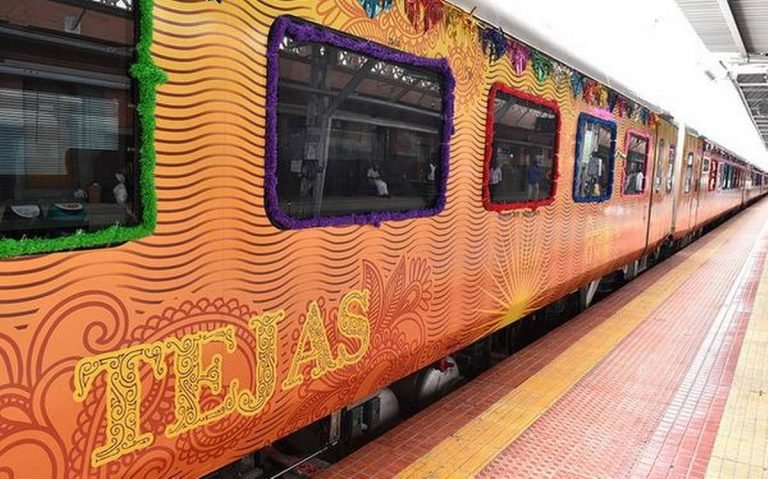
In its first month of operation Railways’ 1st private train, Tejas posts Rs 70 lakh profit

NEW DELHI (Metro Rail News): IRCTC’s Tejas Express has made a profit of around Rs 70 lakh till October this year while earning revenue of nearly Rs 3.70 crore through sale of tickets, sources said, signaling a steady start for the Railways’ first “privately” run train.

The Indian Railway Catering and Tourism Corporation’s Lucknow-Delhi Tejas Express is part of the Railways’ bid to develop 50 railway stations of world-class standards and allowing private passenger train operators to run 150 trains on its network.

The train has run with an average occupancy of 80-85 percent since it began operations on October 5, the sources said.

From October 5 to October 28 (21 days, as the train, runs six days a week), the expenditure incurred by IRCTC in running the train was around Rs 3 crore, they said.

The Railway subsidiary, which spent an average of nearly Rs 14 lakh per day to run the state-of-the-art train, earned around Rs 17.50 lakh daily from passenger fares.

The Tejas Express on the Lucknow-Delhi route is the Railways’ first experience of running a train by a non-railway operator and its own subsidiary IRCTC.

The IRCTC has a slew of benefits worked out for its passenger’s combination meals, free insurance of up to Rs 25 lakh and compensation in case of delays.

The government last month constituted a special task force comprising a group of secretaries to expedite the initiative on private train operation and station redevelopment projects. However, the first meeting of the group is yet to take place.

Delhi to Katra Vaishno Devi train a hit

NEW DELHI (Metro Rail News): Piyush Goyal-led Indian Railways all-new engineless Vande Bharat Express train between Delhi and Shri Mata Vaishno Devi Katra has proven to be a big hit amongst passengers in the first month of its run. Train No 22439/22440 saw occupancy of over 95 percent- in both the directions between October 5 and November 4.

According to Indian Railways officials, the data indicates good patronage by passengers for the new Vande Bharat Express train. The new train was flagged off by Home Minister Amit Shah on October 3 this year, and it began commercial services from October 5.

According to official data, between October 5 to October 31, Train number 22439 NDLS-SVDK Vande Bharat Express did a total of 23 trips with 100% occupancy and net earnings of Rs 3.7 crore. On the other hand, Train number 22440 SVDK-NDLS Vande Bharat Express did a total of 23 trips with 96% occupancy and net earnings of Rs 3.5 crore in the same time period.

The Vande Bharat Express train to Katra also scored on another crucial parameter of Indian Railway’s punctuality. The semi-high speed train, which has a speed potential of 180 kmph, runs at a maximum speed of 130 kmph on this route. Out of the 27 trips from October 5 to November 4, the SVDK-NDLS Vande Bharat Express arrived in New Delhi 5 to 10 minutes ahead of its schedule on as many as 20 occasions.

In both directions, Train No 22439/22440 maintained its punctuality in 26 out of 27 trips, a remarkable achievement for the national transporter.

Train number 22439 NDLS-SVDK Vande Bharat Express leaves the New Delhi railway station every morning, except Tuesday, at 6:00 AM to reach Shri Mata Vaishno Devi Katra at 2:00 PM. En route, the train halts at Ambala Cantt, Ludhiana and Jammu Tawi for 2 minutes each in both the directions. In the return direction the same day, Train number 22440 SVDK-NDLS Vande Bharat Express leaves from Katra at 3:00 PM to arrive in New Delhi at 11:00 PM.

Indian Railways has kept IRCTC’s catering optional for passengers at the time of booking the tickets. The fare for the AC chair car seat between Delhi and Katra is Rs 1,630 (including meals) and Rs 3,015 (including meals) for the Executive chair car.

On the other hand, the fare for the AC chair car seat between Katra and Delhi is Rs 1,570 (including meals) and Rs 2,965 (including meals) for the Executive chair car. The semi-high speed self-propelled train set has reduced the travel time between Delhi and Katra to just 8 hours instead of 12 hours.

DMRC plans to revamp 280 Oldest metro coaches

NEW DELHI (Metro Rail News): Delhi Metro Rail Corporation (DMRC) plans to begin major overhauls of total 280 coaches of Delhi Metro’s oldest corridor- Red Line (Rithala-Shaheed Sthal New Bus Adda) which is showing signs of wear and tear.

Delhi Metro Rail Corporation (DMRC) will now begin a major overhaul of total 280 coaches. The Red Line coaches are nearly two-decade-old, which will not only be refurbished but also upgraded to bring them on a par with those deployed in other corridors.

Delhi Metro brought first coaches from South Korea in 2002 to start the operations on a small section of Red Line. The coaches were manufactured in India itself later. There are more than 40 six-coach trains deployed on the Red Line and many of these are 15 to 17 years old now.

The lifespan of a coach is 30 years. The refurbishment will ensure that the old coaches can be used efficiently for the next 13-15 years.

“The air-conditioning system will be refurbished and as part of the overhaul, we will also focus on floor repair, the section connecting two coaches, painting and suspension,” a DMRC official said.

“Trains on this corridor just have stickers to show the stations. These will be replaced with digital display panels,” he said.

“A major focus will be on overhauling of gangways — the partition between two coaches — that have seen the most damage. The overhaul will include 100% fabric and bellow replacement, cleaning and anti-corrosion measures,” the official added.

DMRC will repair the flooring of many trains, some coaches require complete floor replacement. “The floors of these coaches have been irreparably damaged and the replacement has been planned with the help of the original car builder,” he said. The corporation will also replace secondary suspensions in all trains.

The interiors of all these coaches will sport a new look, too, thanks to a paint job. “These 280 coaches will get a fresh layer of special water-based paint,” the official added. “The whole process of refurbishment will take 20 to 24 months,” he said. At present, the total number of commissioned trains in the metro network is 336, which are made up of 2,206 coaches. All Delhi Metro coaches undergo periodical preventive checks.

UP CM Yogi Adityanath to lay the foundation stone of Kanpur Metro on Nov 15

KANPUR (Metro Rail News): Uttar Pradesh Chief Minister Yogi Adityanath will lay the foundation stone of Kanpur Metro rail project in front of IIT Gate on November 15, 2019. After the foundation stone ceremony, the work of Kanpur Metro Rail project will start on the ground.

According to the source, Uttar Pradesh Metro Rail Corporation Limited (UPMRC) formerly known as Lucknow Metro Rail Corporation (LMRC) have started preparation work for laying off of foundation stone ceremony in Kanpur. The foundation stone of the metro rail project will be unveiled in the main auditorium of IIT.

Shri Deepak Kumar, Principal Secretary, Housing and Urban Planning Department, reached IIT. Where He held a meeting with the Municipal Commissioner SM Bobde, District Magistrate Vijay Vishwas Pant, Inspector General Mohit Aggarwal, UPMRC Managing Director Kumar Keshav, etc. regarding the inaugural program of the Kanpur metro project on November 9, 2019. He checked the preparations made for the foundation stone laying ceremony and directed officials to make necessary preparations for the same.

To unveil the foundation stone laying ceremony, a piling machine is kept in front of the National Sugar Institute. The construction work of the Kanpur Metro project will be commenced by breaking the divider on the GT road.

For the foundation stone laying ceremony, the corridor has been built by putting a board on the UPMRC GT Road from IIT Gate to National Sugar Institute. Not only this, IIT, NSI, and CSJMU have also done road cutting by checking the underground services. UPMRC MD Kumar Keshav and Chief Project Manager visited these places and inspected and gave necessary instructions to the team of AFCONS Infrastructure Limited on November 9, 2019

There are two corridors that will be built under the Kanpur Metro metro project. The first corridor is from IIT Kanpur to Moti Jheel via Phulbag to Naubasta and the second corridor is from CSA to Barra-8.

According to UPMRC officials, the metro will run from IIT Kanpur to Moti Jheel first. The Rs 735 crore project will span 8.7 km long and elevated viaduct along with 9 metro stations are to be built in this priority section. On September 19, AFCONS Infrastructure Limited has been awarded to carry out the constriction work of viaducts and stations of Corridor I.

Earlier, the AFCONS Infra teams arrived in Kanpur with machines. Earlier, October 24 was fixed to start the construction work but due to no dates received from the CMO, so it has been postponed.

NCRTC floats 1st tender for civil construction of Delhi-Gurugram-SNB RRTS Corridor

DELHI (Metro Rail News): The National Capital Regional Transport Corporation (NCRTC) has floated the 1st tender for civil construction of the Delhi-Gurugram-SNB (Shahjahanpur-Neemrana-Behror Urban Complex) RRTS corridor.

NCRTC is implementing the regional rapid transit system (RRTS) in the national capital region (NCR).

Scope of work

NCRTC is inviting bids for the construction of the elevated viaduct, spanning from the end of the ramp at IDPL complex to the start of the ramp at Rajiv Chowk. This distance on the route, will cover three elevated RRTS stations, namely, Udyog Vihar, Sector-17 and Rajiv Chowk. The tender floated by NCRTC has excluded the architectural finishing as well as the pre-engineered steel roof structure of the RRTS stations.

The organisation has already Floated a tender for the engagement of a detailed design consultant (DDC) for the architectural, civil and the E&M work for the design of three RRTS elevated stations in Gurugram-Udyog Vihar, Sector 17, Rajiv Chowk and also for the elevated viaduct between IDPL complex ramp to the Rajiv Chowk ramp for the Delhi-SNB RRTS corridor. The pre-construction activities such as soil testing, utility diversion, geotechnical investigation, pile load test have been in progress on this route of the corridor.

The 106-km long Delhi-Gurugram-SNB corridor is part of the 164-km long Delhi-Alwar RRTS project. Delhi-Alwar RRTS is one of the three corridors prioritized for implementation, along with Delhi-Meerut RRTS and Delhi-Sonipat-Panipat RRTS.

All you need to know about Delhi-Gurugram-SNB-RTTS corridor:-

  • The Delhi-Gurugram-SNB corridor will be constructed on the elevated stretch for about 71 km, covering 11 RRTS stations. The remaining 35 km distance, covering five stations, will be constructed underground, mostly in Delhi and Gurugram.
  • Once operational, the Delhi Gurugram SNB corridor is expected to bring down the travel time between Delhi-SNB to about 70 minutes.
  • This corridor will originate from Sarai Kale Khan in Delhi and connect the areas of Munirka, Aerocity and Gurugram.
  • It will converge at Delhi’s Sarai Kale Khan station with the other two RRTS corridors, namely, Delhi-Meerut and Delhi-Panipat RRTS.
  • These RRTS corridors will be interoperable and will be seamlessly integrated with the other modes of public transport such as Delhi Metro, interstate bus terminals (ISBT) and Indian Railways station. This line will also connect Delhi’s Indira Gandhi International (IGI) airport to the RRTS network
  • This smart line will be passing through the industrialized and urbanized areas of Haryana and Delhi. This will increase the overall productivity of NCR through fast, reliable and safe mode of travel.
  • The RRTS trains will have an operating speed of 160 kmph and an average speed of 100 kmph and will be available at a frequency of every 5-10 minutes on the network.

Chennai Metro 2.0 stations will be high on technology

CHENNAI (Metro Rail News): The second phase of the metro rail, which is expected to be operational in six years, may have stations with different look and feel. This is because the design consultants and architects at Chennai Metro Rail Limited (CMRL) are using computer software for running simulations to come up with designs that suit each place.

The computer program will also help install critical systems required for train operations along the 118.9km stretch of phase-2. This, according to CMRL, will reduce cost and time of construction, while also making optimal use of the available space.

An official said, “The difference is like buying a readymade garment and getting a tailor-made one. If it’s too big or too small for us, it’s not going to serve the purpose. We are designing stations taking into account projected passenger traffic without compromising on comfort. It will not be a cut-paste design for all stations”.

As the detailed design for the 52km priority corridor between MadhavaramSholinganallur and Madhavaram-Koyambedu is being prepared, the design consultants are feeding computers with projected ridership, site conditions and available space for the construction.

“For instance in phase-1, the Airport station has only two entry-exit points, while Thirumangalam has four. But both the stations handle the same passenger traffic, which means we can make do with two entry-exit points.” In phase-1, CMRL went with a standard design with four entry-exit points and other features like staircases, escalators, and elevators as well as other critical systems like tunnel ventilation in almost all stations.

While transit hubs like Alandur and Central were bigger in size and had additional features, most of the other stations were near the same size. A Metrorail official said while the average station length maybe around 145m, the width may vary. Similarly, all stations except changeover points may have only two entry points unlike four in phase-1 stations.

Stations in phase-2 may not have a big concourse area. Some of the stations planned in phase-2, like Thousand Lights and Kilpauk, which already have stations in phase-1, may be linked, so commuters could use the existing entry-exit points to access the stations.

An official said other features like the size and number of staircases, escalators, and elevators linking station at three levels street level, concourse and platform may vary with stations. “The size of the stations may be the same because we need space for the evacuation of passengers during emergencies,” an official said.