Nagpur (Metro Rail News): Rail Vikas Nigam Ltd. (RVNL) has emerged as the lowest bidder to construct the civil package C6 of the 43.8 km long Nagpur Metro Phase 2 project.
Contract C-06 (Nagpur Metro phase 2)
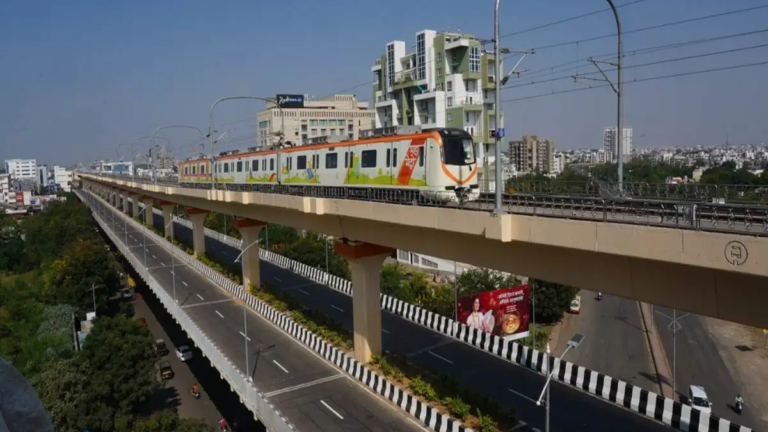
This contract covers the construction of 10 elevated metro stations on the new 6.6 km (Reach 3A) and 5.5 km (Reach 4A) western and eastern extensions of the 19.4 km Aqua Line.
Reach 3A (Lokmanya Nagar to Hingna) consists of 7 elevated stations
Hingna Mount View
Rajiv Nagar
Wanadongri
APMC
Raipur
Hingna Bus Station
Hingna.
Reach 4A (Prajapati Square to Transport Nagar) consists of 3 stations
Pardi
Kapsi Khurd
Transport Nagar
Bidding process
In January 2024, Maha-Metro invited bids for constructing all 10 stations, with an estimated cost of Rs. 307.34 crore and a duration of 900 days.
2 bidders submitted the bids :
RVNL (Rs. 255 crore)
YFC Projects and BBG Infrastructure JV (disqualified)
RVNL’s bid of Rs. 255 crore was significantly less than Maha-Metro’s estimate of Rs. 307.34 crore. A contract should be issued in the upcoming weeks without a drawn-out financial bid evaluation process.
Nagpur-metro-Rail
So far, RVNL has secured 4 major achievements in Phase 2 including:
Package C-01 (the 6.92 km viaduct in Reach 2A)
Package C-05 (the eight stations and viaduct in Reach 1A & 2A)
Package C-08 (6 stations on Reach 2B)
Package C-06 ( 10 elevated stations on Reach 3A and Reach 4A)
Moreover, Nagpur Metro Phase 2 is currently under construction and is expected to be completed by 2026. Asian Development Bank (ADB) will finance Nagpur Metro Phase 2 with a USD 200 million (about Rs. 1678 crore) loan that was authorised in July 2024.
Furthermore, an additional loan of €210.72 million, or around Rs. 1943 crore, is presently under evaluation by the European Investment Bank (EIB).
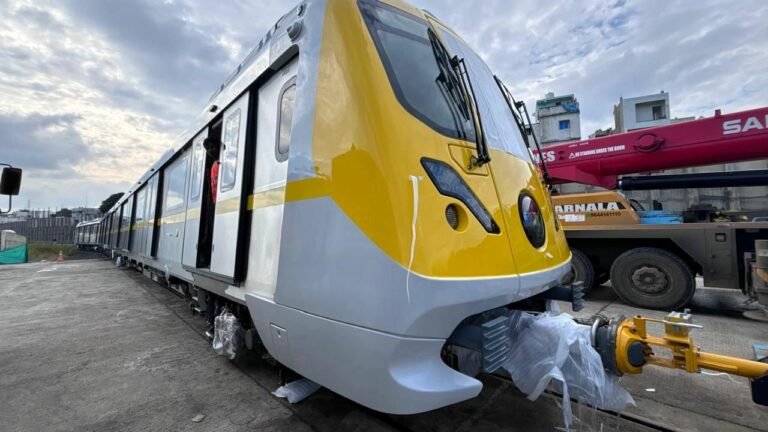
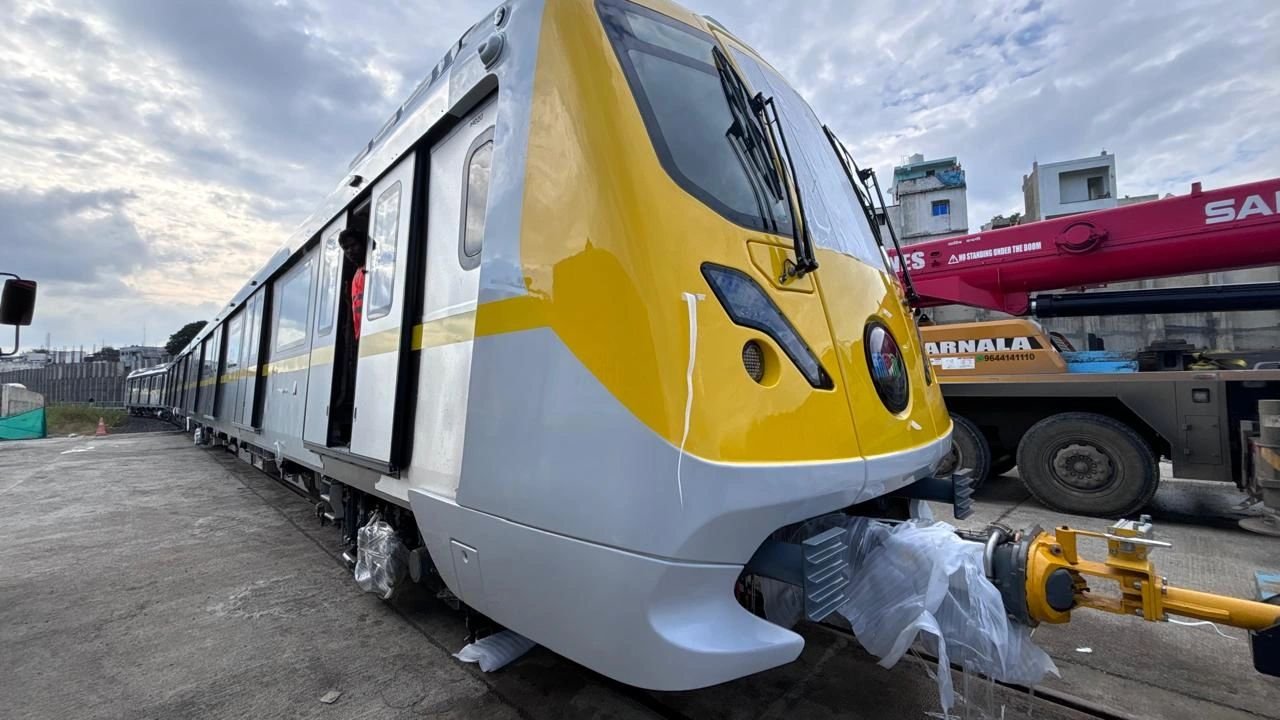
Indore ( Metro Rail News): The 9th Rolling Stock (a 3-car train set) was added to the fleet of 8 existing train sets of Indore Metro at the Gandhi Nagar Depot of the 33.53-long Yellow Line. Additionally, the authority has been conducting night trials over super over the super-priority corridor from Gandhi Nagar to Super Corridor 3 for its successful operations.
9th Rolling Stock to the Indore Metro
S Krishna Chaitanya, MD of Madhya Pradesh Metro Rail Corporation Limited ( MPMRCL) congratulated the entire team, as the city’s fast transit project moves closer to its objective, the ninth set of rolling stock for the Yellow Line of the Indore Metro has arrived and been successfully unloaded at the Gandhi Nagar Depot. Three train sets now total six at Indore Metro. Two more sets came in September after the safe arrival of a new three-car set in August.
MPMRCL has awarded Alstom India the rolling stock contract with a total cost of Rs.3,248 crore. The firm is responsible for supplying train sets to both Indore and Bhopal metro under one package- BH-IN-02. As per the package details, Alstom will provide 25 train sets (75 Coaches) to Indore metro and 27 Train sets (81 coaches) to Bhopal metro. Out of 25 train sets, Indore Metro has been finalised with 9 rolling stocks and 27 coaches so far.
The company’s facility in Baroda is producing these innovative coaches that are recognized worldwide. The company will maintain these coaches for 15 years in addition to providing the communication-based train control signalling system. Additionally, Stockholm, Singapore, and London are also served by the same company’s coaches.
Indore Metro Commencing Night Trials
Mr Shobhit Tandon, Director (System) Madhya Pradesh Metro Rail Corporation Limited, stated
“We are operating the train during night hours so that its functioning can be checked properly. The commercial run of the train over the priority corridor is expected soon”
To make sure there are no problems with the train once the commercial run begins, the Madhya Pradesh Metro Rail Corporation has begun a nightly trial run of the metro for 4 to 5 from Gandhi Nagar to Super Corridor 3 over the super-priority corridor.
Cause of trials
The metro’s signalling system is being examined to fix any glitches or bugs during this trial run.
The train will run both automatically and by the operator. The officials stated that although the train operates automatically, it would initially be controlled by a human operator to ensure safety and inconvenience.
At each station and even halfway through, different signals are installed to gauge the train’s speed and braking capability. The train is signalled to accelerate, decelerate, stop, and so on.
Indore Metro’s status
The Indore Metro is currently under development and not operated yet. The Madhya Pradesh Metro Rail Co Limited (MPMRCL) is building this Mass Rapid Transit System (MRTS) to serve the state’s largest and most populous city, Indore.
Indore Metro is still under construction up to Khajrana Square. The elevated corridor connecting Gandhi Nagar to Radisson Square is almost finished, and girder launching will take place over the corridor until Khajrana Square. Additionally, the number of stations has expanded, and escalators and elevators have been added at numerous corridor stations.
There isn’t much work left once the Gandhi Nagar station is finished. Likewise, the Metro Control Center has been established to ensure appropriate management and functioning of the train.
Vijay Nagar Metro Station ( huge metro station )
The Metro Corporation has requested property to build a sizable metro station at Vijay Nagar Square. This will require some land from the Vijay Nagar bus stand on the one side and land from the Vijay Nagar police station on the other. As a result, the police station will be moved and destroyed. The administration has been asked to provide the police department with around 6 acres of property in exchange.
Pune (Metro Rail News): The Pune Metro project advanced as the Maharashtra government cabinet approved the Detailed Project Report (DPR) of 31.64 Km Pune Metro Phase 2 on 14 October 2024. The approved DPR will now be sent for central government approval. Phase 2 is expected to cost around Rs. 9,897.19 crore.
On 4 October, Maha-Metro invited bids for the appointment of a general consultant for the Pune metro phase 2 Project.
Pune Metro Phase 2’s Approved Lines
Line 5
Khadakwasla station – Kharadi station
25.518 km
Elevated
Total no. of station: 22
Line 5 extension
Nal Stop station – Manik Bagh station
6.118 km
Elevated
Total no.of stations:6
Line 5 Stations:
Khadakwasla
Dalvewadi
Nanded City
Dhayari Phata
Manik Baug
Hingane Chowk
Rajaram Bridge
Deshpande Udyan
Dandekar Pul
Swargate North
Seven Loves Chowk
PCB
Race Course
Fatima Nagar
Ramtekdi
Hadapsar
Magarpatta South
Magarpatta Main
Magarpatta North
Hadapsar Railway Station
Sainath Nagar
Kharadi Chowk
Line 5 Extension Stations:
Paud Phata
Karve Putla
Dhunkar Colony
Karve Nagar
Warje
Daulat Nagar
The DPR will be evaluated by various ministries, including the Ministry of Housing and Urban Affairs (MoHUA) and the Ministry of Finance (MoF). After a thorough review, it will be recommended for final approval by the Central Government’s Cabinet. This step is essential for securing funding and advancing the project towards implementation.
Thane (Metro Rail News): This week marked the official beginning of geotechnical sub-soil study work by Renuka Consultants at Hiranandani Estate for the 29-kilometer Thane Metro project, which has 2 underground and 20 elevated stations circling the city.
This site is located next to Vijay Orovia Phase 1 towers in Hiranandani Estate off of Waghbil Road.
In August 2024, the Central Government’s cabinet authorised the Thane Metro project, which is expected to cost around Rs. 12,200 crore. The metro is expected to be operational by 2029.
A few days ago, India’s Prime Minister Narendra Modi laid the foundation stone for Thane Metro. The findings of Renuka’s study Thane Metro, would aid in accurately establishing the final alignment of Thane Metro’s ring line.
Furthermore, the outcomes will be incorporated into the civil construction tender documents to assist infrastructure firms in submitting more sophisticated financial bids and utilising the proper tools, techniques, and technologies while building.
Additionally, Maha-Metro updated its website, added Thane Metro’s new logo, and made a new X handle recently to update all its work systematically.
Overview of Thane metro
The 26-kilometre elevated Thane Metro route, which has 20 stations, and the 3-kilometre underground twin tunnel segment, which has two underground stations, would encircle the city. Passenger interchanges would be available along the line to the Thane Station of Central Railways, the 32.32 km Line-4 (Green Line) of Mumbai Metro, and the 24.9 km Line-5 (Orange Line).
Thane Metro’s progress
STUP Consultants in September was declared as the lowest bidder for the initial Detailed Design Consultant (DDC) contract for the line, which covered 6 stations:
Dr. Kashinath Ghanekar Natyagraha
Manpada
Dongripada
Vijay Nagari
Waghbil
Waterfront
As per the current rate of advancement of the Thane Metro project, the publication of the first civil tender notice for station construction in Q2 2025.
Before that, a tender notice for building an elevated viaduct connecting these stations by the end of 2024 should appear, as Maha-Metro tends to divide civil work into two distinct packages for viaduct and station works.
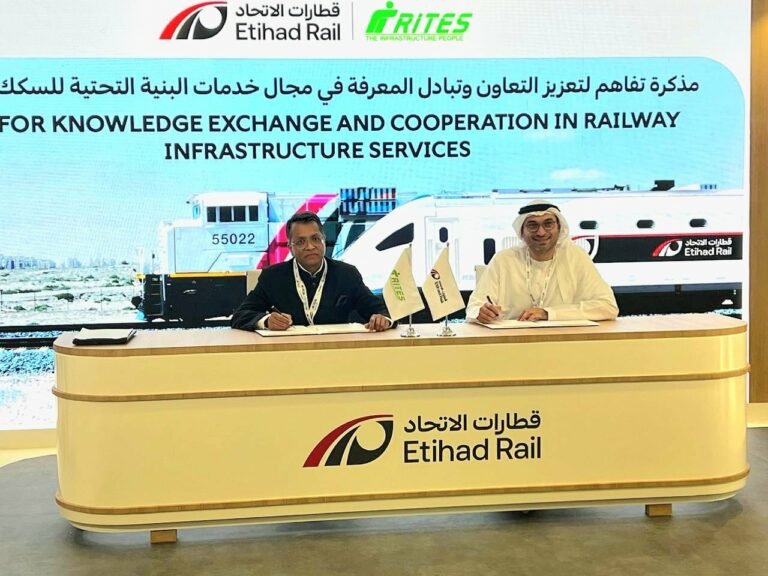
UAE (Metro Rail News): A significant development in the railway sector and related infrastructure can be seen in UAE as Etihad Rail, the UAE national rail network’s developer and operator and RITES, a transport and infrastructure consultant, signed a MoU on 9 October for the same.
The Memorandum Of Understanding (MoU) was signed by the CEO of Etihad Rail and the Chairman and Managing Director of RITES.
The partnership between Etihad Rail and RITES has been looking forward to exploring collaborative opportunities in rolling stock supply/lease, rolling stock repair, consulting, and project management for railway projects.
Through this strategic partnership, RITES and Etihad aim to use their expertise for solutions and innovations towards freight services and future passenger services, which will result in the excellence of overall infrastructure and operations in the UAE.
Chairman and managing director of RITES Ltd. stated “This strategic collaboration with Etihad Rail underscores our strengths and commitment to operational excellence and innovation, while contributing to sustainable infrastructure development. It represents a significant advancement in our strategic initiative of ‘RITES Videsh, aimed at expanding our global services. Together, the entities are laying the foundation to significantly enhance connectivity, setting new benchmarks of excellence in the industry,”
As per the Press Release, The three-day Exhibition and Conference, Global Rail, concluded with 10 high-level strategic partnerships forged among international participants, aimed at shaping the future of the transport and infrastructure sectors. Key MoUs were signed between Etihad Rail and Presight AI Technologies LLC, RITES Ltd, KNR and KORAIL, the Austria Federal Economic Chamber (WKO), L&T Technology Services Limited, IronLev, Nevomo, Hitachi, and SBS Transit, to strengthen ties within integrated transport ecosystems.
(Metro Rail News): East Central and East Coast Railways have selected Rail Vikas Nigam Limited (RVNL) as the lowest-priced bidder for two significant railroad projects. With a combined awarded value of Rs. 463 crores, the projects comprise building additional lines in the Jarapada-Talcher Road section and electrifying the Dhanbad Division.
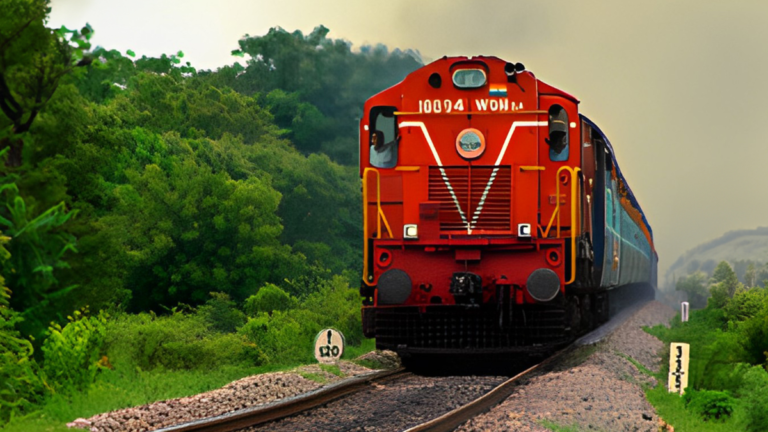
Representational Image
Project 1: East Central Railway contract
Scope
The project’s scope includes the design, procurement, installation, testing, and commissioning of a two-by-25KV feeder line along the track and improvements to the 25KV overhead equipment (OHE).
Segment
The Dhanbad Division’s Garwa Road to Mahadiya segment.
Goal
To reach a 3000 MT loading capacity target for UP and DOWN lines.
Value of Contract
INR 180,96,810
Deadline
Value of Contract: INR 180,96,810
Project 2: East Coast Railway Contract
Scope
The scope of work includes building a new line between Angul and Balram and a third and fourth line between Jarapada and Talcher Road (MCRL Inner Corridor Phase-I Doubling of 14 km).
Work involved
The job involved balancing earthworks, formation, building S&T, major and small bridges, P-Way connection, ballast supply, and other miscellaneous works.
Exclusion
The scope of work in both parts does not include station yards.
Value of contract
INR 283,69,90,691/
Deadline
24 months
RAIL VIKAS NIGAM Ltd.
In a significant development, Rail Vikas Nigam Limited (RVNL), a leading public sector undertaking, has emerged as the lowest bidder (L1) for two significant railway contracts from the East Central Railway and East Coast Railway. These projects, aimed at improving railway infrastructure, will enhance operational efficiency and connectivity
With the two contracts, RVNL has demonstrated its critical role in improving railway infrastructure in important areas. At a total cost of more than ₹463 crores, these initiatives will guarantee effective railway operations and connection in addition to increasing loading capacity.
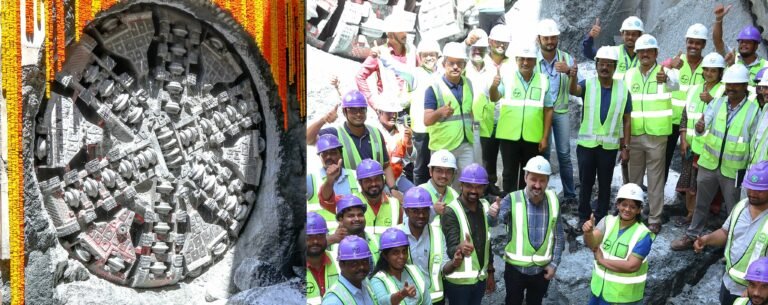
Chennai (Metro Rail News): Another milestone has been recorded in Chennai Metro Phase 2 as Larsen & Toubro (L&T) TBM DZ1041 achieved its 1st breakthrough at Sterling Road Station on Line 3 on 9 October under package TU-02.
Image Credit: Anand Kumar
TBM DZ1041
For its first assignment, TBM DZ10411, nicknamed TBM Palar, was deployed in January 2024 to construct a 708 m up-line tunnel between Chetpet Station and Sterling Road Station in 260 days (Approx 8.5 months).
Image Credit: Anand Kumar
Breakthroughs on Chennai Metro Line 3 in Package TU-02
In May 2021, Larsen & Toubro grabbed Package TU-02 from Chennai Metro Rail Corporation (CMRL) at an estimated Rs.2550 crore spanning 12 Km with a 42-month deadline.
Scope of work: The scope of work under this package includes the construction of twin tunnels at Line 3 between Kellys Station and Taramani Road Junction.
The contractor will also be responsible for the construction of diaphragm walls, entry/exit structures of Chetpet station, Royapettah Government Hospital Station, Thiruvanmiyu Station, and part diaphragm wall of Greenways Road Station with launching and retrieval shafts.
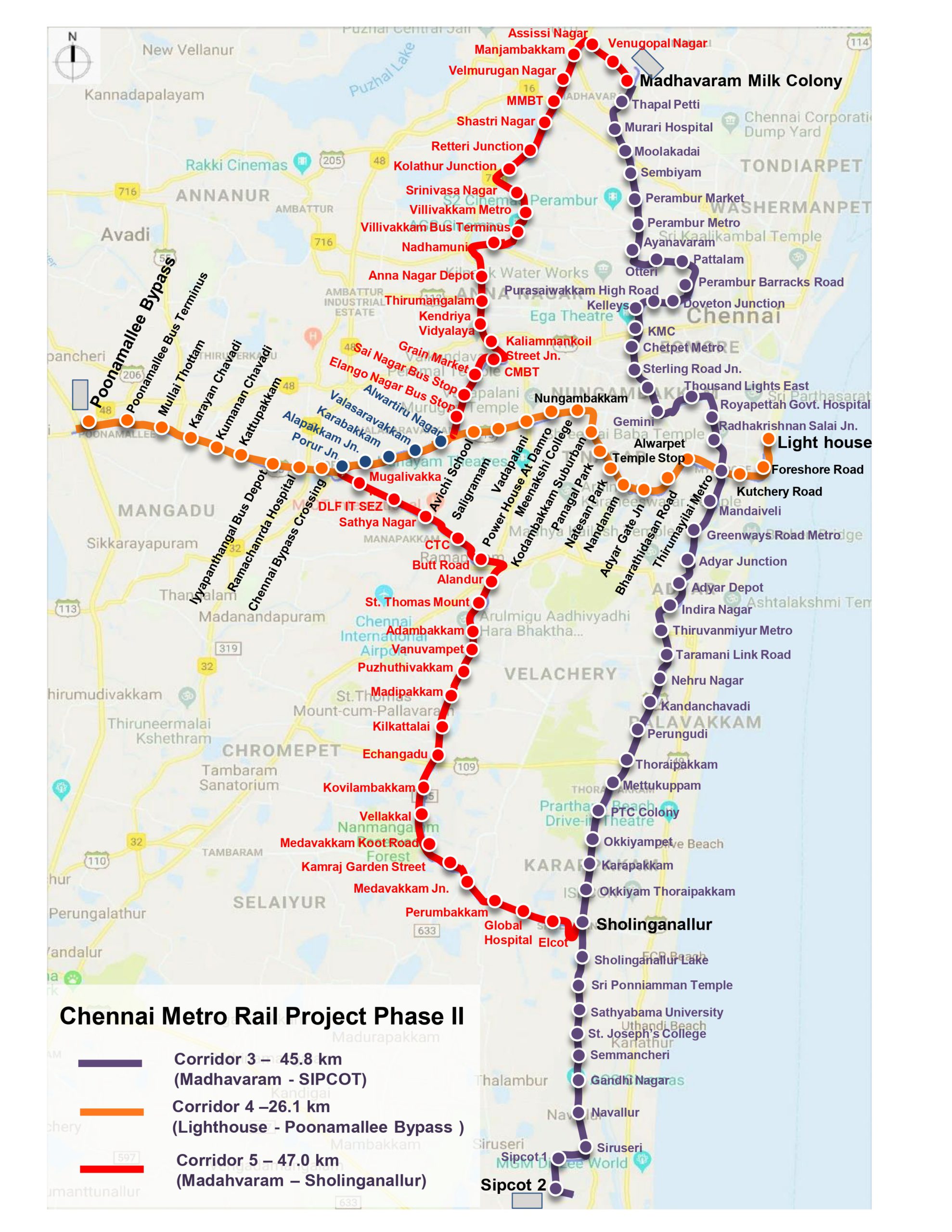
Chennai Metro Phase 2
Chennai Metro Phase 2 Map
Line 3 ( Purple Line )
Madhavaram station– SIPCOT 2 station
45.4 km
Total no. of Stations: 49
Line 4 ( Orange Line )
Light House station – Poonamallee Bus Depot station
Patna (Metro Rail News): Recently, 5 firms have submitted bids for the underground construction of 30.91 km long Patna Metro Phase 1. The construction scope covers the 8 km-long underground section of Patna Metro Line 1 connecting Danapur Cantonment to Khemni Chak under Package PC05 and PC06.
OVERVIEW OF THE PROJECT
The project involves tunnelling twin tunnels through a TBM ( Tunnel Boring Machine) connecting the Rukanpura Ramp to the Mithapur Ramp of 16.86 km long Line 1 of Pune Metro.
Package PC05 will connect the Mithapur Ramp to Vikas Bhawan.
Package PC-06 will connect Vikas Bhawan to the Rukanpur Ramp.
Timeline: 42 months
Funds are sourced from a loan by the Japan International Cooperation Agency (JICA).
In December 2023, the Delhi Metro Rail Corporation (DMRC) invited to tender for both packages, with estimated costs of Rs. 1683 crore (PC-05) and Rs. 1377 crore (PC-06). Five bidders were revealed for both packages.
Firms:
Afcons Infrastructure – Sam India (JV)
ITD Cementation India Ltd.
Hindustan Construction Co.Ltd.(HCC)
Larsen and Toubro Ltd. (L&T)
Tata Projects Ltd.(TPL)
WORK SCOPE OF PACKAGE PC05 ( Patna Metro)
PC-05’s work scope includes the design and construction of three underground metro station
Vikas Bhawan
Vidyut Bhawan
Patna Station
Along with the construction of the Ramp on Mithapur station, as well as the tunnel by cut and cover, shield TBM, and architectural finishing. It also includes the sanitary installation, water supply, and drainage works of the stations along the Danapur to Khemnichak Corridor of Phase I of the Patna MRTS.
Work scope for Package PC06 ( Patna Metro)
PC-06’s work scope includes the design and construction of three underground metro station
Rukanpura
Raja Bazar
Patna Zoo
As well as the twin tunnel by shield TBM, the tunnel by cut and cover, and architectural finishing. It also includes water supply, sanitary installation, and drainage works for the stations on the Danapur to Khemnichak Corridor of Phase I of the Patna MRTS.
Patna Metro
Bidding Procedure
The technical review of the proposals has begun, and it may take several months to finish. After that is finished, the technically qualified bidders’ financial bids will be revealed to determine which bidder is the lowest and most likely to be the contractor for each package.
Hence, only two packages PC05 and PC06 out of six civil construction packages for the Patna metro are left to be awarded.
Package PC04: YFC Projects – Montecarlo JV is currently building the western section of elevated package PC-04, which will be connected to PC-06’s Rukanpura Ramp. The eastern portion of PC-04, which is likewise being built by YFC Projects – Montecarlo JV, will be connected to the Mithapur Ramp of package PC05. So package PC04 will be providing connectivity to both the current package from both the eastern and western sides.
Subsequently, Patna Metro is under construction and has been estimated to be completed by 2026.
Bangalore (Metro Rail News): Bangalore Metro Rail Corporation Limited( BMRCL) announced on 5 October that the commencement of operations on Bangalore Metro’s Phase 2 Yellow Line has been delayed.
BMRCL mentioned that 3 train sets out of 15 trains for Yellow Line will be available by Nov- Dec 2024 and the CMRS inspection will be conducted in the same month leading to operations to begin in January 2025 on Yellow Line.
The testing with prototype trains provided by China Railway Construction Corporation (CRCC) is under progress. The full fleet of 15 trains is expected to be operational by August 2025.
ರೀಚ್-5 (ಹಳದಿ ಮಾರ್ಗ) ಆರ್.ವಿ. ರಸ್ತೆಯಿಂದ ಬೊಮ್ಮಸಂದ್ರದವರೆಗಿನ ಇಂದಿನ ಪ್ರಗತಿಯ ಸ್ಥಿತಿ Status on Commissioning of Reach-5 Line (Yellow Line) from R.V. Road to Bommasandra-as on date pic.twitter.com/YEpTTApKXw
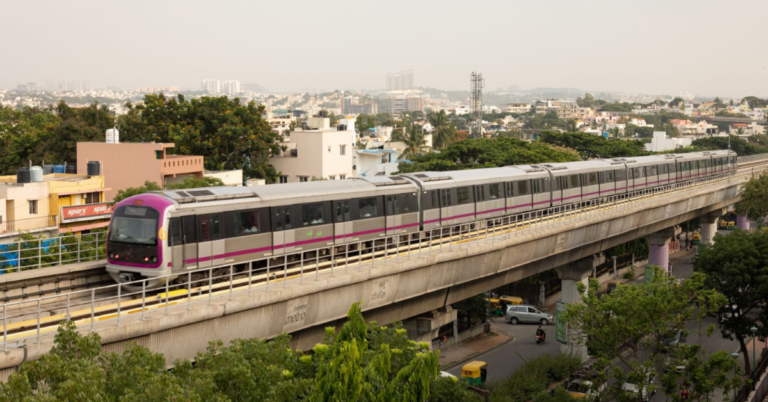
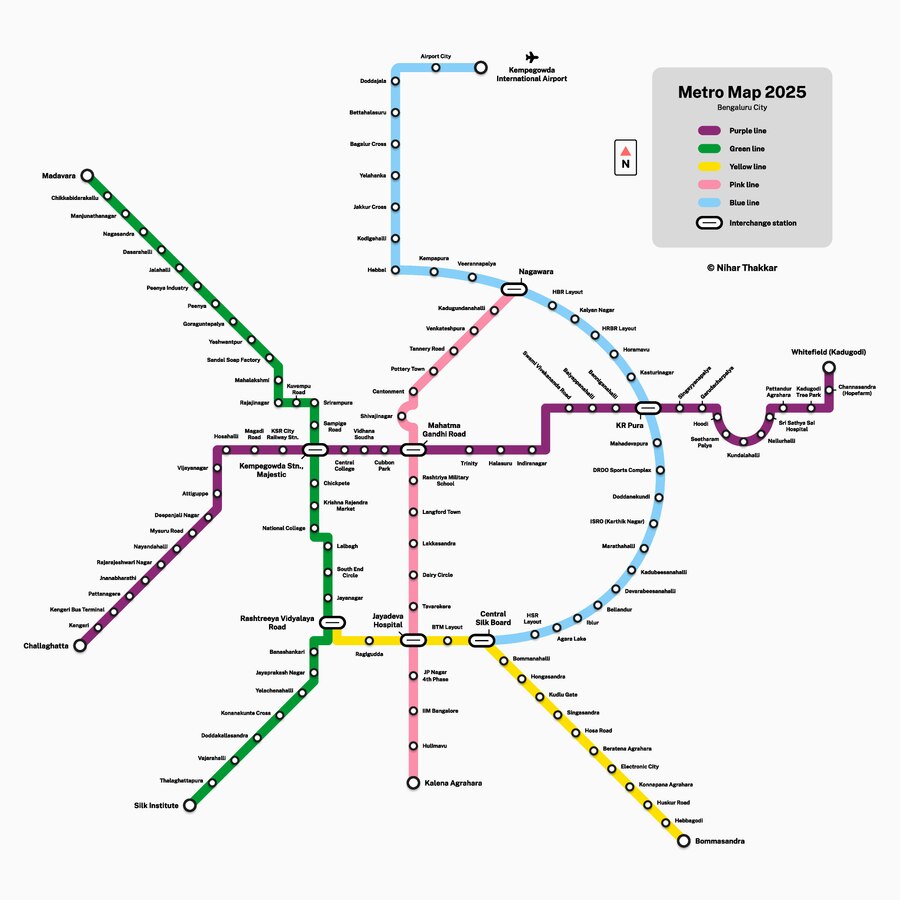
Bangalore Metro Yellow Line spans 19.143 km providing connectivity between Rashtreeya Vidyalaya Road ( RV Road) and Bommasandra through 16 elevated stations.
Stations Covered:
Rashtreeya Vidyalaya Road (RV Road)
Ragigudda
Jayadeva Hospital
BTM Layout
Central Silk Board
Bommanahalli
Hongasandra
Kudlu Gate
Singasandra
Hosa Road
Beratena Agrahara
Electronic City
Infosys Foundation Konappana Agrahara
Huskur Road
Hebbagodi
Bommasandra
Further Updates:
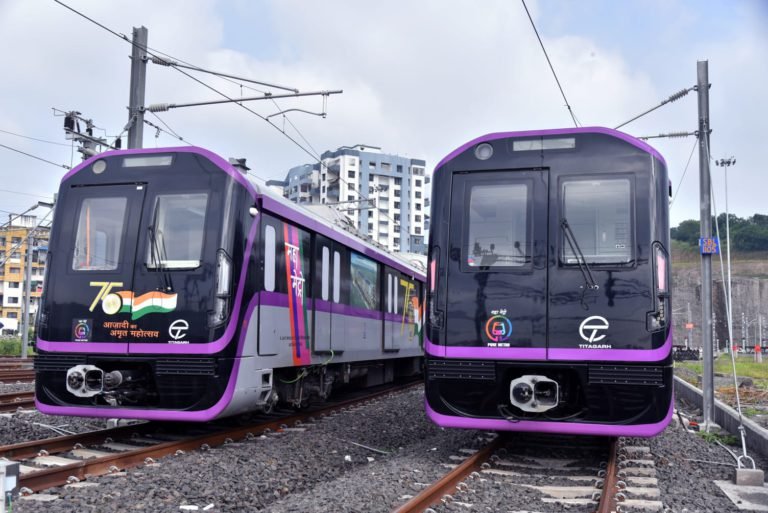
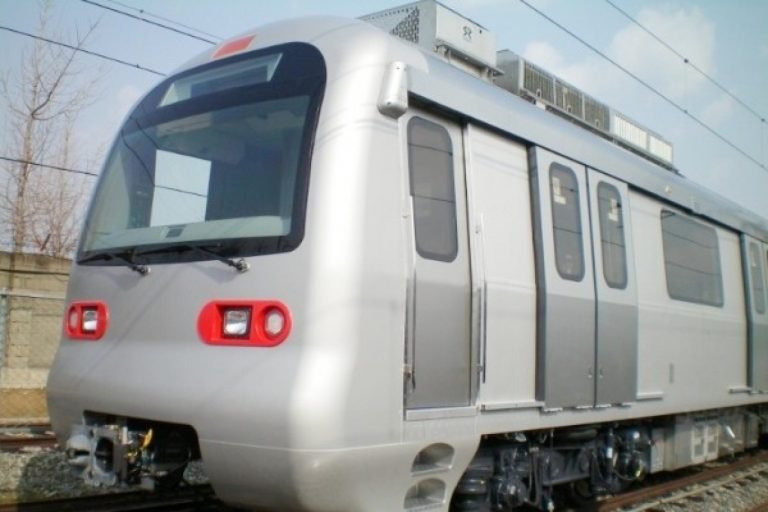
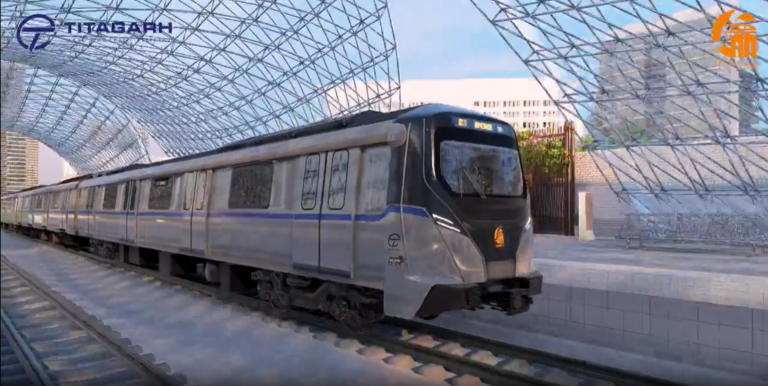
The rolling stock contract for Bangalore Metro Yellow Line was awarded to CRCC later the contract got cancelled and Titagarh Rail System Limited was awarded the contract.
Titagarh will be delivering 2 trains every month and is expected to complete the contract of 15 rolling stocks for Yellow Line by August 2025.
Pune (Metro Rail News): Two Firms, SYSTRA MVA Consulting (India) and STUP – RITES JV have qualified for Package DDC-03, detailed design consultant contract on 7 October for Pune Metro Phase 1A.
Maha-Metro floated tenders for package DCC-03 with a 4 years of deadline in July 2023. Furthermore, the technical bids were opened in August-end to reveal the name of firms who submitted bids and the evaluation for the same was completed on 7 October.
Qualified Bidders
SYSTRA MVA Consulting (India)
STUP – RITES JV
Disqualified Bidder
LKT Engineering – FP Project Management JV
Map of Pune metro
Package DDC-03
The scope of work under this contract includes the Detailed Design Consultancy Services for 2 stations on the Aqua line extension from Vanaz to Chandni Chowk spanning 1.5 Km and 11 stations for a 12 km extension between Ramwadi to Wagholi, excluding Viaduct in station portions of Pune Metro Rail Project.
The appointed design consultant will be responsible for producing and proposing alternate design for all civil , architectural building services electrical and mechanical works.
Stations on Vanaz – Chandni ChowkExtension
Kothrud Bus Depot
Chandni Chowk
Stations on Ramwadi – WagholiExtension
Viman Nagar
Somnath Nagar
Kharadi Bypass
Tulaja Bhavani
Ubale Nagar
Upper Kharadi Road
Wagheswar Temple
Wagholi
Siddharth Nagar
Bakori Phata
Vitthalwadi
Currently, The Aqua Line (Line 2) is operational from Vanaz to Ramwadi spanning 14.665 km through 16 stations.
Package DDC-03 is the third and final design consultancy contract for Pune Metro’s Phase 1 Extension project.
Ahmedabad (Metro Rail News): Following the inauguration, Ahmedabad Metro Phase 2 reached another milestone as the Titagarh Rail System has finally revealed the design of 10 new train sets for Phase 2 Ahmedabad Metro project under rolling stock Package RS3.
As per the guidelines of the contract, Titagarh is responsible for delivering the first prototype of 3 coach trains within 1.34 years from the Letter Of Award (LOA) and completing the contract within 1.8 years of LOA.
The new train sets will operate on the existing Red Line, which spans 39.22 km from APMC to Gandhinagar Sector 1, along with its 5.4 km extension from GNLU to GIFT City. Currently, Hyundai Rotem trains manage operations on the Red Line, and these new train sets will run in parallel with the existing Hyundai Rotem fleet.
Train Specifications:
The interior of the trains is inspired from Ahmedabad’s festivals and culture.
The trains will include a dedicated passenger zone for the differently abled.
These train sets will feature GoA4 grade automation, enabling fully driverless operations in Unattended Train Operations (UTO) mode.
The trains will be designed with Minimalist yet dramatic draft screens.
The 3 coach train-sets will be operated in formations of DMC + TC + DMC where DMC = Driving Motor Car and TC = Trailer Car.
All trains will be stabled and maintained at the existing Gyaspur Depot in south Ahmedabad until the Indroda Depot in Gandhinagar is constructed.
Package RS3
Titagarh Rail Systems Ltd. was awarded Package RS3, a rolling stock contract for supplying 30 coaches with an estimated cost of Rs. 350 crores in August 2023 for the Ahmedabad Metro Phase 2 Project.
Package RS3 is the third major contract of Titagarh in India, following the Pune Metro rolling stock and Surat Metros’ rolling stock contract.
Ahmedabad Metro Phase 2
The Ahmedabad Metro Project, spanning 28.254 Km, consists of 2 corridors with an estimated cost of Rs. 5384.17 crores.
Line 2 ( Red line )
Motera Stadium station – Gandhinagar Sector-1 station
15.4 km
Total No. of Stations: 6
Line 3 ( Eastern Spur )
Gujarat National Law University station – Gujarat International Finance Tec-City station
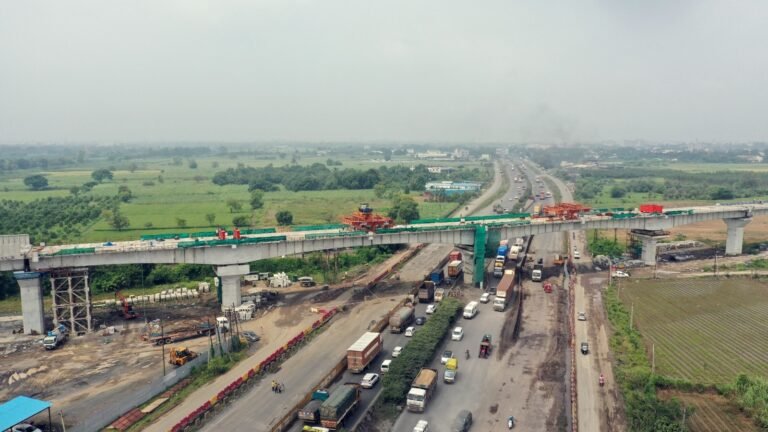
Surat ( Metro Rail News): This week, MG Contractors Pvt. Ltd. (MGCPL) achieved a milestone in the Mumbai – Ahmedabad High-Speed Rail (MAHSR Bullet Train) project by constructing a 210-meter-long balanced cantilever (CLC) bridge. The bridge is located southeast of Surat over NH-48.
A 210-meter-long PSC bridge with spans of 40, 65, 65, and 40 meters has been completed. This bridge crosses one of the busiest sections of the Delhi-Chennai National Highway (NH 48) and is located at Navsari, Gujarat, between the Surat and Bilimora #BulletTrain stations. pic.twitter.com/eql9WamNMG
This 4-span PSC bridge (GAD-10) over national highway NH-48 has a configuration of 40m + 65m + 65m + 40m. It is situated at chainage Km 235.379 in Sasodra village, Navsari District. This bridge falls between the Surat and Bilimora Bullet Train Stations.
The bridge featured 72 segments of varying height which were cast offsite and launched one at a time to ensure that traffic on the road could continue.
The construction of the bridge is part of package P1(B). In 2021, the National High-Speed Rail Corporation Ltd. (NHSRCL) of India awarded MGCPL the Rs. 549 crore Package P1(B) contract.
Under this contract, MGCPL is responsible for constructing 4 PSC (Prestressed Concrete) bridges and 7 steel truss bridges.
Bridges for the bullet train project
This cantilever bridge across NH-48 is the second one with box segments. At Amadpore village, 6.2 km away, is the first one for 260m GAD-11, which was finished in August 2024.
The whole MAHSR project consists of 5 PSC cantilever bridges. Three among them are:
GAD-9 (over NH-09 in Valsad district)
GAD-1441 ( Package P1(B)
GAD- 33 (Package P1(C)
The package P1(B) consists of 11 bridges among which 2 PSC bridges and 2 open web girders have been completed.
Bridge projects
Measure
Location
Type
GAD-1134
70 m,637 MT
over NH-53 in Surat
OWG
GAD-68
100m, 1464 MT
Bhilosa Switching Substation near Silvassa
OWG
GAD-11
260m
NH-48 at Amadpore
PSC
GAD-10
NH-48
NH-48 at Sasodara
PSC
All the mentioned contracts have been constructed under MG Contractors Pvt. Ltd. as the MAHSR project is under construction and estimated to be completed by 2026. All the updates can be fetched from our website.
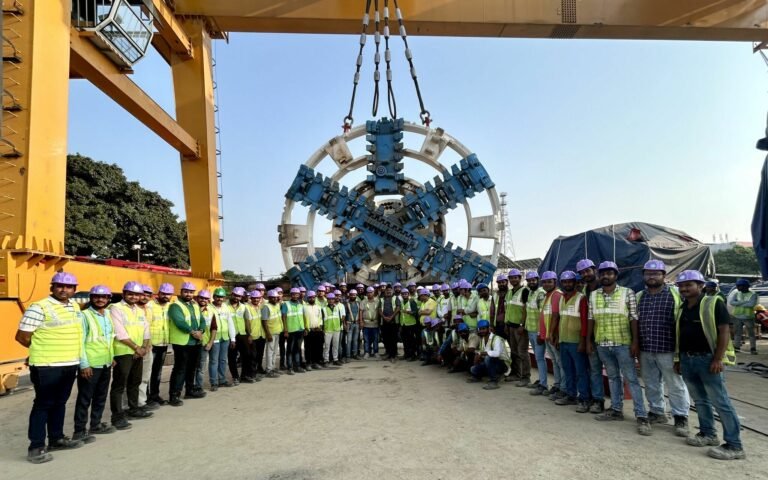
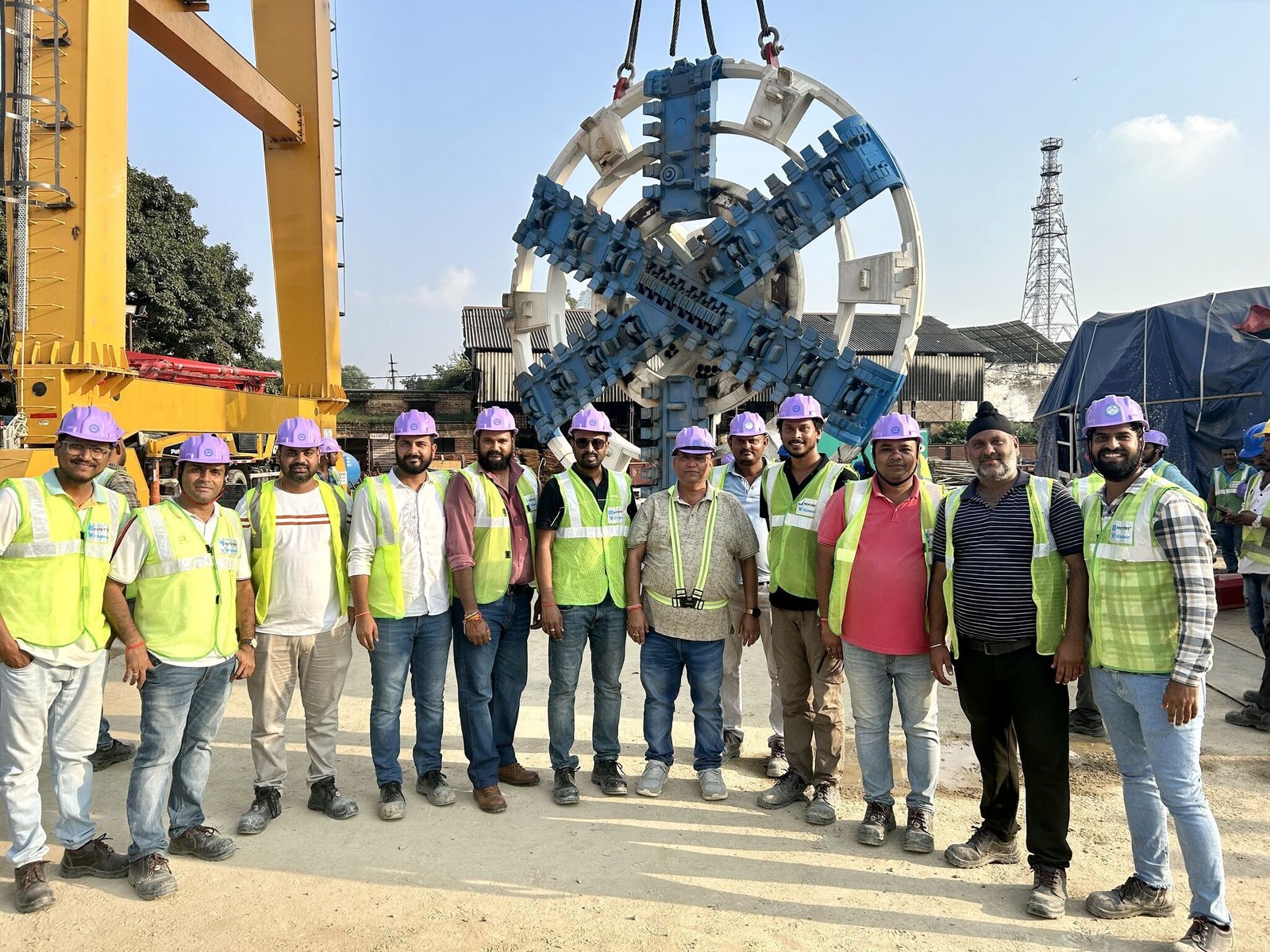
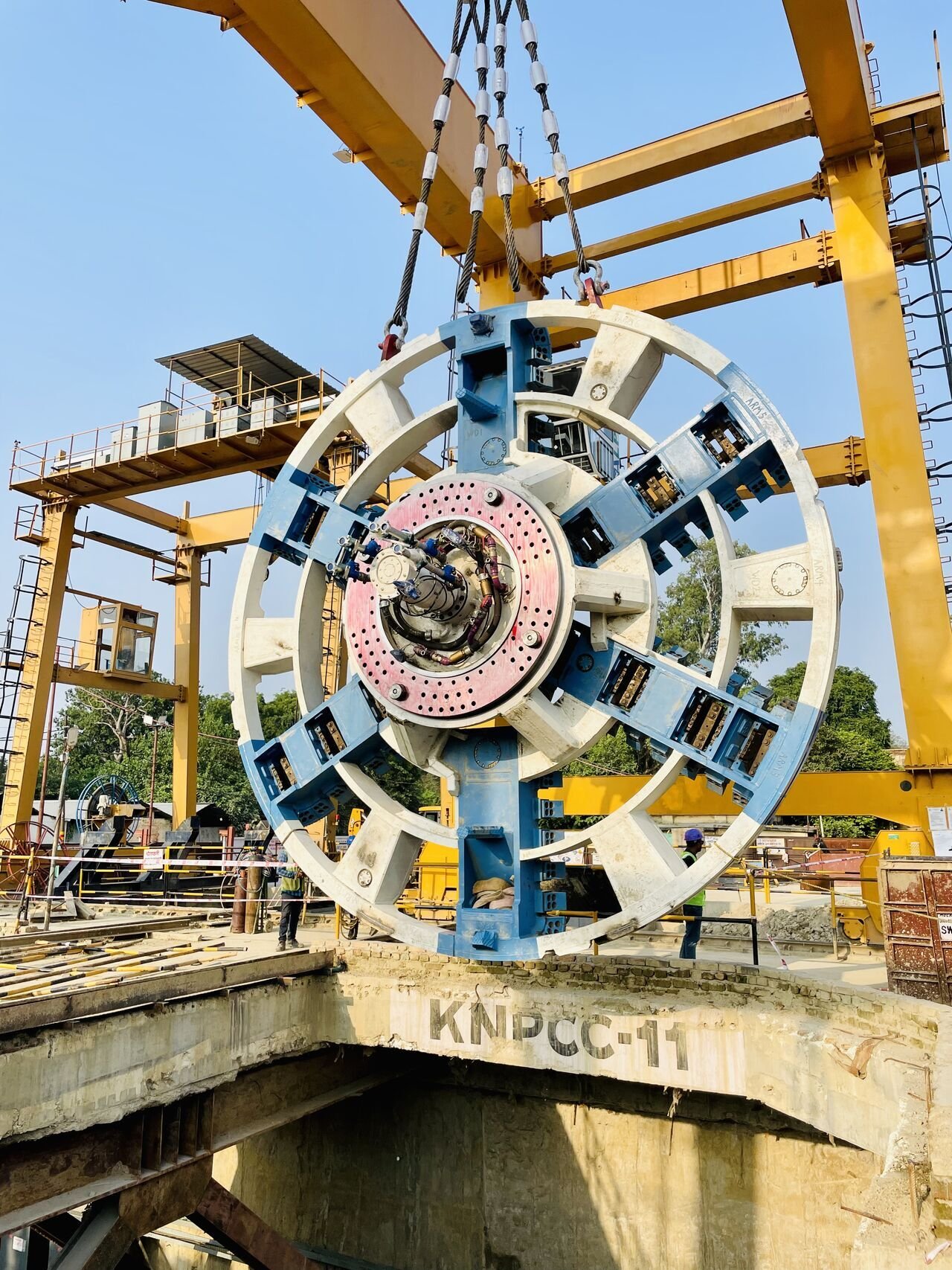
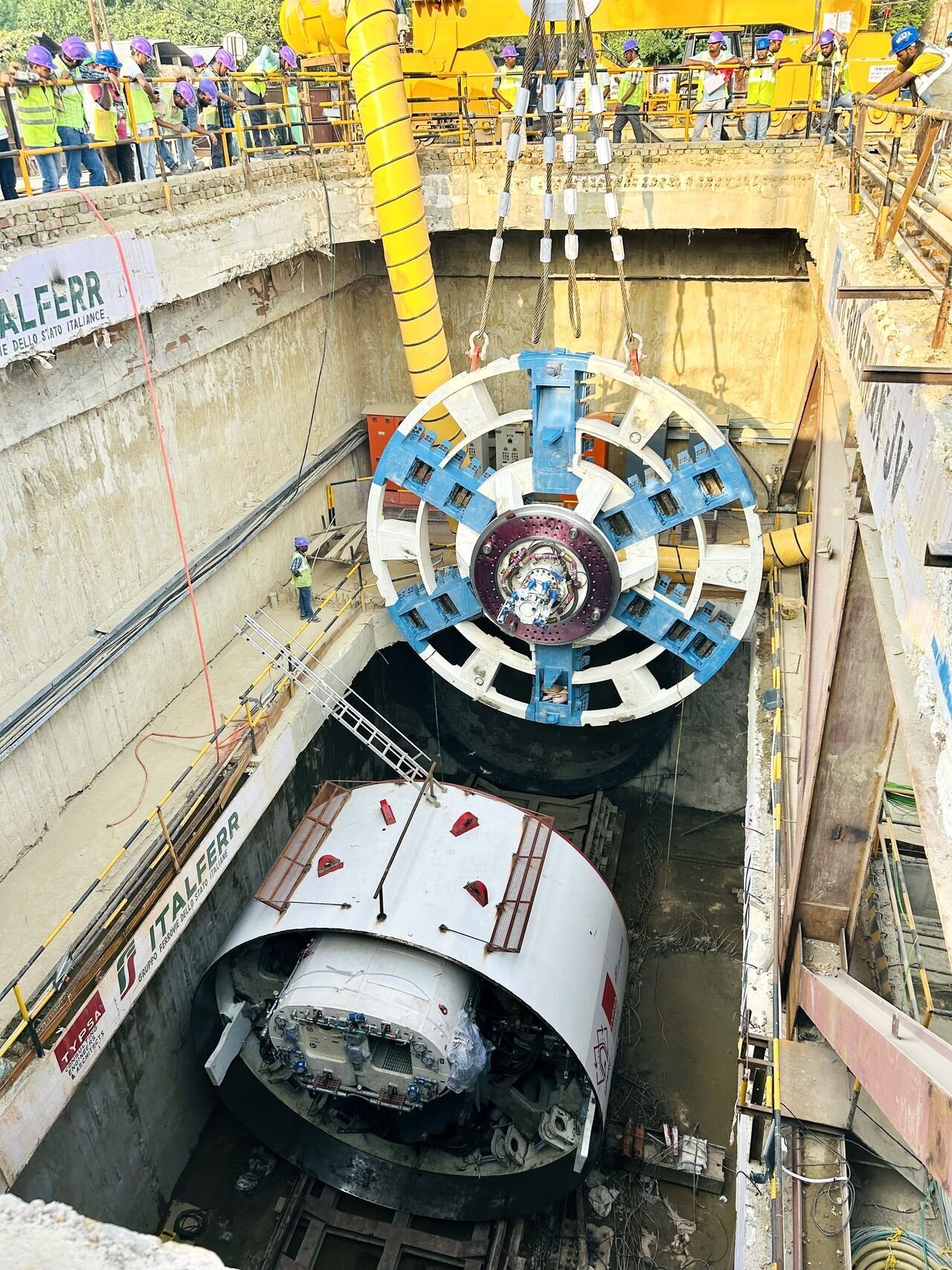
Kanpur (Metro Rail News): Another development has been waiting for the Kanpur Metro Project as Kalpataru Projects International Ltd. (KPIL) – Gulermak JV recently started lowering and assembling their first TBM S-1408A for Kanpur Metro Line 2 at Rawatpur station.
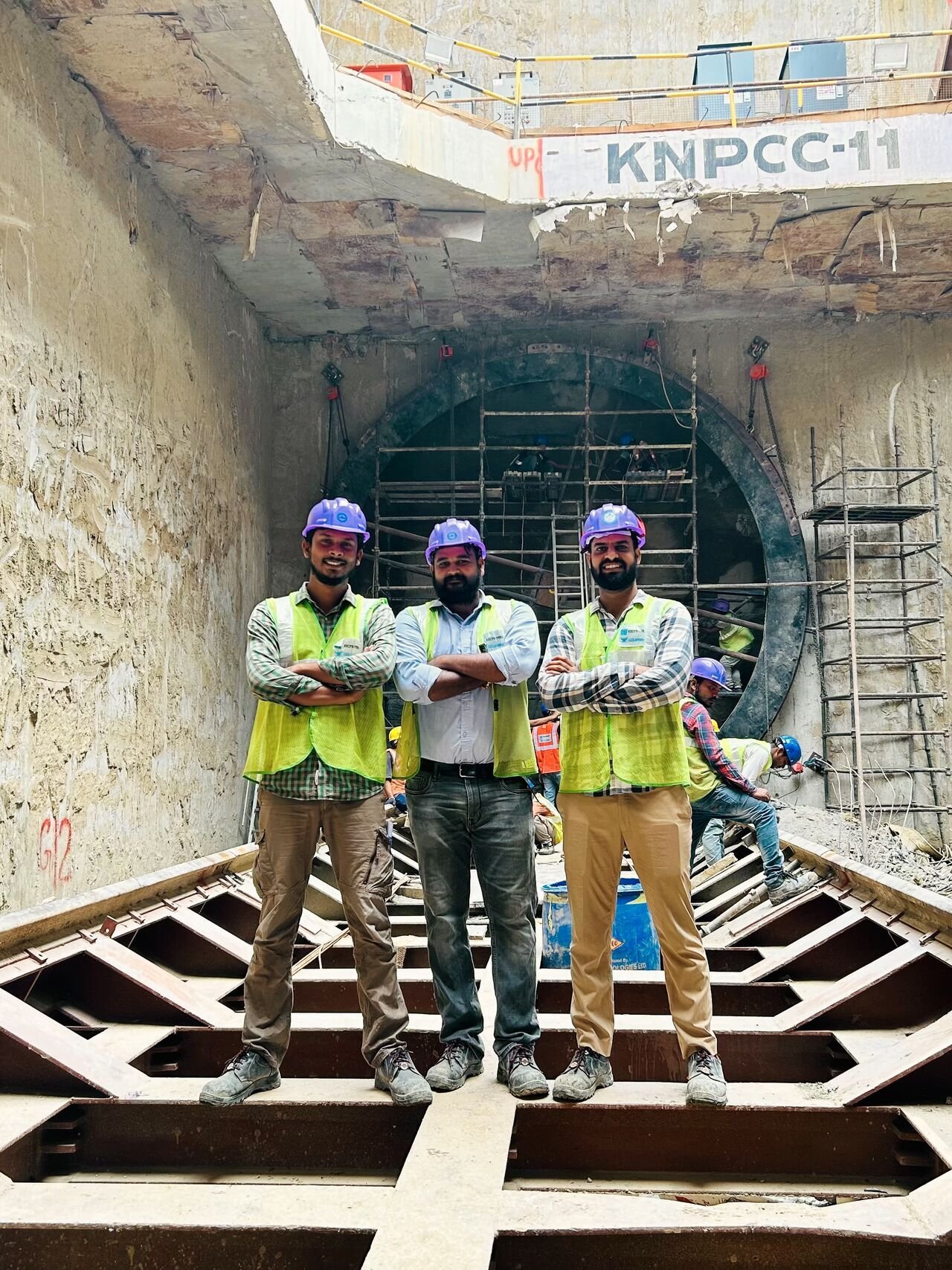
Kalpataru Projects International Ltd. (KPIL) – Gulermak JV’s TBM S-1408A is the first of two TBM deployed for Line 2’s underground package KNPCC-11 and overall a 5th TBM for constructing underground tunnels for Kanpur Metro Phase 1 project.=
Image Credit: Abhishek Yadav
For its first assignment TBM S-1408A will construct a 650 m (Approx) tunnel for the Up Line from Rawatpur stations to ramp at agricultural depot.
Package KNPCC-11
Kalpataru Projects International Ltd. (KPIL) – Gulermak JV bagged underground package KNPCC-11 for Line 2 from Uttar Pradesh Metro Rail Corporation (UPMRC) with an estimated cost of Rs.762.50 crore in December 2023 with a 30-month deadline.
The scope of work under this package includes the twin tunnels for line 2’s underground section spanning 4.08 km between the Agricultural depot and double Pulia ramp and the construction of underground stations at:
Rawatpur
Kakadeo
Double Pullia
Kanpur Metro Line 2
Kanpur Metro Line 2 spans 8.38 Km, providing connectivity between Agriculture College Station and Barra-8 through 8 stations.
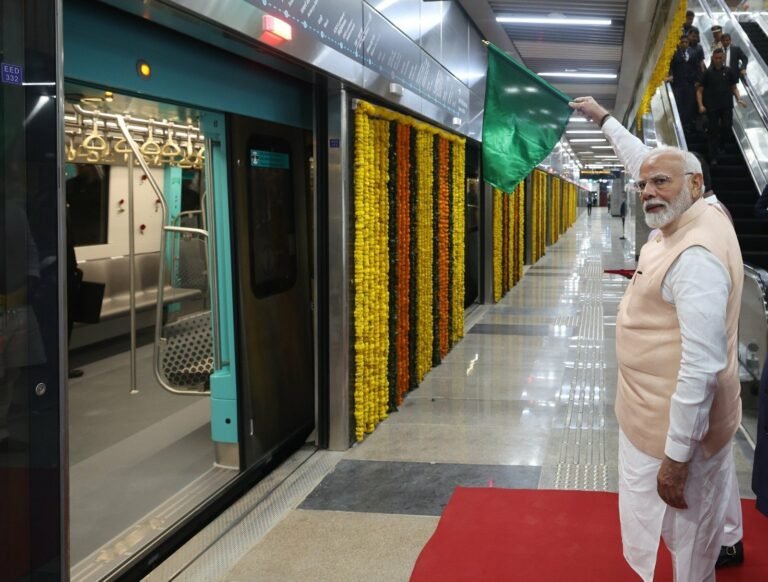
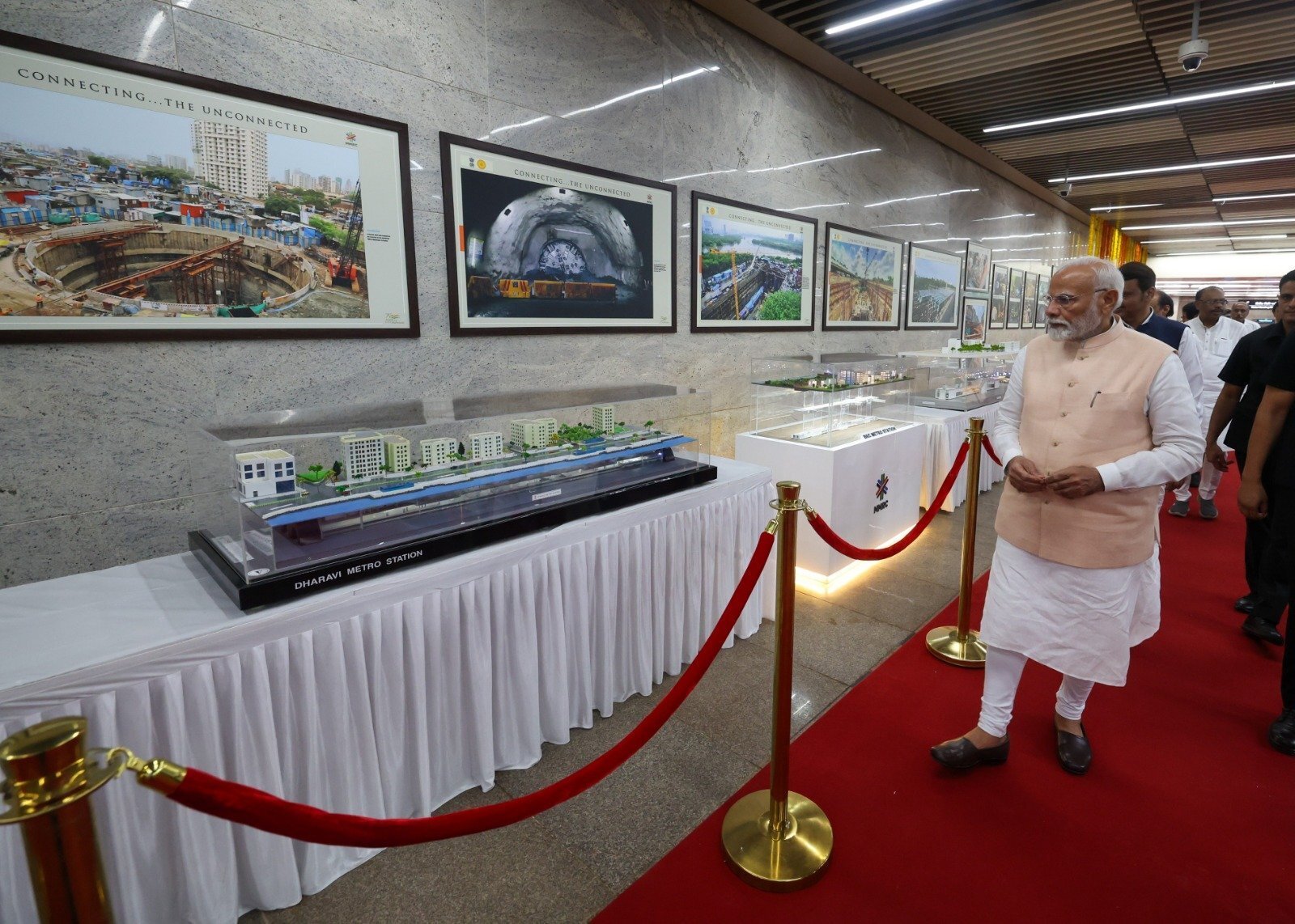
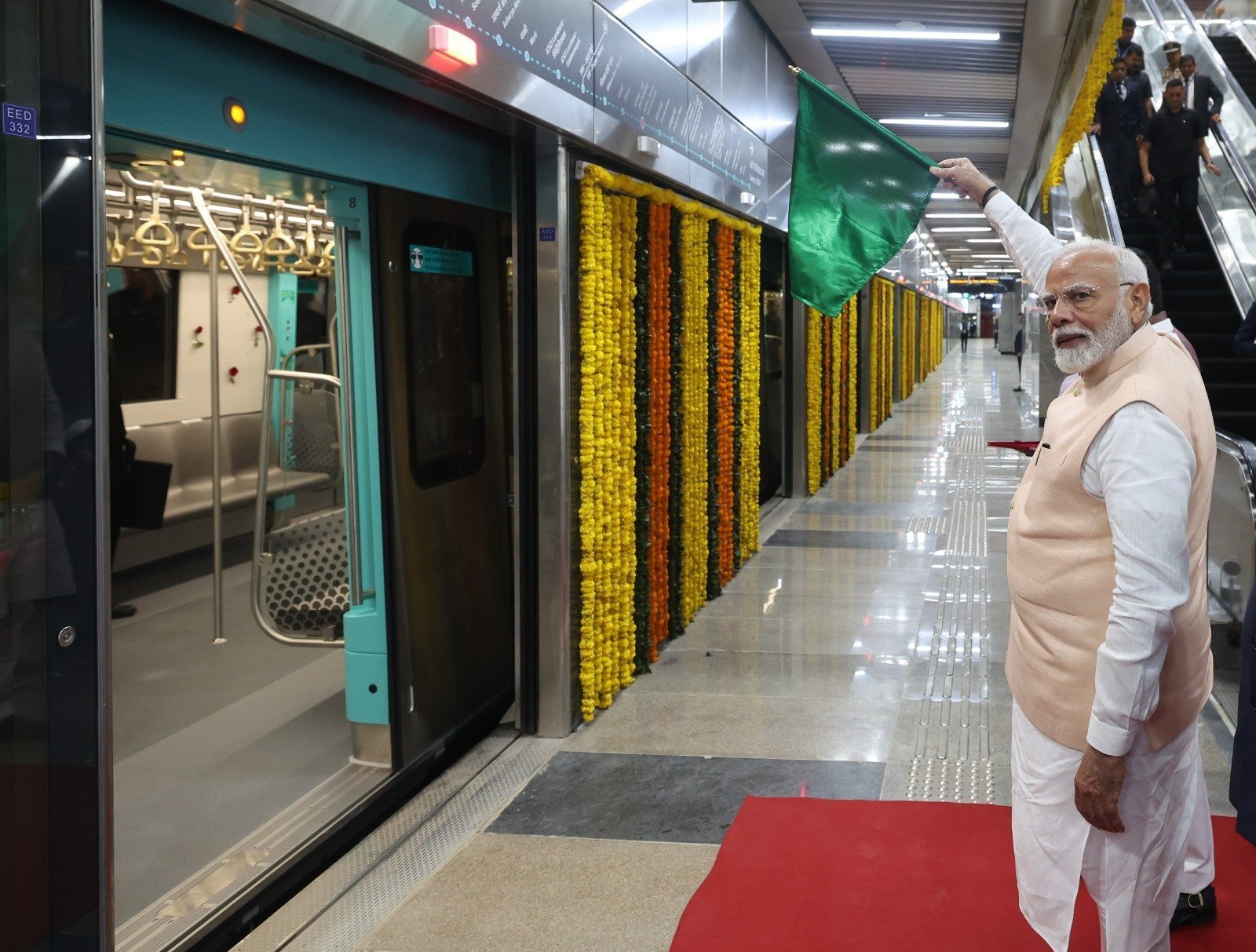
Mumbai (Metro Rail News): Prime Minister Narendra Modi has finally inaugurated the long-awaited Mumbai Metro Line 3 between Aarey colony to Bandra Kurla Complex (BKC) spanning 12 km through 10 stations. Furthermore, he has also laid the foundation for Thane Metro.
Memorable moments from the Mumbai Metro. Here are highlights from yesterday’s metro journey. pic.twitter.com/40KBBYCSQC
Mumbai Metro Line 3, also referred as Aqua Line, a 33.5 km stretch covers 27 stations providing connectivity between Cuffe Parade and Aarey colony.
Initially, PM Modi inaugurated the Line 3 section from BKC to Aarey colony, covering 10 stations.
Stations covered:
Aarey Colony
SEEPZ
MIDC
Marol Naka
CSIA Terminal 2
Sahar Road
CSIA Terminal 1
Santa Cruz
Vidyanagri
Bandra Kurla Complex
The underground tunnels and stations for Mumbai Metro Line 3 from north to south has been constructed through 3 packages which were awarded in july 2016.
As per Alstom’s press release, Alstom’s engagement with Mumbai Metro Rail Corporation Limited (MMRCL) for the Aqua Line includes manufacturing of 31 lightweight, fully furnished modern metro trains of 8 cars each, which is one of the biggest rolling stock contracts in the urban sector for the company in India. It also includes signalling solutions comprising:
Driverless operation, facilitated by the latest generation of CBTC communications-based train control technology, Urbalis Forward, which features GOA4, the highest grade of automation,
Computer-based interlocking
Automatic train supervision
Integrated Platform screen doors (PSD),
Telecommunication systems as well as the Mechanical and Electrical supervisory control and data acquisition system (M&E SCADA).
Further Updates
As per MMRC, the operation on Line 3 will begin from 7 october with the last train departing at 10:30 am. While the full fledged operations will begin from 8 october.