



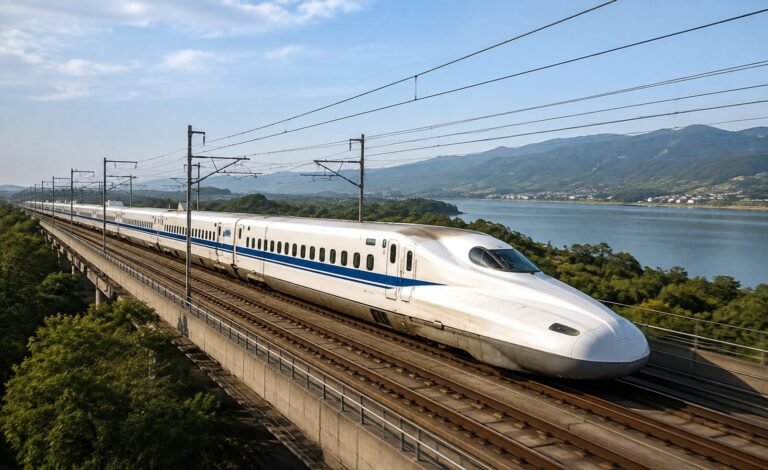
NEW DELHI (Metro Rail News): India is taking a big step toward building its own high-speed rail future. After deciding to manufacture indigenous bullet trains for the Mumbai-Ahmedabad corridor, the country is now developing its own signalling system called the Bharat Train Control System (BTCS).
This system is being designed for nearly 7,000 km of upcoming bullet train corridors across India. The goal is to cut long-term reliance on foreign signalling technology.
What makes BTCS special?
BTCS is built specifically for Indian conditions. It is planned as an open-source, modular, and cost-effective system.
The weekly brief metro & rail professionals read.
This approach will help create a strong domestic industry boosting Indian railway design firms, system integrators, and telecom and component makers.
Once mature, the system could even be exported to other countries looking for affordable high-speed rail solutions.
Complete Control, Zero Dependence in High-Speed Ecosystem through BTCS
India is pairing BTCS with other homegrown efforts. The Integral Coach Factory (ICF) is making indigenous trainsets for high-speed trains, while BEML is producing the coaches. Together with BTCS, this gives India full technological control over both the trains and the systems that run them.
Creating a national open-source signalling protocol will cause a domestic industrial boost for Indian railway design firms, system integrators, and telecom/component manufacturers .
The current signalling systems on India’s fastest corridors
Right now, the Mumbai-Ahmedabad High Speed Rail corridor uses ETCS Level 2, a European system. In June last year, a ₹4,100 crore contract went to Infracon Pvt Ltd (an Indian company) and Siemens (a German firm) for this work.
ETCS Level 2 supports speeds up to 350 km/h with continuous wireless communication and central traffic control. The same system is also used on the Delhi-Meerut Rapid Rail Corridor, currently home to India’s fastest trains.
EETCS Level 2 is serving as the practical reference point while India develops BTCS,as per Times of India reported.
There has also been discussion around Japan’s Digital Automatic Train Control (D-ATC). A former Japanese minister raised concerns about India not using it exclusively for MAHSR (Mumbai–Ahmedabad High-Speed Rail corridor),. Indian officials responded that Japan’s Hitachi trainsets work with ETCS, and India remains open to Japanese protocols if the right proposals come forward.
Big shift toward self-reliance
BTCS marks a clear change. Instead of importing complete high-speed signalling packages, India is using lessons from the ETCS Level 2 experience on the Mumbai-Ahmedabad route to build a lower-cost, scalable system of its own.
This supports the larger Make in India vision-creating technology that India owns, controls, and can grow with.
Also Read: Western Railway floats ₹18,901.68 cr EPC tender for Sarkhej-Dholera Semi High-Speed Double Rail Line
Project Overview