




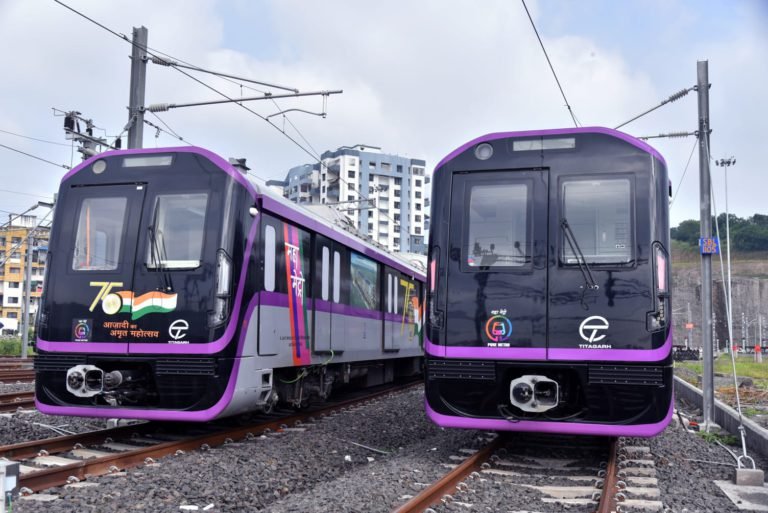
PUNE (Metro Rail News): The Maharashtra Metro Rail Corporation Limited (Maha-Metro) has formally submitted a revised Detailed Project Report (DPR) for the vital Bhakti Shakti-Chakan metro corridor to the Pimpri-Chinchwad Municipal Corporation (PCMC). The submission, made on February 26, 2026, signals a turning point in the region’s long-term urban mobility planning.
The revised plan supersedes an earlier DPR that had estimated the project at ₹10,383.89 crore across a 42.262-km alignment with 31 stations. The updated blueprint adds nearly 5 km to the corridor’s footprint, introduces three additional stations, and fundamentally reimagines key segments of the route to deliver superior area coverage, improved industrial access, and a future-ready infrastructure framework.
EXPANDED SCOPE AND ROUTE MODIFICATIONS
The fully elevated corridor will now stretch 47.215 kilometres, threading together the residential heartlands of Wakad, Pimple Saudagar, and Ravet with the densely populated industrial zones of Bhosari, Moshi, and the Chakan MIDC belt. The alignment has been deliberately reconfigured to incorporate previously excluded high-density localities, most notably Bhosari MIDC, Landewadi, and Bhosari Gaon areas that were consistently identified by commuters and elected representatives as underserved by the original plan.
Get the Daily Metro & Rail Brief
Join 125,000+ metro and rail professionals. Project updates, new tenders and contract awards from across India, in your inbox every day.
AT A GLANCE
| Revised Project Cost | ₹12,937.23 Crore |
| Total Corridor Length | 47.215 km |
| Number of Stations | 34 (Elevated) |
| NHAI Integrated Stretch | 17 km (Bhosari–Chakan) |
| DPR Submitted to PCMC | February 26, 2026 |
| Projected Ridership (2062) | 7.80 Lakh/Day |
The DPR also incorporates provisions for future corridor extensions beyond the terminal stations, enabling eventual connectivity to Talawade MIDC and Kharabwadi from the Bhakti Shakti end, and an onward link towards Shewalewadi via Bhujbal Chowk, effectively future-proofing the network’s growth trajectory.

PROJECTED DAILY RIDERSHIP
| Year | Projected Daily Ridership |
| 2032 | 3.22 Lakh passengers/day |
| 2042 | 5.09 Lakh passengers/day |
| 2052 | 6.69 Lakh passengers/day |
| 2062 | 7.80 Lakh passengers/day |
FUNDING STRUCTURE
The ₹12,937.23 crore investment will be mobilised through a multi-tiered funding architecture that distributes financial responsibility across Central, State, and external stakeholders.
| Funding Source | Share (%) | Amount (₹ Cr) |
| External bilateral / multilateral loans | 60% | ₹6,695.81 Cr |
| Government of India (equity) | 15.43% | ₹1,721.71 Cr |
| Government of Maharashtra (equity) | 15.43% | ₹1,721.71 Cr |
| Other contributions (PCMC / local) | ~9% | ₹798 Cr |
STRATEGIC AND ECONOMIC SIGNIFICANCE
When operational, the Bhakti Shakti–Chakan corridor is expected to serve as the primary mass transit line for one of India’s most industrially active urban agglomerations. The Pimpri-Chinchwad-Chakan industrial belt, home to major automotive, engineering, and pharmaceutical enterprises, generates enormous daily commuter traffic that currently strains the region’s road network beyond capacity.
By offering a fast, high-frequency alternative to road travel, the metro line is projected to substantially decongest key arterial routes, reduce vehicular emissions, and cut average commute times across the corridor.
The revised DPR now awaits formal deliberation and approval by PCMC, after which it will progress through Central and State government sanction processes before construction can be tendered.
Also Read: Design Consultancy Tender Issued for Ahmedabad Metro Phase 3 Routes
Also Read: Delhi Metro orders 90 metro cars for Inderlok-Indraprastha corridor
Also Read: Maha Metro announced single bidder for Thane Metro’s ₹223cr station contract
Discover how AI is bringing the next phase of sustainable urban rail mobility for Viksit Bharat at InnoMetro 2026, India’s prime exhibition and conference for metro & railways, which is going to be held on 21-22 May 2026 at Bharat Mandapam, New Delhi.
Register Now: https://zma.page/ek
Project Overview