



Translation temporarily unavailable — showing the original English article.
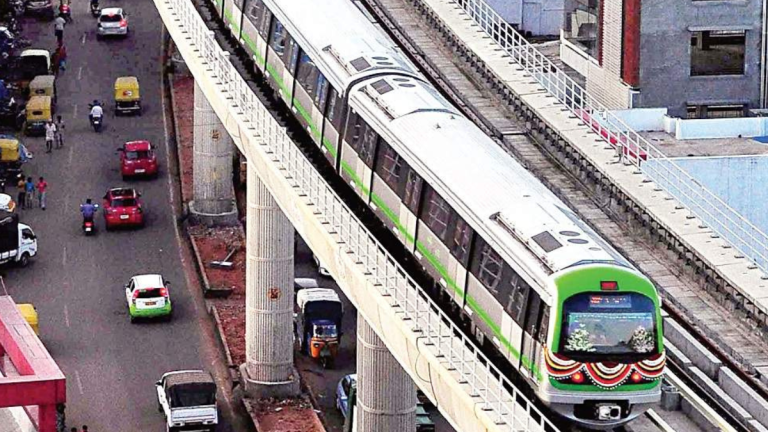
Bangalore (Metro Rail News): Bangalore Metro Rail Corporation (BMRCL) may invite fresh civil-work tenders for Bangalore Metro Phase 3 within the next 45 days. The move comes after BMRCL dropped its plan for an end-to-end double-decker corridor.
The decision follows growing criticism over the delay in starting ground work, even though the Centre approved the project more than two years ago. Under the revised plan, double-decker structures will cover around 11 km of the 44.65-km Phase 3 network. BMRCL will withdraw the tenders it issued earlier this year, revise the project cost and get the required approvals before inviting new tenders.
Bangalore Metro Phase 3 tenders to be floated again
The Bangalore Metro Rail Corporation Limited (BMRCL) invited civil-work tenders in January 2026 for around 18.5 km of the Orange Line. The work covered three packages. However, BMRCL will now recall these tenders because the project design has changed. A senior Urban Development Department official told Moneycontrol that the state government has given in-principle approval to keep double-decker structures on around 11 km of the corridor. Bangalore Metro will first revise the project cost and then invite fresh tenders.
The weekly brief metro & rail professionals read.
The process could take around one month to 45 days. However, the timeline will also depend on the BMRCL board’s approval. The project has faced delays in starting construction work. The Centre approved the project in August 2024, and the government laid the foundation stone in August 2025. Despite these steps, BMRCL has not yet issued work orders.
What is changing in Bangalore Metro Phase 3?
The Centre approved Bangalore Metro Phase 3 in August 2024 with an estimated cost of ₹15,611 crore. The project covers 44.65 km and 31 stations across two corridors.
| Corridor | Route | Length | Stations |
| Corridor 1 | JP Nagar 4th Phase-Kempapura | 32 km | 21 |
| Corridor 2 | Hosahalli-Kadabagere | 12.5 km | 10 |
| Total | 42.5 km | 31 | |
The first corridor will run along the western part of the Outer Ring Road, while the second will follow Magadi Road. The project is currently targeted for completion by 2029.
Double-decker plan cut from entire corridor to 11 km
The state government had been pushing for an end-to-end double-decker design for Bangalore Metro Phase 3. Under this model, road flyovers would run below the Metro viaduct, allowing both transport systems to use the same corridor. The idea was partly driven by Bangalore’s limited road space and high land-acquisition costs. Karnataka has also approved a separate 37-km double-decker road component, estimated to cost around ₹9,700 crore.
However, the Centre raised concerns about the financial and transport impact of building such structures across the entire Phase 3 alignment. MoHUA is examining whether long stretches of road flyovers could create parallel road infrastructure and encourage greater private-vehicle use. The effect on Metro ridership, along with safety, operational feasibility and economic returns, is also under review. The revised Phase 3 plan will therefore retain double-decker structures only at selected locations.
Around 11 km of double-decker sections
The sanctioned project already includes about 3 km of double-decker structures:
- Kanakapura Road junction: 1.4 km
- Kamakya Junction: 1.6 km
Another 8 km is proposed at major traffic bottlenecks. Goraguntepalya is among the locations being considered. At Goraguntepalya, BMRCL is examining a different arrangement in which the road could pass underground through a cut-and-cover section, while the Metro viaduct runs above it. This would allow the Bangalore Metro to cross the busy junction without requiring a large surface-level road structure.
Project has already missed several milestones
The delay in Bangalore Metro Phase 3 has become a major concern as Bangalore continues to face heavy traffic and growing demand for public transport. The Karnataka government approved the two Phase 3 corridors in November 2022. The Centre approved the project nearly two years later, in August 2024. Prime Minister Narendra Modi laid the foundation stone for the Orange Line on August 10, 2025.
However, more than a year after the foundation stone ceremony, BMRCL is still preparing to invite fresh civil-work tenders. BMRCL could not move ahead with the tenders it invited in January 2026 because the government changed the double-decker design. The state government now wants to prevent further delays. Officials said BMRCL dropped the end-to-end double-decker plan for Phase 3 because continuing the design discussions could increase the project cost and delay its completion.
Similar questions around Hebbal-Sarjapur Metro
The double-decker plan is not limited to Phase 3. BMRCL is also considering an end-to-end double-decker design for the proposed 37-km Hebbal-Sarjapur Metro corridor. BMRCL has asked IIT Roorkee to study the proposal. The revised cost of the corridor is estimated at around ₹25,999 crore.
The Centre’s concerns about the Bangalore Metro Phase 3 double-decker design could also affect how Bangalore plans double-decker structures for future Metro corridors.
Also read: Bangalore Metro to be equipped with Alstom’s AI-integrated CBTC system
Project Overview