Home Blog Page 847

Delhi Metro | NGT seeks details of groundwater use by DMRC

New Delhi: The National Green Tribunal has taken exception to Delhi Metro Rail Corporation’s (DMRC) use of groundwater for washing of metro trains and directed it to submit details of the permission granted to it for extraction of groundwater.

A bench, comprising Justice UD Salvi and expert-member Ranjan Chatterjee, which had earlier issued notices to DMRC, Delhi Jal Board (DJB) and Delhi Pollution Control Committee, also sought details regarding the use of groundwater by Delhi Metro.

“Respondent No 1 (DMRC) should come out with a clear stand as to the permission regarding extraction of groundwater, its use made and the duration of its use”, the bench said.

The order came while hearing a plea filed by Delhi resident Kush Kalra who had alleged that DMRC was extracting groundwater instead of using wastewater to wash its trains resulting in depletion of water table.

Advocate Kush Sharma, appearing for Kalra, said that at a time when water crisis has hit 12,000 villages across Latur in Maharashtra, DMRC is busy shining its trains by “illegal” extraction of groundwater. The plea had sought directions to DMRC to compensate as per “Polluter Pays Principle” for exploiting the groundwater for washing metro trains without any permission from the requisite authorities.

Referring to a RTI reply, the plea said that DMRC’s water requirement is met through borewells and DJB connection. It also said that in order to draw water from the borewell, 3 to 5 HP pump was used. “No bottled water is used, groundwater after treatment as per requirement is used for train washing…Borewells have been provided in the depots from where water is sourced.

“Around 400 to 500 liters of groundwater is used for washing of one metro train. The water, after washing of metro train, is sent to Effluent Treatment Plant (ETP). The treated water is then used for gardening and excess is sent to drains,” the RTI reply had revealed.

Further, another RTI response received from Delhi Jal Board said that no permission had been granted to DMRC for digging the borewells. However, in another response, a list of metro stations that had been granted such permissions was provided to DMRC, the plea said while referring to contradiction between the responses.

Bookmark or read metro rail stories offline – Download Metro Rail News App

Delhi Metro | DMRC to install 50MWp Solar PV Plant in the upcoming phases

New Delhi: A workshop on “Latest development in field of Solar Energy and challenges thereof” was organized by the Delhi Metro Rail Corporation (DMRC) in collaboration with Institution of Railway Electrical Engineers (IREE), Institution of Engineering and Technology (IET – Delhi Chapter) at the India International Centre (IIC) today. Sh. Ashwani Kumar Kapoor, Member (Electrical), Railway Board was the Chief Guest for the event and Dr.Mangu Singh, Managing Director (DMRC) was the Guest of Honour. The event was attended by the senior DMRC officials, Railway officials, and the officials from other Metro rail Organisations of India.

Speaking at the occasion, Dr. Mangu Singh said ‘The workshops like this provide an effective platform to deliberate on the challenges being faced by all the stakeholders in realising the ambitious plan of Govt. of India to achieve 40 GW roof top Solar power generation capacity by 2021.’ Dr. Singh further added, ‘Delhi Metro is dedicated to provide Environment friendly system to the nation. As part of it, DMRC has set its own solar mission, for which DMRC is installing Solar PV(Photo Voltaic) power plants at various locations in the existing and upcoming networks of DMRC.

As on date, DMRC has commissioned 6.3 MWp of Roof top Solar Plants. Further, DMRC has signed Power Purchase Agreements (PPA) for 32 MWp roof top Solar power plants. Delhi Metro Rail Corporation Ltd has a target to implement 50 MWp Solar PV Plant on flat/curved roof of the stations, Train Depots and other buildings owned by DMRC inclusive of upcoming Metro stations by 2021. In addition, DMRC is also planning to have electricity from offsite solar power plants of approx. capacity 500 MWp located in other parts of the country like MP, Rajasthan to be carbon neutral for its total electrical energy requirements for next 25 years.

The workshop was addressed by many distinguished speakers from The Energy Research Institute (TERI), Delhi Technological University (DTU), Solar Energy Society of India (SESI), followed by presentations and Panel discussions from experts, Senior officers from Indian Railways, Metro Systems, IIT Delhi and Solar Energy Corporation of India (SECI).

Bookmark or read metro rail stories offline – Download Metro Rail News App

Bengalore Metro | Bangalore Metro Station will soon have startups spaces to business work

Bangalore: Bangalore also called the Silicon Valley of India, is a major tech-hub of the country and attracts a lot of geeks from around for its booming startup culture.

It comes as no surprise that the Government in Karnataka is promoting startups to such an extent that spaces at metro station will soon be rented to budding entrepreneurs for their ventures. In a report by Media, the Bangalore Metro Rail Corporation is planning to send out notification to startups for renting space at large metro stations in the city.

Bangalore’s metro service is still under construction and only recently a small patch of 4.8kms underground was made open to the public for transportation. There have been certain roadblocks on the way preventing the metro to expand as quickly as planned.

Owing to low ridership in the beginning, the plan had taken a backseat, but with the new stations opened recently, the metro officials have come out with the idea of staging startups at the stations to utilize the whole area properly.

A statement from BMRC read, “Some of the stations have ample spaces that can be allowed to given to start-ups for for commercial activities. Earlier, they wouldn’t have got good rentals because of insufficient footfall but now investors or mentors of these start-ups are keener about it. This is for a purely commercial purpose wherein the investors are examining the feasibility of their projects and are the decision makers of whether to go ahead with or not.”

BMRC was quick to confirm that these startups will only be operational if they reduce the inconvenience to riders in terms of getting access to electronics, groceries, meals, jewellery, art and craft and repair shops etc.

Effectively, these small startups will cater to the riders at these stations or around the stations to get their daily fix without the hassles of travelling to far off areas, considering the traffic in Bengaluru is hectic.

An excellent initiative from BMRC to give entrepreneurs exposure to the daily riders on the metro. In case you missed your morning coffee, you know where to get it before reaching the office, or let’s say your phone stopped working last night, you could get it repaired at a metro station close to you.

Green Metro Systems | DMRC’s Jahangirpuri-Samaypur Badli section and RSS at Mukundpur Depot gethighest rating

New Delhi: The DMRC’s newly opened Jahangirpuri-Samaypur Badli Section and the Receiving Sub Station(RSS) at Mukundpur Depot of the Delhi Metro have been awarded the highest possible rating (Platinum) for adherence to green building norms, by the Indian Green Building Council (IGBC), which has devised a rating mechanism for Metro stations and buildings on a scale of platinum, gold, silver etc for following the green building specifications. The Platinum ratings were also awarded to the DMRC residential Complex Metro Enclave at Saket while the DMRC headquarters at Metro Bhawan received ‘Gold’ ratings for maintaining the green building norms.

The awards were given today during the 2nd National Conference on ‘Green Metro Systems’ at Metro Bhawan, organised by DMRC and IGBC, a part of the Confederation of Indian Industries (CII). A Web Application for monitoring Solar Energy Generation by DMRC was also launched during the inaugural session of this daylong conference.

IGBC’s Green Mass Rapid Transit System (MRTS) Rating is the World’s first exclusive rating system to address sustainability in new Mono Rail and Metro Rail systems. This rating system is a tool to enable new Rail based MRTS to apply green concepts during design & construction, so as to further reduce environmental impacts that are measurable. The overarching objective of IGBC Green MRTS Rating is to ensure environmental sustainability, while enhancing commuter experience.

Delhi Metro is developing all its stations of Phase 3 as green buildings. Adhering to green building norms, 12 metro stations of the Delhi Metro network in phase III of the project have already been awarded with platinum, the highest possible rating by the Indian Green Building Council. This achievement will help stations to reduce their power consumption by 35%.

DMRC’s Managing Director and the chief guest for the occasion, Dr. Mangu Singh stressed on the importance of adopting green technologies and said,” Metro being a mass transit rail based system is in any case environment friendly, but we are continuously striving to make it more and more energy efficient with focus on greater care for the environment.” Dr. Singh emphasized on the water recycling and solar initiatives carried out by Delhi Metro which reflects the organizations efforts at the micro level.

Applauding DMRC for its various green initiatives, Dr. Prem C Jain, Chairman, IGBC  said, ”Sustainability and enhanced commuting experience is built-up in DMRC system by design. DMRC has set a benchmark in maintaining the ‘Green’ norms and has inspired other upcoming Metro systems in the country to follow its path of sustainable development.

Sh. A K Gupta, Director (Electrical), DMRC and the Chairman for the occasion highlighted on the different green initiatives by DMRC. He said that adherence to green building norms in Delhi Metro starts as early as in the construction phase itself.

The National Conference on ‘Green Metro Systems’ was attended by delegates from other Metro Systems in the country and renowned speakers on Sustainable Urban Development from different sectors. All the senior officers from DMRC were also present during the conference.

To read our news story offline – Download Metro Rail News App

Chandigarh Metro | Kirron Kher opposes Chandigarh Metro Rail project

Chandigarh: Member of Parliament (MP) Kirron Kher reiterating her stand on non-viability of Metro link in Chandigarh, her statement has once again raised a question mark whether the project will see light of the day or not. The MP, during a media interaction on Wednesday, had clearly said that “I don’t think Chandigarh needs Metro link. It involves a huge budget. I don’t want the city to be uprooted.” However, UT officials say the final call on the project will be taken by the Centre government.

Stating it’s not a financially viable project, the MP had said the solution to the problem of increasing vehicles is a ring road. “However, it is my personal opinion and I don’t want to go against my party’s stand, though I will fight for it.”

Meanwhile, many UT bureaucrats also agreed to the MP’s point of view that “Metro is not a financially viable project and will put a huge financial burden on the exchequer.

A senior UT officer, seeking anonymity, said, “The project can come up only if it is financially viable. Even if it gets started, it will not be easy to maintain it, as Metro involves huge investment on maintenance.”

However, another officer said the Metro could be a white elephant if the administration fails to finds out ways to turn it into a profitable venture. “A module needs to be worked out to turn the Metro project profitable. Expenses can be borne through advertisements and other means,” he added.

Finance secretary Sarvjit Singh said, “We have started the process. A Detailed Project Report (DPR) will be sent to the Centre soon. The final call on the feasibility of the Metro project will be taken by the Centre only.”

The Union ministry of urban development will provide 50% funds for the project, while the rest will be borne by the UT. Sources say the estimated cost of the project has jumped from Rs 10,900 crore to Rs 13,600 crore in the past seven years. They add after the formation of the Greater Chandigarh Transport Corporation (GCTC) this year, the work will get started. The Punjab and Haryana high court had also given its nod for the project. Though the MP is not in its favour, UT administrator Kaptan Singh Solanki earlier this year had told Media that the Metro project was the only affordable solution to tackle traffic congestion.

The total length of the Metro project covering Chandigarh, SAS Nagar and Panchkula is 37.57km. The major portion of the two corridors falls in Chandigarh. Doubts have been raised over financial viability and the relatively low population of the city since very beginning. The Detailed Project Report (DPR) had stated that the Metro project will not be commercially viable till 2051 due to poor Peak-Hour Peak-Direction Traffic (PHPDT). It meant that the facility needs to be used by 40,000-70,000 passengers at the peak hour in peak traffic to ensure viability, which is expected to be achieved only in 2051.

To read our news story offline – Download Metro Rail News App

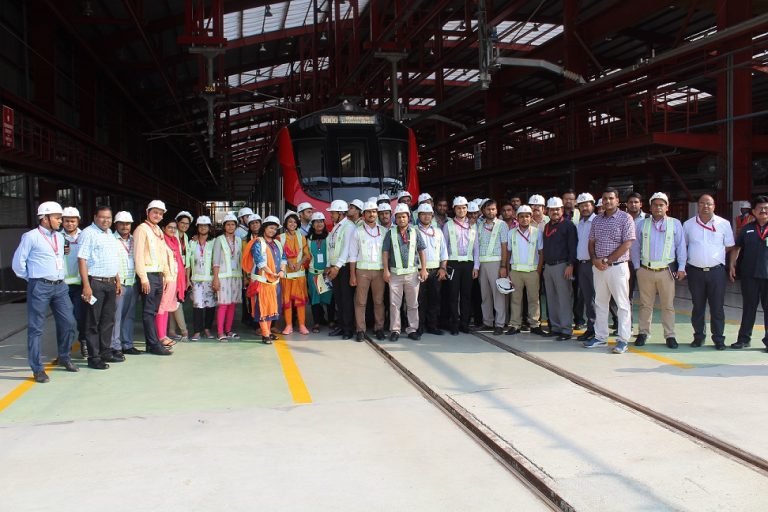
Delhi Metro | Trial run of Delhi Metro’s new ‘Driverless’ Train begins today

New Delhi: The trial run of Delhi Metro’s new ‘driverless’ trains began today, setting the ball rolling on what promises to be a technological feat in the country’s public transport system in little more than a year, when they will run on ‘unattended’ mode.

Delhi Chief Minister Arvind Kejriwal and Union Urban Development Minister Venkaiah Naidu flagged off one train equipped to travel on ‘Unattended Train Operations’ mode at the Mukundpur depot of metro’s upcoming Majlis Park – Shiv Vihar corridor.

In their speeches, Mr Naidu and Mr Kejriwal insisted that metro was one of the best answers to the city’s commutation and pollution woes. Mr Kejriwal thanked the Centre and termed Delhi Metro Rail Corporation (DMRC) as a ‘unique example’ of cooperative federalism.

Mr Naidu said that odd-even was a temporary measure and “cannot be a permanent solution” and said new technology was set to increase metro’s frequency to 90 seconds.

“As we kept on saying during odd-even, till the time we don’t improve our public transport system, one that which inspires car owners to move opt for public transport, pollution or congestion will not come down,” Mr Kejriwal said.

Trial run of trains, that were unveiled last month, will take place between the depot and Majlis Park station, one of the terminal stations of the upcoming Pink Line, for the next few days. Gradually the distance covered by them will be increased, a metro official said.

The new trains will undergo rigorous trials to ensure that they are ready for smooth operations after the commissioning of the 58-km-long Mukundpur- Shiv Vihar and the 34-km-long Janakpuri (West)- Botanical Garden corridors , by the end of this year, although initially, train operators will run them.

“Gradually, driver-less operations, on the Unattended Train Operation (UTO) mode, will be possible and later on, in stages, the new signalling technology – Communication Based Train Control (CBTC) – will be implemented which will bring the time gap between to two trains to 90 seconds instead of the current average of two minutes,” an official said.

To read our news story offline – Download Metro Rail News App

Amravati Metro | AMRC ties up with DMRC for Vijayawada Metro Rail Project

Hyderabad: The State government has asked the Amaravati Metro Rail Corporation, the apex agency for administering the metro rail project in the new capital region, to finalise the conditions of the revised draft agreement with the Delhi Metro Rail Corporation which had been appointed as the executing agency for the project and enter into an agreement for executing the project on turnkey basis.

The government had made AMRC would be the full-fledged owner of the project and it will have a role in the finalisation of all the major contracts and provisions specified in the draft agreement enabling it to have sufficient control over the project. The Vijayawada metro project is yet to receive concurrence from the Government of India and the government, in its draft guidelines, stressed the need for entering into a tripartite agreement involving the DMRC, the State and Central governments.

The government said, in the order issued on Friday, that the Central government would have 50 per cent partnership in the AMRC and a condition would accordingly imposed in the sanction order. The same would prevail over all other agreements that would be entered into for the project, Municipal Administration Principal Secretary R. Karikal Valaven said pointing clauses in the similar agreement signed between the DMRC and the Kochi Metro Rail Corporation.

The government had already Rs. 10 crore to the DMRC as a token fund to enable it to start preparatory work on behalf of the Amaravati Metro Rail Corporation. The DMRC, in its response to the guidelines, informed that in case the Japanese International Cooperation Agency was willing to extend tied loan to Vijayawada and insist on appointment of general consultants, the condition could be agreed to with limited role for such consultants as the DMRC would be responsible for the execution of the project.

The DMRC, however, did not agree to the tripartite agreement as such a provision did not exist. The Government had indicated that the DMRC could claim their remuneration against the project component cost which comes to Rs.222.40 crore plus escalation cost as per WPI. The DMRC agreed to the formula suggested by the Government and indicated an extra fee of six per cent on contingencies and three per cent on all items that would be Rs. 111.20 crore in addition to escalation of 7.5 per cent which comes to Rs. 937.15 crore (taking the total project cost to Rs. 1.048.7 crore).

A fee of six per cent on this would come to Rs. 62.9 crore over and above the Rs. 222.4 crore agreed by the State government taking the total to Rs. 285.3 crore. The government, however said, the actual cost of contingencies and escalation could be known during the execution of the project and it was premature to decide any claim of remuneration at this point of time.
buy cialis daily online https://www.mydentalplace.com/wp-content/themes/twentytwelve/inc/en/cialis-daily.html no prescription

“It is proper to allow the remuneration of six per cent based on the actuals as and when the expenditure is known,” an order issued by the government said.

The agreement between the parties should also have default and exit clauses as a statutory requirement and efforts should be made to complete the priority corridor of the project by December 2018. Information pertaining to the major milestones of completion within the target date should be incorporated into the agreement and any changes in the contents of the agreement should be by mutual consent. According to the order, if the execution of the project was extended beyond the period prescribed in the agreement, the remuneration payable to DMRC should be limited to the actual expenditure incurred by the executing agency.

Pune Metro | Fadnavis says, Centre to clear Pune Metro Rail project in June 2016

Pune: Chief Minister Devendra Fadnavis on yesterday said all the formalities for the proposed Pune Metro Rail project have been completed and it will be cleared by the Centre next month.

“All formalities regarding the Pune Metro Rail project have been completed and after nod from the Public Investment Board (PIB) in June, the proposal will be sent back to the state government,” Fadnavis said.

“After the state government’s nod, tenders will be floated and work on Pune Metro will be expedited,” he added.

Fadnavis said this at a press conference after holding meetings with Pune Municipal Corporation (PMC) and Pimpri Chinchwad Municipal Corporation (PCMC) over various developmental issues.

The proposal of Pune Metro Rail Project, which has completed almost all stages, is lying with the Central government’s Urban Development Ministry for approval.

“Union Minister for Urban Development Venkaiah Naidu has personally monitored the entire project and he is making sure that it gets approved. That is why, a meeting of PIB has been summoned to finalise the project,” Fadnavis said.

When asked whether his government has finalised the land for the proposed international airport in Pune district, he said three to four sites are being considered for the project.
buy flagyl Canada langleyrx.com/flagyl.html no prescription

“However, I cannot divulge the locations as of now. If I tell these places, the situation will become volatile in those areas,” the Chief Minister said.

About the expansion plan of the existing Lohegaon Airport in Pune, Fadnavis said he is sure that the issue of approving the use of additional 15 acres for the airport facilities will be resolved.

“I am sure that Defence Minister Manohar Parrikar will address the issue of handing over the land to Airport Authority of India (AAI),” he said.

Delhi Metro | DMRC to build over 100 cross passages between underground tunnels

New Delhi: The Delhi Metro has a network of cross passages in their underground sections which connect the two parallel underground tunnels. Two Metro tunnels are generally built parallel to each other for up and down movement of trains and these cross passages allow people to move from one tunnel to the other on foot in case of any emergency like fire or any other unusual occurrence in either of the tunnels. These walkways can be used for carrying out maintenance work also.

The Delhi Metro Rail Corporation (DMRC) is constructing over 100 such cross passages between tunnels in the underground sections of the upcoming Phase 3. A cross passage is generally a small path between two tunnels connected through a walkway varying between 6- 10 mtrs.

There will be a cross passage after approximately every 240 mtrs inside every underground tunnel. Cross-passages (CP) are built with reinforced concrete. They are provided to serve two primary purposes: emergency escape and maintenance work.

In the existing network of the Delhi Metro, there are already a total of 108 cross passages These cross passages are protected with fire door assemblies and have a fire protection rating of 1-1/2 hours with a self-closing fire door. They have a minimum of 1120 mm (4 feet) clear width and 2100 mm (7 feet) height to enable the commuters to escape easily in case of any eventuality.

These cross passages are built as per the NFPA (National Fire Precaution Association, USA) 130, 2014 guidelines.
buy elavil online https://healthcoachmichelle.com/wp-content/themes/twentytwentyone/inc/en/elavil.html no prescription

The construction of cross-passages is very challenging as workers have to do a lot of manual work in confined spaces and diligence is required by the supporting engineering staff to monitor the excavation and movement of ground. Over 50 kms of Phase III construction of the Delhi Metro involves underground tunneling.

(Source: DMRC/Press Release)

Mobile App | Metro Rail News launches its Mobile App for Android users

MRN_App_shot

New Delhi: Metro Rail News prides in itself in being proactive in embracing digital technologies and delivering content in newer formats for the new age audiences.

In keeping with the trend, Metro Rail News has recently launched Metro Rail News Mobile App for Android mobile devices on the Google Play Store.  Metro Rail News team invites its readers to try it out first hand on mobile devices by downloading it here –  Metro Rail News Mobile App

To reach out to the widest possible audience on the Android platform, the App has been built to be compatible on devices running latest Android versions. The Android platform is of considerable interest because it the fastest growing mobile operating platform in the world. Also, Android dominates emerging markets like like India, where it is available on the entry-level smartphones.

Metro Rail News has made the App highly customisable so that the reader can fill in the home screen with preferred news settings – it could be city news, sport news or even the opinion pages.

The statistics of mobile readership has been very encouraging and has registered a 150 per cent increase in unique visitors to the website from mobile devices year-on-year. The Android platform has seen the better growth rate – a 250 per cent increase year on year in terms of unique users.

Do send us your feedback on the Android App. We are keen to know how you find it, and it would help us make appropriate changes.