Home Blog Page 846

Gurgaon Metro | CM Khattar to inaugurate Gurgaon Sec 55-56 station on May 2

Chandigarh (PTI) : A group of slum children from Gurgaon will share a ride in Rapid Metro Rail with Haryana Chief Minister Manohar Lal Khattar tomorrow.

Jyoti Bainda, Chairperson, Haryana State Commission for Protection of Child Rights (HSPCR), said today the Commission has arranged the metro ride for 30 slum children with the chief minister.

She said it would be the first ever ride of the slum children on a train.

The Rapid Metro Rail project will be inaugurated by Khattar at Rapid Metro Station, Sector 55-56, Gurgaon tomorrow.

“The chief minister will also interact with women village heads (sarpanch), who will also be travelling with him on the metro. He would discuss issues regarding strengthening of Panchayati Raj institutions and take feedback from them,” said an official release.

Nagpur Metro | NMRC to introduce common mobility card for Metro & Buses

Nagpur: Here is the silver lining for the daily commuters relying on public transportation in Nagpur. Come November, when Nagpur Metro rail is expected to chug off its first phase, there will be a common mobility card, by possessing which, you can hop on to city buses and metro trains without buying separate tickets.

The Maharashtra Metro has tied up with SBI for the mobility card. It is based on an open loop system, which basically means that the card can be used for various purposes, including shopping.

The concept of common mobility card was however initially designed for Mumbai but Nagpur is fortunate to have it first. However, since 2004, successive state governments have been promising that they would incorporate a system for seamless travel whereby commuters in the city don’t have to face the hassle of standing in ticket queues for a bus or rail ride. All you need is a smart card.

However, Mumbai simply has not been able to have a smart a mobility card because the different state government agencies haven’t been able to figure out the cost-sharing formula, as to who would bear the cost of creating the infrastructure for the smart mobility card. Government officials were not sure which undertaking –the Railways, BEST, the monorail run by MMRDA, or the Metro-would pick up the tab for introducing the mobility card. The Nagpur Metro has now solved the puzzle. The estimated cost of putting up kiosks, swiping machines in buses, Metro would have cost Rs 180 crore.

Last week, SBI bagged a tender from the Nagpur Metro and it would be spending the entire Rs 180 crore on the infrastructure for the common mobility card. What’s more, the bank would also give a royalty of Rs 30 crore over the 5 years to the Nagpur Metro.In return, SBI was given exclusive rights in all Metro stations besides getting the mandate to handle the entire cash transactions of the Metro. All the cash earnings from different Metro stations would be deposited in an account with the SBI.

Mantralaya babus are now looking at the Nagpur common mobility card with great interest as they finally believe that the system can be introduced in Mumbai. “What we have done in Nagpur has the potential to be replicated not just in Mumbai but elsewhere in other cities in Maharashtra too,” said Brijesh Dixit, managing director of the Maharashtra Metro.

Ramnath Subramaniam, executive director (strategic planning) for Maharashtra Metro, said that the USP of the mobility card was that it could also be used for shopping.He said, “A lot of banks had shown interest in this unique model since the winning consortium will get a fixed share per transaction for both fare and non-fare as also the huge intangible benefits that could accrue to the bank. In the end, SBI won the bid.”

Source: Nagpur Today

Delhi Metro | DMRC to build residential flats in Delhi to sale public

New Delhi: The Delhi Metro Rail Corporation (DMRC) is all set to venture into the residential real estate market and will soon put up over 500 flats, in the Rs 60 lakh to Rs 1 crore range, for sale.

A senior Delhi Metro Rail Corporation (DMRC) official said the Delhi Metro has initiated the process on this front and people will be able to book a flat, which will come up in Janakpuri and Okhla area, in a month or two.

Around 460 flats would be built in Janakpuri while 90 in Okhla, tentatively within two years.

Plots have been identified, however, construction work has not yet started. Delhi Metro will soon make a formal announcement of the project.

The official said DMRC will follow the model of Delhi Development Authority (DDA) in selling the apartments, which essentially means allotment will be done through a lottery.

Fifteen per cent of the flats, which will be a mix of 2-BHK and 3-BHK, would be reserved for the economically weaker section, metro said, adding that the brochures are likely to be out within a month.

This will be the metros maiden foray into the residential real estate market. It is already into property development and also has a number of staff quarters.

Source: PTI

Lucknow Metro | LMRC commissions automatic train wash plant successfully

Lucknow: The Lucknow Metro Rail Corporation (LMRC) today successfully commissioned the Automatic Train Wash Plant that has been built at the Transport Nagar Metro Depot. This helps metro trains entering or exiting the Depot to be cleaned automatically at the ramp using remote control from the Operation Control Centre located inside the Depot.

The washing plant has rotating plastic brush to clean the side wall of train. The trains are first wet using recycled water and are then scrubbed automatically by the rotating brushes with soap water and are subsequently cleaned by raw water and finally rinsed with RO water. After wet cleaning of the train, air blowers are provided to dry the train surfaces.

It is planned in such a manner that the trains can be washed once in three day.The plant operation starts automatically by sensing the train speed. The minimum washing capacity of plant is 25 numbers of trains per day which can be increased based on future requirements.

The plant is equipped with air blower facility also to clean the dust of underframe area of train. To maintain the quality of train surface, the hardness of water is removed prior to washing and soft RO water is used for washing. To avoid excessive use of water, it is recycled for reuse. Trains are moved at a slow speed of 3-5 kmph to ensure proper cleaning. Special wash mode is provided in train to maintain the requisite speed of train also to ensure proper cleaning.

Rapid Metro | NCR Planning Board sanctions 25 projects for Haryana state

New Delhi: The Centre has approved extension of Metro line from Faridabad to Ballabhgarh at a cost of Rs 580 crore, Urban Development Minister M Venkaiah Naidu said today.

He also added that the National Capital Region Planning Board (NCRPB) has sanctioned 25 infrastructure projects for Haryana related to urban transport and water supply with a loan assistance of Rs 1,552 crore.

An additional 15 projects costing Rs 504 crore will soon be sanctioned, he said.

Addressing a press conference here, Naidu said that the Government of India has recently sanctioned the metro extension from Escort Mujesar, Faridabad to Ballabhgarh with a length of 3.2 kilometres at a total cost of Rs 580 crores.

This extension which is targeted for commissioning by June 2018 would benefit the people of Ballabhgarh and other surrounding areas, he added.

He said that final detailed project report for the metro connection between Narela and Kundli with a length of 4.8 kms has been submitted recently by Delhi Metro Rail Corporation (DMRC) to Haryana Government.

The cost of this extension is estimated to be Rs 1,120 crore, he said.

Naidu said that feasibility report of Express Metro Connectivity between Bata Chowk one of the stations on Badarpur-Escort Mujesar in Faridabad and Sector-45 proposed metro station in Gurugram with length of 31 kms has been submitted to the State Government by DMRC.

He said that the State government may consider one spur from Surajkund area to connect Metro Corridor of Phase IV between Badarpur and Mahipalpur.

Similarly, feasibility report for Metro connection between HUDA city centre and old Gurugram Railway station and further to sector 21, Dwarka via Palam Vihar with a length of 29 kms has been prepared and submitted recently by DMRC to State Government.

He said that the National Capital Region Transport Corporation (NCRTC) is implementing Regional Rapid Transport System (RRTS), a rail based high speed point to point connectivity with station at every five to ten kms.

He said that it is a transformational project which would reduce the travel time significantly.

He said that out of the three corridors to be implemented on priority, two are in Haryana that is 110 kms Delhi-Panipat and 180 kms Delhi-Gurugram-Rewari-Alwar.

All three corridors are interconnected and trains could move from one corridor to other seamlessly, he added.

He said that such high speed connectivity would result in increased widespread economic activity and overall sustainable development of the region.

A total investment of Rs 50,000 crore would be made for these two corridors, he added.

The Minister said that Housing and Urban Development Corporation (HUDCO) has sanctioned eight schemes with a total loan amount of Rs 4,448 core in the State.

This includes four schemes for housing with a loan amount of Rs 922 crore and four schemes for urban infrastructure with a loan amount of Rs 3,526 crore.

(This article has not been edited by Metro Rail News’s editorial team and is auto-generated from an agency feed.)

Alstom delivers additional metropolis metro cars to Panama Metro

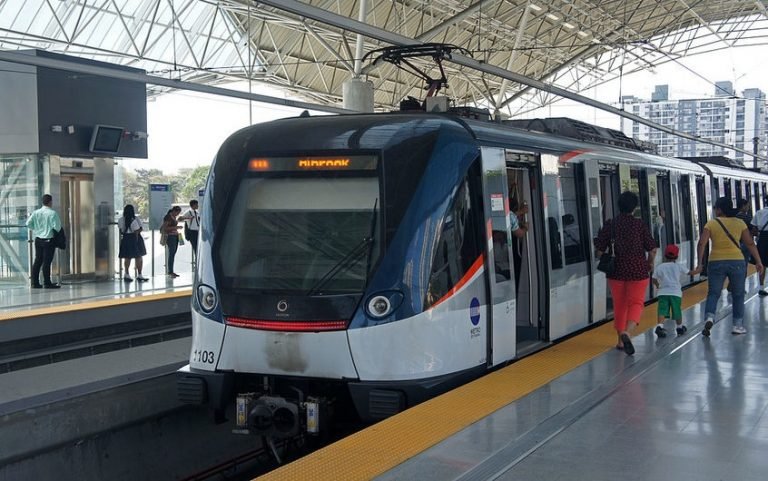
ALSTOM has begun delivering a batch of 70 additional Metropolis metro cars to Panama Metro, which will be used to increase capacity on Line 1.

The first three-car train was delivered to the line’s depot in Albrook on April 25 after completing its sea voyage from Spain.

In November 2015 Panama Metro awarded a €145m contract to a consortium of Alstom, Thales, Sofratresa, CIM, and TSO to expand the Line 1 train fleet and upgrade the line’s signalling system, power supply, and depot facilities.

Under its €130m share of the contract, Alstom is supplying 70 metro cars to lengthen the line’s 20 existing trains from three to five cars and increase the fleet to 26 sets.

Over the next few months Panama Metro will take delivery of three more three-car trains and the first complete five-car set, which is due to arrive in September.

Five-car operation is expected to begin on Line 1 in January 2018 and intermediate cars will be delivered at a rate of two vehicles per month from early next year.

Traffic on the 13.7km north-south line from Los Andes to Albrook has grown rapidly since its inauguration in April 2014 and Panama Metro says the expanded fleet of five-car trains will double capacity on the line.

Source: Rail Journal

Alstom and Airbus sign a cooperation agreement in Cyber Security

Alstom and Airbus announce the signature of a strategic cooperation agreement in the field of cybersecurity. The agreement was signed by Marc Fontaine, Marc Fontaine, Digital Transformation Officer at Airbus and Pascal Cléré, Senior Vice President of Alstom’s Digital Mobility division, at the Airbus site of Toulouse-Blagnac.

The increase in cyberattacks and the expansion of the Internet of Things and Big Data require new measures to protect transport systems. In response to this challenge, this cooperation will support the emergence of a new risk management model adapted to the evolution of the transport industry.

“We are proud to cooperate with Airbus, the world leader in aviation, on this programme, which will provide operators with innovative and efficient cybersecurity solutions for safer transport.

This cooperation is fully in line with our ambition to be the precursor of the field of railway cybersecurity,”
said Pascal Cléré. 

In particular, the programme will focus on the co-development of new analysis services concerning the vulnerability of transport systems, new shared core protection technologies and the definition of a new generation of operational security centres adapted to the industrial sector. Alstom will offer its customers products that comply with the latest legislation and governmental specifications, and will be able to propose audits of their customers’ existing solutions to increase protection levels.

Source: ALSTOM Press Release

Bombardier Trasportation places ‘breakthrough’ order for ABB transformers

Austria: Bombardier Transportation has placed the first contract for ABB’s Effilight roof-mounted traction transformer design, ordering 42 transformers for installation on 21 Talent 3 electric multiple-units which it is to supply to Austrian Federal Railways for use in the Vorarlberg region.

The Effilight has a patented cell design which ABB says can reduce the amount of oil required by up to 70% without compromising functionality. The saving in oil volume compensates for the additional copper introduced to reduce losses and improve energy efficiency. To meet higher energy efficiency objectives, ABB has optimised the design for a load loss reduction of 25% compared with an older design of transformer of the same weight.

The initial order has been placed within a framework agreement which could see ABB supply up to 600 transformers for 300 EMUs by the end of 2024.

Source: Railway Gazette

Amaravati Metro | AMRC decides to entrust metro rail project to two companies

Vijayawada: Amaravati Metro Rail Corporation (AMRC) has decided to entrust metro rail project works, except metro depot at Nidamanuru, to two companies. Though the Delhi Metro Rail Corporation (DMRC) reportedly thought that it would be better to involve three major companies in metro works to facilitate speedy completion of the project, only two companies L&T and Afcons Infrastructure got eligibility in financial bidding that was conducted in Delhi on Monday.

According to a senior officer of AMRC, each corridor work will be entrusted to one company. Two corridors, one from Pandit Nehru Bus Station (PNBS) to Penamaluru and the other from PNBS to Nidamanuru are planned to be built.  “We think it will be easier if the metro works are divided as two parts and one each is entrusted to each company,” he said.

AMRC managing director N P Ramakrishna Reddy told Media that the DMRC and AMRC are now in the process of evaluating price bids submitted by the L&T and the Afcons Infrastructure and it will take around 15 days to complete.
“It may take around two months for the project to take off as a lot of process, including making agreements with the two companies is involved,” he said.
On the other hand, the AMRC is doing parallel exercise to secure foreign funding to the Metro Rail project in addition to the funding from Union and state governments. The state government has already given permission to the AMRC regarding to foreign funding. Germany’s KFW group and AFO group of France have already expressed their willingness to fund Rs 3,600 crore for the metro rail project.
The AMRC is also planning to go for public issue to obtain funds and the process will be in phased manner. “It may take at least 5 to 6 years to complete the metro project. So, the process of gathering funds will depend on needs and pace of the project. We are very cautious on interest rates offered by the financial institutions”, an official said.
Source: Hans India

Underwater Metro | Work begins on India’s 1st underwater metro tunnel in Howrah

Kolkata: Construction of the country’s first underwater metro tunnel commenced on the banks of Hooghly river in Howrah of West Bengal on Friday.

A pair of boring machines was deployed to dig the 520m tunnel with 30m running under the river bed. The work of digging the underwater tunnel is expected to be completed within two months. The commencement of work for the underwater tunnel is an important landmark in progress towards completion of the second phase of Kolkata Metro expansion called the ‘East-west metro project’ that will connect Howrah station in the west with Salt Lake Sector V in the east.

The underwater tunnel was the major roadblock in completion of the project which may significantly reduce traffic congestion on the streets of Kolkata after getting operational. The Howrah station witnesses major traffic of daily commuters coming from neighbouring districts to work in the different parts of the metropolis.

The second phase of metro will also connect with another major railway terminus Sealdah that brings daily passengers from North 24 Parganas, South 24 Parganas and Nadia districts of the state. These districts also satiate much of the agricultural and fish appetite of the city.

The Japan Bank of International Cooperation (JBIC) and Indian Railways funded second phase of metro railway expansion project and it will cost around Rs 50 billion. The project is expected to be completed by 2018. The 14.67km long stretch will have 12 stations, 6 of which will be underground and the rest 6 elevated.

With the beginning of work of the underwater tunnel, other halted stretches and metro railway stations in the phase may also get started. Many stretches of the phase are stuck in land acquisition problems, which the authorities are attempting to solve.